Our readers keep the lights on and my smoothie glass nicely filled. As an Amazon Associate, I earn from qualifying purchases.
A torn bicep tendon throws a wrench into everyday life—lifting a coffee mug, reaching for a seatbelt, or even getting a good night’s sleep can send a sharp reminder of the injury. The right brace changes that, providing targeted compression and stability to offload the injured tendon, reduce inflammation, and support you through daily tasks and rehabilitation. But with options ranging from simple compression sleeves to integrated hot/cold therapy systems, the choice depends heavily on your specific phase of recovery and activity level.
I’m Mohammad Maruf — the founder and writer behind WellFizz. I’ve spent years analyzing the biomechanics and material science of orthopedic supports, specifically how brace geometry, fabric compression profiles, and adjunct therapy features (heat, cold, adjustable strapping) impact healing timelines for bicep and tricep tendon injuries.
After evaluating tens of thousands of user experiences and technical specs, I’ve narrowed the market to the top contenders. This guide breaks down exactly what to look for so you can confidently choose the brace for torn bicep tendon that matches your recovery stage and lifestyle.
How To Choose The Best Brace For Torn Bicep Tendon
Selecting a bicep brace isn’t about picking the most expensive or most popular option—it’s about matching the brace’s specific design features to your injury’s location (distal vs. proximal tendon), your current phase of healing (acute inflammation vs. chronic overuse), and the activities you need to perform. Here are the critical factors to weigh.
Compression Profile and Strap Configuration
The most effective bicep braces use multiple adjustable straps to apply targeted pressure above and below the injured tendon, not just a uniform squeeze. Look for designs with at least two independent compression straps—one that anchors above the muscle belly and one that secures below—to offload the tendon insertion points. Braces that rely solely on elastic sleeve compression often slip down the arm and fail to provide the focused relief needed for a torn tendon.
Integrated Therapy Features: Heat vs. Cold
Acute injuries (first 48-72 hours) benefit most from cold therapy to reduce swelling and numb sharp pain. For this phase, a brace with removable gel ice packs that stay flexible when frozen is ideal. For chronic tendonitis or post-acute rehabilitation, heat therapy improves blood flow and relaxes muscle tightness around the tendon. A few braces now integrate low-voltage heating elements specifically for this purpose. Choose based on where you are in your recovery timeline.
Fit, Sizing, and Long-Term Comfort
A bicep brace that doesn’t fit correctly won’t work correctly. Measure your upper arm circumference at the thickest point and compare against the brand’s size chart—don’t guess based on clothing size. Breathable materials like neoprene or mesh panels reduce sweat buildup during all-day wear. Also consider whether the brace can be worn under or over clothing and if the fasteners (Velcro, hook-and-loop straps, or buckles) allow one-handed adjustment, which is critical if your non-injured arm has limited mobility.
Quick Comparison
On smaller screens, swipe sideways to see the full table.
| Model | Category | Best For | Key Spec | Amazon |
|---|---|---|---|---|
| Sticro Heated Arm Wrap | Heated Brace | Chronic pain & stiffness relief | 3 heat settings + 5 timers | Amazon |
| FEATOL Bicep Brace | Cold/Compression | Acute inflammation & post-surgery | 4 adjustable straps + 2 gel packs | Amazon |
| Cho-Pat Bicep Cuff | Compression Cuff | Active lifting & sports strains | Reinforced dual-strap system | Amazon |
| Copper Compression Shoulder Brace | Shoulder/Bicep Sleeve | Wide-coverage shoulder & arm support | Copper-infused 4-way stretch knit | Amazon |
| Arm Sling Immobilizer | Sling Immobilizer | Post-op immobilization & fracture | Breathable mesh + phone pocket | Amazon |
In‑Depth Reviews
1. Sticro Upper Arm Heating Pad

This brace distinguishes itself by delivering low-voltage heat therapy directly to the bicep and tricep area, making it uniquely suited for chronic tendonitis and post-acute recovery where improving blood flow is the priority. The neoprene construction resists dirt and holds its shape, while the sewn-in straps compress the arm to enhance heat penetration. It reaches target temperature within 3-5 minutes and offers three distinct heat levels with a five-timer auto-off system, so you can dial in exactly the intensity your tendon needs without worrying about overheating.
The S/M size fits arms 8–13 inches in circumference, and the L/XL covers 13–18 inches, which accommodates most adults. The 12V adapter provides safer, steadier power than standard 110V heating pads, and the fiber heating element with built-in thermostat sensor prevents hot spots. Users report noticeable relief from shooting pain that radiates from the shoulder down to the elbow, with some wearing it during sleep after setting the timer. The all-black design makes it discreet enough for use under a loose shirt during the day.
One trade-off is that the straps can slip out of their guides during adjustment, and the controller lacks tactile buttons, which makes it harder to operate by feel in low light. Also, because it relies on a power cord, it’s not a wearable solution for active movement—it’s best for stationary recovery sessions at home or work. For anyone dealing with lingering bicep tendon stiffness rather than acute swelling, this heated brace offers a targeted therapy option that most standard braces lack.
Why it’s great
- Integrated low-voltage heating element with 3 precise temperature levels
- Auto-off timer (up to 60 minutes) for safe, unattended use during rest or sleep
- Sweat-wicking neoprene holds straps and resists staining with regular use
Good to know
- Strap guides can release under tension, requiring readjustment
- Controller buttons are flush-mounted and hard to locate without looking
- Requires a power outlet, limiting portability during active rehab
2. FEATOL Bicep Tendonitis Brace with 2 Gel Ice Packs

This brace from FEATOL combines a four-strap compression system with two recyclable gel ice packs, giving you the ability to apply cold therapy directly over the injured tendon while maintaining stable support. The two main straps stabilize the muscle belly, while two additional elastic straps wrap around for extra compression and positioning—a design that users say resists the annoying slippage common with single-strap braces. The gel packs remain pliable even after freezing, conforming closely to the arm’s curve for better contact than rigid ice packs.
Available in four sizes, it’s designed for both men and women and covers a broad range of arm circumferences. The ice packs insert into internal fastener pockets on the underside of the brace, holding them securely against the skin without requiring you to hold them in place. For heat therapy, the same packs can be microwaved for 20 seconds. Users report that the cold stays effective for 15-20 minutes per session, which aligns with standard ice therapy recommendations. The construction uses both Velcro and elastic straps, offering a finer degree of tightness adjustment than sleeves alone.
The main criticism is that the included ice packs are smaller than some users expect—they cover the tendon area well but won’t wrap the entire upper arm. A few users with larger arms needed help getting the straps tight enough for effective compression. The brace works well for post-surgery recovery, tendinitis flare-ups, and sports-related strains, but if you need full upper-arm icing for a broad muscle tear, a separate larger gel pack may be necessary. Overall, it’s a well-engineered option for anyone in the acute or sub-acute phase who needs consistent cold therapy combined with reliable compression.
Why it’s great
- Four independent straps (two primary + two secondary) prevent the brace from sliding down the arm
- Two flexible gel packs allow swap-and-rotate cold therapy without interrupting recovery time
- Packs can be used for either hot or cold therapy, adding versatility
Good to know
- Gel packs are compact and may not cover the entire upper arm for larger individuals
- Some users found it difficult to self-tighten sufficiently without assistance
- Ice pack cold retention time is limited to roughly 15–20 minutes per session
3. Cho-Pat Bicep/Tricep Cuff

Cho-Pat’s Bicep/Tricep Cuff takes a minimalist, focused approach: rather than a full sleeve or wrap, it’s a dual-strap compression cuff that cinches above and below the bicep and tricep tendon insertions. This design delivers pinpoint pressure exactly where it’s needed for tendonitis relief, without adding bulk or heat buildup. The reinforced straps are engineered to hold their position during movement, making it especially popular among weightlifters, boxers, and strength athletes who need support without restricting range of motion.
Made in the USA, the cuff weighs just under 3 ounces and uses a straightforward hook-and-loop closure system. The upper band secures around the bicep, while the lower band wraps just above the elbow, creating a stable bridging effect that offloads the distal bicep tendon. Users with severe bicep tendonitis report that this is the only brace that provides meaningful relief during heavy pulling exercises like rows and pull-ups. The sizing is narrow—based on upper arm circumference—and the company recommends ordering slightly larger than you think you need because the straps add compression on top of the base fit.
The biggest drawback is the sizing system: the cuffs are not adjustable beyond the strap tension, meaning if your arm circumference falls between sizes, the fit will be either too loose or uncomfortably tight. Additionally, the company enforces a no-returns policy, so measuring your arm precisely before purchase is mandatory. A few taller users with longer muscle bellies found the cuff placement didn’t align well with their tendon locations. For those who get the fit right, though, it’s a durable, low-profile solution that disappears under a shirt and performs exactly as designed for active use.
Why it’s great
- Targeted dual-strap design applies direct compression to bicep and tricep tendon insertion points
- Ultra-light and low-profile for unobtrusive wear during lifting, boxing, and daily activities
- Reinforced straps hold their shape and position better than fabric-only alternatives
Good to know
- Sizing is non-returnable; an incorrect size can render the cuff useless
- Only available in fixed circumference ranges—no fine adjustment beyond strap tension
- May not fit users with very long or very short upper arm length relative to circumference
4. Copper Compression Recovery Shoulder Brace

This brace from Copper Compression takes a broader approach, functioning as a shoulder sleeve that covers the deltoid and upper arm rather than a narrow bicep cuff. The 4-way stretch knit with copper-infused fibers provides consistent compression across a large area, making it a good fit for those whose bicep tendon pain is accompanied by shoulder issues like rotator cuff strain, AC joint pain, or bursitis. The cross-chest strap allows you to adjust the tension across the shoulder and upper arm independently, which helps stabilize the joint complex without limiting arm movement for daily tasks.
The material wicks moisture effectively and the copper infusion doesn’t wash out, extending the brace’s lifespan through repeated laundering. Users report that it can be worn comfortably under or over clothing, and the knit construction avoids the pinching or binding that some strap-based braces cause. For bicep tendonitis specifically, it works best when the inflammation radiates toward the shoulder (proximal tendon) rather than the elbow (distal tendon). It’s also useful for post-activity recovery, when you want gentle compression to manage soreness without aggressive immobilization.
The main limitation is that the fit can be inconsistent for some body types. A few users report that no amount of adjustment makes the brace lie flat against the arm, leaving loose fabric that compromises compression. The underarm area can also chafe if the brace is cinched tight enough to provide meaningful shoulder support. Additionally, it’s not designed for acute injury immobilization—it’s a compression sleeve, not a rigid stabilizer. If your torn tendon requires strict motion restriction, this brace won’t provide that level of control.
Why it’s great
- Large-coverage design supports both shoulder and bicep simultaneously for complex injuries
- Copper-infused knit resists odor and maintains compression through repeated washing
- Cross-chest strap provides customizable tension without restricting basic arm movement
Good to know
- Fit can be sloppy for some arm and shoulder contours, reducing compression effectiveness
- Underarm area may chafe when straps are tightened for strong support
- Provides compression only—no rigid stabilization for acute, unstable tendon tears
5. Arm Sling Shoulder Immobilizer
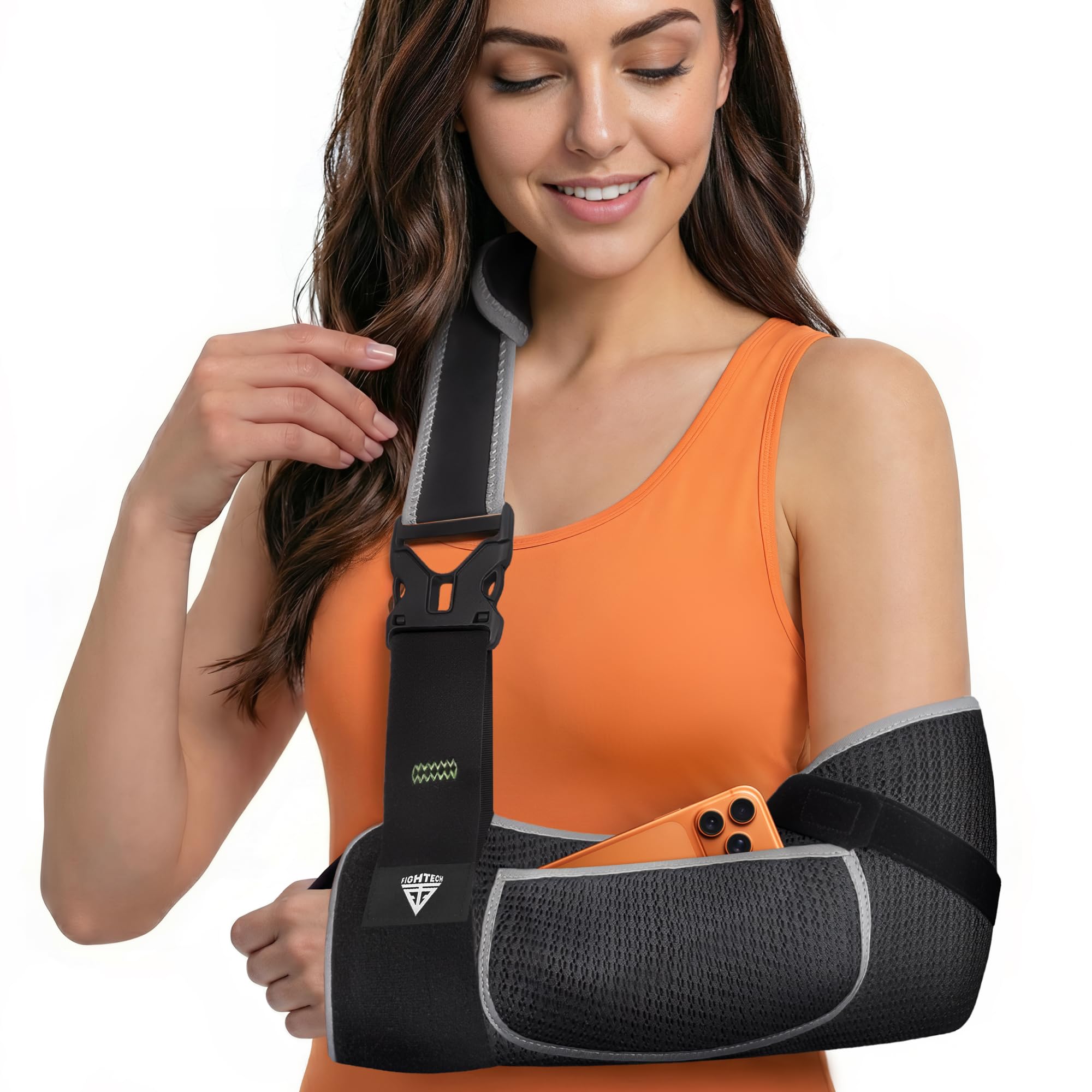
This arm sling from FIGHTECH is designed for maximum immobilization, making it the go-to choice for post-surgical recovery from a torn bicep tendon repair or for acute injuries where any arm movement risks further damage. Unlike compression braces that allow motion, the sling holds the arm at a fixed angle against the body, taking all weight off the shoulder and bicep complex. The breathable mesh construction improves airflow compared to traditional cotton slings, reducing sweat buildup during the early days of recovery when the sling is worn almost constantly.
It features an ergonomic padded shoulder strap that distributes the arm’s weight to reduce neck and upper back strain—a common complaint with basic slings. A built-in thumb loop keeps the hand positioned correctly, preventing wrist drop and elbow hyperextension. The adjustable buckle system allows one-handed tightening, which is critical when your good arm is the only one available. Reviewers consistently note that this sling is more comfortable than the one provided by their hospital or surgeon, and the integrated phone pocket adds a small but appreciated convenience for keeping essentials within reach.
The sling is available in three sizes and works on both arms. The main drawback is that it requires some assistance to put on correctly after shoulder surgery—you can’t easily thread your injured arm through the cuff one-handed. On warmer days, the mesh breathes better than solid fabric but can still get sweaty under the arm. Long-term durability is unproven, with some users questioning how well the stitching holds up after months of daily use. For the immediate post-op or acute injury phase, however, this sling offers superior immobilization that a compression brace simply cannot match.
Why it’s great
- Full immobilization unloads the bicep tendon completely, essential after surgical repair or severe tear
- Breathable mesh and padded neck strap significantly improve comfort over standard hospital slings
- Adjustable buckle and thumb loop promote correct arm positioning to avoid secondary strain
Good to know
- Requires assistance to put on properly in the immediate post-operative period
- Can cause sweating and discomfort during extended wear in warm weather
- Not suitable for active rehab or daily activities where you need some controlled arm movement
FAQ
How tight should a bicep tendon brace be?
Can I wear a bicep brace while sleeping?
How long should I wear a bicep brace each day?
What is the difference between a bicep brace and a shoulder sling?
Final Thoughts: The Verdict
For most users, the brace for torn bicep tendon winner is the FEATOL Bicep Brace because its four-strap compression system paired with two gel ice packs covers both the stabilization and cold therapy needs of acute and sub-acute recovery phases without requiring a separate purchase. If you’re dealing with chronic stiffness rather than acute swelling, grab the Sticro Heated Arm Wrap for its targeted heat therapy and auto-off timer. And for athletes who need a low-profile, precise option during active training, nothing beats the Cho-Pat Bicep Cuff for focused tendon offloading without bulk.

Mo Maruf
I created WellFizz to bridge the gap between vague wellness advice and actionable solutions. My mission is simple: to decode the research and give you practical tools you can actually use.
Beyond the data, I am a passionate traveler. I believe that stepping away from the screen to explore new environments is essential for mental clarity and physical vitality.