Our readers keep the lights on and my smoothie glass nicely filled. As an Amazon Associate, I earn from qualifying purchases.
The promise of an audiophile-grade CD player is simple: extract every last bit of sonic information from the disc and pass it along with zero contamination. Yet the market offers a dizzying split between all-in-one players, dedicated transports, and ripping streamers — each imposing its own trade-offs in jitter control, DAC architecture, and system integration.
I’m Mohammad Maruf — the founder and writer behind WellFizz. My research focuses on the signal-path engineering, DAC chip selections, and mechanical damping solutions that separate a real high-fidelity transport from a mass-market spinner.
Whether you want a standalone transport for an existing DAC stack or a full reference-component player with SACD capability, this breakdown of the best audiophile cd player options will help you match the right transport architecture to your system’s specific needs.
How To Choose The Best Audiophile CD Player
Selecting a high-end CD player means looking beyond retail price and brand heritage. The core question is whether you need the DAC inside the box or whether a dedicated transport paired with an external DAC yields better long-term value. Every other decision — from disc mechanism to digital filter — rests on that first fork in the road.
Transport vs. Player: The Divorce of DAC and Drive
A dedicated CD transport sends raw digital data via coaxial, optical, or I²S output to an external DAC. This allows you to upgrade DACs independently and isolate electrical noise caused by the motor and servo circuits. An integrated player, by contrast, contains both drive and DAC in one chassis — often with a single power supply shared between noisy digital sections and sensitive analog stages, which can introduce high-frequency interference. For systems with a premium DAC already in place, a transport-only unit often yields cleaner sound at a lower total cost than a flagship integrated player.
DAC Architecture and Upsampling
The DAC chip is the heart of any integrated player. Look for modern Delta-Sigma chips from AKM or ESS, which offer wide dynamic range and vanishingly low distortion. Some players and transports also include upsampling engines that re-clock PCM to 768 kHz or convert everything to DSD512 — a feature that can smooth out the harshness sometimes associated with 44.1 kHz digital filters. Just be aware that upsampling adds processing overhead; the best implementations use dedicated FPGA or CT7302CL chips that handle the math independently of the main transport logic.
Mechanical Damping and Disc Drive Quality
Vibration is the enemy of accurate laser tracking. High-end transports employ heavy aluminum chassis, floating laser pickups, and constrained-layer damping to isolate the optical mechanism from both airborne and footfall-induced resonance. The most robust solutions — such as Denon’s S.V.H. loader (Suppress Vibration Hybrid) or the Philips-based servo systems — use die-cast components and layered dampening materials. Lighter plastic trays may pass a visual inspection but can allow micro-vibrations that cause read errors in the form of audible stutters or glares in the high frequencies.
Digital Output Connectivity and Format Support
If you choose a transport, the output interface matters as much as the drive itself. Standard coaxial S/PDIF caps out at 24-bit/192 kHz; optical (TOSLINK) is typically limited to 96 kHz. For high-resolution PCM upsampling or native DSD streams, I²S over HDMI carries the full bandwidth without reclocking ambiguity. Blu-ray players that support SACD playback add another layer of complexity, often requiring HDMI to send DSD to a compatible AV receiver. Confirm your DAC’s input capabilities before selecting a transport — mismatched output formats are the single most common upgrade headache.
Quick Comparison
On smaller screens, swipe sideways to see the full table.
| Model | Category | Best For | Key Spec | Amazon |
|---|---|---|---|---|
| S.M.S.L PL200 | CD Player/DAC | Modern desktop system | AK4499EX DAC chip, 0.00006% THD | Amazon |
| Audiolab 6000CDT | CD Transport | External DAC pairing | Read-ahead buffer, slot-load drive | Amazon |
| Shanling ET3 | CD Transport | I²S enthusiasts | CT7302CL upsampling to DSD512 | Amazon |
| Marantz CD6007 | CD Player | Mid-range system integration | USB-A for FLAC/WAV up to 192kHz | Amazon |
| Yamaha CD-C603 | CD Changer | Multi-disc playback | 5-disc tray, optical output | Amazon |
| Denon RCD-N12 | Mini System | Compact all-in-one system | 60W/ch Class AB, HEOS streaming | Amazon |
| Eversolo Play (CD Edition) | Streamer/DAC/Amp | All-in-one streaming hub | AK4493SEQ DAC, 60W/ch Class D | Amazon |
| Marantz CD 60 | CD Player | Reference 2-channel system | Selectable digital filters | Amazon |
| Bose Wave Music System IV | Tabletop System | Bedroom or kitchen | Waveguide technology, AM/FM tuner | Amazon |
| Denon DCD-1700NE | SACD Player | SACD collection | AL32 Processing Plus, S.V.H. loader | Amazon |
| Bluesound Vault 2i | Ripper/Streamer | CD library digital archive | 2TB storage, FLAC ripping | Amazon |
| OPPO UDP-203 | Universal Disc Player | 4K Blu-ray and SACD | Dolby Vision, HDR10, SACD playback | Amazon |
| Yamaha R-N2000A | Network Receiver | Full system receiver | ESS ES9026PRO DAC, MusicCast | Amazon |
In‑Depth Reviews
1. S.M.S.L PL200 MQA-CD Player

The PL200 packs a flagship AK4499EX DAC with measured distortion down to 0.00006%, making it one of the lowest-THD integrated players at any price tier. The top-loading mechanism with a magnetic puck and vibration-dampened chassis eliminates the read errors that plague tray-based designs — and the bypassable lid interlock adds a nice ritualistic feel to disc changes.
Beyond CD playback, this unit functions as a Bluetooth 5.1 receiver and a full USB DAC, handling MQA full decoding and PCM up to 32-bit/768 kHz. The 1000mW headphone amplifier on the front panel drives high-impedance planar headphones without an external amp, a rare convenience in this class.
On the con side, the shipping packaging from the factory has been inconsistent — some units arrive with missing laser covers or unsealed box tape, though the hardware itself is uniformly well-constructed. The manual is also printed primarily in Chinese, so expect to rely on online resources for the full setup menu.
Why it’s great
- AK4499EX DAC chip delivers reference-level low-distortion performance.
- Top-loading magnetic puck mechanism reduces vibration and mechanical noise.
- Built-in 1000mW headphone amp eliminates the need for a separate amp.
Good to know
- Packaging quality varies; some units arrive with minor cosmetic oversights.
- Manual is mostly in Chinese, requiring online help for full functionality.
2. Audiolab 6000CDT Dedicated CD Transport

The 6000CDT is a pure transport — no internal DAC — designed to feed an external converter via optical or coaxial S/PDIF. Its slot-loading Philips mechanism incorporates a read-ahead digital buffer that re-reads and error-corrects data from damaged discs, a feature that provenly plays discs that conventional drives reject entirely.
Users have reported flawless playback of heavily scratched audiophile CDs that skipped in their previous players, alongside a noticeable uptick in soundstage width and image specificity when paired with a Gustard or Denafrips DAC. The solid steel chassis and compact footprint make it easy to integrate into existing stacks without adding mechanical resonance.
The bundled remote is the weakest point — cheap plastic with tiny, low-contrast labels that are hard to read in dim lighting. Some owners also note that the slot-loading mechanism requires a careful disc insertion angle to avoid misalignment.
Why it’s great
- Read-ahead buffer reads damaged discs that other transports cannot handle.
- Pure transport design isolates noisy servo circuits from the DAC stage.
- Proven reliability across multiple units over several years of use.
Good to know
- Remote control feels cheap and has poor label contrast.
- Slot-load drive can be finicky with disc insertion angle.
3. Shanling ET3 Digital CD Transport

The ET3 is a transport first, but its dedicated CT7302CL upscaling chip sets it apart. This chip converts any incoming PCM signal — from the CD drive, USB input, or Bluetooth — to PCM 768 kHz or DSD512 before output via I²S. Users consistently report that the DSD512 upsampling mode produces a smoother, more analogue presentation compared to the raw 44.1 kHz stream, with no perceivable processing artifacts.
The Philips SAA7824 servo combined with a Sanyo HD850 laser pickup provides quick disc access and silent rotation. Bluetooth 5.0, Wi-Fi, DLNA, and AirPlay support mean the ET3 can also serve as a high-resolution music endpoint for your entire digital library, all feeding through the same upsampling engine and I²S output.
A small but notable number of units arrive dead on arrival, which suggests the manufacturing QC at Shanling’s assembly line is inconsistent. The unit also requires a high-quality 8K-rated HDMI cable for I²S output — generic HDMI cables can introduce handshake issues.
Why it’s great
- CT7302CL upsampling chip converts all inputs to PCM 768 kHz or DSD512.
- Multi-function: CD transport, Bluetooth receiver, Wi-Fi streamer.
- I²S output enables full-bandwidth DSD transfer to compatible DACs.
Good to know
- Inconsistent manufacturing quality; DOA units reported.
- I²S output requires a high-quality 8K HDMI cable.
4. Marantz CD6007 CD Player
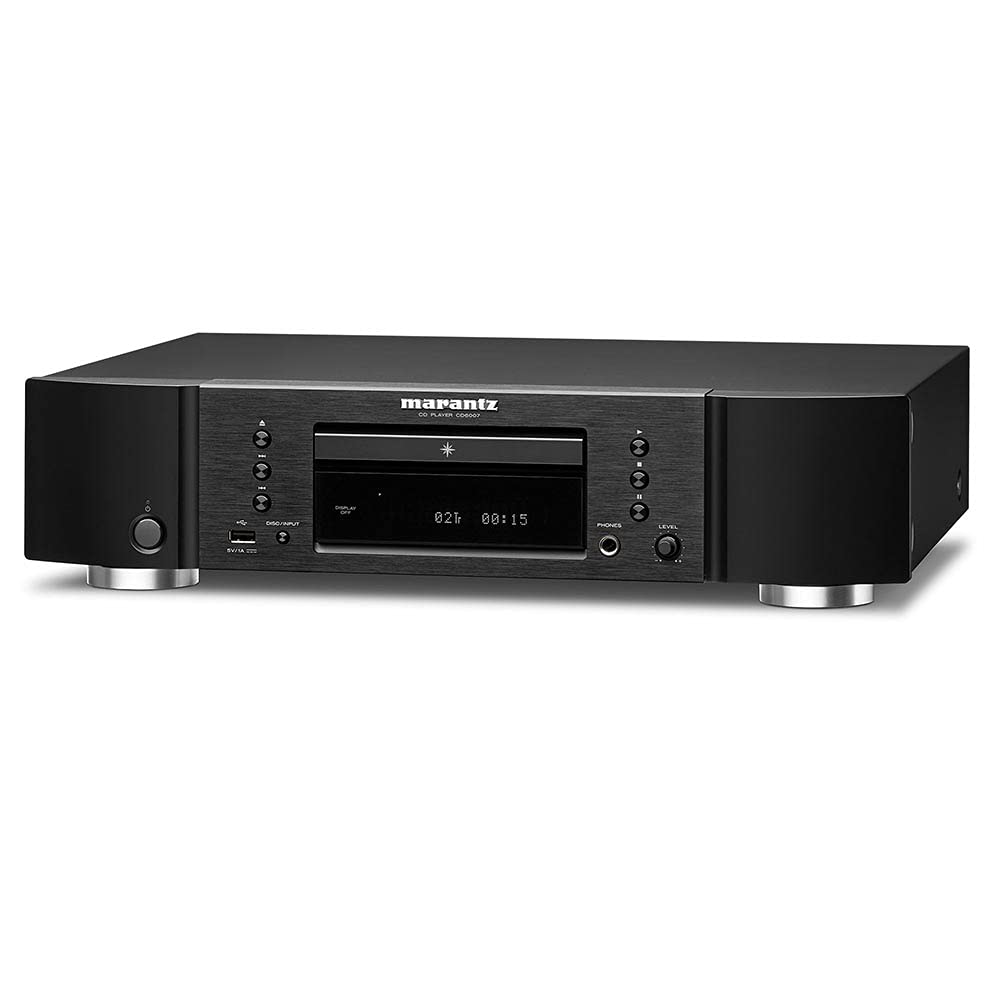
The CD6007 is Marantz’s entry-level audiophile spinner, inheriting the Hyper-Dynamic Amplifier Modules (HDAM) from the company’s higher-end models. The result is a sound signature that leans slightly warm but gains substantial texture in the midrange — pianos and vocals sound notably more “live” than they do on neutral-chip DACs. The front USB-A port accepts FAT32 drives containing FLAC, WAV, and DSD files up to 192 kHz/24-bit, making it a viable playback hub for digital libraries as well.
That said, the USB port refuses NTFS-formatted drives, which forces owners to reformat large-capacity flash drives. The gold-colored finish is divisive visually — some find it elegant, others garish in a black rack. The included 3.5mm headphone jack drives low-impedance IEMs capably but lacks the power for high-ohm over-ear headphones.
From a reliability perspective, the CD mechanism tracks well across thousands of hours, with one caveat: the loading tray uses a composite plastic rather than the die-cast metal of the CD 60, and some users report a slightly flimsy feel during disc insertion.
Why it’s great
- HDAM-based analog stage delivers rich, textured midrange reproduction.
- USB-A input supports high-resolution FLAC, WAV, and DSD files.
- Reliable tracking mechanism with thousands of hours of proven longevity.
Good to know
- USB port does not support NTFS-formatted drives.
- Headphone amp lacks power for high-impedance overhead headphones.
5. Yamaha CD-C603 5-Disc CD Changer

The CD-C603 is one of the last remaining multi-disc changers from a major brand, and for listeners with large CD libraries, the ability to load five discs at once has genuine utility. Yamaha’s PlayXchange feature lets you swap four discs while the fifth plays continuously, eliminating dead air between album changes.
The front USB port supports MP3, WMA, AAC, WAV, and FLAC files up to 96 kHz/24-bit. The optical output lets you bypass the internal Burr-Brown DAC entirely if you prefer an external converter — a smart compromise for a changer that also sees use in non-critical listening zones.
Downsides worth noting: the fully-opening tray is large and can feel plasticky, and a few early units shipped with defective drawer mechanisms that wouldn’t open. The design is also tall and deep — at 22 inches depth, it may not fit standard audio shelf dimensions without overhang.
Why it’s great
- Five-disc capacity with continuous-play swapping for minimal interruption.
- Optical output allows bypass of the internal DAC for higher-end processing.
- USB port supports high-res FLAC and WAV playback.
Good to know
- Deep chassis (22 inches) may not fit standard audio shelf depths.
- Some units have defective drawer mechanisms reported.
6. Denon RCD-N12 Mini Stereo System

The RCD-N12 is a slot-loading CD player, AM/FM tuner, network streamer, and integrated amplifier all in one compact chassis. Its 60 watts per channel into 8 ohms (Class AB) deliver surprisingly robust power to bookshelf speakers, and the HEOS multi-room platform integrates seamlessly with Spotify, Tidal, and Amazon Music.
The inclusion of HDMI ARC input allows the unit to serve as a TV soundbar upgrade, and the phono input (MM) accommodates a turntable without external phono pre-amp. Built-in Wi-Fi and Ethernet provide stable streaming, though the HEOS app is sometimes clunky for browsing large libraries.
There are a few grating trade-offs: the touch-sensitive top panel controls are easily triggered by cats or cleaning cloths, and the phono input offers only modest gain, requiring a separate preamp for moving-coil cartridges. The remote lacks backlighting, which is a frustration in dim rooms.
Why it’s great
- All-in-one design: CD player, streamer, amplifier, and tuner.
- 60W/ch Class AB output drives most bookshelf speakers effectively.
- HDMI ARC, phono input, and HEOS multi-room streaming.
Good to know
- Touch-sensitive top panel is prone to accidental activation.
- Phono input sensitivity is low for moving-coil cartridges.
7. Eversolo Play (CD Edition)
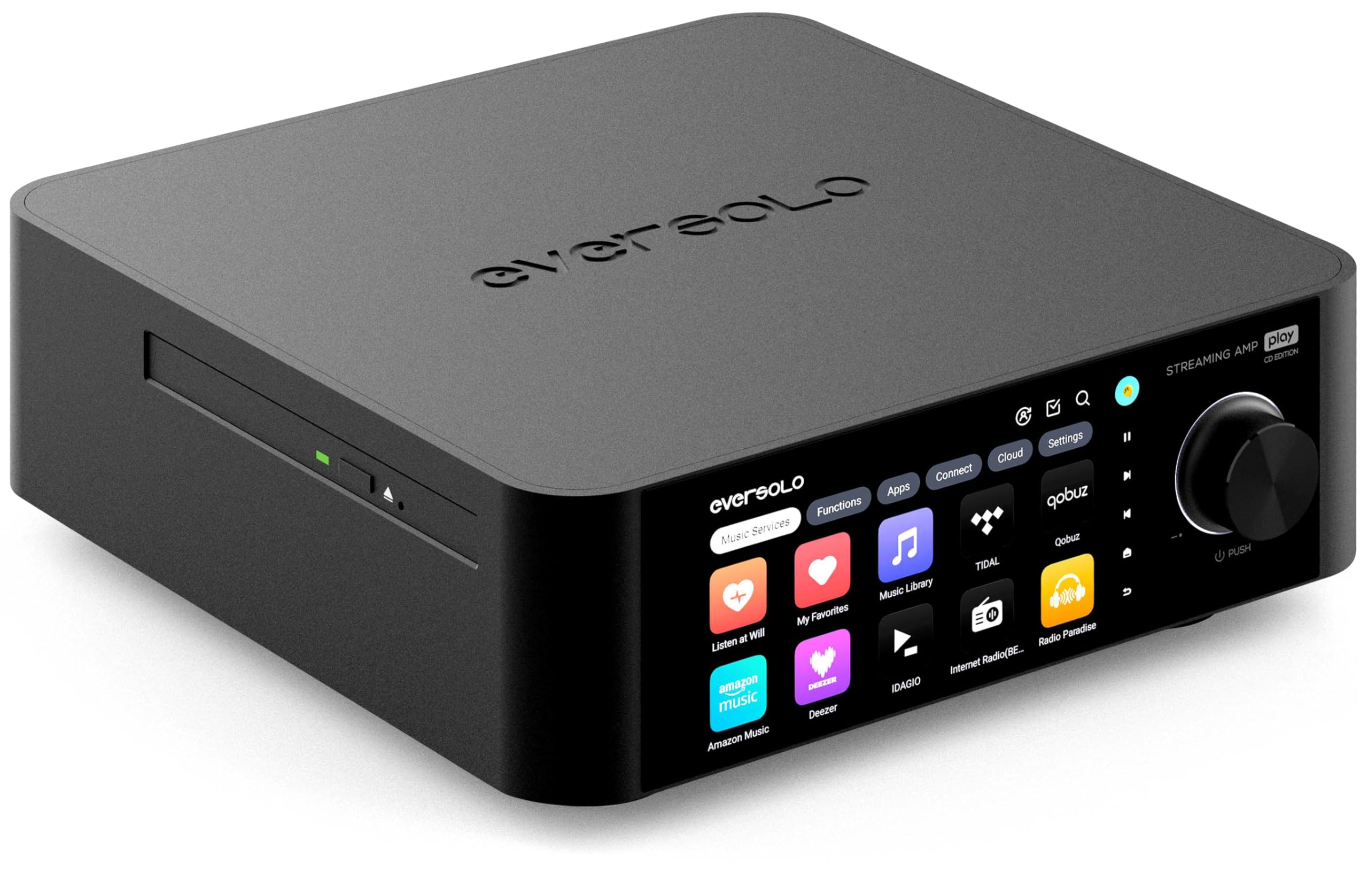
The Eversolo Play integrates a CD drive, streaming DAC, and Class D amplifier into a single unit controlled by a 5.5-inch HD touchscreen. The AK4493SEQ DAC handles DSD512 and PCM 768 kHz, while the 60W per channel (8Ω) amplifier is optimized for 85–88 dB sensitivity bookshelf speakers. The CD edition adds a built-in slot loader, making this one of the few all-in-one solutions that handles physical media, streaming, and amplification without external boxes.
Room correction via FIR filters and a multi-band parametric EQ lets you tune for your specific listening environment, and the Eversolo Control app provides intuitive screen mirroring and queue management. The Phono input (MM/MC) and HDMI ARC allow a turntable and TV to connect directly to the system.
However, the amplifier’s power rating — 110W at 4Ω — is insufficient for larger floor-standing speakers that need current for deep bass control. Some firmware updates have also introduced bugs with the local file library, causing the unit to refuse indexing FLAC files from USB drives.
Why it’s great
- All-in-one CD/streamer/DAC/amp controlled via a 5.5-inch touchscreen.
- Room correction and multi-band EQ provide precise acoustic tuning.
- Phono input (MM/MC) and HDMI ARC for turntable and TV integration.
Good to know
- Amplifier cannot adequately drive low-sensitivity floor-standing speakers.
- Some firmware updates have caused FLAC library indexing bugs.
8. Marantz CD 60 CD Player

The CD 60 is Marantz’s current reference single-disc player, tuned by the company’s Sound Master for a musical signature that emphasizes emotional engagement over clinical accuracy. The selectable digital filter system lets you toggle between Filter 1 (wider soundstage, slightly forward treble) and Filter 2 (smoother, more rounded highs) — a genuinely useful feature for matching the player to different speaker/room combinations.
Build quality is excellent: a layered aluminum front plate, a die-cast tray mechanism, and a high-current, low-noise power supply that reveals micro-detail in crowded orchestral passages. The USB-A front input accepts USB drives with DSD and PCM files, and the headphone output delivers enough current for 32–80 ohm headphones with decent authority.
The biggest limitation is price — you are paying a substantial premium for the Marantz tuning and build, and the CD 60 is strictly an integrated player with no bypass options for external DAC use. Some users also note that the unit is sensitive to vibration from adjacent components, so adequate isolation feet or a dedicated shelf are advisable for best results.
Why it’s great
- Selectable digital filters allow tonal adjustment to match speaker and room.
- High-current, low-noise power supply reveals exceptional micro-detail.
- Die-cast tray and aluminum front panel provide excellent build quality.
Good to know
- Vibration-sensitive; isolation feet or a dedicated shelf are advisable.
- Premium price reflects the Marantz tuning and build premium.
9. Bose Wave Music System IV

The Wave Music System IV is a self-contained tabletop unit that uses Bose’s waveguide technology to produce full-bodied sound from a compact enclosure. The CD/MP3 player sits alongside an advanced AM/FM tuner with dual alarms, making it as much a bedside companion as a music system.
Sound quality is distinctly Bose: smooth, non-fatiguing, and well-balanced, but lacking the dynamic contrast and micro-detail that audiophile separates provide. For its intended use case — background music in a kitchen, bedroom, or home office — it delivers impressive room-filling presence from a 9-pound footprint. The touch-top snooze control and slim remote with 12 presets add genuine everyday convenience.
The major limitation is the lack of Bluetooth out of the box; you’ll need an external Bluetooth adapter for wireless streaming. The system also lacks any digital outputs, so there is no upgrade path to an external DAC. The price-to-performance ratio is the weakest of any product on this list for a purist audiophile.
Why it’s great
- Waveguide technology produces surprising fullness from a compact cabinet.
- Integrated AM/FM tuner and dual alarms make it bedroom-ready.
- Touch-top control and slim remote provide everyday convenience.
Good to know
- No Bluetooth built-in; requires an external adapter for streaming.
- No digital output; cannot be paired with an external DAC.
10. Denon DCD-1700NE SACD Player

The DCD-1700NE brings Denon’s Advanced AL32 Processing Plus — a proprietary algorithm that interpolates data lost during digital recording — to SACD and CD playback. The S.V.H. (Suppress Vibration Hybrid) loader uses a layered die-cast and dampening structure that keeps the laser isolated from both internal motor noise and external footfall vibrations.
Listeners consistently report that the player reveals details in familiar recordings that were previously invisible: breath sounds, room reverberation, and subtle instrumental textures. The Pure Direct mode switches off the display and unused circuit blocks to reduce internal noise further, though the audible difference is subtle in most listening environments.
There are two recurring complaints: the remote control lacks a dedicated disc tray open/close button, which forces you to walk to the unit every time you swap discs. The optical transport is also reportedly sensitive to dust, requiring occasional cleaning with a CD lens cleaner to prevent read errors.
Why it’s great
- AL32 Processing Plus restores lost data for more natural sound reproduction.
- S.V.H. loader effectively isolates the laser from mechanical vibrations.
- SACD support provides access to high-resolution DSD recordings.
Good to know
- Remote has no disc tray open/close button.
- Transport is dust-sensitive; periodic lens cleaning is recommended.
11. Bluesound Vault 2i

The Vault 2i is a CD ripper and network streamer with a 2TB internal hard drive that can store up to 30,000 tracks in FLAC, MP3, WAV, or WMA format. Insert a CD, and the unit automatically rips it, tags it with metadata from online databases, and makes it available immediately on your home network — no computer required.
The Bluesound ecosystem allows multiple Vaults and Nodes to share libraries across rooms, and AirPlay 2, Alexa, and Siri integration cover voice control. The unit also functions as a high-resolution streamer (up to 24-bit/192kHz) via the BluOS app, handling Tidal, Qobuz, and local network shares.
The CD drive is the weakest component — it is slow (approximately 20 minutes per disc) and mechanically noisy during ripping. The BluOS app, while functional, has a steep learning curve for editing metadata and managing playlists, and a few users have reported that the drive mechanism develops skipping issues after about 15 months of daily use.
Why it’s great
- 2TB storage holds up to 30,000 tracks in lossless FLAC format.
- Automated ripping and metadata tagging with no computer needed.
- Multi-room streaming via AirPlay 2, Alexa, and the BluOS ecosystem.
Good to know
- CD drive is slow (up to 20 minutes per disc) and noisy during ripping.
- Some users report drive reliability issues after about 15 months.
12. OPPO UDP-203 Universal Disc Player

The UDP-203 is a universal disc player that handles 4K UHD Blu-ray, Blu-ray 3D, SACD, DVD-Audio, DVD, and CD — all with reference-grade video processing and lossless audio output. Its dual HDMI outputs separate video and audio signals, allowing you to feed video directly to your TV while sending pure audio to a dedicated DAC or AV receiver.
For audiophiles, the UDP-203’s SACD playback is its primary draw: it outputs DSD via HDMI to a compatible receiver or preamp, and its two-channel analog audio output (via the internal 32-bit DAC) is surprisingly competent for direct connection to a stereo amplifier. The build quality is exceptional — a heavily braced steel chassis that weighs over 15 pounds and runs silent.
The unit has no built-in streaming apps, so you cannot use it for Netflix or Spotify without an external streaming device. OPPO officially exited the consumer disc player market in 2018, meaning no firmware updates are forthcoming, and warranty support relies entirely on third-party repair shops. The secondary market prices have climbed accordingly, making this a considered purchase for serious collectors.
Why it’s great
- Universal playback: 4K UHD, Blu-ray, SACD, DVD-Audio, CD.
- Dual HDMI outputs for separate video/audio signal paths.
- Heavily braced steel chassis for silent, vibration-free operation.
Good to know
- No built-in streaming apps for Netflix or Spotify.
- OPPO exited the market; no firmware updates and limited warranty support.
13. Yamaha R-N2000A Hi-Fi Network Receiver

The R-N2000A is Yamaha’s flagship network receiver — a 100W-per-channel integrated amplifier with a built-in ESS SABRE ES9026PRO DAC, phono stage, and MusicCast streaming. While it is not itself a CD player, its DAC and amplification are designed to pair with an external CD transport or player, making it the ideal end-point for a premium CD-based system.
The toroidal power transformer delivers clean, stable current with low mechanical hum, and the symmetrical layout of the amplifier channels minimizes crosstalk. The DAC supports DSD 11.2 MHz native playback and PCM up to 384 kHz, so any CD transport feeding it via coaxial or optical will be fully resolved to the highest possible sample rate.
The receiver is massive — 48.7 pounds — and requires a sturdy rack. It also lacks balanced (XLR) inputs, which is an odd omission at this tier, and the single subwoofer output limits flexibility for dual-sub setups. The YPAO room correction system is basic compared to Dirac or Audyssey, offering little to no manual EQ adjustment after the auto-calibration.
Why it’s great
- ESS ES9026PRO DAC provides high-resolution decoding up to DSD512.
- Toroidal power transformer delivers clean, stable current.
- MusicCast multi-room streaming supports Qobuz, Tidal, and more.
Good to know
- No balanced (XLR) inputs at this premium price tier.
- Single subwoofer output limits dual-sub configuration flexibility.
FAQ
Can any CD transport improve sound quality with my existing DAC?
Is there a meaningful difference between CD transports sold at different price points?
What is the difference between PCM and DSD upsampling in a CD transport?
Should I use coaxial or optical for connecting a CD transport to my DAC?
Final Thoughts: The Verdict
For most users, the best audiophile cd player winner is the S.M.S.L PL200 because its AK4499EX DAC and top-loading mechanism deliver reference-level sound without demanding a separate DAC investment. If you want the flexibility to upgrade DACs independently, grab the Audiolab 6000CDT — a pure transport with exceptional disc-error recovery. And for SACD enthusiasts building a dedicated playback system, nothing beats the Denon DCD-1700NE with its vibration-suppressed loader and AL32 processing.

Mo Maruf
I created WellFizz to bridge the gap between vague wellness advice and actionable solutions. My mission is simple: to decode the research and give you practical tools you can actually use.
Beyond the data, I am a passionate traveler. I believe that stepping away from the screen to explore new environments is essential for mental clarity and physical vitality.