Our readers keep the lights on and my smoothie glass nicely filled. As an Amazon Associate, I earn from qualifying purchases.
Printing with ABS requires an enclosed chamber that holds a steady ambient temperature above 40°C, a heated bed that reaches 100°C, and a hotend capable of 260°C or higher. Without these three conditions, ABS warps on the build plate, delaminates mid-print, and produces brittle finished parts that crack under light load. The printers on this list meet those baseline requirements before you even consider speed, build volume, or multi-color features.
I’m Mohammad Maruf — the founder and writer behind WellFizz. I’ve spent years analyzing market trends, comparing hardware specifications, and digging into the real-world failure modes of FDM printers to identify which models actually deliver reliable ABS output without expensive modifications.
After comparing over a dozen fully enclosed CoreXY printers by build volume, chamber heating capability, nozzle temperature ceiling, and user-reported reliability, I’ve narrowed the field down to the units that genuinely justify their price. This is the best abs 3d printer guide for makers who want dependable results from tough engineering materials.
How To Choose The Best ABS 3D Printer
ABS demands thermal consistency from the first layer to the last. A printer that prints PLA beautifully can fail completely with ABS on the same day if the chamber lacks insulation or active heating. Focus on these three criteria before considering speed or brand reputation.
Active chamber heating vs. passive enclosure
A passive enclosure traps heat radiated from the bed but cannot raise the chamber temperature above roughly 45°C on its own. Printers with an active chamber heater, like the QIDI Q1 Pro, can hold 55°C to 60°C regardless of room temperature, which virtually eliminates warping on large ABS parts. If you plan to print ABS regularly, prioritize a model with a built-in chamber heater rather than relying on a separate enclosure add-on.
Nozzle temperature ceiling and hotend design
ABS prints between 230°C and 260°C, but hotends rated for 280°C or higher provide a safety margin for printing at the upper end of that range without risking thermal degradation of the PTFE liner. An all-metal hotend, such as the 320°C brass-hardened steel nozzle on the ELEGOO Centauri Carbon, eliminates the risk of the liner melting and causing a clog mid-print. Avoid any printer whose hotend specification caps below 260°C if ABS is your primary material.
Build plate adhesion system
ABS shrinks as it cools, pulling the corners of a print upward during the first 10 layers. A heated bed at 100°C combined with a textured PEI or glass surface coated with ABS slurry gives the strongest grip. Printers that offer dual-sided PEI plates, like the Flashforge Adventurer 5M Pro, typically produce better adhesion without adhesive additives. A bed that cools unevenly, indicated by poor temperature uniformity across the surface, will cause the same warping regardless of the coating.
Quick Comparison
On smaller screens, swipe sideways to see the full table.
| Model | Category | Best For | Key Spec | Amazon |
|---|---|---|---|---|
| ELEGOO Centauri Carbon | Mid-Range | Best overall ABS value | 320°C hotend, die-cast frame | Amazon |
| Anycubic Kobra S1 Combo | Mid-Range | Multi-color ABS prints | 600mm/s, 4-color ACE PRO | Amazon |
| QIDI Q1 Pro | Mid-Range | Active chamber heating for ABS | 60°C chamber, 350°C nozzle | Amazon |
| Bambu Lab P1S | Mid-Range | Print farm reliability | 500mm/s, AMS ready | Amazon |
| Flashforge Adventurer 5M Pro | Mid-Range | Beginner-friendly enclosed printer | 600mm/s, 280°C hotend | Amazon |
| FLASHFORGE AD5M Pro | Mid-Range | Quick-swap nozzle versatility | 3s nozzle swap, dual filters | Amazon |
| Sovol SV08 | Premium | Large-format ABS parts | 700mm/s, 350mm³ volume | Amazon |
| Creality K2 Combo | Premium | Multi-color ABS with RFID | 600mm/s, 16-color CFS | Amazon |
| Original Prusa MK4S | Premium | Production-grade ABS reliability | Input shaping, open-source | Amazon |
| Snapmaker Artisan | Premium | Dual-extrusion ABS models | 400mm³ volume, dual extruder | Amazon |
| Dremel DigiLab 3D45 | Premium | Educational and office use | 280°C nozzle, carbon filter | Amazon |
In‑Depth Reviews
1. ELEGOO Centauri Carbon 3D Printer
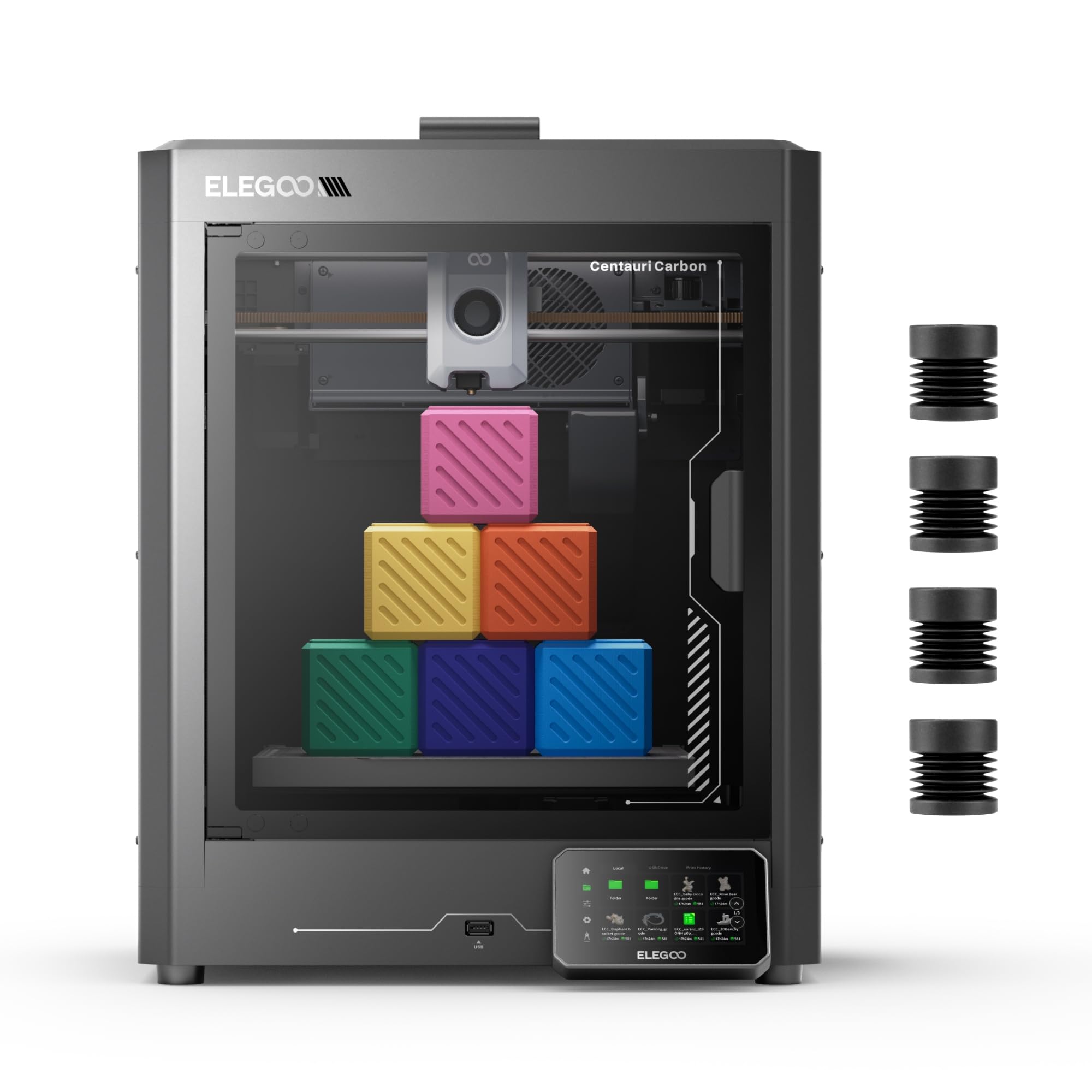
The Centauri Carbon punches well above its price tier with a 320°C brass-hardened steel nozzle and a fully enclosed chamber that reaches stable ABS printing temperatures without active heating. Its die-cast aluminum frame minimizes vibration at 500 mm/s, and user reports confirm that ABS prints emerge without corner lift when the bed is set to 100°C. The built-in chamber camera and dual LED lighting let you monitor first-layer adhesion from another room.
Print quality is consistent across PLA, PETG, and carbon-fiber reinforced filaments, but ABS is where this machine truly shines for its cost. The double-sided PEI plate includes a PLA-specific surface that also grips ABS well at lower bed temperatures, reducing the risk of elephant foot on tall parts. One user reported 300 hours of error-free PETG prints, and the same pattern holds for ABS with standard slicer profiles.
The main trade-off is that the Centauri Carbon lacks active chamber heating, so ambient room temperature below 20°C may cause warping on very large ABS prints. A separate enclosure blanket or a heated chamber upgrade kit would solve this, but the printer’s stock configuration handles most ABS jobs up to 150mm tall reliably. For the price, you get CoreXY speed and a hotend that handles engineering materials without modification.
Why it’s great
- 320°C hotend handles carbon fiber and ABS without PTFE concerns
- Die-cast aluminum frame keeps high-speed prints dimensionally stable
- Excellent bed adhesion with included PEI plate
Good to know
- No active chamber heater; large ABS prints may warp in cold rooms
- Print quality requires wet filament mitigation using external dryer
2. Anycubic Kobra S1 Combo
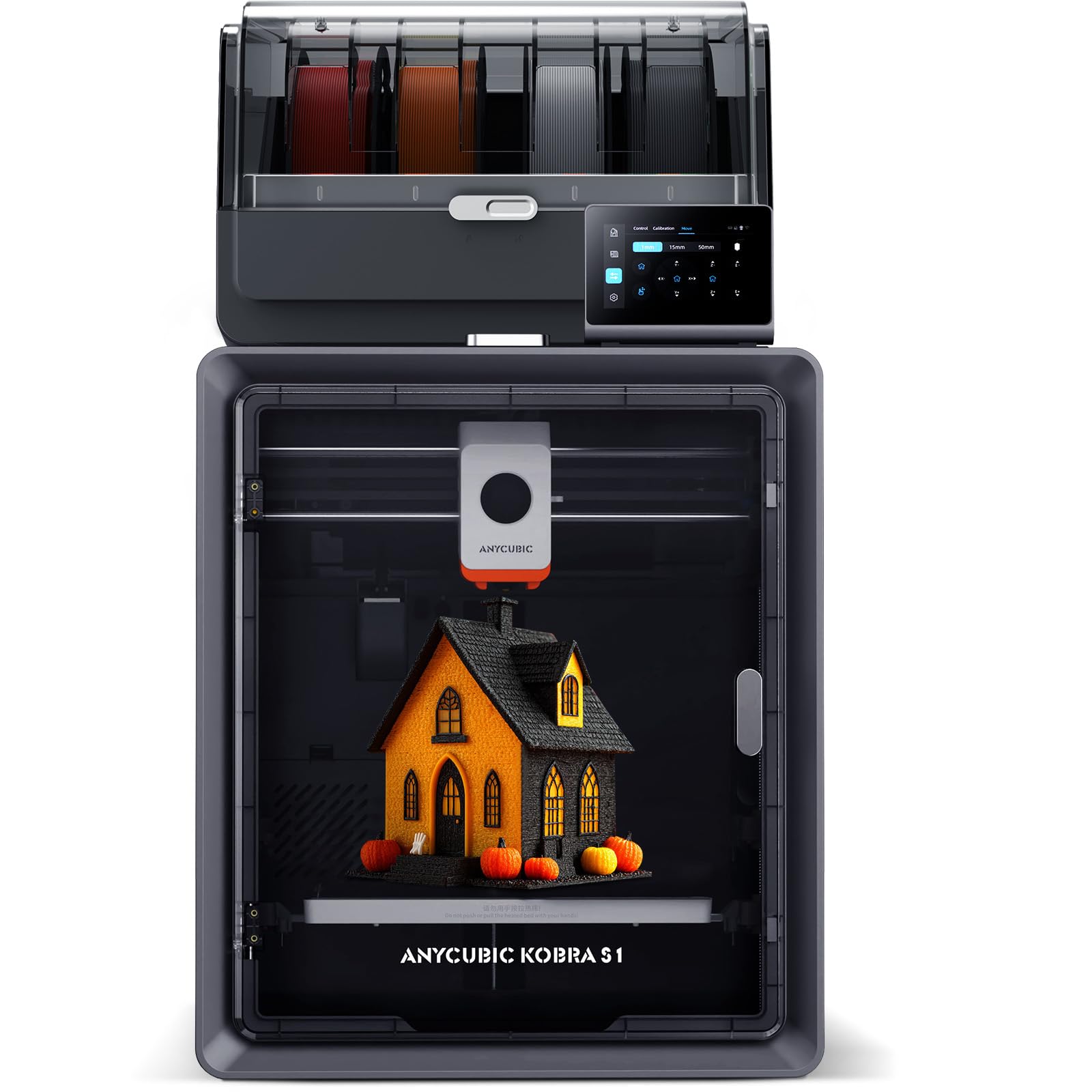
The Kobra S1 Combo brings multi-color printing to the ABS workflow via the ACE PRO filament system, which includes active drying that keeps hygroscopic ABS spools from absorbing moisture during long prints. The CoreXY motion system reaches 600 mm/s, and the fully enclosed chassis holds chamber temperature high enough for small to medium ABS parts without supplementary heating. Flow compensation in the Kobra OS reduces surface artifacts that ABS often shows at high speeds.
The ACE PRO dryer uses dual PTC heating and 360° air circulation, which addresses the root cause of ABS print defects more directly than most printers at this level — moisture-laden filament causes popping and layer separation, and this machine eliminates that variable. Early production units had clogging issues, but the revised version replaces PTFE-lined hotends with an all-metal path and swaps plastic sensor tabs for metal ones. Users report months of trouble-free ABS printing after those changes.
WiFi connectivity through the Anycubic app works reliably for remote monitoring, though the web-based interface feels less polished than dedicated slicer integrations. The build volume at 250mm³ gives you enough room for functional ABS parts like drone frames or automotive brackets without needing a larger platform. If you want multi-color ABS without paying Bambu Lab prices, this combo is the most direct alternative.
Why it’s great
- Built-in filament dryer keeps ABS dry and bubble-free during multi-hour prints
- Multi-color capability reduces post-processing for multi-material ABS prototypes
- Revised hotend design eliminates PTFE-related clogs
Good to know
- ACE PRO in drying mode is louder than the printer during operation
- Cardboard filament reels may not fit the ACE PRO without adapters
3. QIDI Q1 Pro 3D Printer

The Q1 Pro is one of the few printers in the mid-range that includes active chamber heating, which allows it to maintain 60°C regardless of ambient temperature. This makes it the most reliable ABS printer under for large parts — chamber temperature stability directly correlates with interlayer adhesion strength, and the Q1 Pro delivers that consistency within 10 minutes of startup. The 350°C bimetal nozzle handles carbon-fiber and glass-fiber ABS blends without wear concerns.
Independent dual Z-axis motors and a lightweight CoreXY system produce print repeatability around 0.015mm, which matters for functional ABS parts that need to fit together after printing. The printer arrives in 10-minute-ready state with full auto-leveling and a hall-effect filament runout sensor that detects jams, not just empty spools. The touchscreen interface is responsive, and the built-in 1080P camera supports timelapse capture for documentation.
Some users note that the stock side-mounted spool holder feels flimsy, and there is no built-in carbon filter for ABS fumes — an optional filter box is available as a printable download. The chamber gaps around the top glass can leak heat, but printable seals address that mod easily. For pure ABS performance without needing a separate enclosure heated by a space heater, the Q1 Pro sets the benchmark in its price bracket.
Why it’s great
- Active chamber heating to 60°C eliminates ABS warping across large prints
- 350°C bimetal hotend prints every filled ABS variant without wear
- Auto-leveling with dual sensors ensures consistent first layer every time
Good to know
- No built-in HEPA or carbon filter; ABS fumes require ventilation
- Side spool mount is wobbly and best replaced with a printed bracket
4. Bambu Lab P1S 3D Printer

Bambu Lab’s P1S is an enclosed CoreXY machine that prints ABS reliably out of the box, with auto-bed leveling before every print and a fully enclosed body that holds chamber warmth for consistent layer bonding. The 500 mm/s speed with 20,000 mm/s² acceleration is well-tuned for ABS because the input shaping profiles are pre-configured for the machine’s specific resonance frequencies. Users report that ABS parts printed on the P1S require no sanding for functional fit and show minimal layer lines at 0.2mm resolution.
Three-step-servo motors give the extruder high torque consistency, which matters for ABS because material shrinkage creates back-pressure that can cause under-extrusion on less rigid extruder designs. The AMS system allows multi-material printing — you can run PLA supports under ABS parts and dissolve them later, though Bambu Lab explicitly advises against carbon or glass fiber reinforced polymers in the AMS due to abrasive wear. The Bambu Studio slicer integrates with the printer’s cloud service for remote monitoring through the built-in camera.
The main limitation for ABS is that the P1S does not have an actively heated chamber, so in rooms below 20°C large ABS prints can still lift at corners unless you use a brim adhesive or an enclosure blanket. Some users report that TPU prints require more tuning to avoid jams, but ABS generally feeds without issues. For a mid-range printer that handles ABS at production speeds with minimal intervention, the P1S is the standard.
Why it’s great
- Pre-configured input shaping delivers clean ABS layers at 500 mm/s
- Auto-bed leveling before each print eliminates first-layer guesswork
- AMS support for multi-color ABS reduces post-processing time
Good to know
- Not recommended for carbon fiber or glass-filled ABS through the AMS
- Chamber is passive; cold ambient rooms may cause ABS corner lift
5. Flashforge Adventurer 5M Pro

The Adventurer 5M Pro delivers a fully enclosed printing experience in a compact 220mm³ footprint, making it a solid entry point for makers who want to print ABS without building a separate enclosure. The 280°C all-metal hotend reaches full temperature in 35 seconds, and the CoreXY structure maintains stability at 600 mm/s even when printing ABS with high retraction settings. The dual-sided PEI platform grips ABS well at 100°C bed temperature, and auto-leveling through pressure sensing ensures a consistent 0.1mm first layer across the entire bed.
Smart features include a dual circulation system with HEPA filtration, which captures ABS particles and reduces odor compared to open-frame printers — a real advantage for workshop or classroom environments where ventilation is limited. The Flash Maker app allows remote monitoring and parameter adjustments through a built-in camera, and the printer supports PLA, ABS, PETG, TPU, ASA, and carbon fiber filaments through its robust direct-drive extruder. Users report that setup takes roughly 30 minutes from unboxing, with most initial prints succeeding without slicer profile tweaks.
The soft factor here is reliability variance — some units arrive with minor defects like missing handles or calibration errors, though Flashforge’s support team generally replaces affected components quickly. The slicer software (FlashPrint and Orca-FlashForge) is functional but can present installation issues on newer macOS versions. If you want a turnkey enclosed printer that handles ABS for small functional parts without a steep learning curve, the 5M Pro is worth considering.
Why it’s great
- HEPA filtration reduces ABS fumes for safer indoor operation
- Auto-leveling and quick heat-up minimize time to first print
- Dual-sided PEI plate offers strong ABS adhesion without adhesives
Good to know
- WiFi setup requires mobile app; initial software install can be tricky on Macs
- Some units have inconsistent quality control out of the box
6. Flashforge AD5M Pro

The AD5M Pro is essentially an improved version of the original Adventurer 5M Pro, with a 3-second quick-swap nozzle system that lets you switch between 0.4mm and 0.6mm nozzles for different ABS applications — fine detail on prototypes or faster flow for functional brackets. The CoreXY motion system reaches 600 mm/s with built-in vibration compensation that smooths layer lines on tall ABS prints. The fully enclosed chassis with dual-layer filtration blocks dust and smoke, making it suitable for shared studio spaces where ABS fumes are a concern.
Multi-material support includes PLA, ABS, PETG, TPU, ASA, and carbon fiber filaments through a direct-drive extruder that handles flexible materials and abrasive fills without modification. The 220mm³ build volume is adequate for small to medium ABS parts, and users note that bed adhesion for ABS is reliable without glue stick or ABS slurry when the PEI plate is clean. The 1-click auto-leveling system with pressure sensing provides a hassle-free first layer, and the built-in camera enables remote monitoring via the Maker app.
Some users report occasional nozzle clogs, especially with cheap filament, but the quick-swap design makes clearing them less disruptive than printers with fixed hotends. The included software on USB is outdated, so you will need to download the latest FlashPrint version from the website. For a mid-range enclosed printer that lets you adjust nozzle diameter quickly for different ABS needs, the AD5M Pro is a capable choice.
Why it’s great
- 3-second nozzle swap enables fast transitions between detail and speed
- Dual-layer filtration reduces ABS fumes effectively
- Vibration compensation produces smooth layers at high speeds
Good to know
- Software on USB is outdated; requires manual download
- Nozzle clogs can occur with low-quality ABS filament
7. Sovol SV08 Core-XY 3D Printer

The SV08 is an open-source Voron 2.4 derivative that offers a massive 350mm³ build volume at a price point far below most large-format CoreXY machines. It prints ABS reliably when enclosed (the frame side panels are included, though an enclosure kit is sold separately), and the 300°C ceramic heating block reaches 220°C in 40 seconds for fast preheating. The printer uses Klipper firmware with input shaping and pressure advance profiles pre-configured, so large ABS parts print without ringing or bulging at corners.
Quad-gantry leveling with four independent Z motors keeps the build platform parallel to the gantry across the entire 350mm span, which is essential for ABS prints that fill the bed — a 1mm bed tilt on a 350mm print causes first-layer failure that is nearly impossible to recover from. The all-axis linear rails (seven total) provide stiffness that prevents vibration artifacts even at 700 mm/s and 40,000 mm/s² acceleration. The built-in camera supports timelapse and remote monitoring over LAN.
The SV08 is not a turnkey machine for beginners — it requires some assembly and firmware tuning to achieve print reliability matching a Bambu Lab P1S. Users report that Klipper crashes can occur during power-loss recovery, and the PEI sheet on some units wears faster than expected. But if you need ABS parts larger than 250mm³ and you are comfortable with open-source tuning, the SV08 delivers the best volume per dollar in this list.
Why it’s great
- 350mm³ build volume accommodates large ABS functional parts
- Quad-gantry leveling ensures consistent first layer across full bed
- Open-source Klipper firmware allows deep tuning for ABS profiles
Good to know
- Requires assembly and enclosure purchase for ABS printing
- Power-loss recovery with Klipper can be unreliable
8. Creality K2 Combo
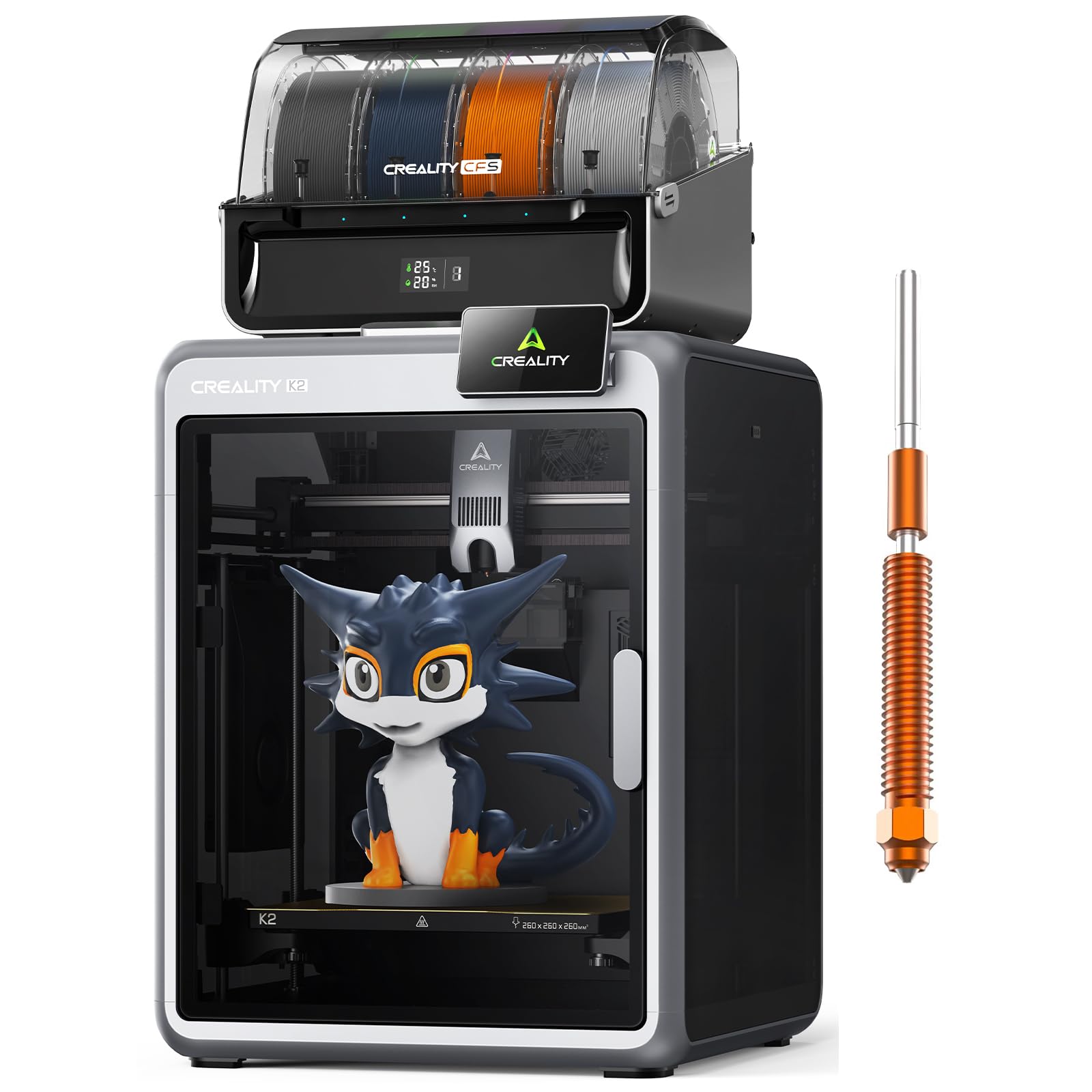
The K2 Combo pairs Creality’s first CoreXY printer with the CFS (Creality Filament System) for up to 16-color multi-material printing, including ABS with soluble supports. The step-servo motor system on the extruder and X/Y axes provides extrusion consistency that minimizes ABS stringing, and the 600 mm/s speed with 20,000 mm/s² acceleration is stable enough for reliable layer stacking. The fully enclosed chassis with a die-cast aluminum top frame maintains chamber temperatures sufficient for small to medium ABS prints.
The CFS includes an airtight case with desiccants and automatic RFID filament detection, which reads Creality spools and pre-sets the correct temperature and retraction values for ABS, reducing the trial-and-error that often accompanies the first ABS print. The smart AI camera detects print failures like spaghetti before they waste hours of material, though early users report that the detection algorithm sometimes misses adhesion failures on the first layer. Auto-leveling scans only the bed area under the print path, which speeds up calibration compared to full-bed probing.
The main drawback is price — the K2 Combo sits at the upper end of the mid-range, and some users argue that the Bambu Lab P1S offers comparable ABS performance for less. However, the CFS multi-color capability is more accessible than Bambu Lab’s AMS for large run productions. If you need multi-color ABS prints without manual filament swapping, the K2 Combo is the most integrated solution in this list.
Why it’s great
- 16-color CFS with RFID auto-configures ABS filament settings
- Step-servo motors improve extrusion consistency for ABS
- AI camera with failure detection saves material on long ABS prints
Good to know
- Higher price than comparable ABS-capable printers
- AI failure detection can miss layer adhesion problems initially
9. Original Prusa MK4S
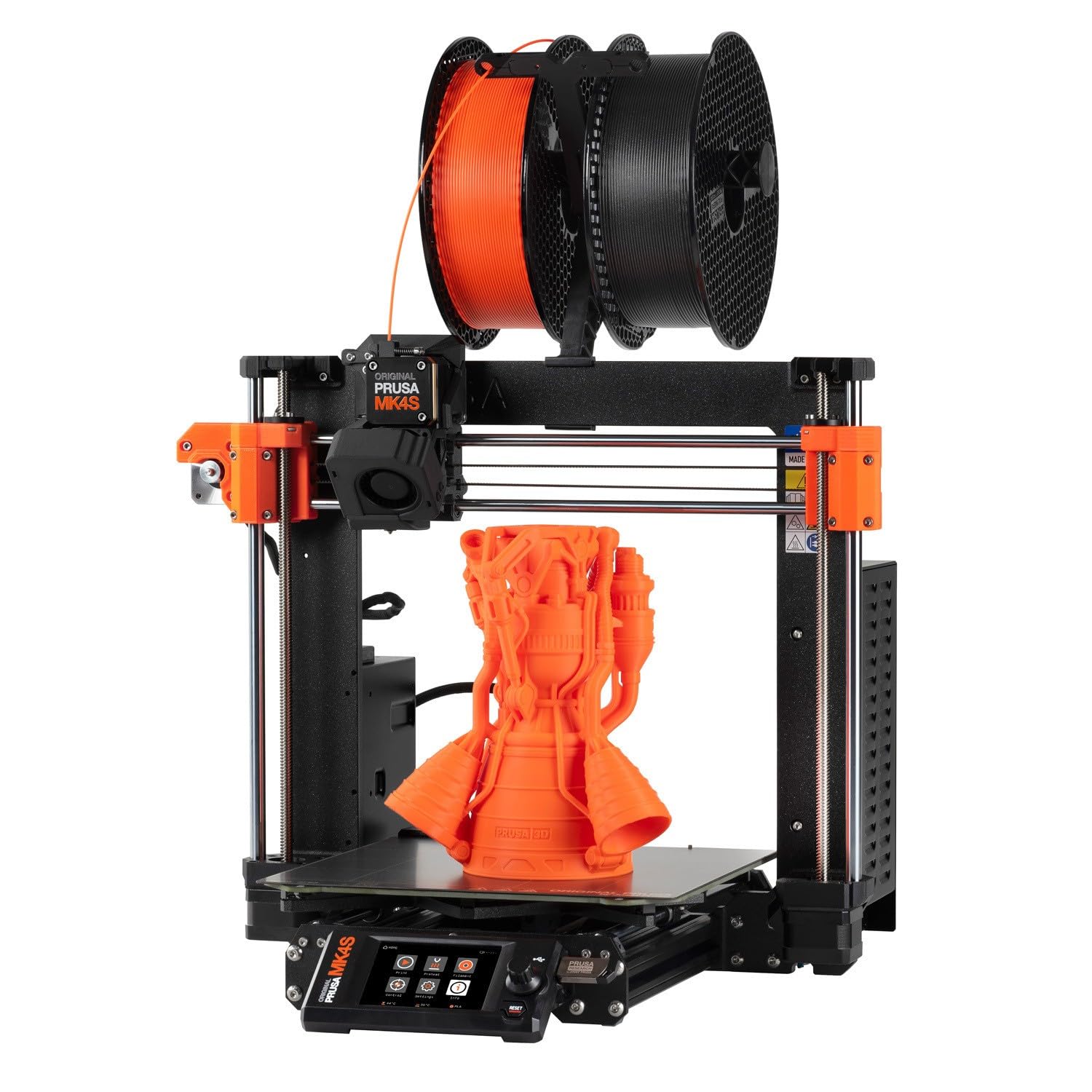
The MK4S is Prusa’s latest iteration of their flagship desktop FDM printer, with input shaping that enables ABS printing at speeds significantly higher than the MK4 while maintaining the brand’s hallmark reliability. The printer ships fully assembled and tested, and the 9.84 x 8.3 x 8.6 inch build volume is sufficient for most prototype-size ABS parts. The open-source design means firmware updates and hardware upgrades are continually available, and the included 1 kg spool of Prusament PLA lets you start printing immediately, though you will need to purchase ABS separately.
The MK4S handles ABS consistently thanks to its heated bed reaching 120°C and a reliable direct-drive extruder that retracts ABS cleanly without stringing across multi-hour prints. The Prusa Connect platform provides seamless remote monitoring and print queue management, which is particularly useful for production environments where ABS parts are printed overnight. Users report that the auto-calibration passes on the first try, and the printer produces functional ABS parts with dimensional accuracy within 0.1mm out of the box.
The price is significantly higher than competing CoreXY machines, and the build volume is smaller than most enclosed printers in the same price range. The Prusa ecosystem’s closed slicer integration means you cannot easily switch to third-party software without losing some features. For workshops and studios where print reliability is more important than raw speed or volume, the MK4S delivers ABS results with near-zero downtime.
Why it’s great
- Industry-leading reliability for ABS functional parts
- Open-source design with long-term upgrade path
- Excellent Prusa Connect remote management for production
Good to know
- Smaller build volume than comparably priced CoreXY machines
- Higher upfront cost; requires separate ABS filament purchase
10. Snapmaker Artisan

The Artisan is a 3-in-1 machine (3D printing, laser engraving, CNC carving) that offers a 400mm³ build volume and dual extrusion for printing ABS models with water-soluble support structures. The dual extruder uses a 7:5:1 planetary gear ratio for precise extrusion of both ABS and support materials, which is rare at this build scale. The industrial-grade steel guide rails and die-cast base plate provide the rigidity needed for large ABS prints without vibration-induced artifacts.
The 3D printing module reaches temperatures sufficient for ABS, printing reliably with PLA, ABS, PETG, and TPU through the 0.4mm nozzles. The quick-swap toolhead design lets you switch between 3D printing and subtractive manufacturing in about 1 minute, which is useful for workshops that need to prototype ABS parts and then machine them on the same platform. The 7-inch touchscreen interface provides live temperature monitoring and g-code preview directly on the machine.
The biggest drawbacks are the learning curve and software reliability. The Artisan requires significant setup time — one user reported 4 hours of assembly from the quick start guide — and the Snapmaker software can present Chinese language prompts or glitch during g-code generation. The price is high for a 3D printer alone, but if you need dual-extrusion ABS and subtractive capabilities in one enclosure, the Artisan consolidates three workstations into one footprint.
Why it’s great
- 400mm³ build volume handles large ABS assemblies
- Dual extruder enables soluble support for complex ABS geometries
- 3-in-1 modular design saves workshop space
Good to know
- Assembly and calibration require significant time investment
- Software can be glitchy with some g-code files
11. Dremel DigiLab 3D45

The Dremel 3D45 is designed for educational and office environments where ease of use and safety are as important as print quality. The fully enclosed plastic frame with a carbon filter and particulate filter significantly reduces ABS fumes, and the printer reaches operating temperature in under 15 minutes from unboxing. The 5-inch full-color touchscreen with intuitive icons guides users through setup without requiring prior 3D printing knowledge, and the all-metal 0.4mm nozzle heats to 280°C for ABS compatibility.
The heated glass build plate reaches 100°C and provides strong ABS adhesion without adhesives, though users note that debris can accumulate in the raised lip surrounding the plate. The RFID system auto-configures filament temperatures when using Dremel-brand spools, which simplifies material selection but locks you into a more expensive filament ecosystem for full automatic operation. The printer handles PLA, ABS, PETG, and Nylon from third-party vendors with manual temperature adjustment, but the DigiLab slicer lacks the advanced tuning features of open-source alternatives.
The build volume is small at 6.7 x 10 x 6 inches, which limits ABS part size to modest prototypes. The printer also does not allow settings adjustments mid-print, which can be frustrating for advanced users who want to tune temperatures after seeing the first layers. For classrooms and offices that need a reliable, low-maintenance ABS printer with limited build volume requirements, the Dremel 3D45 is a plug-and-play solution backed by Dremel’s customer support.
Why it’s great
- Built-in carbon and particulate filters for safer ABS printing
- RFID filament auto-configuration simplifies material setup
- Quick unbox-to-print time for minimal downtime
Good to know
- Small build volume limits ABS part size
- Proprietary filament system increases long-term costs
FAQ
Can I print ABS on any enclosed 3D printer?
What bed temperature should I use for ABS?
Does CoreXY vs. Cartesian matter for ABS printing?
How do I reduce ABS fumes during printing?
Final Thoughts: The Verdict
For most users, the best abs 3d printer winner is the QIDI Q1 Pro because its active chamber heating to 60°C eliminates the single biggest cause of ABS print failure — warping — without requiring enclosure modifications. If you want multi-color ABS capability with built-in filament drying, grab the Anycubic Kobra S1 Combo. And for large-format ABS parts up to 350mm, nothing beats the Sovol SV08 for volume per dollar.

Mo Maruf
I created WellFizz to bridge the gap between vague wellness advice and actionable solutions. My mission is simple: to decode the research and give you practical tools you can actually use.
Beyond the data, I am a passionate traveler. I believe that stepping away from the screen to explore new environments is essential for mental clarity and physical vitality.