Our readers keep the lights on and my smoothie glass nicely filled. As an Amazon Associate, I earn from qualifying purchases.
Choosing a video camera means navigating sensor sizes, codecs, and stabilization systems. Whether you are a solo vlogger, a wedding shooter, or a narrative filmmaker, the split between an action camera with a 1/1.3-inch sensor and a full-frame cinema rig with internal ProRes is massive. Battery life, autofocus reliability, and lens ecosystem lock-in are the real dealbreakers that define whether your footage looks professional or amateur.
I’m Mohammad Maruf — the founder and writer behind WellFizz. With over a decade of analyzing hardware specifications and consumer testing patterns, I focus on the measurable specs (dynamic range, bit depth, sensor readout speed) that separate a smart purchase from an expensive regret in the video-recording market.
After assessing eleven distinct models from DJI, Canon, Panasonic, Blackmagic Design, Nikon, and Sony, this guide ranks each on concrete video performance metrics to help you find the best camera for video recording that matches your workflow and budget.
How To Choose The Best Camera For Video Recording
Selecting the right video camera hinges on your specific shooting environment, the codecs you need for post-production, and the physical ergonomics of the body itself. Three critical dimensions separate a travel-friendly hybrid from a cinematic powerhouse.
Sensor Size and Dynamic Range
Full-frame sensors (Sony a7 III, Nikon Z 6II) deliver superior low-light performance and shallower depth of field compared to APS-C or Micro Four Thirds sensors. A Super 35 sensor (Sony FX30, Blackmagic 6K Pro) offers a balance of cinematic depth and lens flexibility. Dynamic range, measured in stops, directly dictates how much detail you retain in shadows and highlights — pro-tier cameras offer 13 to 15 stops.
Codec and Bit Depth
Internal recording codecs affect file size, color grading flexibility, and editing workflow. 10-bit 4:2:2 color sampling (found on Blackmagic and Sony FX30) allows far more latitude in post than the 8-bit found on entry-level Canon or Panasonic hybrids. ProRes and Blackmagic RAW are editing-friendly, while H.265 compresses smaller but requires more powerful hardware to decode.
Stabilization and Autofocus
In-body image stabilization (IBIS) is critical for handheld video without a gimbal — Panasonic G85 and DJI Action 5 Pro lead in this area. For tracking subjects, phase-detection autofocus (Sony a7 III, Nikon Z 7II) is significantly more reliable than contrast-detection systems. Cinema cameras like the Blackmagic Pocket series lack continuous autofocus entirely, demanding manual focus discipline.
Quick Comparison
On smaller screens, swipe sideways to see the full table.
| Model | Category | Best For | Key Spec | Amazon |
|---|---|---|---|---|
| Sony a7 III | Full-Frame Mirrorless | Hybrid and low-light video | 15-stop dynamic range | Amazon |
| Sony FX30 | Cinema Camera | Indie filmmaking and run-and-gun | Dual base ISO 800/2500 | Amazon |
| Blackmagic 6K Pro | Cinema Camera | Narrative and studio production | Internal ND filters | Amazon |
| Nikon Z 7II | High-Res Mirrorless | Ultra-high-res and timelapse | 45.7MP full-frame sensor | Amazon |
| Nikon Z 6II | Hybrid Mirrorless | Weddings and event coverage | Dual card slots (XQD+SD) | Amazon |
| Blackmagic Pocket 4K | Cinema Camera | Budget filmmaking with vintage lenses | 13 stops dynamic range | Amazon |
| Canon EOS R100 | Entry Mirrorless | Beginner photography and travel | 24.1MP APS-C sensor | Amazon |
| Panasonic Lumix G85 | Mirrorless MFT | Handheld 4K with IBIS | 5-axis dual image stabilization | Amazon |
| DJI Osmo Action 5 Pro | Action Camera | Action sports and all-weather shooting | 13.5-stop dynamic range | Amazon |
| Canon EOS Rebel T7 Bundle | DSLR Bundle | Learning photography with telephoto reach | 500mm preset telephoto lens | Amazon |
| Panasonic Lumix FZ80D | Bridge Camera | Superzoom travel and nature | 60x optical zoom (20-1200mm) | Amazon |
In‑Depth Reviews
1. Sony a7 III Full-Frame Mirrorless with 28-70mm Lens

The Sony a7 III remains a benchmark for hybrid shooters because of its 24.2MP back-illuminated full-frame sensor that delivers 15 stops of dynamic range. For video, the full-pixel readout from 6K oversamples to 4K without line-skipping, producing exceptionally sharp 4K footage. The 693 phase-detection AF points cover 93% of the frame, providing reliable subject tracking for both video and stills that easily outpaces older DSLR systems.
The NP-FZ100 battery is a highlight — real-world use yields approximately 710 shots on a charge or hours of continuous video recording. Paired with the included 28-70mm f/3.5-5.6 kit lens, the system is compact enough for travel while offering the depth and low-light advantages of full-frame. The 3-inch tilting LCD is functional, though the menu system is dense and takes time to master.
Weather sealing is present but caution is advised in dusty or wet environments. The kit lens delivers reliable sharpness from 28mm to 50mm but shows its budget optics at 70mm. For pure video, the Sony a7 III sits in a sweet spot — the autofocus performance and dynamic range justify the investment without stepping into the specialized cinema tier.
Why it’s great
- Exceptional battery life for a full-frame mirrorless
- Reliable phase-detection AF with wide coverage
- 15-stop dynamic range handles high-contrast scenes
Good to know
- Menu system has a learning curve
- Kit lens is average at the telephoto end
- No 4K 60p without a crop
2. Sony Cinema Line FX30 Super 35 Camera

The Sony FX30 packs a 20.1MP APS-C sensor with Cinema Line features that include S-Cinetone color science, Cine EI Quick mode, and dual base ISO (800/2500). For video-first creators, the 6K oversampled 4K delivers exceptional sharpness without moiré. Active cooling means no overheating even in prolonged recording sessions — a critical advantage over many mirrorless hybrids that throttle after 30 minutes.
The dual card slots (SD) and full-size HDMI port make it production-friendly without bulky adapters. The flippable screen and compact magnesium-alloy body allow for gimbal or handheld use. Autofocus performance with Sony E-mount lenses is fast and sticky, using a combination of 495 phase-detection points and contrast-detection.
Battery life is modest — expect one to two hours depending on resolution and LCD brightness. The FX30 is ideal for indie filmmakers, event coverage, and vloggers who prioritize color science and active cooling. It offers roughly 90% of the FX3’s image quality at roughly half the cost.
Why it’s great
- Active cooling prevents overheating during long takes
- S-Cinetone produces cinematic color out-of-camera
- Full-size HDMI and dual SD slots for professional workflow
Good to know
- Battery life is limited to 1-2 hours per charge
- APS-C sensor has less shallow depth of field than full-frame
- No IBIS as strong as Sony’s full-frame bodies
3. Blackmagic Pocket Cinema Camera 6K Pro

The Blackmagic Pocket Cinema Camera 6K Pro is a dedicated filmmaking tool with a Super 35 sensor at 6144 x 3456 native resolution. It records 12-bit Blackmagic RAW and Apple ProRes internally, giving colorists tremendous latitude in post-production. The built-in 2, 4, and 6-stop ND filters eliminate the need for external matte boxes in changing light conditions — a huge advantage for run-and-gun narrative work.
The adjustable tilt 5-inch HDR LCD is bright enough for outdoor use, and the carbon fiber polycarbonate composite body remains portable relative to its studio-class specs. The active EF mount allows use of a massive library of Canon lenses without an adapter. The 13 stops of dynamic range and dual gain ISO up to 25,600 handle challenging lighting without excessive noise.
The biggest friction points are the lack of continuous autofocus (expect to pull focus manually) and the limited battery life from the included NP-F570 — external power via the USB-C port is recommended for all-day shoots. The camera is not suited for vlogging or event videography where autofocus tracking is essential.
Why it’s great
- Internal ND filters save setup time in variable light
- 12-bit Blackmagic RAW gives extreme grading flexibility
- Large 5-inch HDR LCD for accurate focusing
Good to know
- No continuous autofocus — manual pull-focus required
- Battery life is short; external power pack needed
- Auto exposure suffers from harsh iris jumps in variable light
4. Nikon Z 7II Full-Frame Mirrorless

The Nikon Z 7II is built for resolution-intensive work with its 45.7MP BSI full-frame sensor. For video, it shoots 4K UHD at 60p from a full-pixel readout, though it lacks high-efficiency video coding (HEVC) compression, resulting in large file sizes. The built-in intervalometer and in-camera timelapse with exposure smoothing are industry-leading for flicker-free day-to-night sequences.
The 493 phase-detection AF points and improved subject tracking over the original Z 7 make it more reliable for video. The 5-axis IBIS is effective enough to reduce the need for a gimbal in modest movement. The dual card slots (CFexpress/XQD plus UHS-II SD) provide redundancy for event shooting.
Battery life is a notable weakness — backup batteries are essential for a full day of shooting. The menu system is intuitive by Nikon standards, but users coming from Sony will need time to adapt. The Z 7II is best suited for photographers who also need strong video capabilities, especially for commercial work requiring extreme resolution.
Why it’s great
- 45.7MP resolution for high-end commercial output
- Excellent built-in intervalometer and exposure smoothing
- Dual card slots with advanced media support
Good to know
- Large 4K video file sizes without HEVC compression
- Battery life is limited for extended video shoots
- AF tracking can lose fast-moving subjects
5. Nikon Z 6II Full-Frame Mirrorless

The Nikon Z 6II balances a 24.5MP BSI full-frame sensor with 4K UHD 60p video using full pixel readout. Its 273 phase-detection AF points cover the frame widely, and the buffer capacity is 3.5 times larger than the original Z 6, allowing continuous burst of over 100 frames. For event and wedding work, the dual card slots (CFexpress/XQD plus UHS-II SD) offer peace of mind.
The 5-axis IBIS is effective enough for handheld work without a gimbal for social media projects. The vertical battery grip adds extended shooting time and easier vertical shutter operation. USB-C constant power and charging prevent downtime during livestreams.
The main limitation is the AF tracking, which loses subjects periodically during video — not a dealbreaker for controlled shoots but frustrating for fast-paced events. The lack of a Z 70-200mm f/4 S lens is a gap in the lens roadmap. The Z 6II excels as a hybrid for those already in the Nikon ecosystem.
Why it’s great
- Full pixel readout 4K 60p delivers sharp video
- Dual card slots for redundancy
- USB-C constant power for extended sessions
Good to know
- AF tracking during video loses subjects occasionally
- Limited native Z lens options at longer focal lengths
- Battery life requires spare NP-FZ100
6. Blackmagic Pocket Cinema Camera 4K

The Blackmagic Pocket Cinema Camera 4K features a 4/3-inch sensor with 4096 x 2160 native resolution and 13 stops of dynamic range. Its MFT mount opens up a vast selection of lenses, including vintage glass, which can produce unique textures that many videographers prize. The dual gain ISO up to 25,600 minimizes noise in low-light settings.
Recording options include SD/UHS-II, CFast 2.0, and external SSD via USB-C, giving flexibility in media management. The DaVinci Resolve Studio activation key is included, making it a complete post-production package. The 5-inch LCD is large and bright enough to function as a primary monitor for composition and focus peaking.
The lack of IBIS, continuous autofocus, and flip screen make this unsuitable for vlogging or handheld run-and-gun. Battery life is poor — about 30 minutes on the LP-E6 battery — so a V-mount battery plate is a practical necessity. This is a tool for narrative, documentary, and interview work where manual control is the default.
Why it’s great
- ProRes and 12-bit Blackmagic RAW at an entry-level price
- Included DaVinci Resolve Studio license
- Compact body with cinema-grade dynamic range
Good to know
- No IBIS or continuous autofocus
- Short battery life requires external power
- Large 1080p crop factor when shooting HD
7. Canon EOS R100 Mirrorless with 18-45mm Lens

The Canon EOS R100 is the smallest and lightest body in the EOS R series, weighing under 400g with the 18-45mm kit lens. The 24.1MP APS-C sensor paired with the DIGIC 8 processor captures 4K video at 24fps and Full HD at 60fps. The Dual Pixel CMOS AF covers 143 zones with human and animal eye detect, making autofocus reliable for beginner content creators.
At 6.5fps continuous shooting, it is adequate for casual action but not for sports. The 3-inch fixed LCD lacks touch functionality in some menus, and the viewfinder is optical, not an EVF. Wi-Fi and Bluetooth enable easy image transfer to a smartphone.
Video autofocus in 4K is satisfactory for controlled lighting but hunts in low contrast. The RF-S 18-45mm kit lens has a variable aperture of f/4.5-6.3, limiting low-light performance. This camera is ideal for beginners stepping into interchangeable-lens video without the bulk or complexity of higher-end models.
Why it’s great
- Extremely lightweight and compact for travel
- Dual Pixel CMOS AF with reliable face detection
- Easy wireless photo transfer via Wi-Fi
Good to know
- 4K capped at 24fps with no 60p option
- Kit lens is slow (f/4.5-6.3) for low light
- Fixed LCD screen limits vlogging versatility
8. Panasonic Lumix G85 with 12-60mm Power O.I.S.

The Panasonic Lumix G85 remains a favorite for video because of its 5-axis in-body dual image stabilization that works with the 12-60mm Power O.I.S. lens to produce near-gimbal-like handheld footage. The 16MP Micro Four Thirds sensor has no low-pass filter, boosting fine-detail resolving power by nearly 10 percent. Recording QFHD 4K at 30fps with 4K Photo and Post Focus modes provides added flexibility.
The magnesium alloy body with weather sealing allows use in light rain. The 2.36M-dot OLED live viewfinder and 3-inch articulating touch LCD offer clear composition at any angle. The full-size HDMI and microphone jack satisfy basic video production needs. Panasonic’s UI and smartphone app are considered intuitive among MFT users.
Low-light autofocus in 4K video is sluggish compared to phase-detect systems. The battery has average endurance and no headphone jack, ruling out professional audio monitoring. The G85 is a strong choice for travelers and run-and-gun videographers who prioritize stabilization over sensor resolution.
Why it’s great
- Best-in-class IBIS for smooth handheld video
- Weather-sealed magnesium alloy build
- Excellent value in the MFT ecosystem
Good to know
- Video autofocus hunts in low light
- No headphone jack for audio monitoring
- Battery life below average
9. DJI Osmo Action 5 Pro Adventure Combo

The DJI Osmo Action 5 Pro uses a 1/1.3-inch sensor with 2.4-micron pixels and 13.5 stops of dynamic range, producing excellent low-light and high-contrast footage for an action camera. It records 4K at up to 120fps with a 155-degree field of view, and HorizonSteady 360 eliminates roll-axis shake entirely. The 4nm chip enables enhanced subject tracking that centers moving subjects in both 16:9 and 9:16 aspect ratios.
The Adventure Combo includes three 1950mAh Extreme Batteries and a multifunctional battery case, delivering a total recorded time of up to 12 hours. The IP68 rating allows underwater operation to 20 meters without a housing. Dual OLED touchscreens (front and rear) make framing self-filming easy, and the direct wireless connection to DJI Mic 2/Mic mini eliminates the need for a receiver.
The camera body is heavier than expected for a compact action camera. Voice control works reliably within one meter but can be inconsistent outdoors. The internal memory is limited, so a high-speed microSD card is essential for maximum resolution capture.
Why it’s great
- 13.5-stop dynamic range for action camera footage
- Long battery life with the three-battery combo
- HorizonSteady 360 stabilization for shake-free capture
Good to know
- Heavier than previous models
- Requires high-speed memory card for 4K 120fps
- Internal mic only adequate; external mic recommended for windy conditions
10. Canon EOS Rebel T7 DSLR Double Zoom Kit (13 Items)
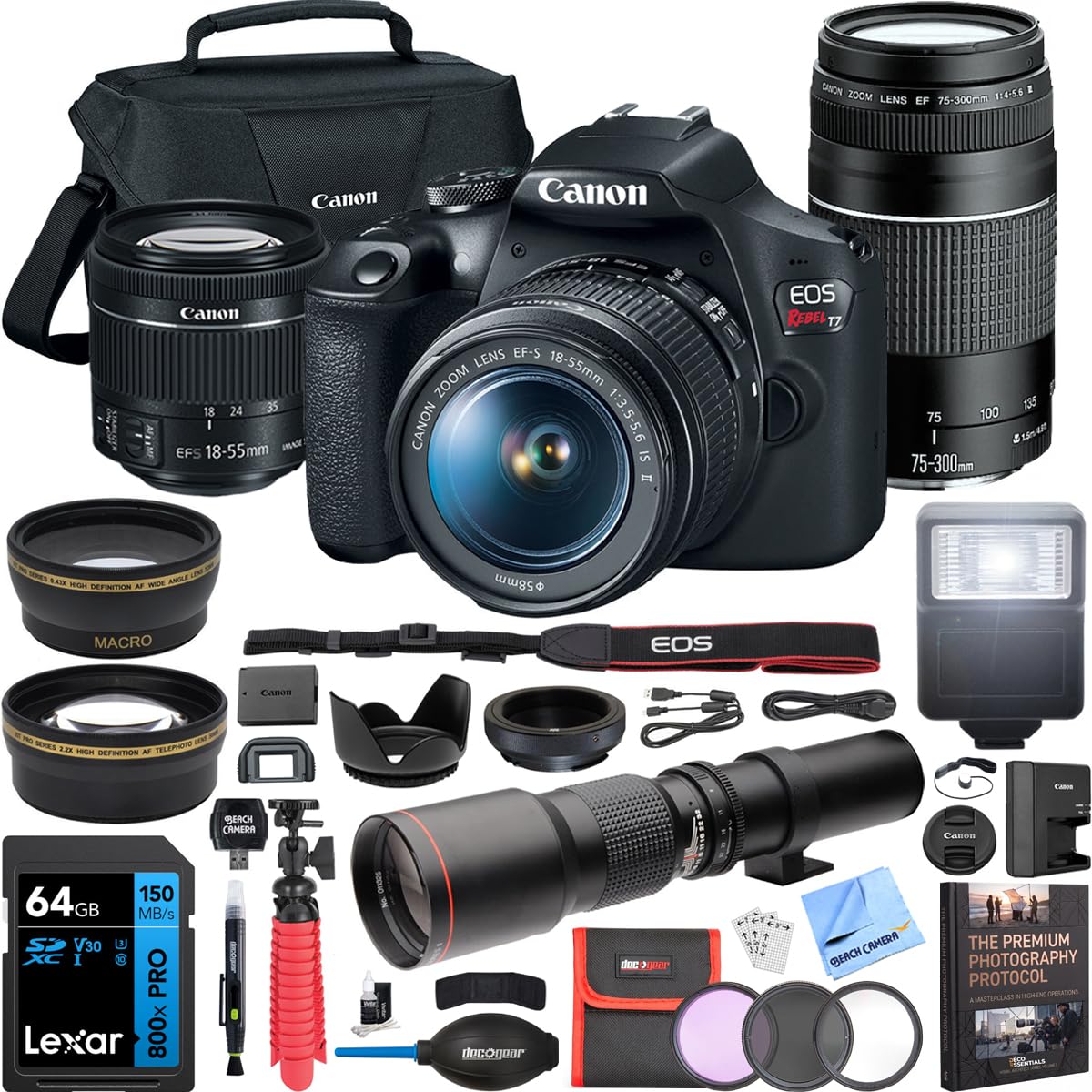
The Canon EOS Rebel T7 is a DSLR with a 24.1MP APS-C sensor and DIGIC 4+ processor, offering Full HD 1080p video recording at 30fps. This bundle throws in a comprehensive set of accessories: a 500mm preset telephoto lens, wide-angle and 2.2x telephoto converters, flash, tripod, filters, and a 64GB memory card. For the beginner on a tight budget, this is a single-package solution for learning both stills and video.
The 9-point AF system with AI Servo AF is functional for stationary subjects but struggles with fast-moving targets. The optical viewfinder has 95% coverage, which is adequate for framing. Built-in Wi-Fi and NFC allow remote shooting and wireless transfer. The bundle accessories, while useful for learning, are budget-tier and will limit image quality at the extremes.
Video resolution is capped at 1080p — no 4K — which is a significant limitation for modern content. Battery drain is reported to be faster than expected, with some users noting low charge after short use. The Rebel T7 is a solid starting point for someone who wants to experiment with different lens types and accessories without a large initial investment.
Why it’s great
- Massive accessory bundle for exploring various photography styles
- Simple interface for absolute beginners
- Wi-Fi and NFC for remote control and sharing
Good to know
- No 4K video recording — limited to Full HD
- Accessories are budget-quality
- Battery drains much faster than expected
11. Panasonic Lumix FZ80D Point and Shoot with 60x Zoom

The Panasonic Lumix FZ80D is a bridge camera with a fixed 60x optical zoom lens covering an equivalent of 20-1200mm. It records 4K video using the 4K Photo and Post Focus features, allowing you to extract 8MP stills or refocus after capture. The 2.36M-dot Large LVF (0.74x equivalent) provides a clear electronic viewfinder even in bright sunlight.
The POWER O.I.S. (Optical Image Stabilizer) effectively suppresses hand-shake vibration at the telephoto end, making handheld long-distance video feasible. The 39-point contrast-detect autofocus is reasonably fast in good light. The built-in flash and hot shoe provide basic lighting options. The camera is lightweight and compact enough to carry on day hikes.
Low-light performance is this camera’s weakest point — images become grainy even at modest ISO values. The interface is not the most intuitive, with some settings buried in menus. Battery life is average, and it drains faster when using the zoom motor. The FZ80D is a niche product for travelers and nature observers who need extreme reach in a compact, affordable body and accept the image quality trade-offs.
Why it’s great
- 60x optical zoom covers wide to supertelephoto
- 4K Photo Post Focus for reframing after capture
- POWER O.I.S. stabilizes telephoto video
Good to know
- Poor low-light performance; grainy at high ISO
- Contrast-detect AF struggles in dim lighting
- Battery life drains quickly with active zoom use
FAQ
Is a full-frame camera always better for video than an APS-C camera?
What does a camera’s bit depth mean for my video editing workflow?
Why do cinema cameras like the Blackmagic Pocket series lack continuous autofocus?
Final Thoughts: The Verdict
For most users, the best camera for video recording winner is the Sony a7 III because it combines full-frame dynamic range, reliable phase-detect autofocus, and exceptional battery life at a price that undercuts dedicated cinema bodies. If you want a powerful cinema camera with internal ND filters and 12-bit color, grab the Blackmagic Pocket Cinema Camera 6K Pro. And for action sports and all-weather shooting, nothing beats the DJI Osmo Action 5 Pro with its 13.5-stop dynamic range and 12-hour battery pack.

Mo Maruf
I created WellFizz to bridge the gap between vague wellness advice and actionable solutions. My mission is simple: to decode the research and give you practical tools you can actually use.
Beyond the data, I am a passionate traveler. I believe that stepping away from the screen to explore new environments is essential for mental clarity and physical vitality.