Our readers keep the lights on and my smoothie glass nicely filled. As an Amazon Associate, I earn from qualifying purchases.
A 32-inch 4K monitor is the single most impactful upgrade you can make to your workspace or gaming rig, but the range in quality between a entry-level panel and a QD-OLED is massive. The wrong choice means settling for washed-out color, stiff 60Hz motion, or a panel that fails within a year. This guide cuts through the marketing to find the real contenders.
I’m Mohammad Maruf — the founder and writer behind WellFizz. Over the last decade, I’ve analyzed thousands of monitor specs and real-user durability reports to separate engineered reliability from spec-sheet hype.
After comparing refresh rates, color gamuts, black levels, panel technologies, and connectivity from eleven of the top models on the market, the findings are clear. This is the complete breakdown of where to spend and where to save when shopping for the best 32 inch 4k monitor.
How To Choose The Best 32 Inch 4K Monitor
Picking the right 32-inch 4K monitor requires you to match the panel’s core strengths to your primary workload. A graphic designer’s needs are completely different from a competitive FPS gamer’s. You need to prioritize color depth and sRGB coverage if you edit photos, but refresh rate and response time if you play fast-paced shooters.
Panel Technology: The Foundation of Image Quality
Three panel types dominate the 32-inch 4K space. IPS panels offer the best color accuracy and wide viewing angles at moderate prices — ideal for professional color work. VA panels deliver deeper native contrast (3000:1 or higher) for richer blacks, making them great for movies and general use. QD-OLED panels provide infinite contrast ratios, perfect blacks, and blazing-fast response times, but they come with a premium price tag and require careful burn-in management over several years of use.
Refresh Rate and Response Time: Motion Clarity Matters
A standard 60Hz refresh rate is perfectly adequate for office productivity, spreadsheets, and casual browsing. But if you play any competitive or fast-moving games, a 120Hz or 240Hz panel becomes dramatically smoother. The jump from 60Hz to 120Hz halves motion blur. For gamers, a response time under 5ms (GtG) is mandatory, and premium OLEDs achieve 0.03ms — virtually instant pixel transitions that eliminate ghosting.
HDR, Color Gamut, and Brightness
True HDR requires a panel that can hit at least 600 nits peak brightness and maintain a high contrast ratio. Many budget monitors advertise HDR10 compatibility but lack the luminance to deliver a convincing experience. For color-critical work, look for 95% DCI-P3 coverage or higher. A Delta E rating below 2 ensures factory calibration is accurate enough for professional use without a separate calibrator.
Quick Comparison
On smaller screens, swipe sideways to see the full table.
| Model | Category | Best For | Key Spec | Amazon |
|---|---|---|---|---|
| ASUS ROG Swift PG32UCDM | QD-OLED | Enthusiast Gaming & Cinema | QD-OLED, 240Hz, 0.03ms | Amazon |
| LG 32GX870A-B UltraGear | OLED | Dual-Mode Gaming | W-OLED, 4K 240Hz / FHD 480Hz | Amazon |
| MSI MPG 321URX QD-OLED | QD-OLED | Competitive & Creative Hybrid | QD-OLED, 240Hz, True Black 400 | Amazon |
| ASUS ROG Strix XG32UCG | Fast IPS | High-FPS Gaming | Fast IPS, Dual Mode, 0.3ms | Amazon |
| Dell UltraSharp U3223QE | IPS | Professional Color Work | IPS Black, 100% sRGB, USB-C Hub | Amazon |
| LG 32UN650-W | IPS | General Productivity & Photo Editing | IPS, DCI-P3 95%, Height Adjust | Amazon |
| Samsung Smart Monitor M7 (M70F) | VA | All-in-One Streaming & Work | VA, Smart TV Apps, USB-C | Amazon |
| Dell S3225QS | VA | Home Office & Casual Gaming | VA, 4K 120Hz, FreeSync Premium | Amazon |
| CRUA Curved 4K 240Hz | VA | Budget Immersive Gaming | VA 1500R, 240Hz, FreeSync | Amazon |
| ViewSonic VX3276-4K-MHD | MVA | Budget Office & Media | MVA, 4K 60Hz, Thin Bezels | Amazon |
In‑Depth Reviews
1. ASUS ROG Swift PG32UCDM

The ASUS PG32UCDM is a reference-grade QD-OLED monitor that sets the standard for what a 32-inch 4K display should be. The quantum dot OLED panel delivers infinite contrast, with blacks that are truly black and highlights that hit 1000 nits peak brightness. The 240Hz refresh rate paired with a 0.03ms GtG response time makes motion clarity flawless in any game.
Color performance is equally staggering, covering 99% of the DCI-P3 gamut with a Delta E of less than 2 out of the box. This means you can do professional photo or video editing without needing a separate calibration tool. The 90W USB-C port powers a laptop while sending video, and the custom heatsink and graphene film minimize burn-in risk over years of daily use.
The glossy screen finish delivers exceptional clarity and pop, though some users may notice reflections in brightly lit rooms. The three-year warranty with burn-in coverage provides serious peace of mind for the investment. This is a no-compromise panel for anyone who needs the absolute best balance of gaming speed and color-critical accuracy.
Why it’s great
- Infinite contrast ratio with perfect black levels
- Exceptional 99% DCI-P3 color gamut with factory Delta E < 2
- 240Hz and 0.03ms response time for elite motion handling
- Three-year warranty includes burn-in coverage
Good to know
- Glossy screen can show reflections in bright rooms
- Premium pricing puts it out of reach for budget buyers
- Requires pixel refresh maintenance to prevent long-term burn-in
2. LG 32GX870A-B UltraGear
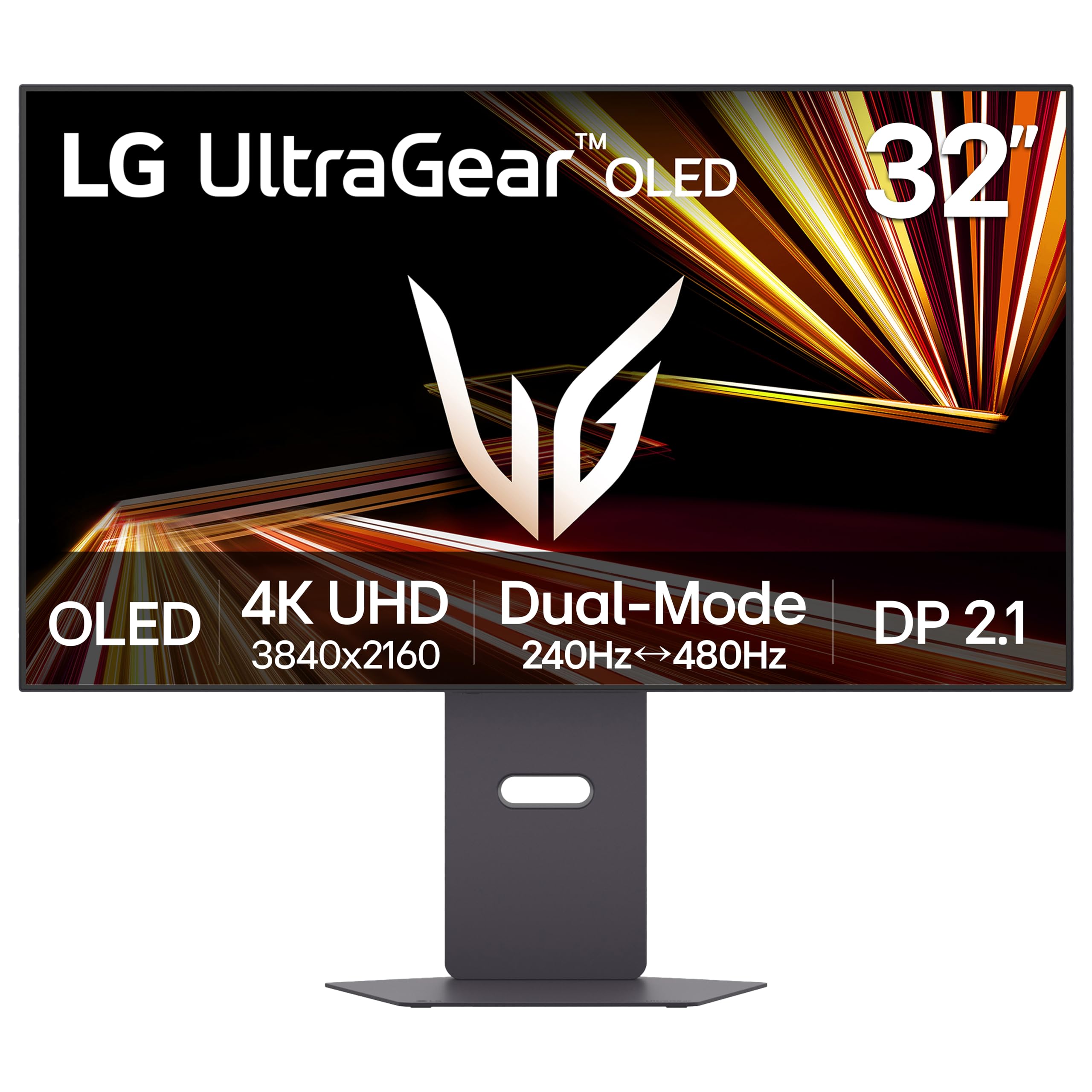
The LG 32GX870A-B uses a W-OLED panel with Micro Lens Array+ technology to push peak brightness up to 1300 nits, making it the brightest OLED in this list. Its standout feature is the Dual Mode functionality — one button switch between 4K at 240Hz for story-driven titles and Full HD at 480Hz for ultra-competitive racing or FPS games.
The 0.03ms response time virtually eliminates motion blur and ghosting. It is NVIDIA G-SYNC Compatible and AMD FreeSync Premium Pro certified, ensuring tear-free gameplay across both GPU ecosystems. The anti-glare/low-reflection coating reduces ambient light distractions better than the glossy QD-OLED competitors.
Built-in speakers are surprisingly robust with deeper bass than typical monitor audio, and the DTS Headphone:X support enhances positional audio for competitive shooters. Some users report a mild grainy texture on static white backgrounds due to the matte coating, and text clarity suffers slightly from the non-RGB subpixel layout. For a pure dual-purpose gaming machine, this OLED is hard to beat.
Why it’s great
- Dual Mode offers 4K 240Hz or FHD 480Hz flexibility
- Peak brightness of 1300 nits for intense HDR
- Excellent anti-glare coating reduces reflections
- Powerful built-in speakers
Good to know
- Matte coating can appear grainy on static white pages
- Text clarity is not as sharp as IPS or QD-OLED competitors
- VRR flicker can occur during severe frame-rate stutters
3. MSI MPG 321URX QD-OLED

The MSI MPG 321URX brings QD-OLED performance to a slightly more accessible price point than the ASUS competitor, while retaining the same core panel technology. With 99% DCI-P3 coverage, a 240Hz refresh rate, and a 0.03ms response time, it delivers identical pixel speed and color vibrancy for gaming and creative work.
VESA DisplayHDR True Black 400 certification ensures that dark scenes in games and movies have exceptional depth without crushed shadows. The KVM function with PiP/PbP makes it easy to control a work PC and a gaming system from a single keyboard and mouse setup. The HDMI 2.1 ports support full 4K 240Hz on modern consoles without compression.
QS users report that the QD-OLED’s anti-reflective coating can produce a noticeable purple tint under direct ambient light. The stand is functional but does not offer the same premium feel as the ROG Swift’s build. Still, for buyers who want OLED-grade image quality without paying the absolute top dollar, this MSI is the prime pick.
Why it’s great
- QD-OLED panel with infinite contrast and 99% DCI-P3
- True Black 400 HDR for excellent dark scene details
- Built-in KVM for dual-computer setups
- Full 4K 240Hz over HDMI 2.1
Good to know
- Purple tint visible on screen in bright rooms
- Stand feels less premium than the ROG Swift
- Mac dual-monitor requires DSC workaround
4. ASUS ROG Strix XG32UCG
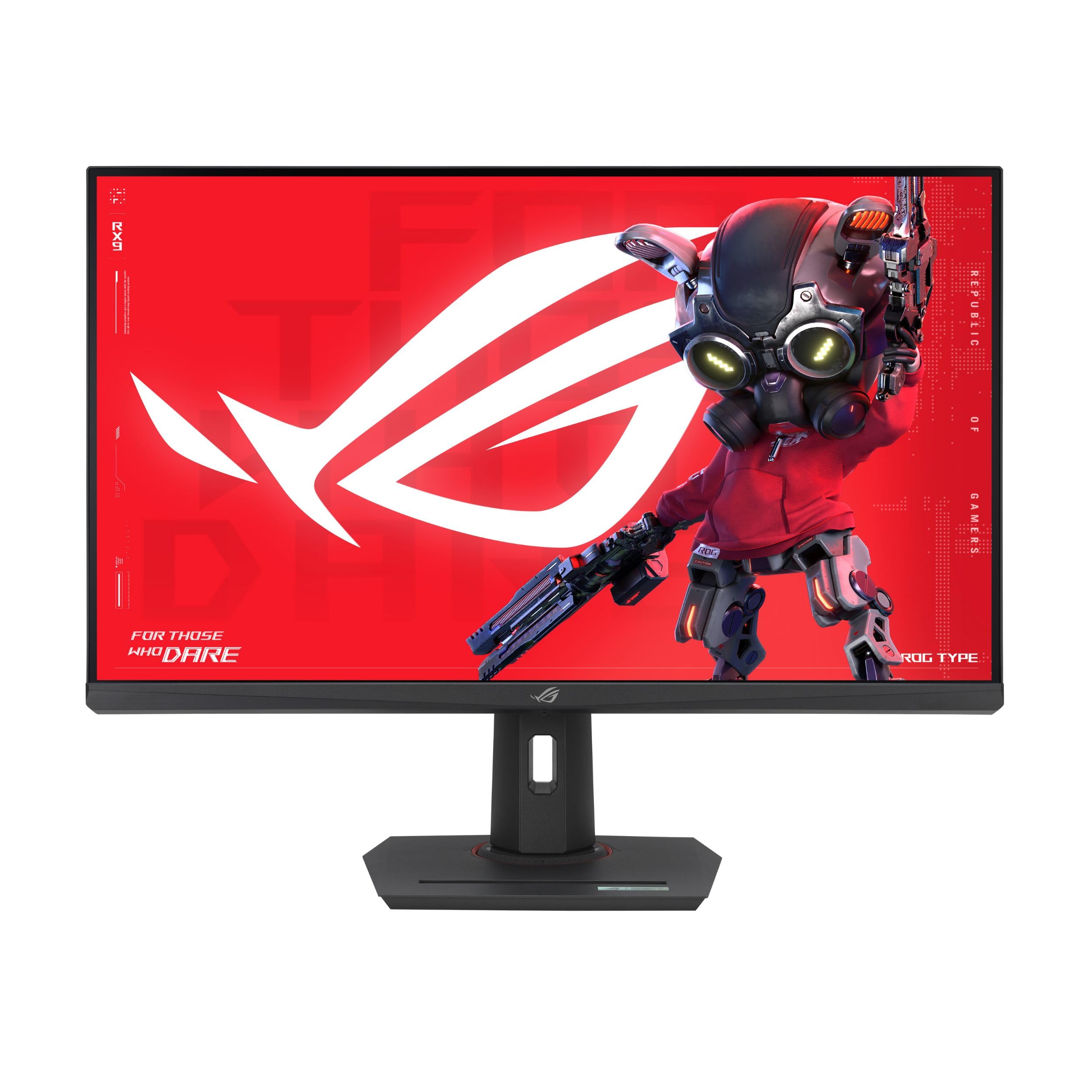
The ASUS ROG Strix XG32UCG uses a Fast IPS panel to achieve a 0.3ms response time and a unique Dual Mode that operates at 4K 160Hz or drops to Full HD 320Hz for competitive play. This makes it an excellent bridge between high-resolution immersion and esports speed — all without switching to OLED.
Color coverage hits 95% DCI-P3, and the Extreme Low Motion Blur Sync (ELMB SYNC) technology works simultaneously with variable refresh rate to eliminate both ghosting and tearing. The USB-C port with DisplayPort Alt Mode supports a clutter-free single-cable laptop connection, and the DisplayWidget Center software allows mouse-based OSD adjustments.
The semi-gloss screen finish gives images a punchy, vivid look that many prefer over matte panels. Dynamic contrast ratio is rated at 100,000,000:1, but static contrast at 1000:1 is typical IPS territory — black levels are not as deep as VA or OLED. For gamers prioritizing motion clarity and high frame rates over perfect blacks, this is a well-priced premium option.
Why it’s great
- Fast IPS with 0.3ms response and Dual Mode up to 320Hz
- ELMB SYNC works with VRR for tear-and-ghost-free visuals
- Semi-gloss screen delivers vibrant, punchy colors
- USB-C with DP Alt Mode for single-cable laptops
Good to know
- Static contrast of 1000:1 limits black depth
- No built-in KVM
- Premium price for an IPS panel
5. Dell UltraSharp U3223QE

The Dell UltraSharp U3223QE is built for the professional who needs color accuracy above all else. Its IPS Black technology achieves a 2000:1 contrast ratio — double that of standard IPS panels — delivering deeper blacks while maintaining the wide viewing angles essential for collaborative workspace reviews.
Factory calibration covers 100% sRGB and a wide Delta E of less than 2 ensures out-of-box accuracy for photo editing, design, and spreadsheets. The built-in USB-C hub provides 90W power delivery, Ethernet, and multiple USB-A ports, transforming the monitor into a true docking station that keeps your desk clean.
At a 60Hz refresh rate, this is not a gaming monitor. The hardware is optimized for static image clarity and flicker-free long sessions. Some users note that the USB-C cable included in the box is short, and there are no built-in speakers or microphone. For color-critical workflows where every shade matters, this Dell is a staple.
Why it’s great
- IPS Black panel delivers 2000:1 contrast for deep blacks
- 100% sRGB coverage with factory Delta E < 2
- Integrated USB-C hub with 90W charging, Ethernet, and USB-A
- Eye-care engineering reduces strain over long sessions
Good to know
- Limited to 60Hz refresh rate
- No built-in speakers or microphone
- USB-C cable is shorter than ideal for desk setups
6. LG 32UN650-W

The LG 32UN650-W offers the best balance of color performance and price in the mid-range category. The IPS panel covers 95% of the DCI-P3 gamut, making it a reliable choice for photo editing, video color grading, and casual creative work. Users consistently report that after a simple Spyder calibration, the color accuracy rivals monitors costing significantly more.
The three-side virtually borderless design and height-adjustable stand make it a clean fit in any dual-monitor office setup. AMD FreeSync compatibility smooths out casual gaming, though the 60Hz refresh rate means you won’t want it for competitive shooters. The single joystick control is intuitive, and the on-screen menu is responsive.
The monitor lacks USB ports and built-in speakers are minimal at best — you will need a separate peripheral hub and audio solution. The non-standard power cord is annoyingly short. Despite these omissions, the core panel quality is genuinely impressive for the price, making this an easy recommendation for the budget-conscious creative professional.
Why it’s great
- 95% DCI-P3 color gamut at a moderate price
- Virtually borderless design with height-adjustable stand
- Calibrates well with Spyder for professional use
- Solid all-rounder for productivity and light gaming
Good to know
- No USB ports or built-in hub
- Speakers are very weak
- Non-standard power cord is short
7. Samsung Smart Monitor M7 (M70F)
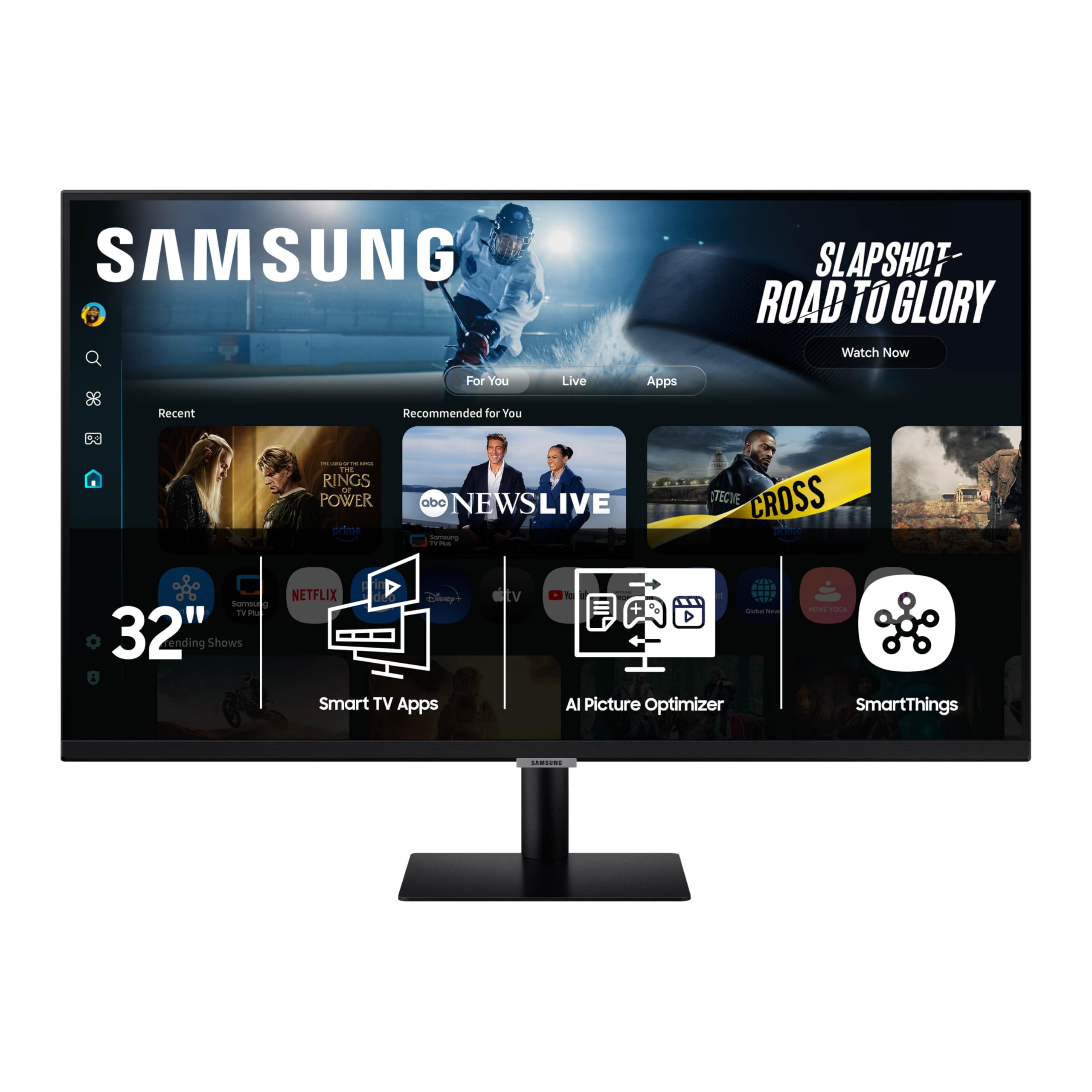
The Samsung M70F Smart Monitor is a unique hybrid that combines a 4K VA panel with full Smart TV functionality. You can stream Netflix, YouTube, and Samsung TV Plus directly on the monitor without connecting a PC. Samsung Vision AI powers features like AI Picture Optimizer that adjusts visuals for different tasks and Active Voice Amplifier that raises dialogue volume in noisy rooms.
The VA panel achieves a native 3000:1 contrast ratio, delivering noticeably deeper blacks than IPS monitors in the same price range. USB-C connectivity with 65W power delivery makes it a true single-cable solution for modern laptops. The solar-charging remote control is an eco-friendly touch that users genuinely appreciate.
The 60Hz refresh rate and the smart processing introduce enough input lag that serious gamers should look elsewhere. Some units have reported intermittent sound issues and settings that change randomly, though these seem to be isolated production variability. For users who want a monitor that doubles as a living room TV, this Samsung is a clever and space-saving choice.
Why it’s great
- Built-in Smart TV apps and Samsung Gaming Hub
- VA panel with 3000:1 contrast ratio for deep blacks
- USB-C with 65W power delivery
- Solar-charging remote included
Good to know
- 60Hz refresh rate limits gaming performance
- Smart TV input lag is higher than dedicated monitors
- Some units exhibit random settings or sound issues
8. Dell S3225QS

The Dell S3225QS upgrades the classic Dell 32-inch 4K formula by adding a 120Hz refresh rate, making it much smoother than a standard 60Hz office monitor while retaining excellent color accuracy. The VA panel delivers a 1500:1 contrast ratio and covers 99% sRGB with 95% DCI-P3, providing vibrant but natural colors suitable for photo editing and media consumption.
ComfortView Plus reduces harmful blue light emissions to 35% or less without washing out colors, making it an excellent choice for all-day work. AMD FreeSync Premium support means variable refresh rate is smooth and tear-free during light gaming sessions on PC or console. The improved speaker system has more output power and deeper frequency response than previous Dell monitor audio.
The ash white finish and ultra-thin bezels give it a clean, modern look, though the stand only offers tilt adjustment — no height or swivel. The HDMI cable included is short at 1.8 meters. For a home office monitor that doubles as a light gaming display, this is arguably Dell’s best value proposition in the 32-inch space.
Why it’s great
- 120Hz refresh rate and FreeSync Premium for smooth motion
- ComfortView Plus reduces blue light without color shift
- 95% DCI-P3 and 99% sRGB coverage
- Better built-in speakers than previous Dell monitors
Good to know
- Stand only tilts — no height or swivel adjustment
- Short HDMI cable included
- VA viewing angle is narrower than IPS
9. CRUA 32″ Curved 4K 240Hz
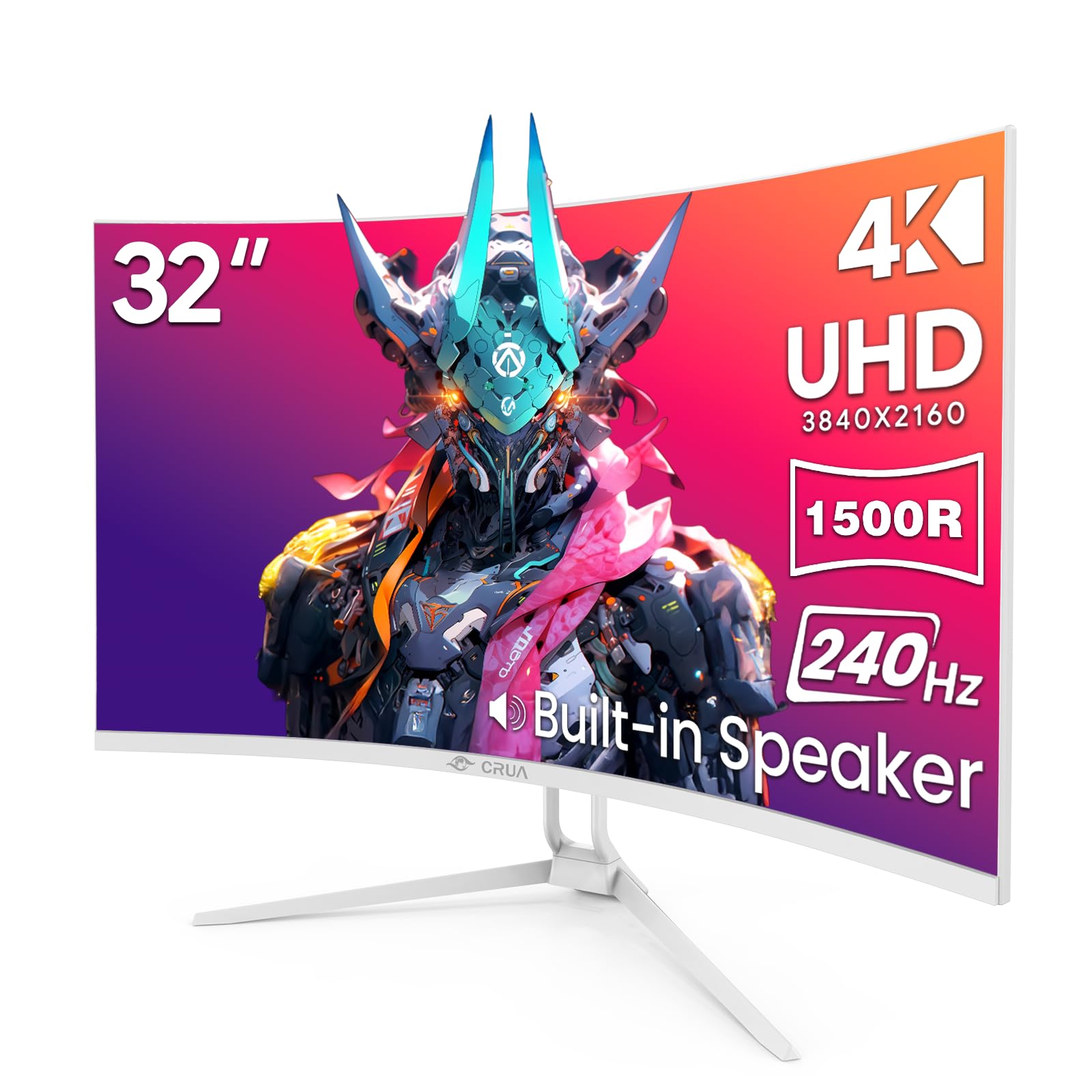
The CRUA 32-inch Curved monitor brings a 1500R VA panel with a 240Hz refresh rate and 4K resolution to a price point that undercuts most high-refresh competitors by a wide margin. The 3000:1 contrast ratio provides solid black levels, and the 120% sRGB color gamut delivers saturated, punchy visuals out of the box.
AMD FreeSync support and a 1ms MPRT response time help reduce tearing and motion blur in fast-paced games. The white finish and RGB backlighting fit well in light-colored or cozy gaming setups. HDMI 2.1 and DP 1.4 ports allow full 4K 240Hz bandwidth from modern GPUs and consoles.
The build quality reflects its budget-friendly positioning — the stand only offers tilt adjustment, and some users report the on-screen menu system is confusing without a remote. The built-in speakers are weak despite the visible grilles, so plan to use dedicated headphones or external desktop speakers. For buyers on a strict budget who prioritize a high refresh rate over build refinement, this CRUA delivers the essential performance numbers.
Why it’s great
- 240Hz 4K at a very accessible price point
- 1500R VA curve with 3000:1 contrast ratio
- Supports HDMI 2.1 for full 4K 240Hz bandwidth
- White finish and RGB lighting for aesthetic setups
Good to know
- Stand lacks height and swivel adjustment
- On-screen menu is difficult to navigate
- Built-in speakers are very weak
10. ViewSonic VX3276-4K-MHD
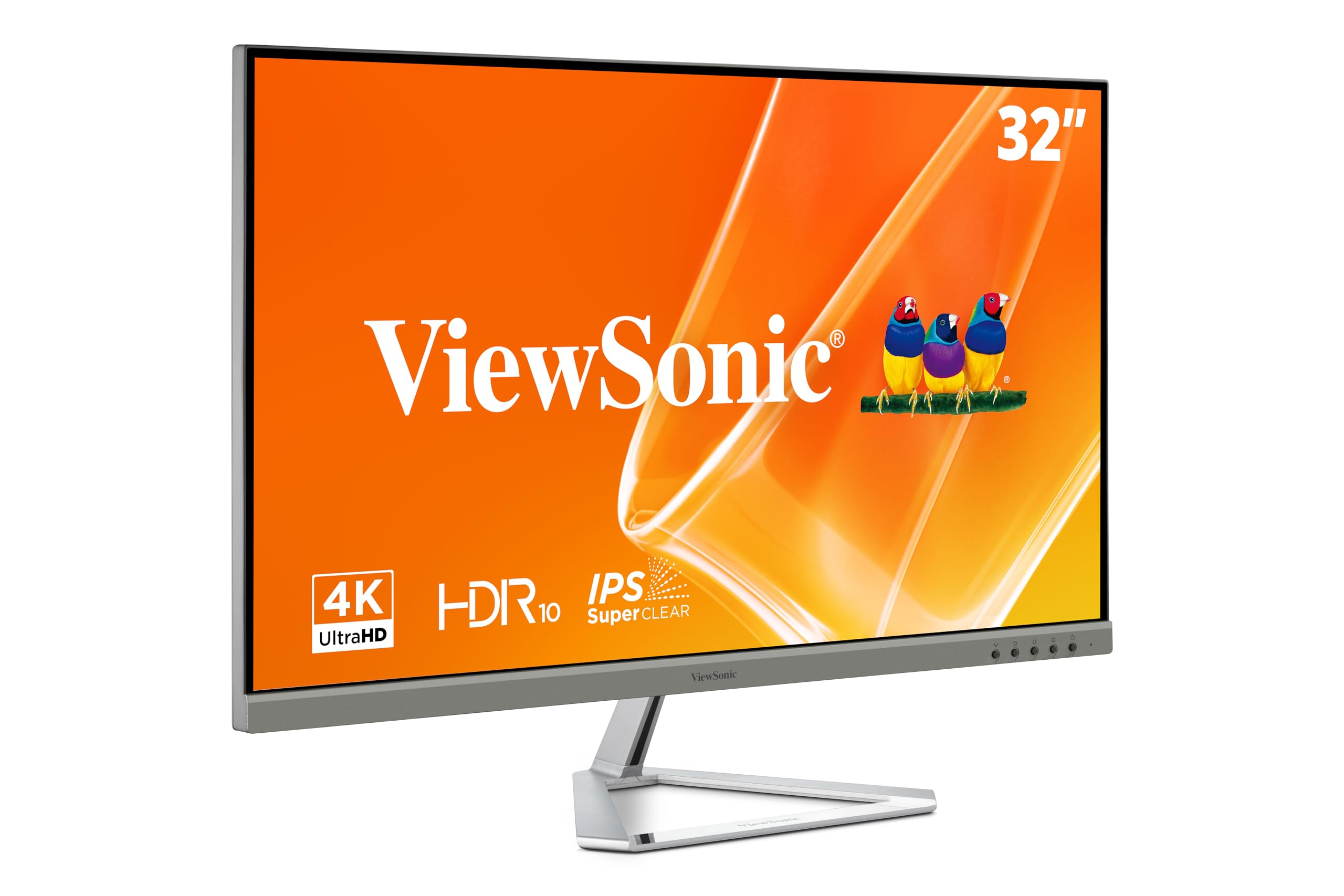
The ViewSonic VX3276-4K-MHD is the entry-level standard for anyone who needs a large 4K screen for office work, web browsing, and media consumption without spending extra. The MVA panel delivers a 2500:1 contrast ratio — better than standard IPS — providing decent black levels for movie watching and text readability.
Flicker-Free technology and a Blue Light Filter reduce eye strain during long work sessions, and the four preset view settings (Game, Movie, Web, Text) make it easy to switch between tasks. The connectivity suite is generous for a budget monitor, with two HDMI ports, DisplayPort, Mini DisplayPort, and audio out. The brushed metal frame and ultra-thin bezels give it a surprisingly premium look on the desk.
The 60Hz refresh rate and the VA panel’s narrower viewing angles mean this is not suitable for gaming or collaborative color work. Some users report that the rear button placement makes menu navigation frustrating, and a small number have experienced vertical lines appearing after extended use. As a pure productivity screen on a tight budget, it performs its core job admirably.
Why it’s great
- Excellent value for a 32-inch 4K productivity screen
- MVA panel with 2500:1 contrast for deep blacks
- Multiple inputs including Mini DisplayPort
- Thin bezels and brushed metal design look premium
Good to know
- 60Hz refresh rate limits gaming potential
- Buttons on the back are difficult to use by feel
- Some units develop vertical lines over time
FAQ
Is a 32-inch 4K monitor too big for desk use?
Can I run a 32-inch 4K monitor at 240Hz with any graphics card?
What is the difference between HDR10 and DisplayHDR True Black 400?
Does a higher color gamut percentage matter for office use?
Final Thoughts: The Verdict
For most users, the best 32 inch 4k monitor winner is the ASUS ROG Swift PG32UCDM because it combines QD-OLED contrast, 240Hz speed, and Delta E < 2 color accuracy in a single panel that handles both high-end gaming and professional creative work without compromise. If you want a KVM and slightly lower cost with the same QD-OLED core, grab the MSI MPG 321URX. And for pure professional color work with a built-in USB-C hub, nothing beats the Dell UltraSharp U3223QE.

Mo Maruf
I created WellFizz to bridge the gap between vague wellness advice and actionable solutions. My mission is simple: to decode the research and give you practical tools you can actually use.
Beyond the data, I am a passionate traveler. I believe that stepping away from the screen to explore new environments is essential for mental clarity and physical vitality.