Our readers keep the lights on and my smoothie glass nicely filled. As an Amazon Associate, I earn from qualifying purchases.
Bagworms are the silent assassins of arborvitae, juniper, and spruce — by the time you spot the brown spindle-shaped cases hanging from branches, the needles have already been stripped bare, often too late to save the tree without aggressive chemical intervention. The active ingredient that reliably halts this feeding frenzy is Bacillus thuringiensis (B.t.), a biological bacterium that paralyzes the caterpillar’s gut within hours of ingestion, stopping damage cold.
I’m Mohammad Maruf — the founder and writer behind WellFizz. For the past several seasons, I have analyzed concentrate-to-water ratios, UV degradation windows, and application timing data across multiple bagworm-targeted insecticides to identify which formulations deliver the fastest knockdown for homeowners fighting defoliation.
This guide breaks down the five most effective bagworm killers based on real field reports and technical specs. If your evergreens are showing the first signs of bagworm damage — browned tips, sparse foliage near the crown — you need the best bagworm insecticide that stops chewing before the tree loses structural integrity.
How To Choose The Best Bagworm Insecticide
Bagworms are not a single species — the term covers several case-bearing moth larvae (Thyridopteryx ephemeraeformis being the most common in North America). The spray must hit the caterpillar during its feeding stage (late spring to early summer) when the bag is still less than half an inch long. Choosing the wrong active ingredient or the wrong formulation for your tree count wastes both money and the narrow treatment window.
Active Ingredient: B.t. vs. Spinosad
Bacillus thuringiensis (B.t. kurstaki) is a stomach poison specific to caterpillars — it is harmless to mammals, birds, and adult bees once dry. Spinosad, derived from a soil bacterium, works on contact and ingestion and is slightly broader-spectrum (it also hits thrips, leafminers, and beetles). For pure bagworm targeting, B.t. is the safer ecological choice; for mixed infestations that include tent caterpillars and armyworms, spinosad gives one-pass coverage.
Formulation: Powder, Hose-End Concentrate, or Ready-to-Spray
Dry powder (like Dipel Pro DF) stores indefinitely and requires a separate sprayer — best for owners of many trees who mix on demand. Hose-end concentrates (like Summit Caterpillar Control) attach directly to your garden hose, ideal for scattered ornamental beds without buying a tank sprayer. Ready-to-spray bottles (like ferti-lome Spinosad RTS) are the most convenient for a single heavy infestation but cost more per application.
UV Breakdown Window
Every biological bagworm spray degrades under direct sunlight within 3 to 4 days. You must respray after rain and every 5–7 days during the hatching period. Products with no residual activity (all B.t. formulations) demand stricter scheduling than spinosad, which has slight residual contact activity on foliage for up to a week.
Quick Comparison
On smaller screens, swipe sideways to see the full table.
| Model | Category | Best For | Key Spec | Amazon |
|---|---|---|---|---|
| Monterey B.t. 8 oz | B.t. Oil Concentrate | Edible gardens & small ornamental trees | 8 oz concentrate, OMRI Listed | Amazon |
| Summit Caterpillar & Webworm Control | B.t. Hose-End | Large landscapes with scattered trees | 32 oz concentrate, hose-end dial | Amazon |
| Valent USA Dipel Pro DF | B.t. Dry Powder | Large properties with 50+ trees | 1 lb bag, 54% B.t. concentrate | Amazon |
| Ferti-lome Spinosad RTS 32 oz | Spinosad Ready-to-Spray | Mixed bagworm & tent caterpillar outbreaks | 32 oz RTS, spinosad contact + ingestion | Amazon |
| Ferti-lome Spinosad RTS Quart | Spinosad Ready-to-Use | Single large bushes & immediate knockdown | 1 quart RTS, no mixing required | Amazon |
In‑Depth Reviews
1. Monterrey B.t. Bundled with Measuring Spoon — 8 oz
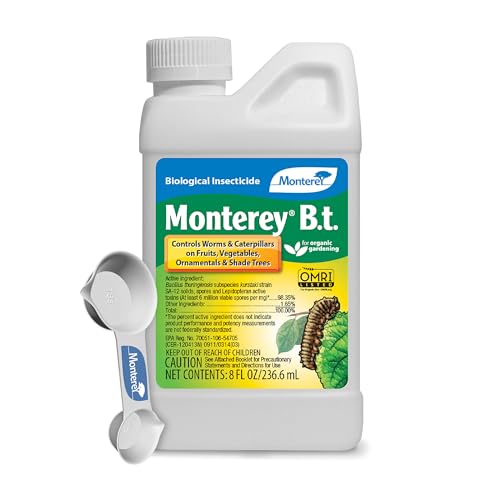
Monterey B.t. arrives as an 8-ounce oil-based concentrate that mixes instantly with water and targets the narrowest possible range — caterpillars and worm-stage insects, including bagworms, cabbage loopers, gypsy moths, and cankerworms. The included measuring spoon eliminates guesswork, which matters because B.t. overdilution is the most common reason bagworm sprays fail on arborvitae.
Customer reports confirm that loopers stopped feeding on flower seedlings within 24 hours, and Texas laurel trees shed their bagworm population after a single thorough application. The OMRI listing means this formulation passes the USDA National Organic Program standards, so you can spray it directly onto broccoli, tomatoes, and melon vines up to the day of harvest without worrying about chemical residue.
The 8-ounce bottle yields roughly 16 gallons of finished spray (at the standard ½ oz per gallon rate), which covers about 8 to 10 medium arborvitae trees per application. The oil carrier helps the B.t. stick to waxy evergreen needles longer than water-only dilutions, a meaningful edge when fighting bagworms on juniper and spruce.
Why it’s great
- OMRI Listed for organic gardens — safe on edibles up to harvest day
- Oil concentrate adheres better to waxy evergreen foliage
- Bundled measuring spoon ensures accurate mixing ratio
Good to know
- Small 8 oz bottle requires multiple purchases for large tree stands
- B.t. breaks down in sunlight within 3–4 days; strict respray schedule needed
2. Summit Caterpillar and Webworm Control — Hose End, 1 Qt Concentrate

Summit’s 1-quart hose-end concentrate solves the labor problem of bagworm control — instead of mixing buckets and loading a tank sprayer, you screw the bottle onto your garden hose, twist the dial to the dilution ratio, and spray the canopy directly. The quart bottle at the “2 oz per gallon” dial setting covers roughly 500 to 600 square feet of foliage, enough for a row of mature arborvitae or a cluster of spruce.
Real-world users report that this formulation eliminated gypsy moth caterpillars after two seasons of strategic spraying during the critical late-instar window, and one verified reviewer said bagworms on arborvitae stopped damaging trees within 7–10 days of the first application. The negative is the smell — one reviewer described it as “horrible” — though the product claims non-toxicity to birds and other wildlife.
The 32-ounce container holds significantly more active concentrate than the Monterey 8 oz bottle, making Summit the smarter choice for larger properties or recurring weekly sprays across multiple tree species. Because it uses B.t. as the active ingredient, it shares the same UV vulnerability — plan a Saturday-morning spray schedule every 5–7 days throughout the bagworm hatching window in June and July.
Why it’s great
- Hose-end sprayer eliminates mixing and tank cleaning
- 32 oz concentrate covers large landscapes cost-effectively
- Safe on vegetables up to day of harvest per user reports
Good to know
- Strong odor during spraying, though it dissipates after drying
- B.t. efficacy drops sharply if rain occurs within 24 hours
3. Valent USA Dipel Pro DF Biological Insecticide BT 54% — 1 lb Bag

Dipel Pro DF is a professional-grade dry flowable powder with 54% B.t. kurstaki — nearly three times the active concentration of typical home-garden B.t. liquids. One pound of this powder mixes into roughly 50 to 80 gallons of finished spray (depending on target pest rate), making it the most economical choice for anyone managing hundreds of trees or an acre of colecrops.
A verified reviewer who owns “hundreds of cedar trees” sprays Dipel Pro DF every summer and reports that bagworms vanish, keeping the trees healthy year after year. Another customer uses it on an acre of colecrops to control cabbage loopers, noting that buying it in bulk is far cheaper than repeatedly purchasing small liquid bottles from the farm store.
The dry flowable formulation stores for multiple seasons without degradation, unlike liquid concentrates that can settle or spoil. However, Dipel requires a dedicated sprayer (backpack, pump, or hose-end tank) and careful measurement — the powder must be stirred into water until fully suspended, and you need to use the entire tank within a few hours because the B.t. spores begin germinating in the water.
Why it’s great
- 54% B.t. concentration — lowest cost per gallon of active spray
- Dry powder stores for years without potency loss
- OMRI Listed with no pre-harvest interval on vegetables
Good to know
- Requires a separate sprayer — not for grab-and-go use
- Must respray every 3–4 days due to UV breakdown
4. Fertilome Spinosad Insecticide Ready to Spray — 32 oz
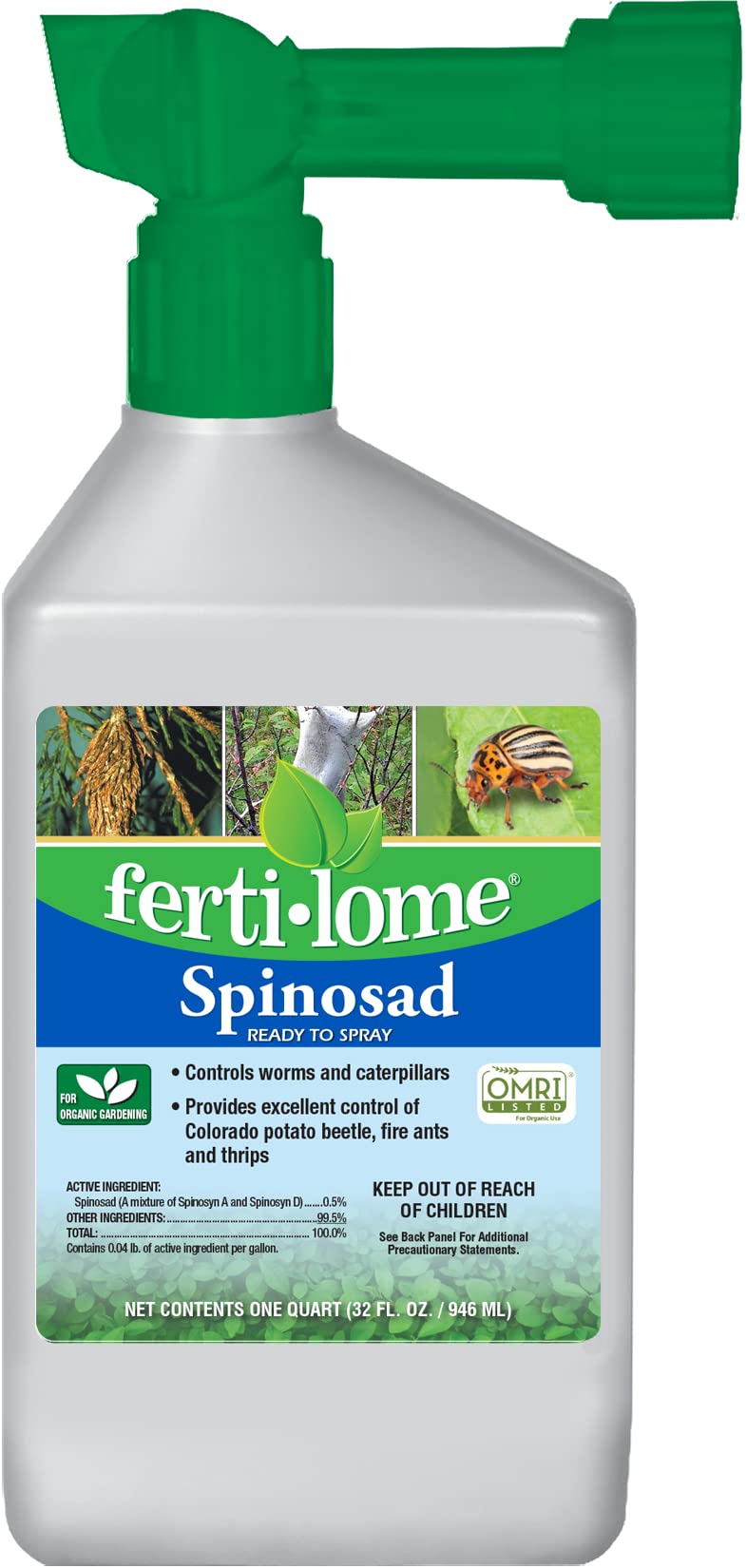
This ferti-lome spinosad formulation comes ready to spray — simply attach your garden hose to the bottle and pull the trigger. Unlike B.t., which only works if the caterpillar ingests the spray, spinosad kills on contact and through ingestion, which gives it an edge against larger bagworms that may have already sealed their cases shut.
Users report that this product effectively wiped out bagworms on spruce trees after a single season, and one customer fighting boxwood moths (a close ecological relative of bagworms) called it “the only product I’m aware of” that eliminates them. The 32-ounce bottle covers roughly 1,000 square feet of ornamental foliage, making it mid-range in coverage but high in convenience.
The OMRI listing confirms it qualifies for organic production, though spinosad is slightly harder on beneficial insects (including some predatory beetles and parasitic wasps) than B.t. Use this product when you need a one-shot knockdown against a severe mixed infestation — bagworms plus tent caterpillars plus armyworms — where B.t.’s narrow specificity falls short.
Why it’s great
- Contact + ingestion activity works on larger bagworms
- No mixing, no measuring — hose-end ready
- Controls broader pest range beyond bagworms
Good to know
- Harsher on beneficial insects than B.t.
- More expensive per application than B.t. concentrates
5. Fertilome Spinosad Bagworm, Tent Caterpillar and Chewing Insect Control, RTS Quart

This quart-sized ready-to-spray bottle is the most convenient option for a homeowner facing a single heavily infested arborvitae or juniper. The spray connects directly to your hose and requires zero dilution math — just set the nozzle, squeeze, and coat the foliage until it drips. One reviewer reported that all bagworms on an evergreen died overnight, saving the tree from losing any more branches.
While the spinosad active ingredient provides fast contact kill, another customer noted that a single treatment did not completely eradicate bagworms from two large bushes — a second application with a B.t.-based product (thuringiensis) was required for full control. This aligns with the technical limitation: spinosad works best on young actively feeding larvae; established bagworms with thick silk cases may survive the initial spray.
At a quart size, this bottle covers roughly one to two large bushes per application. For a yard with multiple arborvitae, the 32-ounce ferti-lome RTS (Product 4) offers better value. Use the quart for surgical strikes — a single cedar, a prized boxwood, or a couple of fruit trees where you want to see results by morning.
Why it’s great
- Overnight knockdown on young bagworms
- Zero mixing — hose-ready in seconds
- Also kills armyworms, sod webworms, and tent caterpillars
Good to know
- Single quart may not fully cover large shrubs
- Established bagworms with thick cases may survive and need follow-up spraying
FAQ
When is the best time to spray bagworm insecticide?
How often do I need to respray bagworm B.t. products?
Are bagworm insecticides safe for vegetable gardens?
Final Thoughts: The Verdict
For most homeowners, the best bagworm insecticide winner is the Monterey B.t. 8 oz because it pairs OMRI-listed organic safety with an oil-based carrier that sticks to waxy evergreen needles and includes a measuring spoon for foolproof mixing. If you cover a larger landscape with scattered trees, grab the Summit Caterpillar and Webworm Control hose-end quart for effortless foliar coverage. And for immediate overnight knockdown against a severe mixed infestation (bagworms plus armyworms), nothing beats the Ferti-lome Spinosad RTS Quart.

Mo Maruf
I created WellFizz to bridge the gap between vague wellness advice and actionable solutions. My mission is simple: to decode the research and give you practical tools you can actually use.
Beyond the data, I am a passionate traveler. I believe that stepping away from the screen to explore new environments is essential for mental clarity and physical vitality.