Our readers keep the lights on and my smoothie glass nicely filled. As an Amazon Associate, I earn from qualifying purchases.
Finding an in-ear monitor that delivers studio-grade clarity without draining your wallet is the central challenge for any musician, audiophile, or serious listener. The market is flooded with bloated bass and muddy mids, forcing you to sift through driver configurations and tuning curves to find a pair that actually reveals the nuances in your mix.
I’m Mohammad Maruf — the founder and writer behind WellFizz. I’ve spent years analyzing the interplay between driver topology, acoustic chamber design, and frequency response graphs to separate genuinely engineered IEMs from marketing-heavy shells.
This guide cuts through the noise to pinpoint the models that deliver real harmonic separation, controlled treble extension, and a soundstage that lets you hear individual instrument layers. Whether you’re tracking vocals on stage or analyzing your favorite album, this list of the best affordable iem options will steer you toward the right pair for your ears.
How To Choose The Best Affordable IEM
Selecting the right budget-friendly IEM requires understanding three interconnected pillars: driver configuration, tunability, and physical ergonomics. Ignoring any one of these can result in a pair that sounds impressive on paper but fatiguing in practice.
Driver Architecture: Single Dynamic vs. Hybrid vs. Multi-BA
Single dynamic driver (1DD) designs offer cohesive, natural sound with excellent bass impact—ideal for genres like jazz, acoustic, and vocal-centric music. Hybrid configurations combine dynamic drivers for low-end punch with balanced armatures (BAs) or planar drivers for detailed mids and highs; they deliver wider soundstage and better instrument separation but require careful crossover tuning. All-balanced-armature (multi-BA) IEMs provide lightning-fast transient response and high clarity, though they can sound thin in the bass without a dedicated low-frequency BA. For most listeners under a premium threshold, a well-tuned single DD or a 1DD+ hybrid provides the best balance of coherence and detail.
Fit, Seal, and Isolation
A proper in-ear seal is non-negotiable. Even the best driver array will sound thin and tinny if the ear tips fail to create an airtight seal. Look for IEMs that ship with multiple silicone and foam tip sizes. Over-ear cable routing with preformed earhooks improves stability for active use, while housings with ergonomic contours reduce ear fatigue during hour-long listening sessions. Disposable foam tips often offer the best isolation for noisy environments like commute or live stage monitoring.
Cable Quality and Detachability
A detachable cable using a standard connector (0.78mm 2-pin or MMCX) is a must-have for any IEM you plan to rely on long term. It allows easy replacement if the cable frays and lets you upgrade to a balanced cable for better channel separation with compatible DACs. Pay attention to cable material: silver-plated copper reduces signal loss at high frequencies, while oxygen-free copper (OFC) delivers warmer, more relaxed sound.
Quick Comparison
On smaller screens, swipe sideways to see the full table.
| Model | Category | Best For | Key Spec | Amazon |
|---|---|---|---|---|
| Linsoul Kiwi Ears Cadenza II | Single DD | Reference Tuning, All-Day Listening | Titanium-coated PET diaphragm / 10–29 kHz | Amazon |
| TRUTHEAR x Crinacle Zero: BLUE2 | Dual DD | Gaming & Critical Listening | Dual-cavity internal magnetic circuit / 20Hz–41kHz | Amazon |
| CCA C12 | Hybrid (5BA+1DD) | Musicians, High Detail Retrieval | 5 balanced armatures + 1 dynamic driver | Amazon |
| Linsoul SIMGOT EW300 | Hybrid (1DD+1Planar+1PZT) | Versatile Tuning, Gaming | 1DD + 1 Planar + 1 PZT per side | Amazon |
| KZ AS10 | Multi-BA (5BA) | Instrument Separation & Vocals | 5 balanced armature drivers | Amazon |
| Vibes 202 Wired Earbuds | Single DD | Budget Entry, Commuting | 1-Tesla dynamic driver / 8–23k Hz | Amazon |
| SENNHEISER IE 100 PRO | Single DD Pro | Professional Stage Monitoring | 10mm dynamic broadband transducer | Amazon |
In‑Depth Reviews
1. Linsoul Kiwi Ears Cadenza II
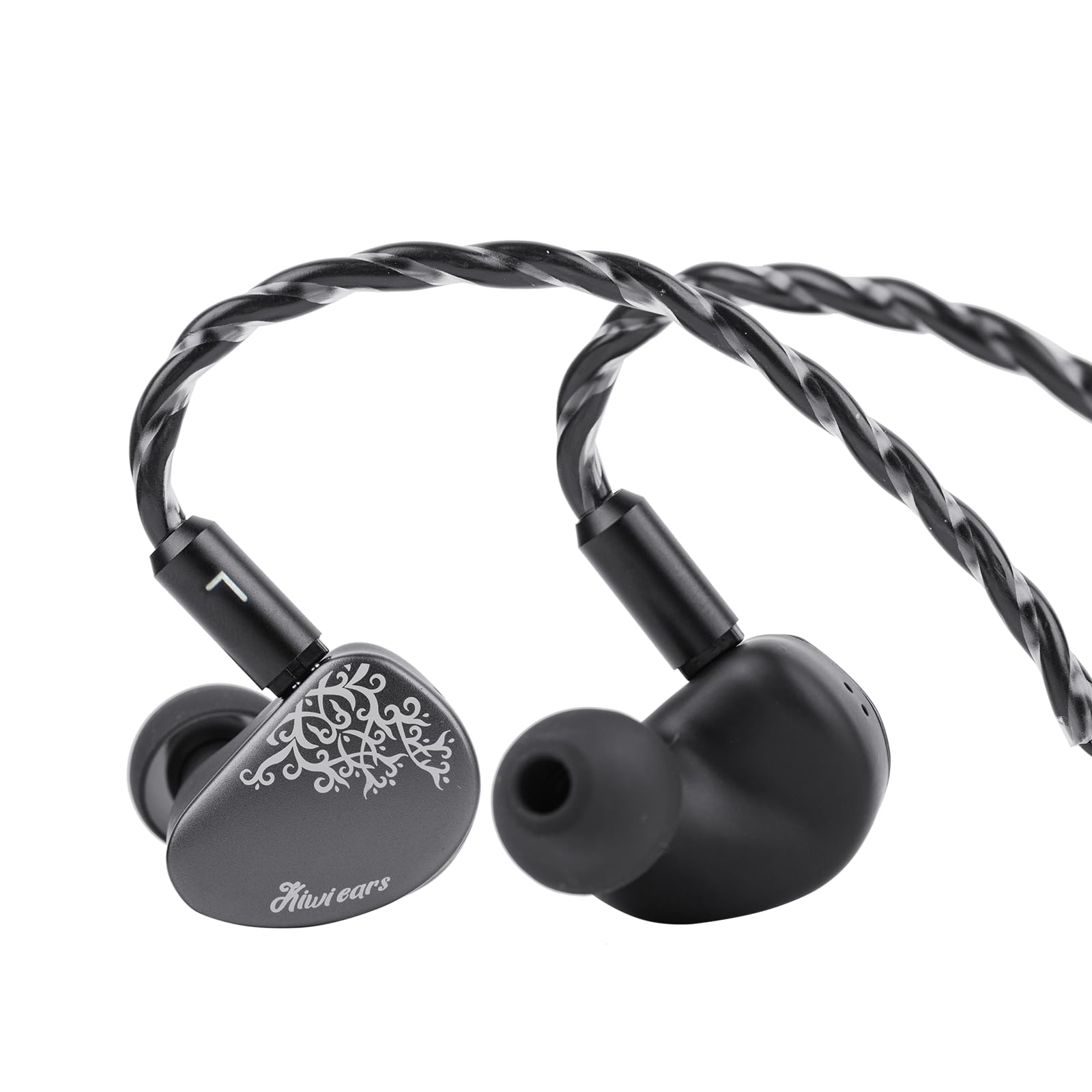
The Cadenza II represents the current benchmark for single-dynamic-driver tuning at a mid-range price. Its titanium-coated PET diaphragm, paired with the redesigned KARS 2.0 (Kiwi Acoustic Resonance System), delivers an 8dB sub-bass boost that cuts off cleanly at 200Hz—preventing midrange bleed. The result is a low end with subwoofer-like physicality that never clouds vocal fundamentals or lower treble energy.
The midrange features a delicate 300–400Hz bump that adds warmth to male and female vocals without making them sound boxy. Treble extends smoothly to 29kHz with a carefully placed peak at 3kHz, ensuring cymbal crashes and string harmonics have air and shimmer without becoming strident. The polycarbonate composite shell feels dense but lightweight, and the CNC-machined aluminum faceplate adds a precise, non-slip texture for gripping during insertion.
Bass extension and decay are controlled with exceptional discipline for a single-DD design—kick drums have snap, not boom. Stock cables are single-crystal oxygen-free copper, which offers low noise floor and natural timbre. If you want a single IEM that doubles as both a mixing reference and a casual listening tool, the Cadenza II is the most coherent choice in this lineup.
Why it’s great
- Sub-bass hits 8dB with zero midrange bleed
- Polycarbonate composite shell is durable and velvet-textured
- Best-in-class stock oxygen-free copper cable
Good to know
- No L/R markings on earpieces; requires visual orientation
- Silicone tips not pre-installed—requires initial setup effort
2. TRUTHEAR x Crinacle Zero: BLUE2

The Zero:BLUE2 is a dual-dynamic-driver IEM with an unusual architecture: a 10mm solid silica gel suspension composite liquid crystal dome with an N52 magnet handles low frequencies, while a dedicated 7.8mm polyurethane suspension LCP dome with an N55 magnet covers mids and highs. This dual-cavity internal magnetic circuit design reduces inter-driver modulation distortion, giving the BLUE2 a cleaner upper register than most dual-DD competitors.
The tuning is V-shaped with a warm bass shelf, slightly recessed lower mids, and a forward treble that remains non-sibilant—a tricky balance. Imaging and separation are excellent for the tier, making it a strong candidate for competitive gaming where footstep localization matters. The DLP-3D printed cavity and silicone capping technique, typically reserved for custom molds, ensures a consistent internal volume that contributes to its stable phase response across the frequency range.
One trade-off is the bulkier housing profile: the spout length can create pressure points for smaller ears. Cable adjustment is also required at the earhooks for a secure fit. Paired with a proper DAC, the BLUE2 reveals recording nuances that cheaper IEMs gloss over, and its 41kHz upper limit supports high-resolution audio streams without roll-off.
Why it’s great
- Dual-cavity DD design minimizes inter-driver distortion
- Warm V-shape tuning with non-sibilant treble—ideal for gaming
- DLP-3D printed cavity for consistent acoustic performance
Good to know
- Bulky housing may cause ear fatigue over long sessions
- Memory foam eartips are fragile and may need replacement quickly
3. CCA C12

The CCA C12 packs five balanced armatures and one dynamic driver per side—six drivers total—into a zinc alloy and resin shell that feels substantially heavier than budget plastic IEMs. The BA array handles mid and high frequencies with the transient speed you expect from armatures, while the dynamic driver delivers a bass foundation that avoids the lean, anemic low end that plagues pure-BA monitors. The overall timbre is warm-toned with high resolution, especially in the upper midrange where vocal harmonics and string overtones resolve clearly.
Stage performance from the C12 is where it shines: reviewers report using it to replace Shure SE215s and even + custom monitors on stage, citing its ability to bypass feedback loops and deliver articulate monitoring in loud environments. The stock 8-strand low-impedance cable is adequate, though the lack of a sliding chin cinch can feel unfinished for active performers. Achieving the proper seal is critical with this model—stock silicone tips may not suit all ear canals, and switching to foam tips dramatically improves bass extension and isolation.
Imaging precision is strong for gaming as well, making it a versatile hybrid for anyone who needs one IEM for both rehearsal and daily commute. The protective slot design on the shell extends the lifespan of the MMCX connectors, a common failure point on cheaper hybrids.
Why it’s great
- Six-driver hybrid (5BA+1DD) delivers exceptional detail retrieval
- Zinc alloy shell with slot protection extends connector lifespan
- Warm, non-fatiguing tuning that outperforms pricier stage monitors
Good to know
- Seal is critical—stock tips may not fit all ear anatomies
- Cable lacks a sliding chin cinch for stage use
4. Linsoul SIMGOT EW300

The SIMGOT EW300 uses a triple-hybrid configuration—one dynamic driver, one planar magnetic driver, and one piezoelectric ceramic (PZT) driver—to cover the full frequency spectrum through three distinct transduction mechanisms. This is rare at any price point, and the challenge lies in phase alignment. SIMGOT addressed this with a tri-matrix acoustic architecture that spatially separates the three drivers within the housing to minimize interference. The PZT driver handles super-high-frequency extension, giving the EW300 an airy, open top end that single-planar designs often lack.
Interchangeable nozzles offer two distinct tunings: a gold-copper nozzle with purple silicone ring tuned to the H-2019 target curve for gaming accuracy, and a stock nozzle aligned with the SIMGOT-Golden2023 curve for musical listening. The gold nozzle emphasizes midrange clarity and positional audio cues—footsteps and gunshots are distinctly layered—while the stock nozzle provides a warmer, more U-shaped signature with deeper bass presence. A 50-hour burn-in period is reported by some users to smooth out initial PZT harshness.
The all-metal housing, CNC-machined from high-density alloy with a mirror-plating finish, is exceptionally robust but adds noticeable weight. One durability concern: the threaded nozzle attachment ring may discolor silicone ear tips over time, and replacement nozzles are not sold separately. For users who want one IEM that adapts to both analytical gaming and relaxed music listening, the EW300’s tunable nozzles deliver genuine versatility.
Why it’s great
- Triple-hybrid (DD+Planar+PZT) provides unique high-frequency air
- Interchangeable nozzles offer two distinct, verified target curves
- CNC alloy housing is premium-grade and durable
Good to know
- PZT driver may sound tizzy before burn-in (approx. 50 hours)
- Nozzle threads are not user-replaceable; silicone tips can stain
5. SENNHEISER IE 100 PRO
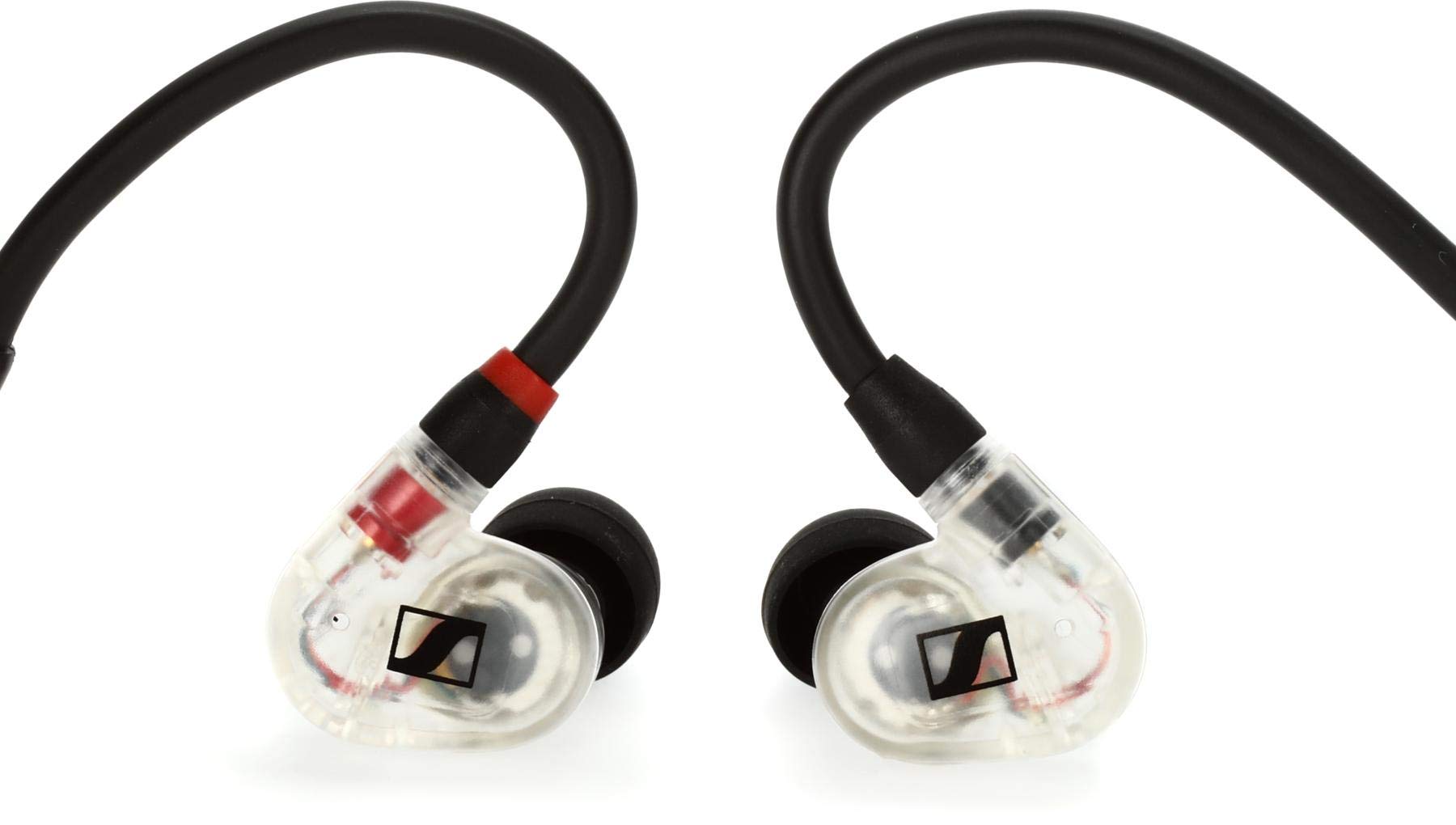
Sennheiser’s IE 100 PRO is built around a single 10mm dynamic broadband transducer designed for low-distortion, high-SPL monitoring. The transducer reproduces a flat-ish curve with a treble boost that helps vocalists and instrumentalists hear presence frequencies clearly on stage. The housing is slim and lightweight, prioritizing comfort for multi-hour sets—the single-driver architecture allows a smaller shell than multi-BA competitors. The internal cable duct routes the wire away from the ear, reducing microphonic noise that can be distracting during silent passages.
The stock cable is detachable but uses Sennheiser’s proprietary MMCX connectors, so third-party replacement options are more limited than standard 0.78mm 2-pin systems. Reviewers note that the treble emphasis can cause sibilance on “S” and “T” consonants for some listeners, meaning this IEM is better suited for instrumental monitoring or bass/vocal mixing rather than critical listening for treble-sensitive ears. The foam inside the nozzle is a critical tuning element—removing it dramatically alters the frequency response toward a thin, unbalanced sound.
Isolation is excellent with the provided foam tips, making it a reliable choice for loud stage environments. The carrying case includes a cleaning tool and multiple tip sizes, though the overall accessory set is minimal compared to the competition. For a stage-first professional who values comfort and vocal presence above wide soundstage, the IE 100 PRO delivers predictable, repeatable performance.
Why it’s great
- Proprietary 10mm transducer with low distortion for stage use
- Compact, lightweight shell designed for all-day wear
- Internal cable duct reduces microphonic handling noise
Good to know
- Treble boost can create sibilance on vocal sibilants
- Proprietary MMCX connector limits aftermarket cable options
6. KZ AS10

The KZ AS10 uses five balanced armature drivers per side—including one dedicated large low-frequency BA—to produce a sound signature that defies the typical “BA bass is weak” stereotype. The low-end BA driver is ported to add texture and weight, giving kick drums a tactile presence that approaches dynamic driver response. The mid and high arrays use two BA units for mids and two for highs, with one mid-high hybrid driver that smooths the crossover region. This configuration yields excellent instrument separation for pop, EDM, and classical genres.
The housing is clear polycarbonate, lightweight and durable, but the pre-formed silicone earhook on the stock cable is directional and may not conform naturally to both ears—left-right fit can be asymmetrical. Switching to foam tips is nearly mandatory for achieving proper seal and maximizing bass extension; with the stock silicone tips, the bass can sound recessed. The U-shaped tuning places mids slightly laid back, which works well for live vocal monitoring but may feel recessed for listeners who prefer forward vocals in casual listening.
Soundstage width is above average for a pure-BA IEM, with good depth layering that lets you pinpoint instrument positions in a mix. The AS10 remains a strong value for anyone seeking high transient speed and clarity in the mid-to-treble range, provided you’re willing to invest in aftermarket tips.
Why it’s great
- Five BA drivers deliver fast transient response and clear highs
- Dedicated low-frequency BA provides better bass weight than pure-BA peers
- U-shaped tuning offers wide soundstage for complex mixes
Good to know
- Stock earhooks may not fit both ears symmetrically
- Foam tips are strongly recommended to achieve proper seal and bass extension
7. Vibes 202 Wired Earbuds

The Vibes 202 uses a single 1-Tesla dynamic driver housed in a semi-transparent resin shell with MMCX connectors, offering an entry point into HiFi IEMs without the complexity of multi-driver hybrids. Frequency response spans 8 Hz to 23 kHz, with a noticeable bass boost centered around 50 Hz that makes kick drums and synth bass lines prominent—ideal for genres like EDM, hip-hop, and pop. The silver-plated Litz-braided cable reduces signal loss and tangling, and the MMCX connector allows future cable upgrades without replacing the entire unit.
Comfort is a strong point: the ergonomic over-ear fit with pre-formed earhooks stays secure during activities like gym sessions or motorcycle riding, and the included six pairs of silicone tips (two colors, three sizes) accommodate most ear canal shapes. The seal provided by the right tip size effectively isolates wind noise for outdoor use, making it functional for commuting. However, the bass-forward tuning means lower-midrange clarity can feel slightly masked on complex rock or orchestral tracks—acoustic guitar fundamentals and cello textures may lack definition.
The rigid carrying case with a carabiner adds portability, and the visual design is available in ten colors, which is unusual at this tier. For a first IEM purchase or a backup pair for on-the-go listening, the Vibes 202 delivers solid build quality and a fun, energetic sound signature.
Why it’s great
- 1-Tesla dynamic driver produces deep, punchy bass for EDM and hip-hop
- MMCX detachable cable allows future upgrades
- Ergonomic fit with six ear tip pairs for outdoor/gym use
Good to know
- Bass boost can mask lower-midrange detail on complex tracks
- Cable length may be excessive for portable use without a cinch
FAQ
Do I need a separate DAC to drive budget IEMs well?
What is the practical difference between silicone and foam ear tips?
Can I use an IEM with more drivers for better gaming performance?
Final Thoughts: The Verdict
For most users, the best affordable iem winner is the Linsoul Kiwi Ears Cadenza II because it delivers near-reference tuning with a single dynamic driver that outperforms many hybrids in coherence and vocal realism. If you want the precision of multi-driver detail retrieval for stage use, grab the CCA C12. And for a durable, tunable option that adapts between gaming and music sessions, nothing beats the SIMGOT EW300.

Mo Maruf
I created WellFizz to bridge the gap between vague wellness advice and actionable solutions. My mission is simple: to decode the research and give you practical tools you can actually use.
Beyond the data, I am a passionate traveler. I believe that stepping away from the screen to explore new environments is essential for mental clarity and physical vitality.