Our readers keep the lights on and my smoothie glass nicely filled. As an Amazon Associate, I earn from qualifying purchases.
Every ounce in your pack demands justification, and a dead phone at mile twelve is the price of choosing a power bank that looked fine on paper but fails when the trees swallow the sun. The market is flooded with smooth marketing and plastic bricks that promise capacity but deliver weight. Real backpacking requires a power bank that balances raw milliamp-hours against packability, recharge speed against ruggedness, and safety certifications against real-world trail utility.
I’m Mohammad Maruf — the founder and writer behind WellFizz. I’ve analyzed the internal cells, discharge curves, and safety circuit designs of over forty portable power stations to find the units that actually survive a weekend in the backcountry without adding unnecessary bulk to your load.
Whether you need to keep your phone alive for navigation, your headlamp lit for midnight camp chores, or your camera charged for sunrise shots, finding the right backpacking power bank comes down to understanding real capacity, true weight, and the charging protocols that matter when you are miles from the nearest outlet.
How To Choose The Best Backpacking Power Bank
A power bank for the trail is a different breed from the one you leave on your nightstand. Capacity, weight, charging speed, and durability all trade off against each other. Here is what to focus on when every gram counts.
Real Capacity vs. Advertised Milliamp-Hours
Manufacturers quote the raw cell capacity, but your phone sees about 60 to 70 percent of that after voltage conversion and internal losses. A 20,000mAh unit typically delivers around 13,000 to 14,000mAh to your devices. Look for power banks that list a rated or typical output capacity, and always under-buy by about 30 percent when estimating how many full charges you will get.
Weight and Packability Per Charge
Backpacking is a game of grams. A dense lithium-polymer cell pack can hold 20,000mAh in a sub-11-ounce frame, while some budget units use older lithium-ion cells that weigh nearly double for the same capacity. Check the item weight before buying — a difference of four ounces might not sound like much, but it adds up across a twenty-mile day.
Charging Speed and Protocols
USB-C Power Delivery and Qualcomm Quick Charge are the two main fast-charging standards. For iPhone users, 20W PD is the floor for meaningful speed. Android flagships benefit from 25W to 45W PD. If you plan to top off a power bank itself from a solar panel or a wall outlet at a resupply point, the input speed matters just as much — look for at least 18W input via USB-C.
Port Versatility and Cable Management
Built-in cables save you from fishing through your pack for a cord, but they also mean the cable length is fixed and the gauge may be thinner than a standalone cable. Units with a detachable lanyard-style USB-C cable offer the best of both worlds. At minimum, ensure you have at least one USB-C input/output and one USB-A output to handle different device connectors.
Quick Comparison
On smaller screens, swipe sideways to see the full table.
| Model | Category | Best For | Key Spec | Amazon |
|---|---|---|---|---|
| INIU P24 (45W GaN) | Hybrid | Ultralight multi-day trips | 10,000mAh / 8.1 oz | Amazon |
| INIU Green 20000mAh | Compact | Balanced capacity and weight | 20,000mAh / 11.1 oz | Amazon |
| Orfeika K26F | All-in-One | Group trips and cable-free charging | 20,000mAh / 0.73 lb | Amazon |
| YBYP 50000mAh | High-Capacity | Extended basecamp or car camping | 50,000mAh / 0.75 lb | Amazon |
| Easesolo CA5-6 | Max Capacity | Week-long expeditions without access to power | 60,000mAh / 1.54 lb | Amazon |
In‑Depth Reviews
1. INIU P24 (45W GaN)
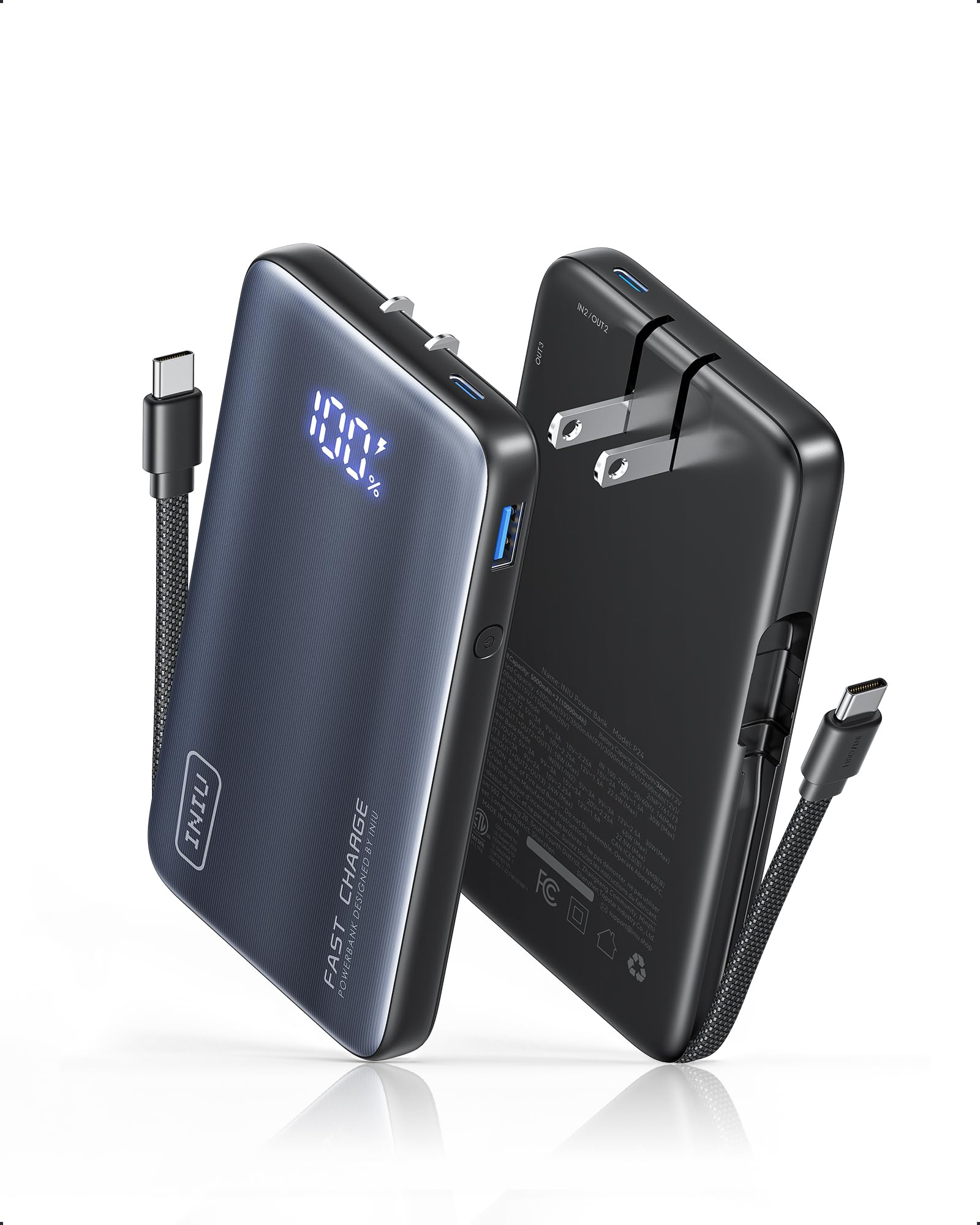
This unit redefines what a backpacking power bank can be by merging a wall charger and a battery pack into a single 8.1-ounce frame. The GaN IV chip delivers 45W of output in power bank mode, enough to push an iPhone 17 Pro Max from 20 to 78 percent in thirty minutes. At just 0.55 inches thick, it slides into a hip belt pocket without creating a bulge.
The built-in foldable AC plug means you can recharge the power bank directly from a wall outlet at a hostel or café without carrying a separate charging brick and cable. The integrated USB-C cable tucks away cleanly and serves as your primary charge line, reducing cord clutter in your pack. Pass-through charging lets you power devices while the bank itself charges, a feature that saves hours at a resupply stop.
Capacity is limited to 10,000mAh — roughly two full phone charges — which is ideal for weekend trips or ultralight setups. The lithium-polymer cells keep the weight low and the form factor slim, and the smart LED display shows exact remaining charge so there are no surprises on the trail. The 3-year warranty backs a build quality that feels substantially denser than typical budget bricks.
Why it’s great
- Ultra-slim profile at 0.55 inches slides into any pocket
- 45W GaN output provides laptop-class charging speed
- Integrated wall plug eliminates need for a separate charger and cable
- Pass-through charging allows concurrent recharge and device power
Good to know
- 10,000mAh capacity may not suffice for trips longer than two to three days
- Built-in cable is short and fixed length, limiting placement options
2. INIU Green 20000mAh

This is the sweet spot for backpackers who want four full phone charges without carrying a half-pound brick. At 313 grams, the INIU Green packs 20,000mAh into a dense lithium-polymer frame that measures 2.8 by 4.1 by 1.2 inches — small enough to cup in your palm. The 22.5W PD output pushes an iPhone 16 to 60 percent in 25 minutes, which is competitive for its weight class.
The detachable nylon lanyard doubles as a USB-C cable, so you never have to dig for a cord at camp. You simply clip the lanyard to your pack strap and have constant access. The smart digital display shows remaining percentage in clear digits, and the flashlight has been tested as genuinely useful for midnight tent trips or rummaging through your pack after dark.
TSA approval is a bonus for air travel to distant trailheads, and the 3-year hassle-free replacement policy shows confidence in the SafeCharge circuitry. Thermal sensors actively manage heat dissipation during fast charging, which keeps both the battery and your device from getting uncomfortably warm. For the weight-to-capacity ratio, this unit is the most practical all-arounder on the list.
Why it’s great
- Dense 20,000mAh capacity in a highly portable 11-ounce package
- Detachable lanyard cable simplifies trail use and cord management
- Clear percentage display removes guesswork for trip planning
- Built-in flashlight provides reliable low-light utility
Good to know
- 22.5W shared output slows when multiple ports are active
- Some users note the unit feels denser than expected, not heavier
3. Orfeika 20000mAh K26F
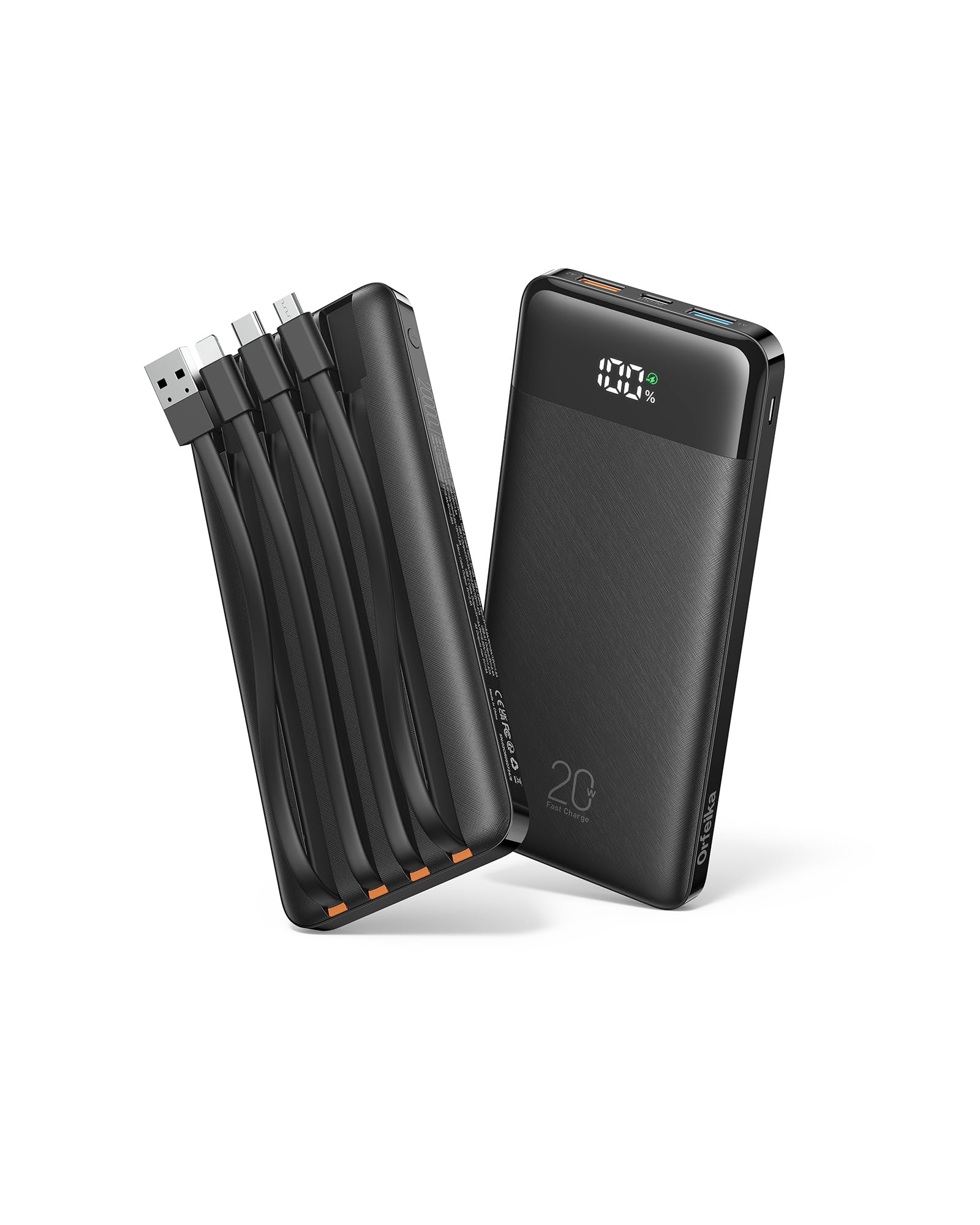
This power bank solves the problem of carrying separate cables for different devices by integrating four built-in cords — Lightning, USB-C, Micro-USB, and a USB-A input cable — into a single 0.73-pound frame. You can charge up to six devices at once using the three built-in output cables plus three external ports, making it ideal for group hikes or family camping trips where everyone needs a top-off.
The 20W PD charging delivers an iPhone 16 to 50 percent in 45 minutes, and the dual USB-C configuration ensures compatibility with modern Android flagships. The low-power mode is a thoughtful inclusion for earbuds and smartwatches, preventing overcurrent damage to small batteries. The scratch-resistant, fire-retardant shell with diagonal texture gives a premium feel and stays grippy in wet conditions.
The LED display shows exact remaining percentage, and the 77Wh rating is well under the 100Wh airline limit, so it flies in your carry-on without issue. The included travel pouch and 24-month support add value, though the built-in cables are fixed length and may require you to keep the power bank close to your phone during charging. For organized backpackers who hate tangled cords, this is the most convenient option.
Why it’s great
- Four built-in cables eliminate the need to carry separate cords for different devices
- Six output channels can charge a group’s gear simultaneously
- Low-power mode safely tops off small electronics like earbuds
- Durable shell with fire-retardant materials stands up to trail abuse
Good to know
- Fixed-length built-in cables limit placement options while charging
- 20W PD is slower than the 22.5W to 45W alternatives for Android phones
4. YBYP 50000mAh Power Bank
This is for the backpacker who stays out for a week or more without any access to grid power. The YBYP packs 50,000mAh into a chassis that is 30 percent smaller than traditional high-capacity bricks, weighing just 0.75 pounds. That is enough to charge an iPhone 17 nine times or an iPad Pro six times, which covers even the most device-heavy multi-day expedition.
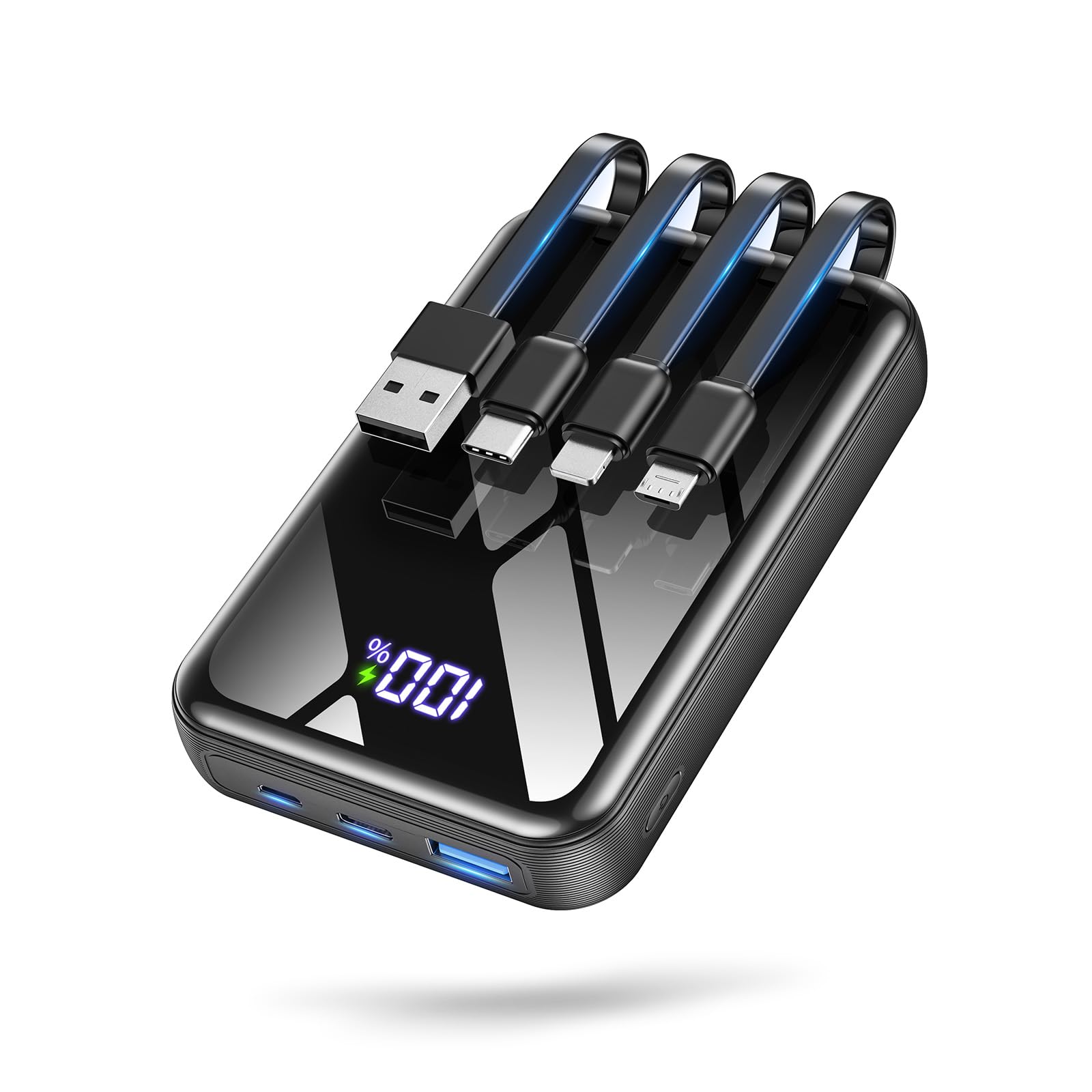
Four built-in cables — Micro-B, USB-A, USB-C, and Lightning — plus three additional ports mean you can charge five devices at the same time. The 22.5W fast charging pushes a Galaxy S25 to 60 percent in 30 minutes. The smart LED display shows exact remaining power, and the 8-layer safety protection with flame-retardant materials provides peace of mind for carrying such a high-capacity unit in a pack.
The trade-off is size: at 4.8 by 3.1 by 1.1 inches, it is thicker than the INIU Green and requires more pack space. It is not a hip-belt pocket companion but rather a basecamp or shelter bank. If you are planning a long-distance hike with resupply points every five to seven days, this unit bridges the gap between daily charging and carrying a heavy power station.
Why it’s great
- Enormous 50,000mAh capacity covers well over a week of device charging
- Four built-in cables reduce accessory weight in your pack
- 22.5W fast charging keeps top-up time reasonable for the capacity
- Compact relative to its capacity, at 30 percent smaller than comparable bricks
Good to know
- Larger physical footprint requires dedicated pack space beyond a pocket
- Weight, while low for 50,000mAh, still adds up for gram-conscious hikers
5. Easesolo CA5-6 60000mAh
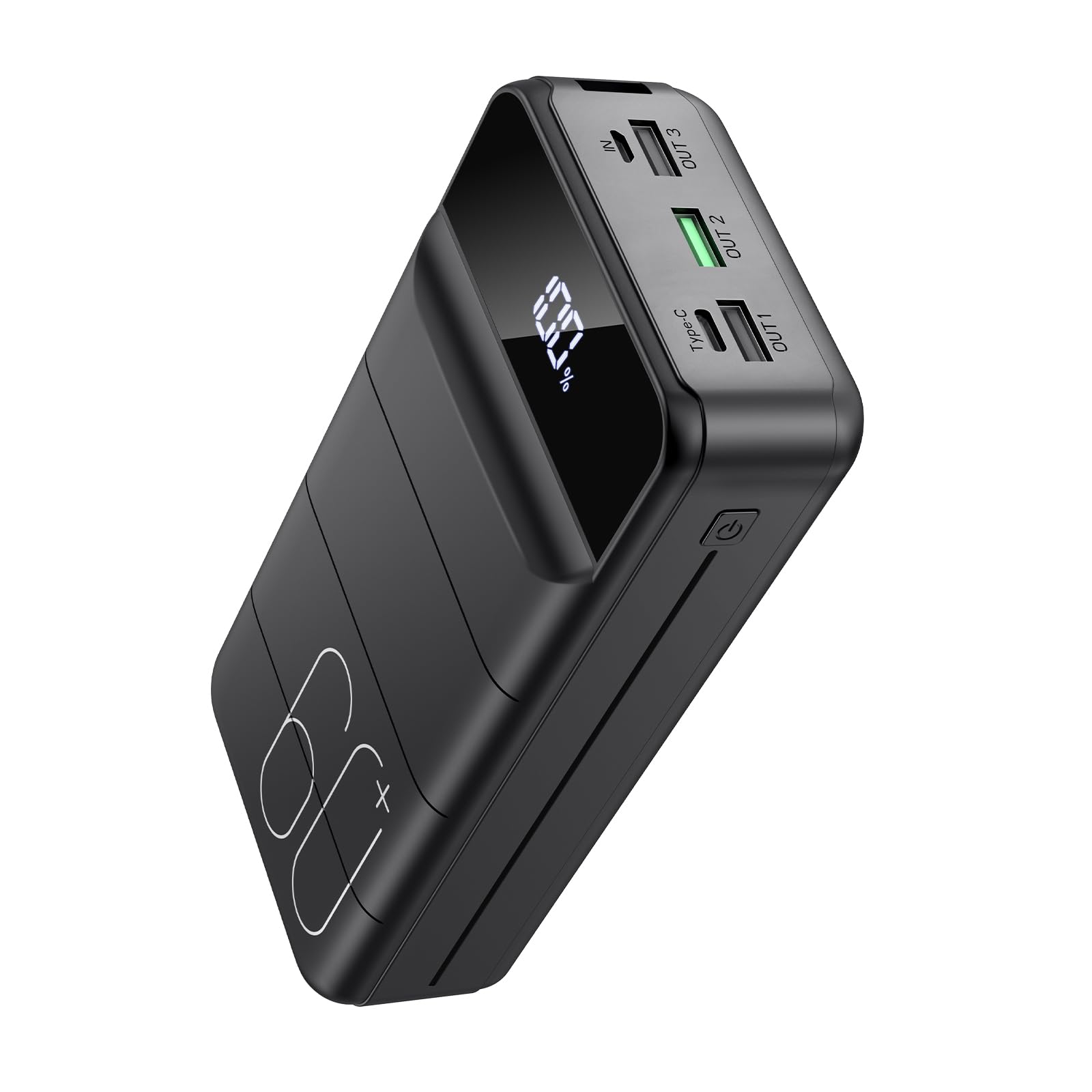
This is the largest capacity unit on the list, designed for expeditions where power access is measured in weeks, not days. The Easesolo holds 60,000mAh, enough to charge an iPhone 15 over fifteen times or a Samsung S24 fourteen times. It also includes a built-in LED flashlight, adding utility for camp tasks and emergency signaling.
The 22.5W PD 4.0 and QC 4.0 fast charging support delivers a phone from 20 to 60 percent in thirty minutes. Three USB-A output ports and one USB-C port allow simultaneous charging of four devices, which is useful for a group sharing a single bank at a basecamp. The dual input system accepts Micro, Lightning, and USB-C cables, so you can recharge the bank with whatever cord you have on hand.
At 1.54 pounds and 7 by 4 by 2 inches, this is a heavy unit that belongs in a support vehicle, a basecamp tent, or a long-term stationary camp — not on a solo thru-hike. User reviews consistently confirm the massive capacity but also note the bulk. If your trip involves car camping, kayak-supported travel, or a long stay at a fixed shelter, this bank delivers unmatched endurance.
Why it’s great
- Unmatched 60,000mAh capacity powers a group’s devices for weeks
- PD 4.0 and QC 4.0 fast charging protocols cover both iOS and Android
- Digital display shows exact remaining charge for precise trip planning
- Built-in flashlight adds utility for camp and emergency use
Good to know
- Weighs 1.54 pounds and is too large for ultralight or day-pack setups
- No built-in cables, so you must carry separate cords for each device
FAQ
Can I use a 60,000mAh power bank on a backpacking trip?
How many times will a 20,000mAh power bank charge my phone on the trail?
Is a power bank with built-in cables better for backpacking than one without?
Final Thoughts: The Verdict
For most backpackers, the best backpacking power bank winner is the INIU Green 20000mAh because it delivers four full phone charges in an 11-ounce frame with a smart detachable lanyard cable and a reliable digital display. If you prioritize ultralight speed and the ability to recharge without a separate brick, grab the INIU P24 GaN unit. And for multi-week expeditions or basecamp power needs, nothing beats the sheer endurance of the Easesolo 60000mAh bank.

Mo Maruf
I created WellFizz to bridge the gap between vague wellness advice and actionable solutions. My mission is simple: to decode the research and give you practical tools you can actually use.
Beyond the data, I am a passionate traveler. I believe that stepping away from the screen to explore new environments is essential for mental clarity and physical vitality.