Our readers keep the lights on and my smoothie glass nicely filled. As an Amazon Associate, I earn from qualifying purchases.
The searing jolt that travels from your lateral elbow down through your forearm every time you grip a coffee cup, shake a hand, or hit a forehand isn’t just inconvenient — it halts your active life in its tracks. Lateral epicondylitis, or tennis elbow, stems from inflammation at the common extensor tendon origin, and the right counterforce brace can intercept that painful tensile load before it reaches the irritated attachment point.
I’m Mohammad Maruf — the founder and writer behind WellFizz. I spend my time dissecting clinical rehabilitation hardware, analyzing foam densities, compression ratings, and pad geometry to separate genuine therapeutic tools from flimsy fabric bands that slip after twenty minutes.
After months of reviewing the market’s leading elbow straps, the brace for lateral epicondylitis conversation narrows to a few design choices: gel-pad precision versus air-cushion pressure dispersal, adjustable strapping versus fixed geometry, and material breathability versus durability under daily wear.
How To Choose The Best Brace For Lateral Epicondylitis
Every tennis elbow brace works on the same mechanical principle: apply external compression across the belly of the extensor muscles, a few finger-widths below the elbow crease, to absorb and redistribute the tensile force that would otherwise tug on the inflamed tendon insertion. The differences lie in how each design delivers that pressure and whether it stays anchored during movement.
Pad Material and Geometry
The pad that sits against the extensor muscle mass is the functional heart of any counterforce strap. Gel pads conform to individual anatomy, spread load across a broader surface, and resist migrating under tension. Air cushions offer lighter, more uniform pressure but can deflate or feel bulky. Hard plastic or foam pillows shift unpredictably and dig into the muscle belly, creating secondary discomfort.
Strap Architecture and Closure
Double D-ring systems let you micro-adjust tension without pinching skin, while single hook-and-loop straps sacrifice precision for speed. The best designs for lateral epicondylitis include a secondary retention point — either a non-slip silicone strip or a contoured shape that hugs the proximal forearm — to prevent the brace from sliding toward the wrist during activity.
Circumference Range and Sizing
Measure around your forearm at the widest point, approximately one inch below the elbow crease. Most one-size straps accommodate 10-to-15 inches, but smaller arms (8-to-9 inches) often experience over-compression with standard straps, while larger arms exceed the hook-and-loop landing zone. Verify the stated range against your own measurement.
Quick Comparison
On smaller screens, swipe sideways to see the full table.
| Model | Category | Best For | Key Spec | Amazon |
|---|---|---|---|---|
| Med Spec EpiGel 223410 | Premium | Dual-gel pad precision | Two movable gel packs | Amazon |
| SquareHit VictoryBand | Premium | Low-profile daily wear | 0.02 lbs, slim profile | Amazon |
| Shock Doctor 828 | Mid-Range | Air cushion even pressure | Integrated air bladder | Amazon |
| Mueller 70207 | Mid-Range | Gel pad with moisture-wicking | Gel pad, double-knit fabric | Amazon |
| BraceAbility 11E02 | Budget | Smaller arm fit | Up to 15” circumference | Amazon |
In‑Depth Reviews
1. Med Spec EpiGel Tennis Elbow Brace 223410
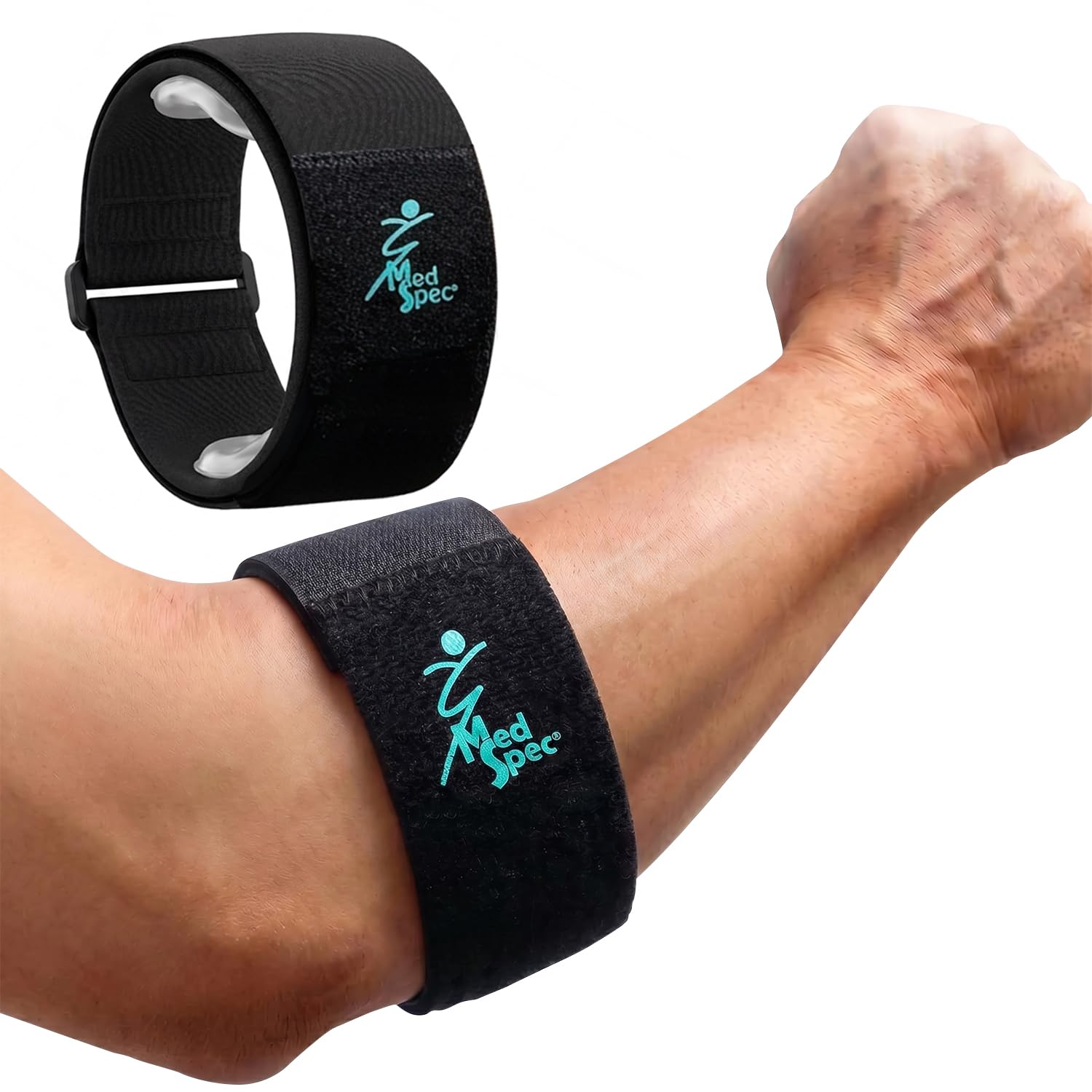
The EpiGel 223410 distinguishes itself with two independently movable gel packs inside a low-profile sleeve — a design that lets you dial the pressure point directly over the extensor muscle belly rather than accepting a fixed pad location. Users report measurable pain reduction within three days of consistent wear during golf, tennis, and desk work.
The dual-pad system creates a broader compression zone that dampens vibration from racket impact or lifting motions more effectively than single-pad alternatives. Each gel pack stays tacky against the skin even during sweaty sessions, and the universal band fits both small and large forearms without the over-compression common in one-size straps.
Some users experience mild skin irritation from prolonged gel contact over eight-plus hours, but the fix is minimal — a cotton pad between the gel and skin preserves relief while eliminating rash. The strap assembly uses heavy-duty hook-and-loop that holds position through repetitive elbow flexion without migrating downward.
Why it’s great
- Two adjustable gel pads for precision compression targeting
- Pain relief reported within 48-72 hours for lateral epicondylitis
- Low-profile fit slides under long sleeves without bulk
Good to know
- Gel can irritate sensitive skin during all-day wear
- Not designed for arms larger than 14-inch circumference
2. SquareHit Tennis VictoryBand Elbow Support Strap

The VictoryBand solves the most common complaint about counterforce braces: obtrusiveness. At 0.02 pounds with a thin elastic strap and a low-profile pressure nub, this band is nearly invisible under a dress shirt or tennis polo, making it the best option for professionals who type all day and still want to play on weekends.
Instead of a bulky gel or air bladder, the VictoryBand uses a molded pressure point precisely calibrated to sit over the extensor muscle origin. Users report that once the band is positioned correctly — a few attempts are required at first — it effectively dampens the vibration that triggers tendon pain during racket sports and repetitive gripping tasks.
The shorter elastic strap compared to wider velcro designs means the adjustment range is narrower, and the lack of a secondary retention feature can allow slight rotation during aggressive play. The 30-day money-back guarantee mitigates the higher upfront investment.
Why it’s great
- Extremely lightweight and slim — disappears under clothing
- Precise pressure point dampens tendon vibration effectively
- Durable construction holds up over years of regular use
Good to know
- Tricky to find the exact position on the first handful of wears
- Higher price point without a gel or cushioning pad
3. Shock Doctor Tennis Elbow Support Strap 828

The Shock Doctor 828 breaks from gel-pad convention by integrating a sealed air cushion that distributes pressure uniformly across the extensor muscles rather than concentrating it at a single point. Athletes who play multiple times a week report that this design reduces post-game soreness without the pinpoint ache that rigid pads can produce.
The Z-Grip closure system uses a hook configuration that grabs aggressively, preventing the strap from loosening during dynamic movements like a tennis serve or a golf swing. Terry lining with Lycra binding keeps the interior comfortable against bare skin during extended play sessions of four to five hours.
A small percentage of units ship with a deflated air bladder, which renders the pad functionally useless until replaced. Users with wider forearms (above 14 inches) find the strap reach insufficient for full closure, and the air cushion adds noticeable bulk under fitted sleeves.
Why it’s great
- Air cushion distributes load evenly across the muscle belly
- Z-Grip closure stays locked through high-intensity motion
- Comfortable Lycra lining reduces skin abrasion during long wear
Good to know
- Some units arrive with a deflated air bladder
- Bulky fit under tight sleeves; limited range for larger forearms
4. Mueller Tennis Elbow Support with Gel Pad 70207

The Mueller 70207 packs a gel pad into a double-knit fabric sleeve that wicks moisture away from the skin, addressing the sweat buildup that makes long-duration wear uncomfortable in many budget-tier straps. Users with active outdoor hobbies like tennis and golf report a 90 percent reduction in pain within three days of intermittent wear.
The hook-and-loop closure lets you tighten and release one-handed, and the 10-to-14-inch circumference range covers the majority of adult forearms. The moisture-wicking fabric also aids heat retention around the joint, which can improve local circulation and range of motion during recovery.
The gel pad sits inside a fabric pocket that tends to shift after a few hours of activity, requiring periodic re-adjustment. Some users note that plastic retaining rings on the strap edges can dig into the skin during forearm rotation, and the single-pad design cannot match the dual-zone compression of the EpiGel.
Why it’s great
- Gel pad provides effective compression at a budget-friendly price
- Moisture-wicking double-knit fabric stays breathable during sports
- Easy one-handed adjustment with hook-and-loop closure
Good to know
- Gel pad pocket can migrate down the forearm during extended activity
- Plastic retaining rings may cause pressure points on some arms
5. BraceAbility Epicondylitis Brace 11E02

The BraceAbility 11E02 is built around a double D-ring closure system that enables micro-adjustments without the fabric bunching common to single-strap designs. The embedded compression tube targets the extensor muscle group directly, and the band fits forearms up to 15 inches — the widest range in this lineup, accommodating larger physiques the other straps cannot.
Users with smaller arms (8-to-10-inch circumference) find this strap particularly effective because the D-rings allow incremental tightening that prevents the band from sliding down during curl motions or Pilates classes. The lightweight elastic material weighs only 8.98 grams, making it nearly unnoticeable during daily activities.
The compression tube itself is a hard circular piece that feels uncomfortable against the skin during prolonged wear and can show through thin shirts. The exposed hook material on the strap frays the elastic fabric over repeated wash cycles, reducing the band’s lifespan compared to gel-pad alternatives.
Why it’s great
- Double D-ring system allows fine tension adjustments for smaller arms
- Widest circumference range (up to 15 inches) of the tested braces
- Extremely lightweight and unobtrusive during indoor activities
Good to know
- Hard circular compression pad creates discomfort under extended wear
- Velcro frays and degrades faster than gel-pad-based straps
FAQ
Should I wear a lateral epicondylitis brace while sleeping?
How tight should a tennis elbow counterforce strap be?
Can one brace treat both lateral and medial epicondylitis?
Final Thoughts: The Verdict
For most users, the brace for lateral epicondylitis winner is the Med Spec EpiGel 223410 because two independently movable gel packs let you target the exact point of maximal tenderness while spreading compression broadly enough to avoid secondary discomfort. If you want a near-invisible band that works under dress shirts and during computer work, grab the SquareHit VictoryBand. And for an entry-level gel-pad strap that covers 10-to-14 inch forearms without breaking the bank, nothing beats the Mueller 70207.

Mo Maruf
I created WellFizz to bridge the gap between vague wellness advice and actionable solutions. My mission is simple: to decode the research and give you practical tools you can actually use.
Beyond the data, I am a passionate traveler. I believe that stepping away from the screen to explore new environments is essential for mental clarity and physical vitality.