Our readers keep the lights on and my smoothie glass nicely filled. As an Amazon Associate, I earn from qualifying purchases.
Bonding aluminum is notoriously difficult. The oxide layer that makes the metal corrosion-resistant also repels most glues, leading to bonds that fail under stress, temperature swings, or moisture. Standard super glues and hardware-store epoxies rarely hold up over time on this slick surface.
I’m Mohammad Maruf — the founder and writer behind WellFizz. I’ve spent years analyzing chemical formulations, tensile strength data, and adhesion test protocols to find out which adhesives genuinely lock onto aluminum without delaminating.
To save you from trial-and-error failures, I’ve assembled this guide to the best adhesive for aluminum, covering structural epoxies, polyurethane sealants, and specialty sprays that deliver reliable bonds on everything from boat hulls to car panels.
How To Choose The Best Adhesive For Aluminum
Selecting the right adhesive for aluminum depends on three main factors: the mechanical load on the joint, the environmental exposure (moisture, UV, temperature), and whether the bond line needs to be flexible or rigid. You won’t find one glue that does everything, but matching the chemistry to the application is straightforward once you know the key parameters.
Understand the Chemistry: Polyurethane vs. Epoxy vs. Spray Contact
Polyurethane adhesives like Sikaflex-221 cure to a semi-rubber consistency, making them ideal for applications that experience vibration, expansion, or contraction — think RV panels, trailer roofs, and boat fittings. They bond aggressively to aluminum’s oxide layer and remain flexible. Epoxies, particularly steel-reinforced varieties like J-B Weld KwikWeld, cure to a hard, rigid mass with extremely high tensile strength (often above 4000 PSI). Use an epoxy when the bond line must bear direct load or be drilled and tapped. Spray contact adhesives like 3M Hi-Strength 94 are best for large-surface laminations where clamping is impractical, such as bonding foam or rubber to aluminum sheets.
Consider the Curing Environment and Application Method
Temperature and humidity during application affect both open time and final strength. Polyurethanes need some ambient moisture to cure, while epoxies cure via a chemical reaction between resin and hardener that is temperature-dependent. Below 50°F, many two-part epoxies become sluggish. For vertical or overhead applications, a thixotropic paste or gel (like the 3M Panel Bonding Adhesive) stays in place without sagging. For intricate repairs or filling gaps, a syringe-style cartridge with a mixing nozzle gives you precise control and consistent mix ratios.
Quick Comparison
On smaller screens, swipe sideways to see the full table.
| Model | Category | Best For | Key Spec | Amazon |
|---|---|---|---|---|
| 3M Panel Bonding Adhesive | Premium Epoxy | Structural auto body repairs | 50 mL cartridge, glass bead tech | Amazon |
| AP Products Sikaflex-221 | Polyurethane Sealant | Marine & RV vibration resistance | NSF approved, paintable | Amazon |
| J-B Weld KwikWeld | Fast Epoxy | General household metal repairs | 4360 PSI, 6-min set time | Amazon |
| 3M Hi-Strength 94 ET Spray | Spray Adhesive | Large surface lamination | 60-min open time, low VOC | Amazon |
| ZIBRWUON Aluminum Foil Wallpaper | Decorative Laminate | Lightweight surface covering | Self-adhesive, 43 sq ft | Amazon |
In‑Depth Reviews
1. 3M Panel Bonding Adhesive

This is the gold standard for automotive-grade structural bonding on aluminum. The two-part epoxy formulation uses glass bead technology to ensure a precise bond-line thickness, preventing the joint from becoming starved of adhesive under clamping pressure. It bonds steel, aluminum, SMC, and fiberglass with a grabby, immediate tack that makes it difficult to slide panels into alignment once the mating surfaces contact — careful positioning is essential.
The 50 mL cartridge is small, so plan for larger jobs by buying multiple units or a larger bulk package. It requires a manual applicator gun and a static mixing nozzle (both sold separately). Once cured, 3M’s panel adhesive delivers a bond strength that many users compare to welding, without burning off protective coatings or introducing rust points, making it a go-to for quarter-panel patches and headlight tab repairs.
Some users note that the cartridge volume is actually 47.5 mL net fill, but the performance is consistent. The 24-hour full cure time is standard for structural epoxies, and the cured material can be drilled, sanded, and painted. If your repair needs to hold a car body panel or a boat hatch, this is the most reliable option on the list.
Why it’s great
- Glass bead technology ensures consistent bond-line thickness
- Bonds aluminum as strong as welding without heat
- Waterproof and resists petroleum chemicals
Good to know
- Requires applicator gun and mixing nozzle (sold separately)
- Very tacky immediately — minimal adjustment time
- Small 50 mL cartridge for larger projects
2. AP Products Sikaflex-221
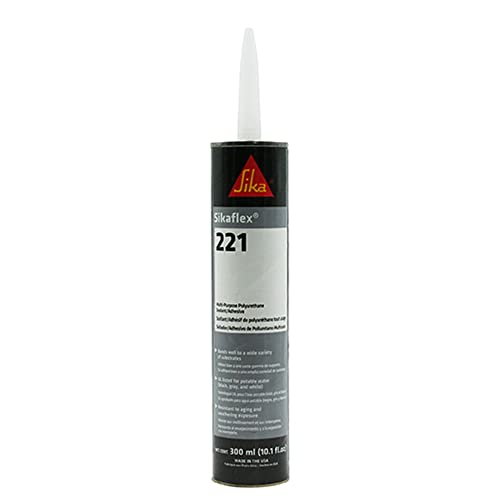
Sikaflex-221 is the industry benchmark for flexible aluminum bonding in marine and RV environments. As a one-component polyurethane, it cures by reacting with ambient moisture to form a permanently elastic seal that absorbs road shock, thermal expansion, and structural flex without cracking. It is the factory-recommended sealant for Airstream trailers, which speaks directly to its engineered compatibility with anodized and painted aluminum surfaces.
Users consistently highlight its durability on solar panel mounts, camper window seals, and roofing applications — reporting no aging or cracking after years of exposure. It is NSF approved for potable water contact and incidental food contact, a rare trait for an adhesive in this class. The aluminum-gray color blends well with unpainted metal surfaces, and it is sandable and paintable for a finished look.
The stuff is messy to apply due to its sticky polyurethane nature, so masking tape is recommended. One caveat: because it is moisture-cured, unopened tubes can harden if stored improperly past the manufacturer date. Buy fresh stock for critical jobs. For any vibrating aluminum assembly — boats, trailers, RV roofs — this is the safer choice than rigid epoxy.
Why it’s great
- Remains flexible to handle vibration and thermal movement
- NSF approved for potable water contact
- Proven long-term durability on Airstreams and marine gear
Good to know
- Very sticky and messy during application
- Moisture-cured — shelf life limited if not stored properly
- Takes 24+ hours to fully cure depending on humidity
3. J-B Weld KwikWeld 2-Pack
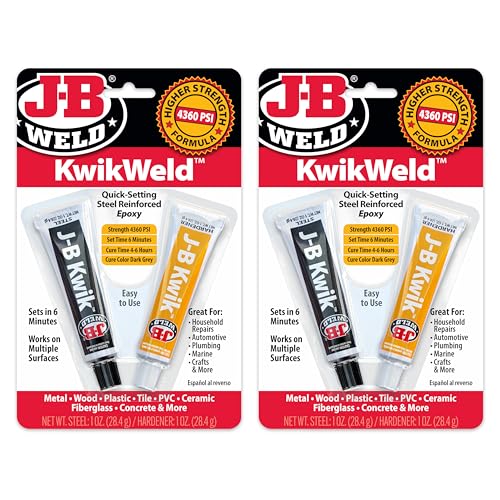
J-B Weld’s KwikWeld is the go-to for DIYers who need a steel-reinforced epoxy that sets in minutes and cures to a machinable hardness in hours. With a tensile strength of 4360 PSI, it exceeds what most household aluminum repairs will ever demand. The two-tube system mixes at a 1:1 ratio and gives you a generous 6-minute working window before it begins to harden — enough time for small repairs but tight for larger alignment jobs.
Users have repaired broken laptop hinges, sunglasses arms, ceramic pieces, and metal brackets with this epoxy, and report that the cured bond can be tapped, drilled, and sanded just like metal. The dark gray color blends acceptably on aluminum, though it won’t match lighter finishes. It also resists temperatures up to 230°F, making it suitable for engine bay and exhaust-adjacent repairs.
The 2-pack gives you two sets of resin and hardener, essentially doubling the capacity for larger projects or allowing you to keep a backup for later use. The epoxy has a paste-like consistency that doesn’t run, so it works for vertical surfaces. However, it is fully rigid once cured — don’t use it on joints that will flex repeatedly. For a fast, strong, general-purpose aluminum epoxy, this is hard to beat.
Why it’s great
- 4360 PSI tensile strength — extremely high for a consumer epoxy
- 6-minute set time speeds up small repairs
- Can be drilled, tapped, and sanded after curing
Good to know
- Rigid bond — not suitable for flexible joints
- Short 6-minute working time for complex alignments
- Dark grey color may not match bare aluminum
4. 3M Hi-Strength 94 ET Spray Adhesive
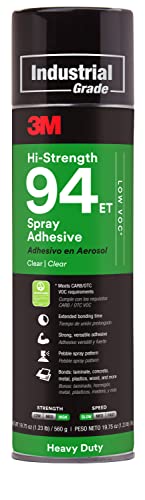
When you need to bond large sheets of material to aluminum — foam insulation, rubber matting, carpet, or laminate — 3M’s Hi-Strength 94 is the industrial spray of choice. It features an extended open time of up to 60 minutes, which gives you generous room to position and reposition your substrate before the tack locks in. The aggressive tack means it grabs hard on contact once the solvent flashes off, requiring about 30 minutes of drying time before mating surfaces.
This is a contact cement delivered via aerosol, not a gap-filling structural adhesive. It excels at laminating porous and semi-porous materials to metal surfaces. Users report successful van insulation projects where foam panels are bonded to aluminum sheet walls, as well as soundproofing foam applied to plastic surfaces exposed to cold temperatures — the bond remained strong even in freezing conditions.
The main trade-off is the strong chemical odor, which requires good ventilation or a respirator. It is GREENGUARD certified and low VOC, but that doesn’t mean the smell is gone. The can lasts for one or two medium-sized projects. For non-structural, large-area aluminum laminations, this spray adhesive is the most practical and efficient method available.
Why it’s great
- 60-minute open time allows careful positioning
- Aggressive tack bonds foam, rubber, and fabric to aluminum
- Low VOC and GREENGUARD certified
Good to know
- Strong solvent odor — requires ventilation
- Not a structural or gap-filling adhesive
- Open time requires planning to avoid premature bonding
5. ZIBRWUON Aluminum Foil Peel & Stick Wallpaper

This entry-level product is a decorative aluminum foil laminate with a pre-applied self-adhesive backing, not a structural adhesive. It is designed for covering countertops, backsplashes, cabinet shelves, and appliances to give a metallic finish. The peel-and-stick application is rental-friendly and removable without residue when used on smooth surfaces without added glue.
The material is thin aluminum foil — measuring 15.7 inches by 394 inches to cover about 43 square feet — and it is tear-resistant, waterproof, oil-proof, and heat-resistant. Installation requires careful planning because the foil crimps easily and bubbles can form if not smoothed immediately with a damp rag. A hairdryer helps soften the material for wrapping corners and curves.
While it is called “adhesive for aluminum” in a marketing sense, this product is a surface covering, not a bonding agent. It is not suitable for joining two pieces of aluminum together or for any load-bearing repair. If your project is purely aesthetic — refreshing an old countertop or lining a drawer — this can deliver a clean, cost-effective finish. For actual structural adhesion, choose one of the other products on this list.
Why it’s great
- Easy peel-and-stick DIY installation
- Waterproof, oil-proof, and heat resistant
- Removable without residue on smooth surfaces
Good to know
- Very thin foil — prone to crimps and bubbles
- Not a structural adhesive; decorative only
- Requires smooth, clean surface for best adhesion
FAQ
Can I use standard super glue for aluminum repairs?
Does the aluminum surface need to be roughened before applying adhesive?
What is the difference between polyurethane and epoxy for aluminum?
Final Thoughts: The Verdict
For most users, the best adhesive for aluminum winner is the AP Products Sikaflex-221 because it combines excellent adhesion to aluminum with the flexibility to survive road vibration, thermal cycling, and moisture exposure — all while being NSF approved for potable water contact. If you need structural steel-grade strength for a load-bearing repair, grab the J-B Weld KwikWeld. And for non-structural large-area laminations, nothing beats the 3M Hi-Strength 94 ET Spray.

Mo Maruf
I created WellFizz to bridge the gap between vague wellness advice and actionable solutions. My mission is simple: to decode the research and give you practical tools you can actually use.
Beyond the data, I am a passionate traveler. I believe that stepping away from the screen to explore new environments is essential for mental clarity and physical vitality.