Our readers keep the lights on and my smoothie glass nicely filled. As an Amazon Associate, I earn from qualifying purchases.
Choosing a 240Hz 1440p monitor is less about chasing a number and more about understanding the interplay between pixel response, panel technology, and color accuracy. The jump from standard 60Hz or 144Hz to 240Hz is immediately tactile—the cursor feels glued to your hand, and fast-paced gaming becomes a blur-free, reactive experience. But with OLED, Fast IPS, and VA panels all vying for your attention, the real challenge is identifying which implementation actually delivers on its spec sheet promise.
I’m Mohammad Maruf — the founder and writer behind WellFizz. I’ve spent years dissecting display specifications, from GtG response times to VESA HDR certifications, to help readers understand exactly how monitor hardware translates into real-world performance.
This guide breaks down the key specifications, practical trade-offs, and standout models within the 240hz 1440p monitor category, focusing on the concrete metrics that define smooth gameplay and accurate image reproduction.
How To Choose The Best 240Hz 1440p Monitor
Selecting a monitor at this performance tier means weighing panel technology, connectivity for achieving full refresh rate, and the quality of HDR implementation. The most common pitfall is buying a monitor with high specs on paper that underperforms in actual motion handling or color reproduction.
Panel Type: The Foundation of Image Quality
OLED panels, including WOLED and QD-OLED, offer per-pixel lighting for perfect blacks and near-instantaneous 0.03ms GtG response times, making motion nearly artifact-free. Fast IPS panels, meanwhile, trade some contrast for higher peak brightness and no risk of burn-in, often reaching 1ms GtG. VA panels provide good contrast but slower response times that can lead to dark-level smearing at 240Hz—making them less ideal for competitive play.
Connectivity and Refresh Rate Delivery
To actually achieve 240Hz at 1440p, you need either DisplayPort 1.4 (with Display Stream Compression if required) or HDMI 2.1. Some budget monitors include HDMI 2.0 ports that cap refresh rate at 144Hz, forcing users to rely on the DisplayPort for full speed. Checking the supported bandwidth of your graphics card’s output against the monitor’s input specifications is essential before purchase.
HDR Performance and Color Gamut
VESA DisplayHDR 400 is a baseline, but DisplayHDR True Black 400 or 600 on OLED panels delivers significantly deeper blacks and more impactful highlights. Color gamut coverage of at least 95% DCI-P3 ensures vibrant, accurate colors in HDR and SDR content. Beware of monitors that advertise HDR without meeting the peak brightness or local dimming requirements for a meaningful experience.
Quick Comparison
On smaller screens, swipe sideways to see the full table.
| Model | Category | Best For | Key Spec | Amazon |
|---|---|---|---|---|
| AOC Q27GAZD | QD-OLED | Value-focused OLED upgrade | 0.03ms GtG, QD-OLED | Amazon |
| Acer Predator X27U | QD-OLED | Budget OLED with ergonomic stand | 0.03ms GtG, HDMI 2.1 | Amazon |
| Alienware AW2723DF | Fast IPS | Competitive FPS gaming | 1ms GtG, 280Hz OC | Amazon |
| LG 34G630A-B | VA Ultrawide | Immersive ultrawide gaming | 3440×1440, 21:9 | Amazon |
| LG 27GS93QE | WOLED | Superior black levels in bright rooms | 0.03ms GtG, WOLED | Amazon |
| INNOCN 2780s | QD-OLED | Mid-range QD-OLED value | 280Hz OC, QD-OLED | Amazon |
| Samsung Odyssey G61SD | QD-OLED | Glare-free OLED with thermal management | 0.03ms GtG, Glare Free | Amazon |
| ASUS ROG Strix XG27AQDMG | Glossy WOLED | Vibrant glossy OLED with heatsink | 0.03ms GtG, Custom Heatsink | Amazon |
| MSI MAG 271QPX QD-OLED E2 | QD-OLED | Burn-in warranty peace of mind | 0.03ms GtG, OLED Care 2.0 | Amazon |
| ASUS ROG Strix XG27ACDNG | QD-OLED 360Hz | High-refresh QD-OLED with AI gaming | 360Hz, 0.03ms GtG | Amazon |
| LG 27GX790A-B | 480Hz WOLED | Extreme motion clarity with DP 2.1 | 480Hz, DP 2.1 | Amazon |
In‑Depth Reviews
1. LG 27GS93QE 27-inch Ultragear OLED Gaming Monitor
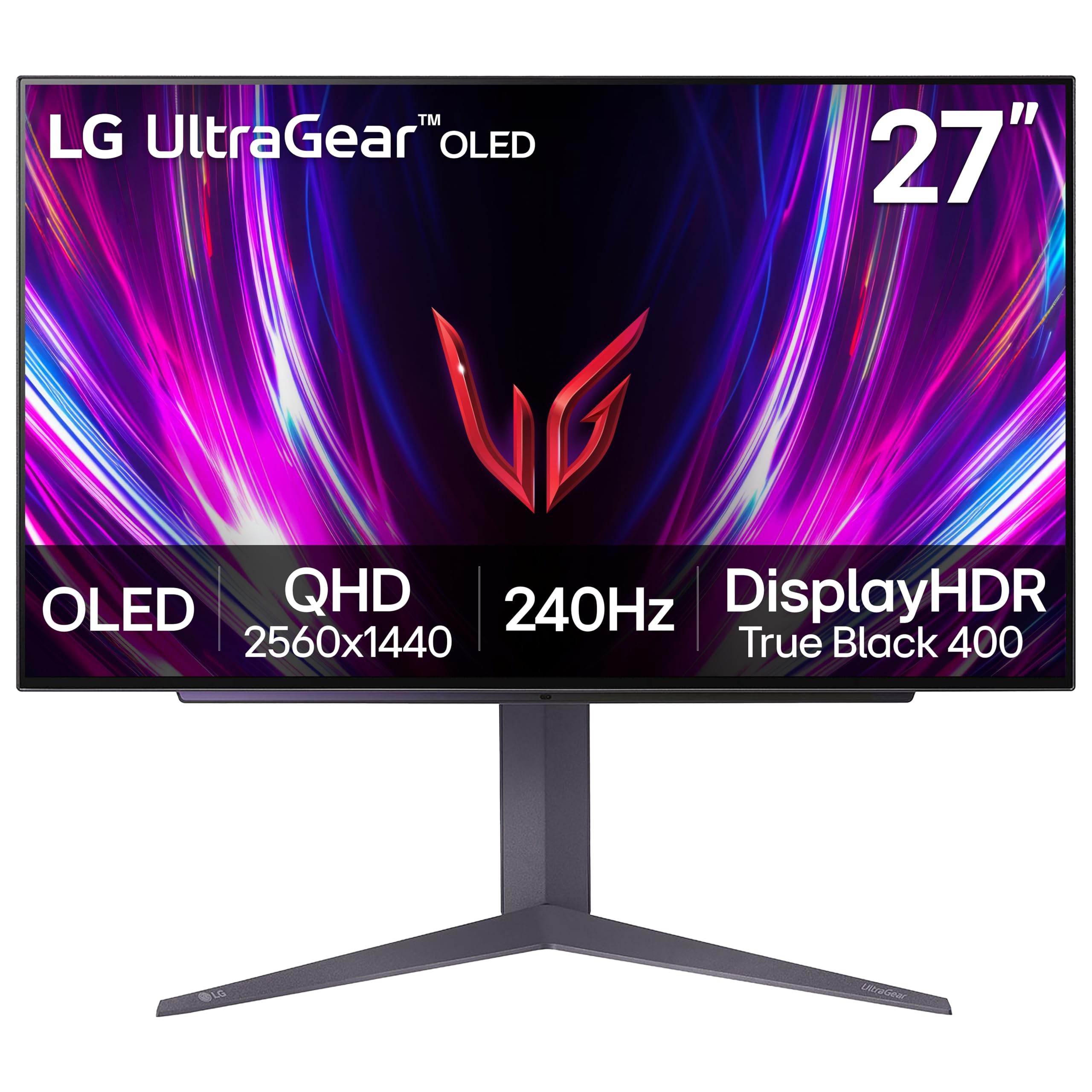
The LG 27GS93QE uses a WOLED panel which offers true black performance that does not wash out under ambient light, a distinct advantage over QD-OLED panels in brighter rooms. Its 0.03ms GtG response time and 240Hz refresh rate deliver motion clarity that eliminates ghosting entirely, making it a formidable choice for competitive titles.
With up to 98.5% DCI-P3 color gamut coverage and VESA DisplayHDR True Black 400 certification, this monitor produces vibrant highlights and deep shadow detail. The matte anti-glare coating reduces reflections effectively without introducing the grainy texture common on some QD-OLED matte finishes.
The included stand provides height, tilt, and pivot adjustments, and connectivity includes both HDMI 2.1 and DisplayPort 1.4 for full 240Hz support across modern GPUs and consoles. The 2-year warranty covering the OLED panel adds confidence for long-term use.
Why it’s great
- WOLED panel retains black depth in bright rooms where QD-OLED turns purple
- Anti-glare coating is borderline glossy with no fuzziness
- Accurate colors out of the box without oversaturation
Good to know
- Low brightness compared to premium OLEDs; best used in controlled lighting
- Auto Input Switch lacks HDMI-CEC functionality for consoles
2. AOC 27″ QD OLED Gaming Monitor Q27GAZD
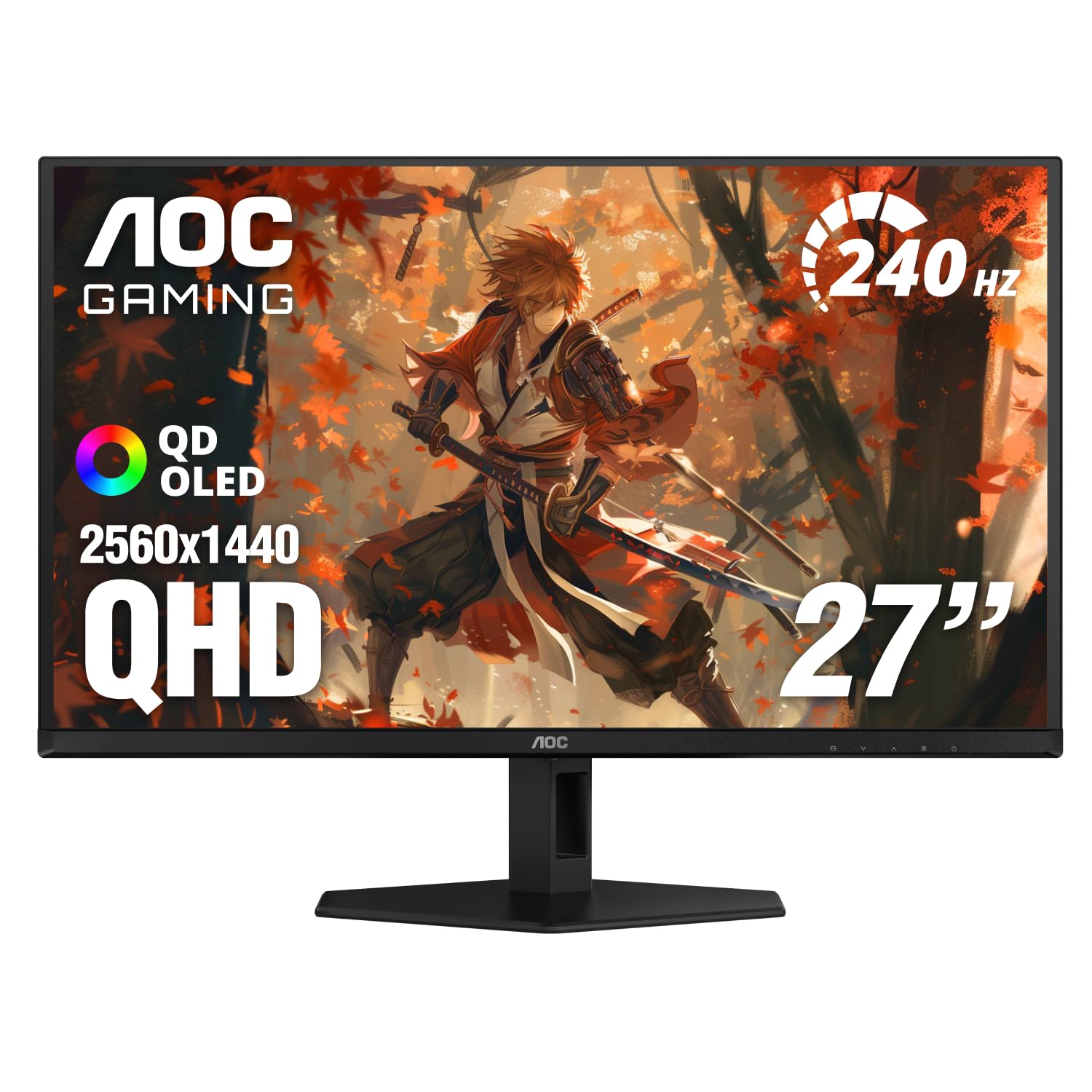
The AOC Q27GAZD brings QD-OLED panel technology to an entry-level price point, delivering 147.6% sRGB and 110.2% DCI-P3 color gamut coverage that rivals monitors costing significantly more. The 0.03ms GtG response and 240Hz refresh rate provide buttery-smooth motion with no perceptible ghosting.
HDR400 True Black certification enables deep blacks and bright highlights, though the glossy screen finish means reflections can be distracting in brightly lit rooms. Multiple customer reviews note that using the DisplayPort is necessary to achieve the full 240Hz refresh rate, as the HDMI ports are limited to 165Hz.
Build quality is functional but economy-class—the stand is wobbly and lacks ergonomic adjustments beyond tilt. Most users recommend pairing this monitor with a VESA monitor arm. For the price, the image quality is transformative compared to older IPS or VA panels.
Why it’s great
- Exceptional QD-OLED color vibrancy and contrast at a competitive price
- No text fringing or eye strain reported in reviews
- G-Sync Compatible for tear-free gaming
Good to know
- HDMI ports limited to 165Hz; DisplayPort required for 240Hz
- Stand has poor stability; a monitor arm is highly recommended
3. Alienware AW2723DF Gaming Monitor

Before OLED became mainstream at 1440p, the Alienware AW2723DF was the gold standard for competitive gaming. Its Fast IPS panel with a 1ms GtG response time and overclockable 280Hz refresh rate provides excellent motion handling with no ghosting, making it an ideal choice for precision shooters.
IPS Nano Color technology delivers 95% DCI-P3 coverage and VESA DisplayHDR 600 certification, producing brighter highlights than most OLEDs in this class without concerns about burn-in. The fully adjustable stand with swivel, pivot, tilt, and height adjustments is among the most solid in its segment.
Notable downsides include the lack of HDMI 2.1—limiting console use to 144Hz—and typical IPS backlight bleed in dark scenes. The 3-year warranty provides peace of mind, and for gamers who prioritize sustained high brightness and zero burn-in risk, this remains a strong option.
Why it’s great
- 280Hz overclocked refresh rate with 1ms GtG for ultra-smooth motion
- Excellent color accuracy out of the box with 95% DCI-P3
- Sturdy, fully adjustable stand with great cable management
Good to know
- No HDMI 2.1; limited to 144Hz over HDMI
- IPS glow and backlight bleed present in dark environments
4. LG 34G630A-B 34-Inch Ultragear Curved Gaming Monitor
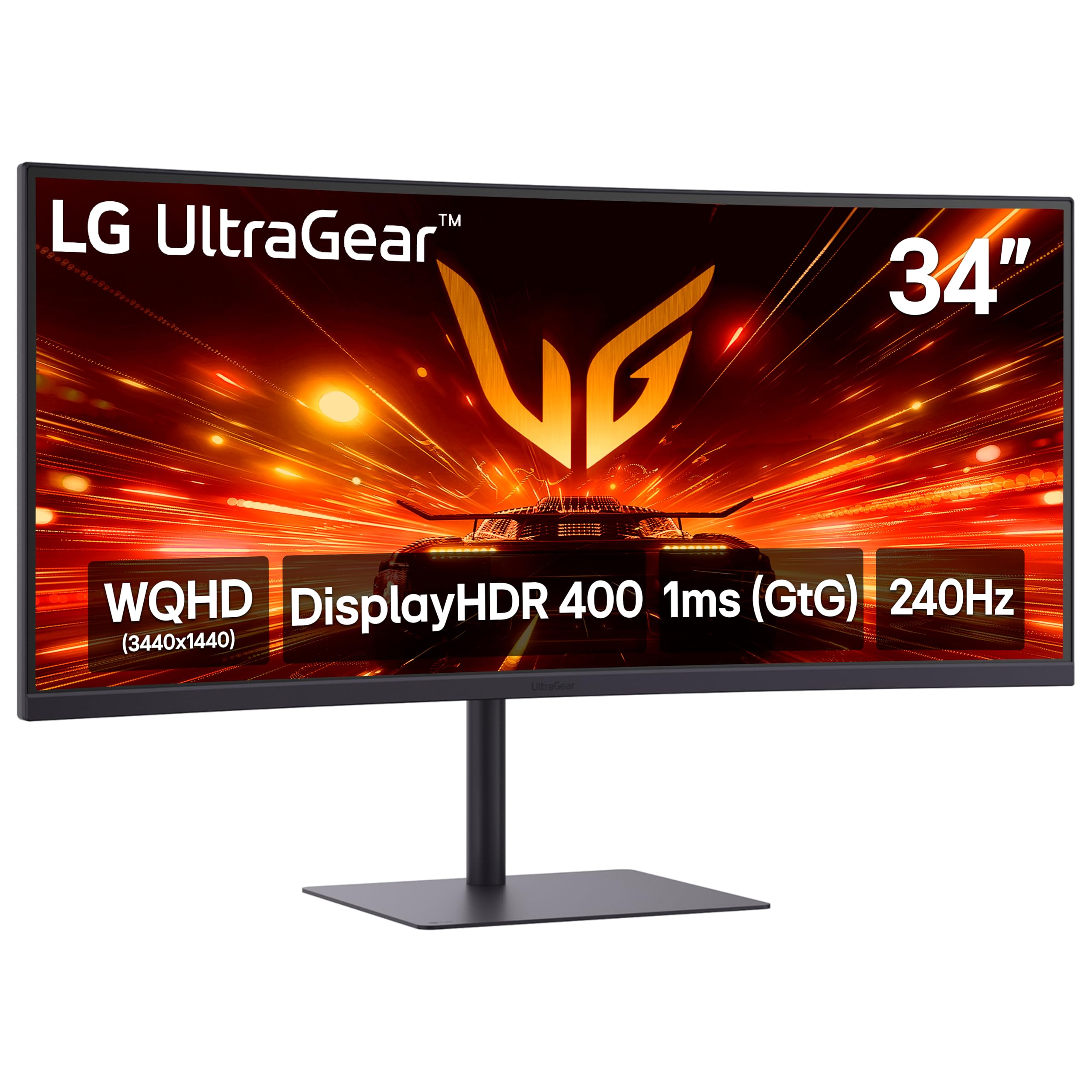
The LG 34G630A-B expands the 240Hz 1440p experience into a 21:9 ultrawide format with a 3440×1440 resolution. Its VA panel offers a high native contrast ratio that produces deep blacks and vibrant colors, making it well-suited for immersive single-player titles and racing games.
With 95% DCI-P3 color gamut and VESA DisplayHDR 400, the monitor delivers decent HDR performance for its class. The built-in speakers are functional for casual use, and the USB Type-C port with 15W power delivery simplifies laptop connectivity. The stand supports height, tilt, and swivel adjustments.
The VA panel’s response time at 240Hz is slower than IPS or OLED, which can result in minor dark-level smearing. The 1500R curve enhances immersion but may not suit all workspace configurations. For those wanting an ultrawide without going to premium OLED pricing, this is a compelling middle ground.
Why it’s great
- Ultrawide 21:9 format provides extra horizontal FOV for games
- VA panel delivers strong native contrast for deep blacks
- USB Type-C with 15W PD simplifies laptop setups
Good to know
- VA response time can cause slight smearing in dark transitions
- Requires significant desk space due to 34-inch curve
5. Acer Predator X27U W1bmiipprx
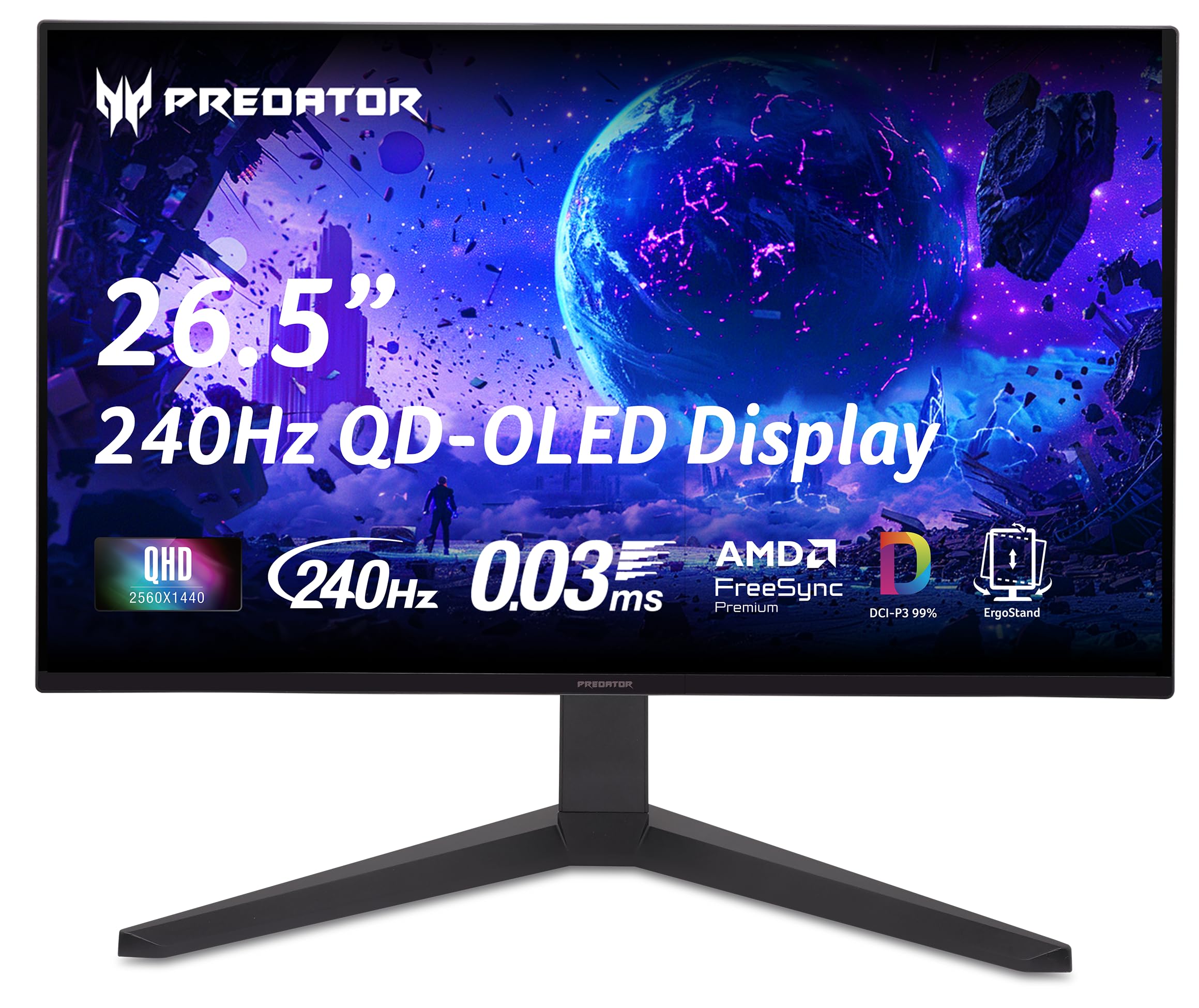
The Acer Predator X27U is a QD-OLED monitor that punches above its price point, offering DCI-P3 99% color gamut and Delta E<2 accuracy for vivid, lifelike imagery. Its 240Hz refresh rate and 0.03ms GtG response make it exceptionally responsive.
The monitor supports both AMD FreeSync Premium and G-Sync Compatible for adaptive sync across a wide range of GPUs. Its ZeroFrame design minimizes bezel distractions, and the stand provides height, pivot, swivel, and tilt adjustments for ergonomic flexibility. Two HDMI 2.1 ports allow full 240Hz on next-gen consoles.
Some users report that the default brightness is lower than premium OLED options, making it better suited for dimmer environments. The control joystick feels plasticky, and the glossy screen can reflect direct light sources. For the price, the image quality is considered a steal by most buyers.
Why it’s great
- Excellent color accuracy with DCI-P3 99% and Delta E<2
- Two HDMI 2.1 ports enable 240Hz on modern consoles
- Budget-friendly entry into QD-OLED performance
Good to know
- Slightly lower peak brightness compared to premium OLEDs
- Build quality feels plasticky with a wobbly stand
6. Samsung Odyssey OLED G6 G61SD

Samsung’s Odyssey G61SD features a QD-OLED panel with a Glare Free matte coating that reduces reflections by 54% compared to standard anti-reflection films. This makes it one of the best OLED options for brightly lit rooms without compromising black depth.
The Dynamic Cooling System uses a Pulsating Heat Pipe to manage temperatures, reducing burn-in risk by keeping the panel cooler. Additional OLED protection features include Logo and Taskbar Detection that automatically dims static elements, and a Screen Saver that dims after 10 minutes of inactivity.
With a 0.03ms response time and G-Sync/FreeSync Premium Pro compatibility, motion is fluid and tear-free. The slim metal design with a silver finish adds a premium aesthetic, though some users note that the aggressive auto-dimming can be distracting during mixed-content use.
Why it’s great
- Glare Free matte coating significantly reduces reflections
- Dynamic Cooling System with heat pipe for enhanced burn-in prevention
- Premium metal design with robust OLED care features
Good to know
- Auto-brightness dimming can be jarring during content transitions
- Pixel Shift feature cannot be disabled, leaving edge gaps visible
7. INNOCN 27″ QD-OLED 2780s
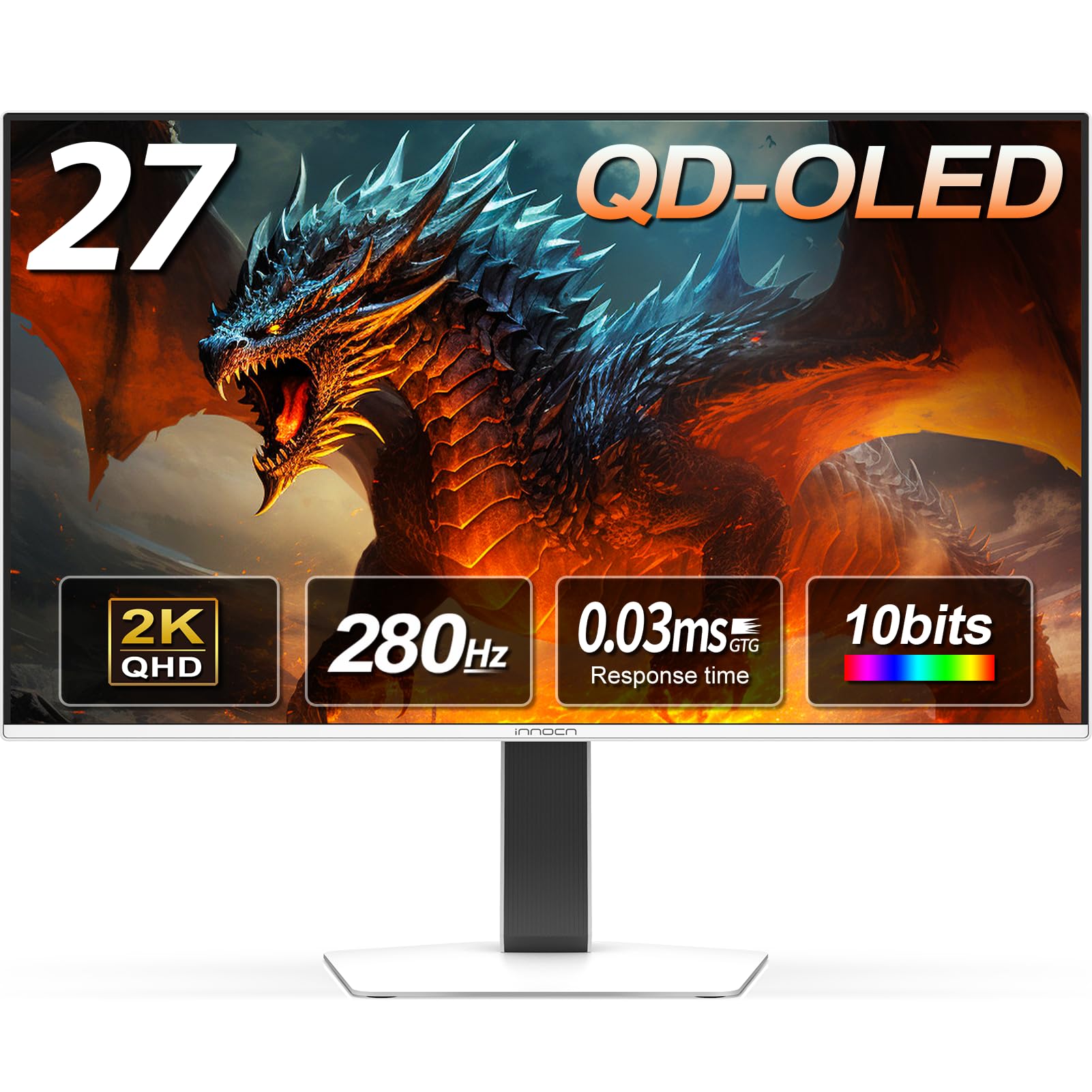
The INNOCN 2780s is a QD-OLED monitor that overclocks to 280Hz, slightly exceeding the standard 240Hz threshold for an extra margin of smoothness. Its 0.03ms response time and 1500000:1 contrast ratio produce stunning image quality with perfect blacks.
With HDMI 2.1 and DisplayPort inputs, the monitor supports full high-refresh rate gaming on both PC and consoles. The stand includes height, tilt, and pivot adjustments, and the white color variant offers a clean alternative to the standard black aesthetic. INNOCN provides lifetime technical support with a 30-day free replacement warranty.
Customer reviews consistently praise the upgrade in image quality over standard VA panels, but note that the built-in speakers are weak. The OSD has limited adjustment for dark and light picture settings, which may frustrate users wanting fine control.
Why it’s great
- 280Hz overclocked refresh rate provides extra smoothness
- Excellent QD-OLED contrast with 1500000:1 ratio
- Lifetime technical support with 30-day replacement warranty
Good to know
- Built-in speakers are weak and unsuitable for primary audio
- Limited OSD adjustments for fine-tuning picture settings
8. ASUS ROG Strix XG27AQDMG

The ASUS ROG Strix XG27AQDMG uses a third-generation WOLED panel with a glossy finish that significantly enhances perceived contrast and color vibrance compared to matte-coated OLEDs. Its custom heatsink and advanced airflow design actively reduce burn-in risk during long sessions.
ROG-exclusive OLED Anti-flicker technology stabilizes the panel during refresh rate fluctuations, reducing eye strain in variable framerate games. The monitor supports G-Sync Compatible and FreeSync Premium, with uniform brightness settings for consistent luminance across the screen.
Text clarity is slightly softer than on IPS panels due to the OLED subpixel layout, but color accuracy and motion clarity are top-tier. The 3-year warranty includes burn-in coverage, providing strong long-term protection for your investment.
Why it’s great
- Glossy WOLED finish delivers exceptional contrast and color pop
- Custom heatsink and anti-flicker technology improve longevity
- 3-year warranty with burn-in coverage
Good to know
- Auto-dimming screen saving features can be annoying
- No built-in speakers; external audio required
9. MSI MAG 271QPX QD-OLED E2

The MSI MAG 271QPX QD-OLED E2 is built around longevity, featuring OLED Care 2.0 with a graphene film and custom heatsink that eliminates the need for an active cooling fan. This fanless design ensures silent operation while extending panel life.
The QD-OLED panel delivers True Black HDR 400 with vibrant colors and deep blacks, and the 240Hz refresh rate at 0.03ms response provides smooth, artifact-free motion. HDMI 2.1 and DisplayPort 1.4 connectivity support full bandwidth for high-refresh gaming.
MSI includes a 3-year burn-in warranty, giving buyers confidence in long-term OLED use. The included stand is functional but bulky, and some users find the default pixel shift setting distracting until adjusted to a slower speed in the OSD.
Why it’s great
- Fanless design with graphene heatsink for silent operation
- 3-year burn-in warranty protects your investment
- Excellent color accuracy and contrast with True Black HDR 400
Good to know
- Bulky stand takes up significant desk space
- Default pixel shift setting may be distracting until adjusted to slow
10. ASUS ROG Strix XG27ACDNG

The ASUS ROG Strix XG27ACDNG pushes beyond standard 240Hz with a 360Hz refresh rate, making it one of the fastest QD-OLED monitors available at 1440p. Its 0.03ms response time and G-Sync Compatible/FreeSync Premium Pro support deliver the smoothest possible motion.
ROG-exclusive OLED Anti-flicker technology and a custom heatsink mitigate OLED wear, and ASUS OLED Care+ includes multiple prevention features. The monitor covers 99% DCI-P3 with Delta E < 2 accuracy, and DisplayWidget Center software allows mouse-based OSD adjustments.
The internal power brick eliminates an external adapter, and configurable RGB lighting adds aesthetic customization. Some users report limited height adjustment range on the stand, and pixel cleaning pop-ups can interrupt gameplay occasionally.
Why it’s great
- 360Hz refresh rate provides the smoothest motion in its class
- Internal power brick reduces cable clutter
- DisplayWidget Center enables easy software-based adjustments
Good to know
- Limited height adjustment range on the included stand
- Pixel cleaning pop-ups may interrupt gaming sessions
11. LG 27GX790A-B Ultragear OLED 480Hz
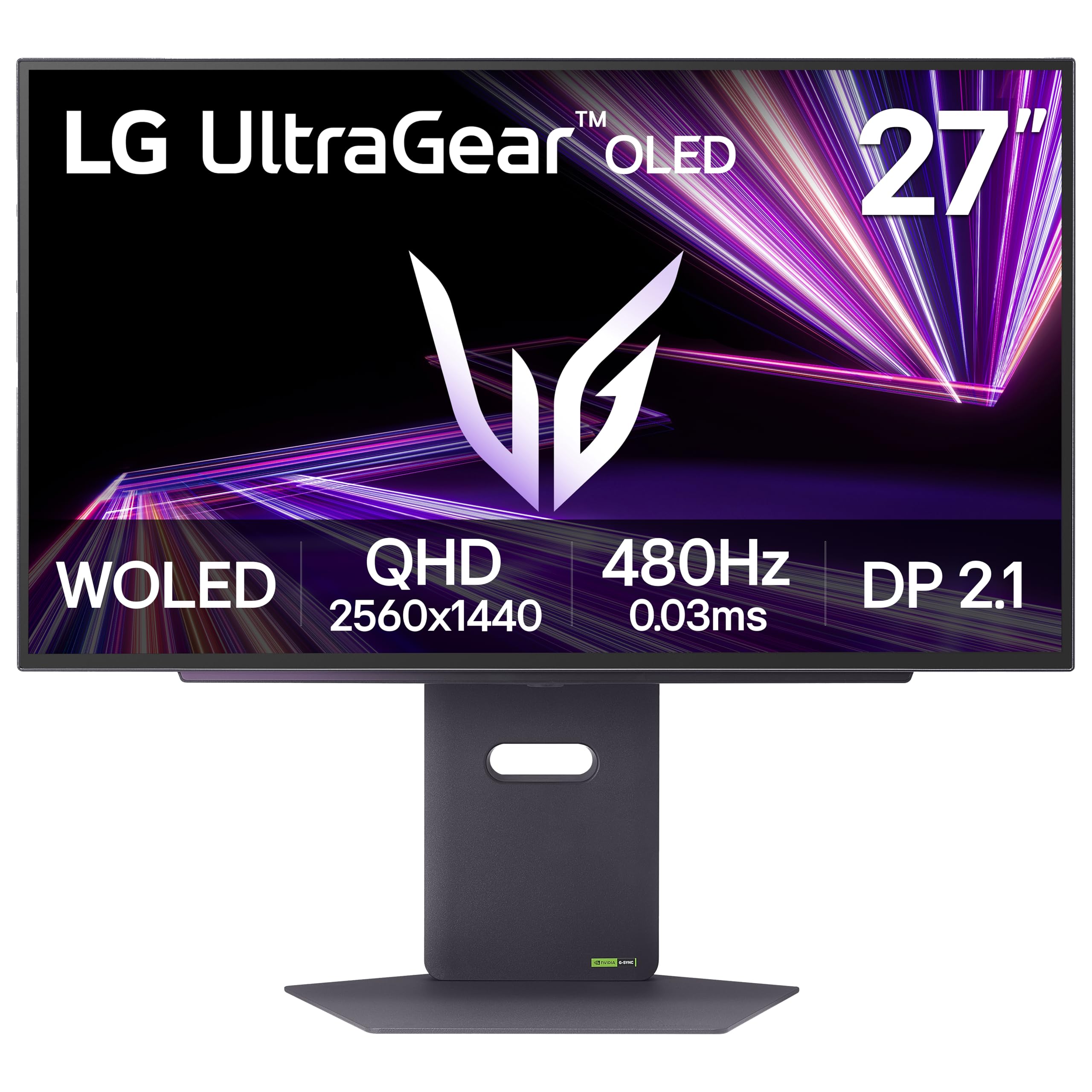
The LG 27GX790A-B redefines the category ceiling with a 480Hz refresh rate WOLED panel, targeting extreme motion clarity for competitive esports. Its 0.03ms response time and DisplayPort 2.1 connectivity provide the bandwidth necessary for this refresh rate at 1440p resolution.
DisplayHDR True Black 400 certification and 98.5% DCI-P3 coverage ensure rich colors and deep blacks despite the high refresh rate. The monitor includes advanced gaming features like Dynamic Action Sync, Black Stabilizer, and a FPS counter, plus a 4-pole headphone jack for spatial audio via DTS HP:X.
The fully adjustable stand supports height, tilt, swivel, and pivot, and RGB hexagonal backlighting adds flair. Note that some users report DP 2.1 implementation may not reach full UHBR13.5 speeds without DSC, so checking compatibility with your GPU is recommended.
Why it’s great
- 480Hz WOLED panel offers unmatched motion clarity
- DisplayPort 2.1 provides future-ready bandwidth
- Excellent HDR brightness with True Black 400 certification
Good to know
- DP 2.1 may require DSC for full bandwidth depending on GPU
- Matte coating can appear slightly grainy on static white pages
FAQ
Can my graphics card run a 240Hz 1440p monitor?
Is OLED worth it for a 240Hz 1440p monitor?
Do I need HDMI 2.1 for 240Hz at 1440p?
Final Thoughts: The Verdict
For most users, the 240hz 1440p monitor winner is the LG 27GS93QE because it combines WOLED’s superior bright-room black performance with accurate colors and a fully adjustable stand at a reasonable price. If you want glossy contrast and a burn-in warranty, grab the ASUS ROG Strix XG27AQDMG. And for extreme motion clarity with the highest refresh rate, nothing beats the LG 27GX790A-B.

Mo Maruf
I created WellFizz to bridge the gap between vague wellness advice and actionable solutions. My mission is simple: to decode the research and give you practical tools you can actually use.
Beyond the data, I am a passionate traveler. I believe that stepping away from the screen to explore new environments is essential for mental clarity and physical vitality.