Our readers keep the lights on and my smoothie glass nicely filled. As an Amazon Associate, I earn from qualifying purchases.
A ball valve that seizes after a season or drips from day one turns a simple shut-off into a constant headache. The quarter-turn mechanism is supposed to deliver instant isolation, but thread quality, port diameter, and body material determine whether you get a reliable seal or a frustrating weep. Choosing the right valve for your pipe material and pressure requirements eliminates service callbacks and keeps your system tight.
I’m Mohammad Maruf — the founder and writer behind WellFizz. I’ve spent years analyzing plumbing hardware specifications, from NPT thread tolerances to WOG pressure ratings, to separate durable fittings from disposable ones.
This guide breaks down five of the most reliable brass ball valves on the market today, covering full-port designs, push-fit convenience, and heavy-duty forged bodies so you can pick the right one for your next plumbing project. Read on for the thorough analysis of every best ball valve contender.
How To Choose The Best Ball Valve
Selecting the right ball valve means matching port size, body material, and connection type to your specific plumbing application. A valve rated for 150 PSI WSP might handle a garden hose perfectly but fail on a gas line. Understanding three key criteria narrows the field fast.
Port Size: Full Port vs. Standard Port
Full-port ball valves have a bore diameter equal to the pipe’s inner diameter, which eliminates flow restriction and pressure drop. Standard-port valves use a smaller ball bore and reduce flow by up to 20% — acceptable for shut-off applications but not ideal for systems requiring maximum throughput. For irrigation lines, water heaters, or main supply shut-offs, full port is almost always the right call.
Pressure Ratings: WSP, WOG, and CWP
WSP (Working Steam Pressure) refers to the maximum allowable pressure for steam service, typically lower than WOG (Water, Oil, Gas) ratings. CWP (Cold Working Pressure) is the maximum pressure at ambient temperature. A 600 PSI WOG valve can handle high-pressure liquid systems, while a 150 PSI WSP rating ensures safety in steam lines. Always check both numbers against your system’s maximum operating pressure.
Connection Type: Threaded, Solder, or Push-Fit
NPT threaded connections are the most common for brass ball valves and require thread sealant like pipe dope or PTFE tape to ensure a leak-free joint. Push-fit valves (compatible with PEX, CPVC, and copper) eliminate the need for tools but demand perfectly square, clean pipe cuts for proper seating. Solder-type connections are less common on ball valves today but still appear in copper plumbing systems.
Quick Comparison
On smaller screens, swipe sideways to see the full table.
| Model | Category | Best For | Key Spec | Amazon |
|---|---|---|---|---|
| Eastman 20047LF | Full Port Brass | Potable water shut-off | 600 PSI WOG / 150 PSI saturated steam | Amazon |
| Midwest Control MBB-75 | Forged Brass Heavy-Duty | High-pressure gas and oil | 600 PSI CWP, forged brass body | Amazon |
| VALFLUIDS Full Port | Lead-Free Threaded | Drinking water lines | 150 PSI WSP / 600 PSI WOG | Amazon |
| EFIELD Push-Fit | Push-Fit PEX | No-tool PEX installation | 200 PSI max, UPC certified | Amazon |
| MI MADOL Hose Valve | Garden Hose Thread | Garden/patio hose connection | 3/4 NPT x hose thread, brass | Amazon |
In‑Depth Reviews
1. Eastman 20047LF Heavy Duty Full Port Ball Valve

The Eastman 20047LF delivers a full-port 3/4-inch IPS design that keeps flow restriction near zero, making it an ideal shut-off for main water lines and water heater connections. The Teflon seal and brass construction handle both high-temperature steam (up to 150 PSIG saturated steam) and high-pressure liquid service at 600 WOG without seizing or degrading over time.
Vinyl-coated stamped steel handle provides a comfortable, no-slip grip during quarter-turn operation, which is especially useful in cramped under-sink spaces where leverage is limited. The valve meets UPC and CSA standards and is certified for potable water, so it is safe for drinking water lines. Multiple user reports confirm leak-free performance after years of service when properly installed with thread sealant.
One important consideration is the fastening nut material — a few users noted rust on the nut after extended outdoor exposure, suggesting the nut uses a less corrosion-resistant alloy than the brass body. For indoor use or dry environments this is irrelevant, but for outdoor installations, periodic inspection or a stainless-steel nut replacement is advisable.
Why it’s great
- Full-port design eliminates pressure drop
- Rated for both high-pressure water and saturated steam
- UPC and CSA certified for potable water
Good to know
- Fastening nut can rust in outdoor conditions
- Vinyl handle may feel small for heavy-glove operation
2. Midwest Control MBB-75 600 PSI CWP Forged Brass Ball Valve

The Midwest Control MBB-75 uses a heavy-duty forged brass body that resists cracking under thermal cycling and vibration far better than cast-brass alternatives. Rated at 600 PSI CWP with a full-port internal design, this valve is built for industrial and commercial applications such as compressed air lines, oil systems, and natural gas service where pressure spikes and flow consistency matter.
UL, CSA, FM, and CE approvals confirm the valve meets rigorous safety standards across multiple regulatory bodies, giving specifiers confidence in critical systems. The NPT threads are cleanly machined and engage smoothly, though it is important to note that the threads are standard NPT pipe thread — not garden hose thread — so adapters are required for hose connections. The valve is also vacuum-rated to 29.9 inches of mercury, enabling use in suction-side applications.
One critical restriction — this valve is explicitly not certified for potable water systems, so it should not be used on drinking water lines. A small number of units have arrived with stripped threads, which points to occasional quality-control gaps. For non-potable high-pressure applications, however, the MBB-75 offers forged-brass toughness at a very competitive price point.
Why it’s great
- Forged brass body for superior crack resistance
- Multiple safety certifications (UL, CSA, FM, CE)
- Full-port design and vacuum-rated service
Good to know
- Not approved for potable (drinking) water systems
- Occasional QC issues with stripped NPT threads
3. VALFLUIDS Full Port Lead-Free Brass Ball Valve

The VALFLUIDS full-port valve combines lead-free brass construction with a two-piece body design and blowout-proof stem, delivering peace of mind for potable water installations at a budget-friendly price. PTFE seats provide consistent sealing across temperature swings, and the CSA/CUPC approval confirms compliance with North American drinking water standards.
Available in sizes from 1/2 inch to 2 inches, this valve’s 1/2-inch variant (model V1500201) handles 150 PSI WSP and 600 PSI WOG, making it suitable for residential water supply lines, hydronic heating systems, and compressed air lines. User feedback highlights clean, well-cut NPT threads that seal easily with standard pipe dope, and the smooth quarter-turn operation requires minimal effort even after months of inactivity.
Several user reports describe units arriving with the internal ball missing entirely, rendering the valve non-functional. This defect rate appears to be small but notable, and suggests batch-specific quality issues. Additionally, the pack does not include mounting hardware or a separate handle lock, so you may need to source those separately for permanent installations.
Why it’s great
- Lead-free brass safe for drinking water
- Blowout-proof stem and PTFE seats for reliable sealing
- CSA/CUPC certified for potable systems
Good to know
- Small risk of defective units with missing ball
- No handle lock or mounting hardware included
4. EFIELD 3/4 Inch Push-Fit Ball Valve
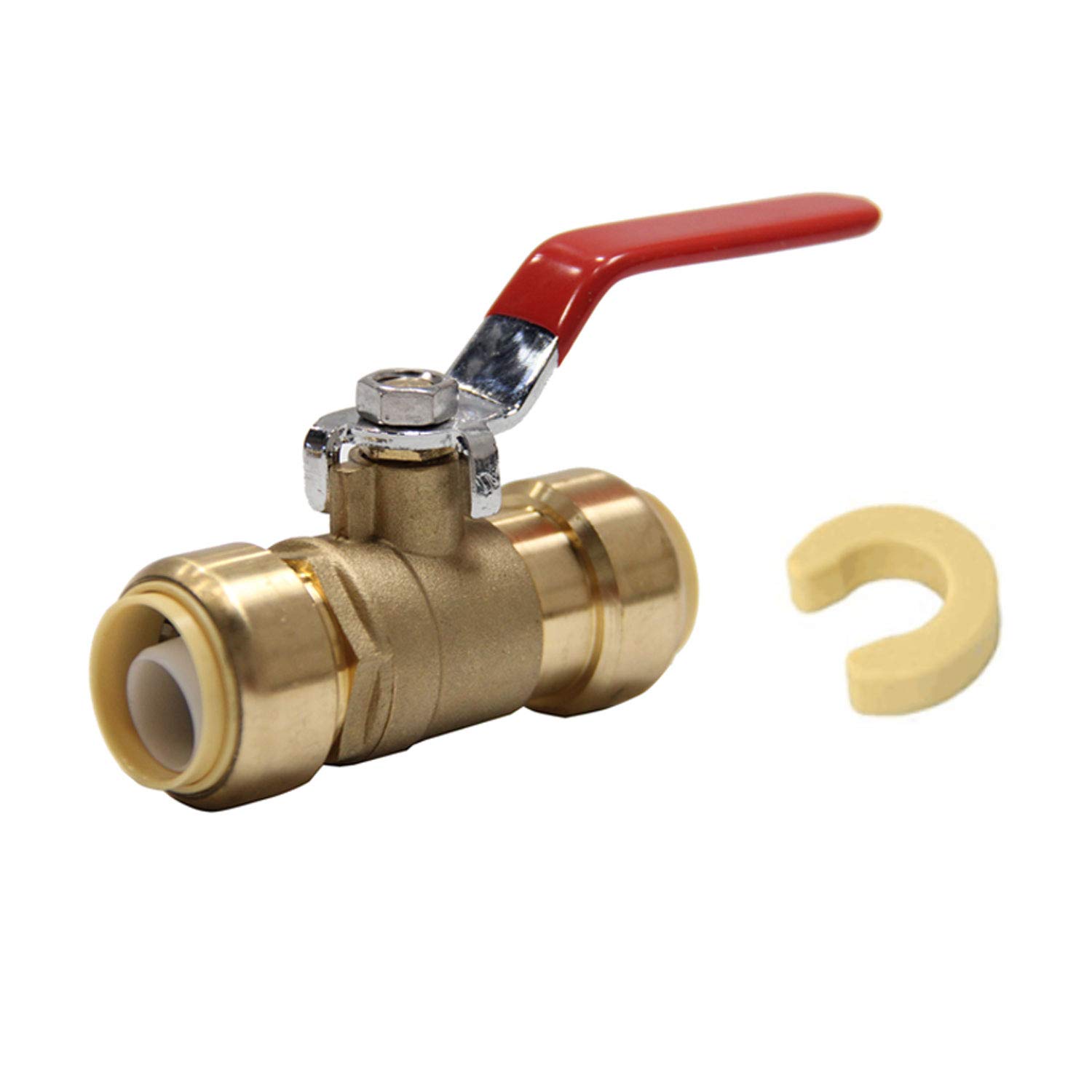
The EFIELD push-fit ball valve eliminates threading and soldering, connecting directly to PEX, CPVC, and copper pipe using just hand pressure. The DZR forged brass body resists dezincification corrosion, a common failure mode in brass fittings exposed to aggressive water chemistry, and the included disconnect clip allows quick removal without cutting pipes.
Installation requires pipe ends to be perfectly square and clean to a depth of 1-1/8 inches — following that rule produces leak-free results that hold at the rated 200 PSI maximum. Users have reported successful installations in tight crawl spaces and under-sink cabinets where wrenches cannot fit, with some completing the job in under 30 seconds. The valve is UPC certified, supporting use in code-compliant plumbing systems.
The push-fit mechanism relies on a stainless-steel grab ring and O-ring seal; if the pipe surface is scored or not fully seated, the seal may leak. The valve is best suited for residential water temperatures and pressures — it is not designed for steam service or high-temperature hydronic systems. Also, the bright red release collar stands out visually if aesthetics matter in exposed installations.
Why it’s great
- Tool-free installation on PEX, CPVC, and copper
- DZR forged brass resists corrosion
- Disconnect clip enables fast removal without pipe cutting
Good to know
- Requires perfectly square, clean pipe cuts for sealing
- Not suitable for steam or high-temperature applications
5. MI MADOL Brass Ball Valve Garden Hose Valve

The MI MADOL garden hose ball valve uniquely combines a 3/4-inch male NPT inlet with a standard 3/4-inch garden hose thread outlet, allowing direct attachment to hose bibs without adapters. The brass body withstands temperatures up to 248°F, making it suitable for hot water garden applications or solar heating systems, and the quarter-turn butterfly handle provides instant flow control even with wet or gloved hands.
Users consistently praise the smooth, drip-free operation and the secure hose connection. One reviewer noted that the internal ball bore could be larger to maximize flow — though for typical garden hose use at standard residential pressure, the flow is more than adequate. The valve measures 3 x 1 x 2 inches and weighs under half a pound, keeping the assembly light on the faucet.
Because this valve uses hose-thread (GHT) on the outlet side rather than NPT, it will not connect to standard threaded iron pipe without an adapter. The single-piece handle offers no positive locking position, so vibration or accidental bumping could open or close the valve slightly. For dedicated garden hose duty where convenience and speed matter, this valve delivers a purpose-built solution.
Why it’s great
- Direct NPT-to-hose thread connection without adapters
- Brass construction rated to 248°F for hot water use
- Quarter-turn butterfly handle for fast gloved operation
Good to know
- Smaller ball bore restricts flow slightly
- No positive handle lock against accidental movement
FAQ
Can I use a brass ball valve for natural gas service?
What is the difference between NPT and garden hose thread?
Why would I choose a push-fit ball valve over a threaded one?
Final Thoughts: The Verdict
For most users, the best ball valve winner is the Eastman 20047LF because its full-port design, potable water certification, and dual WOG/steam pressure ratings cover the widest range of residential and light-commercial applications. If you need a forged-brass valve for high-pressure gas or oil service, grab the Midwest Control MBB-75. And for a tool-free push-fit solution that connects to PEX without thread sealant, nothing beats the EFIELD Push-Fit Valve.

Mo Maruf
I created WellFizz to bridge the gap between vague wellness advice and actionable solutions. My mission is simple: to decode the research and give you practical tools you can actually use.
Beyond the data, I am a passionate traveler. I believe that stepping away from the screen to explore new environments is essential for mental clarity and physical vitality.