Our readers keep the lights on and my smoothie glass nicely filled. As an Amazon Associate, I earn from qualifying purchases.
A scarf that curls, a granny square that refuses to lie flat, or a lace doily that looks more like a crumpled napkin — these are the frustrations that make or break a handmade project. A dedicated blocking board is the single tool that transforms wonky stitches into fabric with crisp, professional edges, and it saves you from the tedium of pinning into sofa cushions or ironing boards.
I’m Mohammad Maruf — the founder and writer behind WellFizz. I’ve spent years researching the hardware behind knitting and crochet accessories, analyzing material density, grid accuracy, pin compatibility, and how each design handles the moisture and tension that come with serious blocking sessions.
Whether you are blocking a stack of 6-inch squares or a full Hexi blanket, choosing the wrong board leads to warped results or wasted time. This guide to the best blocking board for knitting breaks down the specs that actually matter so you can pick the one that fits your workflow.
How To Choose The Best Blocking Board For Knitting
A blocking board is a simple tool, but the wrong one can make your stitches uneven or frustrate you with flimsy pins. Here is what you need to look at before buying.
Material Core: Bamboo vs. Foam
Bamboo boards are rigid, moisture-resistant, and keep pins locked at 90-degree angles. They are ideal for repeated use on granny squares and lace motifs. Foam boards are lighter, interlock into large surfaces, and absorb pins easily, but they compress over time and can warp under heavy moisture or tight pinning.
Grid Density and Hole Count
For bamboo boards, the number of holes per row determines how many squares you can block simultaneously. A board with 20 holes per row (400 holes total) lets you pin a dozen 6-inch squares without crowding. Fewer holes mean you cannot block large motifs in one go without buying extra boards.
Pin Inclusion and Length
Most bamboo boards come with 15 to 30 stainless steel pins. If you block multiple squares at once, you will need at least four pins per square (often more). A board that ships with only 15 pins forces you to buy a separate pack immediately, so check the included pin count against your typical project volume.
Portability and Storage
Foam mats disassemble into individual tiles that fit into a bag. Bamboo boards are bulkier; look for foldable or magnetic-splicing designs that stack neatly. If you attend knit nights or travel with projects, a lightweight foam set with a storage pouch is much easier to carry.
Quick Comparison
On smaller screens, swipe sideways to see the full table.
| Model | Category | Best For | Key Spec | Amazon |
|---|---|---|---|---|
| Juvale Foam Blocking Pad Set | Foam Tile Set | Portable large-surface blocking | 0.7-inch thick foam with grid | Amazon |
| Iswabard Magnetic Splicing Board | Magnetic Bamboo | Expandable workspace for large projects | 4 interlocking 8×8 bamboo panels | Amazon |
| LIVSMON 13 Inch Crochet Board | Bamboo Fixed | Precise granny square blocking | 529 holes, 30 steel pins | Amazon |
| Iswabard 15.75″ Foldable Board | Foldable Bamboo | Large single-board blocking | 400 holes, pine wood base | Amazon |
| Knit Picks Blocking Mats | Foam Tile Set | Budget-friendly precision blocking | 9 textured rubber tiles | Amazon |
In‑Depth Reviews
1. Juvale Foam Blocking Pad Set

This kit is the most complete foam solution on the list. The 0.7-inch thick foam tiles interlock firmly to create a 37.5 x 37.5-inch seamless surface — large enough to block a full sweater or multiple granny squares in a single session. The grid lines printed on each panel align accurately when placed in the correct 3×3 order, making it easy to pin symmetrically.
The 200 T-pins are a serious bonus. Juvale gives you enough to pin two dozen 6-inch squares at once. The included zippered storage bag with a handle keeps everything organized and portable, which matters if you take projects to knit nights.
Reviewers specifically note that the foam holds pins securely without the pins pulling out under tension, and the tiles resist bowing during moderate pinning. The one trade-off is that foam compresses slightly over years of heavy use, and the grid spacing is just over 1 inch rather than a perfect 1-inch metric. For most crochet and knitting blocking needs, this is a precision tool at a practical price.
Why it’s great
- Huge blocking surface from 9 interlocking tiles
- 200 T-pins included so you can work on many squares at once
- Lightweight foam with a durable storage bag for travel
Good to know
- Grid lines require specific panel order to align correctly
- Foam may bow if pins are pulled very tight on large pieces
2. Iswabard Magnetic Splicing Crochet Blocking Board
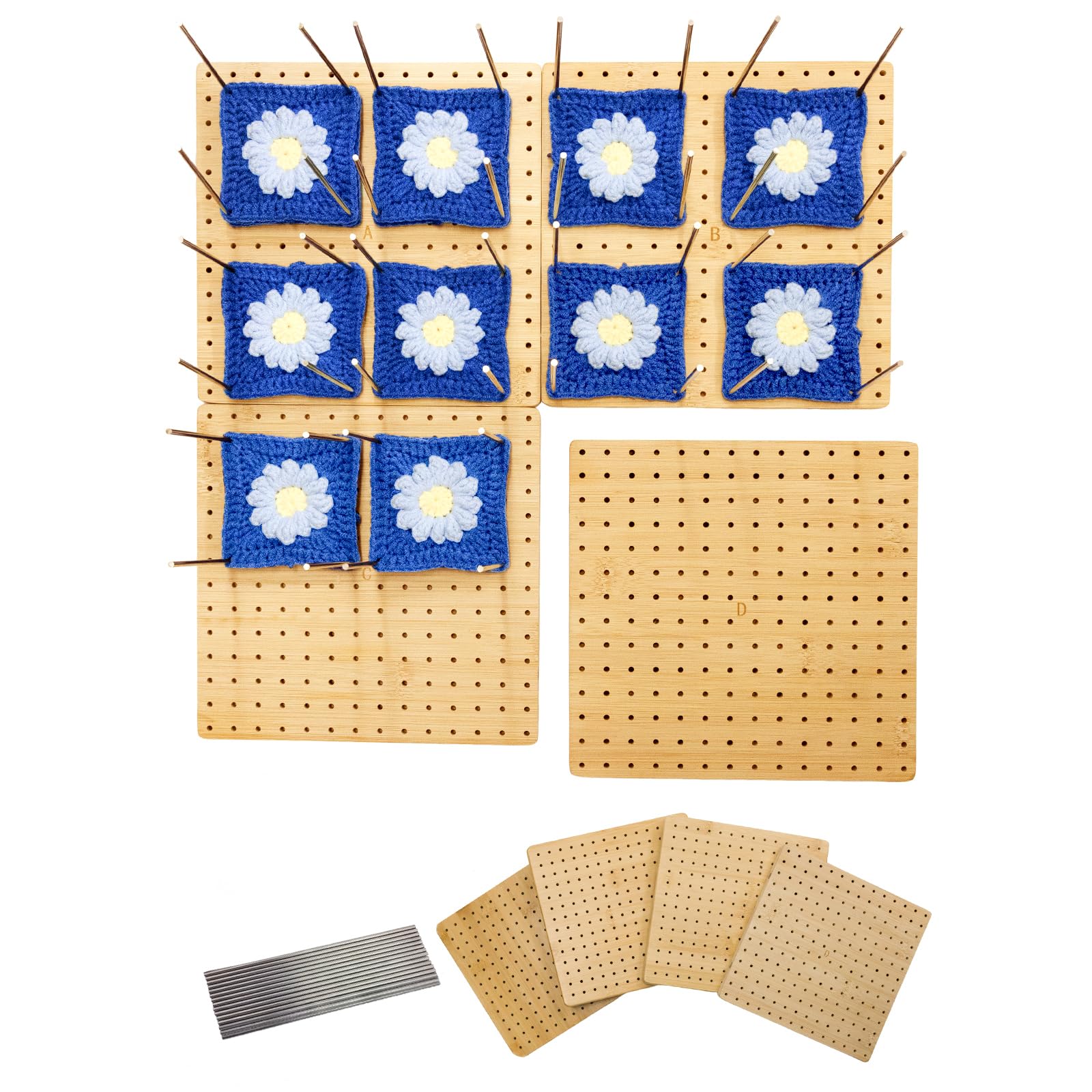
This board uses an innovative magnetic connection system that lets you snap four 8×8-inch bamboo panels together into a single 16×16-inch workspace. Unlike foam tiles that rely on notch-fit alone, the magnetic edges create a rigid, gap-free surface that stays flat during pinning. When you are done, the panels separate and stack into a compact unit — ideal for small storage spaces.
The bamboo is finished with a clear varnish that resists moisture and heat, so steaming or spritzing your squares will not warp the board. Each panel has a grid of holes designed to hold the included stainless steel pegs securely. Reviewers confirm the pins fit tightly without pulling out, even when squares are stretched to exact dimensions. The board accommodates up to 48 squares in one session with extra pegs.
One consideration: the kit ships with only enough pegs for a moderate blocking session. If you plan to fill the entire 16×16 area of all four panels, you will need to buy additional pegs. The build quality is excellent, and the magnetic splicing is genuinely useful for crafters who want a large surface that does not dominate their shelf.
Why it’s great
- Magnetic splice creates a rigid, gap-free 16×16 surface
- Stacks flat for storage when disconnected
- Varnished bamboo resists moisture and heat
Good to know
- Sold with limited pegs — extra pegs needed for full-capacity blocking
- Magnetic connection is strong but individual panels can shift if bumped hard
3. LIVSMON 13 Inch Crochet Blocking Board
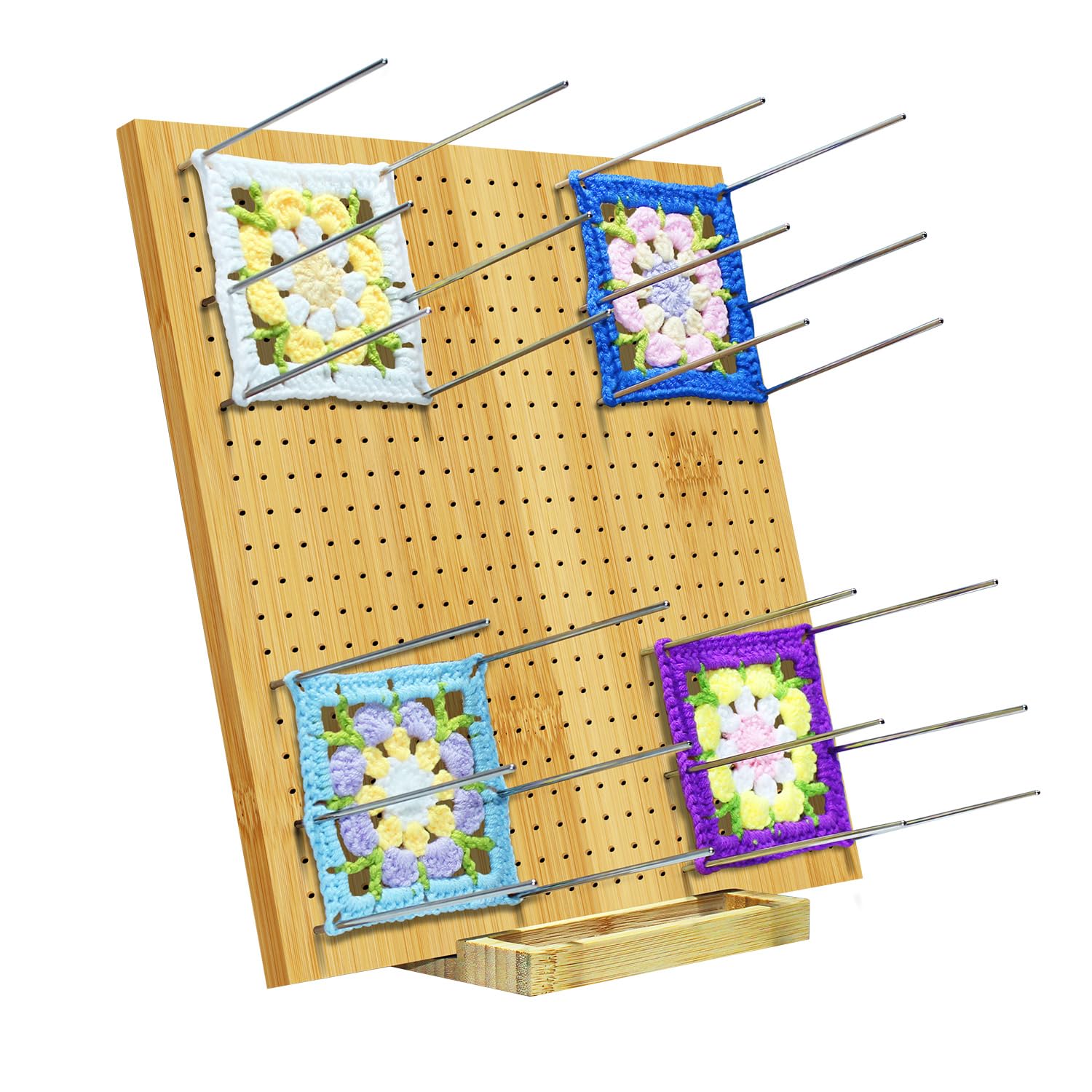
With 23 holes per row and 529 total holes, this board offers the densest pinning grid among the bamboo options. That density matters when you are blocking granny squares with different stitch counts — you can place pins exactly where tension is needed without being constrained by a sparse layout. The 13 x 13-inch workspace is large enough for a single round of 12-inch motifs or multiple smaller squares.
The board is handcrafted from bamboo that has been polished smooth with no burrs or odor. The included 30 stainless steel rod pins are longer than typical T-pins, giving you more grip for thicker yarn projects. Reviewers consistently mention that the squares come out uniformly sized and that the pegs hold even during aggressive stretching.
The main limitation is the fixed, non-expandable size. If you need to block a full blanket or sweater, this board is too small on its own. Also, some users note that pins near the top of taller squares can bow inward slightly under tension. It is a specialized tool that excels at small-to-medium square blocking but is not a universal solution.
Why it’s great
- 529-hole grid gives precise pin placement for any square size
- 30 long stainless steel pins hold thick yarn securely
- Smooth bamboo finish with no sharp edges or odor
Good to know
- Fixed 13-inch size limits large-project blocking
- Pins near top of taller squares can bow inwards slightly
4. Iswabard 15.75″ Foldable Granny Square Blocking Board
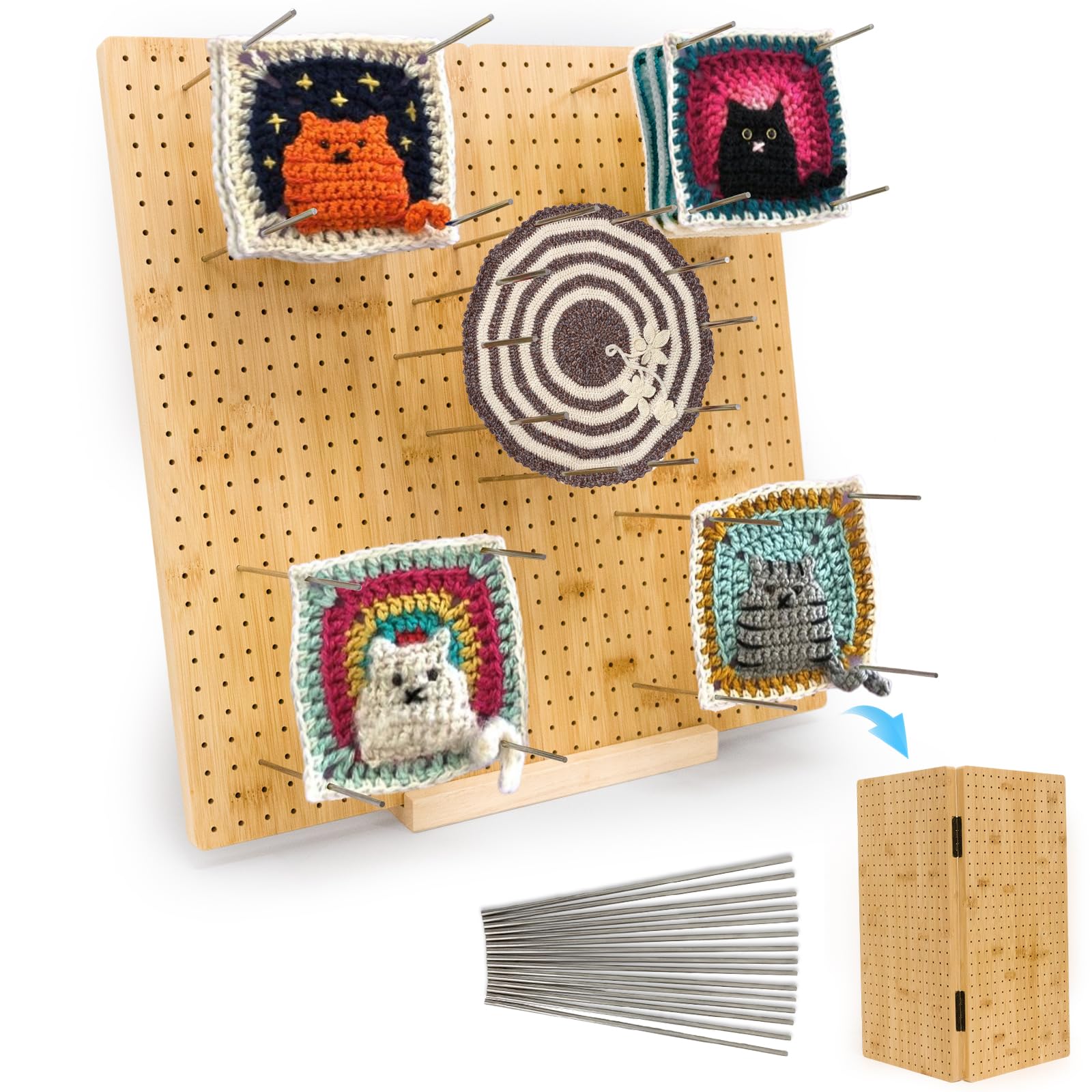
This board delivers the largest single-panel bamboo surface on the list at 15.75 x 15.75 inches, with 400 holes laid out in a 20-per-row grid. The foldable design splits the board into two halves that close together for storage, solving the bulk problem that plagues most large bamboo boards. A pine wood base adds stability, and the bamboo surface is smooth and well-finished.
Fifteen stainless steel pins come included, each 5.9 inches long — enough to block a few squares or motifs immediately. Reviewers appreciate that the board can hold up to eight 6-inch granny squares at once and that the pins insert about half an inch deep for a secure fit. The chamfered holes make pin insertion easy without wobble.
The main drawback is the pin count. Fifteen pins is the lowest inclusion of any bamboo board in this group, and most users will need an additional set before the first blocking session is over. The pin storage recess on the base works well, but the fit can feel slightly loose. For crafters who need a large, foldable bamboo board and are willing to buy extra pins separately, this is a solid choice.
Why it’s great
- Largest single bamboo surface at nearly 16 inches square
- Foldable design makes storage practical
- Pine wood base and chamfered holes for easy pinning
Good to know
- Comes with only 15 pins — an extra pack is a must for most projects
- Pin storage holder feels slightly loose
5. Knit Picks Blocking Mats for Knitting and Crochet

Knit Picks offers nine textured rubber tiles that measure 13 x 13.1 inches each, giving you a combined blocking surface that rivals any foam set in this price tier. The rubber material is softer than the Juvale foam, which means pins insert easily and hold well — reviewers mention that even starched lace doilies pin without the pins slipping or sticking to the board.
The tiles fit together with simple notch joints. They are not interlocking with a locking mechanism, but they stay aligned well during use. The textured surface provides grip that prevents yarn from sliding, and the rubber is durable enough for repeated pinning without developing permanent holes. Users have used these for years without visible wear.
The biggest missing feature is a printed grid. You cannot rely on visible lines to align squares symmetrically, so you must measure manually or use an external ruler for precise blocking. The tiles are also thinner than the Juvale option — some reviewers wish they were thicker for a more substantial feel. As an entry-level solution that gets you a large blocking area at a low entry cost, these mats work reliably.
Why it’s great
- Large total surface from 9 tiles at a very low entry cost
- Soft rubber grips pins securely without permanent damage
- Proven durability over years of use according to loyal customers
Good to know
- No printed grid lines — requires manual measurement for symmetry
- Thinner material feels less substantial than premium foam options
FAQ
Can I use a foam blocking board for steam blocking?
How many pins do I actually need for granny squares?
Is a bamboo board better than foam for blocking lace?
What size blocking board do I need for a sweater?
Final Thoughts: The Verdict
For most users, the blocking board for knitting winner is the Juvale Foam Blocking Pad Set because it combines a massive interlocking surface with 200 pins and a storage bag at a practical price point that suits both beginners and advanced makers. If you prioritize a rigid bamboo surface with precise hole spacing for granny squares, grab the LIVSMON 13 Inch Board. And for a portable expandable workspace that folds flat, nothing beats the Iswabard Magnetic Splicing Board.

Mo Maruf
I created WellFizz to bridge the gap between vague wellness advice and actionable solutions. My mission is simple: to decode the research and give you practical tools you can actually use.
Beyond the data, I am a passionate traveler. I believe that stepping away from the screen to explore new environments is essential for mental clarity and physical vitality.