Our readers keep the lights on and my smoothie glass nicely filled. As an Amazon Associate, I earn from qualifying purchases.
A cold night on rocky ground is only part of the problem. Waking up with a stiff hip or a numb shoulder after your sleeping pad went flat at 3 a.m. is the real reason many campers quit a trip early. The gap between a cheap inflatable and a proper insulated pad is measured in hours of quality sleep—hours that determine whether you hike the next day or pack the car.
I’m Mohammad Maruf — the founder and writer behind WellFizz. I’ve spent the last few seasons dissecting foam densities, valve mechanisms, and ASTM-tested R-values to separate the pads that hold their warmth from the ones that leave you shivering on a deflating bubble.
Whether you are a backcountry hiker shaving grams or a car camper who refuses to sacrifice comfort, this guide breaks down the insulation, thickness, and portability trade-offs that define every serious camping mattress pad on the market right now.
How To Choose The Best Camping Mattress Pad
Buying a pad without understanding R-value and foam density is the fastest route to a cold, uncomfortable night. The market spans closed-cell foam slabs and 4-inch air chambers, each with a specific use case. Start by matching the pad’s insulation to the lowest temperature you expect, then weigh the packed size against your carrying method—backpack or car trunk.
R-Value and Insulation
The ASTM-tested R-value measures how well the pad resists heat transfer. A 3-season pad typically carries an R-value between 4.0 and 5.0, while a 4-season winter pad needs at least 6.0 to keep you warm on frozen ground. Some budget pads omit testing numbers entirely—avoid those if you camp below freezing.
Thickness and Body Support
Thickness directly affects comfort for side sleepers. A 3-inch pad is fine for back sleepers, but side sleepers with sensitive hips need at least 4 inches to avoid bottoming out. Thicker pads also offer more loft, which means better insulation from conductive ground cold.
Weight and Packed Volume
Backpackers should target pads under 2 pounds with a packed diameter of 5 inches or less. Car campers and overlanders can ignore weight entirely and focus on width and thickness—a 30-inch wide pad allows arm sprawl and prevents rolling off during the night.
Construction Type
Self-inflating foam pads combine a foam core with an air chamber for balanced support and thermal insulation. Air-only pads are lighter and pack smaller but require a pump sack or lungs and offer less insulation unless they include reflective layers. Closed-cell foam pads are bombproof and cheap but lack the plushness that most campers expect.
Quick Comparison
On smaller screens, swipe sideways to see the full table.
| Model | Category | Best For | Key Spec | Amazon |
|---|---|---|---|---|
| Acacia 4″ | Self‑Inflating | Ultra‑portable comfort | 4.3″ thick / R‑6.0 / 440‑lb capacity | Amazon |
| Sea to Summit Ether Light XR Pro | Air‑Sprung | Lightweight 4‑season | 3.9″ thick / R‑7.4 / 1.5‑lb pack weight | Amazon |
| Exped MegaMat Long X‑Wide | Self‑Inflating | Vehicle & tent dual‑use | 4″ thick / R‑8.1 / 77.6″ x 30.3″ | Amazon |
| Therm‑a‑Rest MondoKing 3D | Self‑Inflating | Ultimate car‑camp luxury | 4.25″ thick / R‑7.0 / 80″ x 30″ | Amazon |
| Big Agnes Rapide SL | Insulated Air | Ultralight backpacking | 4.25″ thick / R‑4.8 / 1.4‑lb | Amazon |
| Hikenture 4″ | Self‑Inflating | Budget 4‑season car camping | 4″ thick / R‑9.5 / 6.5‑lb | Amazon |
| Therm‑a‑Rest LuxuryMap | Self‑Inflating | Pressure‑mapped support | 3″ thick / R‑6.0 / 77″ x 30″ | Amazon |
| NEMO Tensor All‑Season | Insulated Air | Ultralight & quiet | 3.5″ thick / R‑5.4 / 1.1‑lb | Amazon |
| HEST Foamy | Memory Foam | Car‑camper luxury sleep | 8.8″ thick / dual‑layer foam / 11‑lb | Amazon |
In‑Depth Reviews
1. Acacia 4″ Thick Self Inflating Sleeping Pad

The Acacia uses a Y-shaped telescopic foam core that compresses volume by up to 60% after deflation, making it one of the most packable 4-inch pads in the mid-range tier. At 4.3 inches of loft, it supports side sleepers without bottoming out, and the 440-pound capacity means heavier campers won’t sink through to the tent floor. The rugged 30D elastic fabric with TPU coating resists abrasions far better than ultralight nylons used on backpacking pads.
The two-way automatic valve handles most of the inflation, and the included pump sack lets you fine-tune firmness without blowing moisture into the foam core. An R-value of 6.0 keeps you warm through three-season conditions and shoulder-season frosts, while the side buckles allow you to connect two pads for a couple’s sleep system. The trade-off is weight—it is not ultralight, but for car campers and motorcycle tourers who prioritize comfort, the packed size is impressive.
Owners report that the pad stays firm all night with no mid-sleep top-offs, and the thermal foam does an honest job of insulating against cold ground. The bag doubles as a pump, though a few users note the bag is thin and requires gentle handling. For the balance of warmth, thickness, and packability at its price point, this pad sets a high benchmark.
Why it’s great
- Compressed volume is 60% smaller than standard foam pads
- Adjustable firmness via pump sack for personalized comfort
- R‑6.0 insulation works for three‑season plus cold snaps
Good to know
- Not compact enough for ultralight backpacking
- Inflation sack is thin and needs careful handling
2. Sea to Summit Ether Light XR Pro Insulated Sleeping Pad

The Ether Light XR Pro packs a four-season R-value of 7.4 into a 1.5-pound package that rolls down to half the size of previous Ether models. The Air Sprung Cell construction uses individual air chambers that move independently, so you don’t feel your partner roll over, and the 3.9-inch thickness provides genuine side-sleeper support. The ThermalCore insulation uses multiple reflective layers that stay quiet—no crinkle sound when you shift positions.
The integrated XPRESS valve and pump sack system make inflation fast and adjustment precise, though you can also use an electric pump. The rectangular Regular size measures 72 by 25 inches, giving broad-shouldered campers room without wasting weight on extra width. The nylon face fabric is durable enough for tent floors but still packs down to a fist-sized bundle that fits inside most backpacking packs.
Customer feedback consistently highlights how warm this pad feels in sub-freezing conditions, with no cold spots even on snow. Some users mention the pad requires a small breath top-off after the initial foam expansion settles. The price is in the premium bracket, but the warmth-to-weight ratio justifies it for serious backpackers who need a single pad for all seasons.
Why it’s great
- R‑7.4 is one of the highest ratings in a sub‑2‑lb pad
- Quiet reflective insulation with zero crinkle
- Individual Air Sprung Cells eliminate partner roll disturbance
Good to know
- Premium price point limits it to dedicated users
- Occasional need for a small air top‑off after setup
3. Exped MegaMat Long X-Wide – Self Inflating Foam Pad
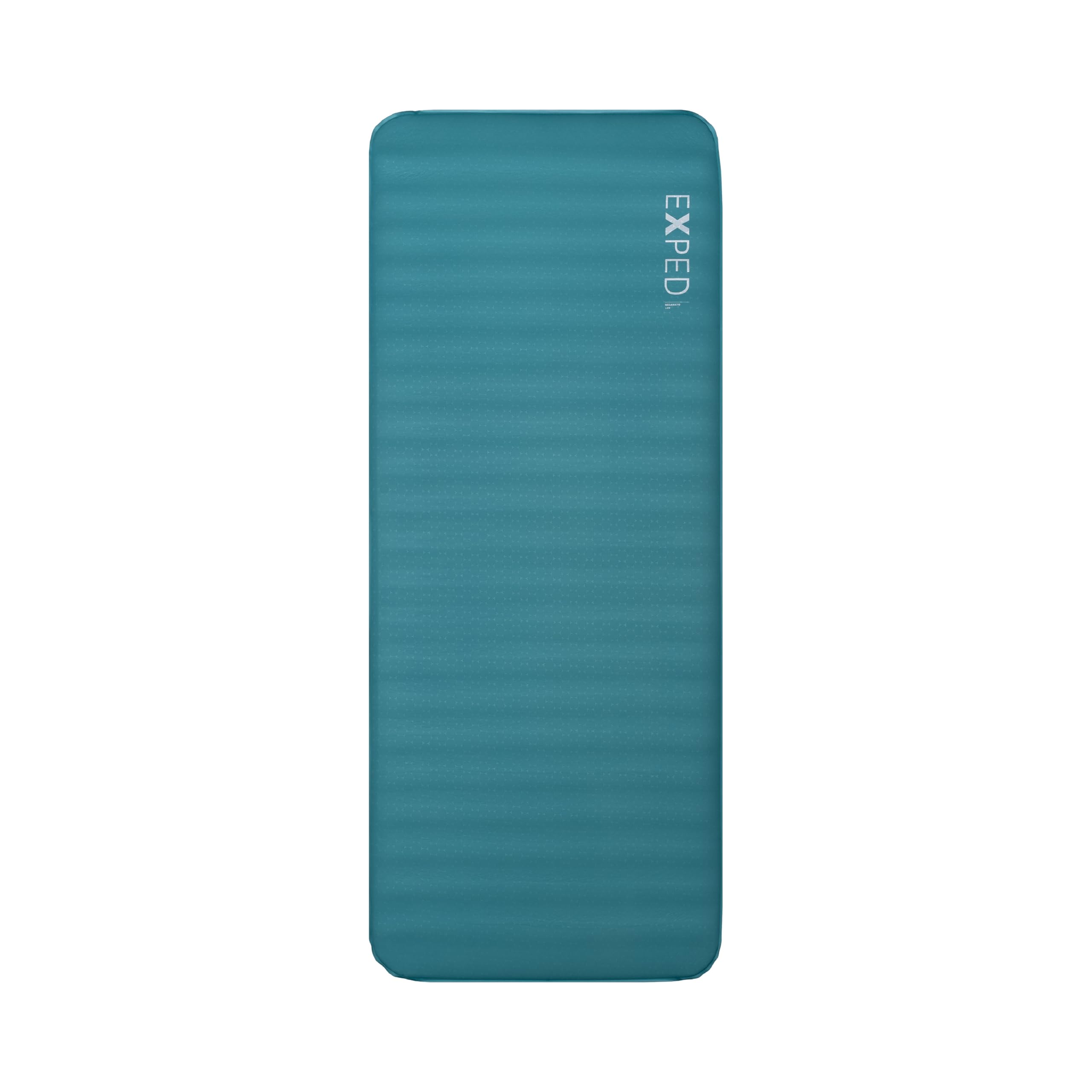
The Exped MegaMat is the reference standard for car-camping and overland sleep systems. At 77.6 inches long and 30.3 inches wide, with a 4-inch profile, it offers a true twin-sized sleep surface. The open-cell foam core with air-channeled insulation delivers an R-value of 8.1, which means you can sleep directly on frozen ground without feeling the cold seep through. The 3D vertical sidewalls prevent the edge collapse that plagues tapered pads.
The self-inflating design uses a large valve that pulls air into the foam core within minutes. You can adjust firmness using the included Top-Up Pump, transitioning from plush to firm depending on your sleeping position. The recycled tricot polyester surface feels soft against skin and reduces fabric noise. At just under 6 pounds, it is too heavy for backpacking, but for vehicle-based trips, the comfort delta over cheaper pads is massive.
Long-term owners praise the build quality—welded handles, robust fabric, and a repair kit included. A small minority report leaks from the valve, but Exped’s customer service is noted for quick replacements. If you sleep in a truck bed, SUV, or large tent and refuse to compromise on mattress feel, this pad delivers a level of support that rivals a home bed.
Why it’s great
- R‑8.1 insulation for extreme cold without ground conductivity
- Full 30″ width with vertical sidewalls for maximum sleeping area
- Adjustable firmness with included Top‑Up Pump
Good to know
- Heavy at 5.7 lb—not for backpacking
- Valve quality inconsistency reported by some users
4. Therm-a-Rest MondoKing 3D Self-Inflating Sleeping Pad

The MondoKing 3D lives up to its name. At 80 by 30 inches with a 4.25-inch loft, it is the largest self-inflating pad Therm-a-Rest makes. The StrataCore construction sandwiches a continuous thermal foam layer between alternating air and foam ridges, achieving an R-value of 7.0 without adding excessive weight. The stretch knit fabric layer on top reduces sheets slipping and feels more like a mattress cover than a camping pad.
The TwinLock valve system uses separate one-way channels for inflation and deflation, so you can pump air in without backflow losing progress. The pad self-inflates to about 80 percent capacity, and a few breaths or pump-sack cycles bring it to full firmness. When packed, the roll measures about 10 inches in diameter and 31 inches long—manageable for car trunks and rooftop boxes. The PFAS-free DWR coating on the stuff sack keeps moisture off during storage.
Customer reports consistently emphasize that heavy users (up to 300 pounds) do not bottom out, and the pad stays firm through multiple nights. The vertical sidewalls create a flat surface that prevents that rolled-edge sensation. Some users note the pad can slide on slick tent floors, and the deflation valve requires precise alignment to avoid slow leaks. For car campers who want the closest thing to a home mattress, this pad is a reliable, USA-made choice.
Why it’s great
- Built in the USA with a limited lifetime warranty
- 4.25″ foam with R‑7.0 for deep winter insulation
- Stretch knit fabric prevents sheet slippage
Good to know
- Bulky when packed—not for backpacking
- Valve alignment can cause slow leaks if not fully closed
5. Big Agnes Rapide SL Insulated Sleeping Pad

The Rapide SL sits at the sweet spot between ultralight and genuinely comfortable. The quilted top creates a pillowy surface that distributes pressure evenly, and the offset I-beam construction keeps the 4.25-inch profile stable without the hammock-like bounce of cheaper air pads. At 1.4 pounds for the wide regular size, it fits neatly into a backpacking loadout without forcing you to sacrifice thickness.
The R-value of 4.8 is rated for three-season use, but pairing it with a closed-cell foam pad underneath pushes it into shoulder-season territory. The high-volume valve inflates quickly with the included Pumphouse sack—four minutes of pumping gets it to full firmness. The superlight double ripstop nylon with aviation-grade TPU lamination resists punctures better than standard balloon-style pads, and the repair kit adds peace of mind for rocky campsites.
Users consistently mention how quiet the Rapide SL is compared to crinkly pads like many budget options. The larger outer chambers keep you centered on the pad, which is a common complaint with standard rectangular air mattresses. A few backpackers wish the pad packed slightly smaller, but the comfort payoff for the extra ounce or two is worth it for most. For thru-hikers and weekend trekkers who value sleep quality, this is a smart investment.
Why it’s great
- Ultralight at 1.4 lb with 4.25″ of loft
- Quiet fabric—no crinkle noise during sleep
- Offset I‑beam prevents the bouncy air mattress feel
Good to know
- R‑4.8 is best for three‑season use without a foam base
- Packs slightly larger than comparable ultralight pads
6. NEMO Equipment Tensor All-Season Ultralight Insulated Sleeping Pad
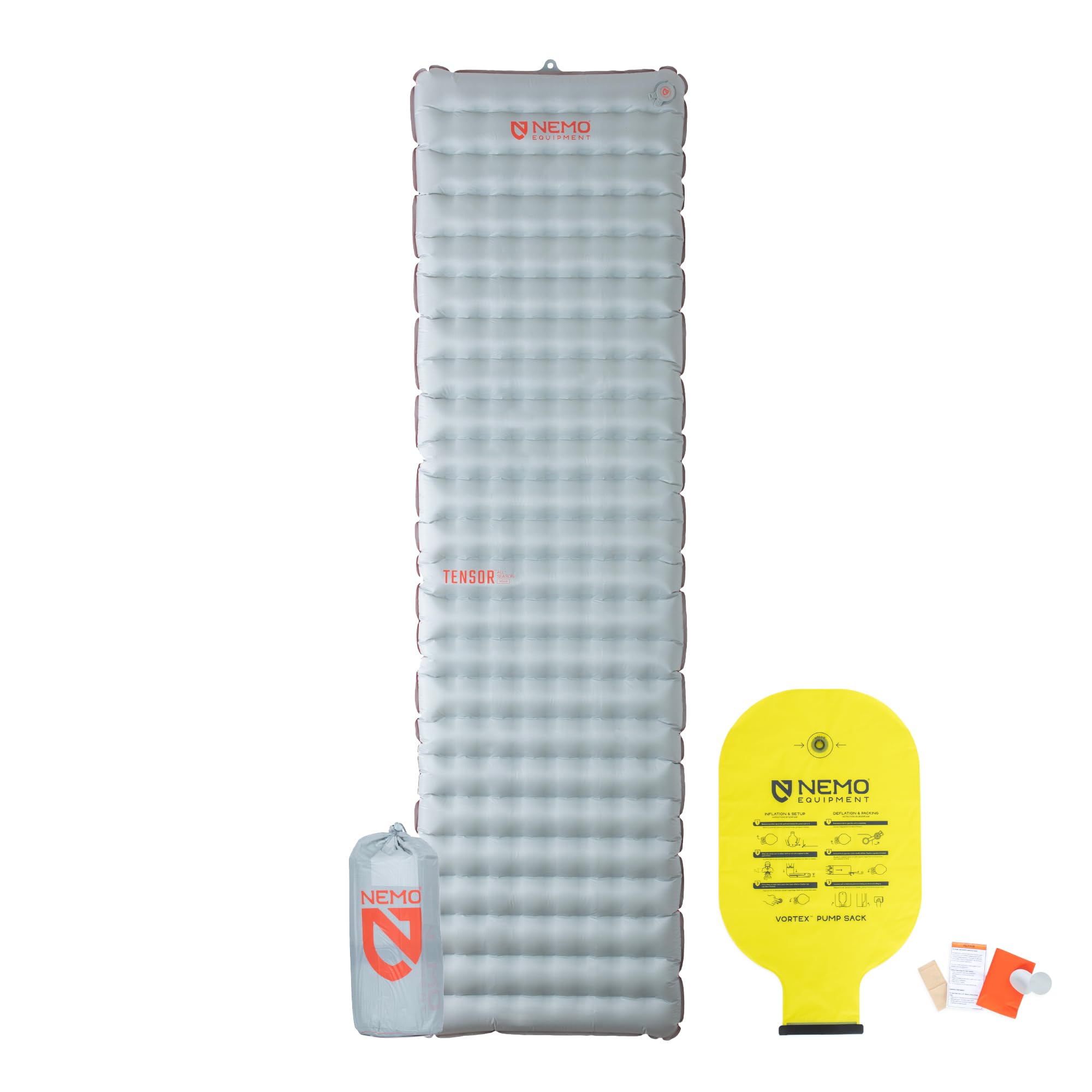
The NEMO Tensor All-Season is the lightest insulated pad on this list at 500 grams for the regular size, making it a go-to for gram-conscious backpackers. The Spaceframe baffles use low-stretch die-cut trusses that eliminate the springy trampoline effect common in air-only pads, providing stable lateral support even on uneven ground. Two layers of floating Thermal Mirror metallized film provide the R-5.4 insulation without the crinkle noise that plagues older reflective pads.
At 3.5 inches thick, it is thinner than the top-tier pads, but the baffle design keeps you off the ground effectively. The fabric is bluesign-approved premium nylon that resists punctures and tears, and the pad packs down to a small cylinder that disappears into a backpack. The included pump sack inflates the pad in a few bags of air, and the micro-adjustment valve allows fine firmness tuning without losing air.
Owner feedback highlights the Tensor’s durability on rocky ground and its ability to stay inflated for multiple nights. Some side sleepers mention the 20-inch width is narrow for broad shoulders, recommending the wide version. The price is comparable to other ultralight insulated pads, but the combination of low weight, quiet fabric, and stable construction makes it a strong contender for hikers who refuse to carry extra ounces.
Why it’s great
- Weighs just 500 grams for ultralight loadouts
- Spaceframe baffles prevent the trampoline bounce
- Quiet reflective film – no crinkling during movement
Good to know
- 20″ width is tight for broad-shouldered sleepers
- 3.5″ thickness may not be enough for sensitive side sleepers
7. Hikenture 4″ Thick Self Inflating Sleeping Pad

The Hikenture 4-inch pad posts the highest R-value on this list at 9.5, making it one of the most thermally efficient pads for budget-conscious campers. The memory foam and air combo design delivers a plush surface that conforms to body shape without the sinking feeling of a pure air mattress. The 28-inch width provides generous space for most sleepers, and the 80-inch length accommodates tall campers without hanging off the edge.
The patented two-way valve supports self-inflation to about 80 percent, and the included pump sack finishes the job in a few bags of air. The polyester top fabric is soft and quiet, and the foam core provides enough insulation that you can skip a separate sleeping pad insulator in most conditions. At 6.5 pounds, it is not a backpacking pad, but for car campers who want winter-ready insulation without spending on premium brands, the Hikenture delivers real thermal performance.
Customer reviews highlight the pad’s ability to stay inflated without leaks over months of use, with several users praising the brand’s responsive customer service for rare defect replacements. The packed size is relatively compact given the 4-inch thickness, though it does require a bit of effort to roll tight. For a budget-tier winter pad that doesn’t cut corners on R-value, this is a serious option.
Why it’s great
- R‑9.5 exceeds most premium pads for cold‑weather camping
- Memory foam conforms to body contours for pressure relief
- Wide 28″ x 80″ fits tall and broad sleepers
Good to know
- Heavy at 6.5 lb – car camping only
- Deflation and rolling require some upper body effort
8. Therm-a-Rest LuxuryMap Self-Inflating Sleeping Pad

The LuxuryMap from Therm-a-Rest uses pressure-mapping technology to vary foam density across the pad—softer foam under the shoulders and hips, firmer support under the lumbar zone. This targeted approach reduces pressure points without adding extra thickness. At 3 inches, it is thinner than the plush options above, but the variable density foam compensates by cradling high-pressure areas more effectively than uniform foam pads.
The TwinLock valve system gives you separate channels for fast inflation and rapid deflation, and the pad self-inflates within a few minutes. The R-value of 6.0 supports year-round insulation, though winter campers may want a closed-cell foam boost for extreme cold. The polyester cover is PFAS-free and resists moisture, and the pad rolls to a 10-inch diameter for storage. Made in the USA, it comes with Therm-a-Rest’s reliable warranty.
Users appreciate the lack of air loss throughout the night, a common complaint with cheaper valves. Some note that the effective sleeping surface is slightly narrower than the stated dimensions due to the foam taper at the edges. The pad is best for car campers and cot users who want targeted support without the bulk of a 4-inch model. For campers with chronic hip or back sensitivity, the pressure-mapped foam is a noticeable upgrade.
Why it’s great
- Differential foam density reduces pressure on hips and shoulders
- TwinLock valve allows fast inflation without backflow
- Made in the USA with a strong warranty
Good to know
- 3″ thickness is average—side sleepers may want thicker
- Effective sleeping area feels slightly smaller than stated size
9. HEST Foamy Camping Mattress Pad

The HEST Foamy redefines camping comfort with an 8.8-inch thick dual-layer memory foam construction that genuinely rivals a home mattress. It requires no pump or air—simply unroll it and let the temperature-resilient foam expand. The 30-inch width gives broad-shouldered sleepers full arm support, and the 78-inch length accommodates tall frames without overhang. A built-in pocket at the top holds your phone, and the compression harness doubles as a dry changing mat.
The trade-off for this comfort is bulk: at 11 pounds and a roll size of about 3.5 cubic feet, this pad is strictly for car camping, van life, or glamping. The dual-layer foam manages temperature better than single-density memory foam, staying supportive in both hot and cold conditions. The water-resistant base layer handles damp tent floors, and the integrated carry handle makes transport easier than wrestling with a rolled tarp.
Owners consistently say the Foamy provides better sleep than their home mattress, with no deflation risk and zero setup time. The main drawbacks are the packed size—it takes up significant trunk space—and the price, which is the highest on this list. For campers who drive to their site and prioritize mattress-quality sleep above all else, the HEST Foamy is the undisputed choice. It also includes linking clips to connect two Foamies for a double-wide sleep system.
Why it’s great
- 8.8″ of memory foam—the thickest camping pad available
- No pump or inflation required; just unroll and sleep
- Built‑in pocket and convertible compression harness
Good to know
- Very bulky at 11 lb—car camping only
- Premium price reflects the mattress-grade construction
FAQ
What R-value do I need for winter camping?
How thick should a camping pad be for side sleepers?
Are self-inflating pads better than air pads for durability?
Can I use a camping mattress pad on a cot?
Final Thoughts: The Verdict
For most users, the camping mattress pad winner is the Acacia 4″ because it balances a 4.3-inch thick, R-6.0 foam core with a telescopic design that packs 60 percent smaller than traditional foam pads. If you want the warmest ultralight option for 4-season backpacking, grab the Sea to Summit Ether Light XR Pro. And for pure car-camping luxury with no compromise, nothing beats the HEST Foamy with its 8.8-inch memory foam profile.

Mo Maruf
I created WellFizz to bridge the gap between vague wellness advice and actionable solutions. My mission is simple: to decode the research and give you practical tools you can actually use.
Beyond the data, I am a passionate traveler. I believe that stepping away from the screen to explore new environments is essential for mental clarity and physical vitality.