Our readers keep the lights on and my smoothie glass nicely filled. As an Amazon Associate, I earn from qualifying purchases.
The difference between a murky, blue-tinted video and a crisp, colorful underwater clip isn’t luck—it’s the sensor size, the white balance logic, and the depth rating of the housing. Shooting below the surface throws every variable into chaos: light falls off fast, particulate matter creates noise, and your camera is fighting a constant battle against pressure. An action camera built for the ocean floor handles these challenges with specific hardware that a general-purpose model simply doesn’t have.
I’m Mohammad Maruf — the founder and writer behind WellFizz. I’ve spent years dissecting the spec sheets of underwater-camera housings, image-sensor architectures, and stabilization algorithms that keep footage smooth despite current, surf, and surge.
Whether you are free-diving through coral gardens, scuba-certified and shooting at depth, or just want to capture poolside cannonballs without buying a disposable, one action camera underwater will handle way more than a premium phone in a soft pouch.
How To Choose The Best Action Camera Underwater
Every underwater housing has a depth limit, and every sensor has a low-light ceiling that dictates how much color you get back in the blue zone. Here are the three filters to pass every candidate through before you commit.
Depth Rating vs. Housing Quality
A camera that claims waterproofing out of the box rarely goes deeper than 33 feet (10 meters) without an external case. If you are scuba-certified and routinely descend past 60 feet, look for a unit that includes a sealed dive housing rated to 130 feet or more. The O-ring seal, the locking mechanism, and the test certification matter more than the branding on the side. Cheap housings fog up; a good one has a moisture-muncher capsule and a vacuum-check port.
Sensor Size and Low-Light Performance
Underwater light can drop ten times brighter than surface light within the first 30 feet. A 1/1.3-inch sensor with larger individual pixels (2.4 µm or bigger) captures usable color at depths where a 1/2.3-inch chip returns nothing but blue noise. If you plan to shoot HDR video below the surface, the sensor generation is the single spec that separates a watchable clip from a muddy artifact.
White Balance Control and Color Filters
Red is the first wavelength to vanish underwater. Automatic white balance on most consumer cameras leaves everything teal at 15 feet. A dedicated underwater-camera camera (or a housing that accepts a physical red filter) fixes this in-camera so you don’t need to color-grade every clip later. For vloggers and casual snorkelers, a camera that lets you lock a custom white balance is a massive time save.
Quick Comparison
On smaller screens, swipe sideways to see the full table.
| Model | Category | Best For | Key Spec | Amazon |
|---|---|---|---|---|
| GoPro HERO12 Black | Premium | Versatile deep-water and everyday adventure | 5.3K60 w/ HDR | Amazon |
| DJI Osmo Action 5 Pro | Premium | Subject tracking and cold-weather endurance | 4-hour battery | Amazon |
| DJI Osmo Action 6 | Premium | 8K resolution and variable aperture | 8K / Variable f2.0–f4.0 | Amazon |
| Insta360 X3 | Mid-Range | 360-degree capture and post-shot reframing | 5.7K 360 HDR | Amazon |
| GoPro Hero (HERO Black) | Mid-Range | Compact pocket-friendly 4K | 4K30 w/ HyperSmooth | Amazon |
| Xtra Edge Action Camera | Mid-Range | Budget 4K with long run time | 1/1.3″ sensor | Amazon |
| AKASO Brave 7 LE | Mid-Range | Beginners needing dual screens and value bundle | 4K30 / 131ft case | Amazon |
| SeaLife SportDiver Ultra | Dedicated | Smartphone housing for scuba photography | 130ft depth rating | Amazon |
| OM System Tough TG-7 | Dedicated | Dedicated macro and microscope underwater shots | 50ft / 4x optical zoom | Amazon |
In‑Depth Reviews
1. GoPro HERO12 Black

The GoPro HERO12 Black inherits the best traits of the line—rock-solid image stability, polished color science, and a housing that hits the 33-foot mark without a case. The jump to 5.3K60 video with HDR for both video and stills means your underwater clips retain highlight detail in the sunbeams and shadow detail in the reef crevices. The 1/1.9-inch sensor isn’t the largest on this list, but the GP2 processor extracts more dynamic range from it than any previous GoPro generation, so your footage stays vivid even when the ambient light drops at 20 feet.
HyperSmooth 6.0 is the best stabilization system GoPro has shipped; during a choppy surface swim or a fast current, the horizon stays level and the roll-axis jitter disappears. The Enduro battery extends cold-weather run time significantly—critical for any diver who shoots in temperate water below 50°F. If you already own GoPro mounts and accessories, the HERO12 is the easiest upgrade path to premium underwater video.
GoPro still forces you into an aftermarket dive housing to push past 33 feet, which adds cost. At full price, the HERO12 is an investment that rewards serious users who want maximum flexibility across land, surf, and depth. The bundled package with the 64GB card and accessory kit is exactly what you need to start shooting on day one.
Why it’s great
- 5.3K60 HDR video preserves highlight and shadow detail underwater
- HyperSmooth 6.0 stabilization handles current and wave chop fluidly
- Enduro battery delivers reliable recording in cold freshwater
Good to know
- Only waterproof to 33ft without an additional dive housing
- Battery drains faster when using the front screen for vlogging
2. DJI Osmo Action 5 Pro Adventure Combo

The Osmo Action 5 Pro flips the script with a 1/1.3-inch sensor and 2.4 µm pixel pitch that collects more light per pixel than most action cams on the market. That extra gathering power directly translates to cleaner footage at 15–30 feet without needing a post-processing color grade. The subject tracking, powered by a 4nm chip, locks onto a diver or a fish and keeps them centered even when you’re drifting with the current—ideal for solo vloggers who can’t operate a gimbal underwater.
The Adventure Combo includes three Extreme Batteries and a multifunctional case that charges them simultaneously. At a rated 4 hours per battery, you can shoot an entire day of shore dives without hunting for an outlet. The IP68 rating to 20 meters also means you don’t need a separate housing for most recreational depths, and the dual OLED touchscreens are bright enough to see through a mask in direct sunlight.
The main trade-off is the size—the body is slightly thicker than a GoPro, and the magnetic quick-release system, while elegant, locks you into DJI accessories unless you buy adapters. For the diver who prioritizes battery life, low-light quality, and hands-free subject tracking, this is the most complete underwater vlogging rig at this price tier.
Why it’s great
- 1/1.3-inch sensor with 2.4 µm pixels for clean low-light underwater footage
- 4-hour battery life per cell with included triple-charging case
- Accurate subject tracking for solo divers capturing moving marine life
Good to know
- No custom white balance lock in auto mode; DJI app needed for manual tweaks
- Magnetic mount system is convenient but not backward-compatible with GoPro accessories
3. DJI Osmo Action 6 Enhanced Combo
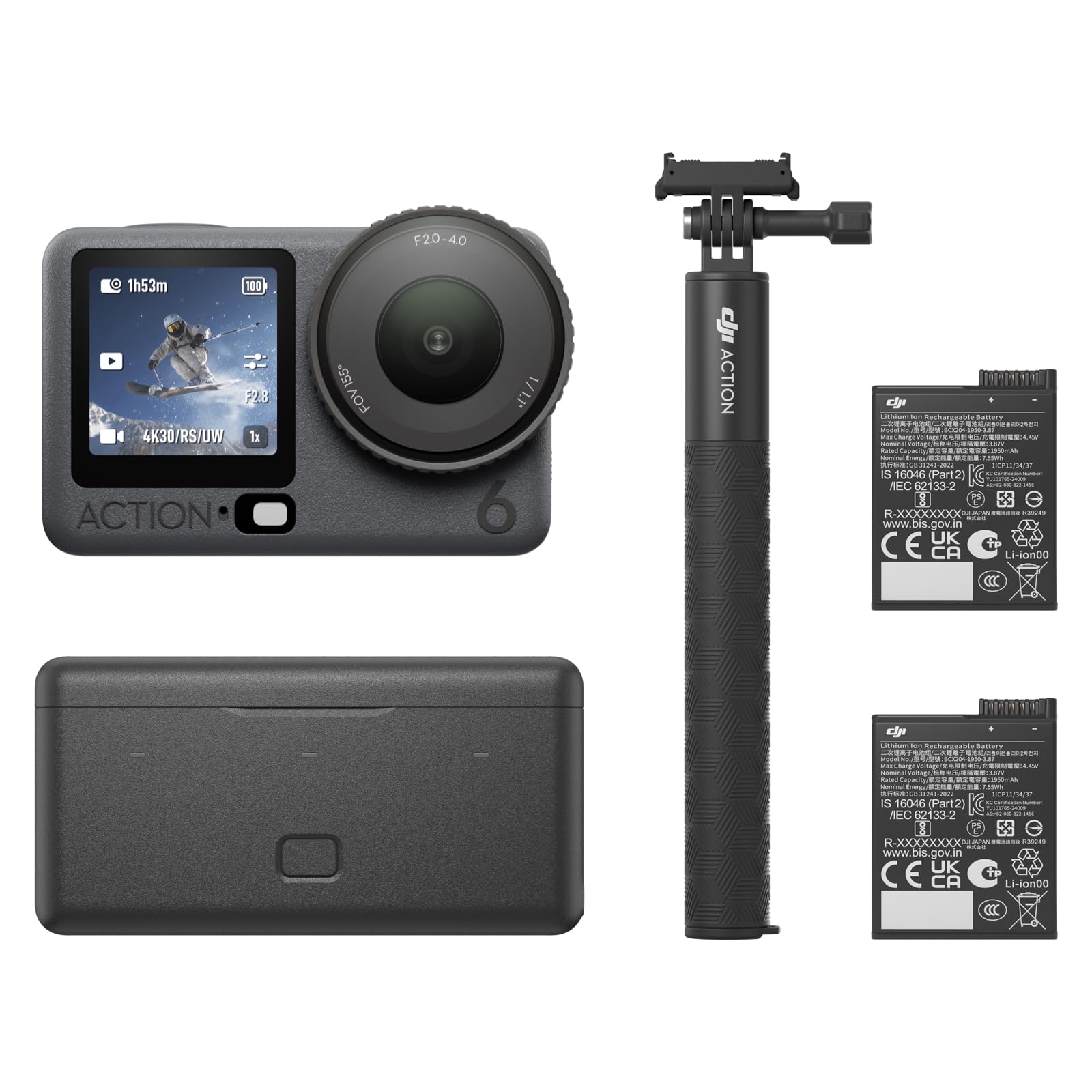
The Osmo Action 6 is a generational step forward, packing a 1/1.1-inch square sensor and a variable aperture that opens to f/2.0 in low light and stops down to f/4.0 for bright, sharp overhead-light shots. This is the first action camera that can genuinely adapt its iris underwater, where light changes instantly as you descend through a thermocline or surface into direct sun. The 8K30 capture gives you enormous cropping room for reframing in post—especially useful when you nail a wide reef shot but want to punch in on a specific fish later.
The Enhanced Combo ships with two 1950mAh Extreme Batteries and a multifunctional case, plus the 1.5m extension rod. The IP68 waterproofing hits 20 meters without a case, and the embedded 50GB internal storage means you can start filming even if you forgot a microSD card. The dual-microphone wireless connection to DJI Mic 2 transmitters also removes any cable tether, which simplifies voiceover recording for underwater vloggers.
The variable aperture mechanism adds mechanical complexity, and the 8K mode does eat through battery faster than 4K—plan your surface intervals accordingly. For hybrid shooters who want a single camera that handles deep water, low-light caves, and bright surface action equally well, the Action 6 is the most future-proof option on this list.
Why it’s great
- Variable aperture adapts to rapid underwater light transitions
- 8K30 video provides massive cropping flexibility for reframing reef shots
- 50GB internal storage eliminates card-dependence for emergency starts
Good to know
- High-res 8K recording reduces the per-battery run time to about 75 minutes
- Variable aperture may require firmware updates for manual exposure precision
4. Insta360 X3

The Insta360 X3 brings 360-degree capture to the underwater world, and its 5.7K Active HDR video gives you the ability to reframe your shot in post-production—meaning you can point the camera in any direction under the surface and later choose exactly where you want the viewer to look. This eliminates the classic “missed the shot because the angle was off” frustration that plagues single-lens cameras on dive trips. The built-in FlowState stabilization and Horizon Lock keep the footage level even when you are drifting sideways in a current.
In single-lens mode, the X3 shoots 4K30 wide-angle, so it functions perfectly well as a conventional action camera when you prefer not to deal with 360 reframing. The 2.29-inch touchscreen is large enough to navigate settings while wearing dive gloves, and the included protective pouch prevents screen scratches during transport. The invisible selfie stick accessory is essential for 360 shoots, turning a normal dive companion into a drone-like third-person view.
The bulkier body is harder to mount on a dive mask or small chest harness, and the 360 files are large (around 6 GB per 12 minutes), so you need plenty of high-speed microSD storage and patience during transfer. For the underwater creator who values creative flexibility over simplicity, the X3 is uniquely capable.
Why it’s great
- Post-shot reframing means you never miss a wide-angle reef panorama
- FlowState and Horizon Lock deliver stable footage in rough currents
- Single-lens mode offers standard 4K action cam functionality when needed
Good to know
- Large 360 file sizes demand fast microSD cards and patience during uploads
- Not fully waterproof to depth without the official dive case
5. GoPro Hero Black (Compact)

The newly streamlined GoPro Hero Black retains the core formula—4K30 video, 12MP stills, and HyperSmooth stabilization—in a body that weighs just 3 ounces and fits into any pocket or BCD sleeve. This is the most portable GoPro in the current lineup, and its foldable mounting prongs mean you can snap it onto any GoPro mount without an extra adapter. If you are a casual snorkeler or a freediver who doesn’t need 5.3K resolution, the Hero Black covers the basics with excellent color reproduction and reliable 4K detail.
The integrated Wi-Fi lets you wirelessly offload clips to the Quik app while still on the boat, and voice control with eight commands works in 11 languages—handy when your hands are busy defogging a mask. The bundle with the 50-in-1 accessory kit and 64GB card is a fantastic entry point for anyone who needs chest mounts, head straps, and a floating grip without hunting for third-party parts.
The battery is rated at 1 hour of continuous 4K recording, which is short compared to competitors, so a spare battery is almost mandatory for a full day of jumping in and out of the water. If you value pocketability and a broad ecosystem of mounts over spec-sheet numbers, the Hero Black is a streamlined, faff-free choice for family dive trips and lap pools.
Why it’s great
- Ultra-compact 3-ounce body is the easiest action cam to pack for a dive
- HyperSmooth stabilization smooths out above-water bumps and sway
- 50-in-1 accessory bundle covers mounts for almost every surface
Good to know
- 1-hour battery at 4K is below average for full-day snorkeling sessions
- No front-facing screen for framing yourself from the camera’s view
6. Xtra Edge Action Camera
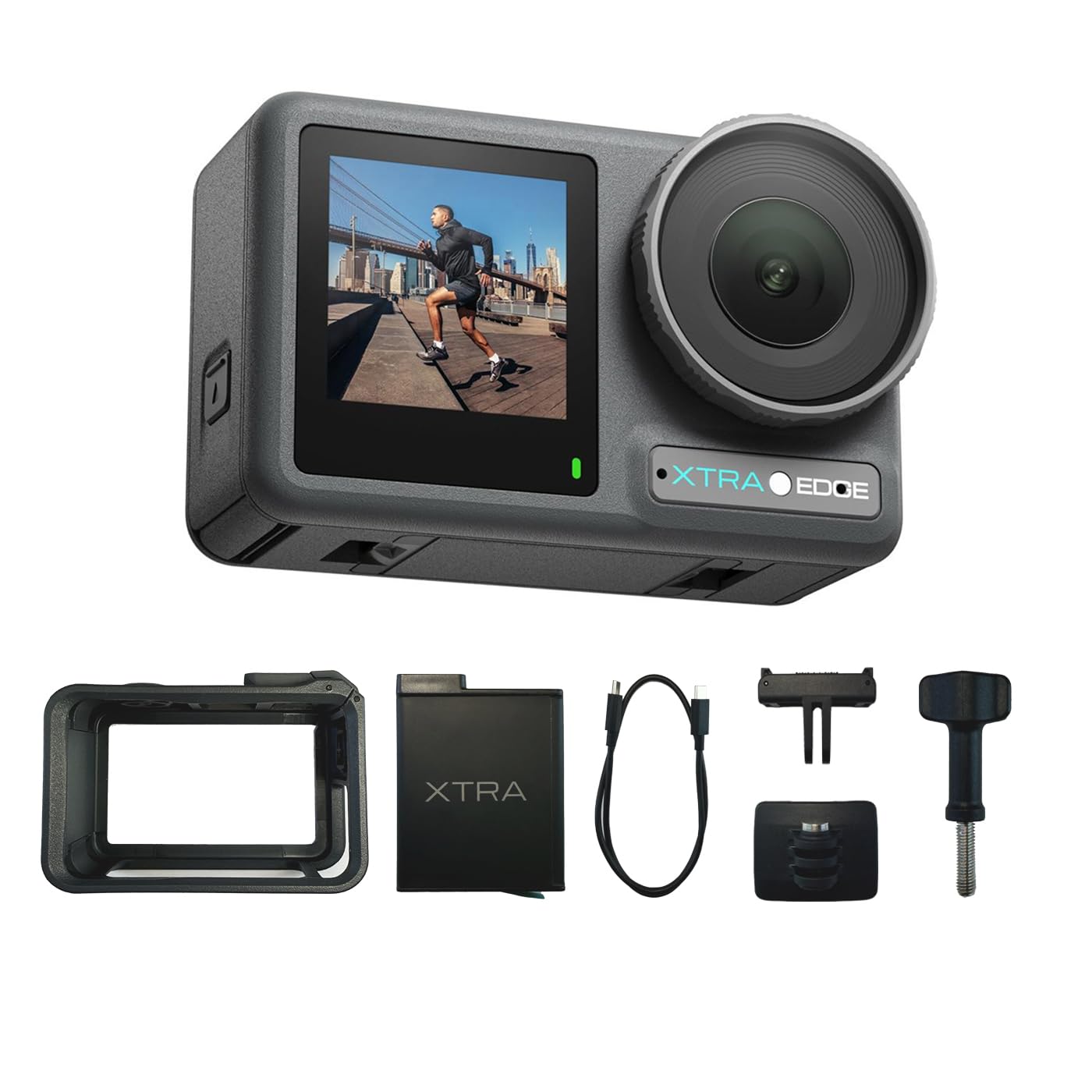
The Xtra Edge Action Camera uses a 1/1.3-inch sensor—the same size class found in premium models—to deliver 4K video with vibrant underwater color at a price that undercuts nearly every name-brand competitor. The hyper stabilization system, while not quite as polished as GoPro’s HyperSmooth, does a solid job of smoothing out slow swim strokes and choppy surface camera work. The 52-foot waterproof rating includes a sealed housing that prevents fogging, so you can drop this straight into a reef dive without hesitation.
Included in the bundle are a dual-facing mount adapter, a cold-resistant battery that is rated to 160 minutes, and a protective frame that lets you swap between horizontal and vertical orientation on the fly. The magnetic quick-mount system is a genuine surprise at this tier—it snaps onto metal brackets instantly and allows quick angle changes without screws or tools. The touchscreen is responsive and the menu layout is intuitive for beginners who want to set it and forget it.
The audio quality is acceptable for narration but picks up wind noise more than premium units, so external mic support would be a welcome addition. For the budget-conscious diver who wants a large sensor and a long battery life without the premium markup, the Xtra Edge is the strongest value in this category.
Why it’s great
- 1/1.3-inch sensor matches premium models for underwater color and detail
- 3-hour battery life is class-leading for a mid-range price
- Magnetic quick mount makes orientation switching effortless
Good to know
- Audio picks up wind and water noise more than competitor microphones
- No front screen for selfie framing while shooting POV
7. AKASO Brave 7 LE

The AKASO Brave 7 LE is the entry-level champion for underwater vloggers who want dual screens, 4K30 recording, and a dive housing rated to 131 feet—all at a very accessible price point. The inclusion of a front-facing color display is rare at this level; it makes framing selfie-style underwater clips easy without a second camera or an external mirror. The 20MP photo mode gives solid stills for reef identification or social media posts, and the electronic image stabilization 2.0 handles the slow underwater movements of a recreational swimmer.
The bundle is generous: two rechargeable batteries, a remote control, the waterproof housing, and a collection of mounting brackets that cover helmet, chest, and handlebar setups. The IPX7 water-resistant body handles splashes and rain without the housing, so you can use it topside as a standard action cam for hiking or biking. The remote control is especially useful for the diver who mounts the camera on a tray and wants to start/stop recording without reaching for the shutter button.
Low-light performance is limited compared to the larger-sensor models, and the 4K video lacks the crispness of GoPro or DJI processing. But for the snorkeler, pool trainer, or family vacation shooter who prioritizes value and twin-screen ease, the Brave 7 LE is a reliable, feature-packed workhorse that leaves room in the budget for a spare microSD card and a travel case.
Why it’s great
- Front screen makes underwater vlogging and self-framing simple
- 131-foot dive housing covers nearly all recreational scuba depths
- Included remote control and dual batteries extend shooting sessions
Good to know
- Low-light footage is noticeably grainier than premium sensors
- Stabilization struggles during fast, jerky movements above water
8. SeaLife SportDiver Ultra

The SportDiver Ultra is not an action camera itself—it is a premium smartphone housing that turns your existing iPhone or Android into a dedicated underwater camera rated to 130 feet. This approach has one massive advantage: you use the phone’s own sensor, which in modern flagships is often a 1/1.28-inch or larger chip with state-of-the-art computational photography. The housing includes a red color-correction filter, a vacuum-seal pump for leak testing, and an audible moisture alarm that screams instantly if the seal fails, giving you time to surface before water damage occurs.
ScubaLab gave it the “Tester’s Choice” top pick for 2024, and the reason is the enclosure’s ergonomics—large shutter buttons, 7 mounting points for a tray system, and a tension spring that keeps the phone cradled securely while adding shock protection. The Moisture Muncher capsule prevents internal fogging, and the included spare O-rings, lubricant, and removal tool mean you can maintain the seal between dives. It comes with a travel case, filter, and vacuum pump as part of the standard bundle.
You must seal the phone inside before every dive, which adds 3–5 minutes of prep, and the phone is inaccessible while the housing is closed—so you cannot switch between cameras or check messages. This is a dedicated underwater photography tool, not a casual option. For the scuba diver who already owns a high-end phone and wants better image quality than any compact action sensor, it’s the most cost-effective upgrade.
Why it’s great
- Utilizes your smartphone’s flagship-grade sensor for superior underwater images
- Red filter restores lost red wavelengths for natural color at depth
- Audible leak alarm and vacuum-check seal provide high safety confidence
Good to know
- Phone is completely sealed and unusable as a phone while in the case
- Setup takes several minutes; not ideal for quick snorkel-splash sessions
9. OM System Olympus Tough TG-7

The OM System TG-7 is the last true rugged point-and-shoot camera, waterproof to 50 feet, shockproof to 7 feet, crushproof to 220 pounds, and freezeproof to 14°F. Unlike every action camera on this list, it has a 4x optical zoom lens (25–100mm equivalent) and a dedicated underwater microscope mode that captures detail from 1 centimeter away from the lens—so you can photograph a nudibranch’s gills or the texture of a coral polyp without an external diopter. The five underwater modes, including Underwater HDR and Underwater Snapshot, dial in the white balance and exposure logic automatically for snorkeling and scuba conditions.
The back-illuminated CMOS sensor is older and smaller than the action cam sensors above, but the true compensation tool is the lens. With an F2.0 maximum aperture at wide angle and optical zoom reach, you get flexibility that no action camera offers: you can stand back and capture a whole reef wall, then zoom in for a close-up of a sea star without losing image quality. The 4K 30p video is clean for a compact, and the 120fps high-speed movie mode lets you capture slow-motion splashes and creature movements.
The battery life is decent, but the battery meter gives almost no warning before it cuts out—a spare is essential for day trips. Image processing is also noticeably behind modern phone computational photography in low light. However, for macro enthusiasts, underwater biologists, and travel photographers who need a camera that truly survives anything, the TG-7 is the most functional, go-anywhere optician on the market.
Why it’s great
- 4x optical zoom captures details action cameras lose to digital zoom
- Underwater microscope mode enables 1cm macro shots without add-ons
- Rugged to 50ft, crushproof, and freezeproof for extreme travel conditions
Good to know
- Small, older sensor struggles in low light compared to action cam sensors
- Battery dies with minimal warning; carry at least one spare for diving
FAQ
Do I need a red filter for shooting underwater above 15 feet?
Can I use a GoPro without a dive housing for saltwater snorkeling?
What is the difference between HyperSmooth, FlowState, and RockSteady stabilization?
Final Thoughts: The Verdict
For most users, the action camera underwater winner is the GoPro HERO12 Black because it delivers the best balance of resolution, stabilization, and software polish for recreational divers who want to shoot above and below the surface with one camera. If you prioritize battery stamina and subject tracking for solo vlogging, grab the DJI Osmo Action 5 Pro. And for dedicated macro shooters and adventure travelers who need optical zoom and ruggedness, nothing beats the OM System Tough TG-7.

Mo Maruf
I created WellFizz to bridge the gap between vague wellness advice and actionable solutions. My mission is simple: to decode the research and give you practical tools you can actually use.
Beyond the data, I am a passionate traveler. I believe that stepping away from the screen to explore new environments is essential for mental clarity and physical vitality.