Our readers keep the lights on and my smoothie glass nicely filled. As an Amazon Associate, I earn from qualifying purchases.
Your clients shouldn’t hear your neighbor’s dog, the office printer, or the hum of your HVAC. A headset that can’t isolate your voice from the chaos of a real workspace turns every call into an annoying game of “say that again.” The right pair of call center headphones does one thing above all else: it makes you sound like you’re in a quiet room, no matter where you actually are.
I’m Mohammad Maruf — the founder and writer behind WellFizz. I’ve spent years analyzing audio specs, noise-cancellation technology, and workplace ergonomics to separate the handful of headsets that actually perform from the dozens that just look the part on a spec sheet.
Whether you are equipping a busy contact center or setting up a work-from-home desk, choosing the right headset is a major productivity lever. This guide breaks down the top models to help you find the best call center headphones for your specific work environment.
How To Choose The Best Call Center Headphones
The buying decision for a call center headset is different from picking a pair of gaming cans or music headphones. You are not chasing thumping bass or soundstage width; you are optimizing for voice clarity, background noise rejection, and physical endurance over a full shift. Here are the three specs that actually matter.
Microphone Technology: The Most Important Feature
A fixed boom mic with a unidirectional or noise-canceling pickup pattern is non-negotiable. The mic should capture your voice from a consistent distance and reject sounds coming from the sides and rear. Dual-microphone setups with digital signal processing, like Acoustic Fence or Acoustic Shield technology, are the gold standard for open offices and noisy home environments.
Connection Type and Platform Certification
Wired USB headsets offer zero latency, zero pairing issues, and the most reliable connection for high-call-volume roles. Wireless models using DECT technology provide superior range and security compared to standard Bluetooth, making them ideal for multi-room mobility. Look for headsets certified for your primary platform — Microsoft Teams or Zoom — to guarantee integrated mute controls and seamless call management.
Comfort and Build for Extended Wear
An eight-hour shift demands more than just soft ear pads. A lightweight frame with a metal-reinforced headband and memory-foam cushions that do not trap heat is essential. The clamping force must be moderate — enough to stay put, not enough to cause a headache. Pay attention to the weight in ounces, as every extra gram compounds over several hundred calls.
Quick Comparison
On smaller screens, swipe sideways to see the full table.
| Model | Category | Best For | Key Spec | Amazon |
|---|---|---|---|---|
| Poly Voyager 4310 UC + Stand | Wireless / Single-Ear | Hybrid workers needing mobility | 24-hr talk time / 164-ft range | Amazon |
| Yealink WH62 Dual Teams DECT | Wireless / Dual-Ear | High-density office environments | 525-ft range / 14-hr talk time | Amazon |
| Plantronics CS520 Binaural | Wireless / Dual-Ear | Maximum wireless range on DECT | 350-ft range / 13-hr talk time | Amazon |
| Logitech Zone Wired | Wired / Dual-Ear | Open-office noise cancellation | 40mm drivers / Dual-mic ANC | Amazon |
| Poly Blackwire 5220 | Wired / Dual-Ear | Multi-device connectivity | USB-C/A + 3.5mm / Dynamic EQ | Amazon |
| Yealink UH37 USB | Wired / Dual-Ear | Value-focused Teams users | 35mm drivers / Dual-mic NC | Amazon |
| Jabra Evolve 20 Wired | Wired / Dual-Ear | Budget-friendly entry point | 28mm speakers / USB-C/A | Amazon |
In‑Depth Reviews
1. Poly Voyager 4310 UC Wireless + Charge Stand

The Voyager 4310 UC strikes a rare balance between wireless freedom and professional-grade audio. Its Acoustic Fence technology uses a dual-microphone array to isolate your voice from ambient noise — a feature that, in real-world testing, made a barking dog in the same room sound like a faint, distant murmur on the listener’s end. The 24-hour talk time easily covers two full shifts without needing a recharge, and the included BT700 USB adapter provides a solid 164-foot wireless range through walls and floors.
The single-ear wearing style is a deliberate design choice for multitasking. It keeps one ear open to your physical environment — a safety advantage for anyone who needs to hear a doorbell or a colleague’s voice without removing the headset. The boom mic is flexible but requires positioning close to the corner of your mouth for optimal pickup; users who slouch or lean back will need to adjust the mic arm.
Connectivity is versatile, pairing with your computer via the USB-A dongle and with your smartphone via Bluetooth 5.2 simultaneously. The multipoint connection lets you take a mobile call without removing the headset. The included charging stand keeps the headset topped off between calls, eliminating the cable-clutter problem common to desk-mounted chargers.
Why it’s great
- Exceptional 24-hour battery life for all-day wireless use
- Acoustic Fence mic technology blocks background noise effectively
- Multipoint Bluetooth lets you switch between PC and phone seamlessly
Good to know
- Single-ear design limits immersion for those who prefer stereo audio
- Mic boom needs close positioning for best performance
- Not ideal for high-fidelity music listening
2. Yealink WH62 Dual Teams DECT Wireless

The Yealink WH62 is engineered for the dense, interference-heavy environment of a real call center. It uses DECT 6.0 technology rather than standard Bluetooth, which means it operates on a dedicated frequency band with less congestion and stronger security — critical for organizations handling sensitive customer data. The 525-foot wireless range is the longest in this lineup, allowing an agent to walk to a break room, supply closet, or even an adjacent building wing without dropping a call.
Acoustic Shield Technology powers the dual noise-canceling microphones, filtering out chatter, keyboard clatter, and HVAC hum intelligently. The ear cups are packed with soft memory foam and a breathable fabric cover, and the entire headset weighs just 0.28 pounds in the dual-ear configuration. Users with smaller head sizes have noted the adjustable headband may still feel loose on the smallest setting — a point to consider before purchasing.
Microsoft Teams certification provides one-click meeting join, integrated mute control, and a busy light on the ear cup that signals your availability. The base station charges the headset and serves as the active link to your desk phone or computer via USB, which some users found limiting for on-the-go use. If your setup requires a portable dongle rather than a fixed base, this design choice is worth noting.
Why it’s great
- Industry-leading 525-foot wireless range on DECT 6.0
- Microsoft Teams certified with one-click meeting join
- Lightweight dual-ear design with breathable memory foam pads
Good to know
- Base station acts as dongle — not ideal for mobile use
- May feel large on smaller head sizes
- Setup process requires connecting to base, not direct USB plug
3. Plantronics CS520 Binaural Wireless

The Plantronics CS520 is a veteran in the call center space, and its longevity on the market is a testament to its reliability. This DECT wireless system delivers an exceptional 350-foot range, and users consistently report maintaining a crystal-clear signal through multiple floors, basements, and backyards. The binaural (dual-ear) design provides full stereo audio, which reduces listening fatigue and helps you catch subtle cues in a caller’s tone during long negotiation or support calls.
The noise-canceling microphone is housed in a lightweight, adjustable boom that bends easily to stay in the ideal position. The mic pickup is excellent at rejecting the echo common in rooms with hard flooring or bare walls. One-touch answer, end, mute, and volume controls are located directly on the ear cup, eliminating the need to fumble with an inline controller.
Battery life is rated at about 13 hours of talk time, and the quick-charge feature delivers several hours of use from just a 30-minute charge. The headband does not open as wide as some larger-headed users would like, which can create pinch pressure after a few hours. It is also worth noting that this model uses a charging base that keeps the headset docked — you will need to ensure your desk layout accommodates the base unit.
Why it’s great
- Proven DECT reliability with 350-foot range through walls
- Binaural audio reduces listening fatigue on long calls
- Fast charge delivers hours of use in 30 minutes
Good to know
- Headband may feel tight for larger head sizes
- Charging base requires dedicated desk space
- Not compatible with Google Voice without additional adapter
4. Logitech Zone Wired (Teams Certified)

The Logitech Zone Wired is the best option for open-office environments where background chatter is constant. It features dual-microphone noise-canceling technology certified for open-office conditions, meaning the microphones are tuned specifically to suppress the type of diffuse, multi-directional noise found in bullpens. The 40mm drivers are the largest in this roundup and deliver full-bodied voice reproduction with notably low distortion at high volumes.
The build quality uses a Teflon-coated stainless steel headband with a silicone cushion at the top, which distributes weight evenly across the crown. Memory-foam ear pads provide a comfortable seal for passive noise isolation, though some users with smaller heads have flagged that the clamping force is on the tighter side during the first week of use. The in-line controller is well-constructed and gives tactile feedback for volume and mute adjustments.
Cable quality is a recurring point of discussion. The cord itself is tangle-resistant, but several long-term reviewers noted that the non-detachable connection at the earpiece became a failure point after several months of daily twisting and bending. Logitech provides the Logi Tune app for EQ adjustment and sidetone control, which lets you hear your own voice in the headset to avoid shouting — a useful feature for those who speak loudly on calls.
Why it’s great
- Open-office certified dual-mic noise cancellation
- Large 40mm drivers deliver clear, low-distortion audio
- Logi Tune app enables sidetone and EQ customization
Good to know
- Non-detachable cable may fray at connection point over time
- Clamping force feels tight for smaller head sizes initially
- Requires software app for full feature control
5. Poly Blackwire 5220 Wired

The Poly Blackwire 5220 wins on connectivity versatility. It includes a tethered USB-C connector, a USB-A adapter, and a 3.5mm analog jack, letting you swap between a desktop PC, a laptop, and a smartphone without carrying multiple headsets. This makes it an excellent choice for hot-desking environments or hybrid workers who move between a home office and a corporate desk throughout the week.
Dynamic EQ automatically adjusts the audio profile based on your activity — boosting voice frequencies during calls and shifting to a flatter, more musical EQ during playback. The noise-canceling boom mic is effective at suppressing ambient sounds; one reviewer noted that a dog barking in the same room was completely inaudible to the person on the other end of the Zoom call. The ear cushions conform well and the flexible headband strap helps distribute pressure for those prone to tension headaches.
A notable downside reported by multiple users is the “muffled self-hearing” phenomenon — the sensation of hearing your own voice as if your hands are cupped over your ears. This can be disorienting for new users. Some units also showed a decline in noise-cancellation performance after about five months of heavy daily use, which is worth monitoring if you rely on it in a noisy environment.
Why it’s great
- Triple connectivity: USB-C, USB-A, and 3.5mm analog jack
- Dynamic EQ optimizes voice clarity during calls
- Comfortable flex strap reduces pressure on the crown
Good to know
- Muffled self-hearing can feel odd for new users
- Noise-cancellation performance may degrade after months of heavy use
- No sidetone adjustment available out of the box
6. Yealink UH37 USB Wired

The Yealink UH37 punches well above its price tier. It includes dual-microphone noise cancellation with Acoustic Shield technology — the same type of intelligent noise filtering found in headsets costing twice as much. In practice, the UH37 blocks out household sounds like television audio and background conversations effectively, as confirmed by multiple users who reported callers couldn’t hear their kids or neighbors.
The 35mm speakers deliver stereo sound with dynamic EQ that automatically switches between call mode and music mode, providing clear voice reproduction during meetings and a more immersive profile when you need a break. The build feels sturdy but not heavy, and the adjustable headband accommodates most head shapes.
Microsoft Teams certification provides native mute and call-control integration. The only substantial durability complaint involves the non-detachable cable: at least one user reported fraying at the USB-C connector after roughly a year of use. For the price, however, the UH37 delivers a feature set that rivals models in the premium tier, making it a strong value pick for contact centers on a budget.
Why it’s great
- Excellent dual-mic noise cancellation at an entry-level price
- Microsoft Teams certified for seamless call control
- Lightweight design with metal-reinforced frame
Good to know
- Non-detachable cable may fray at USB-C connector over time
- Ear pads may cause moisture buildup during long shifts
- In-line controller is not as robust as premium competitors
7. Jabra Evolve 20 Wired (2025 Edition)
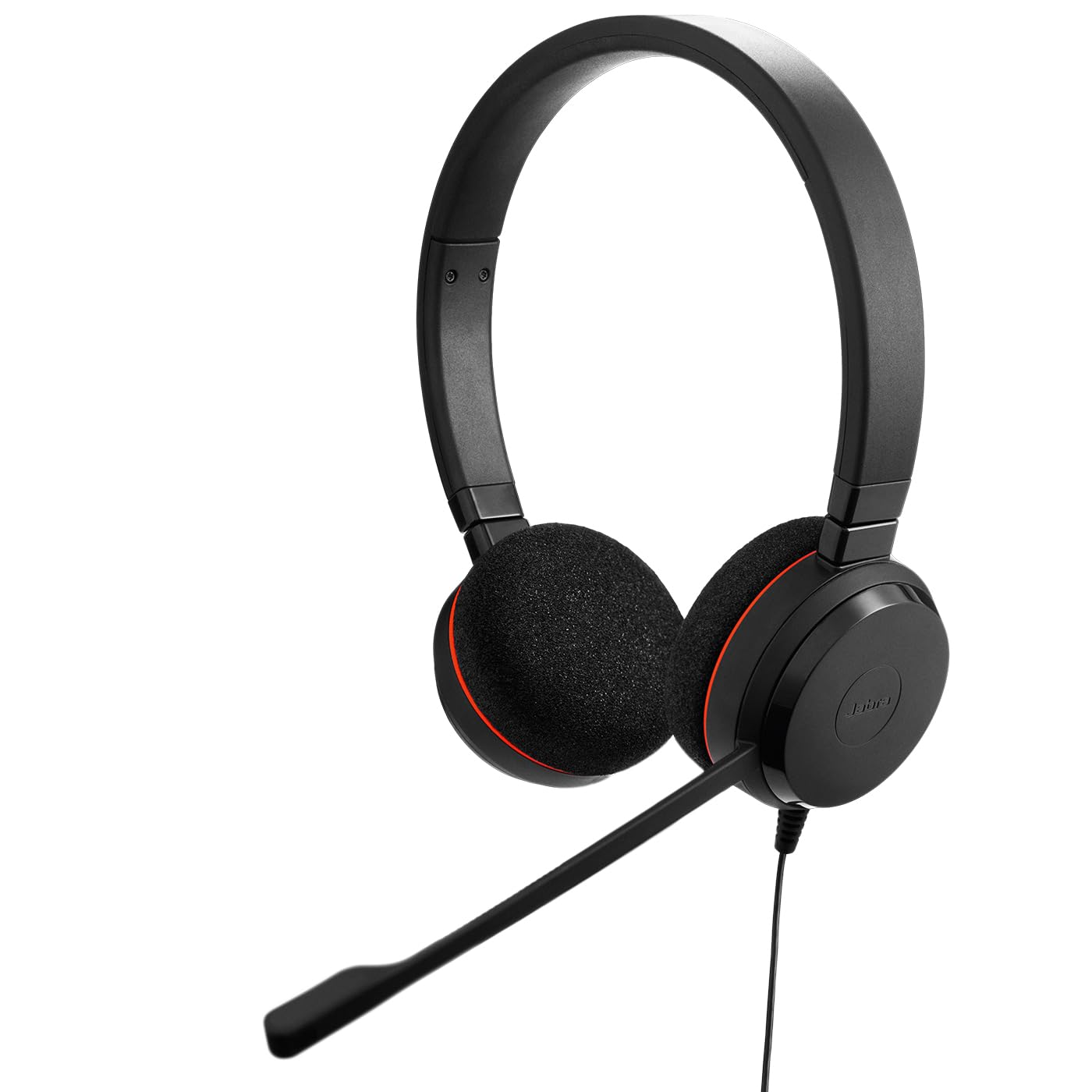
The Jabra Evolve 20 is the most accessible entry point into professional-grade call center audio. It uses a wired USB connection with both USB-C and USB-A compatibility, making it a true plug-and-play solution for any modern laptop or desktop. The 28mm speakers are smaller than the competition, but they produce surprisingly clear audio for voice calls — enough that telehealth professionals and customer service agents report clients cannot hear lawnmowers or barking dogs on the agent’s end.
The design prioritizes comfort with foam or leatherette ear cushions and a lightweight frame. Users who spend 90% of their workday on calls consistently describe the Evolve 20 as comfortable for long stretches. The cable is long enough to reach a floor-mounted tower without tension, though it uses a hard-wired connection at the headset with no replacement option if the cable fails.
Noise cancellation here is achieved through the microphone’s pickup pattern and passive ear-cup isolation rather than active digital processing. It works well in moderately noisy environments but will struggle in open offices with loud, close-proximity chatter. The ear pads are not user-replaceable, which limits the long-term lifespan. For the price, the Evolve 20 is a reliable workhorse that handles basic call center duties without fuss.
Why it’s great
- Affordable entry point with solid voice clarity
- Lightweight design with comfortable leatherette cushions
- Works with both USB-C and USB-A out of the box
Good to know
- Cable and ear pads are non-replaceable — limits repairability
- Smaller 28mm drivers lack bass and music playback quality
- Passive noise isolation not as effective as active ANC models
FAQ
Are wireless call center headphones reliable for high call volume?
What does Microsoft Teams certification actually mean for a headset?
How do I know if a headset will be comfortable for an 8-hour shift?
Can I use a single-ear headset instead of dual-ear for call center work?
Final Thoughts: The Verdict
For most users, the best call center headphones winner is the Poly Voyager 4310 UC because it combines wireless freedom, exceptional battery life, and Acoustic Fence noise cancellation into a package that suits both office and home environments. If you need the longest wireless range in a dual-ear design, grab the Yealink WH62. And for a rock-solid wired option with multi-device support and premium noise cancellation, the Poly Blackwire 5220 is a reliable choice that won’t let you down.

Mo Maruf
I created WellFizz to bridge the gap between vague wellness advice and actionable solutions. My mission is simple: to decode the research and give you practical tools you can actually use.
Beyond the data, I am a passionate traveler. I believe that stepping away from the screen to explore new environments is essential for mental clarity and physical vitality.