Our readers keep the lights on and my smoothie glass nicely filled. As an Amazon Associate, I earn from qualifying purchases.
If the reverb in your room is so loud it distorts your podcast, or your neighbor’s TV hums through the shared wall, you are shopping for acoustic treatment — not construction materials. The difference between soundproofing (mass-loaded vinyl, double drywall) and acoustic absorption (foam, fiber panels) is the single most misunderstood concept in this category. Acoustic panels are designed to tame slap echo, flutter echo, and standing waves inside a room, not to block sound from entering or leaving. They reshape the sonic signature of your space, making recordings clearer, phone calls crisper, and movie dialogue legible.
I’m Mohammad Maruf — the founder and writer behind WellFizz. I analyze hundreds of hours of user data, cross-reference ASTM C423 absorption coefficients where available, and compare foam density, open-cell structure, and coverage ratios so you don’t have to guess what defines this narrow category.
Whether you are dialing in a home studio, calming a noisy open office, or just trying to stop your living room from sounding like a cave, the right acoustic panels for soundproofing will transform how your space sounds without a single structural change.
How To Choose The Best Acoustic Panels For Soundproofing
Selecting the right acoustic panels comes down to matching the panel’s material density and thickness to your specific room dimensions and noise source. A few core specs separate a dead-quiet vocal booth from a mildly less echoey hallway.
Foam Density vs. Panel Thickness
Higher density foam (typically 25–35 kg/m³) absorbs more energy per square inch, meaning a 1-inch dense panel can outperform a 2-inch low-density wedge. Thicker panels push absorption down into lower frequencies, but without adequate density, the extra material just takes up wall space. Look for panels that list their density explicitly.
NRC Rating — The Only Number That Matters
The Noise Reduction Coefficient (NRC) is a single-number average of how much sound a panel absorbs across frequencies. An NRC of 0.80 means the panel absorbs 80% of incident sound. Most standard foam panels fall between 0.55 and 0.85. For home studios, aim for 0.70 or above. For casual echo reduction in a living room, 0.55 is often acceptable.
Surface Coverage Strategy
You do not need to cover every inch. The general rule is to treat 15-25% of the total wall surface area, focusing on first reflection points (the spots where sound bounces directly from speaker to your ear). Place panels at ear level, behind speakers, and on the ceiling above your listening position for maximum effect. Over-treating a small room can make it sound “dead,” which is ideal for recording but uncomfortable for conversation.
Quick Comparison
On smaller screens, swipe sideways to see the full table.
| Model | Category | Best For | Key Spec | Amazon |
|---|---|---|---|---|
| Tonor Dual-Layer | Large Panels | Full-wall treatment | 47.2″ x 23.6″ x 0.72″ | Amazon |
| Knightsacoustic 96 Pack | Bulk Wedge | Large studio builds | 96 sq. ft. total coverage | Amazon |
| 100 Pack Acoustic Foam | Value Bulk | Budget studio upgrade | 12″x12″x1″, 100 pieces | Amazon |
| GUERRI Wedge 36 Pack | 2-Inch Wedge | Mid-frequency absorption | 2″ thick, 25 kg/m³ foam | Amazon |
| Soon Global Art Panels | Decorative Fiber | Style-meets-acoustics | Polyester fiber, 0.4″ thick | Amazon |
| 54 Pack Wedge Foam | Entry Wedge | First-time echo fix | 12″x12″x1″, 270 adhesive dots | Amazon |
| Amantech Hexagon Set | Style Panels | Decorative noise control | Hexagon 12×10.23″, 0.4″ thin | Amazon |
In‑Depth Reviews
1. TONOR Dual-Layer Thickened Acoustic Wall Panels

The TONOR panels are a different beast from standard foam wedges. Each panel measures 47.2 by 23.6 inches at just 0.72 inches thick, but the dual-layer 100% high-density polyester fiber construction absorbs mid-to-high frequencies as effectively as 2-inch open-cell foam. The adhesive backing is strong — peel and stick directly to clean drywall without additional tape or glue.
Installing four panels gives you roughly 31 square feet of coverage, enough to treat the first reflection zone above a desk or behind a home theater sofa. The classic stripe pattern looks like felted fabric rather than standard acoustic foam, so it blends with decor instead of screaming “studio foam.” Users report a measurable reduction in reverb from movie dialogue and stereo playback, and the reinforced edges mean no crushed corners out of the box.
For a mid-sized room needing fast, clean coverage, the TONOR set delivers the best value per square foot of any panel in this roundup. The only real trade-off is the 0.72-inch thickness — it does not push low-frequency absorption as deep as a 2-inch wedge, so pair with bass traps in corners if sub-100 Hz rumble is your main problem.
Why it’s great
- Large panel size reduces install time drastically
- Self-adhesive backing works on smooth walls without extra supplies
- High-density fiber absorbs more per millimeter than standard foam
Good to know
- Thinner profile is less effective on deep, low-frequency bass rumble
- Stripe pattern color may appear darker than product images show
2. Knightsacoustic 96 Pack Sound Proof Foam Panels
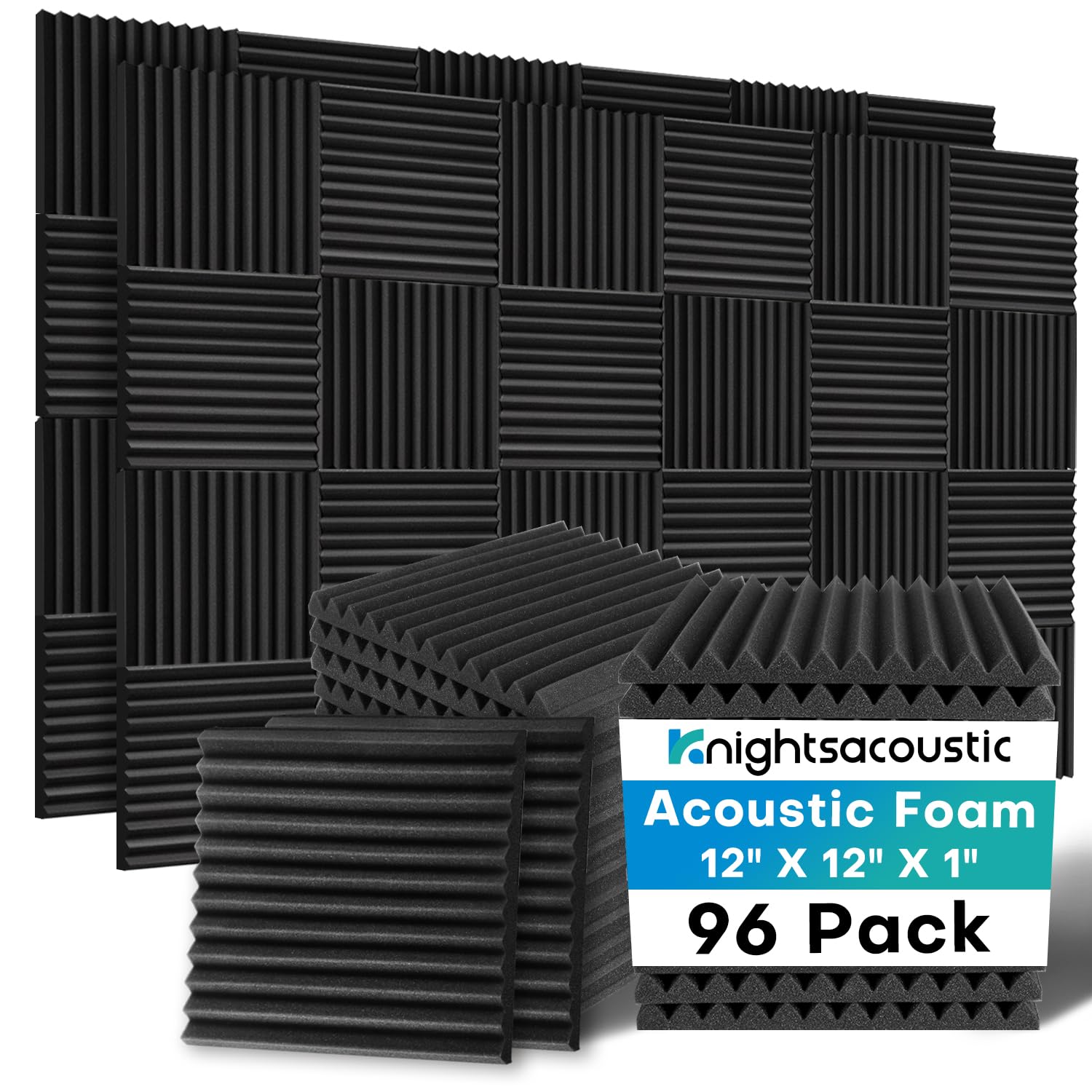
The Knightsacoustic pack is a serious bulk option for anyone building out a dedicated recording space or game room. With 96 panels each measuring 12 by 12 inches at 1 inch thick, you get 96 square feet of total coverage — enough to treat two opposing walls and the ceiling in a 10×12 room with room to spare. The high-density polyurethane foam recovers its shape within a few hours after decompression.
These panels are designed for professionals: no adhesive is included, which means you control the mounting method. Spray adhesive or the brand’s own adhesive squares (search B0CFV11LVN) are the recommended route. Users who soaked compressed panels in water and dried them on low heat reported full expansion to a clean, uniform surface with no lingering chemical odor. The echo reduction is immediate, turning a lively untreated room into a controlled acoustic space.
Because this pack lacks adhesive, it adds a step to installation. But for the coverage-to-cost ratio, it is the most flexible option for a full-room build where you want uniformity. Just budget time for expansion and drying if any panels arrive stubbornly flat.
Why it’s great
- Massive 96-panel count covers an entire room in one order
- Recovers shape quickly after compression with proper care
- Odor-free after expansion, suitable for closed recording environments
Good to know
- No adhesive included — requires separate purchase or spray glue
- Some users needed the water-soak trick to restore full thickness
3. 100 Pack Acoustic Foam Panels

This 100-pack kit is the entry-point bulk buy that actually performs. Each panel is 12 by 12 by 1 inch, and the high-density black foam does a solid job of absorbing mid-range and high-frequency echo in a home office or gaming den. The kit includes 250 pieces of double-sided tape, so you can mount every panel without buying extra supplies — a rare convenience at this volume.
Users report a significant reduction in echo after covering roughly 50 square feet, with particular praise for the clean black look that doesn’t clash with dark studio decor. The adhesive is strong: some users noted that repositioning requires care because the tape bites hard into the foam. A few panels arrived with crimped edges, but the overall build consistency is good for the price point.
The obvious limitation is the 1-inch thickness. These panels tame slap echo well, but they will not absorb deep bass. For a balanced room, treat corners separately with dedicated bass traps. But for a fast, affordable echo fix that covers a large surface, this pack delivers disproportionate value.
Why it’s great
- 100 panels with 250 tape dots included — ready to install out of the box
- Good high-density construction for the price tier
- Lightweight and easy to cut for custom fit around outlets
Good to know
- 1-inch thickness is weak on sub-200 Hz frequencies
- Adhesive can be difficult to remove if misapplied
4. GUERRI Sound Proof Foam Panels 36 Pack Wedge
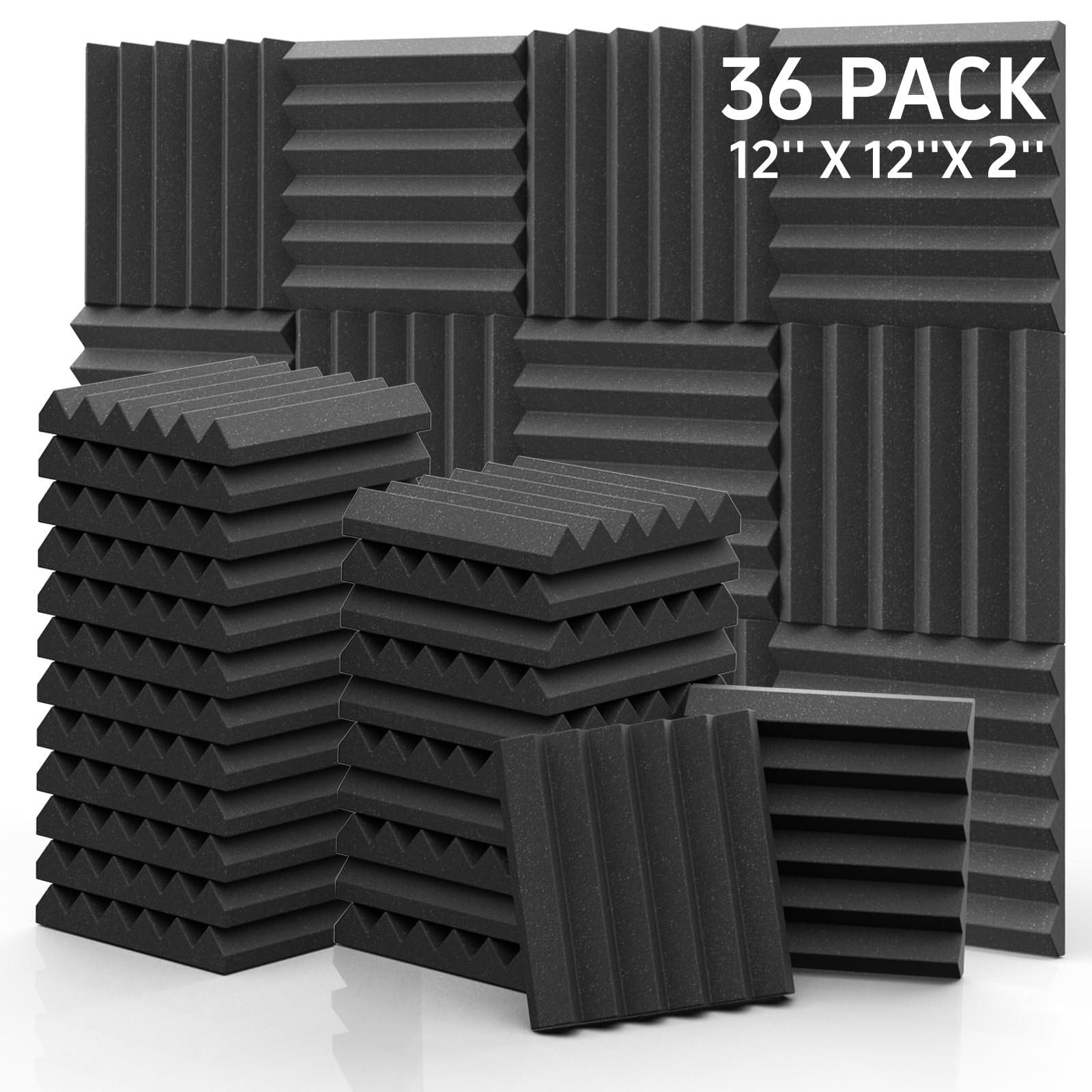
The GUERRI 36-pack is the only 2-inch thick wedge panel in this lineup, and that extra inch makes a noticeable difference in how low the absorption reaches. The 25 kg/m³ density polyurethane foam is SGS-tested for flame retardancy, which matters if you are covering large wall areas near electronics or heat sources. Each panel is exactly 12 by 12 by 2 inches, covering 36 square feet total.
The wedge profile scatters sound reflections more effectively than flat panels, reducing flutter echo and standing waves in narrow rooms. Users confirm that after mounting these on first-reflection points, spoken word becomes clearer and background reverb drops considerably. This pack does not include adhesive, so you will need spray adhesive or glue dots — but the wedge design stays put well once mounted.
The main trade-off is the vacuum-sealed packaging. Panels arrive compressed and may need several hours to fully fluff back to the stated 2-inch thickness. Some users reported a mild chemical smell initially, which dissipates within a day of ventilation. If you need deeper frequency absorption without building bass traps, the GUERRI wedges are your best non-custom option here.
Why it’s great
- 2-inch thickness improves lower-mid frequency absorption
- Wedge shape scatters reflections for cleaner room acoustics
- Flame retardant certified for safer installation
Good to know
- No adhesive backing or stickers included
- Needs up to 24 hours to reach full expanded thickness
5. Soon Global 8-Pack Acoustical Wall Panels

The Soon Global panels are for the buyer who refuses to choose between acoustic control and interior design. Each panel is made from flame-resistant high-density polyester fiber and printed with artist-curated designs. The panels are roughly 48 by 32 inches but some measure slightly smaller at 11.875 by 15.75 inches per tile — it is best to measure your wall before committing to a pattern layout.
Installation is straightforward: the included 50 transparent adhesive dots hold the lightweight fiber panels well on smooth walls, though some users reinforce with a tiny nail per panel for extra security. The sound absorption is real — outdoor stair noise and mid-frequency rattles are noticeably muffled. The thinner construction (under 0.5 inches) means deep bass passes through, but for conversational echo and high-frequency reflections, these perform well above their thickness class.
Cutting the panels to custom shapes requires a sharp utility knife and patience; the fiber material does not slice as cleanly as foam. The colors are slightly less vibrant than the product photos, leaning into a muted, dreamlike palette. If your priority is a feature wall that also quiets the room, the Soon Global panels execute that hybrid role better than any foam wedge can.
Why it’s great
- Unique printed designs double as wall art
- Flame-resistant polyester fiber is safer than standard foam
- Reduces echo and reverb despite thin profile
Good to know
- Cutting the fiber material is difficult and messy
- Thin construction offers minimal low-frequency absorption
6. 54 Pack Sound Proof Foam Panels Wedge
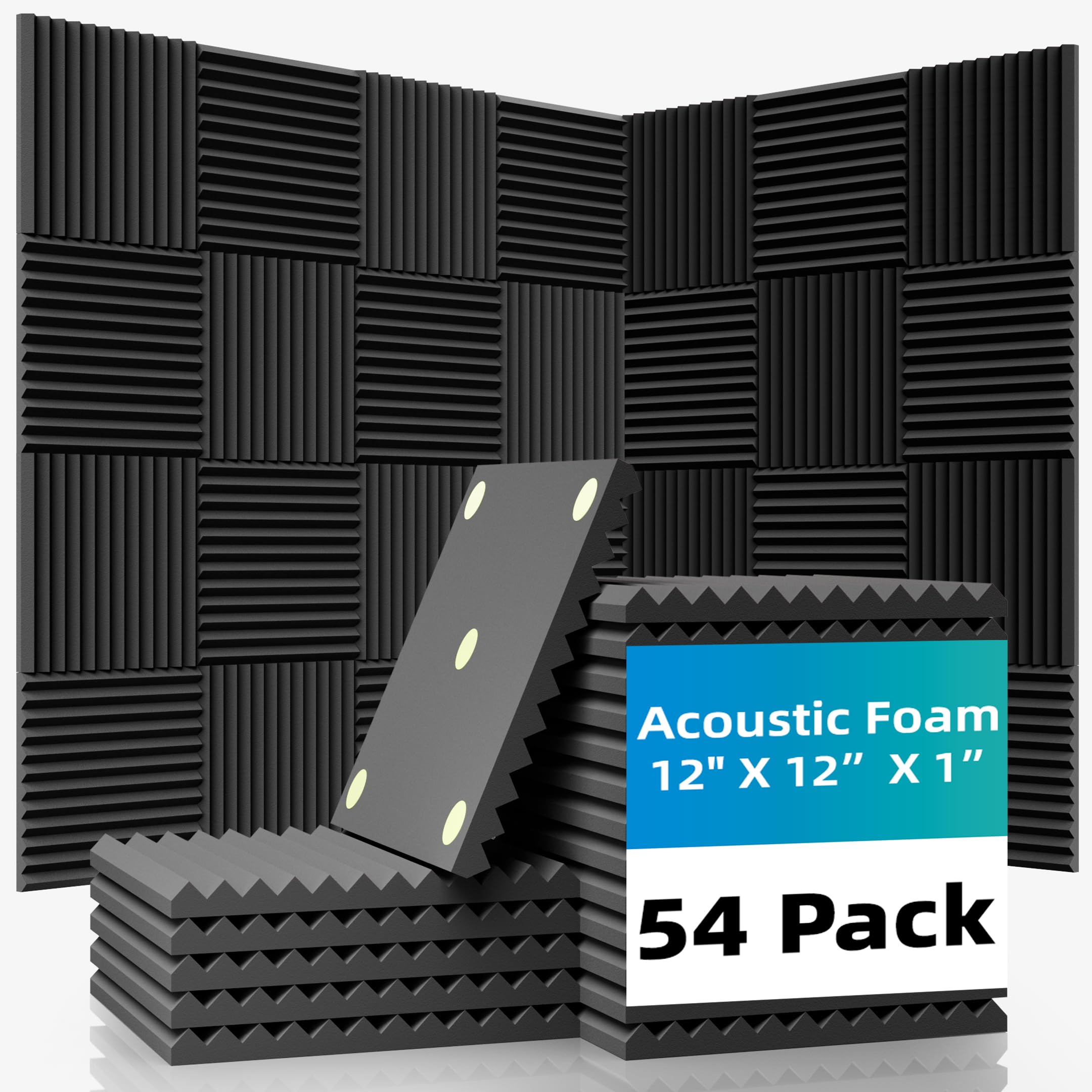
This 54-pack wedge set is the classic “first kit” for someone dipping into acoustic treatment. Each panel is 12 by 12 by 1 inch and made from high-density polyurethane foam with a wedge-cut surface that breaks up parallel wall reflections. The kit ships with 270 adhesive stickers, so you can install the entire batch in under an hour with no tools.
The wedge design helps reduce mid-frequency flutter echo in game rooms and home offices. Users report clearer Zoom calls and less tinny reverb after covering the wall behind their monitor. The adhesive dots stick firmly to clean painted walls, and most panels expand back to full size within 20 minutes of unpacking. Some users noted minor batch inconsistency — a second pack arrived with thinner foam and a different color hue — so check the contents before installation.
At 1 inch thick, these panels handle high-frequency absorption well but let low-bass energy pass through relatively unchanged. They are a legitimate entry-level solution for echo control, but if your room has a subwoofer or heavy footfall noise, you will need to supplement with bass traps. For the price per panel, this kit is a fair introduction to acoustic treatment with minimal commitment.
Why it’s great
- Generous 270 adhesive dots included for fast install
- Wedge profile reduces flutter echo effectively
- Lightweight and easy to reposition during layout
Good to know
- Inconsistent quality between different packs reported
- 1-inch thickness limits low-frequency absorption range
7. Amantech 12 Pack Acoustic Panels Self Adhesive Hexagon

The Amantech hexagon set is the most visually interesting option in this list. Twelve honeycomb-shaped panels in beige, each measuring 12 by 10.23 by 0.4 inches, can be arranged into eye-catching geometric wall patterns. The 100% polyester fiber material is odorless and formaldehyde-free, making it safe for bedrooms and children’s spaces.
The self-adhesive backing is strong enough for smooth drywall, and the panels can be cut with a utility knife for edge-fit installations. Users report a genuine reduction in room echo — not as dramatic as 2-inch foam, but clearly noticeable for mid-frequency reflections like TV dialogue and conversation. The hexagonal layout also spreads absorption across a wider surface area than square panels of the same count, which helps in rooms with irregular reflection points.
The biggest compromise is the 0.4-inch thickness. These are essentially thin acoustic tiles, not deep absorption panels. They excel at taking the harsh edge off a room’s reverb, but they will not eliminate standing waves or control low frequencies. The size was also slightly inconsistent across bundles, which can break symmetry in a tight geometric pattern. For a decorative echo-reduction layer that doubles as wall art, the Amantech hexagons fit a narrow but real niche.
Why it’s great
- Hexagon shape allows creative, seamless wall patterns
- Self-adhesive backing installs in minutes with no glue
- Odor-free, high-density polyester fiber is family-safe
Good to know
- 0.4-inch thickness delivers only light echo reduction
- Minor size variance between panels can break pattern alignment
FAQ
What is the difference between soundproofing and acoustic treatment?
How many acoustic panels do I need for a standard 10×12 room?
Can acoustic panels stop sound from leaking into a microphone?
Should I get 1-inch or 2-inch thick panels?
Final Thoughts: The Verdict
For most users, the acoustic panels for soundproofing winner is the TONOR Dual-Layer because it combines large-format coverage, genuine high-density polyester absorption, and a clean aesthetic that doesn’t scream “recording studio.” If you want deep frequency absorption and are willing to buy adhesive separately, grab the Knightsacoustic 96 Pack. And for a budget-sensitive echo fix with no extra hardware, the 100 Pack Acoustic Foam Panels offer unbeatable coverage per dollar.

Mo Maruf
I created WellFizz to bridge the gap between vague wellness advice and actionable solutions. My mission is simple: to decode the research and give you practical tools you can actually use.
Beyond the data, I am a passionate traveler. I believe that stepping away from the screen to explore new environments is essential for mental clarity and physical vitality.