Our readers keep the lights on and my smoothie glass nicely filled. As an Amazon Associate, I earn from qualifying purchases.
A belt sander that tracks off the rollers, stalls under light pressure, or sprays a cloud of fine dust across your shop isn’t a tool—it’s a frustration that stops a project dead. The difference between a frustrating afternoon and a smooth, progressive finish comes down to three things: motor torque that holds its speed, tracking that stays true through the cut, and dust collection that actually captures the fines before they settle. Choosing the right one means knowing which spec matters for your specific work, not just grabbing the cheapest unit with the biggest belt.
I’m Mohammad Maruf — the founder and writer behind WellFizz. Over the last several years I have analyzed the engineering specifications and market trends of hundreds of stationary and handheld woodworking tools, comparing motor designs, belt geometries, and dust architectures to help buyers match tools to real workshop demands.
This guide digs into the real differences between the top models available to help you pick a belt sander for woodworking that matches your skill level, budget, and the specific jobs you tackle most often.
How To Choose The Best Belt Sander For Woodworking
Buying a belt sander without understanding the interplay between belt size, motor power, and dust collection is like choosing a saw blade by its color. Each variable changes how the tool behaves in your hands and what kind of finish it leaves behind.
Belt Size: The First Decision
The belt dimensions dictate what the tool is good at. A 3-by-21-inch belt is the standard for handheld sanding—it is nimble enough for doors, edges, and small panels yet long enough to keep the cut flat. A 4-by-24-inch belt, like the WEN HB424V, covers more surface area per pass and removes material faster, but it is heavier and harder to control on vertical surfaces. For benchtop units, a 4-by-36-inch belt paired with a disc gives you the most versatility for shaping and finishing smaller pieces.
Motor Spec: Amps vs Torque vs Stall
Motor amperage is a headline number, but it is the torque curve that keeps the belt moving under pressure. A 7-amp motor that bogs down on a knot is less useful than a well-designed 9-amp motor that holds its speed. Look for user reports about stalling, not just the label. Brushed motors are common at every price point and offer easy maintenance, while brushless options like the DEWALT DCW220B deliver higher efficiency and runtime but typically come with a premium price.
Dust Collection: The Difference Between Clean and Hazardous
Fine wood dust is a health hazard and a shop nuisance. A dust bag that captures only the coarse chips isn’t doing its job. The most effective setup routes through a port that connects to a shop vacuum. Models with a standard 2.5-inch or 35mm port give you that option. Benchtop units with dual ports, one for the belt and one for the disc, prevent cross-contamination between the two operations.
Variable Speed vs Fixed Speed
Variable speed gives you control over the aggressiveness of the cut. Low speeds (around 660 feet per minute) are excellent for finishing passes and softer woods, while high speeds (above 1300 feet per minute) tear through stock removal. If you work exclusively with hardwoods or need fine control for edge work, variable speed is worth the investment. For rough dimensioning of construction lumber, a fixed-speed unit can save you money without sacrificing performance.
Quick Comparison
On smaller screens, swipe sideways to see the full table.
| Model | Category | Best For | Key Spec | Amazon |
|---|---|---|---|---|
| Metabo HPT SB8V2 | Handheld | Pro woodworking & heavy stock removal | 9.0 Amp / 1,020W motor | Amazon |
| DEWALT DCW220B | Cordless | Jobsite mobility & scribing | 20V MAX brushless motor | Amazon |
| WEN HB424V | Hybrid Handheld/Bench | Material removal & bench versatility | 10 Amp / 4″ x 24″ belt | Amazon |
| SKIL BB9504-00 | Benchtop Combo | Home shop precision & shaping | 4.5 Amp induction motor | Amazon |
| Woodskil 4×36 | Benchtop Combo | DIY shaping & home projects | 0-90° belt tilt | Amazon |
| Jellas 7Amp 3×21 | Handheld Entry | Entry-level sanding & bench conversion | Variable speed 120-400 RPM | Amazon |
| Genesis GBS321A | Handheld Budget | Occasional DIY & quick jobs | 8 Amp / 18,000 RPM | Amazon |
In‑Depth Reviews
1. Metabo HPT SB8V2

The Metabo HPT SB8V2 delivers the most balanced combination of power, control, and durability in the 3-by-21-inch handheld class. Its 9-amp, 1,020-watt motor provides consistent torque even when hogging off material with a coarse 40-grit belt, and the variable-speed dial at the base of the handle allows you to dial back the aggression for finishing passes on softer woods like pine or poplar. The clear front cover is a small touch that makes a big difference when you are sanding flush against a jamb or a cabinet face—you can see exactly where the belt meets the work.
The dust bag mounts on the left side, which improves visibility when sanding into corners, and while the bag captures a decent amount of coarse debris, serious shops will want to connect the sander to a shop vac for fine particle control. The flush-surface design lets the platen ride flat against vertical surfaces without gouging the workpiece, a feature that matters when you are stripping paint off door panels or leveling a misaligned joint. Users note that the sander feels heavier than some competitors at 9.5 pounds, but that weight translates to stability when the belt is under load.
With a professional 5-year warranty and a reputation for holding up to daily use, the Metabo HPT SB8V2 is the right choice for woodworkers who need a reliable handheld sander that can graduate from deck boards to fine furniture. The tool-less belt change and accurate tracking adjustment mean you spend your time sanding, not fiddling with the belt guide.
Why it’s great
- Powerful 9-amp motor resists stalling even under heavy pressure
- Variable-speed dial gives real control for different wood types
- Flush sanding design and clear cover improve precision and visibility
- 5-year warranty provides confidence for professional use
Good to know
- Heavier than some competitors at 9.5 pounds—can fatigue arm during extended overhead work
- Dust bag is only adequate; a shop vac connection is needed for fine dust
2. DEWALT DCW220B

The DEWALT DCW220B is the first serious cordless belt sander that can stand toe-to-toe with corded units in many woodworking scenarios. The brushless motor delivers up to 22 percent more power than its predecessor, with enough torque to drive a 3-by-21-inch belt through hard maple without bogging, and the variable-speed trigger offers 25 speed settings so you can dial in the exact rate for scribing, shaping, or final smoothing. The 16.7 percent larger sanding surface area compared to the equivalent Milwaukee cordless model means fewer passes on longer boards, which directly translates to faster job completion on site.
The dust collection system, when paired with the optional DEWALT Airlock adapter, achieves up to 95 percent efficiency—easily the best dust capture of any sander in this lineup. The tool-free belt change system is quick and intuitive, and the overmolded auxiliary handle provides a comfortable second handhold for controlling the sander during heavy passes. The unit is cordless, so you can take it up a ladder, out to a deck, or across a jobsite without dragging an extension cord, but the trade-off is battery life. Real-world reports indicate runtime of 10 to 12 minutes per charge with a 5Ah battery on medium speed, so plan for multiple batteries on larger projects.
If you are already invested in the DEWALT 20V MAX platform and need a portable sander that doesn’t compromise on power, the DCW220B is a legitimate replacement for a corded sander. It pairs wirelessly with compatible DEWALT dust extractors for automatic activation, a feature that professional woodworkers who prioritize dust control will appreciate.
Why it’s great
- Brushless motor provides power comparable to many corded units
- Excellent dust collection with Airlock adapter—95% efficiency
- Cordless freedom for jobsite mobility and hard-to-reach areas
- 25-speed selection dial allows precise speed control
Good to know
- Battery life is limited to about 10-12 minutes per charge—requires spare batteries for full-day work
- Tool-only purchase; no battery or charger included
3. WEN HB424V

The WEN HB424V is an absolute beast for the price, offering a 10-amp motor with a 4-by-24-inch belt that removes material faster than most corded 3-inch models. The variable-speed control allows you to adjust the belt speed from 660 to 1,310 feet per minute, which is a wide enough range to tackle everything from aggressive stock removal to gentle finishing passes. The defining feature of this sander is its dual-mode design: it functions as a powerful handheld belt sander, and with the included mounting clamps and rubber pad, it can be flipped upside down and bolted to a benchtop to serve as a stationary sander for shaping small parts.
The quick-release belt tension lever makes grit changes fast, and the tracking adjustment holds true even after prolonged use. However, the dust collection is this sander’s weakest point—the included bag captures only the larger particles, and the 1.2-inch dust port requires an adapter to connect to most shop vac hoses. Several users report that a standard 2.5-inch vacuum hose won’t fit without 3D-printed or aftermarket adapters. The sander is heavy, as you would expect with a 4-inch-wide belt, but the weight helps keep the platen flat on the work surface without requiring downward pressure from the user.
For woodworkers who need a single sander that can switch between handheld flattening and benchtop shaping, the WEN HB424V offers versatility that most units at this price cannot match. The two-year warranty provides reasonable protection, and the performance far exceeds what the price tag suggests. Be prepared to solve the dust port issue if a clean shop is a priority.
Why it’s great
- 10-amp motor with a 4-inch belt delivers exceptional material removal speed
- Dual-mode design works as handheld and benchtop sander
- Wide variable-speed range from 660 to 1,310 FPM
- Quick-release belt tension for easy grit changes
Good to know
- Dust collection is poor without a shop vac adapter—plan to use a vacuum for fine dust
- Heavy build makes it tiring for overhead or vertical sanding
4. SKIL BB9504-00

The SKIL BB9504-00 is a stationary benchtop sander built around a 4.5-amp induction motor that provides consistent speed under load without the decibel spike of a brushed universal motor. The combination of a 4-by-36-inch belt and a 6-inch disc gives you two sanding surfaces for different tasks—the belt handles long edges and flat surfaces, while the disc excels at shaping curves and end-grain work. The belt tilts from 0 to 90 degrees, and the work table tilts from 0 to 45 degrees with a miter gauge included, allowing precise angle sanding for frame and joinery work.
The dust collection is handled by a standard 2.5-inch port that connects directly to most shop vac hoses, so fine dust is captured effectively without requiring adapters. The quick-tension release lever makes sandpaper changes simple, and the pre-drilled mounting holes in the base allow permanent bench installation. Users consistently note the motor’s resistance to bogging down even when pressing hard into the disc, a sign of the induction motor’s superior torque characteristics compared to similarly priced benchtop units that use lower-grade universal motors.
For the home workshop woodworker who needs a dedicated sanding station for shaping, cleaning up edges, and squaring small parts, the SKIL BB9504-00 is a clean, quiet, and accurate choice. The three-year limited warranty offers extended protection, and the weight of 25.6 pounds keeps the unit stable during heavy use. The only operational caution is that both the belt and disc run simultaneously whenever the machine is on—no independent switching—so be mindful of loose clothing near the disc.
Why it’s great
- Induction motor delivers quiet, consistent power that resists bogging
- Belt tilts 0-90°, table tilts 0-45° with miter gauge for precise angle work
- Standard 2.5-inch dust port connects to shop vac without adapters
- Rugged construction with stable 25.6-pound base for bench mounting
Good to know
- Belt and disc run simultaneously; no independent control
- Warranty is 12 months as standard, extendable to 36 with registration
5. Woodskil 4×36

The Woodskil 4×36 belt and disc sander brings a 3/4-horsepower motor to the benchtop class that provides enough torque for consistent sanding of wood, metal, and plastic parts. The 4-by-36-inch belt can be tilted from horizontal to vertical, making it a true 2-in-1 station for flat sanding on the horizontal plane and edge profiling when the belt is upright. The 6-inch disc sander adds the ability to shape curves and clean up miters, and the adjustable work table tilts from 0 to 45 degrees to accommodate bevel work and angled edges.
A unique feature at this price point is the dual dust exhaust ports—one dedicated to the belt and one to the disc—which prevents cross-contamination of particles and simplifies connection to a shop vac. The multi-wedge belt drive mechanism extends belt life by reducing slippage, and the transparent PC guard lets you see the belt condition without stopping the machine. Users report straightforward assembly and a stable platform thanks to the 25-pound weight and steel base.
The Woodskil is best suited for the home DIYer who needs a compact bench sander for furniture repairs, knife sharpening, and small project work. The 2-year warranty provides adequate coverage for occasional use. It doesn’t have the raw power of a premium induction motor, but the combination of belt tilt, disc sander, and dual dust collection makes it a versatile addition to any home shop.
Why it’s great
- Belt tilts from 0 to 90 degrees for both flat and edge sanding
- Dual dust exhaust ports keep belt and disc debris separate
- Steel base and 25-pound weight provide good stability for bench mounting
- Multi-wedge belt drive extends belt life
Good to know
- Motor is adequate but not as powerful as premium induction motors
- Some users note the belt tension requires periodic adjustment to prevent drift
6. Jellas 7Amp 3×21
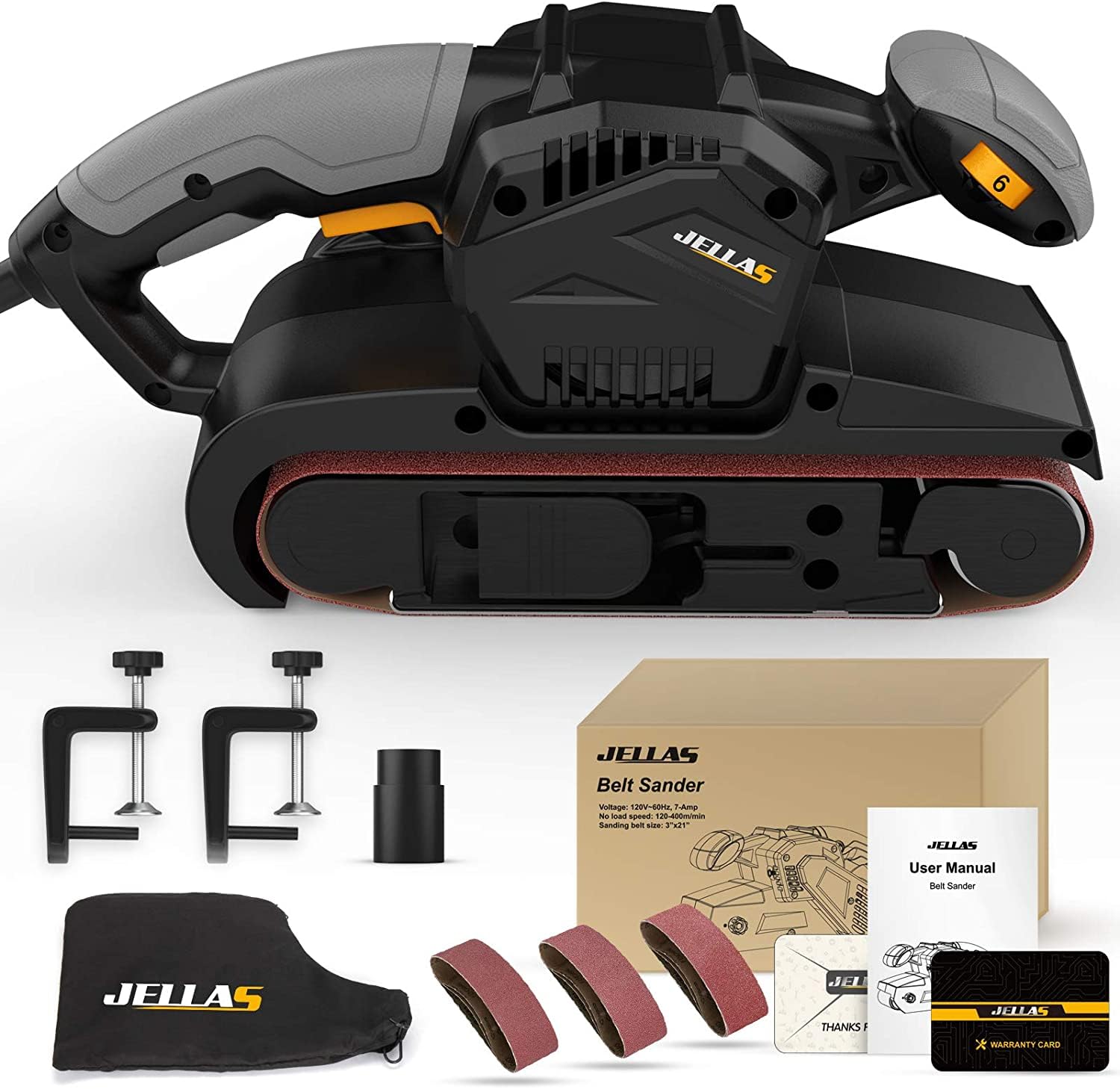
The Jellas 7Amp belt sander is the most feature-packed entry-level unit in this guide, offering variable-speed control with six dial settings from 120 to 400 RPM, a 10-foot power cord, and the ability to convert into a benchtop sander using the included C-clamps. The 7-amp motor is adequate for light to moderate stock removal on softwoods and thin hardwoods, and it includes ten sanding belts in grits from 40 to 180 so you can start working immediately without a separate purchase. The soft-grip handle reduces hand fatigue during extended sessions, and the low-profile design lets you reach into tighter spaces than bulkier units.
The dust collection bag is detachable and easy to empty, but like many budget sanders, it struggles with fine dust—the included 2-in-1 vacuum adapter (35mm and 32mm) is a practical solution for connecting a shop vac, which dramatically improves particle capture. Belt tracking is stable once adjusted, and the lock-on button is a welcome feature for sustained sanding without constant trigger pressure. The sander is lightweight and comfortable, making it a good choice for beginners who want to learn belt sanding technique without the intimidation of a heavy, aggressive machine.
For the hobbyist or DIYer who needs a first belt sander for weekend projects like sanding a tabletop or smoothing reclaimed lumber, the Jellas offers strong value. It won’t hold up to daily professional use, but for occasional shop work it delivers reliable performance and enough included accessories to keep you running for your first few projects.
Why it’s great
- Variable-speed control with six dial settings for different materials
- Converts to a benchtop sander with included C-clamps
- Comes with ten belts from 40 to 180 grit—ready to work out of the box
- 10-foot power cord provides good reach without an extension
Good to know
- Dust bag is only moderately effective; plan to use a shop vac for fine dust
- Motor is best suited for light to moderate use, not professional daily work
7. Genesis GBS321A

The Genesis GBS321A is the most budget-conscious option in this lineup, offering an 8-amp motor, variable-speed control, and a single-lever quick-change belt system at a price that makes it accessible to any DIYer. The motor has enough power for deck boards, pallet wood, and general home improvement sanding, and the adjustable front handle provides a comfortable grip for horizontal and vertical passes. The low-profile design lets you get into tight spots like door jambs and cabinet interiors, which is a genuine advantage for a tool at this price level.
The dust bag is this sander’s biggest weakness—multiple users report that it is flimsy and ineffective, with fine dust escaping from under the belt and the bag filling quickly with only coarse chips. The dust port has a non-standard square opening that makes it difficult to connect most shop vac hoses without modification. The cord placement is also awkward for right-handed users, occasionally catching on the edge of the workpiece when sanding close to a vertical surface. Some users have reported that the motor can stall when too much dust accumulates in the brush compartment, requiring periodic cleaning.
For the occasional user who needs a belt sander for one or two weekend projects and doesn’t want to spend beyond the bare minimum, the Genesis GBS321A works. The variable speed gives some flexibility, and the quick-change belt system is genuinely convenient. But the dust collection limitations and durability concerns mean it is best reserved for light-duty applications where shop cleanliness is not a priority.
Why it’s great
- 8-amp motor provides decent power for occasional home projects
- Single-lever quick-change belt system saves time on grit swaps
- Adjustable front handle and low-profile design improve control in tight spaces
- Variable-speed control adds versatility for different materials
Good to know
- Dust bag is flimsy and ineffective—fine dust escapes easily
- Dust port has a non-standard square opening, making shop vac connection difficult without modification
- Durability concerns with plastic components; best for occasional use
FAQ
How do I prevent my belt sander from digging a gouge into the workpiece?
Why does my belt sander track to one side and how do I fix it?
Is a 4-inch belt sander too heavy for handheld work?
Can I use a belt sander for sharpening chisels and plane blades?
Final Thoughts: The Verdict
For most users, the belt sander for woodworking winner is the Metabo HPT SB8V2 because it offers the best balance of power, variable-speed control, and build quality for both job site and shop use. If you want the freedom of cordless operation and have a DEWALT battery platform, grab the DEWALT DCW220B. And for a versatile hybrid that switches between handheld and benchtop duty with a massive 4-inch belt, nothing beats the WEN HB424V.

Mo Maruf
I created WellFizz to bridge the gap between vague wellness advice and actionable solutions. My mission is simple: to decode the research and give you practical tools you can actually use.
Beyond the data, I am a passionate traveler. I believe that stepping away from the screen to explore new environments is essential for mental clarity and physical vitality.