Our readers keep the lights on and my smoothie glass nicely filled. As an Amazon Associate, I earn from qualifying purchases.
A dead CPAP battery at 2 AM in a tent isn’t just inconvenient — it’s a medical risk. The difference between a restless night and restorative sleep while camping comes down to one choice: the watt-hour capacity and DC compatibility of your portable power source. Most general-use power banks leave CPAP users gasping by dawn because they were designed for phones, not respiratory therapy.
I’m Mohammad Maruf — the founder and writer behind WellFizz. Over years of analyzing backup power systems, I’ve evaluated dozens of portable stations specifically for their ability to deliver clean, stable power to sensitive medical devices through multiple overnight cycles in off-grid conditions.
Whether you’re car-camping for a weekend or preparing for extended power outages, this guide breaks down the essential specs and real-world performance of the battery for cpap camping that will keep your therapy uninterrupted from dusk till dawn.
How To Choose The Best Battery For CPAP Camping
Selecting a battery for CPAP camping requires more than picking the biggest number. Your machine’s specific power draw, the availability of DC direct cables, and the battery’s internal chemistry all determine whether you wake up rested or scrambling for power at dawn. Here are the three factors that separate a reliable camping companion from a frustrating paperweight.
Watt-Hour Capacity vs. Your CPAP’s Real Draw
A CPAP machine with the humidifier off and heated tube disconnected typically draws between 30 and 60 watts per hour. A 200Wh battery running a 50W machine should deliver roughly four hours — but that calculation only holds true if you lose no energy to conversion. Connecting through the AC inverter increases draw by 15–20% compared to DC direct, so always prioritize a battery with a native DC output at your machine’s voltage (typically 12V, 15V, or 24V).
DC Direct Cables and Voltage Matching
Not all batteries come with the right cable for your CPAP. Look for a unit that includes a dedicated DC cable for your specific model — ResMed AirSense 10/11, AirCurve 10/11, AirMini, or Philips DreamStation. Some premium options offer adjustable voltage DC ports that let you dial in 12V, 16.5V, 20V, or 24V to match your machine’s exact input requirement. Running your CPAP through the AC port wastes battery capacity that could give you an extra night of sleep.
Battery Chemistry: LiFePO4 vs. Lithium-Ion
Lithium Iron Phosphate (LiFePO4) batteries last 3,000 to 3,500 charge cycles compared to 500 cycles for standard lithium-ion. For frequent campers, this chemistry pays for itself within two seasons. LiFePO4 also handles partial charging better and maintains stable voltage output as the battery drains, preventing the sudden shutdowns that plague older lithium packs. If you camp more than a handful of nights per year, the upfront investment in LiFePO4 is well worth it.
Quick Comparison
On smaller screens, swipe sideways to see the full table.
| Model | Category | Best For | Key Spec | Amazon |
|---|---|---|---|---|
| BLUETTI CPAP X30 | Dedicated CPAP | Multi-night off-grid therapy | 297Wh, DC 12/15/24V outputs | Amazon |
| EASYLONGER ES960 | Dedicated CPAP | LiFePO4 longevity & RV trips | 297.6Wh, LiFePO4, 4 cables | Amazon |
| BLUETTI Elite 30 V2 | General Power | CPAP + device charging hub | 288Wh, 600W/1500W surge | Amazon |
| EASYLONGER ES720 | Dedicated CPAP | Universal voltage for any machine | 266.4Wh, 4 DC cables included | Amazon |
| GRECELL EB300 | General Power | Wireless charging & solar prep | 288.6Wh, 60W USB-C PD | Amazon |
| MARBERO M823 | General Power | Lightweight tent camping | 237Wh, 4.6 lbs, LED lantern | Amazon |
| Anker SOLIX C300 | Solar Bundle | Solar recharging & quiet operation | 288Wh, 25dB fan, 60W panel | Amazon |
| HOWEASY H260 | General Power | Budget-friendly backup | 178Wh, 260W AC output | Amazon |
| DaranEner 192Wh | General Power | Entry-level compact backup | 192Wh, LiFePO4, 5.73 lbs | Amazon |
In‑Depth Reviews
1. BLUETTI CPAP Battery Backup X30

The BLUETTI X30 is purpose-built for CPAP therapy off-grid. Its 297Wh capacity delivered five consecutive nights of sleep on a Philips System One (pressure 10, humidifier off) in real-world testing — using only 80% of the battery over five nine-hour sessions. That works out to roughly 16% drain per night, meaning most campers get nearly a full week of therapy from a single charge.
The three dedicated DC output ports at 12V, 15V, and 24V eliminate the efficiency loss from AC inversion. The unit auto-detects the correct voltage from the connected cable, so there is no guesswork. Included cables cover ResMed S9, AirSense 10/11, AirCurve 10, AirMini, and Philips DreamStation. At just 4.1 pounds with a built-in handle, it slides easily into a duffel bag for car camping.
Some users reported that the advertised weight is slightly understated — actual weight measures around 4.2 pounds — and only one CPAP can be powered at a time. The LiFePO4 chemistry supports roughly 2,000 charge cycles, making this a long-term investment for the regular camper. Pass-through charging allows simultaneous power delivery and recharging during the day.
Why it’s great
- Achieved 5–7 nights per charge with humidifier off on ResMed devices
- Three adjustable DC outputs matched to common CPAP voltages
- Comprehensive cable set with color-coded compatibility labels
Good to know
- Actual weight slightly exceeds the advertised 3.9 pounds
- Only powers one CPAP device at a time
- Some compatibility issues reported with Philips DreamStation
2. EASYLONGER ES960 CPAP Battery Backup 297.6Wh

The ES960 from EASYLONGER delivers 297.6Wh of LiFePO4 capacity rated for over 3,000 charge cycles, making it one of the most durable options for frequent campers. Real-world testing with an AirSense 10 (no humidifier, no heated tube) produced over 36 hours of runtime — enough for two full nights with margin to spare for charging phones and a smart watch.
Four dedicated DC cables are included for ResMed S9, AirSense 10/11, AirCurve 10/11, AirMini, and Philips DreamStation 1/2. The unit also supports pass-through charging, so you can top up the battery during the day while keeping your devices powered. Six output ports provide flexibility for laptops, handheld gaming consoles, and car refrigerators under 180W.
Some early units had runtime variability — the first unit tested delivered only 8 hours before replacement. The replacement unit ran 36+ hours. This suggests quality control can be inconsistent, so test immediately upon arrival. The battery exceeds the airline 160Wh limit, so it is strictly for car camping, RV use, or home backup. The flashlight button is easy to trigger accidentally in a bag.
Why it’s great
- 3000+ cycle LiFePO4 chemistry for years of camping seasons
- Over 36 hours runtime on AirSense 10 with no heat or humidity
- Versatile six-port output hub for charging multiple devices
Good to know
- Some units required replacement to achieve advertised runtime
- Flashlight switch activates easily during transport
- Exceeds airline Wh limit for carry-on restrictions
3. BLUETTI Elite 30 V2 Portable Power Station 600W
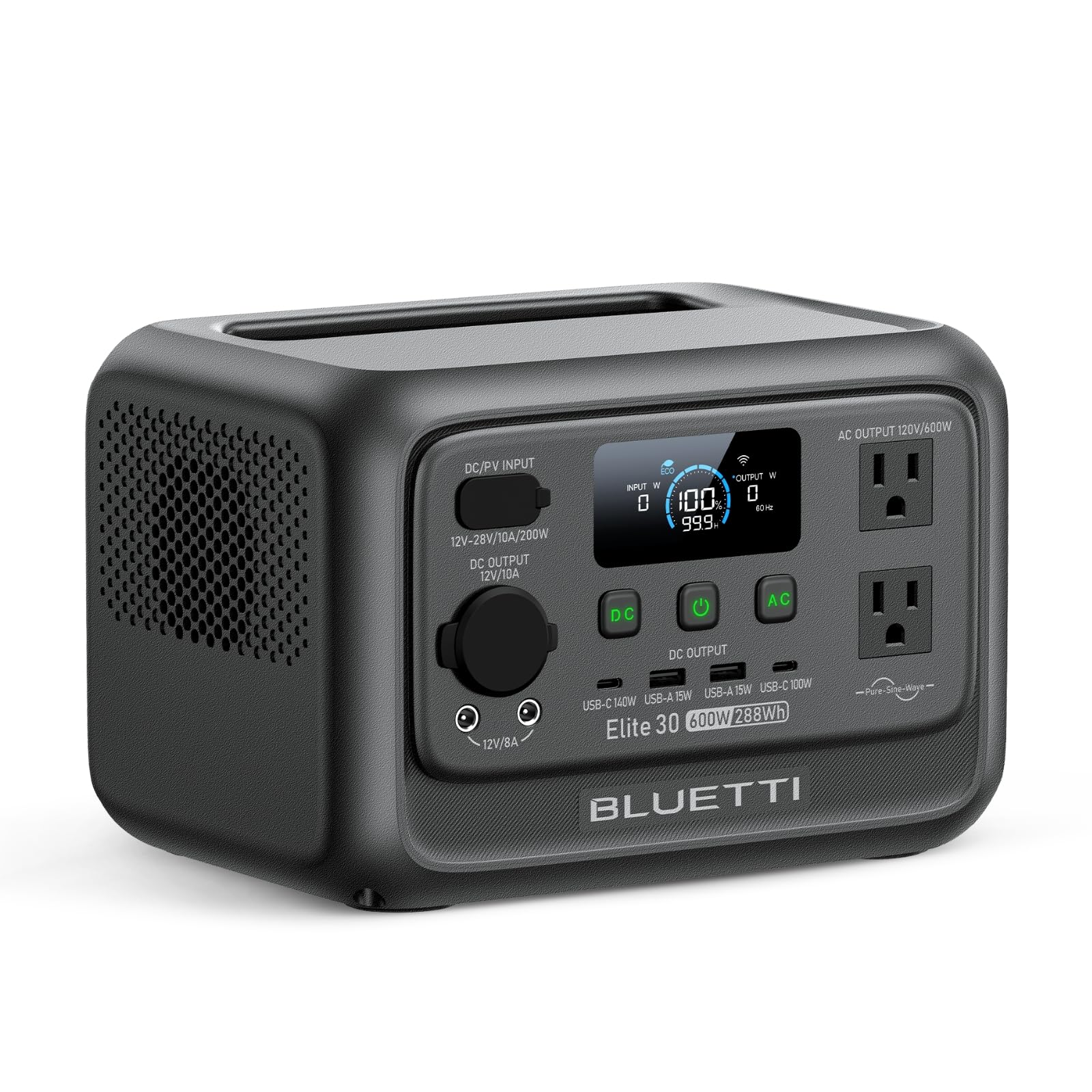
The BLUETTI Elite 30 V2 packs 288Wh and a 600W continuous inverter (1,500W surge in Power Lifting mode) into a 9.4-pound chassis. While it is not a dedicated CPAP battery, its 10ms UPS switch makes it ideal for home blackout scenarios where your CPAP must not skip a breath during the transition from wall power to battery.
Two USB-C ports deliver 140W and 100W PD respectively — enough to fast-charge a laptop and phone simultaneously while running your CPAP from the AC outlet. The unit recharges from 0–80% in 45 minutes via AC, which is significantly faster than most competitors. Smart cooling and UltraCell technology reduce standby power consumption to just 4.5W, preserving more capacity for overnight use.
The trade-off is that this is a general power station, not a CPAP-specific unit. You will need to use the AC outlet or a third-party DC adapter, which reduces overall efficiency compared to direct DC connection. The fan under load is audible but not disruptive in a tent environment. The companion app provides remote monitoring and power management.
Why it’s great
- 10ms UPS transfer protects CPAP during grid-to-battery switch
- 380W wall charging reaches 80% in just 45 minutes
- App-enabled control for monitoring battery status remotely
Good to know
- No dedicated CPAP DC cables included
- 9.4 pounds is heavier than dedicated CPAP units
- Cooling fan activates under sustained load
4. EASYLONGER CPAP Battery Backup Power Supply ES720

The ES720 stands out for its adjustable DC voltage selector that lets you match 12V, 16.5V, 20V, or 24V output to your CPAP’s exact requirement. This eliminates the need for a separate voltage converter and ensures maximum efficiency. The 266.4Wh capacity delivered three nights for a ResMed AirCurve 10 user (pressure 12–17, no humidifier) in real-world use, with enough reserve for an additional night.
Four dedicated CPAP cables are included for ResMed S9, AirSense 10/AirCurve 10, AirMini/AirSense 11, and Philips DreamStation. The unit also includes a 180W cigarette lighter socket for car accessories. Pass-through charging lets you recharge the battery during daylight hours while running your CPAP simultaneously — ideal for extended off-grid stays where you have access to solar panels or a vehicle.
The buttons require firm pressure to activate, which some users found inconvenient in the dark. The LED indicators are bright enough to be slightly distracting in a tent. At 3.31 pounds, it is one of the lighter dedicated CPAP batteries, but it uses standard lithium-ion chemistry rather than LiFePO4, so total cycle life is shorter — expect around 500 full cycles before noticeable capacity loss.
Why it’s great
- Four selectable DC voltages match any CPAP without extra adapters
- Achieved three nights of use on AirCurve 10 in real-world test
- Pass-through charging supports simultaneous use and recharging
Good to know
- Lithium-ion chemistry yields ~500 cycles versus LiFePO4
- Buttons require deliberate pressure and LEDs are bright
- Voltage setting resets after each power-off cycle
5. GRECELL Portable Power Station 330W EB300
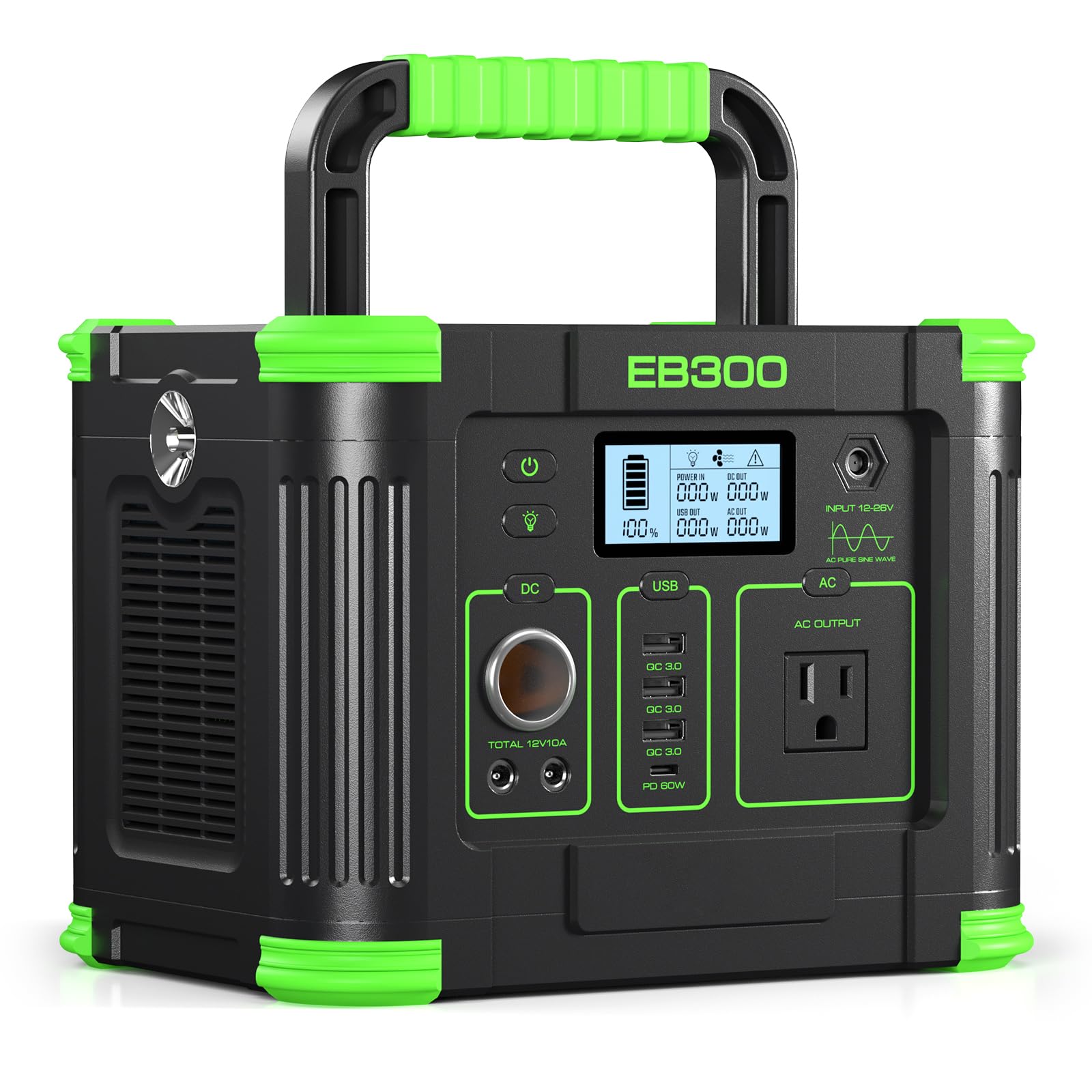
The GRECELL EB300 packs 288.6Wh with a 330W pure sine wave inverter and a built-in 5W wireless charging pad on top — a convenience for campers who want to drop their phone onto the station without fumbling with cables. The 60W USB-C PD port charges a MacBook Pro fully, and nine total ports handle everything from a CPAP to a drone battery.
The MPPT solar controller boosts efficiency by up to 30% compared to standard controllers, making this a solid choice for campers who plan to pair it with a 60–120W solar panel. Recharge time via AC wall outlet is roughly 6–7 hours. The dual whisper-quiet fans only activate under heavy load, so CPAP operation alone typically keeps them off, preserving battery and silence.
The wireless charging pad is positioned on top of the unit, which means the phone may slide off if the station is bumped during the night. The stated weight on the listing is ambiguous — the unit actually weighs roughly 7.9 pounds, heavier than dedicated CPAP options. It also lacks dedicated CPAP DC cables, so you will need to run through the AC outlet or source a third-party 12V adapter.
Why it’s great
- Integrated 5W wireless charging pad reduces cable clutter
- Smart MPPT solar controller improves solar efficiency by 30%
- Nine output ports handle CPAP plus multiple personal devices
Good to know
- No CPAP-specific DC cables included in the box
- Wireless charging area is flat with no lip to hold phone
- Actual weight is higher than many dedicated CPAP batteries
6. MARBERO Portable Power Station 300W M823
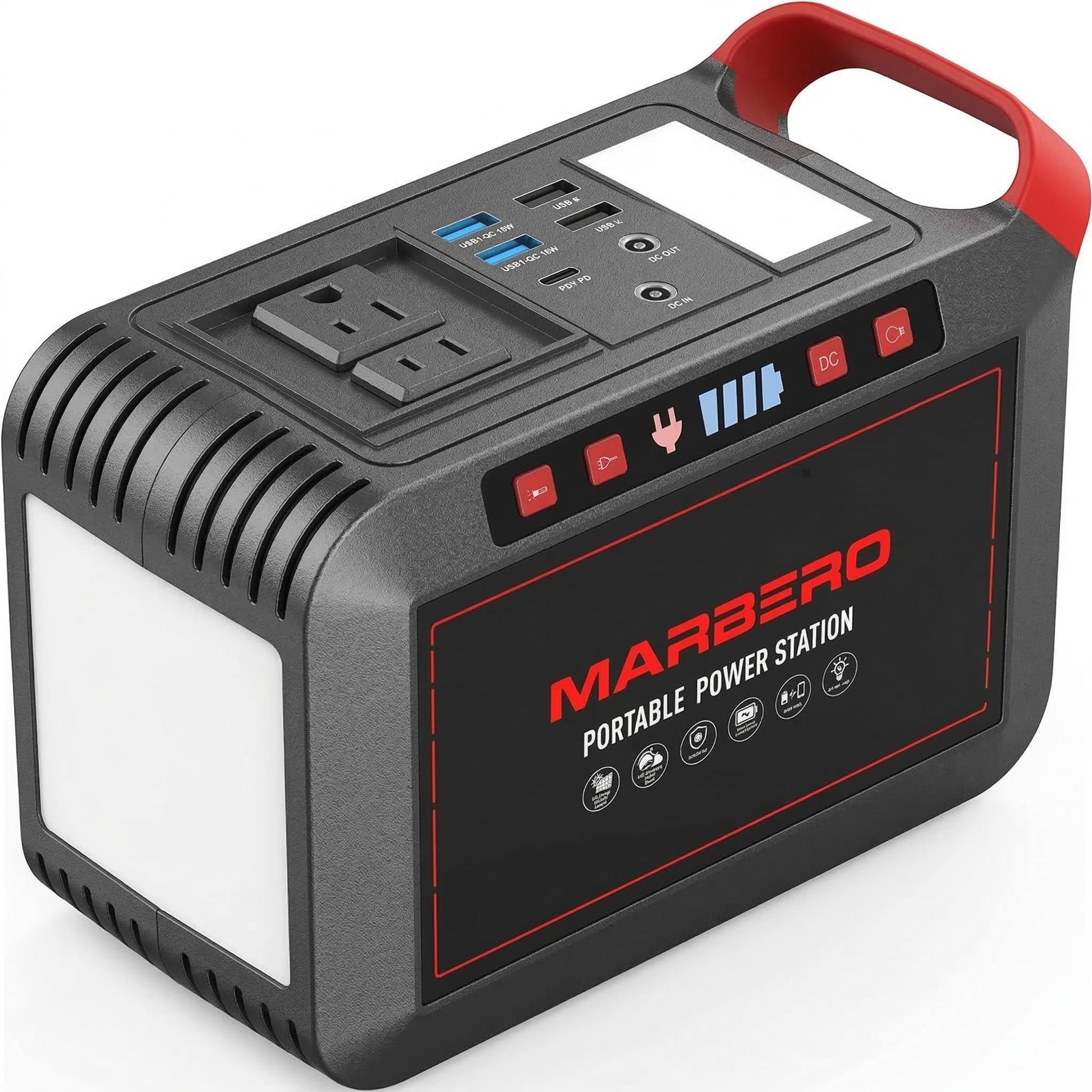
The MARBERO M823 is the lightest unit in this review at 4.6 pounds, with a compact cuboid shape (8.15 x 5.83 x 3.9 inches) that fits easily into a backpack. Its 237Wh capacity (equivalent to 64,000mAh at 3.7V) is on the lower side but sufficient for a single overnight session with a modern CPAP running without humidification — expect roughly 5–6 hours of therapy from the AC outlet.
The dual LED camping lantern is a practical bonus, offering two brightness levels on the top light and three modes (steady, twinkling, SOS) on the side light. Recharge time is 6 hours via wall outlet or 8 hours via car adapter. The cooling vents keep internal temperatures stable even during sustained use, and the BMS protects against overcharge, overload, and short circuits.
Multiple users reported that the unit failed after several months of use — the battery suddenly stopped delivering power or the AC outlet button blinked red. This suggests reliability can be inconsistent over the long term. The 237Wh capacity is marginal for a full night with a higher-pressure CPAP or any humidity setting, so this is best suited for low-power machines and shorter sleep schedules.
Why it’s great
- Lightest unit at 4.6 pounds with compact backpack-friendly dimensions
- Dual LED lantern with SOS mode for emergency and campsite lighting
- Cooling vents maintain safe temperatures during sustained discharge
Good to know
- Reports of sudden battery failure after several months of use
- 237Wh capacity is marginal for a full night with humidification
- Included USB-C port limited to 18W PD — slower device charging
7. Anker SOLIX C300 with 60W Solar Panel

The Anker SOLIX C300 bundles a 288Wh LiFePO4 power station with a 60W solar panel, creating a complete off-grid power system for the CPAP camper. The cooling fan emits only 25dB from 3.3 feet — quieter than a library — making it practically inaudible inside a tent. The two USB-C ports deliver 140W and 100W PD, fast enough to recharge the station itself or power a high-draw laptop.
The solar panel consists of an IP68-rated ETFE surface that folds into a compact carry package. In full sun, it delivered 40–52W input, recharging the station from 63% to full before noon in one real-world test. The station itself supports three AC outlets, a car socket, and four USB ports. The Anker app provides WiFi and Bluetooth monitoring of battery temperature, input wattage, and remaining capacity.
The combined weight of the station and solar panel reaches over 15 pounds, making this a car-camping or base-camp solution rather than a backpacking option. The station is 15% smaller than similar models but still bulky at 9.49 inches tall. No CPAP-specific DC cables are included, so you must use the AC outlet or purchase a third-party DC adapter — reducing overall battery efficiency by the inverter conversion loss.
Why it’s great
- Near-silent 25dB fan operation for undisturbed tent sleep
- Included 60W solar panel delivers ~50W in full sun for daytime recharge
- App-based monitoring of battery state and charging speed
Good to know
- Total system weight exceeds 15 pounds — car camping only
- No CPAP-specific DC cables; AC inverter use reduces efficiency
- Solar panel and station ship separately with staggered delivery
8. HOWEASY Portable Power Station 260W H260
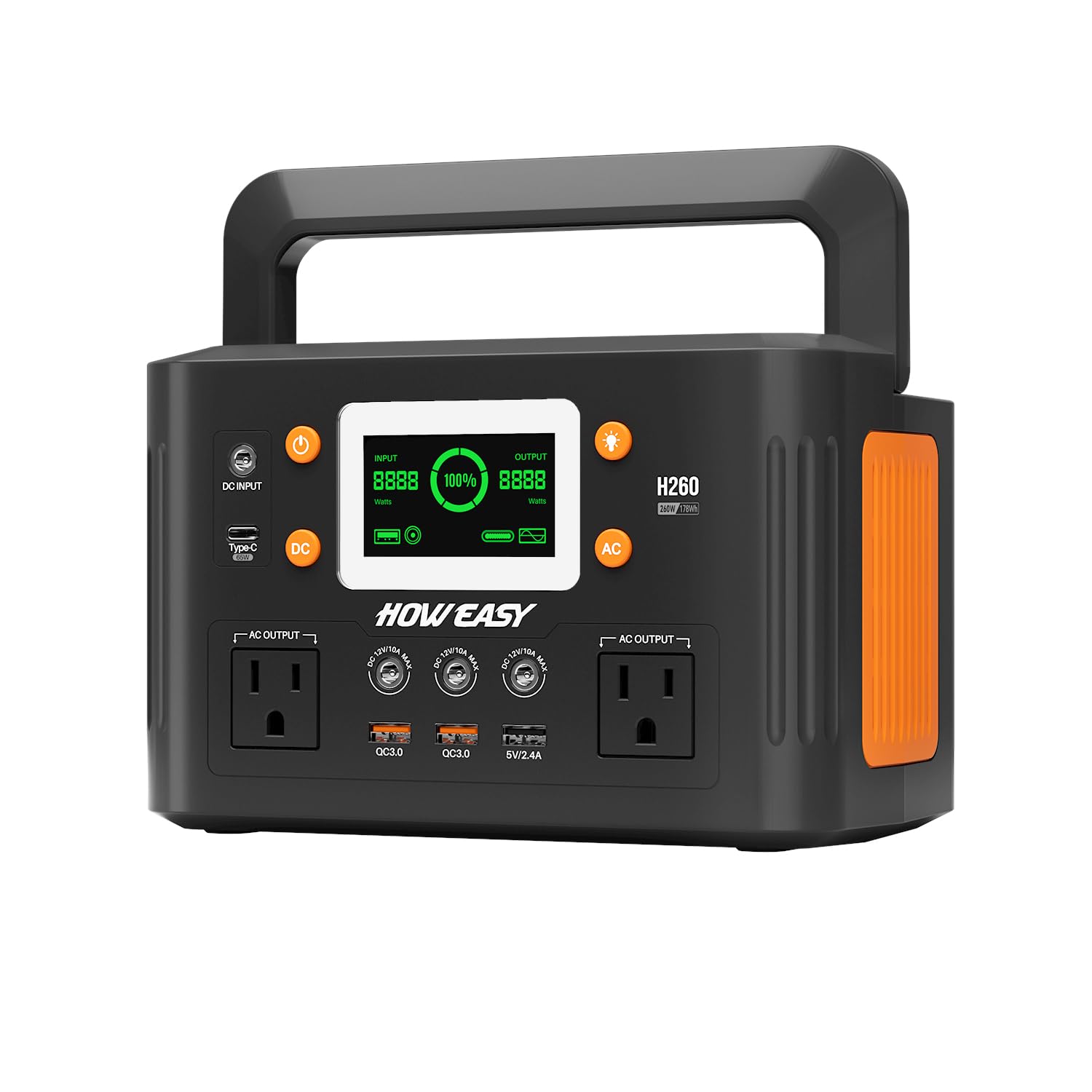
The HOWEASY H260 offers 178Wh of capacity and 260W continuous output (500W peak) in a 5-pound package small enough to tuck into a duffel bag. This is an entry-level option best suited for campers who need a single night of CPAP therapy on a low-pressure machine. Running a 50W CPAP through the AC outlet would yield roughly 3–3.5 hours of runtime — enough for a short sleep or a backup for a partial outage.
Nine output ports include two AC outlets, one 65W USB-C PD port, three USB-A ports, and three DC ports. The built-in LED flashlight offers low, high, and SOS flashing modes. Triple recharge modes (wall, car, solar) provide flexibility, and the lithium battery has no memory effect, so partial charging does not degrade capacity over time.
The internal cooling fan is noticeably louder than premium competitors — several users described it as intrusive during quiet camping. The unit lacks a true on/off switch; the DC button turns off the DC output but leaves the system in a low-power standby state. For CPAP use specifically, the 178Wh capacity is marginal, and the lack of a DC cable for common CPAP machines means you will lose 15–20% of capacity to AC inversion.
Why it’s great
- Compact 5-pound design fits easily in a duffel or backpack
- Nine total ports including 65W USB-C PD for fast device charging
- Triple recharge methods with no battery memory effect
Good to know
- Cooling fan is louder than competitors — noticeable in tent
- 178Wh capacity provides only 3–3.5 hours for a typical CPAP
- No CPAP-specific DC cables and no true power-off switch
9. DaranEner Portable Power Station 192Wh
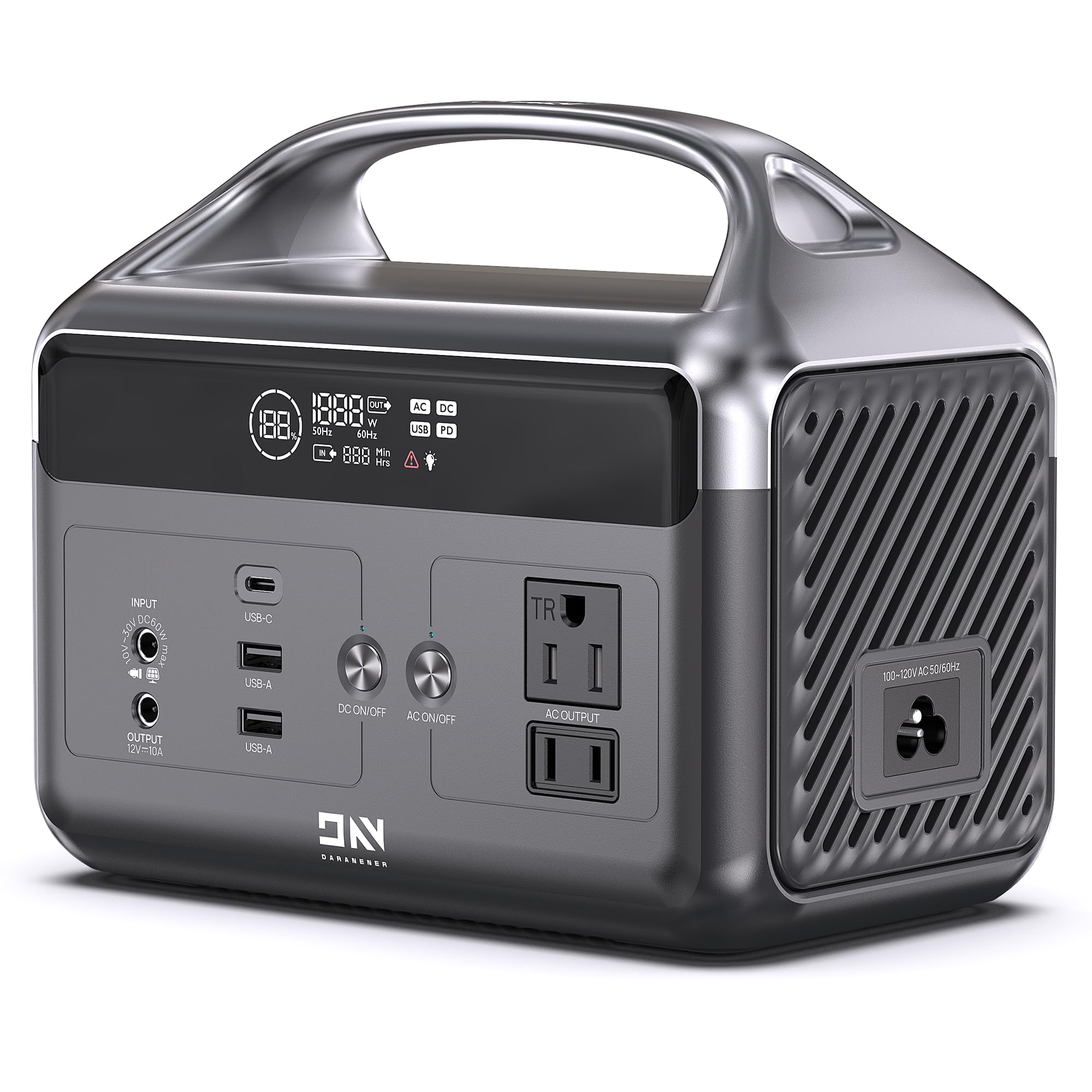
The DaranEner 192Wh power station is the most affordable LiFePO4 option in this lineup, offering the long-cycle-life chemistry at a budget-friendly entry point. Its 192Wh capacity, paired with a 300W pure sine wave inverter (600W surge), can run a low-power CPAP for roughly 3–4 hours — sufficient for a nap or a partial night, but not a full sleep cycle for most users.
Six output ports include two AC outlets, one USB-C PD 60W port, two USB-A QC3.0 ports, and one 12V DC output. The built-in MPPT solar controller optimizes solar charging efficiency, and the LiFePO4 cells are rated for 3,500+ cycles — roughly ten times longer than standard lithium-ion. The 5.73-pound weight and toaster-like footprint make it easy to stow in a car camping bin.
Customer reports highlight excellent customer support when defects occur — a unit with a faulty DC output was replaced without requiring return shipping. However, the same reviews note that the DC side (USB outputs) can fail while the AC side continues working. For CPAP use, the AC-only connection reduces effective runtime, and the 192Wh capacity means you will need to recharge daily even with a low-power machine and no humidification.
Why it’s great
- LiFePO4 chemistry rated for 3,500+ cycles — built to last years
- Compact toaster-sized footprint at just 5.73 pounds
- Responsive customer support with no-return replacement policy
Good to know
- 192Wh capacity provides only 3–4 hours for moderate CPAP draw
- Some units experienced DC-side output failure over time
- No CPAP-specific DC cables — AC connection reduces efficiency
FAQ
How many nights can a CPAP battery last while camping?
Can I use any portable power station for my CPAP machine?
What does pass-through charging mean for CPAP camping?
Are CPAP batteries TSA approved for air travel?
Final Thoughts: The Verdict
For most users, the battery for cpap camping winner is the BLUETTI CPAP X30 because its 297Wh capacity, dedicated DC voltage ports, and comprehensive cable set provide five to seven nights of therapy without efficiency loss. If you want the longest cycle life for frequent trips, grab the EASYLONGER ES960 with 3,000+ LiFePO4 cycles. And for a complete solar-powered setup that recharges during the day, nothing beats the Anker SOLIX C300 with its included 60W panel and silent 25dB fan.

Mo Maruf
I created WellFizz to bridge the gap between vague wellness advice and actionable solutions. My mission is simple: to decode the research and give you practical tools you can actually use.
Beyond the data, I am a passionate traveler. I believe that stepping away from the screen to explore new environments is essential for mental clarity and physical vitality.