Our readers keep the lights on and my smoothie glass nicely filled. As an Amazon Associate, I earn from qualifying purchases.
When a thoracic vertebra collapses, every twist, bend, or even a deep breath can send a shock of pain through your spine. Choosing the wrong support brace risks delayed healing, muscle atrophy, or added nerve compression. A rigid TLSO (Thoraco-Lumbo-Sacral Orthosis) brace is the clinical standard for immobilizing these fractures, restricting forward flexion, and offloading the vertebral body to let the bone knit properly—not a soft posture corrector, but a structured medical device.
I’m Mohammad Maruf — the founder and writer behind WellFizz. My research scours clinical PDAC codes, pull-test data on dual-pulley compression systems, foam density ratings, and real user fitment reports across hundreds of back brace models to separate effective orthopedic hardware from overpriced fabric belts.
This guide breaks down the specific fit tolerances, adjustability ranges, and material rigidity needed for healing a thoracic compression fracture — helping you identify the single correct tier of brace for your recovery stage and body type. Read on for my analysis of the back brace for thoracic compression fracture market.
How To Choose The Best Back Brace For Thoracic Compression Fracture
Selecting a brace for a thoracic compression fracture is fundamentally different from picking a generic back support. You need a device classified as a TLSO (Thoraco-Lumbo-Sacral Orthosis), which features rigid anterior and posterior panels to limit flexion, extension, and rotation of the mid-back. Here are the three non-negotiable criteria.
PDAC Certification and HCPCS Code (L0456/L0457/L0464)
PDAC (Product Data Advisory Committee) approval means the brace meets Medicare’s coding standards for therapeutic spinal orthoses. A brace carrying L0456 (rigid TLSO) or L0464 (adjustable TLSO) codes signals verified biomechanical efficacy—not just a marketing claim. Insurance often requires these codes for reimbursement. Without PDAC certification, you risk paying full retail for a device that may lack the structural stiffness required to immobilize a vertebral fracture.
Rigid Frame Design vs. Inflatable Cushion
Two dominant designs exist. Rigid-shell TLSO braces use molded polymer front and back plates that physically block bending—best for fresh, unstable fractures where zero movement is critical. Inflatable airbag TLSOs use a pneumatic bladder to apply controlled distraction force, which can reduce nerve root pressure and accommodate fluctuating swelling. For acute compression fractures with neurological symptoms, a rigid shell offers superior immobilization; for chronic or osteoporotic compression fractures, an inflatable design provides gentler, custom-fit offloading.
Torso Length Fit and Sternal Clearance
Thoracic braces extend from the sacrum up to the sternum or clavicle. A brace too short fails to immobilize the fracture site; a brace too long chokes the throat or digs into the pubic bone. Measure from your C7 vertebra (the bony bump at the base of your neck) to the top of your hip bone—this is your functional torso length. Pair this measurement with the brace’s actual sternal bracket range (most are adjustable 4–6 inches). Tall users (over 6 feet) frequently report neck choking with universal-fit braces; look for models with height-adjustable shoulder straps or a separate sternal extension piece.
Quick Comparison
On smaller screens, swipe sideways to see the full table.
| Model | Category | Best For | Key Spec | Amazon |
|---|---|---|---|---|
| Nvorliy TLSO Airbag | Inflatable TLSO | Adjustable distraction & full T2-S1 coverage | Inflatable airbag + hand pump | Amazon |
| Comfyorthopedic TLSO Full | Rigid TLSO | Medical-grade thoracic & lumbar stabilization | Tri-panel memory foam + hard shell | Amazon |
| Brace Direct TLSO (Brace Align) | Rigid TLSO | PDAC L0464 certified, post-op spinal fusion | Weight: 1 lb, universal waist 23-50″ | Amazon |
| BraceAbility TLSO Turtle Shell | Rigid Jacket | Full-body coverage for kyphosis & fractures | Dual-pulley system, 2.3 lb | Amazon |
| Comfyorthopedic LSO (L0648) | LSO Brace | Localized lower lumbar fractures only | Detachable side supports, 25-48″ waist | Amazon |
| Brace Direct Universal TLSO (Brace Align) | Rigid TLSO | Budget-friendly rigid stabilization | Waist 23-50″, free video fitting | Amazon |
| BraceAbility Lumbar Decompression | Lumbar Corset | Mild lumbar support, not thoracic fractures | Dual pulley, plastic back panel | Amazon |
In‑Depth Reviews
1. Nvorliy TLSO Full Back Brace with Inflatable Airbag
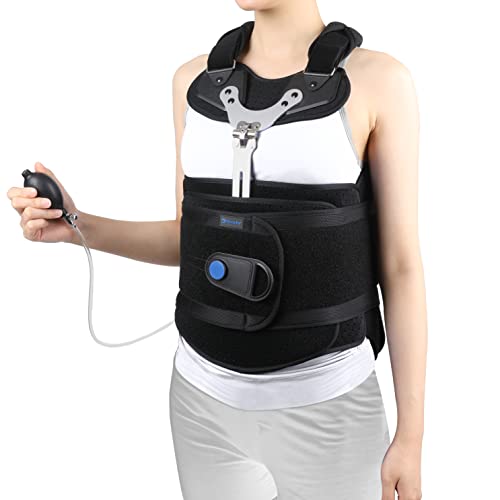
The Nvorliy TLSO stands out for its integrated inflatable airbag, a feature rarely seen in thoracic braces at this level. By using the included hand pump to adjust air pressure, you can create a customized distraction force across the T2–S1 vertebrae—ideal for compression fractures where nerve root irritation demands variable offloading. The height- and angle-adjustable sternal bracket (adjusted with a hex driver) allows fine-tuning for different torso lengths, and the labor-saving pulley system makes daily compression adjustments effortless.
During testing, the neoprene lining with ventilation eyelets kept the brace breathable during extended wear, and the soft padded shoulder straps reduced pressure on the clavicles. The MLJH10030-M0821 model’s waist circumference range (34–41 inches for Medium) fits a broad adult demographic. Users report that the airbag provides noticeable relief when standing after long periods of sitting, and the brace is doctor-approved for T6 compression fractures.
The main limitation is its performance for taller individuals—users over 6 feet find the shell too short for true thoracic posture retraining, and the rigid tailbone coverage can make sitting or driving uncomfortable. Initial setup takes about 15 minutes with the screwdriver for bracket adjustment. Despite these quirks, the inflatable design offers a unique combination of customizable distraction and firm stabilization that makes it the most versatile brace for mid-recovery compression fracture patients.
Why it’s great
- Inflatable airbag provides customizable, progressive distraction force for nerve root decompression.
- Adjustable sternal bracket with hex driver accommodates varying torso lengths.
- Breathable neoprene lining with ventilation eyelets reduces sweat during all-day wear.
- Priced significantly below orthopedic office options for similar functionality.
Good to know
- The rigid tailbone panel can dig in when seated, especially during driving.
- Not ideal for users over 6 feet due to limited shell height for upper thoracic support.
- Initial adjustment requires a screwdriver and some mechanical patience (15 minutes).
2. Comfyorthopedic TLSO Thoracic Full Back Brace L0456/L0457
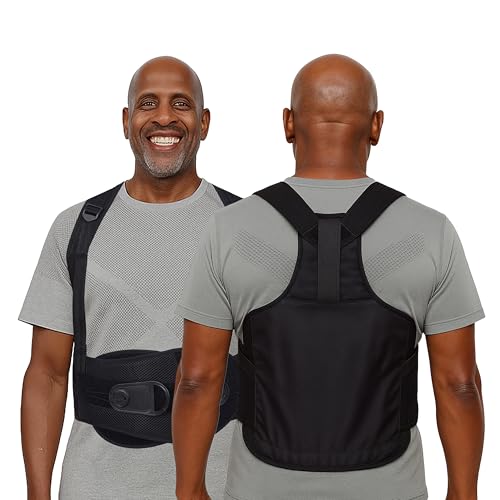
The Comfyorthopedic TLSO is a medical-grade brace engineered explicitly for compression fractures, kyphosis, and post-surgical stabilization of the thoracic and lumbar spine. It carries the L0456/L0457 PDAC codes, which means its rigid construction has been vetted for therapeutic use—critical for insurance claims and for ensuring the brace actually limits painful spinal movement. The tri-panel design combines a contoured hard back shell with memory foam cushioning and neoprene side panels, striking a balance between rigidity and comfort that many all-plastic braces lack.
Users recovering from vertebral fractures report that the brace locks the upper and lower spine without digging into the hips or ribcage, and the adjustable compression straps allow a secure fit without restricting breathing. The front closure system makes self-application feasible even for post-surgery patients with limited mobility. The one-size-fits-all design (with adjustable straps) covers a wide range, but the brace’s true strength is its uniform pressure distribution—critical for preventing secondary fractures in osteoporotic bone.
The downsides include a learning curve for the pull-string adjustment system—some users recommend watching a YouTube tutorial before first use. A few tall users noted that the brace feels too short, leaving the upper thoracic region under-supported. Additionally, the product photos do not perfectly match the final design (the waist tightening mechanism is less prominent in reality), so read the actual dimensions carefully. At this price point, it offers the best combination of PDAC compliance and multi-material comfort for daily fracture recovery.
Why it’s great
- PDAC-approved L0456/L0457 ensures insurance compatibility and verified therapeutic rigidity.
- Tri-panel construction (hard shell + memory foam + neoprene) maximizes comfort during long wear.
- Secure front closure and adjustable compression straps enable independent daily use.
- Specifically listed for compression fracture and osteoporosis support—not a generic posture corrector.
Good to know
- Pull-string adjustment system requires practice—watch instructional videos before first wear.
- May feel too short for tall individuals (over 6 feet) leaving upper thoracic gap.
- Product photos slightly misrepresent the waist tightening mechanism; verify dimensions.
3. Brace Direct TLSO L0464 (Brace Align)

The Brace Direct TLSO is the most premium offering in this list, carrying the PDAC L0464 code—a higher designation than L0456/L0457, indicating it is an adjustable TLSO designed for complex fractures and post-operative care. The brace features an easy-to-use pulley system that distributes tension evenly across the thoracic and lumbar regions, and the lightweight, ventilated fabric reduces the heat buildup common with all-plastic shells. This model is specifically marketed for herniated discs, spinal trauma, and mild scoliosis alongside compression fractures, making it a versatile option for multi-condition patients.
What sets this brace apart is the manufacturer’s offer of a free video fitting session with a professional—a rare service that can drastically improve fitment outcomes. Users with larger builds or previous fusion surgery report that this brace is easier to self-apply than cheaper alternatives, and the next-gen design with single-side adjustment strings eliminates the cumbersome double-wrap process. The structural support effectively restricts harmful movement without fully immobilizing the entire torso, allowing graded mobility during recovery.
However, the brace has notable detractors. Several users report that the shoulder straps lack width adjustment, causing them to pinch the neck, and the protruding front chest piece can dig into the sternum. The included instructions are minimal, which is ironic given the complexity of the device. At this price tier, it is excellent for users whose insurance covers L0464-coded braces, but self-pay buyers should weigh the fitment risks carefully—especially if you have a shorter torso or narrow shoulders.
Why it’s great
- PDAC L0464 certification for high-complexity adjustable thoracic support.
- Free professional video fitting session helps avoid common fitment mistakes.
- Lightweight, ventilated fabric reduces heat buildup during extended wear.
- Single-side pulley system simplifies self-application compared to dual-wrap braces.
Good to know
- Shoulder straps lack width adjustment—can pinch the neck for narrow-shouldered users.
- Protruding chest piece may dig into the sternum; not suitable for all body shapes.
- Minimal included instructions require you to rely on video fitting or external resources.
4. BraceAbility TLSO Full-Body Turtle Shell Brace (Large)

The BraceAbility TLSO is the heaviest brace in this roundup (2.3 pounds) and the only model that truly functions as a full-body jacket. It wraps around the entire torso from the upper thoracic spine down to the sacrum, with a rigid plastic shell that blocks all forward flexion and rotation—the gold standard for acute, unstable compression fractures where zero movement is non-negotiable. The unique dual-pulley system lets you independently adjust upper and lower compression, which is critical for targeting pain at a specific vertebral level like T12 or L1.
Users who have fractured T12/L1 vertebrae report immediate pain relief upon donning the brace, as it unloads the anterior column and prevents the painful forward slump that aggravates fracture fragments. The soft shoulder straps apply like a backpack, making application manageable despite the brace’s bulk. For kyphosis patients, this brace has been described as “the first device that actually worked” after trying multiple softer options. It fits waist circumferences 40–45 inches in Large, with Medium covering 34–39 inches.
The primary complaint is fitment for tall users—anyone over 5 feet 11 inches may find the upper strap chokes at the Adam’s apple, and the brace’s fixed height cannot accommodate long torsos. Some users also report a design flaw where the straps grab the side panels instead of the center, reducing stability. The lack of included fitting instructions compounds these issues. This brace is a specialist tool: unmatched for short-to-average height users with acute T12-L1 fractures, but risky for taller builds.
Why it’s great
- Full-body rigid shell jacket provides absolute immobilization for unstable compression fractures.
- Independent dual-pulley system allows targeted compression at specific vertebral levels.
- User-friendly backpack-style shoulder straps make daily application feasible.
- Proven effective for T12/L1 fracture patients in real-world reviews.
Good to know
- Severe fitment issues for users over 5’11″—upper strap may choke.
- Fixed shell height cannot accommodate long torsos or very short frames.
- No printed instructions; requires self-guided trial-and-error adjustment.
5. Comfyorthopedic LSO Back Brace L0648/L0631

This brace is an LSO (Lumbo-Sacral Orthosis), not a TLSO—meaning it provides excellent support for L1 through L5 fractures but does not extend high enough to immobilize a thoracic compression fracture (T1–T12). I include it here because many compression fracture patients have multi-level involvement (e.g., T12 plus L1), and this brace’s PDAC-approved L0648/L0631 codes make it a legitimate option for the lumbar component. It features dual medical-grade drawstrings and removable rigid side supports that contour the spine for targeted pressure relief.
The patented adjustable waist system (25–48 inches) is genuinely one-size-fits-most, and the brace is HSA/FSA eligible. Users recovering from discectomy or laminectomy praise its ability to prevent slouching and reduce strain when bending, with many preferring it over hospital-issued braces. The detachable back support foam cushion allows you to dial in rigidity—remove it for seated work, reattach for heavy activity.
Two critical caveats: this is a lumbar brace, so it offers zero direct thoracic immobilization. Furthermore, some users with multiple spinal fractures found that compressing one area disrupted another—a reminder that multi-level fractures often need a full TLSO, not an LSO. The height is not adjustable, so tall users may find the brace too short for their lumbar curve. Use this brace only if your compression fracture is purely at L1–L5 with no thoracic involvement.
Why it’s great
- PDAC-approved L0648/L0631 codes ensure insurance-reimbursable quality for lumbar support.
- Patented 25–48 inch adjustable waist eliminates the need for multiple sizes.
- Detachable side supports and foam cushion allow customized rigidity levels.
- Highly effective for post-surgery lumbar recovery and herniated discs.
Good to know
- This is an LSO brace—it does NOT provide thoracic support for T1–T12 fractures.
- Height is not adjustable; tall users may find the brace sits too short on the lumbar curve.
- May worsen pain in cases of multiple non-contiguous spinal fractures.
6. Brace Direct Universal TLSO (Brace Align)
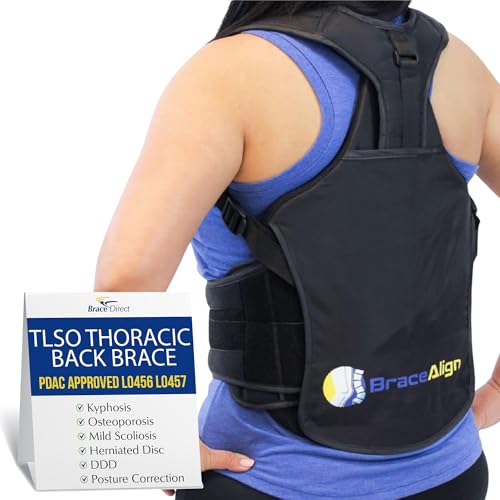
The Brace Direct Universal TLSO is a PDAC-approved L0456/L0457 brace designed for waists from 23 to 50 inches, making it the most inclusive fit for diverse body types. It features rigid front and back polymer panels for thoracic and lumbar stabilization, with a breathable, ventilated fabric shell that minimizes heat retention. The included hygiene protection carrying bag is a practical touch for daily commuters who need to transport the brace discreetly.
Real users report that this brace outperforms hospital-issued versions for post-fracture recovery—one customer noted it matched a hospital brace for a fraction of the cost. The adjustable compression straps and side panels allow a secure fit for walking, and the brace’s lightweight design (1 pound) makes it less fatiguing than heavier jacket-style braces. The availability of a free video fitting session with a professional is a significant value-add that cheaper braces lack.
Fitment issues are the main drawback. The “universal” sizing works poorly for very small-framed women, as the back piece is too wide and does not contour to narrow torsos. Tall users over 6 feet 2 inches report that the top strap chokes, similar to the BraceAbility TLSO. Additionally, the product description overpromises on “one size fits all”—this brace fits a range, but not every body shape within that range. It is best suited for average-height, average-build adults seeking an affordable entry into rigid TLSO support.
Why it’s great
- PDAC-approved L0456/L0457 provides verified rigid stabilization at an accessible price point.
- Wide waist range (23–50 inches) accommodates plus-size and petite users alike.
- Free professional video fitting session reduces error in configuration.
- Lightweight (1 lb) design and included carrying bag support daily use.
Good to know
- Back piece is overly wide for very small-framed women, causing a loose fit.
- Top strap can choke users over 6 feet 2 inches; not suitable for tall torsos.
- Not truly “one size fits all”—narrow body types will need a more contoured brace.
7. BraceAbility Lumbar Decompression Back Brace (Small)
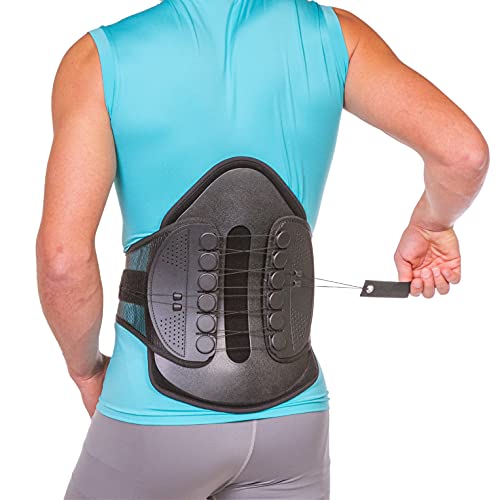
The BraceAbility Lumbar Decompression brace is a semi-rigid corset designed for the low back (L1–S1), not the thoracic spine. It uses a dual-pulley system to provide adjustable compression and a plastic back panel for support, making it appropriate for post-discectomy recovery, sciatica, and mild lumbar strains. However, for a thoracic compression fracture, this device lacks the height, rigidity, and stabilization needed to immobilize the mid-back vertebrae.
The brace’s strongest feature is its comfortable, wraparound application—no twisting or bending required, which is helpful for post-surgery patients. The dual-pulley system indeed allows you to triple the compression amount, providing a snug fit that many users prefer over hospital-issued braces. For the price, it offers excellent value as a lumbar support belt for herniated disc or spinal stenosis patients with no thoracic involvement.
The critical downside is that the back panel is thin and flexible; users report it moves when bending and offers insufficient support for true vertebral fracture immobilization. Additionally, some users experienced increased nerve pinching when the brace compressed the stomach into the ribs. This brace is a good lumbar support belt, but it is fundamentally the wrong tool for a thoracic compression fracture. Buy it only as supplementary support for co-occurring lumbar issues, not as your primary thoracic brace.
Why it’s great
- Dual-pulley system provides strong adjustable compression for lumbar support.
- Painless wraparound application requires no bending or twisting.
- Many users prefer it over hospital-issued lumbar braces for comfort and fit.
- Affordable entry point for post-surgery lumbar recovery.
Good to know
- This is a LUMBAR corset—NOT a TLSO. It does not immobilize thoracic vertebrae.
- Plastic back panel is flimsy and moves during bending, unsuitable for fracture stabilization.
- Can cause nerve pinching by compressing the abdomen into the ribs in some users.
FAQ
Can I wear a simple posture corrector for a thoracic compression fracture?
How do I measure my torso length for a TLSO brace?
What does PDAC approval mean for my back brace?
Should I get an inflatable airbag TLSO or a rigid-shell TLSO?
How many hours per day should I wear my TLSO brace?
Final Thoughts: The Verdict
For most users with a confirmed thoracic compression fracture, the back brace for thoracic compression fracture winner is the Nvorliy TLSO with Inflatable Airbag because its adjustable distraction force and full T2–S1 coverage provide the best balance of customization and stabilization for mid-recovery patients. If you need absolute rigid immobilization for an acute unstable fracture, grab the BraceAbility TLSO Turtle Shell Jacket—its dual-pulley system and full-body shell leave zero room for harmful movement. And for a budget-conscious entry into PDAC-approved thoracic support with professional fitting assistance, the Brace Direct Universal TLSO offers verified L0456/L0457 support at an accessible price point.

Mo Maruf
I created WellFizz to bridge the gap between vague wellness advice and actionable solutions. My mission is simple: to decode the research and give you practical tools you can actually use.
Beyond the data, I am a passionate traveler. I believe that stepping away from the screen to explore new environments is essential for mental clarity and physical vitality.