Our readers keep the lights on and my smoothie glass nicely filled. As an Amazon Associate, I earn from qualifying purchases.
Waking up with your ring and pinky fingers completely numb, clutching a dead weight at your side, is a specific misery that only cubital tunnel syndrome delivers. The culprit is almost always the same: hours of sleeping with your elbow bent past a safe angle, compressing the ulnar nerve inside the cubital tunnel. A good brace is the only reliable mechanical intervention to stop that damage while you sleep.
I’m Mohammad Maruf — the founder and writer behind WellFizz. I’ve spent years analyzing orthopedic supports, from material science in foam density to the mechanical efficacy of aluminum hinge placement, to separate the braces that actually offload the nerve from the ones that just squeeze your arm.
Whether you’re dealing with post-work flare-ups or chronic night-time entrapment, finding the right brace for cubital tunnel syndrome means choosing a design that locks in a safe angle without causing new pressure points or shoulder pain from a design that simply doesn’t fit your anatomy.
How To Choose The Best Brace For Cubital Tunnel Syndrome
The wrong brace can make nerve pain worse by adding compression to the elbow or by pulling your shoulder into an awkward position. Look for a brace that controls the angle without squeezing the tunnel itself. Pay attention to adjustability, material breathability, and the number of fastening straps — three straps are far more secure than two for preventing migration during sleep.
Angle Adjustability Is Everything
A fixed 180-degree brace forces your elbow completely straight. For many, a slight 120-150 degree bend is more tolerable and reduces tension on the nerve. Adjustable braces with a removable hinge pin or interchangeable metal rods let you dial in the exact angle that relieves your symptoms without causing shoulder discomfort.
Inner Padding and Breathability
You’ll be wearing this for 6-8 hours while you sleep. If the inner foam traps heat or the fabric causes friction, you will rip it off at 3 AM. Soft foam padding covered with a cotton or lycra lining prevents sweat buildup and skin irritation, especially for those with sensitive skin or latex allergies.
Straps and Sizing
A brace that slides down your forearm during sleep is useless. Look for separate hook-and-loop straps for the upper arm, the elbow joint, and the forearm. That triple-point fixation prevents migration better than a single continuous wrap. Always measure your bicep circumference to choose the right size category.
Quick Comparison
On smaller screens, swipe sideways to see the full table.
| Model | Category | Best For | Key Spec | Amazon |
|---|---|---|---|---|
| Sylong 4-Angle Adjustable | Adjustable Angle | Day & Night Use with Precise Angle Lock | 4 locking angles (120°-180°) | Amazon |
| Sylong 3-Angle Support | Interchangeable | Recovery Phase with Progressive Angles | 3 replaceable metal supports | Amazon |
| Sylong Adjustable Stabilizer | Bendable Frame | Custom 90-180° Bending Angle | Adjustable aluminum strip | Amazon |
| Sylong 3-Plate Immobilizer | Rigid Splint | Strict Night Immobilization | 3 rigid support plates | Amazon |
| FEATOL Resting Hand Splint | Hand & Wrist | Combined Wrist & Finger Immobilization | Removable metal splint | Amazon |
In‑Depth Reviews
1. Sylong 4-Angle Adjustable Elbow Brace

This brace breaks the mold by offering a bracket with four precisely drilled locking positions — 120°, 135°, 150°, and 180° — selected by inserting a screw into the matching hole. The mechanical lock is far more reliable than a bendable strip, which can drift during the night. The Velcro straps are placed at three points, so the brace stays anchored even for side-sleepers who toss frequently.
The foam inner padding is dense enough to prevent the hard bracket from digging into your arm, yet breathable enough to avoid night sweats. Users report that the 150° night mode is the sweet spot for ulnar nerve relief without pulling on the shoulder joint. The hinge pin can be removed to allow limited motion while still providing structural support for daytime wear during typing or desk work.
One limitation is the learning curve for positioning — the screw head faces the same side regardless of left or right arm, which can cause discomfort if you sleep on that specific side. Some users find it slides slightly toward the wrist without an extra strap overnight, but the overall stability and adjustability justify the extra effort.
Why it’s great
- Four distinct therapeutic angles with a positive mechanical lock, not a flexible metal strip.
- Day/night mode allows one brace to serve both active and resting needs.
- Good foam padding and breathable fabric prevent skin irritation during long wear.
Good to know
- The screw head placement may press into the arm on one side during sleep.
- May shift toward the wrist overnight, requiring a separate lightweight strap.
2. Sylong 3-Angle Support Elbow Brace
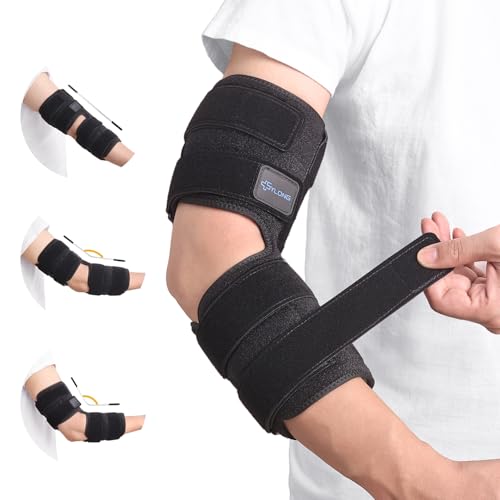
Unlike braces with a single adjustable hinge, this one ships with three separate metal support rods corresponding to 120°, 150°, and 180° angles. You swap the rod as your recovery progresses — starting at a higher angle for acute irritation and moving to a straighter lock as symptoms subside. The exchange is simple and tool-free, making it an ideal option for people who want to progress through therapy stages.
The open elbow design leaves the olecranon (the point of the elbow) exposed, which prevents direct pressure over the ulnar nerve groove. The four Velcro straps provide a secure hold on the bicep and forearm, and the foam padding is thick enough to prevent the metal rod from creating a pressure line. Users with sensitive skin note that wearing a thin cotton sleeve underneath solves any irritation from the inner grip material.
This brace is slightly bulkier than the 4-angle version due to the pocket that holds the rod, but it remains comfortable for overnight use. The main trade-off is that you cannot micro-adjust the angle — you are locked to the three preset rods. That said, the patent-protected design shows serious engineering intent.
Why it’s great
- Three distinct pivot angles available by swapping rods, supporting phased recovery.
- Open elbow cutout prevents pressure on the ulnar nerve groove.
- Four adjustable straps offer a personalized, secure fit for almost any arm.
Good to know
- Bulkier than single-hinge braces due to the rod pocket.
- The inner grip material may irritate sensitive skin without a base layer.
3. Sylong Adjustable Angle Stabilizer Brace

This brace uses a lightweight, bendable aluminum strip that lets you shape the support to any angle between 90° and 180°. You simply bend the strip with your hands until the brace holds your elbow at the exact angle you find comfortable. That infinite adjustability is valuable if you need a very specific position that preset holes don’t offer, particularly during the day when you need to keep your arm slightly flexed for desk work.
The flannel-like fabric outer and soft foam padding make it one of the more comfortable options for extended wear. The open center design relieves direct pressure over the cubital tunnel, which is key for true nerve offloading. Four Velcro straps provide secure fixation, but because the aluminum strip is continuous, the brace cannot be locked into a rigid 180° without potential bending back over time.
A number of users report that the brace works well to prevent elbow flexion but does not effectively prevent the arm from straightening fully. Side-sleepers also note that the fastening ring can press into the ribs when lying on the affected side. It is best suited for those who need a moderate, adjustable bend without full immobilization.
Why it’s great
- Infinitely adjustable angle from 90° to 180° by simply bending the metal strip.
- Soft flannel fabric and open elbow design improve comfort for long sessions.
- Four adjustable Velcro straps provide a customized fit for varying arm sizes.
Good to know
- Cannot fully prevent the arm from straightening if you force it.
- Side-sleepers may feel pressure from the fastening ring on the ribs.
4. Sylong 3-Plate Immobilizer Elbow Brace
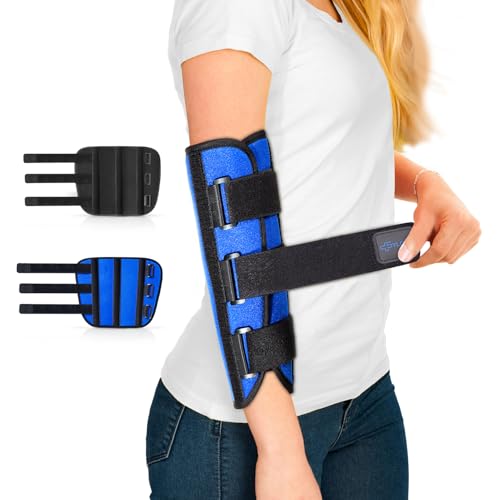
This brace is built for absolute immobilization — three rigid plastic plates surround the arm to prevent any elbow bending whatsoever. The semi-circular sleeve design wraps around the arm, and the three hook-and-loop straps correspond to the upper arm, elbow joint, and forearm. This three-point fixation makes it exceptionally stable for people who are aggressive sleepers or have involuntary muscle spasms.
The inner lining is made of soft foam with a smooth lycra fabric sleeve, which is very breathable and reduces friction on the skin. It is available in three sizes for bicep circumferences from 8.5 to 17 inches. Unlike adjustable-angle braces, this one forces a completely straight arm position (180°), which is ideal for those whose nerve irritation flares primarily from nighttime flexion.
Some users find the brace too long, especially when combined with a wrist brace, as it can overextend the hand. The rigid plates make it bulkier to sleep in, and the straight-arm position may cause shoulder strain for some. For those who need a strict night-time immobilizer without any adjustment, this is a solidly built choice.
Why it’s great
- Three rigid support plates provide the most reliable full-arm straightening.
- Soft foam with lycra inner sleeve is very skin-friendly and breathable.
- Three sizes offer a precise fit across a wide range of arm circumferences.
Good to know
- Forces a completely straight arm, which may cause shoulder or wrist discomfort.
- The brace is relatively long and may not combine well with other wrist splints.
5. FEATOL Resting Hand Splint Night Immobilizer

This is not a standard elbow brace — it is a resting hand splint that immobilizes the wrist and fingers in a functional position. For cubital tunnel patients who also have significant numbness in the ring and little fingers, keeping the hand from clenching at night can be equally important. The removable metal splint runs from the forearm to the fingertips, preventing palmar flexion that can further compress the ulnar nerve at Guyon’s canal.
The foam particle padding is thick and soft, providing cushioning across the palm and fingers. Four adjustable straps secure the fingers, palm, wrist, and forearm independently. Users recovering from stroke or carpal tunnel surgery report that this splint keeps the fingers straight and reduces morning stiffness significantly. The Velcro is strong and the opposite-direction straps allow for fine tension adjustment.
This splint is not for those who only need elbow support — it is specifically for patients who wake with clenched fingers or wrist drop. The little finger strap can occasionally slip off if the hand is narrow, and the bulk may restrict thumb movement for some. It is best used as a complement to an elbow brace, not a replacement.
Why it’s great
- Full hand and wrist immobilization prevents finger clenching and wrist flexion.
- Thick foam particle padding provides excellent comfort for all-night wear.
- Four independent straps allow precise adjustment for fingers, palm, wrist, and forearm.
Good to know
- Not an elbow brace — intended as a complement for hand/wrist support.
- The little finger strap may loosen for users with narrow hands.
FAQ
Should I sleep with my elbow fully straight or slightly bent?
Can I wear an elbow brace during the day for cubital tunnel?
Final Thoughts: The Verdict
For most users, the brace for cubital tunnel syndrome winner is the Sylong 4-Angle Adjustable Elbow Brace because it offers four distinct mechanical lock positions, making it versatile for both day and night use without slipping. If you want the ability to progress through recovery phases with separate angle rods, grab the Sylong 3-Angle Support Brace. And for strict night-time immobilization that keeps the arm completely straight, nothing beats the Sylong 3-Plate Immobilizer.

Mo Maruf
I created WellFizz to bridge the gap between vague wellness advice and actionable solutions. My mission is simple: to decode the research and give you practical tools you can actually use.
Beyond the data, I am a passionate traveler. I believe that stepping away from the screen to explore new environments is essential for mental clarity and physical vitality.