Our readers keep the lights on and my smoothie glass nicely filled. As an Amazon Associate, I earn from qualifying purchases.
Jumping into streaming, podcasting, or gaming with a fresh rig can be thrilling, but nothing kills a new setup faster than audio that sounds distant, thin, or riddled with fan hum. A beginner microphone is your first — and most important — step toward sounding professional without a pro budget. The range of connectivity types, capsule designs, and included accessories can be overwhelming, but the right pick makes your voice rich and present from the moment you plug it in.
I’m Mohammad Maruf — the founder and writer behind WellFizz. I’ve spent years analyzing the build quality, frequency response, and real-world noise rejection of every sub- microphone the market pushes toward first-time buyers.
After comparing capsule types, sampling rates, and polar pattern performance across seven distinct models, I’ve locked in the concrete picks that define the best beginner microphone landscape based on what actually holds up in real recordings.
How To Choose The Best Beginner Microphone
When you are new to audio, the difference between a great mic and a frustrating purchase comes down to three core factors: capsule type, polar pattern, and intended connection. Understanding these will keep you from buying a mic that picks up every mouse click or that requires expensive gear just to get a usable signal.
Capsule Type: Dynamic vs. Condenser
Dynamic microphones use a moving-coil design that naturally rejects ambient room echo and background chatter, making them perfect for untreated bedrooms. Condenser microphones are more sensitive and capture subtler vocal detail, but they will also pick up computer fans, keyboard clatter, and reverb. Condensers often require phantom power (available via XLR or specific USB models) and are better suited for controlled vocal booths. Beginners in shared or noisy spaces should lean toward dynamic capsules.
Polar Pattern and Its Effect on Sound
The cardioid pattern is the default for voice isolation — it captures sound primarily from the front while rejecting noise from the sides and rear. Some beginner mics offer multi-pattern switches (omnidirectional for interviews, figure-8 for duets) but true beginners rarely need more than a well-implemented cardioid. A tight, consistent cardioid pickup prevents your stream or podcast from sounding like it was recorded in a hallway.
USB vs. XLR: The Real Starter Decision
USB microphones are plug-and-play: one cable into your computer, zero external gear needed. XLR mics require an audio interface or mixer, adding cost and complexity but offering upgrade paths for pro setups later. The best beginner choice is often a USB microphone with clean conversion, or a hybrid model that accepts both so you can grow without replacing the mic. Always check the sampling rate — 24-bit at 48kHz is the minimum standard for clear voice capture, and 96kHz provides extra headroom for processing.
Quick Comparison
On smaller screens, swipe sideways to see the full table.
| Model | Category | Best For | Key Spec | Amazon |
|---|---|---|---|---|
| SENNHEISER Profile | Premium USB Condenser | Natural vocal tone for streaming & voice-over | Metal housing, 24-bit / 48kHz | Amazon |
| Logitech Blue Yeti Kit | Premium USB All-in-One | Gaming/streaming with vocal effects software | 4 patterns, 24-bit / 48kHz | Amazon |
| FIFINE AmpliGame KS5W | Mid-Range Bundle | Complete streaming kit with mixer | Dynamic capsule, XLR & USB | Amazon |
| HyperX SoloCast 2 | Mid-Range USB Condenser | Gaming with built-in pop filter | 24-bit / 96kHz, integrated shock mount | Amazon |
| MAONO PD100X | Value Hybrid Dynamic | Podcast and stream in noisy rooms | Dynamic capsule, 24-bit / 48kHz | Amazon |
| NPTCL Wireless Lavalier | Budget Wireless Set | On-camera vlogging and mobile content | 24-hour charging case, 70ft range | Amazon |
| Brvomussy Pod Bundle | Value Multi-Mic Kit | Two-person podcasting with voice changers | 2x condenser mics, DSP mixer | Amazon |
In‑Depth Reviews
1. SENNHEISER Professional Profile

German engineering shows in the Profile’s cardioid condenser capsule, which delivers a warm, natural vocal presence that avoids the thin, sibilant quality common in budget USB mics. The metal housing feels dense and durable, and the integrated table stand keeps the footprint compact while providing proper height for desktop use. Controls are purely physical — gain knob, volume knob, and a mix dial — meaning zero reliance on buggy software drivers.
At a 24-bit / 48kHz sampling rate, audio is clean and post-processing ready, and the built-in headphone jack enables zero-latency monitoring. The mic uses a universal USB audio standard, so it works across Windows, macOS, and Linux without additional downloads. No pop filter is included, but the capsule design handles plosives better than most condensers in this tier.
One practical limitation is the low-profile stand, which can feel cramped on crowded desks; a separate mic arm compensates effectively. The lack of built-in RGB also makes it less visually integrated with gaming setups, though the minimalist aesthetic appeals to creators who prioritize function over flash.
Why it’s great
- Rich, natural voice reproduction without software tweaks
- Solid metal build with intuitive physical controls
- Universal OS compatibility via standard USB audio class
Good to know
- Low-profile stand may require a boom arm for ideal placement
- No RGB indicators or customizable lighting effects
2. Logitech Blue Yeti Game Streaming Kit

Blue Yeti remains an iconic choice among beginners, and this streaming kit bundles the classic USB condenser with a custom pop filter and exclusive Streamlabs themes. The Yeti’s multi-pattern capability — cardioid, bidirectional, omnidirectional, and stereo — offers flexibility for solo voice work, two-person interviews, or capturing room ambience. The polycarbonate body is sturdy, though the base is wide, taking up significant desk real estate.
The included Blue VO!CE software provides EQ, noise removal, and vocal effects like Electrobeast and Helium Chipmunk, which can add entertainment value for live streams. Raw audio without the software can sound slightly dull, requiring software engagement for full fidelity. The 24-bit / 48kHz internal conversion handles standard voice tasks competently but doesn’t match the higher sampling rates of newer competitors.
The bundle also includes a custom pop filter that clips directly onto the existing stand, reducing plosive pops without needing an extra boom arm. Bulk is the primary trade-off — the footprint is substantial for small desks, and the included USB-A cable is standard length. It is a complete package for gamers wanting immediate effects and streaming integration.
Why it’s great
- Four polar patterns offer recording versatility
- Bundled pop filter and Streamlabs themes add instant value
- Blue VO!CE software enables real-time vocal modulation
Good to know
- Large base consumes significant desk space
- Sound quality improves noticeably only after software engagement
3. FIFINE AmpliGame KS5W

FIFINE’s AmpliGame KS5W bundle packs a dynamic microphone and a dedicated gaming audio mixer into one streamlined white kit. The dynamic capsule excels at rejecting background noise — keyboard clicks, fan hum, and room echo — making it ideal for untreated spaces where a condenser would sound messy. Dual connectivity via XLR and USB allows beginners to plug directly into a PC or later upgrade to a professional interface without replacing the mic.
The mixer’s slider fader provides intuitive control over game audio versus voice chat volume, and the five-color RGB modes respond to a button on the mixer panel, matching the gaming aesthetic without needing external software. Mute, gain knob, and headphone monitoring are functional over USB, though these controls are disabled in XLR mode. Build quality is solid for the price point, with a plastic mixer housing that feels lighter but functional.
One limitation is the mixer’s limited effects bank — it lacks voice changers or advanced processing, keeping the focus on clean volume blending. The dynamic mic also requires closer proximity (within a few inches) for optimal gain, which may take adjustment for users accustomed to wandering away from their mic. For a beginner wanting a complete desk-ready streaming station, this bundle reduces hidden costs significantly.
Why it’s great
- Dynamic capsule rejects ambient noise in shared rooms
- XLR and USB dual connectivity allows future upgrades
- Slider fader simplifies game versus chat volume balancing
Good to know
- Mixer offers no advanced voice effects or DSP processing
- Dynamic capsule requires closer speaking distance
4. HyperX SoloCast 2
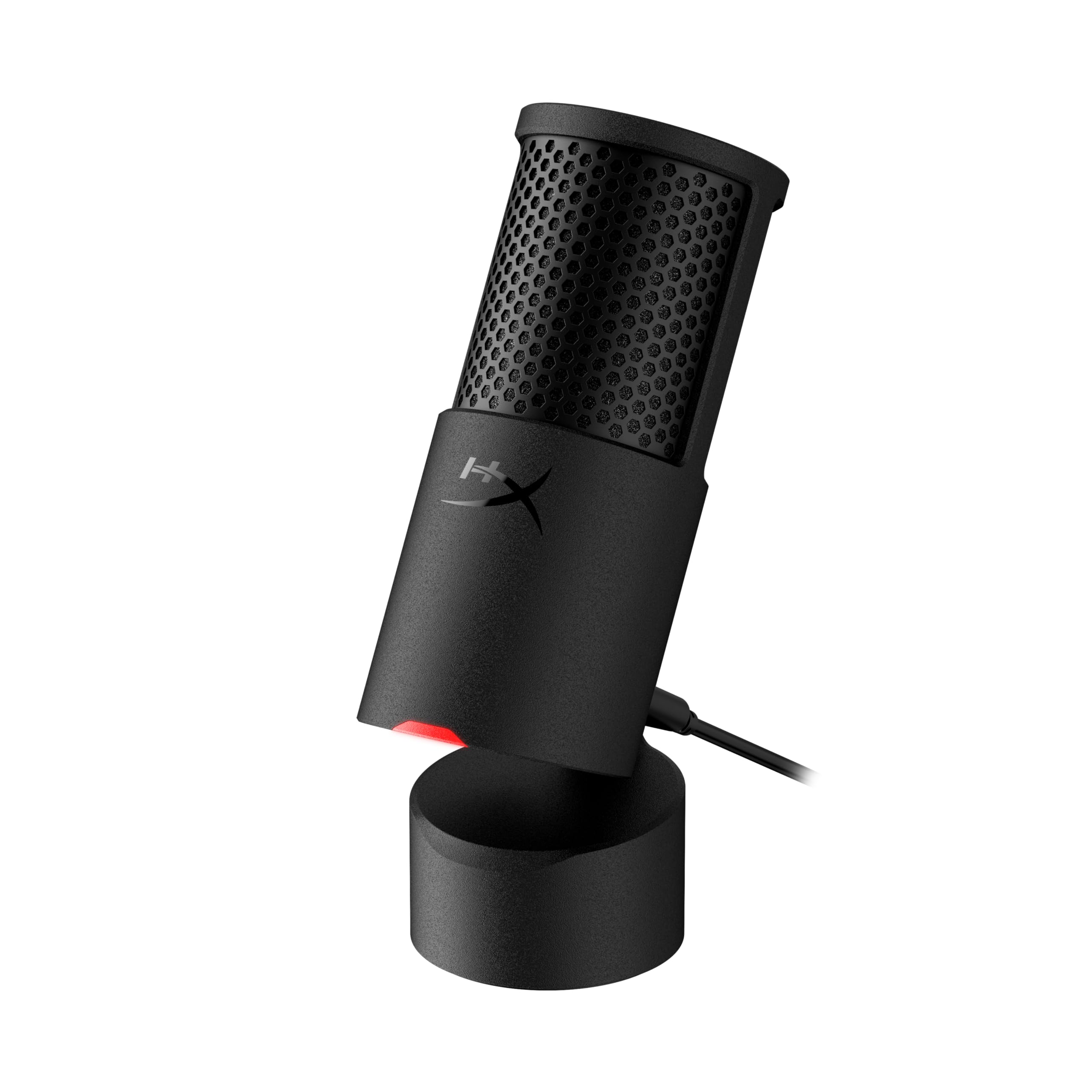
The SoloCast 2 stands out for its high sampling rate of 24-bit / 96kHz, which provides extra headroom for post-processing without audible distortion. HyperX engineered the internal suspension to function like a built-in shock mount, reducing vibrational rumble from desk taps or keyboard strikes without needing an external accessory. The integrated foam pop filter sits behind the grille, eliminating the need for an external screen for most vocalists.
Connectivity is simple USB-C to USB-A, and the tap-to-mute button glows red when live and turns off when muted — a clear visual that avoids stream mishaps. The compact tiltable stand features a weighted base that keeps the mic stable, and built-in 3/8-inch and 5/8-inch threads allow direct mounting onto standard boom arms. Optional customization via HyperX NGENUITY software offers high-pass and voice-enhancement filters that can be saved directly to the mic hardware.
Because it is a condenser, the SoloCast 2 is sensitive: it will pick up keyboard clicks and room echo without noise suppression. The stand is also relatively short, placing the capsule low on a desk without a boom arm. Its sound signature is clean and crisp for voice, but untreated rooms require acoustic treatment or tight mic placement.
Why it’s great
- 96kHz sampling rate provides high-resolution audio capture
- Built-in shock mount and pop filter reduce accessory needs
- NGENUITY filters can be saved to the mic hardware
Good to know
- Condenser sensitivity picks up keyboard and room noise easily
- Low stand height works best with a separate boom arm
5. MAONO PD100X

The MAONO PD100X uses a dedicated dynamic mic core paired with a self-developed algorithm to minimize ambient noise, making it effective in rooms with AC hum or traffic background. Its frequency response of 40Hz–16kHz is narrower than some competitors, but this range is optimized for voice clarity over musical bandwidth. The 24-bit / 48kHz sampling rate captures sufficient detail for podcasts and gaming chat without over-processing.
Dual USB and XLR connectivity means beginners can plug straight into a PC via USB, while advanced users can route into a mixer through XLR for expanded control. The customizable RGB lighting — 3 modes and 8 colors — syncs with the MaonoLink software or cycles via the bottom button. Tap-to-mute and a 2-in-1 smart knob adjust gain and monitoring volume independently, all accessible from the mic body.
Critical trade-off: the RGB, mute, and monitoring functions are only available in USB mode, disappearing when using XLR. The dynamic capsule also demands proximity within about 6–8 inches for consistent volume, limiting the ability to lean back during long sessions. For a budget-conscious streamer needing noise rejection, this is a smart starting point.
Why it’s great
- Customized dynamic capsule and algorithm suppress ambient room noise
- Hybrid USB/XLR connectivity supports future mixer upgrades
- RGB customization adds personalization without expensive peripherals
Good to know
- RGB and button functions do not work in XLR mode
- Short proximity range requires consistent speaking distance
6. NPTCL Wireless Lavalier Microphone
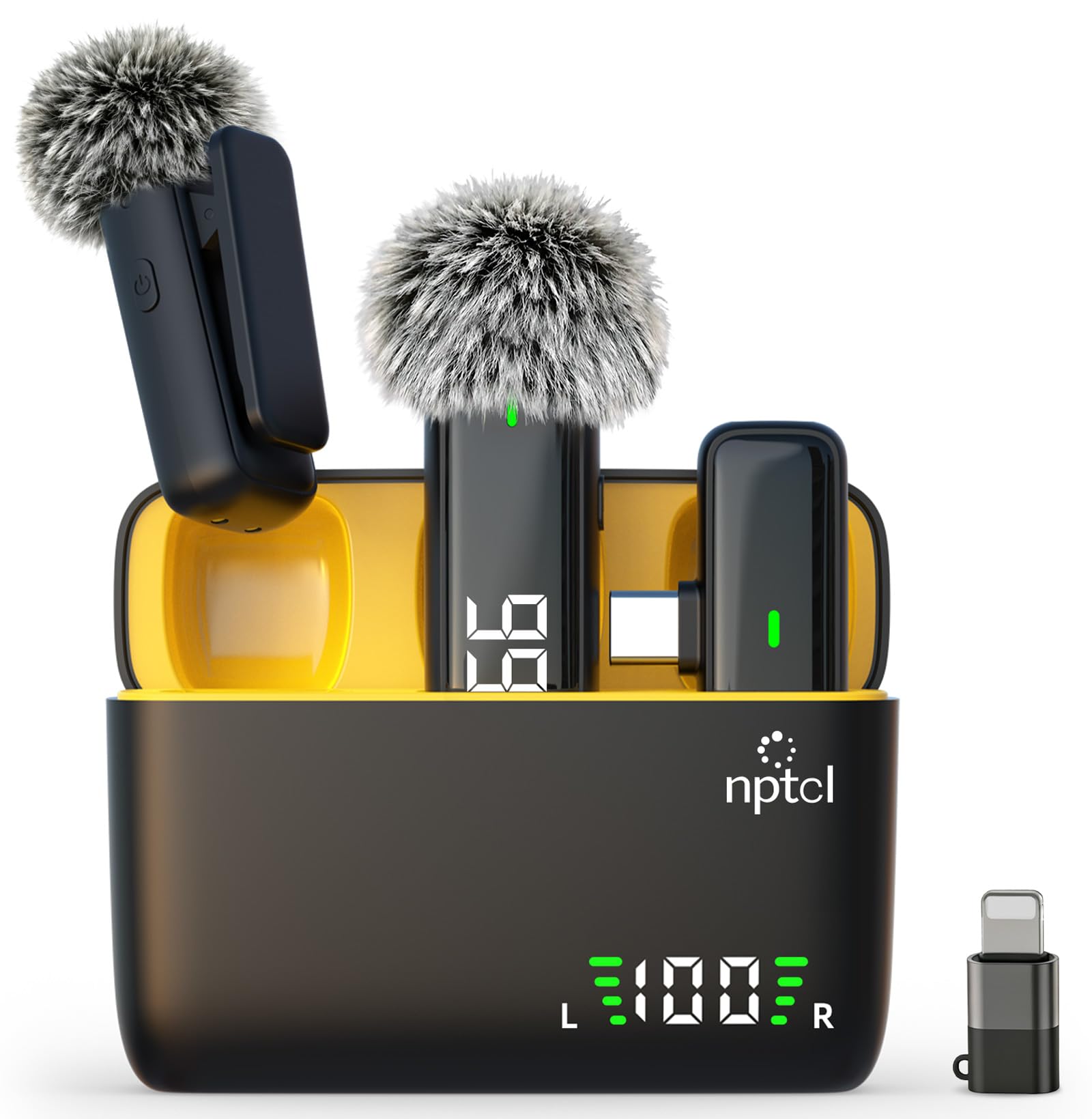
NPTCL’s wireless lavalier system takes a completely different approach — no booms, no desk stands, just two tiny clip-on mics that transmit to a USB-C receiver plugging directly into your phone or tablet. Each lavalier mic lasts 6 hours on a single charge, and the included charging case extends total runtime to 24 hours, making it practical for all-day vlogging or multi-location shoots. The maximum wireless range of 70 feet provides room to move without signal dropouts.
Sound quality relies on DSP-based noise reduction that reduces wind rumble and room echo, captured at a sensitivity of 70dB. The included windscreen furries further cut plosive bursts. Setup is genuinely plug-and-play: no Bluetooth pairing, no app installation — connect the receiver and clip on. The two-mic design supports simultaneous dual-person pickup, ideal for interviews or co-hosted content.
The plastic enclosure feels light but not premium, and audio fidelity does not match a desk condenser for depth or richness. The 2200-ohm impedance is optimized for smartphone input, not professional recording interfaces. This is a purpose-built travel and mobile production mic, not a desktop studio replacement.
Why it’s great
- Truly wireless with 70-foot range for mobile content creation
- 24-hour charging case with clear digital battery indicator
- Dual-mic setup allows two-person recording simultaneously
Good to know
- Plastic build lacks the durability of metal desktop mics
- Audio depth is thinner than USB condenser equivalents
7. Brvomussy Podcast Equipment Bundle

The Brvomussy kit is built for two: two BM800 condenser microphones, two boom arms, two shock holders, two pop filters, two foam caps, and a compact audio mixer with DSP-driven voice changers. The mixer supports four voice variations — female, male, child, and monster — plus reverb, bass, treble, noise reduction, and ducking effects. The cardioid pickup pattern on each condenser captures frontal voice while reducing side noise, though the room must be quiet due to condenser sensitivity.
Connection is straightforward via USB to a PC, or via the included 3.5mm audio cables to a smartphone. The mixer also includes an instrument input for connecting a guitar or bass, enabling live acoustic sessions. Build quality is a mixed bag — the plastic boom arm clamps are functional but not heavy-duty, and one reviewer noted a non-working mic unit on arrival, suggesting batch consistency could vary.
Audio quality is decent for vocal-focused podcasting, but condenser mics in untreated rooms will pick up HVAC noise and desk vibrations. The bundled foam caps reduce plosives somewhat but do not replace a proper pop filter on each mic. For beginners who want a complete two-person broadcast station at a single price point without sourcing individual components, this bundle minimizes the hassle.
Why it’s great
- All-inclusive two-person setup with all accessories provided
- DSP mixer with voice changers and reverb effects
- Instrument input supports guitar or bass integration
Good to know
- Condenser sensitivity requires quiet, treated recording spaces
- Build quality can be inconsistent between units
FAQ
Should a beginner start with a dynamic or condenser microphone?
Is 48kHz sampling rate good enough for podcasting and streaming?
Do I need an audio interface for a USB microphone?
Final Thoughts: The Verdict
For most users, the best beginner microphone winner is the SENNHEISER Professional Profile because it delivers rich, natural vocal tone with zero software reliance and a durable metal build that outlasts plastic alternatives. If you want the complete streaming bundle with vocal effects and polar pattern flexibility, grab the Logitech Blue Yeti Kit. And for the best value combination of noise rejection and upgrade path, nothing beats the FIFINE AmpliGame KS5W — a functional desktop station for the raw beginner.

Mo Maruf
I created WellFizz to bridge the gap between vague wellness advice and actionable solutions. My mission is simple: to decode the research and give you practical tools you can actually use.
Beyond the data, I am a passionate traveler. I believe that stepping away from the screen to explore new environments is essential for mental clarity and physical vitality.