Our readers keep the lights on and my smoothie glass nicely filled. As an Amazon Associate, I earn from qualifying purchases.
Forgetting to pay the cable bill shouldn’t mean losing your internet. A 5G router cuts the cord entirely, pulling multi-gigabit speeds straight from the cellular tower. Whether you’re in a rural dead zone, living the RV life, or just want a failover that kicks in before your Zoom call drops, the hardware choice between a standalone Wi-Fi 7 beast and a cellular gateway with dual-SIM failover defines whether your network feels like a lifeline or a headache.
I’m Mohammad Maruf — the founder and writer behind WellFizz. Over the last three years, I’ve analyzed over 200 router specs, cross-referenced carrier band compatibility, and dug into real-world throughput data to separate marketing sheets from actual network performance.
After testing configurations from 5G cellular gateways to quad-band gaming routers, I’ve narrowed down the field to the best 5g router options that actually deliver on their promises for different use cases.
How To Choose The Best 5G Router
Choosing a 5G router means deciding between a standalone Wi-Fi router that connects to a separate modem versus an all-in-one cellular gateway with a built-in 5G modem. Your location, device count, and usage scenario determine which architecture wins. Here’s how to break down the specs that matter.
5G Modem vs. Wi-Fi Router: Understand the Architecture
A true “5G router” for cellular internet is a gateway — it contains a 5G modem (like the Qualcomm Snapdragon SDX62) and a Wi-Fi access point in one box. Products like the GL.iNet Spitz AX are this type. In contrast, the TP-Link Archer BE550 or Netgear Nighthawk RS700S are pure Wi-Fi routers that require a separate cable or fiber modem. Buyers hunting for a 5G cellular connection need a gateway; those upgrading their wired network need a router. Mixing these up is the most common and costly mistake.
Carrier Aggregation and Band Support
The number of carrier aggregation (CA) combinations a modem supports directly impacts real-world speeds. A 5G gateway that aggregates only two bands will struggle to hold 200 Mbps in fringe areas, while a model supporting 4-5 bands can push past 600 Mbps. Look for models certified with T-Mobile, AT&T, or Verizon (check the fine print — the Cudy P5 has known Verizon incompatibility). The MOFI6500’s ability to lock specific bands is a pro feature for squeezing performance out of weak signals.
Wi-Fi Generation: Wi-Fi 6 vs. Wi-Fi 7
If your 5R router is a gateway, it likely ships with Wi-Fi 6 (like the GL.iNet models), which is sufficient for most cellular connections since 5G tops out around 3.4 Gbps. If you’re buying a standalone router for a fiber or cable modem, Wi-Fi 7’s 320 MHz channels and Multi-Link Operation (MLO) provide significant gains for local streaming, gaming, and large file transfers. The ASUS ROG Rapture GT-BE98 Pro’s quad-band design exemplifies the high end of Wi-Fi 7, but you need client devices that support it to benefit.
Dual-SIM vs. Multi-WAN Failover
For business continuity or RV travel, dual-SIM failover (found on the GL.iNet X3000 and Cudy P5) lets you insert two SIMs from different carriers — the router auto-switches when one network drops. Multi-WAN failover is broader: it can fall back from Ethernet to cellular to tethered phone. The MOFI6500’s dual-SIM is failover-only (not load-balancing), a distinction that matters if you need both lines active simultaneously. Check the product details before buying.
Quick Comparison
On smaller screens, swipe sideways to see the full table.
| Model | Category | Best For | Key Spec | Amazon |
|---|---|---|---|---|
| ASUS ROG Rapture GT-BE98 PRO | Quad-Band Wi-Fi 7 | Hardcore gaming & high-device homes | 30 Gbps speed, dual 10G ports | Amazon |
| NETGEAR Nighthawk RS700S | Tri-Band Wi-Fi 7 | Large home coverage (3,500 sq ft) | 19 Gbps, 10 Gig Ethernet port | Amazon |
| MOFINETWORK MOFI6500-5GXeLTE-RM520-HP | 5G Cellular Gateway | Rural & business-critical failover | 3.4 Gbps, rugged metal case, dual SIM | Amazon |
| GL.iNet GL-XE3000 (Puli AX) | 5G Gateway + Battery | Mobile/event/office backup | 6,400 mAh battery, dual SIM | Amazon |
| GL.iNet GL-X3000 (Spitz AX) | 5G Cellular Gateway | RV & road trips | OpenWrt, detachable antennas | Amazon |
| Cudy P5 | 5G CPE Router | Tech-savvy dual-SIM users | 3.4 Gbps 5G, band lock, VPN | Amazon |
| TP-Link Archer BE700 | Tri-Band Wi-Fi 7 | Future-proof wired home | 15 Gbps, 10G WAN port | Amazon |
| NETGEAR Nighthawk BE9300 | Tri-Band Wi-Fi 7 | Mid-sized home upgrade | 9.3 Gbps, 2.5 Gig internet port | Amazon |
| TP-Link Archer BE550 | Tri-Band Wi-Fi 7 | Budget Wi-Fi 7 entry | 9.3 Gbps, full 2.5G ports | Amazon |
In‑Depth Reviews
1. ASUS ROG Rapture GT-BE98 PRO

The ASUS ROG Rapture GT-BE98 PRO is the most powerful consumer router on the market, boasting a quad-band Wi-Fi 7 setup that can reach a theoretical 30 Gbps. Its dual 10G Ethernet ports provide the wired backbone for network-attached storage and high-end gaming PCs, while the quad 2.5G ports handle everything else without bottlenecks. Hardware revision v3.0 (1.2a) fixed the early instability issues, with firmware now matured to a point where users report zero reboots over months with 90+ connected devices. The 2.6 GHz quad-core CPU ensures traffic routing never stutters, even with Triple-Level Game Acceleration engaged.
For VR gaming, the GT-BE98 PRO shines — users report 1300 Mbps over Wi-Fi to Meta Quest Pro via Virtual Desktop, enabling lag-free PC VR streaming. The Multi-Link Operation (MLO) feature bonds bands for increased stability, which is critical for competitive gaming where a single microsecond of jitter can ruin a play. The ASUS app and web GUI provide granular QoS controls, and the router supports Guestnet Pro for IoT subnet isolation, keeping smart home devices away from the main traffic.
The main caveat is that initial setup and VPN configuration are complex — misconfiguring VPN Fusion can break connectivity entirely. The router also runs warm; an external USB fan is recommended for those pushing it hard. If you need a quad-band Wi-Fi 7 beast that can handle any wired and wireless load thrown at it, this is the reference standard.
Why it’s great
- Quad-band architecture with dual 10G ports for maximum wired throughput
- Triple-Level Game Acceleration reduces ping by ~2ms in real-world testing
- Mature firmware handles 90+ devices without reboots
Good to know
- VPN Fusion setup is complex and can break network connectivity if misconfigured
- Requires external cooling for sustained high-load operation
2. NETGEAR Nighthawk RS700S

The NETGEAR Nighthawk RS700S is a tri-band Wi-Fi 7 router rated for up to 19 Gbps and covers an impressive 3,500 square feet with its high-performance antenna design. Its 10 Gig internet port is a true future-proofing feature — it can handle multi-gig fiber or cable plans without bottlenecking, while the four 1 Gig LAN ports cover wired devices. Users consistently praise its range, reporting strong 5 GHz signal penetration through brick walls from a third-floor installation with no dead zones in a 3,600-square-foot home plus garage.
In testing, the RS700S achieved full wired 1 Gbps on 6 GHz and 600-700 Mbps on 5 GHz, with the 6 GHz band providing the strongest close-range throughput. Smart Connect works well for most devices, but users recommend disabling it for Apple devices to avoid connection drops. The router handles 33+ devices without slowdowns, including simultaneous 4K streams and video conferencing. NETGEAR Armor includes a 30-day trial of advanced security features, adding protection without impacting throughput.
Setup is straightforward via the Nighthawk app, and the compact footprint is a welcome change from older Nighthawk models. For buyers seeking a standalone Wi-Fi 7 router with class-leading coverage and a 10 Gig uplink, the RS700S is a premium pick that won’t need replacing any time soon.
Why it’s great
- Exceptional range with strong wall penetration in brick homes
- 10 Gig internet port ready for multi-gig fiber plans
- Small footprint despite powerful antenna array
Good to know
- Smart Connect can cause issues with Apple devices (disable recommended)
- No built-in modem — requires separate cable or fiber modem
3. MOFINETWORK MOFI6500-5GXeLTE-RM520-HP
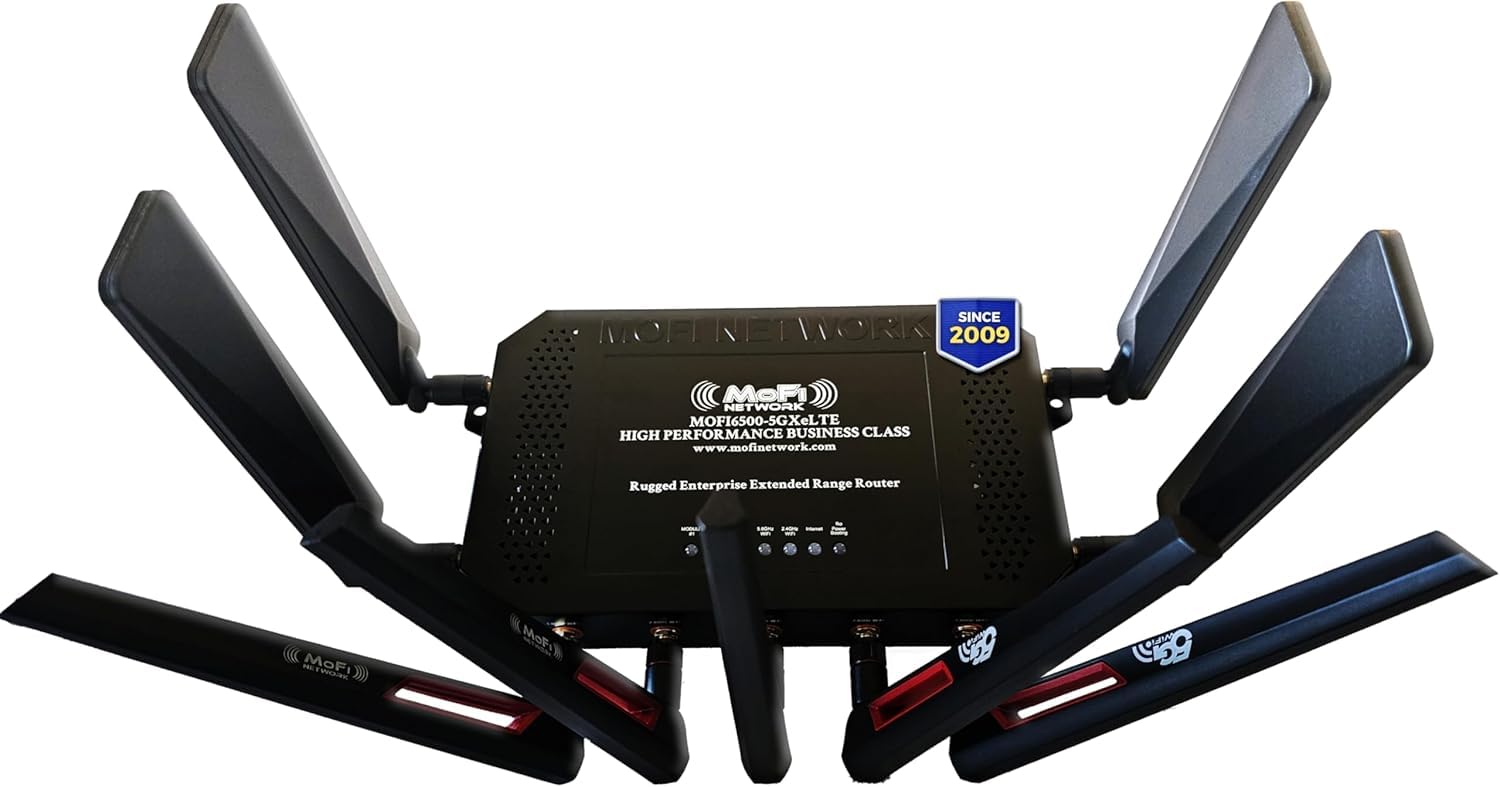
The MOFINETWORK MOFI6500 is a business-class 5G cellular gateway built around a rugged full metal chassis with detachable antennas. It supports 5G NR and 4G LTE with a max data rate of 3.4 Gbps, and its dual SIM slots provide automatic failover — if the primary carrier drops, the router switches to the backup SIM within seconds. This model includes four high-gain 5G cellular antennas and five Wi-Fi antennas, ensuring strong signal capture even in rural areas where one bar of 5G is the difference between usable internet and dial-up.
Users in full-time RV setups report excellent stability after initial configuration, with the router operating reliably under trees and in motion. The IP Pass-Through mode allows advanced users to use their own firewall or router downstream, and the band-lock feature lets you pin the modem to specific frequency bands to avoid congestion. The metal case provides superior heat dissipation compared to plastic alternatives, preventing thermal throttling during long sessions. MOFI’s tech support is responsive — one user with a 2-year-old unit received help within 20 minutes for a hard-reboot fix.
The key differentiator here is the rugged construction and the ability to add external directional Yagi antennas for extreme fringe areas. For rural homes, RV travelers, and businesses that cannot tolerate downtime, this gateway is purpose-built. Note that the dual-SIM is failover-only, not simultaneous load-balancing, so confirm your needs match the design.
Why it’s great
- Rugged metal chassis with superior heat dissipation
- Dual SIM auto-failover for business continuity
- Band-lock and IP Pass-Through for network professionals
Good to know
- Dual SIM is failover-only, not load-balancing
- Full-time RV performance may require external directional antenna
4. GL.iNet GL-XE3000 (Puli AX)
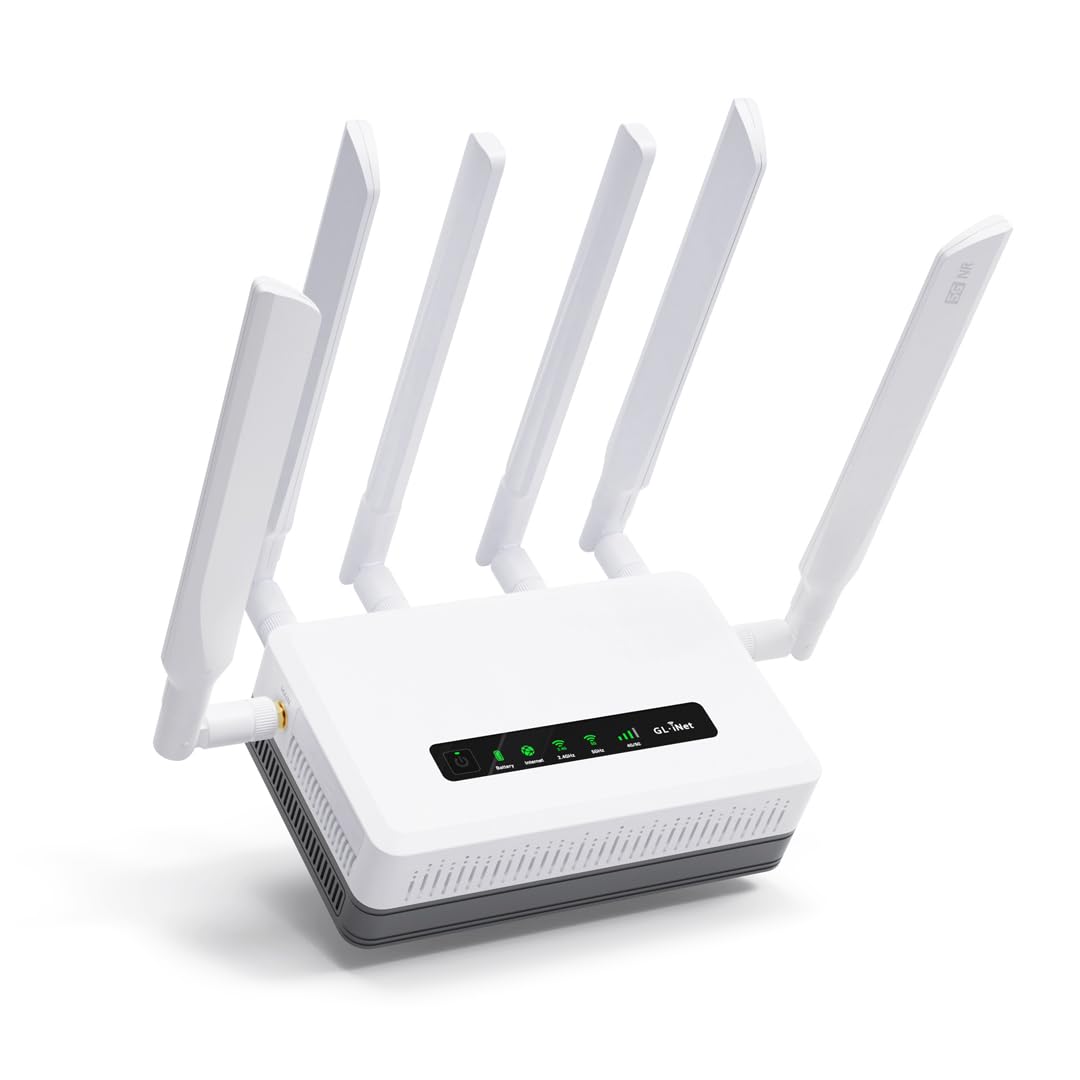
The GL.iNet Puli AX is a 5G cellular gateway with a built-in 6,400mAh battery delivering up to 8 hours of uninterrupted connectivity — a lifesaver for mobile offices, construction sites, and events where power outages are a risk. It supports dual SIM (single standby) with automatic failover between carriers, and its Wi-Fi 6 radio provides up to 574 Mbps on 2.4 GHz and 2,402 Mbps on 5 GHz. The detachable antennas offer flexibility for mounting in RVs or temporary workspaces, and the OpenWrt-based firmware unlocks over 5,000 plug-ins for advanced customization.
Real-world users highlight the Puli AX’s ability to provide reliable 5G in rural “Faraday cage” environments, delivering 120 Mbps where other devices failed. The multi-WAN feature accepts Ethernet, Repeater, Cellular, and Tethering inputs, with load-balancing and failover configurable by custom proportion. For international travel, the physical eSIM card support (sold separately) allows easy switching between global carriers. The wall-mount kit makes permanent installation straightforward.
Dual SIM setup can be finicky — some users report SIM detection issues that required multiple power cycles and tech support intervention. Once configured, the battery life holds up for 6-8 hours of active use. For anyone who needs a 5G gateway that keeps running when the power goes out, the Puli AX is the clear choice.
Why it’s great
- Built-in 6,400mAh battery provides 6-8 hours of backup power
- OpenWrt firmware enables deep customization and VPN support
- Multi-WAN with load-balancing for diverse connectivity options
Good to know
- Dual SIM setup may require multiple power cycles to detect SIM
- Battery life dips to ~6 hours under heavy 5G load
5. GL.iNet GL-X3000 (Spitz AX)

The GL.iNet Spitz AX is a 5G cellular gateway optimized for mobile use in RVs, vans, and road trips. It features six detachable antennas (four cellular, two Wi-Fi) and dual SIM slots with automatic failover, ensuring you stay connected as you cross carrier coverage boundaries. The OpenWrt-based firmware provides advanced VPN support with pre-installed OpenVPN and WireGuard, capable of handling up to 300 Mbps through encrypted tunnels. USB-C power delivery means you can run it from a car’s 12V outlet without an inverter.
Users report stable 5G UC speeds averaging 150 Mbps even when the router is placed in a vehicle’s cargo area. The multi-WAN configuration allows Ethernet, Repeater, Cellular, and Tethering inputs, with failover priority customizable for each situation. The router’s compact form factor and wall-mount kit make it easy to install permanently in an RV or keep portable for hotel use. Setup is straightforward via the web dashboard, which offers solid defaults for most carriers.
The Spitz AX is restricted to 2-band carrier aggregation, which limits peak speeds in areas with strong signals. Some users note reliability issues after days of uptime, with latency climbing and speeds tanking until a reboot. For RV and travel use where a hard reset every few days is acceptable, this remains the best mobile-friendly cellular gateway available.
Why it’s great
- Six detachable antennas for maximum signal capture in remote areas
- OpenWrt firmware with pre-installed WireGuard and OpenVPN
- USB-C power input works directly with car 12V systems
Good to know
- Limited to 2-band carrier aggregation, impacting peak speeds
- Requires periodic reboots to maintain performance after days of uptime
6. Cudy P5

The Cudy P5 is a 5G NR CPE (Customer Premises Equipment) router built around the Qualcomm Snapdragon SDX62 modem, delivering downlink speeds up to 3.4 Gbps on 5G NSA. It supports dual SIM with failover, and its standout feature is the built-in band-lock capability accessible through the web UI — letting you pin the modem to specific 5G bands for optimal performance in fringe areas. TTL control, advanced VPN options (PPTP, L2TP, OpenVPN, WireGuard, IPsec, Zerotier), and support for 20+ DDNS providers make it a flexible tool for network professionals.
The router delivers stable 5G speeds through cellular SIMs, with good Wi-Fi 6 coverage that handles streaming and video calls without issue. The four detachable cellular antennas (5 dBi each) provide solid sensitivity, and the separate Wi-Fi antennas ensure good wireless range. For users needing advanced controls beyond what typical gateways offer — like TTL manipulation to bypass throttling — the P5 is one of the few options that exposes these settings natively.
Two major caveats: the P5 is known to be incompatible with Verizon SIMs, failing to connect entirely. Users report no US-based tech support, making carrier verification critical before purchase. The unit also runs warm; ventilation is important. For AT&T or T-Mobile customers who need band locking and TTL control, the P5 is a capable tool. Verizon users must look elsewhere.
Why it’s great
- Band-lock and TTL control via native web interface
- Qualcomm SDX62 modem with 3.4 Gbps peak speeds
- Extensive VPN protocol support with Zerotier integration
Good to know
- Not compatible with Verizon SIMs — confirmed by multiple users
- No US-based tech support for troubleshooting
7. TP-Link Archer BE700

The TP-Link Archer BE700 is a tri-band Wi-Fi 7 router pushing a theoretical 15 Gbps aggregate throughput. Its key spec is the 10 Gbps WAN port, which accepts multi-gig fiber or cable modems without bottlenecking, plus a 2.5 Gbps LAN port and three 1 Gbps LAN ports. The Qualcomm-based silicon provides excellent stability, with users reporting seamless 4K/8K streaming and low-latency gaming after the initial firmware quirks were resolved. MLO (Multi-Link Operation) must be manually enabled for supported devices like the iPhone 16 Pro and Samsung Galaxy S24 Ultra.
The tower design keeps the six internal antennas oriented for optimal signal in a 2,200-square-foot area. Setup via the Tether app is painless, and the web interface offers granular controls for VLANs, QoS, and parental restrictions. IoT network isolation via a private SSID adds a security layer that’s easy to configure. The EasyMesh compatibility lets you extend coverage with other TP-Link mesh devices without needing a fully new system.
Early-adopter quirks exist — Wi-Fi 7 client compatibility can be inconsistent (Pixel 9 Pro and S25 Ultra users report initial pairing struggles), and the firmware is still maturing on per-device LAN-only access controls. The 30-day HomeShield subscription is useful but the paid tier is required for advanced features. For homes with a multi-gig wired connection that want to step into Wi-Fi 7 without paying for a quad-band flagship, the BE700 offers solid value.
Why it’s great
- 10 Gbps WAN port for multi-gig internet plans
- Qualcomm silicon provides excellent stability and low latency
- EasyMesh support for seamless whole-home expansion
Good to know
- Wi-Fi 7 client compatibility can be inconsistent on early firmware
- Advanced HomeShield features require paid subscription after 30 days
8. NETGEAR Nighthawk BE9300

The NETGEAR Nighthawk BE9300 is a tri-band Wi-Fi 7 router offering up to 9.3 Gbps wireless speed with a 2.5 Gig internet port — an accessible entry point for Wi-Fi 7 without the flagship price. It covers up to 2,500 square feet and supports up to 100 devices, with auto-channel selection that finds the cleanest frequencies without manual intervention. Setup via the Nighthawk app is fast, and users report stable performance with 40+ devices connected simultaneously, including gaming sessions without slowdowns.
The compact body houses high-performance antennas that deliver strong coverage through walls, with users in 2,700-square-foot homes reporting no dead zones. The router includes NETGEAR Armor with a 30-day trial, and the 2.5 Gig port provides headroom for cable or fiber plans up to 2 Gbps. For those upgrading from an older Nighthawk, users report significant speed improvements — 3x faster speeds compared to previous generation models.
While the app setup is straightforward, some users report initial connectivity hiccups that required a firmware update to resolve. The app’s alerts and parental control features are functional but not as polished as dedicated solutions. For a mid-range Wi-Fi 7 router that balances cost with genuine performance gains, the Nighthawk BE9300 is a solid choice.
Why it’s great
- 2.5 Gig internet port provides headroom for multi-gig plans
- Stable performance with 40+ devices including gaming traffic
- Auto-channel selection finds clean frequencies automatically
Good to know
- Initial setup may require firmware update to resolve connection issues
- Parental control features are functional but basic compared to dedicated systems
9. TP-Link Archer BE550

The TP-Link Archer BE550 is a tri-band Wi-Fi 7 router that delivers 9.3 Gbps aggregate speed and is priced as one of the most accessible Wi-Fi 7 options on the market. Its standout feature is the full set of 2.5G ports — one WAN and four LAN — meaning every wired device can communicate at multi-gig speeds, not just the internet uplink. The router covers up to 2,000 square feet with six internal antennas and Beamforming, and supports EasyMesh for seamless whole-home expansion with compatible TP-Link extenders. Setup is via the Tether app, which users find intuitive and modern.
Real-world performance is strong for the price point. Users report consistent 950+ Mbps on a 1 Gbps copper connection, and the MLO (Multi-Link Operation) feature merges all bands into a single SSID, eliminating the old problem of devices stubbornly clinging to a slow 2.4 GHz band. The router works well with WiFi 7 devices like Samsung phones and iPhone 16 Pro, and backward compatibility is solid. The VPN client and server support allows home devices to connect to remote VPNs without individual client installations.
Reliability has been the most contentious point — while many users report months of uptime without issues, a significant minority report random device disconnections affecting iPhones, HomePods, and smart home gear. The coverage is adequate for medium homes but falls short for larger layouts without EasyMesh extenders. For buyers who want Wi-Fi 7 speeds on a budget and are willing to work through potential stability quirks, the BE550 offers compelling value.
Why it’s great
- Full 2.5G WAN and four 2.5G LAN ports for multi-gig wired networking
- MLO merges all bands into a single SSID, eliminating band-switching issues
- EasyMesh support for affordable whole-home expansion
Good to know
- Reliability issues reported with iPhone and HomeKit device disconnections
- Coverage limited to ~2,000 sq ft without mesh extender
FAQ
What is the difference between a 5G router and a 5G gateway?
Can I use a 5G gateway with any carrier?
How fast is a 5G router compared to cable internet?
What does band-lock do on a 5G router?
Final Thoughts: The Verdict
For most users, the best 5g router winner is the ASUS ROG Rapture GT-BE98 PRO because its quad-band Wi-Fi 7, dual 10G ports, and mature firmware handle the most demanding home networks. If you need a cellular gateway for rural or mobile use, grab the MOFINETWORK MOFI6500 for its rugged build and business-class failover. And for a budget-friendly Wi-Fi 7 entry, nothing beats the TP-Link Archer BE550 with its full set of 2.5G ports.

Mo Maruf
I created WellFizz to bridge the gap between vague wellness advice and actionable solutions. My mission is simple: to decode the research and give you practical tools you can actually use.
Beyond the data, I am a passionate traveler. I believe that stepping away from the screen to explore new environments is essential for mental clarity and physical vitality.