Our readers keep the lights on and my smoothie glass nicely filled. As an Amazon Associate, I earn from qualifying purchases.
A table saw’s real potential isn’t unlocked by horsepower or fence precision—it’s the blade that decides whether a project ends with sanding or assembly. The wrong tooth count leaves scorch marks on hardwoods, while a dull carbide tip turns a premium sheet of plywood into a chipped mess. For anyone feeding dimensional lumber or veneered panels through the arbor, the blade selection defines the outcome of every cut.
I’m Mohammad Maruf — the founder and writer behind WellFizz. I’ve spent years dissecting tool accessory specifications, from carbide grain formulations to hook angles, to separate marketing claims from measurable cutting performance.
Understanding tooth geometry, kerf thickness, and plate stability prevents wasted material and rework. Whether you need glue-ready rip cuts or chip-free crosscuts on melamine, the right blades for table saw turn a noisy power tool into a precision joinery instrument.
How To Choose The Best Blades For Table Saw
A table saw blade is a consumable precision tool, not a permanent accessory. The wrong choice leads to burned edges, tear-out, and shorter carbide life. Focus on three pillars: tooth geometry for the material, kerf thickness for the saw’s power, and plate construction for stability.
Tooth Count and Grind Pattern
Low tooth counts (24 or fewer) with a flat-top grind or triple-chip grind excel at ripping solid lumber fast, clearing chips efficiently. High tooth counts (60–80) with an alternating top bevel (ATB) produce polished crosscuts on plywood and melamine with minimal breakout. A 40-tooth ATB hybrid serves as a general-purpose blade for mixed cuts.
Kerf Width: Thin vs. Full
Thin kerf blades (around 0.091 inches) remove less material per pass, reducing waste and placing less strain on lower-horsepower saws. Full kerf blades (0.125 inches) offer greater stability and reduced deflection in heavier cuts but require a motor with sufficient torque to avoid bogging.
Carbide Grade and Coatings
Micro-grain carbide blends such as TiCo HI-Density or C3/C4 formulations resist chipping and hold an edge longer than standard carbide. Non-stick coatings like Perma-Shield reduce resin buildup and friction-generated heat, extending cutting life between sharpenings.
Quick Comparison
On smaller screens, swipe sideways to see the full table.
| Model | Category | Best For | Key Spec | Amazon |
|---|---|---|---|---|
| Forrest Woodworker II WW10407125 | Premium | Fine woodworking; glue-ready edges | 0.125″ kerf, 40 teeth | Amazon |
| Freud P410 Premier Fusion | Premium | Melamine and veneered plywood | Hi-ATB grind, 40 teeth | Amazon |
| Freud LM75R010 Glue Line Ripping | Premium | Low-waste ripping, joinery prep | 0.091″ kerf, 30 teeth | Amazon |
| CMT Orange Tools 256.050.10 | Mid-Range | All-around cross/rip on hardwoods | 50 teeth, combo grind | Amazon |
| Oshlun SBW-100050 | Mid-Range | Radial arm saws and finish work | Negative hook angle, 50 teeth | Amazon |
| Bosch DCB1024 Daredevil | Mid-Range | Fast ripping, daily work | ATB grind, 24 teeth | Amazon |
| FOXBC 10-Inch Ultra Finish | Budget | Entry-level finish cuts | 80 teeth, 0.098″ kerf | Amazon |
In‑Depth Reviews
1. Forrest Woodworker II WW10407125

The Forrest Woodworker II has been a benchmark in woodworking circles for decades, and the 10-inch 40-tooth model justifies the reputation with a 0.125-inch full kerf that resists deflection even during heavy rip cuts on dense hardwoods. The 30-degree ATB grind produces crosscuts that are often glue-ready straight off the saw, eliminating sanding passes on exposed joinery.
Users consistently report exceptional carbide longevity, with many exceeding two years of regular use before sending the blade for resharpening. The full kerf demands a motor with solid torque, but the payoff is a stable cut with minimal burn marks. The package includes a plastic tooth guard and clear instructions to avoid overheating the tips.
While the upfront cost is high, the ability to resharpen the blade up to a dozen times makes the per-cut cost lower than disposables. Owners note that it is not ideal for spline slots due to the ATB tooth geometry, but for general ripping and crosscutting on a cabinet saw, it remains the gold standard.
Why it’s great
- Resharpenable multiple times; long-term value unmatched.
- Full kerf provides superb stability on rip cuts.
- Glue-ready edges with no tear-out on plywood.
Good to know
- High price point; heavy for low-horsepower saws.
- ATB grind not suitable for spline or groove cuts.
2. Freud Next Generation Premier Fusion P410

The Freud P410 is engineered for woodworkers who frequently cut laminated materials and veneered plywood. Its Fusion Trio Tooth design marries a 30-degree Hi-ATB grind with a double grind and axial shear face grind, producing polished edges that rival panel saws. On double-sided melamine, users report zero chipping on both faces during crosscuts.
TiCo HI-Density Carbide maintains a sharp edge longer than standard carbide grades, and the Perma-Shield non-stick coating prevents resin buildup during long ripping sessions in oak or maple. Laser-cut anti-vibration slots reduce whine and keep the blade tracking straight, even on jobsite saws with less mass.
Some users note the high ATB requires careful feeding to avoid grabbing, and one review mentioned a broken tooth upon arrival due to thin packaging. It is not recommended for dado stacks. For fine woodworking demanding minimal sanding, this blade delivers results comparable to the Forrest line at a lower entry cost.
Why it’s great
- Exceptional chip-free cuts on melamine and laminate.
- Anti-vibration slots reduce noise significantly.
- Resharpenable, offering good long-term value.
Good to know
- High ATB can be grabby on thin stock.
- Packaging may not protect carbide tips during shipping.
3. Freud LM75R010 Glue Line Ripping Blade
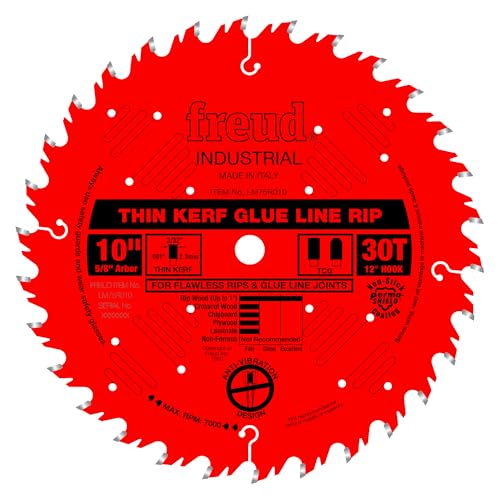
Dedicated ripping blades often sacrifice finish for speed, but the LM75R010 proves a thin kerf can deliver both. With a 0.091-inch kerf and 30 teeth featuring a triple-chip grind, this blade cuts through dense hardwoods with minimal waste and no burning. The 12-degree positive hook angle pulls material through quickly, making it ideal for long rip cuts on a cabinet saw.
The TiCo HI-Density Carbide and Perma-Shield coating keep the blade running cool and clean, even after hundreds of linear feet of rip cuts in white oak or maple. Laser-cut anti-vibration slots keep the plate stable, reducing the saw marks that require jointer passes. Users producing cutting boards and furniture have noted time savings of up to 30% on joint prep.
This blade requires precise saw alignment to reach its full potential; misaligned fences can cause binding on the thin kerf. It is not designed for crosscuts—the TCG grind leaves a slightly rough edge on end grain. For joinery-focused woodworkers, it is a specialized tool that earns its place in the arsenal.
Why it’s great
- Thin kerf reduces waste and motor strain.
- Glue-line quality rips on hardwoods.
- Anti-vibration slots improve cut accuracy.
Good to know
- Saw must be perfectly aligned to avoid binding.
- Not intended for crosscutting; TCG leaves rough edges.
4. CMT Orange Tools 256.050.10 Combination Blade
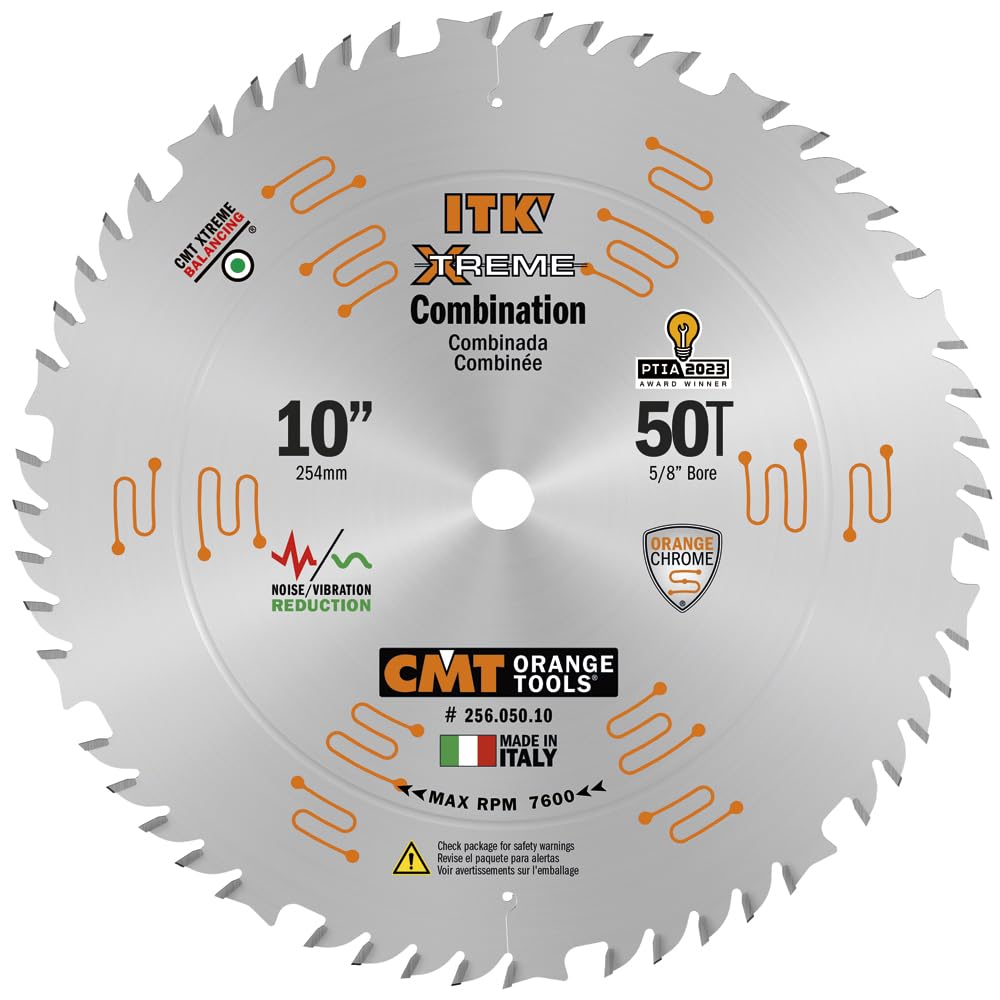
CMT’s 50-tooth combination blade splits the difference between a ripping and crosscutting tool with its ATB plus one flat tooth grind. On a compact jobsite saw, the thin kerf reduces motor drag, allowing the blade to cut through 8/4 hard maple without bogging. Users report smooth feeds with no burning and minimal tear-out on plywood.
The laser-cut vibration slots keep noise low, and the carbide tips arrive razor-sharp—capable of cutting a finger on contact. Made in Italy, the blade has earned praise for its longevity: many owners report resharpening up to 20 times, which is unusual for a mid-range blade. The balance is excellent straight out of the box, with no wobble detectable at high RPM.
One minor note is that the blade lacks a low ATB angle for a truly flat-bottom kerf, so it is not ideal for spline joints. The thin kerf also requires the saw to be tuned with zero side play. For a versatile blade that handles both rips and crosscuts on dimensional lumber, this is a strong contender.
Why it’s great
- Extremely sharp from the factory; precise balance.
- Low vibration and noise during cuts.
- Resharpenable many times; long service life.
Good to know
- Not for spline slots; ATB leaves slight V-bottom.
- Requires well-aligned saw for best performance.
5. Oshlun SBW-100050 50-Tooth Combination Blade
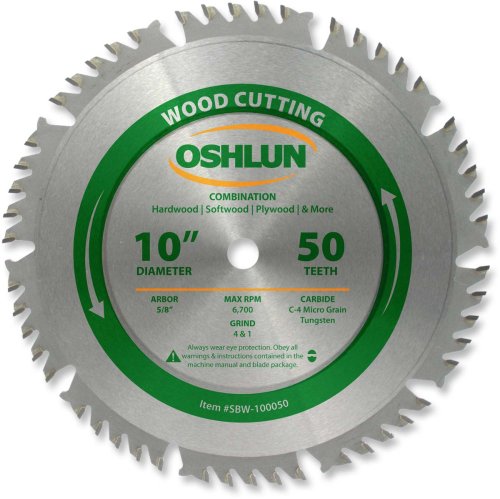
Radial arm saws have a notorious tendency to climb forward during cuts, and the Oshlun SBW-100050 addresses this with a negative hook angle that prevents kickback. The 50-tooth combination grind (4 ATB and 1 flat-top) produces clean crosscuts on pine, cedar, and hardwoods with minimal splintering. Users running radial saws have reported a significant safety improvement after switching.
The blade features tensioned and surface-ground steel plate, which maintains flatness under thermal stress. On a table saw, it produces cuts that are slightly rougher than a dedicated finish blade—tooth marks are visible on exposed cabinet faces—but acceptable for general carpentry and cabinetry that will be sanded.
A few users noted a strong mothball odor from the packaging, though it did not affect performance. The kerf is wider than many thin-kerf options, resulting in more material waste per cut. For radial arm saw owners who prioritize safety and clean crosscuts, the Oshlun offers solid performance at a practical price.
Why it’s great
- Negative hook angle prevents climbing on radial saws.
- Smooth crosscuts with minimal tear-out.
- Tensioned plate stays flat under heat.
Good to know
- Wider kerf produces more waste than thin-kerf blades.
- Tooth marks visible on cabinet-grade cuts.
6. Bosch DCB1024 Daredevil 24-Tooth Ripping Blade

Bosch’s Daredevil line targets the speed-oriented user who needs clean rip cuts without swapping blades multiple times a day. The DCB1024 features 24 teeth with an ATB grind and a thinner kerf for faster material removal. On a 15-amp table saw, this blade rips through 2x framing lumber and plywood with noticeably less resistance than a general-purpose 40-tooth blade.
The Brute Carbide formulation offers better impact resistance, reducing chipping when encountering knots or nail-embedded lumber. The Speed Coat anti-friction finish prevents burning on long rip passes and keeps the blade running cooler. Users report that the cut quality is a dramatic improvement over stock blades commonly bundled with table saws.
This is not a finish blade—crosscuts will show modest tear-out on veneered materials. The 24-tooth geometry is optimized for speed, so dedicated finishing work requires a separate blade. For general contractors or DIYers who prioritize rip efficiency, it delivers strong value.
Why it’s great
- Fast ripping with low resistance.
- Anti-stick coating prevents pitch buildup.
- Brute Carbide resists chipping from knots.
Good to know
- Not recommended for crosscutting finished panels.
- Low tooth count leaves rougher rip edge.
7. FOXBC 10-Inch Ultra Finish 80-Tooth Blade

FOXBC’s 80-tooth blade aims to deliver near-polished finish cuts at an entry-level price. The high-density tungsten carbide tips produce clean crosscuts on oak, pine, melamine, and plywood with very little tear-out. Users have noted that it outperforms more expensive models in the 80-tooth category for smoothness and low vibration.
The 0.098-inch kerf is slightly thicker than true thin-kerf blades, which adds some resistance but also increases plate stability for less deflection. On a table saw, the blade runs quietly with no wandering, making it a solid choice for DIYers working on molding and trim projects. The ATB grind handles both thin veneers and solid stock effectively.
Some users note that the “extra thin kerf” labeling is somewhat misleading—the kerf is comparable to a standard 40-tooth blade rather than an ultra-slim profile. The blade is not as durable as premium carbide options; the tips will dull faster with heavy use. For cost-conscious woodworkers who need occasional finish cuts, it offers strong value.
Why it’s great
- Produces smooth, tear-free crosscuts.
- Runs quietly with minimal vibration.
- Very affordable for an 80-tooth blade.
Good to know
- Kerf not truly thin; closer to standard thickness.
- Carbide tip longevity lags behind premium brands.
FAQ
Can I use a miter saw blade on my table saw?
How often should I sharpen a table saw blade?
What does kerf thickness actually affect?
Why do some blades have laser-cut slots?
Final Thoughts: The Verdict
For most users, the blades for table saw winner is the Forrest Woodworker II WW10407125 because it delivers glue-ready edges with a full-kerf stability that makes it the benchmark for serious woodworking. If you want a versatile blade that handles melamine and laminate without chipping, grab the Freud P410 Premier Fusion. And for joinery-focused ripping with minimal waste, nothing beats the Freud LM75R010 Glue Line Ripping blade.

Mo Maruf
I created WellFizz to bridge the gap between vague wellness advice and actionable solutions. My mission is simple: to decode the research and give you practical tools you can actually use.
Beyond the data, I am a passionate traveler. I believe that stepping away from the screen to explore new environments is essential for mental clarity and physical vitality.