Our readers keep the lights on and my smoothie glass nicely filled. As an Amazon Associate, I earn from qualifying purchases.
Choosing the right charger for your 3.7V 18650 batteries isn’t just about convenience; it’s about safety, battery longevity, and getting reliable power for your devices. The wrong charger can silently degrade your cells, while the right one can restore and maintain their performance for years.
I’m Mohammad Maruf — the founder and writer behind WellFizz. My process involves deep-diving into technical specifications, analyzing thousands of user experiences, and cross-referencing safety certifications to separate marketing hype from genuine performance.
Based on a thorough analysis of the current market, we’ve identified the key chargers that balance advanced features with robust protection. The final decision hinges on your specific needs, from simple charging to professional-grade battery analysis. Getting this right is the single most important step in managing your best 3.7 v 18650 rechargeable batteries effectively.
How To Choose The Best 3.7 V 18650 Rechargeable Batteries Charger
Your charger is the guardian of your battery investment. It’s not a passive accessory. The right choice depends on your technical needs, the variety of batteries you own, and how much data you want about your cells’ health.
Primary Function: Charge-Only vs. Analyzer
Basic chargers simply refill your batteries. Advanced models add functions like capacity testing (measuring the actual mAh), internal resistance checking, and refresh cycles. If you’re a hobbyist with flashlights or vaping devices, a smart charger with a basic display is perfect. If you manage large packs for solar projects or need to grade used cells, a professional analyzer is essential.
Speed and Flexibility
Charging current, measured in Amps (A) or milliamps (mA), dictates speed. A 1A (1000mA) charge is standard; 2A or 3A is faster but may generate more heat. Look for adjustable current settings—this allows you to gently charge sensitive or older cells with a lower current, extending their life.
Safety as a Non-Negotiable
Beyond brand reputation, look for explicit mentions of protection circuits: over-charge, over-current, short-circuit, and reverse polarity. Physical certifications like UL or CE listed on the product specs are a strong indicator of built-in safety standards, not just marketing claims.
Quick Comparison
On smaller screens, swipe sideways to see the full table.
| Model | Type | Best For | Key Feature | Amazon |
|---|---|---|---|---|
| EBL PD4 | Smart Charger | Enthusiasts & Data | Discharge & Test Modes | Amazon |
| XTAR Dragon VP4L Plus | Professional Analyzer | Battery Repair & Grading | 0V Activation, USB Output | Amazon |
| XTAR VC8 Plus | 8-Bay Workstation | High-Volume Users | 8 Bays, 4 Test Slots | Amazon |
| Opus BT-C3100 | Feature-Packed Analyzer | Detailed Capacity Testing | 5 Modes, Adjustable Current | Amazon |
| XTAR VX4 Visible Mixer | Mixed Chemistry Specialist | 1.5V Li-ion & Ni-MH | Dedicated 1.5V Li-ion Tester | Amazon |
| Dlyfull 4 Bay | Universal USB-C | Fast, Portable Charging | 2000mA Max on One Slot | Amazon |
| HiQuick Combo | Starter Kit | New Users to Rechargeables | Includes 4 C Batteries | Amazon |
| VICTAGEN Combo | 4-Bay Value | Household Use | Dual Micro-USB & Type-C Input | Amazon |
| Swanlake LCD Display | 2-Bay Adjustable | Precise Control | 0.5A/1A/2A Selectable Current | Amazon |
| EBL Universal | Entry-Level Universal | Wide Compatibility | Charges Li-ion & Ni-MH | Amazon |
| Yuntunele 2-Pack | Button Top Batteries | Flashlight Replacements | 2500mAh Button Top Cells | Amazon |
In‑Depth Reviews
1. EBL PD4 Universal Charger

The EBL PD4 strikes a remarkable balance between advanced functionality and an accessible mid-range position. It moves far beyond simple charging, offering critical tools like a dedicated discharge mode and capacity testing capability. This allows you to see the actual, real-world mAh of your 18650 cells, which is invaluable for identifying aging batteries or verifying new ones.
Its intelligent LCD display provides clear, real-time data on voltage, current, and estimated time remaining. With two bays supporting up to 2000mA, it offers flexibility for fast charging when needed, while still accommodating gentler rates for smaller or sensitive cells. The automatic battery type recognition works reliably across a wide range of lithium-ion and Ni-MH chemistries.
For the user who wants to graduate from a basic charger to one that offers genuine insight into battery health without stepping into complex professional territory, the PD4 is an exceptional choice. It delivers the core features of more expensive analyzers in a user-friendly package, making it our top recommendation for most enthusiasts.
Why it’s great
- Offers valuable capacity testing and discharge functions.
- Clear LCD screen with detailed charging data.
- Supports a very wide range of battery sizes and chemistries.
- Provides a solid mix of speed and safety features.
Good to know
- The capacity test function is limited to one slot at a time.
- Some units may experience occasional software glitches requiring a reboot.
2. XTAR Dragon VP4L Plus

The XTAR Dragon VP4L Plus is a professional-grade workstation designed for those who take battery management seriously. Its standout feature is the ability to attempt recovery of over-discharged batteries that other chargers would simply reject as dead. This “repair” function, along with its precise capacity testing and included test probes for checking internal resistance, makes it a powerful diagnostic tool.
It handles a mixed bag of batteries with ease, charging different chemistries and sizes in all four slots simultaneously. The addition of a USB output port allows it to double as a regulated power bank, adding to its utility. The build quality is substantial, reflecting its premium positioning and intended use in demanding scenarios.
This is the charger for the user who salvages cells from old laptop batteries, needs to rigorously grade performance for custom packs, or simply demands the highest level of control and information. The learning curve is steeper, but the capabilities are unmatched in its class.
Why it’s great
- Can potentially revive deeply discharged batteries.
- Comprehensive testing with included probes for internal resistance.
- Functions as a stable USB power bank.
- Excellent build quality and reliable performance.
Good to know
- Premium price point reflects its professional features.
- Interface and multitude of functions have a steeper learning curve.
- Some users report it may not charge newer 1.5V Li-ion formats.
3. XTAR VC8 Plus 8-Bay Charger

When you need to charge and manage a large quantity of batteries, the XTAR VC8 Plus is the definitive solution. With eight independent bays, it can handle an entire fleet of cells at once, significantly cutting down on management time. It’s particularly adept with large 21700 and 26650 cells, which can be charged in all eight slots simultaneously.
Intelligently, it splits functionality: slots 1 through 4 offer full analysis modes (grade, store, charge), while slots 5 through 8 are dedicated charge-only bays. This design provides a perfect balance for users who need to test a subset of their collection while quickly charging the rest. The included 12V/3A adapter ensures it has enough power to run all bays effectively.
For vapers with multiple mods, flashlight enthusiasts with numerous lights, or anyone building custom battery packs, the VC8 Plus is a productivity powerhouse. It turns a chore into an efficient, organized process.
Why it’s great
- Massive capacity to charge eight large cells at once.
- Smart design with four analyzer slots and four charger slots.
- Comes with a capable 12V DC power adapter.
- Excellent for users with many 21700/20700/18650 batteries.
Good to know
- Its physical footprint is larger, requiring more desk space.
- The “grade” capacity test cycle is time-consuming, as expected.
- Some battery brands with unusual wrappings may have fit issues.
4. Opus BT-C3100 V2.2

The Opus BT-C3100 is a veteran in the analyzer category, beloved for its deep feature set at a competitive price point. It offers five distinct modes: Charge, Discharge, Test (capacity), Quick Test, and Refresh. This makes it an incredibly versatile tool for characterizing battery performance, cycling cells for storage, or reviving lazy ones.
Its adjustable charging current is highly flexible, ranging from a gentle 200mA up to a robust 2000mA when using a single slot. The built-in cooling fan is a critical feature that manages heat during high-current charging or prolonged discharge cycles, a sign of thoughtful engineering for sustained operation. The display, while not flashy, presents all necessary data clearly.
For the tech-savvy user who wants granular control and a wide array of diagnostic functions without the premium brand price, the Opus remains a top-tier contender and a benchmark in its category.
Why it’s great
- Extensive mode selection for detailed battery analysis.
- Wide range of user-selectable charging currents.
- Active fan cooling enhances safety during heavy use.
- Proven, reliable design with a strong user community.
Good to know
- The fan noise can be noticeable.
- User interface buttons and menus can feel a bit dated.
- Quality control on individual units can vary; check upon arrival.
5. XTAR VX4 Visible Mixer

The XTAR VX4 carves out a unique niche by specializing in the latest 1.5V Li-ion rechargeable batteries (like those designed to replace AA alkalables), while still fully supporting standard 3.6/3.7V Li-ion and Ni-MH cells. It’s one of the first chargers to properly integrate capacity testing specifically for these 1.5V lithium cells, displaying results in both mAh and the more relevant mWh (milliwatt-hours).
Included with a capable 20W USB-C PD adapter, it supports rapid charging at up to 3A per slot. Its “Mixer” capability allows any combination of supported battery types to be charged simultaneously without issue. The smart CVSA technology for Ni-MH cells aims to reduce heat and improve safety, a thoughtful touch for mixed-chemistry households.
If your battery ecosystem is evolving to include modern 1.5V lithium AA/AAA cells alongside your traditional 18650s, the VX4 is the future-proof charger designed to handle them all intelligently.
Why it’s great
- Leading-edge support for 1.5V Li-ion battery testing.
- Comes with a high-power 20W PD adapter for fast charging.
- Excellent for households using a mix of battery technologies.
- Clear display with energy (mWh) measurement.
Good to know
- Primarily optimized for charging, with more limited analysis modes than dedicated testers.
- Physically larger than some 4-bay competitors.
6. Dlyfull 4 Bay USB-C Charger

The Dlyfull 4 Bay charger is a strong mid-range contender that emphasizes speed and modern connectivity. Its key advantage is a dedicated slot that supports up to 2000mA (2A) charging current, allowing for very quick top-ups of a single high-capacity 18650 or 21700 cell. When charging multiple batteries, the current smartly distributes to maintain safe speeds.
The use of a USB-C input port is a welcome modern feature, making it easy to power from laptops, power banks, or car chargers with ubiquitous USB-C cables. The build quality feels solid for its category, and it covers an exhaustive list of compatible battery sizes. It focuses on doing the core job of charging very well, with useful safety protections in place.
This is an ideal charger for someone who values quick turnaround times, appreciates the convenience of USB-C, and needs a reliable workhorse for daily use with various devices.
Why it’s great
- Very fast 2000mA charging option on one slot.
- Modern USB-C input for easy power sourcing.
- Compact and well-built for a 4-bay charger.
- Extensive compatibility list for both Li-ion and Ni-MH.
Good to know
- The high-speed 2000mA rate is limited to a specific single slot.
- It is primarily a charger and lacks advanced testing functions.
- Springs in the sled can be stiff initially.
7. HiQuick Rechargeable C Battery Combo
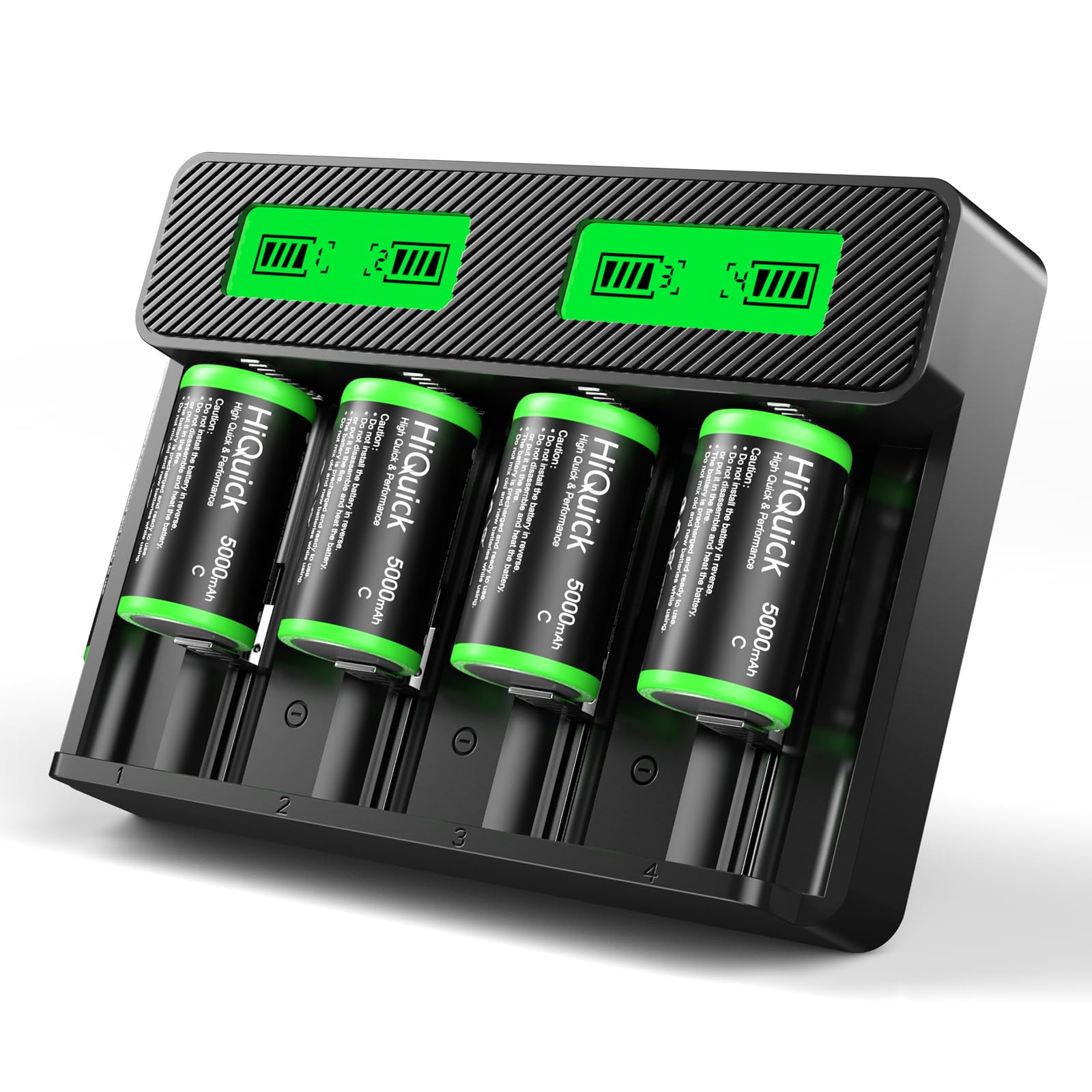
The HiQuick combo pack is an excellent entry point into the world of rechargeables, especially for households that still use C or D size batteries for toys, lanterns, or radios. The inclusion of four high-capacity 5000mAh Ni-MH C batteries provides immediate value and gets you started right away. The charger itself features a clever built-in USB cable, reducing clutter.
It carries a UL safety certification, which is a significant plus for a bundled kit, providing extra assurance. The LCD display clearly shows charging progress. Its compatibility extends to 18650 lithium-ion cells, making it a versatile hub for common household rechargeable needs beyond just the included C cells.
This is a hassle-free solution for someone tired of buying disposable C or D batteries and wants a simple, all-in-one kit to make the switch to rechargeable power. It simplifies the process beautifully.
Why it’s great
- Excellent value with four high-capacity C batteries included.
- Convenient built-in USB cable for reduced clutter.
- UL safety certification adds a layer of trust.
- Perfect for families making the switch to rechargeables.
Good to know
- The included C batteries may not hold a charge as long as premium-brand cells.
- It does not fit flat-top 18650 batteries, only button-top.
- Primarily designed for charging, not analysis.
8. VICTAGEN 4-Slot Combo

The VICTAGEN 4-slot charger offers a compelling package of features at a value-oriented point. Its standout practical advantage is the inclusion of both Micro-USB and Type-C input ports, giving you maximum flexibility to use whatever cable you have on hand. The four bays operate independently, and the LCD provides synchronized status for all cells.
It feels well-constructed and employs fire-resistant materials, with standard multi-protection circuits for safety. The charging speeds are sensible at up to 1000mA for Li-ion cells. For a user who needs a dependable, no-nonsense 4-bay charger to manage AA, AAA, and 18650 batteries for household gadgets, this model delivers reliable performance without unnecessary complexity.
It’s a workhorse charger that gets the job done efficiently, and the dual-input design is a thoughtful touch that enhances everyday convenience.
Why it’s great
- Highly convenient dual Micro-USB and Type-C input.
- Clear LCD shows status of all four slots at once.
- Solid build quality with good safety protections.
- Great for general household battery management.
Good to know
- It cannot physically fit larger 21700 batteries despite some claims.
- The display can be quite bright with no auto-dimming.
- Lacks the advanced testing modes of smarter chargers.
9. Swanlake LCD Display Charger
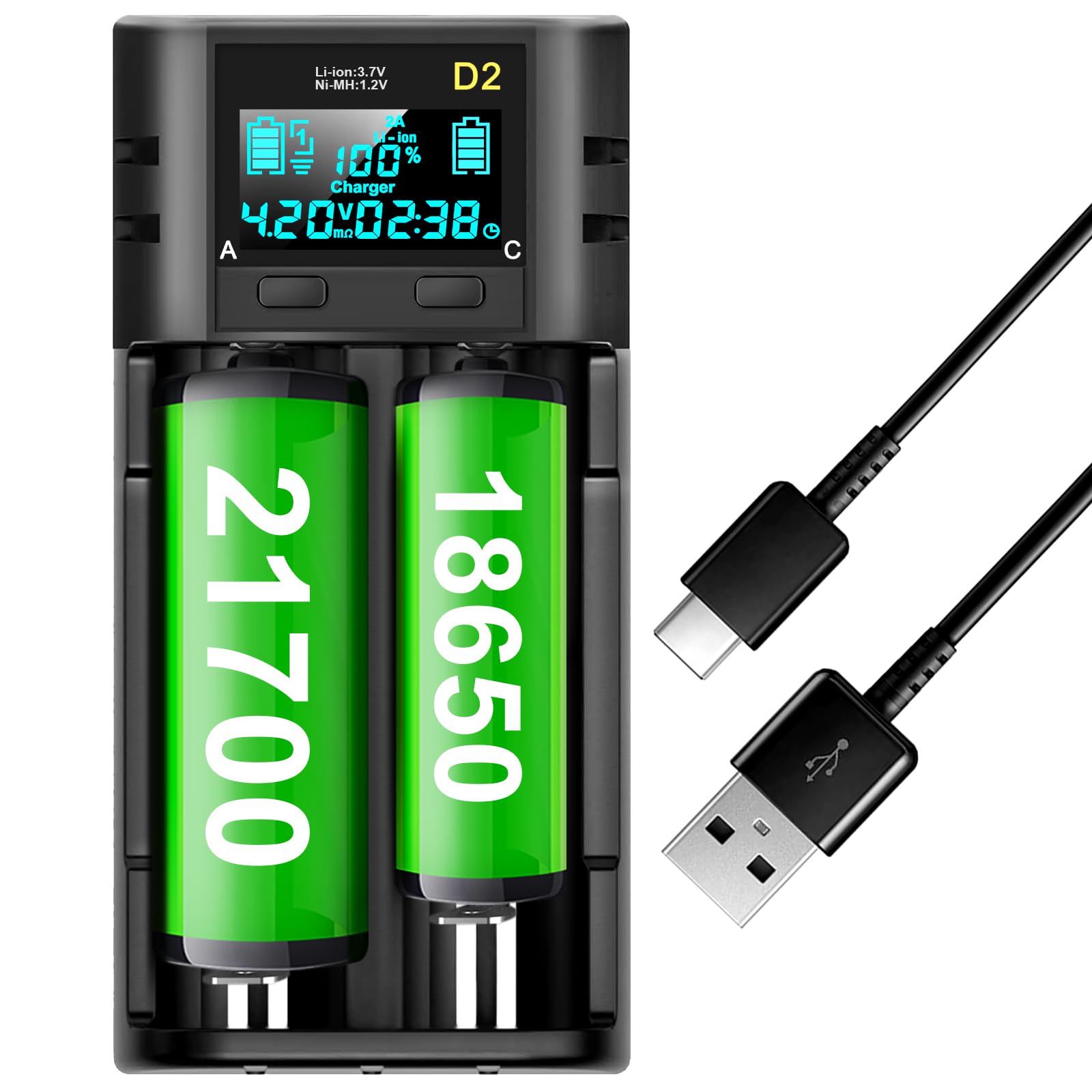
For users who prioritize precise control over charging parameters in a compact form factor, the Swanlake 2-bay charger is a standout. It allows you to manually select the charging current for lithium batteries between 0.5A, 1A, and 2A. This is incredibly useful for gently nursing low-voltage cells back to health or choosing the optimal speed for your battery’s health.
The LCD display is informative, showing voltage, current, time, and a power percentage. Its ability to automatically detect and switch between battery chemistries works reliably. As a dedicated two-bay unit, it’s perfect for a desktop where space is limited, or as a travel charger due to its smaller size.
If you don’t need multiple bays but want granular control over how your batteries are charged, this model offers a level of customization typically found in more expensive units.
Why it’s great
- User-selectable charging current (0.5A/1A/2A) for Li-ion.
- Compact and portable two-bay design.
- Clear, data-rich LCD display.
- Can often charge cells that other basic chargers reject.
Good to know
- Only two bays, limiting volume capacity.
- The adjustable current feature applies only to lithium batteries, not Ni-MH.
10. EBL Universal Charger
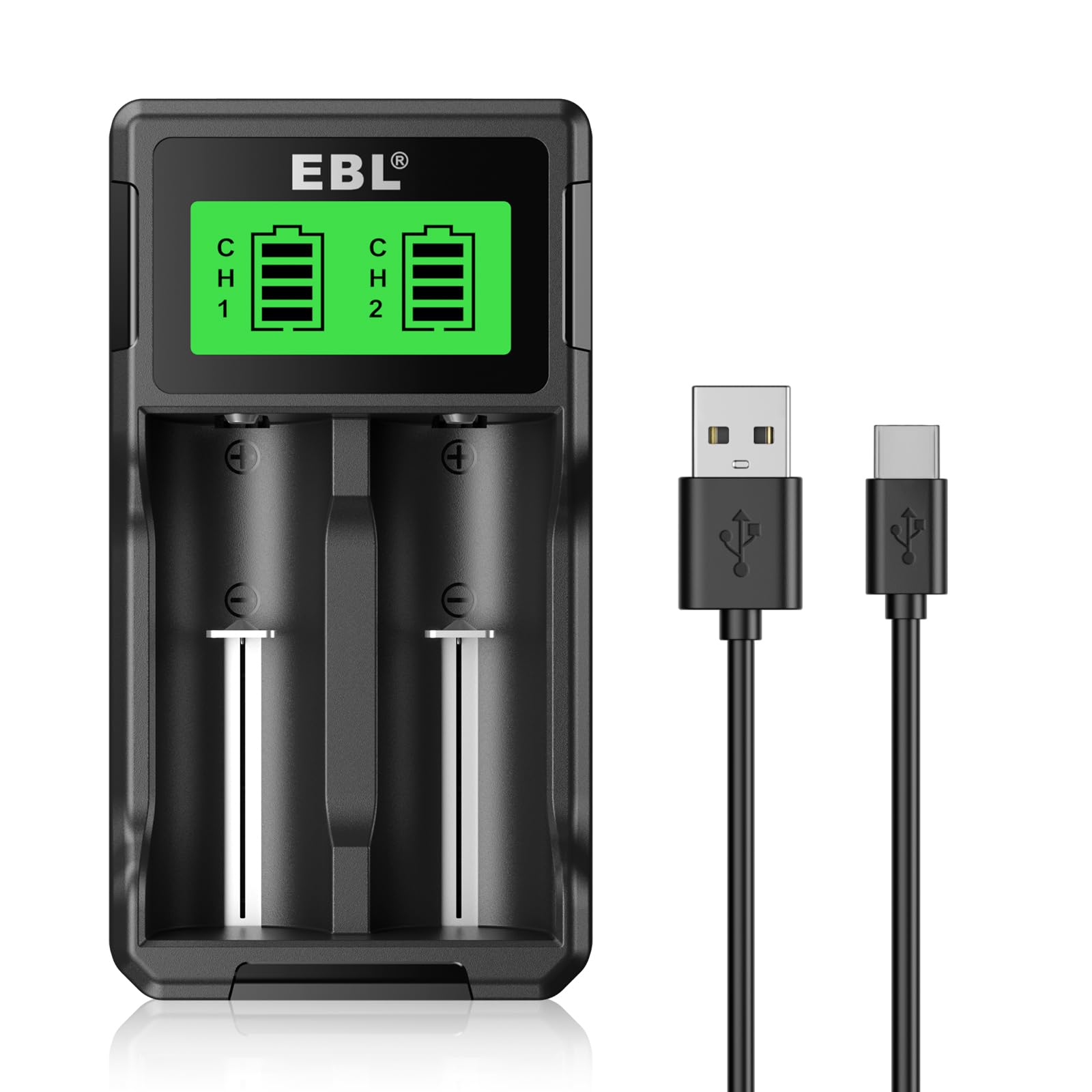
The EBL Universal charger is a classic entry-level model that excels at one thing: compatibility. It can charge an incredibly wide array of both 3.7V lithium-ion sizes and 1.2V Ni-MH/Ni-CD cells, from 10440 up to 26650 and from AAA up to C size. This makes it a versatile “first charger” for someone accumulating various battery-powered devices.
It offers a respectable 1000mA charging speed for Li-ion cells, which is faster than many basic chargers. The small LCD screen provides basic status information, and its Micro-USB powerprotection systems are in place for safety. Its compact size and budget-friendly nature make it a practical choice for casual users.
Why it’s great
- Exceptional compatibility with a huge range of battery sizes.
- Fast 1000mA charging for 3.7V Li-ion batteries.
- Compact and portable with a simple LCD display.
- An excellent entry point into universal charging.
Good to know
- Charging times for high-capacity cells can be long.
- Uses the older Micro-USB standard for power input.
- The sleds and sliders can feel a bit tight for larger batteries.
11. Yuntunele 2-Pack 18650 Batteries

This two-pack of 2500mAh button-top 18650 batteries serves a specific purpose: direct replacement for devices that require this form factor. Many flashlights, headlamps, and older electronic devices are designed for button-top cells, which have a small protruding positive terminal, making these batteries a necessary choice for compatibility.
With a mid-range capacity of 2500mAh, they offer a solid balance between runtime and value. Users report they hold a charge well and provide reliable performance for common applications. It’s critical to note that these are bare lithium-ion cells and must be charged using a compatible 18650 charger from this list—they are not a standalone product.
If you have a device that has stopped holding a charge and you’ve confirmed it requires a button-top 18650, this affordable two-pack provides a straightforward solution to get your gear back in action without overcomplicating the process.
Why it’s great
- Fills the specific need for button-top 18650 replacements.
- Provides two batteries, offering a backup or a pair for dual-cell devices.
- Mid-range capacity is sufficient for many common applications.
- Budget-friendly solution for reviving old devices.
Good to know
- Capacity is on the lower side compared to modern 3500mAh cells.
- No charger included—you must provide your own.
- As with all bare cells, proper handling and charging safety are paramount.
Understanding the Specs
Charging Current (mA/A)
This determines how fast a battery charges. A higher current (e.g., 2000mA or 2A) charges faster but may increase heat. Adjustable current lets you choose a gentler, slower charge (e.g., 500mA) to extend battery lifespan, which is ideal for smaller cells or maintaining health.
Input Voltage & Port
How you power the charger. USB (5V) is versatile, allowing use with power banks, laptops, or car adapters. USB-C is the modern standard. Some advanced chargers require a dedicated 12V DC adapter for full power, enabling higher charging currents and more simultaneous bays.
Protection Circuits
These are the electronic safeguards built into the charger. Essential ones include over-charge (stops at 4.2V), over-current, short-circuit, and reverse polarity protection. They prevent battery damage and are a critical line of defense for safe operation.
Battery Compatibility
Lists the physical sizes and chemical types a charger supports. Key terms: Li-ion (3.6V/3.7V), LiFePO4 (3.2V), and Ni-MH/Ni-CD (1.2V). Ensure your specific cell size (like 21700 or 16340) is listed. Note that some chargers don’t fit flat-top or protected batteries.
FAQ
Can I charge different battery types at the same time?
What does “0V activation” or “battery repair” mean?
How do I know if I need a button-top or flat-top 18650?
Is it safe to leave batteries in the charger after they’re full?
Final Thoughts: The Verdict
For most people, the best 3.7 v 18650 rechargeable batteries charger winner is the EBL PD4 because it delivers essential battery health insights like capacity testing at a mid-range price, perfectly bridging the gap between simple and professional. If you want professional-grade repair and analysis, grab the XTAR Dragon VP4L Plus. And for managing a large collection efficiently, nothing beats the 8-bay capacity of the XTAR VC8 Plus.

Mo Maruf
I created WellFizz to bridge the gap between vague wellness advice and actionable solutions. My mission is simple: to decode the research and give you practical tools you can actually use.
Beyond the data, I am a passionate traveler. I believe that stepping away from the screen to explore new environments is essential for mental clarity and physical vitality.