Our readers keep the lights on and my smoothie glass nicely filled. As an Amazon Associate, I earn from qualifying purchases.
Choosing the right 10 meter radio is less about the biggest box and more about matching robust engineering with your specific communication needs. The wrong choice can leave you with a weak signal, frustrating background noise, or a radio that simply doesn’t fit your vehicle. This guide cuts through the marketing to focus on the technical specifications and real-world performance that truly matter for clear, long-distance communication.
I’m Mohammad Maruf — the founder and writer behind WellFizz. My research focuses on dissecting complex product specifications and analyzing thousands of data points from user experiences to identify which features deliver tangible results, separating genuine innovation from mere gimmicks.
Our deep-dive analysis reveals the top performers that deliver exceptional clarity and power for your mobile or base station, ensuring you get the best 10 meter radio for your specific needs.
How To Choose The Best 10 Meter Radio
Selecting a 10 meter radio requires looking beyond simple wattage claims. The right model balances output power with receiver sensitivity, physical size, and a control layout that suits your operating environment, whether that’s a crowded truck cab or a home shack.
Power Output & Modulation Modes
Look at both Peak Envelope Power (PEP) and the supported modes. A radio with 40-60W PEP on Single Sideband (SSB) is ideal for long-distance “skip” communication, while a strong 12-25W AM signal is perfect for local trucker channels. FM offers the cleanest audio for local repeater use. A versatile radio offering all three modes (AM/FM/SSB) provides the greatest flexibility.
Receiver Performance & Noise Reduction
A powerful transmitter is useless if you can’t hear the reply. Advanced features like adjustable RX/TX Digital Noise Reduction (DNR) and a good Automatic Noise Limiter (ANL) are critical for filtering out engine whine and electrical interference, especially in a mobile installation. An “up-armored” or high-sensitivity receiver pulls in weaker signals that other radios might miss.
Form Factor & Installation
Consider where the radio will live. For modern vehicles with limited dash space, a compact or DIN-sized radio is essential. Ensure the microphone connector location (front or side) works for your mounting plan. Features like a multi-color, dimmable display enhance usability day and night without causing distraction.
Quick Comparison
On smaller screens, swipe sideways to see the full table.
| Model | Type | Best For | Key Feature | Amazon |
|---|---|---|---|---|
| Radioddity QT60 Pro | Mobile | Balanced Power & Features | 60W, Adjustable Noise Reduction | Amazon |
| AnyTone AT-5555N II | Mobile/Base | High-Performance Mobile | 60W PEP, Large LCD, NRC | Amazon |
| Radioddity QT80 | Base/Mobile | Maximum Output Power | 80W High Power, 7-Color Display | Amazon |
| Stryker SR-497HPC | Base Station | Premium Base Operations | 100+W PEP, 12-Color Display | Amazon |
| President Richard | Mobile | Feature-Rich Compact Radio | DIN Size, Digital SWR, USB Port | Amazon |
| Retevis HS4 | Base Station | Multi-Band Hams | 6 Bands, CW Mode, Cooling Fan | Amazon |
| AnyTone ARES II | Mobile | PC-Programmable Flexibility | Weather Band, Echo, VOX | Amazon |
| Stryker SR-447HPC2 | Mobile | Truckers Needing Compact Power | 55W+, 7-Color LED, Tough Build | Amazon |
| Radioddity QT40 | Mobile | Entry-Level with SSB | SSB Mode, Noise Reduction, NOAA | Amazon |
| President Ronald | Mobile | Simple, Reliable Communication | 50W PEP, 7-Color Display, Compact | Amazon |
| Stryker SR-94HPC | Mobile | Ultra-Compact Installation | Tiny Size, 45W+ PEP, TFT Display | Amazon |
In‑Depth Reviews
1. Radioddity QT60 Pro

The Radioddity QT60 Pro strikes an exceptional balance between accessible price and high-end performance, making it our top recommendation. It delivers a robust 60 watts of output power across SSB, AM, and FM modes, providing more than enough punch for serious long-distance communication while remaining manageable for mobile use. The large, user-friendly LCD screen presents all critical information clearly, minimizing distraction during operation.
Where the QT60 Pro truly excels is in its advanced noise handling. The customizable TX and RX digital noise reduction, with five adjustable levels, allows you to fine-tune the audio clarity to match your exact environment. This means you can effectively cancel out engine noise, alternator whine, and other interference that plagues mobile installations. The inclusion of an Automatic Squelch Control (ASQ) and comprehensive weather alerts with NOAA further enhances its utility for both hobbyists and practical applications.
Feedback from experienced operators consistently praises its “quietest receiver” capabilities, often noting it outperforms more expensive classic rigs in noisy environments. The build feels solid, the menu system is logical, and it comes PC-programmable for deep customization. For the operator who wants premium features like effective noise reduction, strong power, and a clear display without stepping into the highest price tier, the QT60 Pro is an outstanding and reliable choice.
Why it’s great
- Superior adjustable noise reduction cleans up both transmit and receive audio.
- Strong 60W output provides excellent range for its class.
- Intuitive large display and sensible control layout.
- Excellent value for the features and performance offered.
Good to know
- The channel selector knob can feel slightly loose to some users.
- PC programming cable is not included, required for advanced setup.
2. AnyTone AT-5555N II

The AnyTone AT-5555N II, often called the “Quad 5 N II,” is a favorite among serious operators who prioritize a clean signal and robust construction. It boasts a high 60-watt PEP output on SSB and AM, backed by a large, informative LCD panel that constantly displays useful metrics like live SWR. This radio is built on a reputation for durability and consistent performance, fitting the standard form factor of traditional mobile radios.
Its standout feature is the implementation of Noise Reduction Circuit (NRC) technology, which reviewers describe as a “total game changer.” This system dramatically reduces background hiss and static on receive, allowing you to copy distant and weak signals that would be buried in noise on other radios. The difference is so pronounced that users report making consistent contacts they simply couldn’t hear before. The transmitter audio is also known for being crisp and punchy, earning good reports on the air.
While it offers deep programmability via PC, many common adjustments are easily accessible through the front panel and microphone. It’s also famously straightforward to modify for expanded frequency coverage. For the operator who values a super-clean receiver, strong audio reports, and a no-nonsense, reliable build, the AT-5555N II represents a professional-grade tool in the mid-range category.
Why it’s great
- Industry-leading NRC noise reduction for exceptionally clear receive audio.
- High 60W PEP output and excellent transmitter audio quality.
- Large display with always-on SWR meter for antenna safety.
- Durable build quality with a proven track record.
Good to know
- Uses a proprietary 6-pin microphone connector, not the standard 4-pin.
- The menu system has a learning curve for new users.
3. Radioddity QT80

When your primary requirement is raw output power, the Radioddity QT80 stands at the top of the heap for non-amplified radios. With a staggering 80 watts of output, it provides the strongest possible signal punch straight from the radio itself, giving you a significant edge in breaking through pile-ups and reaching distant stations. Despite this power, it maintains a relatively compact chassis that can still work in a mobile environment with adequate power supply.
Beyond brute force, the QT80 is a fully-featured modern transceiver. It shares the excellent adjustable noise reduction system found in other Radioddity models, ensuring your powerful signal is also a clean one. The customizable 7-color LCD display allows you to match the radio’s look to your dashboard or shack aesthetics, and all essential controls are thoughtfully laid out. It also supports a wide range of modes including SSB, AM, FM, and PA.
Experienced hams note that this radio is essentially a rebadged Anytone AT-6666 Pro, a platform known for its stability and performance. It is also famously easy to modify for operation on additional amateur bands like 12 and 15 meters, adding tremendous value. If you operate in challenging signal environments or simply want the maximum legal power available without adding an external amplifier, the QT80 is the definitive choice.
Why it’s great
- Unmatched 80-watt output for the strongest possible barefoot signal.
- Easy hardware modification unlocks 12m and 15m bands.
- Customizable display colors and effective noise reduction.
- Solid construction in a surprisingly manageable size.
Good to know
- Requires a robust 13.8V power supply and proper wiring to handle the current draw.
- The high power output may not be necessary or desirable for strictly local communication.
4. Stryker SR-497HPC

The Stryker SR-497HPC is a legendary radio in the premium segment, known for its massive power output and iconic styling. With a peak power of over 100 watts PEP, it blurs the line between a transceiver and a small amplifier, offering unparalleled signal strength right from the main unit. Its large, traditional meter and prominent controls give it a classic “big radio” feel that is both functional and impressive on a base station desk.
This radio isn’t just about power; it’s packed with features for the discerning operator. The brilliant 12-color backlit front panel is highly customizable, and the “up-armored” receiver is designed to handle strong nearby signals without overload. It includes professional-grade features like variable talkback, dual digital echo controls, two selectable roger beeps, and a pre-wired jack for an external frequency counter. The automatic Antenna Warning Indicator (AWI) provides crucial protection against high SWR.
Owners report that, when properly set up, the SR-497HPC delivers stunningly clear and punchy audio that gets noticed on the air. Its build quality is rugged, and it carries the Stryker reputation for durability. For the operator who wants the ultimate in factory power, a classic aesthetic with modern lighting, and a no-compromise feature set for serious base station operation, this radio is a top-tier investment.
Why it’s great
- Extremely high 100+ watt PEP output for dominant signal presence.
- Classic, professional layout with a highly customizable 12-color display.
- Robust “up-armored” receiver handles strong signal environments well.
- Comprehensive features including AWI protection and echo controls.
Good to know
- Large physical size is best suited for base stations or large truck installations.
- Premium price tag reflects its position as a high-end performance tool.
5. President Richard

The President Richard packs a remarkable density of features into a compact, single-DIN sized chassis, making it the perfect solution for modern vehicles with limited dash real estate. Despite its small size, it doesn’t sacrifice performance, delivering a solid 50+ watts PEP. Its streamlined design houses a sophisticated menu-driven system that controls everything from RF power and modulation to echo and digital SWR metering.
This radio shines with thoughtful, practical features. The built-in digital SWR meter allows you to tune your antenna safely without extra equipment. A front-panel USB charging port is a modern convenience for powering devices on the go. It’s also compatible with both electret and dynamic microphones, giving you flexibility in your audio setup. The clean, uncluttered front panel belies the depth of adjustment available in its menus, where power can be adjusted up to impressive levels without ever opening the case.
Users love the Richard for its combination of a tiny footprint, strong output, and professional features like scanning and dual emergency channels. It receives high marks for clear audio on both transmit and receive. For the truck driver or mobile operator who needs a powerful, full-featured radio that fits seamlessly into a factory dashboard slot, the President Richard offers outstanding value and capability.
Why it’s great
- Perfect DIN-size form factor for easy installation in modern vehicles.
- Feature-packed with digital SWR meter, USB port, and extensive menus.
- Respectable 50W+ output from a very compact unit.
- Clean audio and good receiver sensitivity.
Good to know
- Uses a less common 6-pin microphone connector.
- Menu system requires consulting the manual for initial setup.
6. Retevis HS4
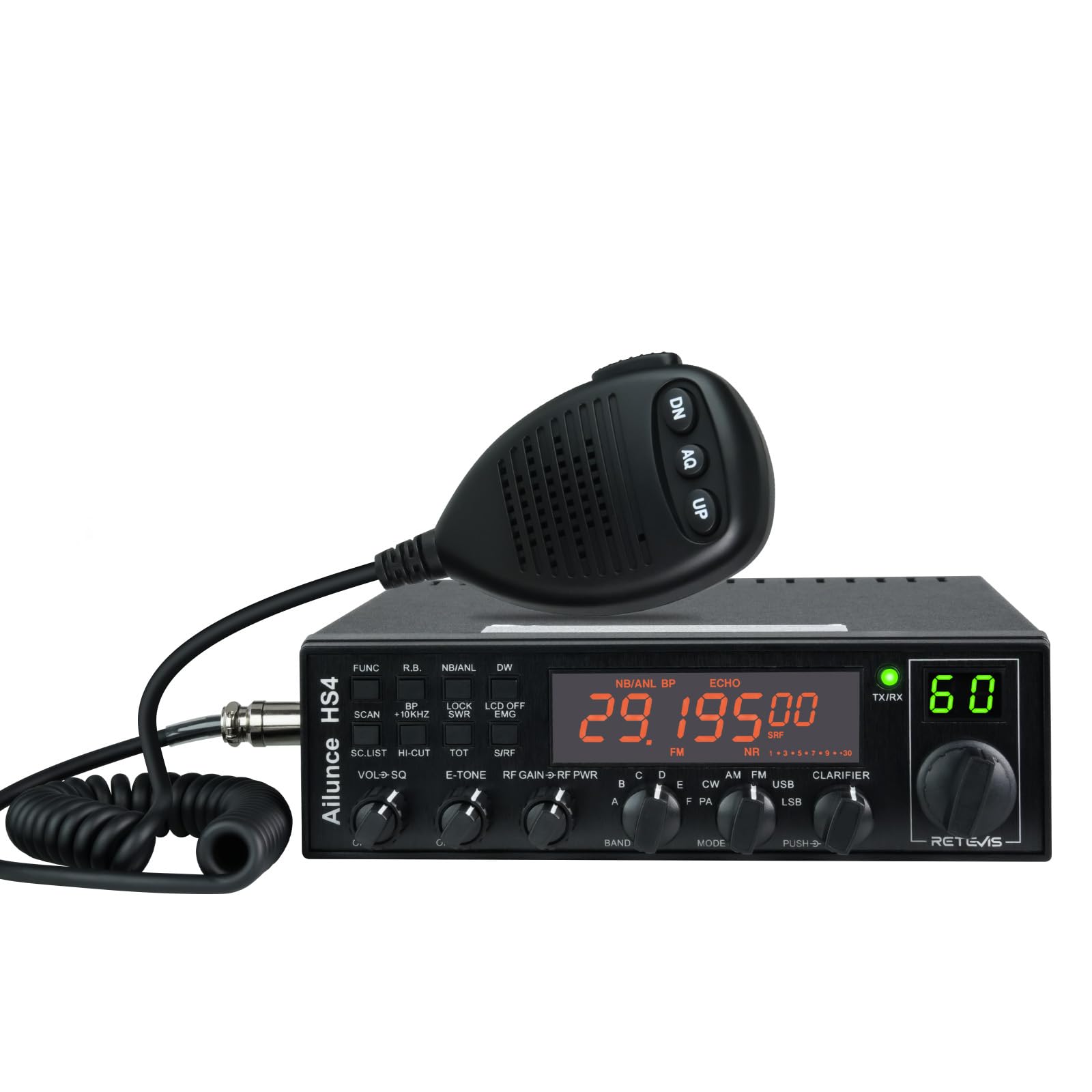
The Retevis HS4 is a compelling option for amateur radio operators who appreciate a traditional, full-control panel layout and multi-band capability. It features a large, easy-to-read LCD frequency display and a prominent VFO knob for smooth tuning, which will feel familiar and comfortable to any ham. Beyond the standard 10-meter band, its architecture supports easy expansion to other HF bands, offering great versatility from a single unit.
This radio is built with the ham in mind, including support for CW (Morse code) mode with an external key, a feature often omitted from more CB-centric export radios. It also includes a useful dual-watch function, allowing you to monitor two frequencies simultaneously. The built-in cooling fan ensures stable operation during long transmissions, making it suitable for extended contesting or net operation. The front panel is comprehensively laid out, giving direct access to most functions without diving into deep menus.
Owners report being impressed with the audio quality, build feel, and the sheer number of features offered for its price point. It provides a more “ham radio” experience compared to some other exports, with its band selections, CW mode, and classic interface. For the licensed amateur or aspiring general class licensee who wants a capable, multi-mode HF mobile rig that starts on 10 meters, the HS4 is a fantastic and cost-effective platform.
Why it’s great
- Classic ham radio interface with VFO knob and large display.
- Supports CW mode for Morse code operation.
- Multi-band capable with six programmable band memories.
- Includes a cooling fan for sustained high-power operation.
Good to know
- Larger physical size is more suited for base or large mobile installations.
- May have more features than a casual operator needs.
7. AnyTone ARES II

The AnyTone ARES II is a software-defined radio at heart, offering immense flexibility through its PC programming interface. While it delivers solid mid-range power (40W FM, 12W AM, 35W SSB), its true strength lies in its customizability. You can program not only the 10-meter frequencies but also a wide range of receive-only frequencies, such as VHF weather bands and even local public service channels (where lawful).
This makes the ARES II a versatile companion. You can have one bank of channels for 10-meter ham communication, another for monitoring NOAA weather alerts, and others for listening to local activity. The radio features both transmit and receive digital noise reduction, an echo function, VOX for hands-free operation, and CTCSS/DCS tone capabilities. The microphone includes up/down buttons for controlling the radio, adding convenience.
Users who enjoy tinkering and tailoring their gear will appreciate the depth of the ARES II’s software. It allows fine-grained control over functions like power output, scan lists, and display options. While its out-of-the-box performance is good, its potential is unlocked on the computer. For the tech-savvy operator who wants one radio to handle both transmitting and sophisticated monitoring, the ARES II is a uniquely adaptable tool.
Why it’s great
- Highly programmable via PC for both transmit and wideband receive.
- Can monitor weather channels and other VHF/UHF frequencies.
- Includes useful features like VOX, echo, and noise reduction.
- Good value for a software-defined feature set.
Good to know
- Maximum power output is lower than some competitors in its class.
- Requires time and a computer to fully explore its capabilities.
8. Stryker SR-447HPC2

The Stryker SR-447HPC2 is a heavy-duty compact radio built to deliver reliable power in the demanding environment of a commercial truck. It generates a solid 55+ watts PEP from a chassis that’s significantly smaller than a full-sized export radio, designed to fit in the standard radio slot of many semi-trucks. Its construction feels rugged, with a focus on durability and heat dissipation via a wrap-around cast aluminum heat sink.
This model includes Stryker’s signature flair with a brilliant 7-color LED-backlit faceplate that can be set to a static color or left to cycle through the spectrum. Controls are straightforward and include variable power and talkback, along with dual front-mounted controls for the digital echo. The “up-armored” receiver provides good adjacent channel rejection, helping to minimize interference from nearby strong signals, a common issue on the road.
Truck drivers and mobile operators praise the SR-447HPC2 for its combination of size, power, and toughness. It’s a radio that gets the job done without unnecessary complexity, offering the core features needed for clear communication and a strong signal. If you need a no-nonsense, compact workhorse that can withstand the vibrations of the road and fit where a bigger radio can’t, this Stryker is an excellent and proven choice.
Why it’s great
- Compact, rugged design built for mobile durabilityand a loud, clear receiver.
Good to know
- Lacks Single Sideband (SSB) mode, which some long-distance operators prefer.
- The squelch control placement may be less convenient for some users.
9. Radioddity QT40

The Radioddity QT40 is an excellent entry point into the world of Single Sideband (SSB) operation without a steep investment. It provides a full 40 watts of power and supports AM, FM, USB, and LSB modes, giving new operators the tools to explore the greater efficiency and range of sideband communication. Its retro-styled chassis houses modern technology, including digital noise reduction for both transmit and receive.
This radio is praised for its sensitive receiver and clean, punchy audio from the stock microphone. The inclusion of a USB programming cable in the box is a significant plus, allowing you to easily set up memories, adjust settings, and enable features like the NOAA weather alert function directly from your computer. The front panel layout is intuitive, with a clear signal meter and all essential controls like RF gain and squelch readily accessible.
For CB users looking to upgrade, the QT40 is frequently mentioned as a fantastic step up. It offers more power and the clarity of SSB, which can dramatically increase your reach during good band conditions. The learning curve is manageable, and the community support for programming and modification is extensive. If you’re ready to move beyond AM and want a capable, well-featured SSB radio at an accessible price point, the QT40 is a standout choice.
Why it’s great
- Affordable introduction to SSB operation with solid 40W power.
- Includes USB programming cable for easy software customization.
- Effective noise reduction and NOAA weather alerts.
- Sensitive receiver and good audio quality out of the box.
Good to know
- Power output is lower than some larger mid-range models.
- The retro style may not appeal to all users.
10. President Ronald

The President Ronald is a straightforward, no-fuss 10 meter radio that delivers reliable performance in a compact package. It puts out a honest 50 watts PEP, providing a noticeable power advantage over standard CB radios while maintaining a simple control scheme that will feel familiar to any user. The 7-color display is easy to read and adds a touch of personalization without overwhelming complexity.
This radio focuses on the essentials: clear AM and FM communication, a functional automatic squelch, and a decent built-in speaker. Its smaller size compared to full-width radios makes it easier to install in tight spaces in modern vehicles. User reviews consistently highlight its clean transmit audio and the fact that it often performs at or above its rated power with simple menu adjustments, making it a trustworthy workhorse.
For someone who wants a step up in power from a basic CB but doesn’t need the extensive bells and whistles of a menu-driven export radio, the Ronald is a perfect fit. It’s a plug-and-play option that emphasizes core performance and reliability. It’s an ideal choice for truckers, RVers, or anyone who needs effective, powerful communication without a complicated setup process.
Why it’s great
- Simple, reliable operation with solid 50W PEP output.
- Compact size suitable for dash or console mounting.
- Clean audio and good receive sensitivity for its class.
- Straightforward interface ideal for users who prefer simplicity.
Good to know
- Lacks SSB mode and more advanced features like noise reduction.
- Display and control options are more basic than some competitors.
11. Stryker SR-94HPC
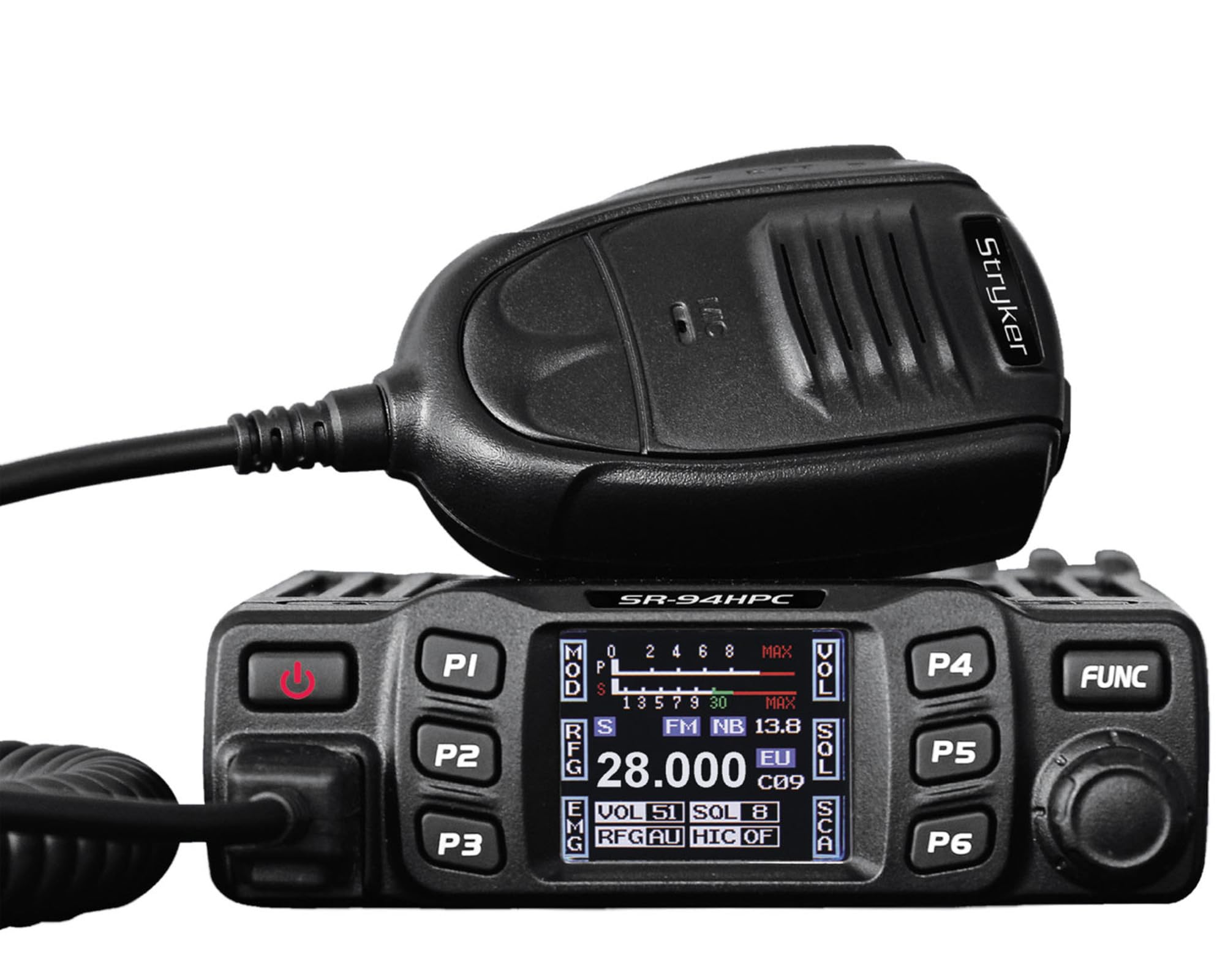
The Stryker SR-94HPC is a marvel of miniaturization, packing surprising power into one of the smallest 10 meter radio chassis on the market. Measuring just about 5.8 by 4.8 inches, it can be installed in center consoles, under seats, or in other tight spaces where a traditional radio would never fit. Despite its size, it utilizes quality components like three FQP13N10 final transistors to generate a robust 45+ watts of PEP.
Its standout feature is the brilliant full-color TFT display, which is remarkably sharp and configurable. You can choose to show frequency, power output, SWR, supply voltage, or S-units, making it a highly informative tool despite its small footprint. The wrap-around cast aluminum heat sink does an excellent job of managing thermals, ensuring stable performance during long transmissions. It also features SWR protection to safeguard the radio.
This radio is perfect for the operator with a modern vehicle who wants high performance without a bulky radio dominating the cabin. It’s a favorite for discreet installations. While its small knobs might take some getting used to, its powerful output and excellent display clarity make it a unique and highly capable solution for space-constrained mobile operations.
Why it’s great
- Extremely compact size allows for creative and discreet installations.
- Full-color TFT display is exceptionally clear and information-rich.
- Produces impressive power for its physical dimensions.
- Effective heat dissipation design for a small package.
Good to know
- Very small control knobs may be difficult to adjust while driving.
- The menu system is comprehensive but can be complex due to the small interface.
Understanding the Specs
PEP vs. Dead Key
Peak Envelope Power (PEP) is the maximum instantaneous power your radio can produce on voice peaks, crucial for SSB and for the perceived “punch” of an AM signal. The “dead key” is the steady carrier power an AM radio puts out when you key the mic without speaking. A good radio has a high PEP swing from a moderate dead key for clear, efficient communication without overdriving.
Noise Reduction (NR, DNR, NRC)
This is a digital signal processing feature that actively analyzes incoming audio and filters out constant background noise like engine static or alternator whine. Adjustable levels let you balance noise suppression with audio naturalness. Advanced systems also apply processing to your transmitted audio, ensuring you sound clearer to others in noisy environments.
FAQ
Do I need a license to operate a 10 meter radio?
Can these radios be used on CB channels?
What is the most important accessory for a 10 meter radio?
What is the difference between AM, FM, and SSB?
Final Thoughts: The Verdict
For most people, the best 10 meter radio winner is the Radioddity QT60 Pro because it masterfully balances strong 60-watt power, exceptional adjustable noise reduction, and an intuitive interface at a compelling mid-range point. If you want the absolute maximum output in a manageable package, grab the Radioddity QT80. And for a feature-packed radio that disappears into your dashboard, nothing beats the President Richard.

Mo Maruf
I created WellFizz to bridge the gap between vague wellness advice and actionable solutions. My mission is simple: to decode the research and give you practical tools you can actually use.
Beyond the data, I am a passionate traveler. I believe that stepping away from the screen to explore new environments is essential for mental clarity and physical vitality.