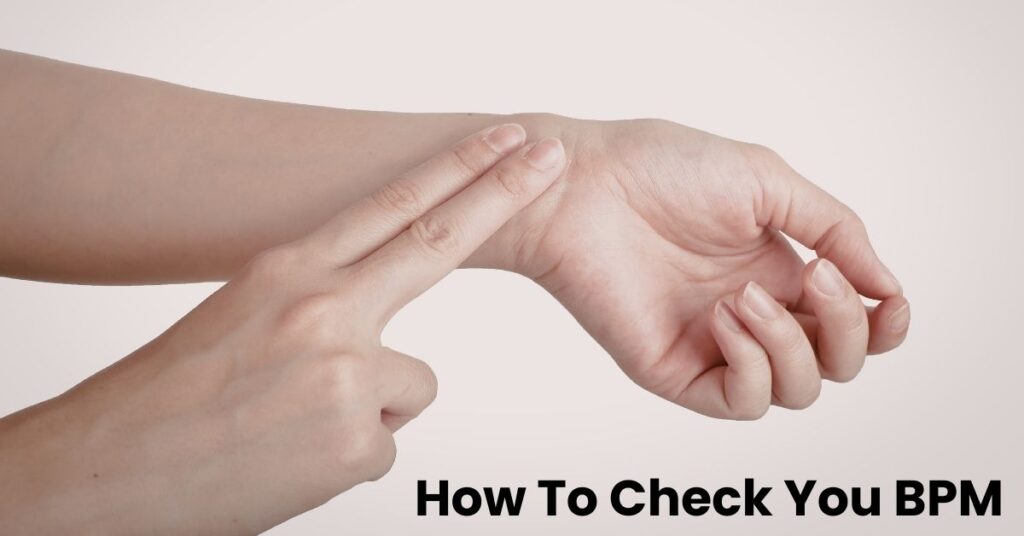
To check BPM, feel your pulse with two fingers and count beats for 60 seconds, or count 15 seconds and multiply by four.
If you’ve ever felt your heart thump after a sprint, a stressful email, or a strong cup of coffee, you’ve already met BPM. It’s a simple count: how many times your heart beats in one minute. Learning how to check you bpm gives you a quick read on effort during exercise, a calm baseline at rest, and a clean way to spot changes that don’t match how you feel.
This article walks through hands-on ways to measure BPM, when to measure it, how to avoid bad readings, and how to track the number so it stays useful.
What BPM Means And When It’s Worth Checking
BPM stands for beats per minute. That’s it. Yet the context around the number matters. A reading taken right after climbing stairs tells a different story than a reading taken while seated and calm.
Most people check BPM for one of three reasons:
- Resting baseline: a steady number you take under similar conditions, often in the morning before you get moving.
- Workout effort: a quick check during training to see if you’re working in the range you meant to hit.
- Symptom check: a reading when you feel a flutter, racing, dizziness, or fatigue that’s out of character.
| Method | Best Time To Use It | Common Slip-Up |
|---|---|---|
| Wrist pulse, count 60 seconds | Resting BPM and calm checks | Pressing too hard and losing the pulse |
| Wrist pulse, 15 seconds × 4 | Quick checks during exercise | Rounding the count or starting late |
| Neck pulse, 30 seconds × 2 | When wrist pulse is hard to feel | Using the thumb (it has its own pulse) |
| Manual count with a metronome app | Keeping a steady count cadence | Following the beat, not the pulse |
| Chest strap heart-rate monitor | Intervals, cycling, and HIIT sessions | Dry strap contact leading to dropouts |
| Wrist wearable (optical sensor) | Day-to-day trends and easy logs | Loose fit causing spikes or gaps |
| Phone camera pulse apps | Occasional spot checks | Cold fingers or movement skewing results |
| Apical pulse (stethoscope on chest) | Clinical settings or training practice | Hard to do solo without practice |
How To Check You BPM With Your Fingers
This is the cleanest method for most people. You’re measuring the pulse wave in an artery. The wrist is usually easiest.
Step-By-Step Wrist Pulse Check
- Sit down and relax your arm on a table, palm up.
- Place the tips of your index and middle fingers on the inside of the opposite wrist, below the base of the thumb.
- Press lightly until you feel a steady tap. If you press hard, the tap can fade.
- Use a clock with seconds. Count each tap for 60 seconds.
MedlinePlus shows the same wrist placement and counting options, including the 15-second method for a faster read; see MedlinePlus “How to take your wrist pulse”.
Fast Counts For Real-Life Moments
Counting a full minute is the best way to cut math errors. Still, there are times you want a fast number, like mid-run or right after a set. Two shortcuts are common:
- 15 seconds × 4: count the beats you feel in 15 seconds, then multiply by four.
- 30 seconds × 2: count for 30 seconds, then multiply by two.
If your beat feels uneven, stick with 60 seconds. Short windows can miss a pattern.
Neck Pulse Option
If your wrist pulse is faint, try the neck. Place two fingers in the groove next to your windpipe, just under the jawline. Press gently. Count the beats the same way.
Use one side of the neck at a time. Pressing both sides can make you feel lightheaded.
Checking Your BPM At Home Without Guesswork
A good reading starts before you touch your wrist. Small choices can shift the number and make a calm day look like a hard day.
Pick A Consistent Moment
If you want a resting baseline, aim for a repeatable routine. Many people do it soon after waking, before caffeine, before a shower, and before scrolling the phone. Sit quietly for a minute, then count.
Warm Hands, Still Body
Cold fingers tighten blood vessels and can hide the pulse. Rub your hands together or run them under warm water, then dry them and try again. Keep your arm still and steady on a table so you’re not chasing the beat.
Repeat And Use The Middle Value
One reading can be a blip. Take three counts, each one minute apart, and write down the middle number. This trims out a single odd count without needing math averages.
How To Check Your BPM During Workouts
Workout checks are about effort, not perfection. Your goal is a number that’s close enough to guide pacing.
Pick The Right Time Window
Heart rate changes fast after you stop moving. If you’re doing a running interval, count while walking, not after you’ve stood still for a minute. If you’re lifting, check between sets before your breathing fully settles.
Use A Target Range, Not A Single Number
Workout heart rate is usually used as a range. The American Heart Association shares a simple table for target zones by age and intensity in its Target Heart Rates Chart. Use it as a starting point, then adjust based on how you feel and what your training calls for.
Manual Check Versus Wearables
Wrist wearables use light to sense blood flow near the skin. They’re handy for trends across days. Chest straps read electrical signals and tend to hold steady during intervals. If you see spikes that don’t match your effort, tighten the watch band, wipe sweat from the sensor area, or switch to a chest strap for that session.
Common Mistakes That Make BPM Readings Go Sideways
Most bad readings come from the same few habits. Fixing them is easy once you know what to watch for.
Using Your Thumb
Your thumb has its own pulse. If you use it to feel someone else’s pulse, you can count your own beat by accident. Stick with index and middle fingers.
Counting The Clock, Not The Beat
When you’re distracted, you can drift into counting seconds instead of taps. Use a timer that beeps at 15 or 30 seconds, or trace each tap with a tiny finger movement so you stay locked in.
Pressing Too Hard
If you mash the artery, the pulse wave can vanish. Ease up until the beat returns. You want contact, not pressure.
Measuring Right After A Trigger
Caffeine, nicotine, a hot shower, and a stressful moment can push BPM up for a while. If your goal is a baseline, wait until you’re calm and seated.
What Your Number Can Tell You Over Time
A single BPM value is a snapshot. A log is a story. Tracking helps you spot drift, see how sleep and hydration show up in your body, and notice when training is paying off.
Simple Logging That Stays Useful
- Write the date and time.
- Note the position: seated, lying down, standing.
- Note the context: just woke up, post-workout, feeling unwell.
- Record the method: wrist 60s, 15s × 4, wearable, chest strap.
After two weeks, patterns start to show. After two months, you’ll often know your normal range without looking it up.
Resting Range Basics
Many sources cite a resting range of 60 to 100 beats per minute for adults, with trained athletes often lower. Kids run higher. The number matters less than whether it fits your usual pattern and your symptoms.
| Pattern You See | Common Non-Emergency Reasons | Next Step |
|---|---|---|
| Resting BPM higher than your norm for several days | Poor sleep, dehydration, extra training load, illness | Rest, hydrate, recheck at the same time next day |
| Resting BPM lower than your norm with no symptoms | Improved fitness, more rest, calmer routine | Keep logging and note how you feel |
| Sudden high BPM with fever | Fighting an infection | Focus on fluids and rest, track temperature |
| Fast BPM with chest pain, fainting, or severe shortness of breath | Could be serious | Seek urgent medical care |
| Irregular beat you can feel, even at rest | Extra beats, anxiety, medication effects | Write down timing and triggers, talk with a clinician |
| Wearable shows spikes but manual count feels steady | Sensor fit or motion artifact | Adjust fit, clean sensor, compare again |
When A BPM Check Should Lead To Medical Care
Most odd readings have simple causes. Still, there are moments when a BPM check is a “stop and get help” signal.
Go Now If Any Of These Show Up
- Chest pain or pressure.
- Fainting, near-fainting, or sudden weakness.
- Severe shortness of breath that’s new for you.
- A fast heart rate that won’t settle after rest.
Book A Check-In If This Keeps Happening
- Repeated resting BPM above your usual range for weeks.
- Repeated irregular beats you can feel, even when calm.
- Dizziness, fatigue, or breathlessness paired with a number that seems out of character.
Bring your log. A short list of dates, times, and readings can make the visit far more productive.
Practical Tips To Get Better Numbers Each Time
These small habits make BPM checks faster and cleaner.
- Use the same fingers and the same spot. You’ll find the pulse quicker with repetition.
- Count out loud. It keeps you on track when the beat is fast.
- Use a timer. A stopwatch removes guesswork on start and stop.
- Log right away. You won’t remember the exact number an hour later.
- Recheck after two minutes. If the first reading surprises you, a second read often clears it up.
Once you’ve done it a handful of times, how to check you bpm stops feeling like a task and starts feeling like a quick glance at a dashboard.
References & Sources
- MedlinePlus (U.S. National Library of Medicine).“How to take your wrist pulse.”Shows finger placement and counting options for measuring pulse rate.
- American Heart Association.“Target Heart Rates Chart.”Lists target heart-rate zones by age and activity intensity.

Mo Maruf
I created WellFizz to bridge the gap between vague wellness advice and actionable solutions. My mission is simple: to decode the research and give you practical tools you can actually use.
Beyond the data, I am a passionate traveler. I believe that stepping away from the screen to explore new environments is essential for mental clarity and physical vitality.