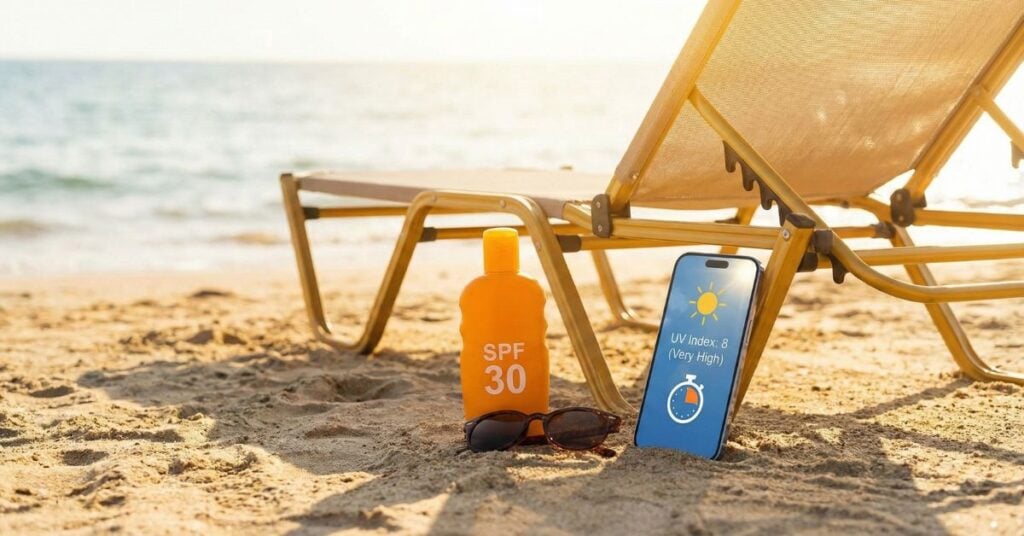
At UV Index 8, a light tan can show in 10–20 minutes for some people, while pale skin may turn pink in 5–15 minutes.
People type “UV-8” when they mean a UV Index reading of 8. It’s not a tanning-bed level. It’s a public number that sums up the strength of the sun’s UV rays where you are, right then.
That’s why there isn’t one universal minute mark. Your skin tone, how much bare skin you show, the time of day, and even what you’re standing near can change the outcome fast.
Below you’ll get a plain way to estimate your own window at UV 8, plus safer options when you want color without stacking UV on your skin.
How Long Does It Take To Tan In UV-8? Timing Ranges You Can Start With
UV Index 8 is strong enough that the first visible change for many people is not a tan. It’s warmth, then tightness, then pink. A tan is your skin’s pigment response to UV stress, and that deeper shade can keep developing after you’ve already gone indoors.
Use these starter ranges as a cautious baseline. They assume midday sun, no sunscreen, and large areas of exposed skin.
- Pale skin that burns fast: pinkness can show in 5–15 minutes; a tan may be faint or delayed.
- Medium skin that sometimes burns: a light tan may show in 15–35 minutes; pinkness can start in 15–25 minutes.
- Deep skin that rarely burns: a tan can show in 25–60 minutes; redness can still happen, just later and less obvious.
If you’ve ever burned on a day like this, treat your first session as a short “test,” not a goal. Set a timer and stop before any pink shows up.
Why Your Tan Clock Changes From One Person To The Next
Two friends can share the same towel and still get different outcomes. The sun is only part of the story.
Skin Tone And Pigment Response
Dermatology often groups skin into Fitzpatrick types I through VI based on how it tends to burn or tan. Lighter types can redden fast and may not tan much before they burn. Deeper tones can tan with less visible redness, yet UV can still injure skin cells even when you don’t see a burn.
Time Of Day And Altitude
UV Index 8 often shows up near midday. It can also appear earlier or later at higher elevations. If you’re hiking or skiing, cut your time down even when the air feels cool.
Reflected UV From Bright Surfaces
Water, sand, pale pavement, and snow can bounce UV back onto your face and body. That extra exposure can sneak up on you because it doesn’t feel like “stronger sun.” It just adds more rays to the same minute.
Clouds And Shade
Thin clouds can still let a lot of UV through. Shade helps, yet it isn’t a full shield because scattered rays can reach you from the sides. Treat shade as a way to slow down the dose, not erase it.
Sunscreen And Clothing
Broad-spectrum sunscreen slows tanning and slows burning. That’s the job. Clothing can do even more: a tightly woven shirt, sunglasses, and a brimmed hat cut UV without needing reapplication.
Set Up A Safer Outdoor Session At UV 8
If you’re going to be outside while the UV Index sits at 8, treat time like a budget. Spend it in short blocks, take breaks, and stop early when your skin starts to feel warm.
Check The Hourly UV Where You Are Standing
Use a weather app with an hourly UV chart. UV can climb fast from late morning through early afternoon, then fall again. The CDC sun safety notes also point out that UV can reach you on cloudy days and can reflect off water, sand, snow, and concrete.
Apply Sunscreen Like You Mean It
Use a broad-spectrum sunscreen and put it on dry skin. Spread it over each exposed patch, not just the spots you think will burn. Give it time to set before you step into sun.
Use A Timer And Keep The First Block Short
At UV 8, your first block should be small. Five to ten minutes can be plenty, especially if you burn easily. Rotate your body so you don’t cook one side while the other stays pale.
Take Shade Breaks On Purpose
Shade slows the dose, yet it doesn’t block all rays. Still, it gives your skin time to cool and makes it easier to notice early pinkness before it turns into a full burn.
Reapply After Swimming Or Heavy Sweat
Water and sweat can thin sunscreen and create patchy burns. Towel off, then reapply. If you’re out for a while, set a repeating reminder so you don’t lose track.
What UV Index 8 Means On Public Charts
The UV Index is a scale built to help people judge sun strength at a glance. It doesn’t tell you how long it takes to tan. It tells you how fast UV can affect unprotected skin and eyes, so you can plan shade, clothing, and sunscreen.
If you want to see how the scale is defined, these two pages are a solid starting point: WHO UV Index Q&A and EPA UV Index scale. UV Index 8 sits in the 8–10 range, where unprotected skin can change fast.
One more thing: UV Index is not the same as heat. A breezy 22°C day can still bring a harsh UV reading. Your skin reacts to rays, not air temperature.
Once you’ve got the basics in place, the next step is spotting the factors that shift your dose up or down even when the UV Index reads the same.
| Factor | How It Changes UV Dose | What Helps |
|---|---|---|
| Skin type (burn vs tan) | Sets how fast redness and pain can appear | Start with the shortest timer if you burn fast |
| Midday sun | Raises UV per minute even when air feels cool | Shift outdoor time earlier or later when you can |
| Altitude | Thinner air can mean more UV reaching your skin | Cut time down on hikes, slopes, and high lookouts |
| Water or sand nearby | Adds reflected rays onto face, chest, and legs | Use shade breaks and wear a hat and sunglasses |
| Snow or pale pavement | Bounces light upward toward chin, nose, and eyes | Protect the face and use lip balm with SPF |
| Light cloud layer | Can hide how strong the rays still are | Follow the UV number, not the sky color |
| Shade with side light | Scattered rays still reach exposed skin | Pair shade with clothing and sunscreen |
| Water time and sweat | Strips sunscreen and leads to uneven exposure | Reapply after toweling off and set reminders |
| Recent sun exposure | Stressed skin can redden faster the next day | Take rest days and use sunless color options |
A tan is UV stress showing on your skin. The FDA risks of tanning page notes that a tan doesn’t block UV harm.
Signs You’ve Had Enough Sun For The Day
Tanning goals can blur your judgment. Your skin gives clues when you’re past your best stop time. When you spot any of these, get out of direct sun.
- A hot or prickly feel, even with a breeze.
- Pink lines from straps, seams, or a watch.
- Patchy redness on the nose, ears, shoulders, or tops of feet.
- Itching that starts in the sun and lingers after you go inside.
Once you’re done, take a lukewarm shower, pat dry, then moisturize. Skip hot tubs and scrubs that night.
UV 8 Timing By Fitzpatrick Skin Type
The table below gives starter windows at UV Index 8. It is not a promise, and it is not a target. It’s a way to choose a conservative stop time and avoid “just a few more minutes.”
| Fitzpatrick Type | Light Tan May Show | Pinkness Can Start |
|---|---|---|
| I (pale, burns) | Often none before redness | 5–10 min |
| II (fair, burns easily) | 15–25 min | 10–15 min |
| III (medium, may burn) | 20–35 min | 15–25 min |
| IV (olive, seldom burns) | 25–45 min | 20–35 min |
| V (brown, rarely burns) | 35–60 min | 30–50 min |
| VI (deep brown, rarely burns) | 45–75 min | 40–70 min |
Color Options That Skip UV
For a bronzed look without extra UV, go sunless and keep sunscreen for outdoor time.
Self-Tanners
DHA lotions and mousses tint the outer skin layer. Exfoliate the day before, moisturize knees and elbows, apply with a mitt, then wash hands.
Bronzing Drops And Body Makeup
These wash off with soap. They’re handy when you want a one-night shade boost without any extra sun time.
Spray Tans
Pick a tech who matches undertones. Wear loose clothes after and follow rinse timing.
When To Skip Outdoor Tanning Plans
If any item below fits you, choose shade and sunscreen, or go sunless.
- You had a blistering burn in the last week.
- You use acne meds, retinoids, or antibiotics that list sun sensitivity.
- You have a new or changing mole, a sore that won’t heal, or a sun-triggered rash.
- You’re planning sun time for a child or teen.
If you’re unsure about a medicine or skin condition, read the label and ask a clinician.
UV 8 Day Checklist
Keep this list on your phone for UV 8 days.
- Check the hourly UV number before you head out.
- Pick a stop time that’s shorter than your last burn-free day.
- Apply broad-spectrum sunscreen on dry skin, then wait 15 minutes.
- Bring sunglasses and a brimmed hat.
- Set a timer for shade breaks and sunscreen reapplication.
- End the session when your skin feels warm. Don’t bargain with the sun.
- Afterward, cool down, hydrate, and moisturize.
UV Index 8 can change skin fast. Treat it as a limit and stop early.
References & Sources
- World Health Organization (WHO).“Radiation: The Ultraviolet (UV) Index.”Defines the UV Index and what the numbers mean for planning sun time.
- U.S. EPA.“UV Index Scale.”Lists UV Index ranges and the type of protection suggested at higher readings.
- Centers for Disease Control and Prevention (CDC).“Sun Safety Facts.”Notes when UV tends to be strongest and that UV can reflect off common surfaces.
- U.S. Food and Drug Administration (FDA).“The Risks of Tanning.”Summarizes tanning risks and states that a tan does not block UV harm.

Mo Maruf
I created WellFizz to bridge the gap between vague wellness advice and actionable solutions. My mission is simple: to decode the research and give you practical tools you can actually use.
Beyond the data, I am a passionate traveler. I believe that stepping away from the screen to explore new environments is essential for mental clarity and physical vitality.