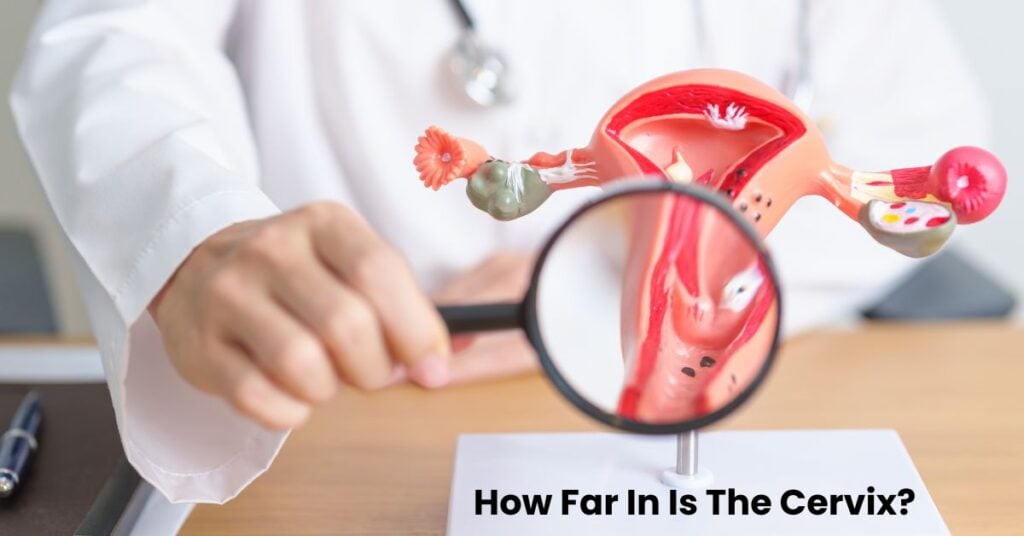
In many bodies, the cervix is 7–10 cm from the vaginal opening, and it shifts with arousal and the menstrual cycle.
If you’ve ever wondered how far you need to reach to find your cervix, you’re not alone. People ask this when placing a tampon or menstrual cup, checking IUD strings, tracking cycle patterns, or just getting a clearer map of their anatomy.
There isn’t one fixed number. The cervix sits at the top of the vaginal canal, yet the “reach” can change across the month, with arousal, and with body position.
Where The Cervix Sits
The cervix is the lower end of the uterus that opens into the vagina. It’s the doorway between the uterus and the vaginal canal. The vaginal canal is a muscular tube that can change length and angle. A clinical medical terminology text describes it as a canal that can be around ten centimeters long, with its upper end meeting the cervix.
Why A Diagram Can Mislead Your Fingers
Most diagrams show the cervix and vagina as straight lines. In real life, the vagina has folds, and the walls rest together when you’re not aroused. Your finger also follows an angle, not a ruler-straight path.
The cervix can tilt forward or back, and the angle of the canal shifts when you squat, sit, or lie down. So the reach depends on distance and direction.
How Far In Is The Cervix? Practical Distances By Situation
Clinical sources give a broad range because bodies vary. Cleveland Clinic places the cervix anywhere from 3 to 6 inches inside the vaginal canal. In metric units, that’s about 7.6 to 15.2 cm from the vaginal opening.
MedlinePlus also states that the cervix sits at the top of the vagina and notes that the cervix itself is about 2.5 to 3.5 cm long. That length is the cervix, not the full reach from the opening, but it helps explain why you feel a firm “end point” when you touch it.
What Can Shift The Reach
Cycle timing. Cleveland Clinic notes that the cervix can change location and texture across the menstrual cycle. Arousal. With arousal, the vagina can lengthen and the cervix can lift upward. Body position. Squatting or lying back can change the angle and the feel of the reach. Pregnancy and birth history. Pelvic tissue tone and cervix angle can shift after pregnancy and birth, changing your baseline.
What The Cervix Feels Like Under A Finger
Cleveland Clinic describes the cervix as a barrier that stops your finger from sliding farther. Texture can range from firm and tight to soft and spongy, depending on cycle timing. Many people describe it as feeling like the tip of a nose, with a small dimple in the center (the external opening of the cervix).
If you feel a smooth surface with no clear “end,” you may be pressing into the vaginal wall at an angle. Shifting your hips or aiming a bit up and back can change what you touch.
Clean Check Basics
- Wash hands with mild soap and warm water, then rinse well.
- Trim and smooth nails to avoid scratches.
- Stop if you feel sharp pain.
- If you’re postpartum or healing from a procedure, wait until a clinician has cleared you for vaginal insertion.
How To Find Your Cervix With Clean Hands
This self-check is meant for body awareness. It can’t diagnose a condition. Stop if anything feels painful.
- Pick a position. Squat, sit on the toilet, or lie on your back with knees bent.
- Start with one finger. Insert your index or middle finger and aim slightly upward.
- Feel for the end point. The cervix feels like a rounded bump or firm pad.
- Find the center. The small dimple can feel like a tiny donut hole.
- Mark the reach. Note which knuckle is closest to the opening when you touch the cervix.
If You Can’t Reach It
Some people have a higher cervix, and some days it rides higher. Try a deeper squat, relax your pelvic muscles, and use your longest clean finger.
If your goal is checking IUD strings and you can’t find them, don’t dig around and don’t use tools. Book a check with a clinician.
If Touching Hurts Or Bleeds
Light pressure on the cervix can feel odd. Sharp pain is a stop sign. Bleeding after touching the cervix also calls for a check, especially if it repeats.
MedlinePlus lists warning signs tied to cervix disorders that include bleeding that isn’t normal for you, pain during sex or an exam, and abnormal discharge. That symptom list can help you decide when a visit makes sense.
Distance Clues For Cups, Tampons, And Sex
Once you know your own knuckle marker, product fit gets less mysterious. A lower cervix can make some menstrual cups feel long. A higher cervix can make removal harder if the stem or base sits deep.
During sex, contact with the cervix can feel good for some people and unpleasant for others. If deep penetration hurts, try positions that keep the angle shallower, add lubrication, and slow down.
| Moment Or Setup | What Your Fingers May Notice | What That Can Mean |
|---|---|---|
| Early bleeding days | Cervix feels lower and firm | Long cups may feel crowded |
| Mid-cycle near ovulation | Cervix may feel softer and higher | Reach can feel longer |
| After arousal | Canal feels longer; cervix feels farther | Normal lift of cervix and vaginal lengthening |
| Deep squat | Cervix can feel closer | Angle shifts and pelvic floor relaxes |
| Lying on back | Reach feels more consistent | Good setup for repeat checks |
| Full rectum | More pressure on the back wall | Less space, different angle |
| Postpartum months | Baseline may feel lower or angled | Tissues are still settling |
| High cervix baseline | Finger may not reach the end point | Longer reach can be normal anatomy |
| Strong pelvic floor tension | More resistance at the opening | Relaxation can change reach |
Cross-check the numbers and anatomy in trusted sources: Cleveland Clinic on cervix location and cycle changes, MedlinePlus on cervix anatomy, NCBI Bookshelf on vagina and cervix terms, and MedlinePlus on cervix disorders.
How Clinicians Find The Cervix
In a pelvic exam, a speculum gently holds the vaginal walls apart so the cervix can be seen. A clinician can also use a bimanual exam (one hand inside, one hand on the abdomen) to feel the uterus and cervix position.
Why A Pelvic Exam Can Feel Different Than A Finger Check
During a self-check, your finger moves through natural folds of the vaginal wall. During an exam, the speculum changes the shape of the canal. That can make the cervix feel “closer” than it does during a self-check.
When To Get Medical Care
If you’re checking your cervix because something feels off, book a visit. A clinician can check for irritation, infection, cervical changes, or a misplaced tampon.
Get urgent care if you have heavy bleeding, fever, severe pelvic pain, or you think a foreign object is stuck. Don’t try to remove anything with tweezers or other tools.
| What You Notice | Next Step | What A Visit Can Check |
|---|---|---|
| Bleeding between periods | Schedule a clinic visit | Cervix and vaginal exam, plus any needed tests |
| Pain during sex that doesn’t ease | Book an evaluation | Irritation, infection, or pelvic causes |
| Abnormal discharge or strong odor | Get tested | Infection checks and treatment plan |
| You can’t find IUD strings | Use backup birth control and call your clinic | String position and device placement |
| Sharp pain when touching the cervix | Stop and arrange care if it repeats | Inflammation or other causes of pain |
| A new sore spot or lump | Arrange an exam soon | Visual check and follow-up plan |
| Postpartum bleeding that increases | Call your maternity team or urgent care | Healing check and infection signs |
Common Mix-Ups When You Check
A cervix check can feel a bit like finding a light switch in the dark. The tissues are soft, the canal curves, and your finger can slide along a wall without reaching the top. If you miss it on the first pass, that can happen.
- Vaginal wall. The wall can feel smooth and stretchy. Keep moving upward until you meet a firmer mound.
- Fornix pocket. The space around the cervix can feel like a dip or pocket. The cervix sits at the center.
- Arousal changes. After arousal, the canal can feel longer. Check again later if you want your baseline reach.
- Mucus and slip. Slick mucus can blur texture. Use the pad of your finger and keep nails away from tissue.
- Tilted position. The bump may sit off-center. Sweep in a slow circle near the top instead of reaching straight in.
Try three slow breaths, unclench your jaw, and soften your belly. Then shift position: squat deeper, or place one foot on a low stool. Those changes can bring the cervix into reach without pushing harder.
If you’re checking IUD strings, use a light touch. Strings can curl around the cervix or tuck into a fold. If you can’t find them, use backup birth control and book a placement check.
Logging can help. Write the cycle day, your knuckle marker, and whether the cervix felt firm or soft. After a few checks, your own pattern starts to show.
If your goal is simple body awareness, a self-check once in a while can be enough. If your goal is tracking fertility signs, consistency beats perfect measurement. Pick the same position, use the same finger marker, and log what you feel.
When you want a simple anchor, treat the cervix as the end point of the vaginal canal. If you can touch that firm “end point,” you’ve found your answer for that day, in that body position, in that moment, for you too.
References & Sources
- Cleveland Clinic.“Cervix: Anatomy, Function, Changes & Conditions.”Gives the 3–6 inch location range and notes that cervix position and texture shift across the menstrual cycle.
- MedlinePlus Medical Encyclopedia.“Cervix.”States the cervix is at the top of the vagina and provides cervix length details.
- NCBI Bookshelf.“Chapter 7 Female Reproductive System Terminology.”Describes the vagina as a muscular canal and notes that its upper portion meets the cervix.
- MedlinePlus.“Cervix Disorders.”Lists warning signs such as unusual bleeding, pain during sex, and abnormal discharge.

Mo Maruf
I created WellFizz to bridge the gap between vague wellness advice and actionable solutions. My mission is simple: to decode the research and give you practical tools you can actually use.
Beyond the data, I am a passionate traveler. I believe that stepping away from the screen to explore new environments is essential for mental clarity and physical vitality.