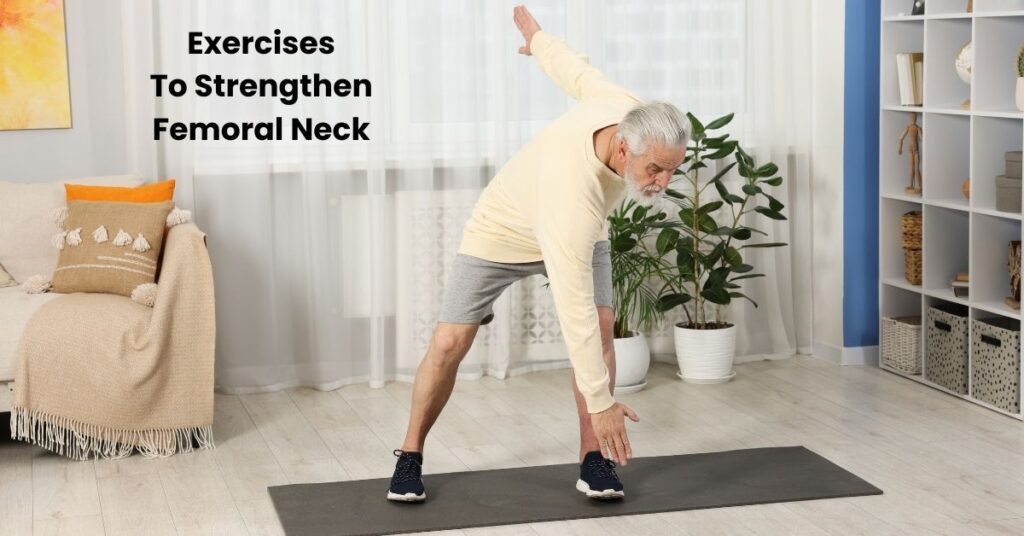
Well-chosen walking, step-ups, squats, and balance drills load the hip and train the muscles that steady it.
The femoral neck is the narrow bridge of bone between your thigh bone’s shaft and the ball that sits in the hip socket. It carries big forces with every step. When it weakens, a fall can turn into a serious fracture.
If you want a clear starting point, build your week around exercises to strengthen femoral neck that you can repeat without paying for it the next day. You’ll use two levers: load that travels through the leg into the hip, and strength that keeps the joint lined up.
| Exercise | Hip Loading Angle | Why It Helps The Femoral Neck |
|---|---|---|
| Brisk walk with hills | Forward, mild impact | Repeated ground contact loads the hip with each stride. |
| Stair climbs or step-ups | Forward + up | Adds higher hip force while training glutes and quads. |
| Squat to a box | Vertical loading | Builds leg strength so daily tasks feel smoother. |
| Split squat | Single-leg bias | Challenges the hip in a stance close to walking. |
| Hip hinge (Romanian deadlift pattern) | Posterior chain | Trains glutes and hamstrings to guide the femur under load. |
| Side-lying hip abduction | Lateral control | Targets glute med so the pelvis stays level on one leg. |
| Band side steps | Lateral steps | Builds side-to-side hip strength for slips and quick changes. |
| Single-leg balance with reach | Small shifts | Trains foot-to-hip control so you react fast to wobble. |
| Farmer carry | Upright loading | Strengthens trunk and hip side muscles that resist pelvic drop. |
Why The Femoral Neck Takes A Beating
Walking is a long string of single-leg stands. In each one, the femoral neck deals with more than bodyweight because hip muscles pull hard to keep the pelvis level. Add stairs, a fast pace, or a loaded carry, and that narrow bridge works even more.
Bone responds to repeated stress. Your goal is a safe dose that you can repeat, then a small step up when that dose feels easy.
What “Strengthening” Means For Bone
Bone remodels over time. Think months, not days. A useful plan uses weight-bearing movement and resistance work you can recover from, since recovery is part of the change.
The National Institute of Arthritis and Musculoskeletal and Skin Diseases explains how weight-bearing and muscle-strengthening activity can build bone by applying controlled stress. Their page on exercise for bone health lays out the categories in plain language.
What Strong Muscles Do For The Femoral Neck
Stronger hips and legs share load and keep the femur tracking well in the socket. That usually means fewer sloppy steps, fewer sudden twists, and more steady force through the joint.
Exercises To Strengthen Femoral Neck
Use this as a menu. If you only pick four moves, pick one weight-bearing movement, one squat pattern, one hinge pattern, and one side-hip drill. Add balance work when you can.
Weight-Bearing Moves That Load The Hip
Feet on the ground, body moving through space. The ground reaction force travels up the leg into the hip.
- Brisk walking: Start with 15–25 minutes. Add hills or short faster bursts once it feels smooth.
- Stairs: Use a steady handhold if needed. Two to five minutes of continuous climbs can be enough at first.
- Step-ups: Use a step height that lets you keep your pelvis level. Drive through the whole foot.
Squat Patterns For Hip And Thigh Strength
Squats train quads and glutes, which makes standing up, lifting, and stairs feel easier.
- Box squat: Sit back to a box or bench, then stand. Keep your ribs stacked over your pelvis.
- Goblet squat: Hold a weight close to your chest so you stay upright.
- Split squat: Stay tall, lower straight down, then stand with control.
Hinge Patterns That Train The Back Of The Hip
Hinges build glutes and hamstrings, which guide the thigh bone when you stand, step, and lift.
- Hip hinge drill: Slide hips back while keeping your spine long. Practice with hands on thighs first.
- Romanian deadlift: Hold light weights, soften knees, push hips back, then stand by squeezing glutes.
- Glute bridge: Feet flat, squeeze glutes to lift hips. Pause for a full breath at the top.
Lateral Hip Work For Pelvic Control
Side-hip strength keeps the pelvis from dropping in single-leg work. That drop can change how force hits the femoral neck.
- Side-lying abduction: Lift the top leg with toes slightly down. Keep the torso still.
- Band side steps: Take small steps and keep knees tracking over toes.
- Standing hip hikes: Stand on a step, let one hip drop a little, then lift it using the stance-side hip.
Strengthening The Femoral Neck With Weight-Bearing Moves
Keep weight-bearing activity in your week. Walking, stair work, and low-impact aerobics all load the hips and legs. The Mayo Clinic notes that weight-bearing aerobic activities work directly on bones in the legs, hips, and lower spine, and they list practical examples you can copy. Their page on exercising with osteoporosis is a solid reference.
Two details matter most: consistency and progression. A 20-minute walk you repeat four times a week beats a hard outing you can’t repeat.
Simple Progression Without Guesswork
Pick one knob to turn at a time. Add five minutes, add a small incline, or add four to six short faster bursts. Keep the change small enough that your joints feel normal the next day.
Form Cues That Keep Hip Loading Clean
Form isn’t about looking perfect. It’s about keeping load where you want it and keeping joints out of cranky positions.
Keep The Pelvis Level In Single-Leg Work
During step-ups, split squats, and balance drills, watch the hip of the free leg. If it drops hard, reduce the range or use a lower step. Pelvic level usually means the side hip muscles are doing their job.
Use The Whole Foot
Press through heel, big toe, and little toe. If your foot rolls in and your knee caves, the hip often follows. A steady foot gives the femur a cleaner track line.
Move With A Calm Spine
In squats and hinges, keep your ribcage stacked over your pelvis. If you arch or round hard, you’ll steal work from hips and put it into the low back.
How To Set Sets, Reps, And Frequency
You don’t need fancy programming. You need a repeatable dose. For most adults, two to three strength sessions a week plus regular walking is a workable start.
Start With These Training Targets
- Strength moves: 2–4 sets of 6–12 reps, stopping with 2–3 reps left in the tank.
- Balance drills: 2–3 rounds of 20–40 seconds each side.
- Walking or stairs: 3–5 sessions a week, 15–35 minutes.
Load Choices That Make Sense
If a set makes your form fall apart, the load is too high. If you can talk in full sentences while squatting, it’s too light to build strength. Aim for a middle zone where the last reps are work, yet still clean.
| Day | Main Work | Time And Notes |
|---|---|---|
| Mon | Squat + side hip | Box squat 3×8, band side steps 3×12 steps, easy walk 10–20 min |
| Tue | Walk or stairs | 20–30 min brisk walk, add a hill if it feels smooth |
| Wed | Hinge + balance | RDL 3×8, glute bridge 2×10, single-leg reach 3×20 sec |
| Thu | Walk | 15–35 min, finish with 4–6 short faster bursts |
| Fri | Step-ups + split squat | Step-ups 3×8 each, split squat 2×8 each, calf raises 2×12 |
| Sat | Optional easy movement | Easy bike ride, relaxed hike, or long walk at a chat pace |
| Sun | Rest or mobility | Gentle hip flexor stretch, short stroll, light breathing drills |
Safety Checks For Real Life Bodies
If you have diagnosed osteoporosis, a recent fracture, hip surgery, or sharp groin pain, get clearance from your clinician before you load the hip hard. If pain changes your gait, stop and swap the movement for something that feels normal.
Use a handhold for balance drills and step-ups when needed. The goal is quality reps, not white-knuckle wobbling. If balance is the limiter, work near a counter or rail, then widen the challenge later.
Avoid sudden twists under load. Keep feet planted during squats and hinges. Turn by stepping, not by spinning on one leg.
Progress Markers You Can Feel
You don’t need a scan to notice progress in daily life. Watch for these wins:
- Stairs feel smoother and less tiring.
- You can stand on one leg longer without the pelvis dropping.
- Walking pace rises without extra effort.
- Squats feel controlled, with knees tracking cleanly.
If your wins stall, change one variable: add a small amount of load, add a set, or add five minutes to a walk. Stay with that change for two to three weeks.
Putting It Together Week After Week
Keep a short menu of moves you enjoy and repeat it. Rotate in one new drill every few weeks, then keep your walking habit steady. Over time, steady loading plus stronger hips can shift your risk picture in a good direction.
If you miss a week, restart with the last easy level and build again. Consistency beats hero workouts, and your hips will reward patience always.
When you’re choosing exercises to strengthen femoral neck, think like this: load through the leg, train the hips to hold the pelvis level, and practice balance so a slip doesn’t turn into a fall.
References & Sources
- National Institute of Arthritis and Musculoskeletal and Skin Diseases (NIAMS).“Exercise for Your Bone Health.”Explains weight-bearing and muscle-strengthening activity and how controlled load can build bone.
- Mayo Clinic.“Exercising with Osteoporosis: Stay Active the Safe Way.”Lists weight-bearing, strength, and balance options and safety notes for bone loss.

Mo Maruf
I created WellFizz to bridge the gap between vague wellness advice and actionable solutions. My mission is simple: to decode the research and give you practical tools you can actually use.
Beyond the data, I am a passionate traveler. I believe that stepping away from the screen to explore new environments is essential for mental clarity and physical vitality.