Our readers keep the lights on and my smoothie glass nicely filled. As an Amazon Associate, I earn from qualifying purchases.
A drone that shuts down at the first drop of rain or skims a lake surface without risking a total loss isn’t just a convenience — it’s a necessity for anyone flying near water. Standard consumer drones offer zero ingress protection, meaning one accidental splash, one unexpected downpour, or one low-altitude pass over a wave can end your flying session permanently. The difference between a flyer who worries about every cloud and one who launches with full confidence comes down to a single design choice: true waterproofing versus purely cosmetic “water resistance.”
I’m Mohammad Maruf — the founder and writer behind WellFizz. For this guide, I analyzed the specific ingress protection ratings, payload capabilities, and real-world corrosion resistance across nine models to identify which platforms genuinely handle water exposure without compromising flight performance.
Whether you’re an angler casting bait offshore, a cinematographer shooting coastal landscapes, or a hobbyist who simply wants to fly after the storm clears, finding the right best waterproof drone means understanding which builds seal out moisture and which merely claim to.
How To Choose The Best Waterproof Drone
Choosing a waterproof drone requires looking past marketing language like “splash-proof” or “water-resistant” and focusing on measurable ingress protection ratings, material corrosion resistance, and the type of water exposure you actually face — freshwater lakes, saltwater coastlines, or heavy rain. The wrong assumption is that any drone with a hydrophobic coating can survive a dunk; only fully sealed designs with IP certification and marine-grade components meet that standard.
Ingress Protection Rating
The IP67 rating means the drone is dust-tight and can survive submersion in up to one meter of freshwater for 30 minutes. No lower rating offers real underwater survivability. For saltwater use, an IP67 build must also feature corrosion-resistant motors and sealed circuit boards, because salt residue degrades unprotected electronics even after a single exposure.
Payload and Flight Performance
If you need a waterproof drone for fishing, pay attention to bait capacity measured in pounds and the casting range. A heavy-lift model with Level 6 wind resistance can carry large live bait in ocean gusts, while a lightweight sub-250g drone is better suited for coastal photography without FAA registration. Your use case determines whether raw payload or portability matters more.
Quick Comparison
On smaller screens, swipe sideways to see the full table.
| Model | Category | Best For | Key Spec | Amazon |
|---|---|---|---|---|
| Potensic ATOM SE | Mid-Range | Beginner water-adjacent flying | 249g, Level-5 wind resistance | Amazon |
| Gleesfun G11PRO | Mid-Range | Budget-friendly gimbal flying | 3-axis brushless gimbal, 4K/30fps | Amazon |
| Ruko F13PRVR8 | Mid-Range | Ultra-light travel with long flight | 249g, 96 min flight (3 batteries) | Amazon |
| Bwine F7GIM | Mid-Range | Professional aerial footage | 3-axis gimbal, 6K photo, 70 min flight | Amazon |
| Bwine F7MINI | Mid-Range | FAA-exempt travel with built-in screen | 249g, 96 min flight, 6km transmission | Amazon |
| Holy Stone HS600D | Premium | Wind-resistant aerial cinematography | 1/2″ Sony CMOS, 80 min flight, Level-6 wind | Amazon |
| DJI Mini 5 Pro | Premium | Advanced tracking and obstacle avoidance | 1-inch CMOS, 52 min flight, ActiveTrack 360° | Amazon |
| DJI Mavic 4 Pro | Premium | Professional tri-camera system | 100MP Hasselblad, 51 min flight, 30km range | Amazon |
| SwellPro FD2 Fisherman MAX | Premium | Heavy-lift fishing with waterproof build | IP67 waterproof, 7.0 lbs bait capacity, 1.5km range | Amazon |
In‑Depth Reviews
1. SwellPro FD2 Fisherman MAX
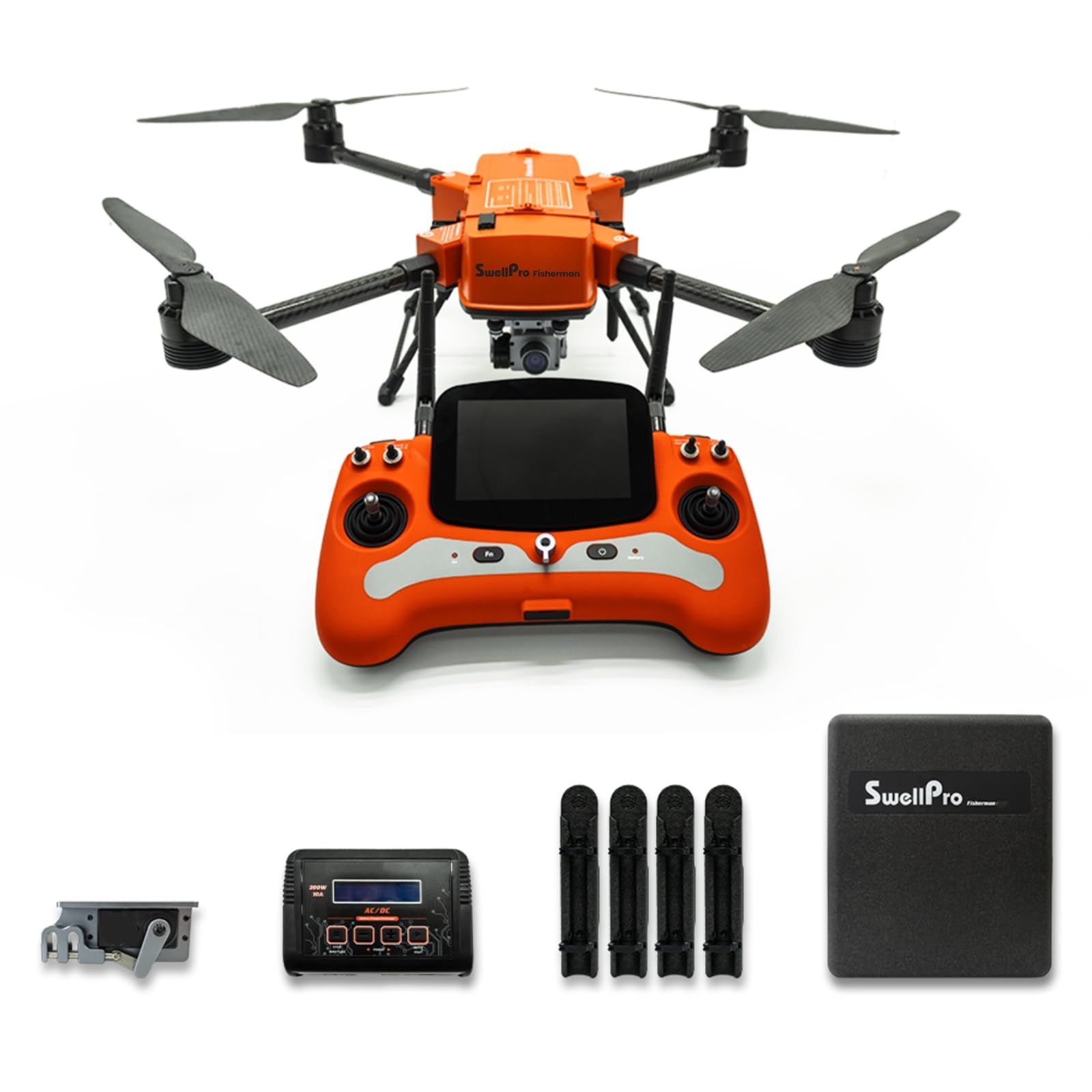
The SwellPro FD2 Fisherman MAX is the only true IP67-rated drone in this lineup, meaning the aircraft is completely sealed against dust and can survive submersion in one meter of freshwater for 30 minutes. Its 7.0-pound bait capacity and 1.5-kilometer casting range make it the definitive tool for offshore anglers who need to deliver large live bait or chunks of meat to specific spots beyond kayak range. The foldable arms and included carry case partially offset its 7.8-pound weight, but the splash-proof remote and 4K camera with real-time multi-color LCD display keep you in control even in salt spray.
Under load, the drone maintains Level 6 wind resistance, flying safely in ocean gusts up to 40 mph. The auto-return function activates when battery reaches a low threshold or signal is lost — a critical safety net over open water. Real-world users confirm it handles heavy payloads without wobble and that the 4K video recorded to onboard flash is solid, but the remote has a specific start-up sequence that requires a long-press, quick release, then another long-press, which can be confusing on first use.
Battery charging uses exposed red and black wires, not a standard smart charger, and accessory availability is limited — SwellPro ships spare parts from China, meaning longer wait times. Some regions, including Texas, have banned fishing drones entirely, so checking local regulations before purchase is essential. For those who can legally fly it, the Fisherman MAX remains the only heavy-lift waterproof drone that combines a true ingress protection rating with professional-grade bait deployment.
Why it’s great
- True IP67 certification guarantees freshwater submersion survival.
- 7.0-pound bait capacity enables serious offshore fishing.
- Level 6 wind resistance keeps it stable in 40 mph gusts.
Good to know
- Remote start-up sequence is non-intuitive and needs practice.
- Spare accessories take time to arrive from China.
- Fishing drone bans exist in some states; verify local laws.
2. DJI Mavic 4 Pro
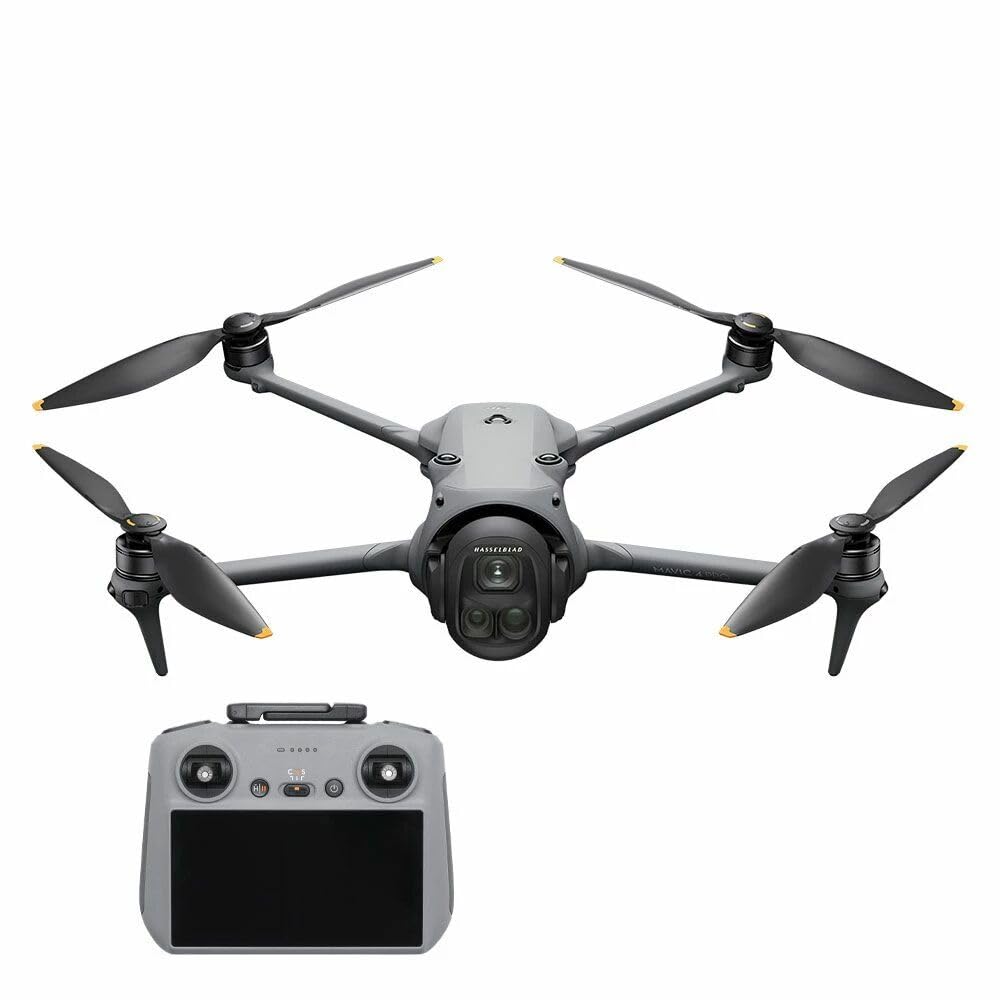
The DJI Mavic 4 Pro represents the absolute ceiling of consumer drone imaging with its flagship 100MP 4/3 CMOS Hasselblad main camera, dual telephoto lenses, and a 360-degree infinity gimbal that enables dynamic camera movement without mechanical limits. Its O4+ video transmission system pushes 10-bit HDR footage up to 30 kilometers, making it the go-to platform for professional cinematographers who need to capture coastal landscapes, offshore structures, or waterfront real estate from extreme distances. The 51-minute flight time per battery, paired with the 7-inch rotatable RC Pro 2 remote, gives you a full working session without constant battery swaps.
The Nightscape Omnidirectional Obstacle Sensing system operates at 0.1 lux, meaning you can fly safely in near-darkness — critical for dawn or dusk shoots over water. Real-world operators report that the 24x zoom range and image transfer workflow are noticeably smoother than earlier Mini Pro models, and the drone is nearly impossible to crash thanks to its sensor array. However, the Mavic 4 Pro does not carry an IP rating; it relies on internal component design rather than sealed enclosures, so a direct dunk into saltwater would be catastrophic. It is designed to handle light rain or spray, not submersion.
One unit shipped with a battery installation error that prevented takeoff, and the return process through Amazon was reportedly frustrating. But for operators who treat the Mavic 4 Pro as a weather-resistant rather than waterproof tool, the camera quality and flight intelligence are unmatched in this bracket. If you need a true waterproof drone for fishing, this is not the right choice; if you need a professional imaging drone that can tolerate coastal moisture, the Mavic 4 Pro is the best in class.
Why it’s great
- 100MP Hasselblad sensor delivers studio-grade aerial photos.
- 30-kilometer O4+ video transmission with 10-bit HDR.
- 0.1-lux obstacle sensing enables safe night flights.
Good to know
- Not IP-rated; cannot survive submersion.
- Some units reported battery installation defects.
- Return process via Amazon had mixed reviews.
3. Holy Stone Sentinel HS600D

The Holy Stone Sentinel HS600D combines a 1/2-inch Sony CMOS sensor with a 3-axis brushless gimbal and electronic image stabilization to produce publish-ready 4K HDR video and 48-megapixel stills, even in challenging coastal winds. Its 603-gram reinforced frame and Level 6 wind resistance allow it to fly in 30 to 40 mph gusts where many lighter drones would be grounded. The included relay remote controller with a built-in screen provides a low-latency wired connection that replaces unstable Wi-Fi links, ensuring your video feed stays solid even when flying over open water.
Flight time reaches roughly 40 minutes per battery with two included, and the auto-return function combined with multi-sensor safety systems — TOF, GPS, and optical flow positioning — reduces collision risk during low-altitude water approaches. Users report that the drone handles gusty rain without issues, though the manufacturer does not claim an IP rating. The camera produces steady footage at 200 feet, but reviewers noted the lack of ISO and exposure time control, meaning you cannot adjust settings for overcast water scenes. The drone also cannot shoot in RAW format, which limits post-processing flexibility.
The remote control requires connecting your phone via USB-C for the relay system, and charging the controller itself needs a USB-A to C cable that is not intuitive for all users. Despite these quirks, the HS600D offers a stable, wind-resistant platform for coastal aerial photography at a mid-range price. It is not a fully sealed waterproof drone, but its build quality and gimbal performance make it a strong choice for flying in damp marine environments if you avoid direct submersion.
Why it’s great
- Sony CMOS sensor with 3-axis gimbal produces smooth 4K footage.
- Level 6 wind resistance keeps it stable in strong gusts.
- Relay remote with built-in screen eliminates Wi-Fi interference.
Good to know
- No manual ISO or exposure control for camera.
- No RAW photo output limits editing options.
- Not rated for immersion; avoid direct water contact.
4. DJI Mini 5 Pro Fly More Combo Plus
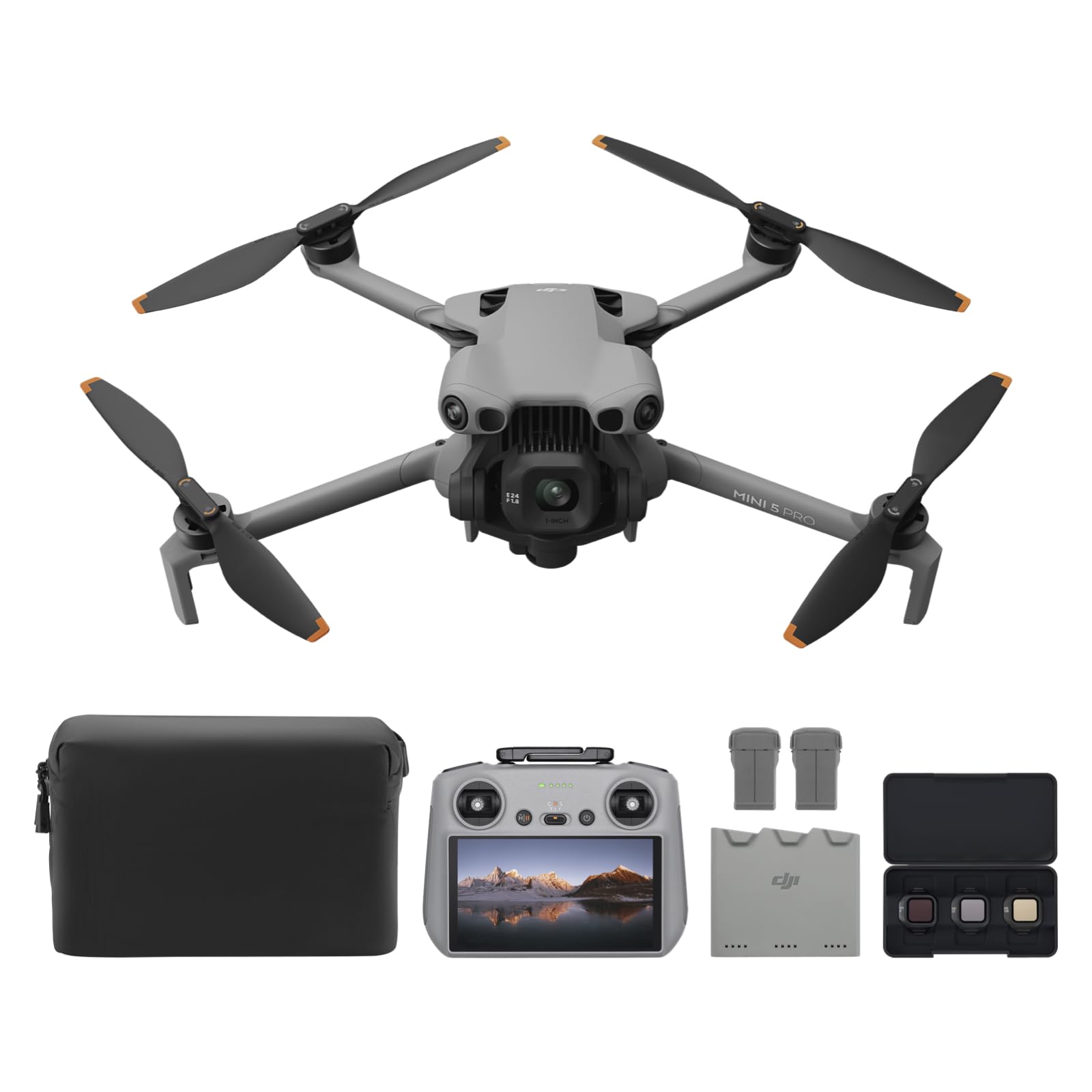
The DJI Mini 5 Pro packs a 1-inch CMOS sensor capable of 4K/60fps HDR video and 50-megapixel stills into a sub-250-gram frame that slips into a jacket pocket, making it the most portable drone here for shooting near water. The Fly More Combo Plus includes three Intelligent Flight Batteries that each deliver up to 52 minutes of flight time, and the two-way charging hub can power all three in about 193 minutes. The ActiveTrack 360° system, combined with forward-facing LiDAR and omnidirectional obstacle sensing that works down to 0.1 lux, allows the drone to autonomously track moving subjects over water without pilot input — useful for following boats, swimmers, or surfers.
True vertical filming and a 225-degree gimbal rotation give you full creative framing freedom, and the 42GB of internal storage means no SD card is required for short sessions. Real-world users confirm the drone is incredibly capable for its size but note a critical catch: the Fly More Combo Plus batteries push the total takeoff weight over 250 grams, which triggers FAA Remote ID requirements and registration. The DJI RC 2 controller is excellent but heavy, and a lanyard is recommended for extended sessions.
The Mini 5 Pro does not carry an IP rating — it relies on the same internal component design as other DJI consumer drones. It can handle light drizzle but will not survive a dunk. One user reported receiving a defective unit with charging hub issues and firmware errors, though the drone itself is superb when functional. For anyone flying in misty coastal conditions or over lakes who prioritizes portability and tracking intelligence, the Mini 5 Pro is the lightest premium option. For true waterproof operation, look to the SwellPro FD2 instead.
Why it’s great
- 1-inch CMOS delivers exceptional 4K HDR quality in a 249g frame.
- ActiveTrack 360° and omnidirectional obstacle sensing enable safe autonomous tracking.
- 52-minute battery life per pack extends shooting sessions significantly.
Good to know
- Fly More batteries push weight over 250g, requiring FAA registration.
- No IP rating — cannot survive submersion in water.
- Occasional firmware and battery charging defects reported.
5. Bwine F7GIM
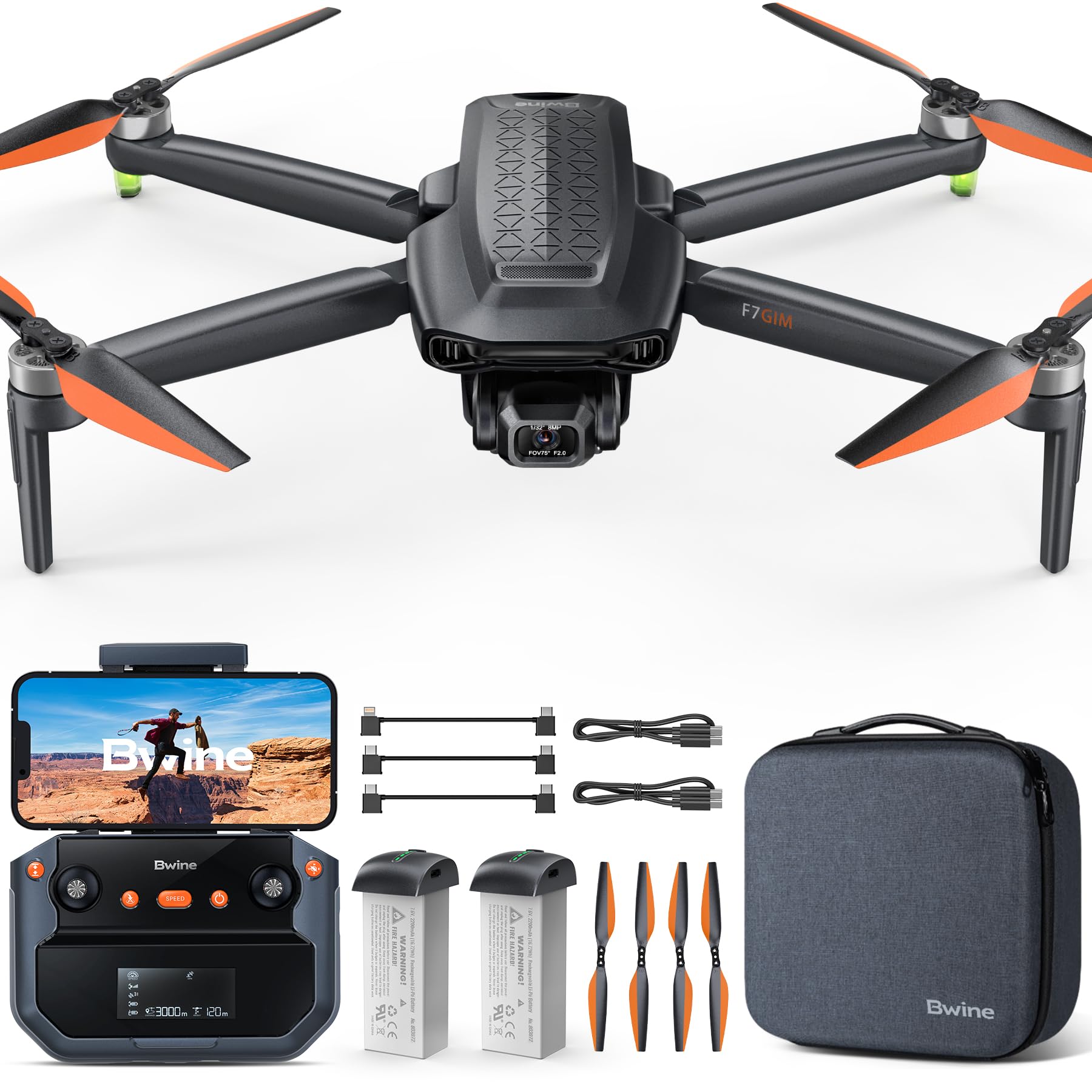
The Bwine F7GIM brings a 3-axis brushless gimbal, 6K photo capability, and 4K/30fps video to a mid-range price point that challenges more expensive models. Its 18-megapixel sensor with imported components produces sharp images, and the gimbal stabilizes footage even in strong winds and high-speed flight — a claim backed by a reported 300% improvement in stability accuracy. The TOF and GPS six-sensor system lifts low-altitude stability by 200%, making this drone genuinely beginner-friendly for water-adjacent flying near docks, shorelines, or reservoirs where precision matters.
The 70-minute total flight time comes from two 35-minute batteries, and the 10,000-foot digital transmission range keeps your feed lag-free using a wired connection rather than Wi-Fi. The industrial aesthetic with orange propellers and a textured body stands out, and the included shockproof carrying case protects the drone during coastal transport. Real-world users confirm the drone is ready to fly out of the box with no assembly, and the beginner mode limits height and distance to prevent accidental water landings. The camera does show noticeable distortion during fast turns, a trait common with electronic image stabilization when the gimbal cannot fully compensate.
The remote control stores the USB-C cable inside the phone holder, a small but smart design touch. The main drawback: battery drains quickly in sport mode, and the SD card must be formatted to FAT32 — a 128GB Samsung EVO card worked but requires extra setup. Customer service is responsive, with one user receiving a replacement after a GPS connection issue. The F7GIM is not waterproof, but its wind resistance and stability make it a solid choice for flying in marine environments where direct water contact is avoidable.
Why it’s great
- 3-axis brushless gimbal delivers professional-level stabilization in wind.
- TOF and GPS sensors improve low-altitude stability for beginners.
- 70-minute total flight time from two batteries covers long shooting sessions.
Good to know
- Camera distorts image during fast turns.
- Sport mode drains battery rapidly.
- SD card must be FAT32 formatted; not plug-and-play.
6. Bwine F7MINI
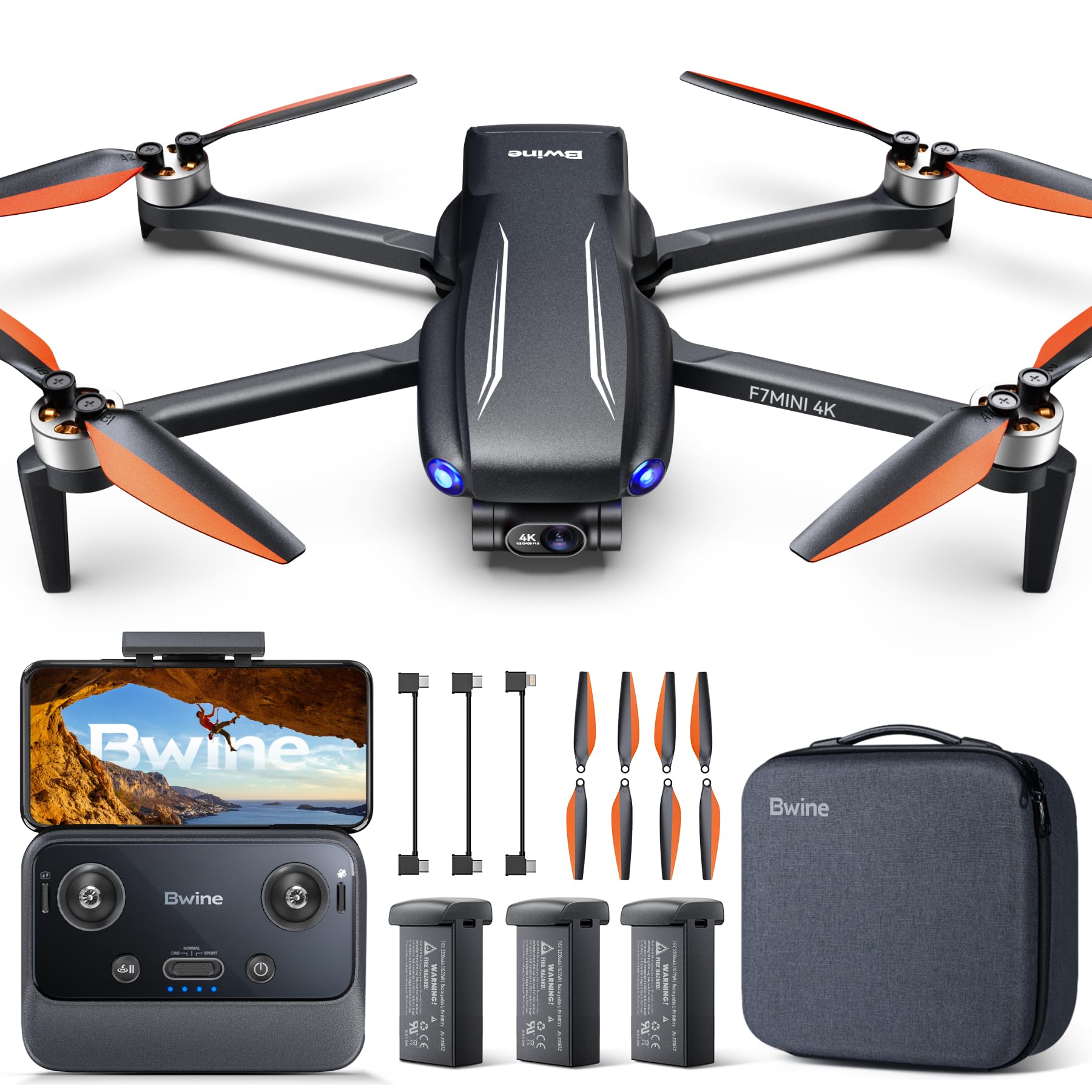
The Bwine F7MINI distinguishes itself with a built-in 5.5-inch touchscreen controller that eliminates the need to connect a phone — a standout convenience for flying over lakes, rivers, or coastal paths where you want to keep your personal device dry. It weighs exactly 249 grams, keeping it FAA-exempt and free from Remote ID requirements, and its foldable design packs down to 5.55 inches in length. The 3-axis gimbal with electronic image stabilization supports Level 5 wind resistance, while the 1/2-inch 48MP CMOS sensor with an F1.8 aperture captures 8K photos and 4K/30fps video that rivals larger models.
Flight time totals 96 minutes across three included batteries, each delivering about 32 minutes, with support for PD 3.0 fast charging to reduce downtime. The 20,000-foot wired digital transmission range (roughly 6 kilometers) provides zero-latency video with 150% stronger anti-interference than Wi-Fi systems. The smart return-to-home, dynamic home point, and 120-decibel locator buzzer make it easy to recover the drone if you lose signal over water. Beginners praise the clear on-screen instructions and the ability to film without a phone tethered to the remote.
One limitation: transferring photos and video from the controller to a phone is slow; using a computer is faster. The drone itself feels premium, and the gimbal holds steady in moderate winds, but it lacks any official water resistance rating — treat it as a weather-tolerant, not waterproof, platform. For travelers who want a lightweight drone with a built-in screen for flying near water, the F7MINI is an excellent mid-range choice.
Why it’s great
- Built-in screen controller eliminates phone connection in damp conditions.
- Under 250g at exactly 249g — no FAA registration needed.
- 96-minute total flight time across three batteries is class-leading.
Good to know
- No official water resistance rating; avoid direct spray.
- Transferring media from controller to phone is slow.
- Maximum resolution limits at 6 kilometers require open sky.
7. Ruko F13PRVR8

The Ruko F13PRVR8 balances ultra-portability with genuine imaging performance, packing a 1/2-inch 48MP CMOS sensor into a 248-gram body that avoids FAA registration entirely. Its 3-axis brushless gimbal combined with electronic image stabilization keeps 4K/30fps footage smooth even in Level 5 winds, and the 8K photo mode captures detail that surpasses standard 4K cameras. The 20,000-foot R2 digital transmission range uses a wired relay system rather than Wi-Fi, which eliminates signal dropouts common over large bodies of water.
The three intelligent batteries deliver a total of 96 minutes of flight time, with the AI Takeoff/Landing system and quadruple positioning — GPS, barometric altitude hold, TOF, and optical flow — ensuring stable lift-off and landing on uneven terrain like sandy banks or rocky shores. The built-in beeper helps locate the drone if it lands in tall grass near the waterline. Real-world users praise the easy setup and the included carrying case, though some received units with defective batteries that the customer service team replaced quickly.
Camera stabilization is excellent for the price, but review units showed that the drone can drift slightly when the joysticks are released in windy conditions. The remote feels well-built, but the screen can be hard to read in direct sunlight. The F13PRVR8 does not carry an IP rating and should not be flown in rain or intentionally submerged. For budget-conscious flyers who want a lightweight, FAA-exempt drone with a gimbal for coastal photography, the Ruko delivers strong value without compromising flight fundamentals.
Why it’s great
- 248g weight keeps it FAA-exempt and highly portable.
- 3-axis gimbal with EIS produces smooth 4K footage.
- AI Takeoff/Landing system simplifies flight near water.
Good to know
- No water resistance rating; avoid rain and spray.
- Some units shipped with defective batteries.
- Joysticks can feel sensitive; requires steady hands in wind.
8. Gleesfun G11PRO

The Gleesfun G11PRO enters the mid-range bracket with a 3-axis brushless gimbal, GQ2.0 digital transmission out to 10,000 feet, and a total flight time of 70 minutes across two batteries. Its 1/3.2-inch CMOS sensor captures 6K photos and 4K/30fps video with a wide dynamic range, and the Cruise Control feature allows the gimbal to maintain stability automatically while you focus on framing — useful for capturing slow-moving boats or shoreline panoramas. The 40-piece kit includes a well-organized carrying case, spare propellers, and multiple phone connection cables, making it a complete out-of-box experience.
The GL2.0 Smart Battery Management system charges both batteries in roughly 2.5 hours and maintains 80% performance retention after 300 cycles, which reduces long-term replacement costs. Real-world users report that the drone handled rainstorms without failure, though the manufacturer does not claim any formal IP rating. One user had a controller replaced free of charge after eight months of use, indicating strong customer support. The app and wired phone connection work seamlessly, and the beginner mode helps new pilots avoid misjudging distance over open water.
The downsides are typical for its price tier: the camera image shows some fish-eye distortion around the edges, and the 70-minute flight time depends heavily on flying conditions — aggressive maneuvers or strong wind will reduce it closer to 50 minutes. The gimbal protector and camera cover are separate pieces that require careful handling during storage. The G11PRO is not a waterproof drone, but its robust build, responsive service, and rain-tolerant performance make it a solid backup for flyers who need a reliable platform near water without paying premium prices.
Why it’s great
- 3-axis gimbal provides steady footage in variable winds.
- Smart Battery Management system extends battery lifespan.
- Complete 40-piece kit eliminates need for extra purchases.
Good to know
- No formal water resistance rating; rain survivability is incidental.
- Camera exhibits fish-eye distortion on edges.
- Flight time drops with aggressive flying or strong winds.
9. Potensic ATOM SE

The Potensic ATOM SE delivers the entry-level waterproof drone concept in a sub-250-gram package that completely avoids FAA registration and Remote ID requirements. Its 249-gram weight, foldable design, and included shoulder bag make it the most portable option for casual flyers who want to launch from a dock, beach, or boat deck without bureaucracy. The 12MP Sony 1/3-inch CMOS sensor captures 4K/30fps video with ShakeVanish stabilization — a software-based correction system that smooths out minor vibrations from the 16m/s top speed in Sport mode.
The 93-minute total flight time from three batteries is exceptional at this tier, and the 60W parallel charging hub can charge all three batteries simultaneously in 1.5 hours, turning downtime into a quick battery swap. The PixSync 2.0 transmission reaches 4 kilometers, and the GPS auto-return function activates on signal loss or low battery. Real-world reviewers confirm the drone is incredibly easy to learn: one user had it in the air within five minutes, and the beginner mode with altitude limits provides a safe envelope for flying over water.
The camera is solid but limited — the solid mount means any abrupt turn causes a distracting tilt effect that a gimballed camera would cancel. The 118-degree field of view is wide enough for landscape shots but introduces barrel distortion at the edges. The ATOM SE has no water resistance coating or IP rating; it relies on the user to avoid rain and spray. For beginners on a budget who want a lightweight, reliable drone for flying near calm lakes or rivers, the Potensic ATOM SE is the most affordable entry point, but genuine waterproof capability requires moving up to the SwellPro FD2 Fisherman MAX.
Why it’s great
- Under 250g with no FAA registration required.
- 93-minute total flight time from three batteries is class-leading at this price.
- 60W parallel charging hub recharges all batteries in 90 minutes.
Good to know
- Solid camera mount tilts during turns — no gimbal stabilization.
- No water resistance; avoid flying in rain or over spray.
- 4K video shows barrel distortion at wide angle.
FAQ
Can I fly a non-waterproof drone in light rain?
Does the DJI Mini 5 Pro have any water resistance?
How do I clean a waterproof drone after saltwater use?
Final Thoughts: The Verdict
For most users, the best waterproof drone winner is the SwellPro FD2 Fisherman MAX because it is the only model with true IP67 waterproof certification, a 7.0-pound bait capacity, and Level 6 wind resistance that handles ocean conditions safely. If you want a lightweight, FAA-exempt drone with a built-in screen for flying near lakes and rivers, grab the Bwine F7MINI. And for beginner flyers who want maximum flight time and portability without breaking the bank, nothing beats the Potensic ATOM SE. Any of these choices will get you in the air and keep you flying with confidence around water — just match your use case to the right level of ingress protection.

Mo Maruf
I created WellFizz to bridge the gap between vague wellness advice and actionable solutions. My mission is simple: to decode the research and give you practical tools you can actually use.
Beyond the data, I am a passionate traveler. I believe that stepping away from the screen to explore new environments is essential for mental clarity and physical vitality.