Our readers keep the lights on and my smoothie glass nicely filled. As an Amazon Associate, I earn from qualifying purchases.
The reality of indoor cycling training is that you are trading wind, momentum, and scenery for a stationary setup where every drivetrain whir and resistance curve becomes magnified. Converting your outdoor bike into a stationary machine introduces a specific set of compromises — noise levels that can interrupt a household, resistance patterns that either mimic a flat road or a steep alpine climb, and stability demands that a floor-standing frame must satisfy ride after ride. The stationary bicycle trainer market has bifurcated into two distinct philosophies: wheel-on fluid or magnetic units that preserve your bike’s rear wheel, and direct-drive smart trainers that remove the wheel entirely for power measurement and virtual integration.
I’m Mohammad Maruf — the founder and writer behind WellFizz. Over the past several months I have analyzed mechanical specifications, decibel ratings, resistance curves, and smart connectivity protocols across dozens of models to understand what separates a trainer that collects dust from one that becomes a consistent part of a weekly routine.
The decision ultimately comes down to how much accuracy, noise tolerance, and virtual training immersion you require from your setup. Once you lock in those priorities, selecting the best stationary bicycle trainer becomes a matter of matching those non-negotiable specs to a frame that fits your bike’s axle standard and your floor space.
How To Choose The Best Stationary Bicycle Trainer
Three factors separate a tolerable indoor trainer from one you will look forward to mounting every ride. Concentrate on the resistance type, the drivetrain interface, and the connectivity ecosystem before considering anything else.
Resistance Type: Fluid vs. Magnetic vs. Electromagnetic
Fluid trainers use a sealed impeller spinning in silicone fluid — resistance rises progressively as speed increases, closely simulating the inertia of outdoor riding. They produce a distinct but tolerable whoosh that measures around 65 to 75 decibels. Magnetic trainers use fixed or adjustable magnets against a metal flywheel; the resistance curve is flatter and typically noisier due to mechanical contact. Electromagnetic (smart) trainers use a digitally controlled magnetic field that adjusts resistance in real-time based on virtual terrain or structured workout targets. These are the quietest option at 55 to 65 decibels and offer power measurement accuracy within one to five percent.
Wheel-On vs. Direct-Drive Interface
Wheel-on trainers clamp a roller against your rear tire. This is the cheaper and more portable approach, but it wears your tire tread, introduces slight power inaccuracies from tire pressure variations, and requires calibration before each session. Direct-drive trainers replace your rear wheel entirely. Your bike’s chain connects directly to a cassette mounted on the trainer’s flywheel hub. The result is higher power accuracy, zero tire wear, and a quieter drivetrain. The trade-off is higher cost and the need to match the trainer to your bike’s cassette speed and axle standard.
Connectivity: ANT+ FE-C vs. Bluetooth FTMS
If you plan to use virtual platforms such as Zwift, Rouvy, or TrainerRoad, confirm your trainer supports both ANT+ FE-C and Bluetooth FTMS protocols. ANT+ FE-C allows the trainer to receive resistance control commands and broadcast power, speed, and cadence simultaneously. Bluetooth FTMS is the newer standard that achieves the same function over Bluetooth. Trainers that only broadcast one protocol may lock you out of certain apps. The highest compatibility comes from units that support dual connectivity simultaneously.
Quick Comparison
On smaller screens, swipe sideways to see the full table.
| Model | Category | Best For | Key Spec | Amazon |
|---|---|---|---|---|
| Saris H3 | Direct Drive | Accuracy enthusiasts | 59 dB noise / ±2% power | Amazon |
| Wahoo KICKR V6 | Direct Drive | Serious racers | ±1% power / 2200W max | Amazon |
| Garmin Tacx Neo 2T | Direct Drive | Road feel simulation | 32 neodymium magnets / silent | Amazon |
| Wahoo KICKR CORE 2 | Direct Drive | Zwift integration | Integrated WiFi / 20 levels | Amazon |
| Saris M2 | Smart Wheel-On | Budget smart training | Electromagnetic / ±5% power | Amazon |
| Alpcour Fluid | Fluid Wheel-On | Realistic road feel | Progressive resistance / stainless steel | Amazon |
| YESOUL S3 | Studio Spin Bike | Home spin classes | 100 magnetic levels / 350 lb capacity | Amazon |
| Sunny Health & Fitness SF-B223018 | Fan Bike | Full-body HIIT | 8 fan blades / 330 lb capacity | Amazon |
| VANSWE VSRB408 | Recumbent Elliptical | Low-impact rehab | 8 magnetic levels / 400 lb capacity | Amazon |
In‑Depth Reviews
1. Saris H3 Series Smart Trainer

The Saris H3 represents the direct-drive sweet spot where power accuracy hits two percent but the price stays well below flagship territory. The electromagnetic unit delivers resistance that feels natural across every gradient from zero to twenty percent, and the claimed 59 decibel noise floor makes it the quietest trainer in this comparison — a critical distinction for apartment dwellers or early-morning riders. The unit ships with an eleven-speed cassette pre-installed, which removes the usual first-time setup headache of cassette installation and spacer alignment.
Real-world feedback from users who have logged over two thousand miles confirms the H3 pairs instantly via Bluetooth or ANT+ FE-C to Zwift, Rouvy, and TrainerRoad without calibration drift. The aluminum and composite frame is heavy at over forty pounds, but that mass contributes to rock-solid stability during sprints exceeding one thousand watts. The integrated ANT+ USB dongle and sweat guard are thoughtful inclusions that save you from buying accessories separately.
The main trade-off is the lack of road-surface vibration features found on pricier units like the Tacx Neo 2T. The H3 does not simulate cobbles or gravel texture, so if tactile immersion matters more than accuracy, you may prefer a model with dynamic inertia feedback. Also note that the thru-axle adapter setup for 142x12mm hubs requires following the manual closely — some users reported initial confusion about which spacer arrangement fits their frame.
Why it’s great
- Consistent power accuracy within ±2% without requiring recalibration between sessions
- 59 dB noise rating is genuinely quiet enough to hold a conversation or watch television alongside
- Includes an 11-speed cassette, ANT+ dongle, and sweat guard out of the box
Good to know
- Heavy at over 40 pounds, making relocation between rooms a deliberate effort
- Lacks the side-to-side tilt or surface vibration effects that some riders prefer for realism
- Thru-axle compatibility requires careful attention to included spacer orientation
2. Wahoo KICKR V6 Smart Trainer

The Wahoo KICKR V6 sets the benchmark for direct-drive smart trainers by combining a high-inertia flywheel with KICKR AXIS feet that introduce subtle side-to-side movement. This lateral compliance mimics the natural bicycle sway during out-of-saddle efforts, making it the most road-like stationary trainer currently available. The resistance unit generates over 2200 watts with accuracy within one percent, and automatic calibration means you never need to perform a spin-down procedure before a workout.
WiFi connectivity at 2.4 GHz provides a stable data link to platforms like Zwift, TrainerRoad, and Wahoo SYSTM without relying on Bluetooth range or ANT+ dongles. The unit is quiet enough that the dominant sound is your drivetrain rather than the trainer itself. Users consistently report seamless integration with the Wahoo ecosystem and reliable power data that matches outdoor power meter readings within a watt or two.
The KICKR V6 is undeniably bulky and heavy, requiring a dedicated floor space rather than frequent relocation. The premium price also excludes the cassette, so you must budget for an additional 11 or 12-speed cassette purchase unless you already have one. A minority of users encountered initial WiFi pairing difficulties that required temporarily disconnecting their phone from their home network during setup.
Why it’s great
- AXIS feet provide real side-to-side motion that reduces hip stiffness during long sessions
- ±1% power accuracy and automatic calibration remove guesswork from structured training
- WiFi connectivity ensures stable data transmission even in crowded Bluetooth environments
Good to know
- Does not include a cassette, adding to the initial investment cost
- Bulk and weight make it impractical to store away after each ride
- WiFi setup can require a workaround if your phone refuses to switch bands during pairing
3. Garmin Tacx Neo 2T Smart Trainer

The Garmin Tacx Neo 2T distinguishes itself through two features no other trainer in this class matches: it generates resistance without an external power supply and it simulates road surface textures through motor vibration. The 32 neodymium magnets create enough eddy current braking to deliver up to 2200 watts of resistance purely through the drivetrain’s motion, so you can place the unit anywhere without needing a floor outlet. The vibration motor reproduces cobblestones, gravel, and wooden boardwalks in apps that support the Tacx Road Feel protocol.
Build quality is exceptional at 47.4 pounds, with a foldable frame that collapses to a compact footprint when not in use. The unit is virtually silent — the only audible noise comes from your bike’s chain and freehub. The included Tacx Premium software subscription provides access to real-world video routes, though the Neo 2T also works seamlessly with Zwift and Rouvy via ANT+ and Bluetooth. Power accuracy is factory-calibrated and requires no manual spin-down.
The Neo 2T’s primary limitation is its cost, which positions it at the top of the market alongside the Wahoo KICKR V6. The unit also requires correct spacer installation on the freehub to prevent drivetrain noise — a handful of users reported a clicking sound that resolved after adjusting the cassette spacer orientation. The integration with the Garmin ecosystem is excellent for Garmin device users but offers no advantage over standard ANT+ protocols for everyone else.
Why it’s great
- Runs without external power, allowing placement anywhere without outlet constraints
- Motor-driven road surface vibration adds immersion that no other trainer provides
- Foldable leg design reduces storage footprint when not in use
Good to know
- Premium price point requires a significant training budget commitment
- Road feel feature requires compatible apps and may not work with all platforms
- Cassette spacer alignment is critical to avoid drivetrain noise during high-torque efforts
4. Wahoo KICKR CORE 2 Zwift Cog and Click
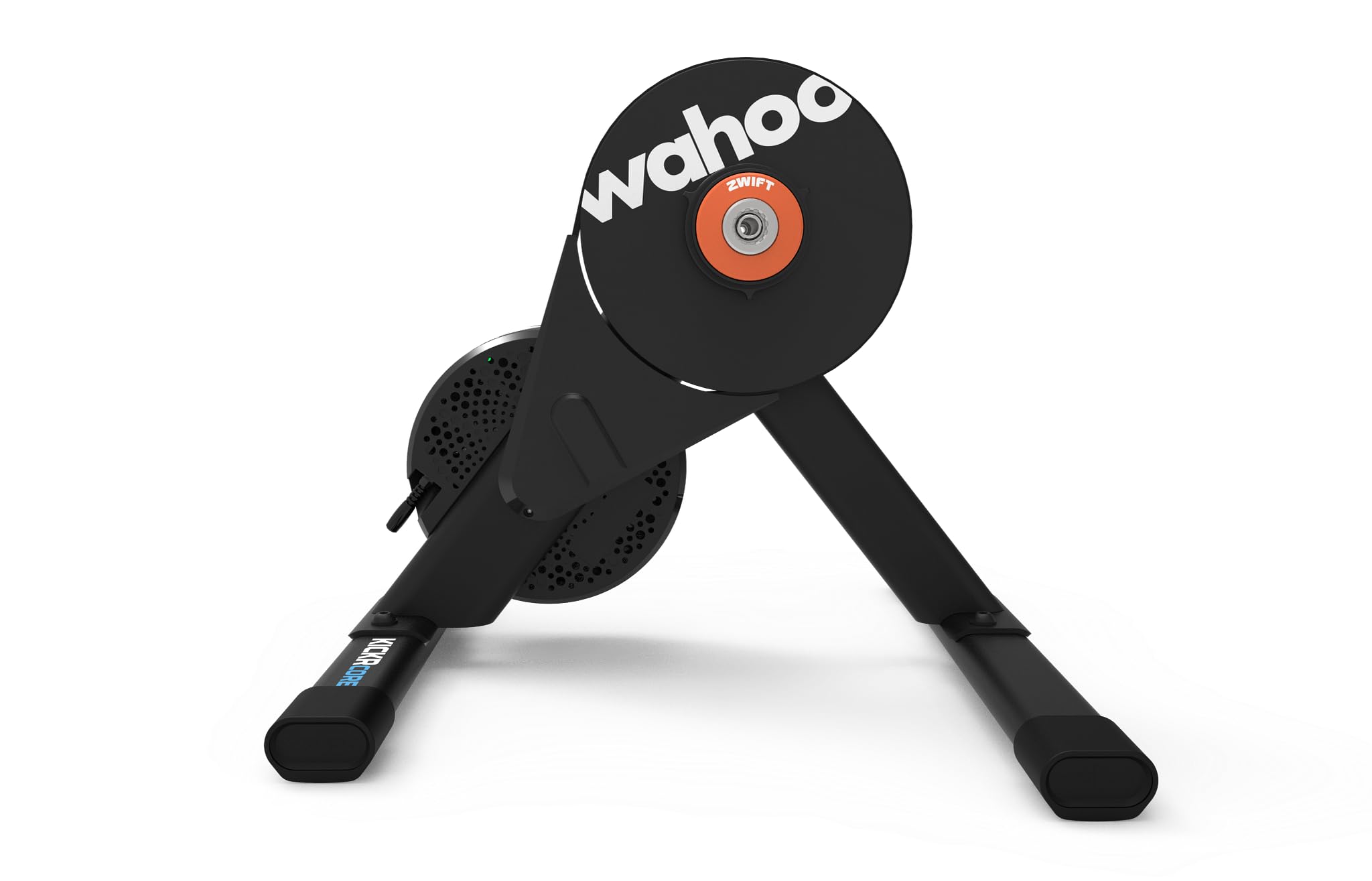
The KICKR CORE 2 is Wahoo’s mid-range entry point into the direct-drive ecosystem, sharing the same basic frame architecture as the KICKR V6 but without the AXIS feet and with a slightly lower maximum resistance. The third-generation Zwift Cog and Click system replaces a traditional cassette with a single Cog that simulates shifting through the Zwift app interface, meaning you never need to install a cassette or adjust a derailleur. This makes the CORE 2 the fastest direct-drive setup available — unbox to first ride in under fifteen minutes.
Integrated WiFi delivers automatic firmware updates and stable connectivity without USB dongles or Bluetooth interference. The unit handles Zwift’s variable terrain faithfully, and the twenty resistance levels cover everything from flat cruising to double-digit gradients. The build quality is consistent with Wahoo’s reputation, and the alloy steel frame supports riders up to the standard weight limit without flex during sprints.
The Zwift Click virtual shifter has been a source of frustration for some users. Despite firmware updates, several reviews report that the Click either fails to pair or loses shifting function mid-ride. The Cog works perfectly with a standard cassette if you choose to ignore the virtual shifting, which defeats the main selling point. Additionally, the Cog and Click system requires an active Zwift subscription, adding a recurring cost that a traditional cassette setup avoids.
Why it’s great
- Zwift Cog eliminates cassette installation and derailleur adjustment concerns
- Integrated WiFi ensures reliable connectivity and automatic firmware updates
- Quick setup time makes it the most accessible direct-drive trainer for new users
Good to know
- Zwift Click virtual shifter has inconsistent performance across reported user experiences
- Virtual shifting requires an ongoing Zwift subscription to function
- Only compatible with 2.4 GHz WiFi networks, which may conflict with dual-band router configurations
5. Saris M2 Smart Indoor Trainer

The Saris M2 (formerly the CycleOps Magnus) brings electromagnetic smart resistance to the wheel-on format at a price that undercuts most direct-drive options. The unit uses a magnetic brake against the rear tire to deliver up to 1500 watts of resistance with ±5% power accuracy — sufficient for serious structured training without requiring you to remove your rear wheel. Bluetooth and ANT+ FE-C dual connectivity ensures compatibility with every major virtual training platform, and the included one-month Rouvy subscription provides an immediate entry into virtual riding.
Assembly involves attaching the legs and calibrating the roller tension knob, which users report takes about fifteen minutes. The steel frame folds for storage and weighs twenty pounds, making it one of the most portable smart trainer options available. Noise levels around 70 decibels at twenty mph are audible but blend into the background with music or headphones. The progressive magnetic resistance curve feels smooth and transitions naturally when virtual terrain changes.
The wheel-on design introduces tire wear and the need for consistent tire pressure to maintain power accuracy. Some users experienced slipping at very high power outputs above 700 watts, although proper tension adjustment usually resolves this. A small number of reports mention difficulty with the tension calibration instructions — specifically the recommendation to tighten until the yellow knob clicks, which can actually overtighten the roller against the tire.
Why it’s great
- Electromagnetic smart resistance provides controlled, repeatable workouts at a wallet-friendly price
- Wheel-on design preserves your bike’s rear wheel and allows quick transition to outdoor riding
- Compact, foldable frame and 20-pound weight make it easy to relocate or store
Good to know
- Tire wear and pressure consistency affect power reading accuracy over time
- Roller tension calibration instructions can be misleading and may require experimentation
- Some users report slipping during high-power sprints if tension is not set correctly
6. Alpcour Fluid Bike Trainer Stand

The Alpcour Fluid Trainer is the most cost-effective way to experience the progressive resistance curve that makes fluid trainers feel distinctly similar to outdoor riding. As the sealed impeller spins faster, the silicone fluid heats and thickens, creating resistance that ramps naturally with your effort level. This means intervals feel authentic — you cannot simply jam into a gear and hold cadence; you must work through the resistance curve the same way you would climbing a real hill. The stainless steel frame supports up to 300 pounds and folds for storage, with a carrying bag included.
Assembly takes minutes with a single bolt and included wrench. Once mounted, the dual-lock system secures the bike dropout to the frame without wobble, and the front wheel riser block brings the bike to a level riding position. The noise level hovers around 70 decibels at high speed — noticeable but not disruptive, sitting below the threshold where it would interrupt a conversation or television audio. Large riders have reported the frame handles their weight without flex or instability.
The fluid resistance curve starts very light below 160 watts, which means casual spinning offers almost no resistance. Riders accustomed to high-torque training will need to maintain a high wheel speed to feel adequate load, and dropping back to lower speeds mid-interval can feel like the resistance vanishes. The included instructions are sparse and one review noted the front wheel riser block cracked after limited use, though the trainer remained functional without it.
Why it’s great
- Fluid resistance provides the most authentic road-like feel among non-smart trainer types
- Stainless steel frame and foldable design combine durability with portability
- Included carrying bag and front wheel riser block offer complete setup out of the box
Good to know
- Resistance remains minimal below 160 watts, limiting its utility for recovery spins
- Assembly instructions are minimal and may require trial-and-error for proper tension setup
- Plastic front wheel riser block has durability concerns reported by some long-term users
7. YESOUL S3 Smart Exercise Bike

The YESOUL S3 is a dedicated studio-style spin bike rather than a trainer that requires your existing bicycle. Its belt-drive system and magnetic resistance deliver a whisper-quiet ride that measures well below 50 decibels, making it the most apartment-friendly option in this comparison. The bike offers 100 resistance levels controlled via a twist knob, and the 10-inch tablet mount positions your device at eye level for following YESOUL’s on-demand fitness classes or third-party apps. The carbon steel frame supports up to 350 pounds and the bike ships seventy percent pre-assembled.
Bluetooth connectivity allows the S3 to broadcast cadence and heart rate data to the YESOUL app, providing real-time feedback on a connected tablet. The SPD clip pedals accommodate cycling shoes while the included toe cages work with regular athletic footwear, making the bike accessible to mixed households. The transport wheels and relatively compact 2×4 foot footprint make repositioning between rooms straightforward.
The seat cushion is a common complaint — multiple users describe it as uncomfortable for sessions lasting beyond thirty minutes. Handlebar adjustability is limited in reach, which can force taller riders over 5’10” into a stretched position that compromises proper spin posture. The YESOUL app requires a subscription for full access to the class library, and the demo content is limited enough that most users will feel pressure to upgrade after the first few rides.
Why it’s great
- Ultra-quiet magnetic belt drive allows late-night workouts without disturbing household members
- 100-level magnetic resistance range provides granular control from gentle warmups to maximum effort
- SPD pedals with included toe cages eliminate the need for special shoes for casual riders
Good to know
- Stock saddle is uncomfortable for extended workouts and may require an aftermarket replacement
- Handlebar reach adjustment is limited and may not fit taller riders optimally
- YESOUL app’s full class library requires a paid subscription after a short trial period
8. Sunny Health & Fitness SF-B223018 Fan Bike

The Sunny Health & Fitness SF-B223018 is a fan bike — the type of machine you see in CrossFit boxes and HIIT studios — where resistance is generated by eight fan blades spinning through air. The faster you pedal, the more air you move, and the harder the resistance becomes with no upper limit. This bi-directional fan design also provides a cooling breeze proportional to your effort, which is a genuine comfort advantage during high-intensity intervals. The Q235 steel commercial-grade frame holds up to 330 pounds and the belt drive keeps the ride smooth.
The dual-action handlebars move with your arms, engaging the upper body while the legs work, enabling full-body conditioning in a single session. The SunnyFit app connects via Bluetooth to track workout metrics and grants access to a library of on-demand classes. The seat adjusts four ways to accommodate different torso lengths, and the transport wheels make moving the 109-pound unit manageable for one person. Users comparing this to the Assault AirBike Classic note that the drivetrain is nearly identical in feel.
The pedals use non-standard threading, making pedal replacement with standard 9/16 MTB pedals difficult. The included monitor requires fresh batteries immediately — out-of-box performance shows sparse data until you replace the shipped cells. The seat, while plush, is not ergonomically shaped for long steady-state rides, and the fan noise, while quieter than older fan bike models, is still present as a low rushing sound during high-RPM efforts.
Why it’s great
- Unlimited air resistance scales naturally with effort, perfect for HIIT and Tabata protocols
- Cooling airflow from the fan provides heat management that magnetic trainers cannot replicate
- Dual-action handlebars deliver simultaneous upper and lower body engagement
Good to know
- Pedal threading is non-standard, limiting aftermarket replacement options
- Monitor display can be unresponsive until fresh batteries are installed
- Fan whoosh at high RPMs is noticeable, though quieter than earlier generation fan bikes
9. VANSWE VSRB408 Recumbent Elliptical Cross Trainer
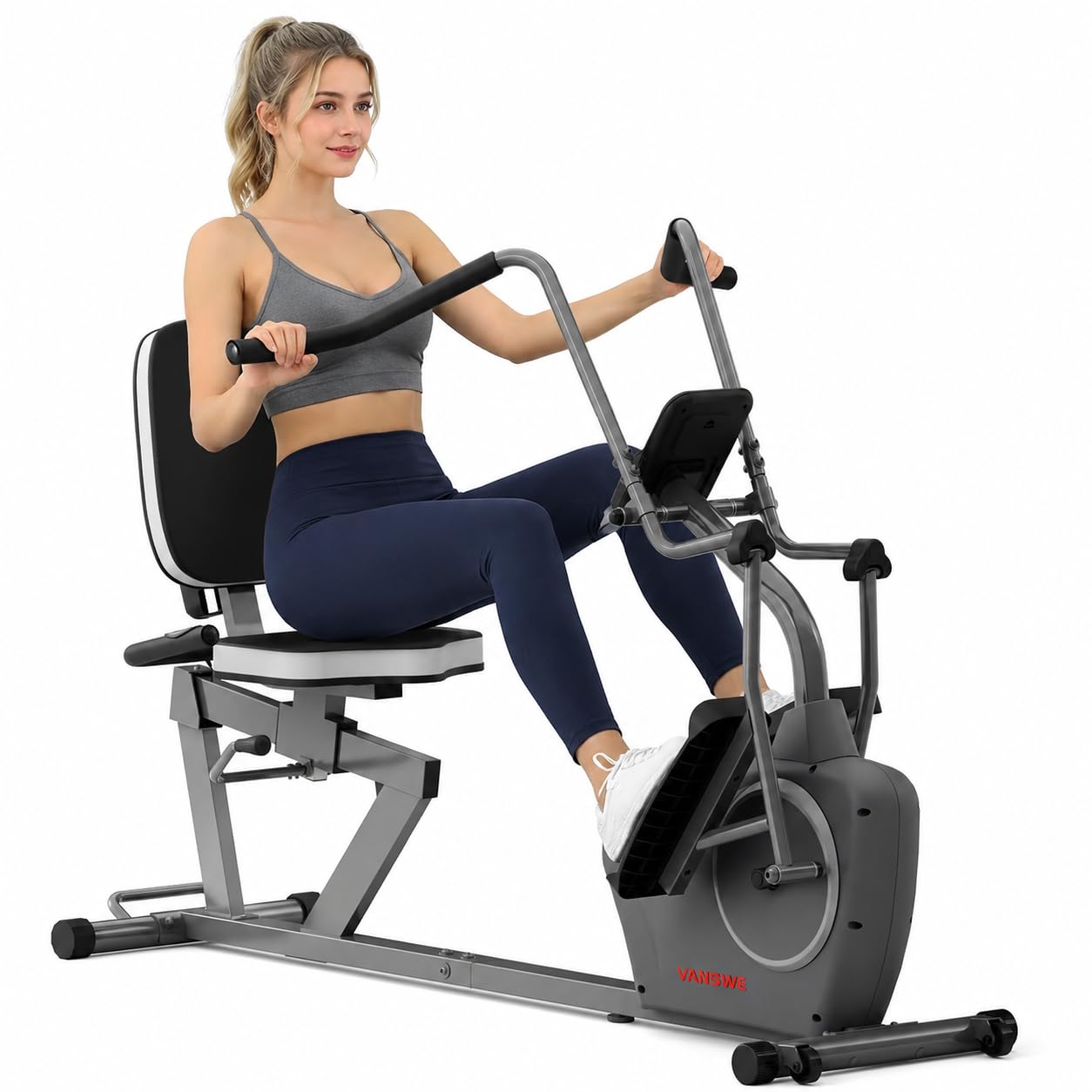
The VANSWE VSRB408 hybridizes a recumbent bike with an elliptical cross-trainer, creating a low-impact machine that prioritizes joint comfort and full-body movement. The recumbent seat with backrest positions your hips below your shoulders, reducing lumbar strain compared to upright exercise bikes. Moveable arm handles engage your upper body while the oversized foot pedals follow an elliptical path — meaning zero compressive force on knees or hips during each revolution. The 400-pound weight capacity and 75-pound steel frame provide exceptional stability for larger users.
The eight-level magnetic resistance system is belt-driven and practically silent — multiple users describe it as producing zero audible noise during operation. The infinite seat slider adjusts from 29 to 37 inches, accommodating riders from 5’2″ to 6’5″ without readjustment between sessions. Bluetooth connectivity pairs with Kinomap and Zwift for virtual rides, and the LED monitor tracks time, speed, distance, calories, and heart rate. The unit ships eighty percent pre-assembled and the tool-free seat adjustment is intuitive.
The elliptical stride length is fixed, which means riders with very long legs may feel the motion is slightly short for their preferred range of motion. The tablet holder is positioned above the moving arm handles, requiring you to reach past them to interact with the screen. The pedals are wide enough for stability during intense sessions, but riders used to standard pedal cages may find the open platform requires intentional foot placement to maintain consistent contact.
Why it’s great
- Recumbent design with padded backrest eliminates lower back fatigue during extended sessions
- Elliptical footpath provides zero-impact joint motion suitable for rehab and senior fitness
- Belt-driven magnetic resistance operates at near-silent noise levels
Good to know
- Elliptical stride length is fixed and may feel restrictive for taller riders
- Tablet mount position requires reaching around moving arm handles to access the screen
- Pedals lack cages or straps, requiring deliberate foot placement during high-cadence work
FAQ
Will a direct-drive trainer fit my thru-axle bike without extra adapters?
How much tire wear should I expect from a wheel-on trainer?
Can I use my smart trainer with Zwift and Rouvy at the same time?
Why does my fluid trainer feel easy at low cadence but extremely hard above 90 RPM?
Final Thoughts: The Verdict
For most users, the best stationary bicycle trainer winner is the Saris H3 because it delivers direct-drive power accuracy at 59 dB noise with a pre-installed cassette and no calibration routine — a balanced package that suits structured training and casual virtual riding alike. If you want the most immersive road-like feel with side-to-side motion and top-tier accuracy, grab the Wahoo KICKR V6. And for budget-conscious riders who still want smart connectivity, nothing beats the Saris M2 for getting onto Zwift without removing your rear wheel.

Mo Maruf
I created WellFizz to bridge the gap between vague wellness advice and actionable solutions. My mission is simple: to decode the research and give you practical tools you can actually use.
Beyond the data, I am a passionate traveler. I believe that stepping away from the screen to explore new environments is essential for mental clarity and physical vitality.