Our readers keep the lights on and my smoothie glass nicely filled. As an Amazon Associate, I earn from qualifying purchases.
Campground quiet hours don’t care about your power needs. A generator that drowns out conversation or wakes neighboring RVers defeats the entire purpose of portable power. Finding a unit that balances hushed operation with enough wattage for an air conditioner, refrigerator, or CPAP machine is the real challenge in this category.
I’m Mohammad Maruf — the founder and writer behind WellFizz. I’ve spent years analyzing inverter generator specifications, decibel ratings, and real-world owner reports to separate marketing noise from actual performance.
This guide compares the top models that deliver genuinely low noise output without sacrificing the power you need, helping you find the quietest portable generators that fit your camping, RV, or home backup setup.
How To Choose The Best Quietest Portable Generators
Selecting a quiet inverter generator requires understanding three interconnected factors: actual noise level, power output, and runtime. The quietest models use inverter technology, enclosed frames, and variable-speed engines to reduce sound while still delivering clean electricity for sensitive electronics.
Decibel Ratings and Real-World Noise
Manufacturer decibel claims are measured at a specific distance — typically 23 feet at no load. A 59 dBA rating at 23 feet might sound dramatically different at 10 feet or under load. Look for units rated at 60 dBA or below for campground compliance. Models with ECO mode further reduce noise by letting the engine idle down when demand is low.
Power Output vs. Appliance Draw
A 2,200-watt unit can handle a small RV air conditioner and lights, but a 3,500-watt unit is needed for a 15,000 BTU AC plus a microwave. The starting surge of an appliance is often double its running wattage. Match the generator’s surge capacity to your largest appliance’s startup draw, then check that the rated watts cover everything running simultaneously.
Fuel Type and Runtime Constraints
Gasoline offers the highest energy density per gallon, producing longer runtimes between refills. Propane (dual-fuel models) stores indefinitely without degradation and burns cleaner, but reduces peak wattage by roughly 10%. Decide which matters more: maximum quiet runtime on a single tank, or the convenience of stacking propane cylinders for multi-day trips.
Quick Comparison
On smaller screens, swipe sideways to see the full table.
| Model | Category | Best For | Key Spec | Amazon |
|---|---|---|---|---|
| Westinghouse 4000W | Premium Inverter | RV trips & remote start convenience | 52 dBA noise rating | Amazon |
| Champion 4000W | Premium Inverter | Lightweight 4000W with CO shield | 48.1 lb / 64 dBA | Amazon |
| Westinghouse 11000W | High-Capacity Inverter | Whole-house backup via transfer switch | 457cc dual-fuel inverter | Amazon |
| WEN DF360iX | Dual Fuel Inverter | Dual fuel flexibility & CO watchdog | 49 lb / conversation-quiet | Amazon |
| ERAYAK 4500W | Premium Inverter | Clean power for sensitive electronics | 60.5 dBA / 0.2% THD | Amazon |
| AIVOLT 4300W | Mid-Range Inverter | CO alert safety & LCD display | 60 dBA / electric start | Amazon |
| Pulsar PGD40ISCO | Mid-Range Inverter | Ultra-light 4000W for easy transport | 47.3 lb / 59 dBA | Amazon |
| WEN 56360i | Value Inverter | Lightest 3600W for travel trailers | 46 lb / RV-ready 30A | Amazon |
| PowerSmart 3800W | Value Inverter | Budget-friendly 59 dBA operation | 59 dBA / 52 lb | Amazon |
| PowerSmart 3600W | Value Inverter | 8-hour runtime at low load | 1.3 gal tank / 149cc | Amazon |
| Pulsar PG2200BiS | Compact Dual Fuel | Dual fuel for small loads & recharging | 80cc / 60 dBA dual-fuel | Amazon |
In‑Depth Reviews
1. Westinghouse 4000 Peak Watt Portable Inverter Generator

The Westinghouse 4000W inverter generator earns the top spot by combining an industry-leading 52 dBA noise rating — genuinely quieter than normal conversation — with 3,300 rated watts and a remote start key fob. That decibel figure is measured at 23 feet with the unit in ECO mode, and real-world reports confirm it stays unobtrusive enough to use in campgrounds with strict quiet hours. The telescoping handle and wheels make the 61.7-pound unit manageable for one person to roll to the tailgate or RV site.
Power delivery is clean (less than 3% THD), protecting laptops and CPAP machines from voltage irregularities. The 1.69-gallon fuel tank delivers up to 7 hours of runtime at half load, and the rotating digital display shows fuel level, remaining runtime, and power output in real time. The TT-30R 30-amp outlet directly powers RV electrical systems without an adapter.
Three starting methods — remote key fob, electric push button, and recoil backup — ensure you never get stranded with a dead battery. The CO sensor and automatic low-oil shutdown add essential safety layers. For the combination of quiet operation, convenience features, and sufficient power for most RV and home backup needs, this is the unit to beat.
Why it’s great
- Remote start key fob works from inside the RV or house
- 52 dBA at 23 feet is genuinely campground-friendly
- Digital display shows fuel level and runtime remaining
Good to know
- At 61.7 pounds, it’s heavier than some competitors
- Not dual-fuel; runs on gasoline only
2. Champion Power Equipment 4000-Watt RV Ready Portable Inverter Generator

At under 49 pounds, the Champion 4000W is one of the lightest inverters in its power class, making it ideal for RVers who need to lift their generator into a truck bed or storage compartment. The 149cc engine delivers 4,000 starting watts and 3,000 running watts, which is enough to handle a 15,000 BTU RV air conditioner plus lights and a 12V fridge — provided you stagger heavy loads. The 64 dBA noise rating at 23 feet places it slightly above the whisper-quiet leaders but still well within conversational levels.
Champion’s CO Shield carbon monoxide auto-shutoff system adds critical safety protection, automatically stopping the engine if CO builds up in an enclosed or semi-enclosed area. The unit includes a TT-30R 30-amp RV outlet, a 5-20R household duplex outlet, and a 12V automotive-style port. Parallel capability allows linking two Champions for up to 8,000 starting watts.
Owners consistently report first-pull starts and fuel consumption of about 5 gallons over 24 hours under continuous AC load — efficient for extended boondocking. The 3-year limited warranty with free lifetime technical support provides above-average peace of mind for a mid-range inverter.
Why it’s great
- Extremely light for a 4000W inverter generator
- CO Shield adds real safety for campsite use
- Reliable first-pull starts in all conditions
Good to know
- 64 dBA is louder than the quietest models
- Cannot run AC and microwave simultaneously
3. Westinghouse 11000 Peak Watt Dual Fuel Portable Inverter Generator

For homeowners who need backup power for an entire house — heat pump, well pump, refrigerator, lights, and even a Tesla charge — the Westinghouse 11000W dual fuel inverter is the heavy-hitter. Rated at 9,000 running watts on gasoline and 8,100 on propane, it connects directly to a transfer switch via the L14-30R 30-amp or 14-50R 50-amp outlets. The 457cc OHV engine with cast iron sleeve is built for longevity, and the 9.8-gallon tank delivers up to 17 hours of runtime at 25% load.
Despite its 187-pound weight, the wheel kit and foldable handle allow one person to maneuver it into position. The remote start key fob works at 50 feet, while the electric push button and recoil backup ensure starting in any weather. Clean inverter power (less than 3% THD) protects computers, TVs, and medical devices — something traditional open-frame generators cannot claim.
The unit runs quieter than expected for its output class, with owners describing it as conversation-level rather than deafening. The dual-fuel flexibility means you can store propane indefinitely for emergencies while using gasoline for daily convenience. A 3-year warranty backs this significant investment.
Why it’s great
- Powers a whole house via transfer switch including 240V appliances
- Clean inverter power safe for sensitive electronics
- Remote start works from inside the house
Good to know
- 187 pounds is not truly portable for most people
- Propane regulator connection can feel awkward to attach
4. WEN Quiet and Lightweight 3600-Watt Dual Fuel RV-Ready Inverter Generator

The WEN DF360iX brings dual-fuel flexibility — gasoline (3,600 surge / 2,900 rated) and propane (3,500 surge / 2,600 rated) — into a compact 49-pound package. For RVers who want the option to run on stored propane without worrying about gasoline degradation, this is a strong contender. The conversation-level noise rating makes it acceptable in campgrounds, and the WEN Watchdog CO sensor automatically shuts the unit down if dangerous carbon monoxide levels are detected.
The TT-30R RV receptacle provides direct connection to travel trailers, while two 120V household outlets and dual USB ports handle daily charging needs. The digital display shows voltage, frequency, runtime, and load percentage — useful for monitoring fuel efficiency. The fuel shut-off feature lets the carburetor run dry before storage, preventing gummed-up fuel lines.
Owners note that both 20A household outlets hold plugs a bit loosely, which is an annoyance but not a functional failure. The tool-free LPG quick-connector makes propane hookup simple. For the price, the dual-fuel capability plus CO watchdog safety makes this the most versatile mid-range option.
Why it’s great
- Runs on gasoline or propane with quick-change connector
- CO Watchdog auto-shutoff for safety
- Fuel shut-off extends engine life during storage
Good to know
- Household outlets hold plugs loosely
- Propane reduces peak wattage by about 10%
5. ERAYAK 4500W Portable Inverter Generator

The ERAYAK 4500W inverter generator produces exceptionally clean power with total harmonic distortion measuring between 0.2% and 1.2% — far below the 3% threshold typically considered safe for sensitive electronics. This makes it the top choice for powering CPAP machines, gaming consoles, and medical devices that demand pure sine wave current. The 208cc engine delivers 4,500 peak watts and 3,500 running watts, enough for a 15,000 BTU RV AC plus other essentials.
At 60.5 dBA, the noise level is equivalent to a normal conversation, and the ECO mode dynamically adjusts engine speed to match the load, further reducing noise and fuel consumption. Fuel efficiency is impressive: 0.21 gallons per hour at 25% load, or 0.56 gph at full rated load. The 50-amp parallel-ready outlet allows connecting two units for up to 7,000 running watts.
The control panel includes a 30-amp L5-30R RV outlet, two 120V AC outlets, a 12V cigarette lighter port, and a USB-C port for modern devices. The included wheel kit and telescoping handle (sold separately) improve portability. A 3-year limited warranty with free US-based technical support backs the unit.
Why it’s great
- Ultra-low THD for sensitive medical and computer equipment
- Excellent fuel economy at partial loads
- USB-C port for modern device charging
Good to know
- Some owners report difficulty with customer support
- Wheel kit sold separately
6. AIVOLT 4300W Inverter Generator
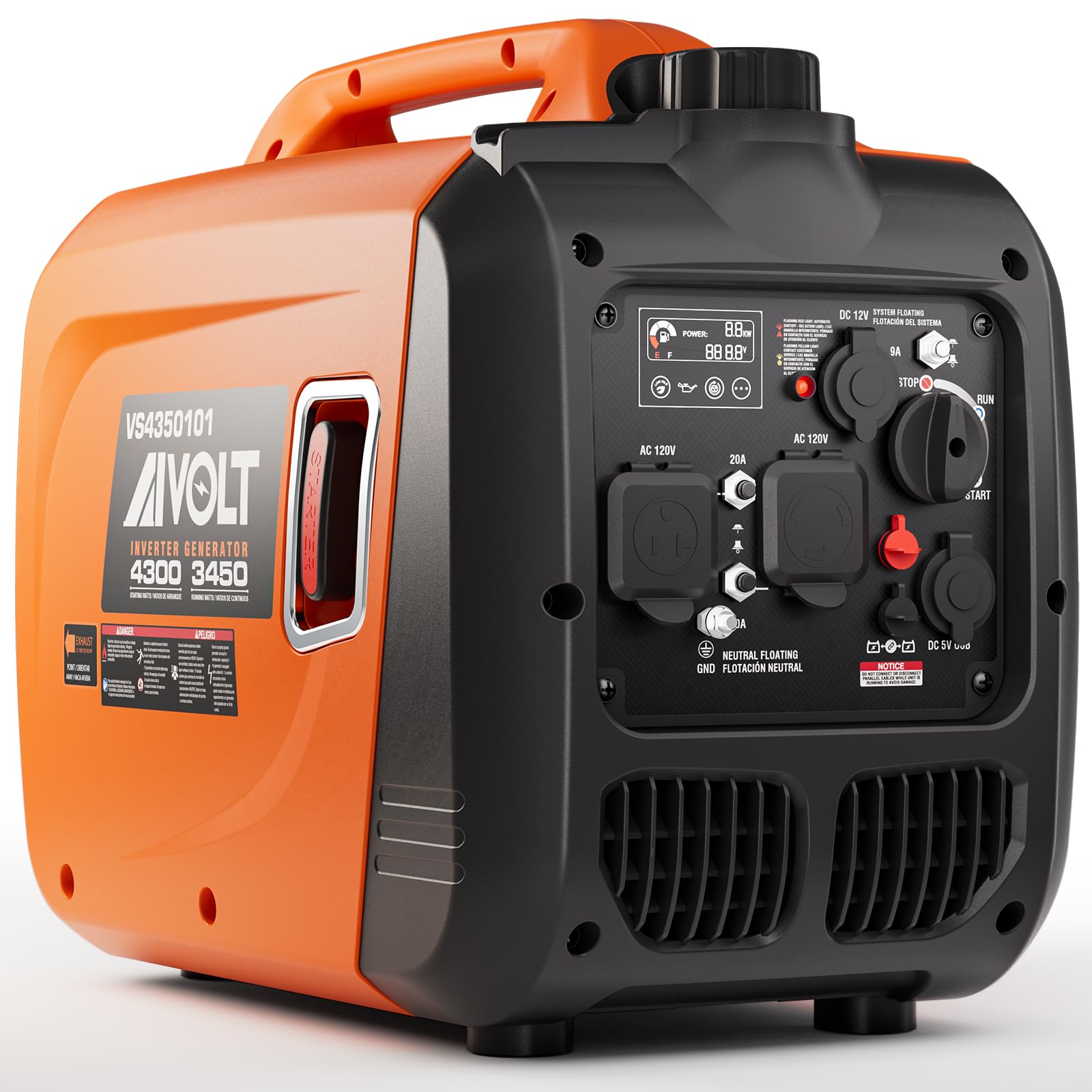
The AIVOLT 4300W packs a 149cc copper-wound engine producing 4,300 starting watts and 3,450 running watts, with a noise rating of 60 dBA at 23 feet. Its standout feature is the CO Alert technology that automatically shuts the generator down if carbon monoxide reaches unsafe levels — a feature that should be mandatory for anyone using a generator near a camper or home.
The 5-in-1 LCD display shows oil level, fuel level, overload warnings, and current operating status in real time. The control panel includes a 120V 30-amp locking outlet for RV hookups, a 120V 20-amp outlet, a 12V DC outlet, plus USB-A and USB-C ports for modern devices. The unit weighs 50.7 pounds — lighter than most 4000W competitors — and comes with an RV adapter and battery charging cable.
The electric start eliminates pull-cord frustration, though a recoil backup is present. Owners report that the generator runs quietly at idle but gets noticeably louder under heavy load, measuring around 72-73 dBA at 5 feet. This is still acceptable for campground use but worth noting if absolute silence is your priority. The parallel kit lets you connect two AIVOLT units for double the output.
Why it’s great
- CO Alert automatic shutoff for safety
- Informative LCD display with multiple data points
- Electric start with included battery charging cable
Good to know
- Noise increases noticeably under heavy load
- Engine oil not included in the box
7. Pulsar PGD40ISCO Ultra Light Quiet 4000W Inverter Generator

The Pulsar PGD40ISCO tips the scales at just 47.3 pounds while delivering 4,000 peak watts and 3,200 rated watts — an excellent power-to-weight ratio that makes it one of the most portable 4000W-class generators available. The 59 dBA noise rating at 23 feet puts it in the quiet category, suitable for campgrounds with moderate noise restrictions. The 145cc engine paired with a 1-gallon fuel tank provides about 4 hours of runtime at half load.
The clean inverter power (less than 3% THD) makes it safe for laptops and other electronics. It comes parallel-ready, allowing you to pair two Pulsar units for double the output. The control panel includes standard 120V outlets and a USB port for direct device charging. The compact white enclosure measures just 18.9 by 11.4 by 17.3 inches, sliding easily into tight RV storage compartments.
Owners with over 400 hours of use report nothing more than routine spark plug and air filter replacements, suggesting solid long-term reliability. Some note that the fuel cap can vapor-lock in hot conditions, requiring periodic loosening to relieve pressure. The lack of wheels means you carry it everywhere, but at 47 pounds that is manageable for most adults.
Why it’s great
- Remarkably light for a 4000W inverter generator
- 59 dBA noise rating for campground use
- Proven long-term reliability with hundreds of hours
Good to know
- No wheels included; must be carried
- Fuel cap may vapor-lock in high heat
8. WEN 3600-Watt Portable Inverter Generator

At 46 pounds, the WEN 56360i is the lightest 3600W inverter generator on this list, making it ideal for travel trailer owners who need to hoist the unit in and out of a truck bed. The 149cc engine generates 3,600 surge watts and 2,900 rated watts — enough to start and run a 13,000 BTU RV air conditioner. Owners confirm it handles the AC plus lights and a furnace fan continuously for about 4 hours on a tank of gas during hot-weather camping.
The fuel shut-off feature lets the carburetor run dry before the engine stops, preventing stale fuel from clogging jets during storage — a common failure point on generators left unused for months. The fully enclosed design keeps noise down to a conversational level, and the unit includes a TT-30R RV receptacle plus two USB ports for device charging.
Starting is reliable even in cold weather: owners report two pulls in mild conditions and four pulls at 14 degrees Fahrenheit. The ECO mode lets the engine idle down automatically, reducing both noise and fuel burn. The 3-year warranty adds confidence for a sub-500-dollar generator.
Why it’s great
- Lightest 3600W inverter at 46 pounds
- Fuel shut-off protects carburetor during storage
- Reliable cold-weather starting
Good to know
- Not powerful enough for large power tools
- Runs on gasoline only; no dual-fuel option
9. PowerSmart 3800W Portable Inverter Generator
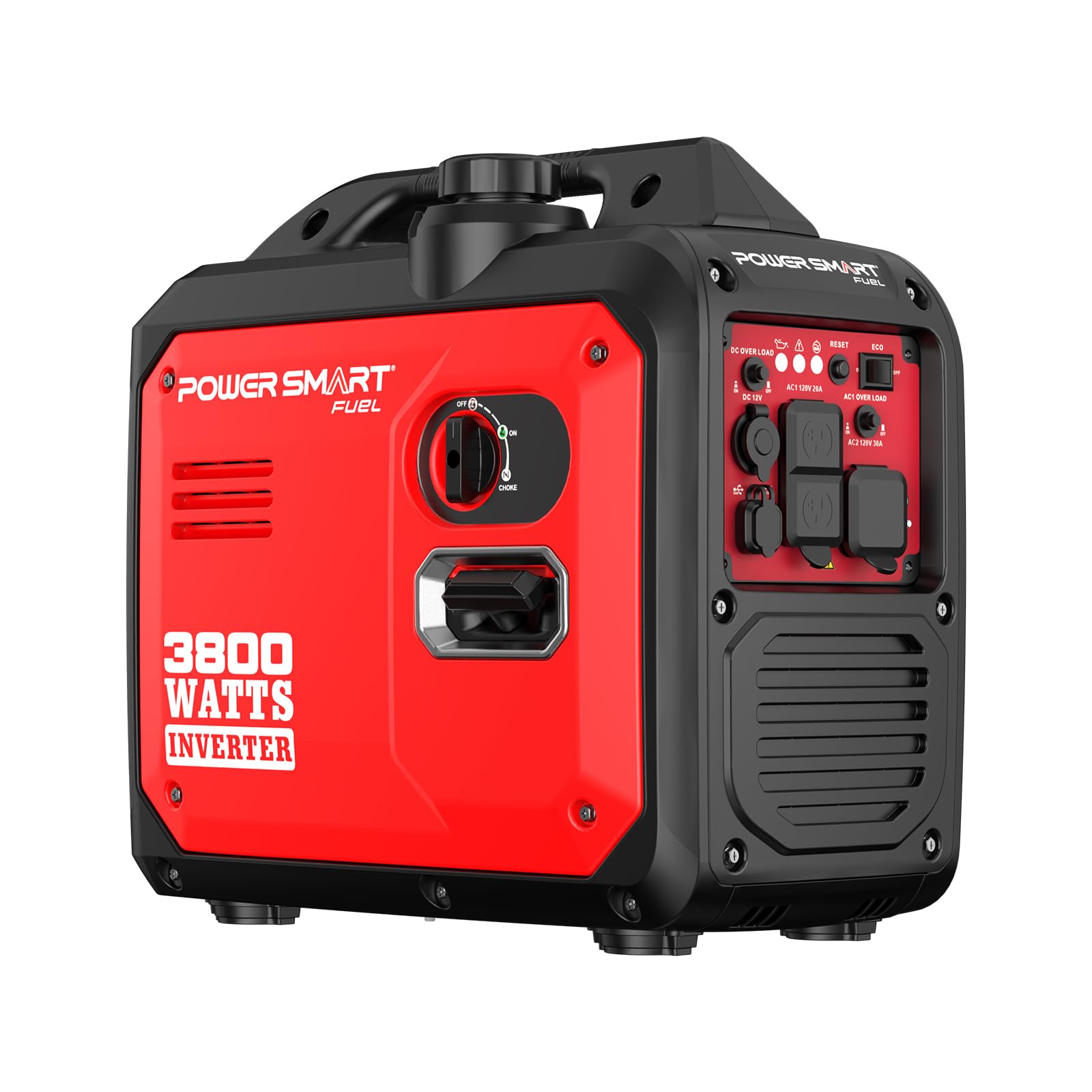
The PowerSmart 3800W inverter generator delivers an impressive 59 dBA noise rating at a very accessible price point, making it the top budget-friendly option for campers who prioritize quiet operation. The 143cc 4-stroke engine produces 3,800 starting watts and 3,200 rated watts — sufficient for powering a small RV, tailgate setup, or home essentials during an outage. The 52-pound weight with ergonomic handle makes transport straightforward without needing wheels.
The clean sine wave output (less than 3% THD) protects sensitive electronics, and the 1.19-gallon fuel tank provides up to 4.5 hours of runtime at 50% load in ECO mode. Two 120V 26.7A AC outlets and a USB port handle typical loads. The parallel-ready design allows linking two units for increased capacity.
Customer reports highlight first-pull starts and quiet operation that genuinely matches the 59 dBA claim. Owners in remote off-grid locations report the unit handles varying loads smoothly without surging. The 2-year warranty is shorter than some competitors but reasonable at this price tier.
Why it’s great
- 59 dBA noise at a budget-friendly price
- Clean sine wave protects electronics
- Parallel-ready for expanded power
Good to know
- Only 2-year warranty
- Runs on gasoline only; no dual fuel option
10. PowerSmart 3600-Watt Portable Inverter Generator

This PowerSmart 3600W model stands out for its extended runtime: the 1.3-gallon fuel tank delivers up to 8 hours of operation at 25% load, which is excellent for overnight camping or long power outages where refueling is inconvenient. The 149cc engine provides 3,600 starting watts and 3,200 rated watts, with a steady 26.7A output that can handle a 15,000 BTU RV air conditioner.
The advanced inverter technology produces clean power with less than 3% THD, safe for laptops and smartphones. The TT-30R 30-amp outlet connects directly to RV power cords, and the parallel-capable design lets you double output by linking two units. At 50.7 pounds, it remains portable enough for one person to load into a vehicle.
Owners consistently praise the quiet operation — noticeably less intrusive than conventional generators in the same power range — and the first-pull starting reliability. The unit works well for pop-up events and home backup setups where noise is a concern. The 2-year warranty is standard for this price segment.
Why it’s great
- Up to 8 hours runtime at partial load
- TT-30R outlet for direct RV connection
- Quiet operation for its power class
Good to know
- Gasoline only; no propane option
- 2-year warranty is shorter than premium brands
11. Pulsar 2,200W Portable Dual Fuel Quiet Inverter Generator

The Pulsar PG2200BiS is a compact dual-fuel inverter generator that runs on both gasoline (2,200 peak / 1,800 rated watts) and propane (2,000 peak / 1,600 rated watts). This makes it ideal for recharging battery power stations, running small camp loads, or powering a pellet stove during an outage. The 60 dBA noise rating at the 2,200-watt level is extremely quiet, comparable to a household conversation.
The 80cc engine sips fuel: up to 8 hours on a single 1.18-gallon tank of gas at half load. On propane, a standard 1-pound tank provides about 75 minutes of runtime, but you can connect larger bulk tanks using the included propane hose. The stable sine wave output protects sensitive electronics despite not being labeled as pure sine — owners confirm it runs computers and CPAP machines without issues.
The compact form factor (19.7 by 11.22 by 17.91 inches) and lightweight design make it easy to stow in a car trunk or RV compartment. The unit is CARB and EPA compliant for sale in all 50 states. Starting on propane takes a few more pulls than gasoline, but once the technique is learned — slow priming pulls followed by quick pulls — it fires reliably.
Why it’s great
- Dual fuel for fuel flexibility and propane storage
- Very quiet for small loads and campsite use
- CARB compliant for California use
Good to know
- Propane starting requires learning the priming technique
- Power limited to 1,800 watts; not for large AC units
FAQ
Can I run a 15,000 BTU RV air conditioner on a 3,200-watt generator?
Is 59 dBA quiet enough for campground quiet hours?
How often do I need to change the oil in a portable inverter generator?
Final Thoughts: The Verdict
For most users, the quietest portable generators winner is the Westinghouse 4000W because it combines a category-leading 52 dBA noise floor with remote electric start, a telescoping handle, and enough power for RV air conditioners and home backup circuits. If you need whole-house power with dual-fuel flexibility, grab the Westinghouse 11,000W. And for lightweight, campground-friendly power on a budget, nothing beats the WEN 3600W at 46 pounds with reliable starting and fuel shut-off protection.

Mo Maruf
I created WellFizz to bridge the gap between vague wellness advice and actionable solutions. My mission is simple: to decode the research and give you practical tools you can actually use.
Beyond the data, I am a passionate traveler. I believe that stepping away from the screen to explore new environments is essential for mental clarity and physical vitality.