Our readers keep the lights on and my smoothie glass nicely filled. As an Amazon Associate, I earn from qualifying purchases.
A Japanese chef knife isn’t just a kitchen tool — it’s a precision instrument that demands a different cutting philosophy than the heavy, thick-spined German blades most home cooks start with. The wrong choice means fighting a brittle edge that chips on a bell pepper stem or a blade geometry that wedges in dense squash rather than gliding through. Understanding steel type, cladding, edge angle, and handle construction determines whether your first cut feels effortless or frustrating.
I’m Mohammad Maruf — the founder and writer behind WellFizz. After analyzing over two dozen Japanese chef knives and cross-referencing steel specifications, edge retention data, handle ergonomics, and real-world user notes across the mid-range and premium segments, this guide distills everything a decisive buyer needs without the marketing noise.
The search for the best japanese chef knife comes down to how much you value edge durability versus outright sharpness, and whether a full knife set or a single exceptional blade fits your cooking rhythm.
How To Choose The Best Japanese Chef Knife
Buyers often assume any Japanese knife is automatically better than a Western one, but the real decision is matching steel hardness and blade geometry to your cutting habits. Softer Western knives bend; brittle Japanese knives chip. The right choice balances these trade-offs against your prep style.
Steel Core: VG-10 vs SG2 vs Molybdenum
VG-10 is the workhorse stainless alloy for Japanese knives — it hits 58-60 HRC, holds a fine edge, and resists corrosion well. SG2 (also called R2) is a powdered metallurgy steel that reaches 63+ HRC with finer carbide distribution, meaning longer edge retention but more challenging sharpening. Molybdenum-alloyed steel like Mac’s original formula offers a middle path: good edge retention with less brittleness, easier to maintain on a ceramic rod.
Edge Angle and Geometry
Japanese chef knives typically come sharpened to 8-15 degrees per side, whereas Western knives average 20 degrees. A 9-12 degree edge glides through tomato skin and raw fish with minimal resistance but is prone to chipping on hard squash, bones, or frozen food. The 15-degree edge found on many entry-level Japanese knives offers a safer durability balance for home cooks who aren’t obsessive about maintenance. Blade grind — convex, hollow, or flat — also determines how food releases and how the knife wedges in dense ingredients.
Handle Construction and Material
Traditional Japanese wa-handles (octagonal or D-shaped) are lighter and improve pinch-grip maneuverability, while Western-style handles offer full-tang weight and familiarity. Pakkawood is resin-impregnated hardwood that resists moisture well. G-10 fiberglass handles (like the Kyoku Shogun series) are nearly indestructible and provide secure grip even with wet hands. High-end birch handles offer beauty and warmth but require periodic oiling to prevent staining and cracking.
Quick Comparison
On smaller screens, swipe sideways to see the full table.
| Model | Category | Best For | Key Spec | Amazon |
|---|---|---|---|---|
| Miyabi Birchwood SG2 | Premium | Ultimate edge retention | SG2 powder steel, 9.5-12° edge | Amazon |
| Yoshihiro VG-10 Damascus | Mid-Range | Versatile daily driver | VG-10 core, 60 HRC, 16 layers | Amazon |
| Shun Classic Blonde | Premium | Balanced sharpness & durability | VG-MAX core, 16°, 68 Damascus layers | Amazon |
| Mac Chef Series Hollow Edge | Mid-Range | Lightweight slicing precision | Molybdenum steel, hollow edge | Amazon |
| HOSHANHO 16-Piece Set | Set | Complete kitchen upgrade | 10Cr15CoMoV steel, 58 HRC, 15° blade | Amazon |
| KYOKU Shogun Series | Budget | Entry-level Damascus value | VG-10 core, 8-12° edge, G-10 handle | Amazon |
| SYOKAMI 7-Piece Set | Budget | Space-saving foldable block | High-carbon steel, 15°, magnetic block | Amazon |
In‑Depth Reviews
1. Miyabi Birchwood SG2

The Miyabi Birchwood SG2 represents the pinnacle of Japanese knife metallurgy — a powdered metallurgy SG2 core clad in 100 layers of flower-pattern Damascus steel, hand-honed to a 9.5-12 degree edge using the three-step Honbazuke process. At 63+ HRC, this blade will retain its razor sharpness longer than any VG-10 competitor, making it the clear choice for cooks who prioritize edge longevity and are comfortable with a brittle blade that demands respect. The Karelian birch handle is not just visually stunning — its silky texture improves grip as hand warmth releases natural oils, though it does require periodic conditioning with mineral or linseed oil.
The 8-inch gyuto profile is authentically thin — a true Japanese blade geometry that slices through dense carrots and raw salmon with zero wedging. The 5.4-inch handle length provides excellent leverage for a pinch grip, and the weight distribution (1.18 pounds) feels balanced and nimble rather than blade-heavy. Users consistently report that the edge glides through tomato skin without pressure, a direct result of the steep bevel and powdered steel’s fine carbide structure.
That said, this is not a beginner knife. The edge is brittle enough to chip if twisted against a bone, used on a glass cutting board, or dropped in a sink. The birch handle can stain from acidic ingredients if not wiped immediately. And at this tier, the absence of a protective sheath in the box is a notable oversight — you’ll want to purchase a blade guard separately. This knife rewards disciplined technique and careful maintenance.
Why it’s great
- SG2 powder steel holds edge longer than any VG-10 knife in this guide
- 9.5-12 degree Honbazuke edge is extraordinarily sharp out of the box
- Karelian birch handle offers unmatched grip feel and beauty
Good to know
- Brittle edge chips easily on bones, nuts, or frozen foods
- No sheath included — budget for a blade guard
- Birch handle requires periodic oiling to prevent staining
2. Yoshihiro VG-10 Hammered Damascus Gyuto
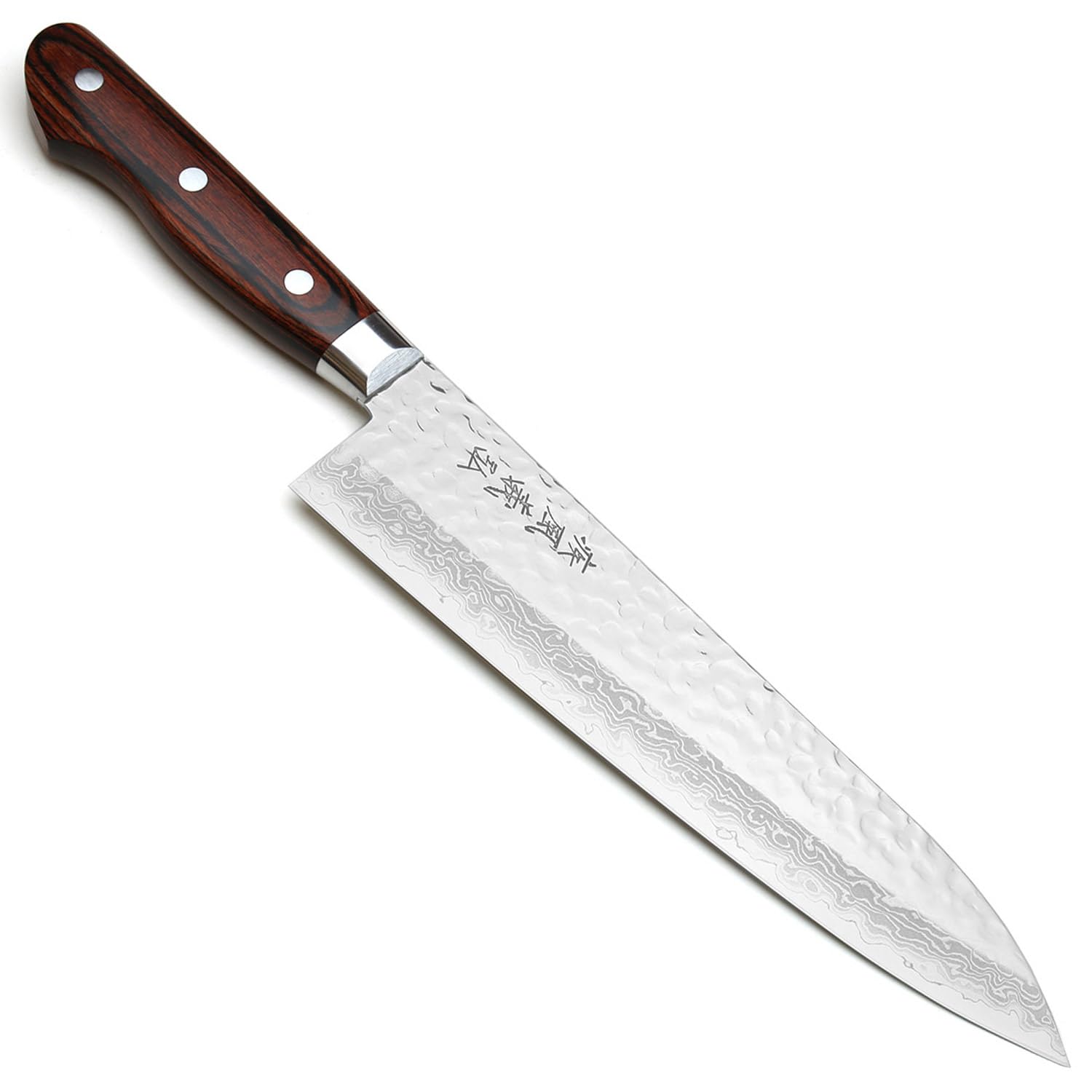
The Yoshihiro VG-10 Hammered Damascus Gyuto is a perennial seller for good reason — it combines a proven VG-10 stainless steel core (60 HRC) with 16-layer Damascus cladding and a hammered tsuchime finish that provides genuine food release benefits. The mahogany Western-style handle is full-tang, ergonomically contoured, and offers the familiar weight distribution that chefs transitioning from German knives will appreciate. At 8.25 inches, the blade length is slightly longer than standard, giving extra reach for slicing large roasts or melons.
Out of the box, users report a frighteningly sharp edge that slices through tomatoes without any sawing motion — a testament to the 15-degree double-bevel grind. The hammered texture is not decorative; it creates air pockets that reduce surface contact with sliced food, making diced onions less likely to stick mid-cut. The mahogany handle is comfortable for extended prep sessions, though it lacks the moisture resistance of Pakkawood, so immediate drying after use is important.
Where the Yoshihiro shines is value — it offers handcrafted Japanese construction with genuine VG-10 performance at a price that undercuts premium brands by a significant margin. The downsides are minor: the blade can develop micro-chips on hard cutting boards if used with lateral force, the packaging is basic for a gift, and the logo placement varies between units. It also lacks a saya cover, so you’ll need a sheath or magnetic strip for safe storage.
Why it’s great
- Hammered tsuchime finish significantly reduces food sticking
- VG-10 core at 60 HRC provides excellent edge retention
- Full-tang mahogany handle feels familiar and well-balanced
Good to know
- No saya sheath included for storage
- Mahogany handle requires careful drying to prevent water damage
- Edge is brittle enough to chip on hard boards with lateral torque
3. Mac Chef Series Hollow Edge Chef’s Knife

The Mac Chef Series Hollow Edge 8-inch is a longtime Wirecutter #1 pick and a cult favorite among professional cooks who prefer a lightweight, nimble blade over heavier German alternatives. The secret is Mac’s proprietary molybdenum-vanadium alloy steel — not as hard as VG-10 but significantly tougher, meaning the edge flexes rather than chips when hitting the occasional bone or hard squash. At 9.1 ounces, it’s one of the lightest 8-inch chef knives available, reducing wrist fatigue during long prep sessions.
The hollow-edge (granton) grind creates small divots along the blade face that break surface tension and reduce friction, though the effect is most noticeable on moist ingredients like potatoes and cucumbers rather than dry chopping. The Pakkawood handle is resin-stabilized, offering better moisture resistance than natural wood, and the steel bolster provides a comfortable pinch-grip transition. The 2mm blade thickness is significantly thinner than Western knives, which explains the effortless cutting but also means the knife is not suitable for heavy tasks like splitting butternut squash or carving through joints.
The main trade-off is edge retention — the softer molybdenum steel requires more frequent honing (a ceramic rod works best) and will not hold its factory sharpness as long as a VG-10 or SG2 knife. Some users report rust spots developing within a month if the blade is not thoroughly dried after use, which is common with molybdenum alloys. It also struggles with dense root vegetables more than Damascus-clad options. For cooks who prioritize weight and comfort over maximum edge life, this remains a compelling choice.
Why it’s great
- Lightest knife in this guide at only 9.1 ounces — ideal for long prep
- Molybdenum alloy is tougher and less chip-prone than VG-10
- Hollow edge reduces sticking on moist ingredients
Good to know
- Edge dulls faster than VG-10 or SG2 — needs frequent honing
- Prone to rust spots if not dried immediately after washing
- Not suitable for heavy tasks like squash splitting or bone work
4. Shun Classic Blonde 8″ Chef’s Knife
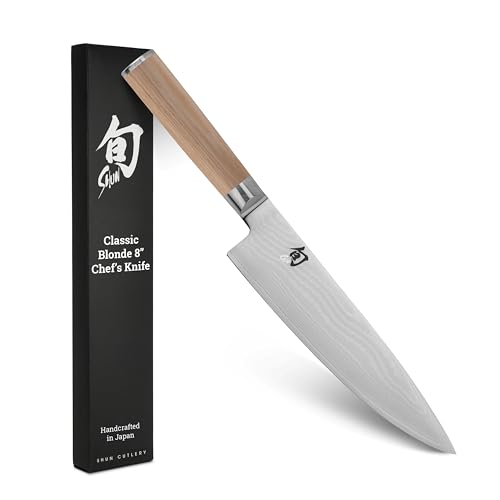
Shun’s Classic Blonde reimagines the Classic Series that introduced Japanese cutlery to American kitchens, upgrading from VG-10 to a proprietary VG-MAX core that optimizes carbide distribution for improved edge retention and chip resistance. The 68-layer Damascus stainless steel cladding creates a striking visual gradient, and the 16-degree double-bevel edge offers a balance that suits both experienced cooks and confident home users. The D-shaped blonde Pakkawood handle is designed for both left and right-handed use, a rare consideration in the Japanese knife world.
At 10.88 ounces, the Shun feels substantial but not heavy — noticeably denser than the Mac but lighter than a typical German chef knife. The blade profile curves smoothly for rock-chopping while maintaining a fine tip for precise work. Users consistently report that the edge remains sharp for months with regular honing, and the VG-MAX alloy shows better corrosion resistance than standard VG-10, with fewer reports of rust spots even in humid environments. Shun also offers free sharpening service, which adds long-term value.
The premium price reflects the brand’s marketing as much as the materials — you’re paying for the Shun name, warranty, and customer support infrastructure. Some users find the blade slightly too thin for heavy-duty tasks like breaking down chickens, and the blonde handle shows dirt and stains more readily than darker Pakkawood. Edge chipping is still possible if misused, but the VG-MAX formulation is noticeably tougher than older Shun steels. For a single go-to knife backed by a well-established warranty network, the Classic Blonde is a strong premium contender.
Why it’s great
- VG-MAX core improves chip resistance over standard VG-10
- Blonde Pakkawood handle is comfortable and ambidextrous
- Free sharpening service adds long-term value
Good to know
- Premium price includes brand markup
- Blade may be too thin for heavy poultry breakdown
- Blonde handle shows grime and stains quickly
5. HOSHANHO 16-Piece Japanese Knife Set

The HOSHANHO 16-Piece set is the only full-kitchen option in this guide, and it earns its place by offering genuine Japanese high-carbon stainless steel (10Cr15CoMoV, equivalent to VG-10 in performance) across a comprehensive lineup: 8-inch chef, 7-inch santoku, 8-inch bread, 8-inch carving, 7-inch fillet, 6-inch utility, 3.75-inch paring, six 4.5-inch steak knives, kitchen shears, and a sharpening rod, all housed in a ventilated acacia wood block. Each blade is sharpened to a 15-degree angle and hardened to 58 HRC — a solid middle ground between sharpness and toughness.
The Pakkawood handles are full-tang and ergonomically shaped for a secure pinch grip, and the weight distribution across each knife is consistent and professional. The included sharpening rod is a practical addition for daily maintenance, and the block’s bottom ventilation prevents moisture buildup. Users report that the chef and santoku knives perform well on vegetables, meat, and fish, with the 15-degree edge offering a noticeable upgrade over typical grocery-store knife sets. The steak knives are a welcome bonus for dinner service.
Where the set falls short is fit and finish — some units show minor imperfections at the blade-handle junction, and the scissors have a complex swivel lock that can fail. The knives are made in China despite the Japanese steel name, which matters to purists. At its typical price, it represents strong value for someone upgrading from a cheap block set, but the individual knife quality does not match the Yoshihiro or Shun single blades. The magnetic block works well, but loading heavy knives requires care to avoid bumping adjacent blades.
Why it’s great
- Comprehensive 16-piece set covers every kitchen knife need
- 10Cr15CoMoV steel provides VG-10-like performance at a set price
- Included sharpening rod and ventilated block add daily usability
Good to know
- Made in China despite Japanese steel branding
- Scissors mechanism can fail prematurely
- Individual knife quality doesn’t match dedicated single blades
6. KYOKU Shogun Series VG-10 Damascus Chef Knife

The KYOKU Shogun Series 8-inch chef knife delivers a genuine VG-10 steel core with 67-layer Damascus cladding at a price point that undercuts most competitors by a wide margin. The blade is cryogenically treated and sharpened to an 8-12 degree edge using the traditional Honbazuke method, resulting in out-of-box sharpness that rivals knives costing three times as much. The G-10 fiberglass handle with mosaic pin is impervious to heat, cold, moisture, and corrosion — a practical choice for busy kitchens where knives get wet repeatedly throughout the day.
The blade’s 58-60 HRC hardness is on the lower end of VG-10 performance, which actually works in its favor for durability — it’s less prone to chipping than harder VG-10 knives while still holding an edge significantly better than generic stainless. The included sheath and gift box add value that most budget knives skip entirely. Users consistently report that the knife maintains its sharpness for months with simple stropping, and the balanced weight distribution reduces fatigue during extended use.
The downsides are predictable at this tier: the Damascus pattern is laser-etched rather than forged into the steel, the G-10 handle texture is less refined than Pakkawood, and the blade geometry is slightly thicker behind the edge than premium options, meaning it wedges slightly in dense produce like potatoes. The fit and finish are good for the price but not flawless — some units have minor inconsistencies at the spine transition. For the cook who wants VG-10 performance and Damascus aesthetics without the premium spend, the KYOKU is a pragmatic entry point.
Why it’s great
- Genuine VG-10 core at an accessible price point
- G-10 fiberglass handle is nearly indestructible and moisture-proof
- Includes sheath and gift box for safe storage
Good to know
- Damascus pattern is laser-etched, not traditionally forged
- Blade geometry is thicker behind the edge — some wedging on dense veg
- Handle texture lacks the comfort of wood or Pakkawood
7. SYOKAMI 7-Piece Knife Set
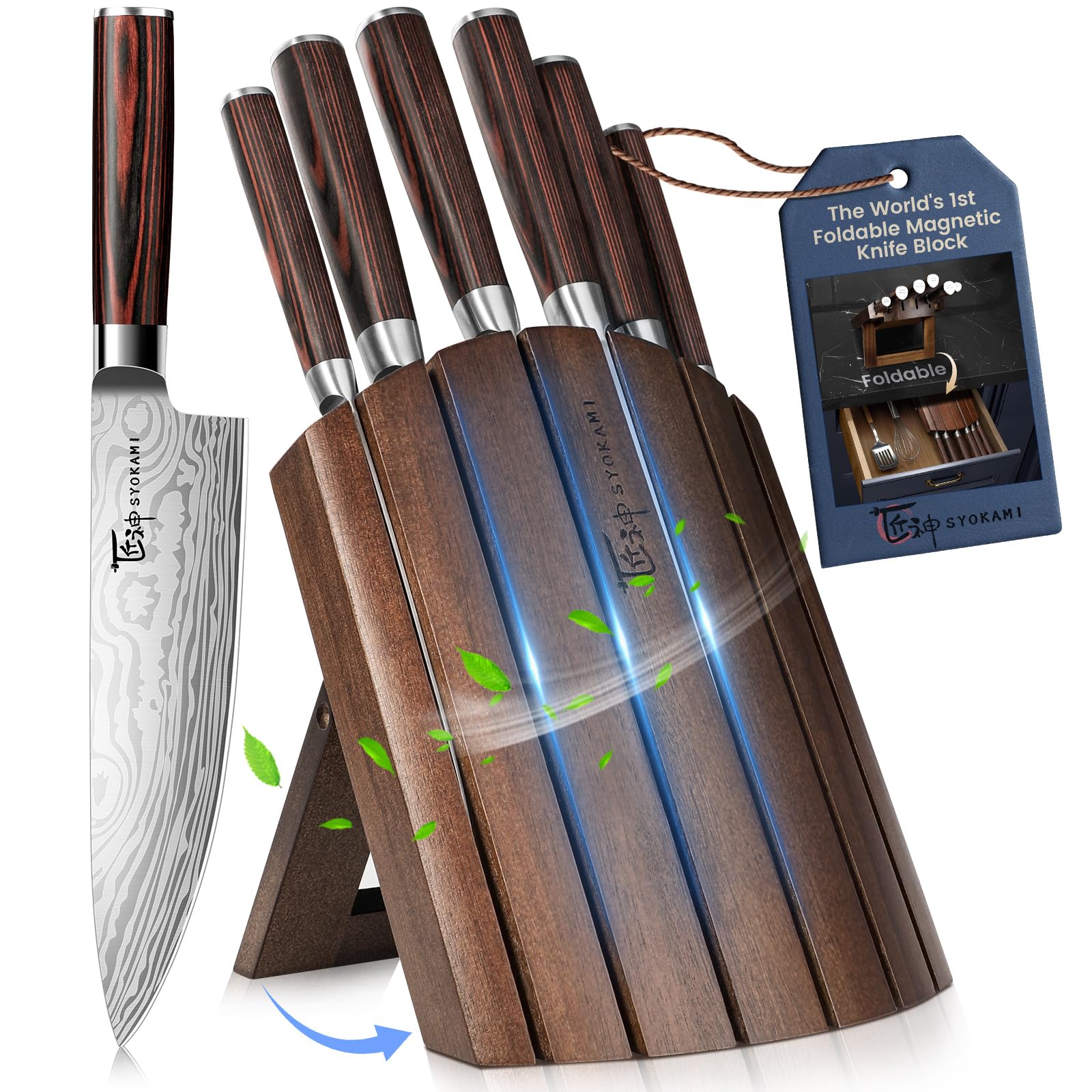
The SYOKAMI 7-Piece set differentiates itself with a foldable acacia wood knife block that collapses flat for drawer storage — a genuine space-saving innovation for small kitchens or homes with children and pets. The six-knife lineup covers the essentials (8-inch chef, 7-inch santoku, 8-inch slicing, 8-inch bread, 6-inch utility, and 3.8-inch paring) with blades made from high-carbon stainless steel hardened to 56+ HRC and hand-sanded to a 15-degree edge. The magnetic strip inside the block holds each knife securely when the block is upright on its easel stand.
The knives are sharp out of the box and perform well for everyday tasks — slicing tomatoes, dicing onions, and portioning cooked meat. The santoku is particularly effective for push-cutting vegetables, and the paring knife has a comfortable finger-length blade for peeling and detail work. The acacia wood block is FSC-certified and looks attractive on the counter, though the easel stand can feel unstable when fully loaded, and the magnets are not powerful enough to resist a firm pull — knives can shift if the block is bumped from the side.
The steel is not as hard or edge-retentive as VG-10, so expect to need sharpening more frequently — the 56 HRC rating is softer than the other knives in this guide. The block’s foldable mechanism is clever in concept but the easel mode requires careful placement to avoid tipping, and the open slot design collects debris that needs brushing out. For a family wanting a complete, space-conscious knife set without a high budget, the SYOKAMI is functional and attractive, but serious cooks should invest in a single better blade.
Why it’s great
- Foldable block stores flat in a drawer — ideal for small kitchens
- Complete 7-piece set covers all essential knife types
- Acacia wood block is attractive and FSC-certified
Good to know
- 56 HRC steel dulls faster than VG-10 or SG2
- Easel stand can tip when fully loaded with knives
- Magnetic grip is not strong enough for secure side-bump resistance
FAQ
Can I use a Japanese chef knife on a bamboo cutting board?
How often should I sharpen a VG-10 Japanese chef knife?
Is it safe to mince garlic with a thin Japanese blade?
Final Thoughts: The Verdict
For most users, the best japanese chef knife winner is the Yoshihiro VG-10 Hammered Damascus Gyuto because it pairs genuine Japanese VG-10 performance, hammered food-release texture, and a full-tang mahogany handle at a price that represents real value. If you want uncompromising edge retention and are willing to handle a brittle blade with care, grab the Miyabi Birchwood SG2. And for a complete kitchen upgrade that includes bread, slicing, and steak knives in one package, the HOSHANHO 16-Piece Set delivers the most practical coverage for the money.

Mo Maruf
I created WellFizz to bridge the gap between vague wellness advice and actionable solutions. My mission is simple: to decode the research and give you practical tools you can actually use.
Beyond the data, I am a passionate traveler. I believe that stepping away from the screen to explore new environments is essential for mental clarity and physical vitality.