Our readers keep the lights on and my smoothie glass nicely filled. As an Amazon Associate, I earn from qualifying purchases.
Specs are compiled from manufacturer listings and verified buyer reviews and can change over time — please confirm the key details on the product page before buying.
Finding a home computer that actually fits your life — not a clunky tower that eats your desk or a slow all-in-one that struggles with video calls — depends on one thing: matching the processor and memory to what you do every day. In this guide you will get clear, plain-English advice on eleven different home computers, from tiny mini PCs that hide behind your monitor to tower desktops with room to grow, so you can pick the one worth your money without getting lost in tech jargon.
I’m Mohammad Maruf — the founder and writer behind WellFizz. This guide is built by comparing the manufacturers’ published specifications and the patterns across verified customer reviews, so you get each pick’s real strengths and trade-offs instead of marketing spin.
if you need a computer for remote work, school assignments, streaming, or light creative projects, you will find a reliable match here — we have sorted through the specs and buyer feedback to surface the most dependable options for a home computer that delivers real everyday value without the usual guesswork.
Our Picks at a Glance
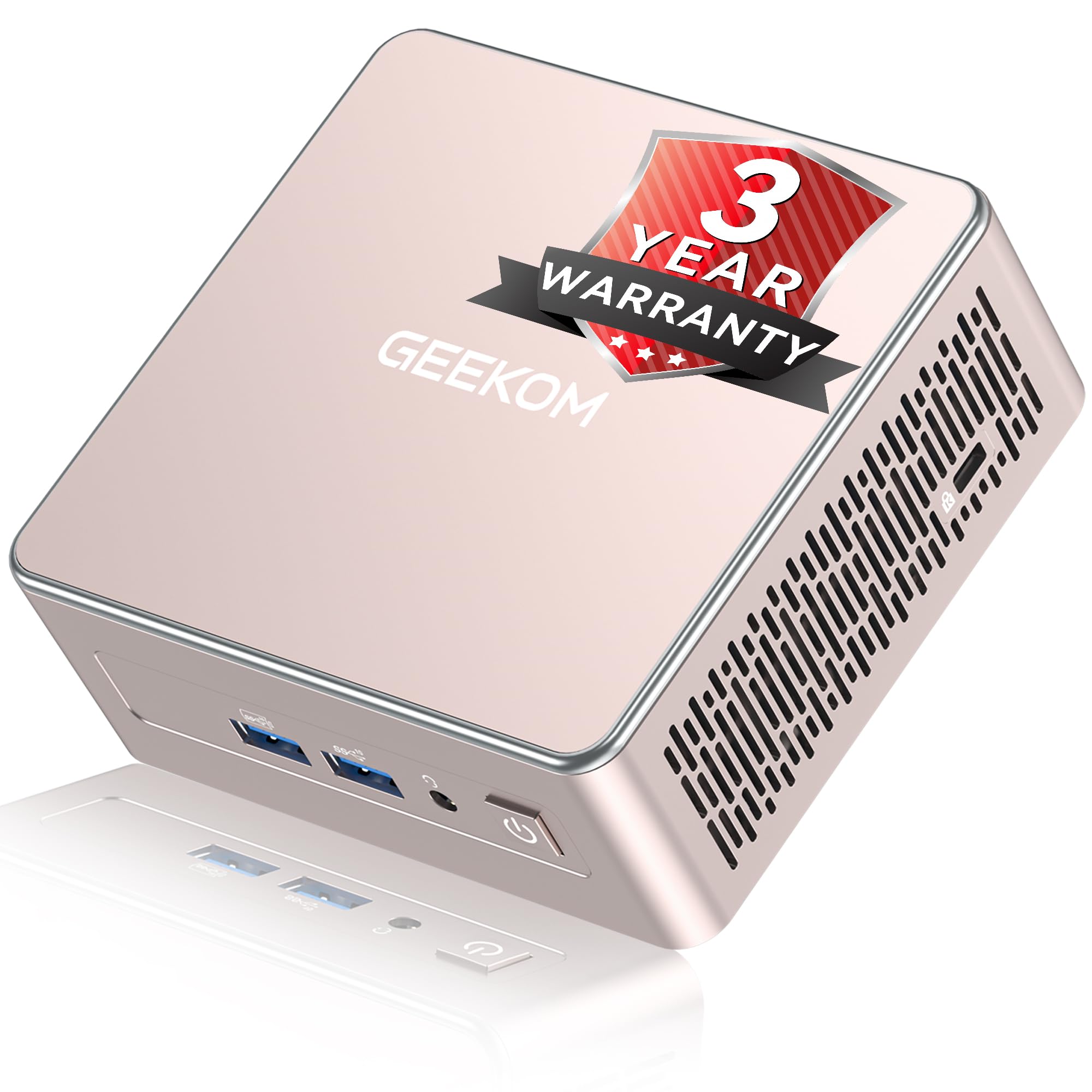
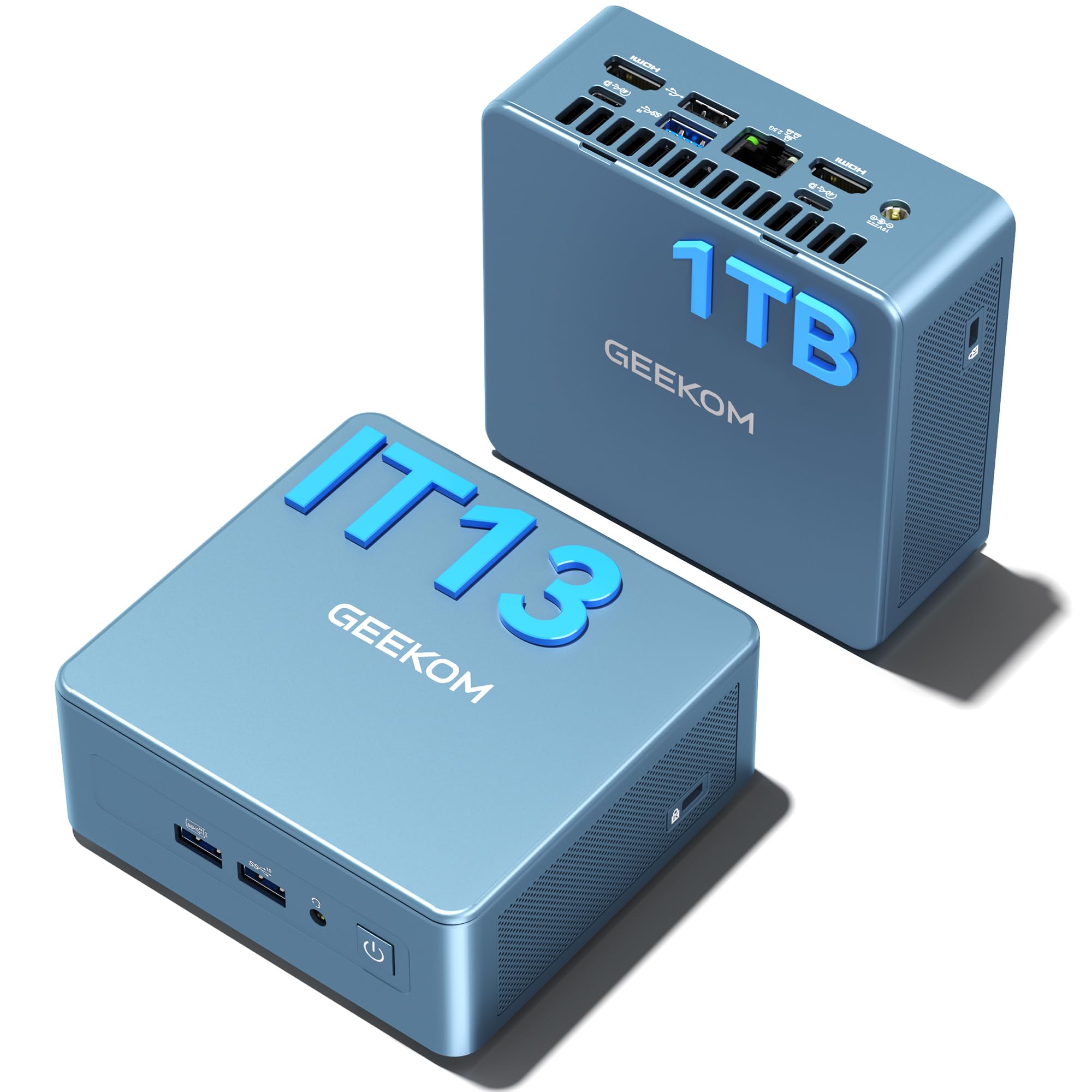

How To Choose The Best Home Computer
Before you click “buy”, understand three things — the processor (its “brain”), the memory for multitasking, and the form factor that fits your desk. A fast processor and enough RAM (16GB is a realistic balance for comfort) matter more than brand names or flashy lights.
Processor Generation Matters More Than Model Number
A 13th-gen Intel chip is substantially faster and more power-efficient than a 7th-gen chip with a similar-sounding “i7” label. Look for at least a 12th-gen Intel Core (i5 or higher) or a modern AMD Ryzen 5 or 7 to ensure your computer handles Windows 11 and new software without slowing down in two years.
RAM and Storage — What Realistic Multitasking Needs
8GB of RAM is the absolute minimum for comfortable browsing and office work, but 16GB is where you stop noticing lag when you have ten browser tabs open alongside a video call. For storage, a 512GB NVMe SSD is the baseline — it boots in seconds and loads apps instantly. Skip machines with old-school hard drives (HDDs); they feel sluggish from day one.
Mini PC, Tower, or All-in-One — Which Desk Space Wins?
A mini PC (about the size of a thick book) tucks behind your monitor and runs silently, making it ideal for tight desks. Towers offer more room for internal upgrades and usually have better cooling for heavy workloads. All-in-ones combine the screen and computer into one clean unit — great for a spare room or a tidy kitchen counter, but usually harder to upgrade later.
Quick Comparison
| Model | Best For | Processor / Cores | RAM / Storage | Max Display Res | Amazon |
|---|---|---|---|---|---|
| GEEKOM A5 (2026)★ Best Overall | Best Overall | Ryzen 5 7430U / 6 cores | 16GB / 512GB NVMe | 7680×4320 | Amazon |
| GEEKOM IT13Premium Compact | Premium Compact | i5-13600H / 12 cores | 16GB / 1TB NVMe | 7680×4320 | Amazon |
| Dell 24 AIO (EC24250)Best All-in-One | Best All-in-One | Core 3 100U / 6 cores | 8GB / 512GB SSD | 1920×1080 | Amazon |
| ASUS V500 Tower | Power User Tower | i7-13620H / 10 cores | 32GB / 1TB SSD | 4096 | Amazon |
| HP Pro Tower 290 G9 | Mid-Range Tower | i5-12500 / 6 cores | 16GB / 512GB SSD | — | Amazon |
| HP ProDesk 600G4 | Budget Tower | i7-8700 / 6 cores | 32GB / 1TB SSD | 3840×2160 | Amazon |
| Dell Optiplex 7060 SFF | Budget SFF | i7-8700 / 6 cores | 32GB / 512GB NVMe | 3840×2160 | Amazon |
| MECHAZER AIO 23.8″ | Curved AIO | i7-7700HQ / 4 cores | 16GB / 512GB SSD | 1920×1080 | Amazon |
| Lenovo IdeaCentre AIO | Budget AIO | Intel N100 / 4 cores | 8GB / 512GB SSD | 1920×1080 | Amazon |
| GEEKOM A9 Max | Creator / AI | Ryzen AI 9 HX 370 / 12 cores | 32GB / 1TB SSD | 8K via USB4 | Amazon |
| Core Innovations AIO 24″ | Entry-Level | Celeron N5095 / 4 cores | 4GB / 128GB | 1920×1080 | Amazon |
In‑Depth Reviews
1. GEEKOM A5 2026 Edition Mini PC
Our pick — 4.5★ from 450+ verified ratings; the strongest balance of quality and price.
The tiny PC that outruns most towers for daily tasks.
This mini PC is the smartest starting point for nearly any home user because it packs a modern AMD Ryzen 5 7430U processor (which hits a max speed of 4.3 GHz) into a chassis barely larger than a book. You get 16GB of DDR4 RAM that you can upgrade later to 64GB, plus a 512GB NVMe SSD for fast boot times — and if you need more space, it has an empty M.2 slot and a bay for a 2.5-inch drive, supporting up to 10TB total. The cache memory installed size here is 16 MB, compared to 1.5 MB in entry-level all-in-ones, so it feels snappier right from the start.
Buyers report it is “perfect for WFH (Zoom, Teams, remote desktop), streaming, light gaming,” and they highlight that it handles multiple 4K monitors without a hitch. That is possible thanks to the AMD Radeon Vega 7 graphics, which drive up to four displays at once (including 8K visuals through a USB-C port). The 3-year limited warranty is rare at this level, and with Wi-Fi 6 and Bluetooth 5.2 built in, you get a reliable, future-proof connection for video calls and file transfers.
Desk-space hero: Vibration-damping feet, a metal mid-frame, and a reinforced ABS+PC shell make it sturdy enough for 24/7 operation behind your monitor. One real trade-off: It is a mini PC, so you will need to supply your own monitor, keyboard, and mouse — but the VESA mount lets you attach it directly to the back of most screens.
Your best bet if: You want the most performance per square inch of desk space, with room to upgrade RAM and storage later. Look elsewhere if: You need an all-in-one with a built-in screen or you expect to do heavy gaming on integrated graphics.
2. GEEKOM IT13 Mini PC (2026)
A mini PC with 12-core muscle that rivals full-size towers.
When you need serious horsepower without the tower bulk, the GEEKOM IT13 delivers a 13th Gen Intel Core i5-13600H processor with 12 cores and 16 threads, hitting up to 4.8 GHz. That processor muscle, paired with 16GB of RAM (upgradeable to 96GB) and a 1TB PCIe Gen4 NVMe SSD — makes this a genuine workstation substitute for photo editing, coding, and running multiple heavy applications side by side.
Unlike the A5, this unit adds dual USB4 ports (at 40Gbps each) that support 8K output and eGPU connections, so you could drive two 8K monitors plus two 4K displays at the same time. It also includes next-gen tri-band Wi-Fi 6E (2.4, 5, and 6 GHz) and a 2.5G Ethernet port for lag-free streaming and large file transfers. Buyers call it “awesome,” noting it handles dual 4K monitors quietly and stays cool thanks to the metal frame, though a few mention the default fan curve can be loud until you adjust it in the BIOS.
Built tough: The reinforced ABS+PC composite shell with a metal frame is rated to withstand 440 lbs (200 kg) of static pressure — overkill for a desk, but it means this thing is built to last. The catch: The IT13 is not a plug-and-play machine for everyone; some buyers needed to update drivers and tweak fan settings to get the quietest performance.
Reach for this if: You regularly edit photos, run virtual machines, or want a silent, compact PC that can power multiple high-resolution monitors. Skip if: Your budget is tight or you want a system that works perfectly from the start with zero configuration.
3. Dell 24 All-in-One Desktop (EC24250)
The clean, cable-free all-in-one that works from the first boot.
If a single power cable and a keyboard-and-mouse combo sounds better than a tangle of wires, the Dell EC24250 delivers a sharp 23.8-inch FHD IPS display with 99% sRGB color coverage, according to the maker. It runs on an Intel Core 3 processor 100U (a 6-core chip that reaches 4.7 GHz), paired with 8GB of DDR5 RAM and a 512GB SSD — enough for smooth web browsing, streaming, and office tasks without the clutter of a separate tower.
Dell included a 5MP infrared webcam with HDR support, so you look clear on video calls even in dim lighting. The display also uses Dell ComfortView Plus to reduce blue light without washing out colors. Buyers call it “simple, fast, compact” and one reviewer who called it “The ‘I Finally Got My Life Together’ Desktop” noted it is quiet, quick to boot, and maintains a reliable connection with no cable mess. Dell backs it with 1-year onsite service — they come to you if something breaks.
Strong speaker setup: Dual Bluetooth speakers with Dolby Atmos spatial sound give you clear audio for music and video chats without needing external speakers. One trade-off: With only 8GB of soldered DDR5 RAM, heavy multitaskers (dozens of browser tabs plus large documents) might hit a performance wall sooner than with a 16GB machine.
Pick it for: A tidy home office or student desk where simplicity and a built-in webcam matter more than raw multitasking muscle. Look at a mini PC + monitor instead if: You want to upgrade RAM later or need more than 8GB for complex spreadsheets and coding.
4. ASUS V500 Tower Desktop
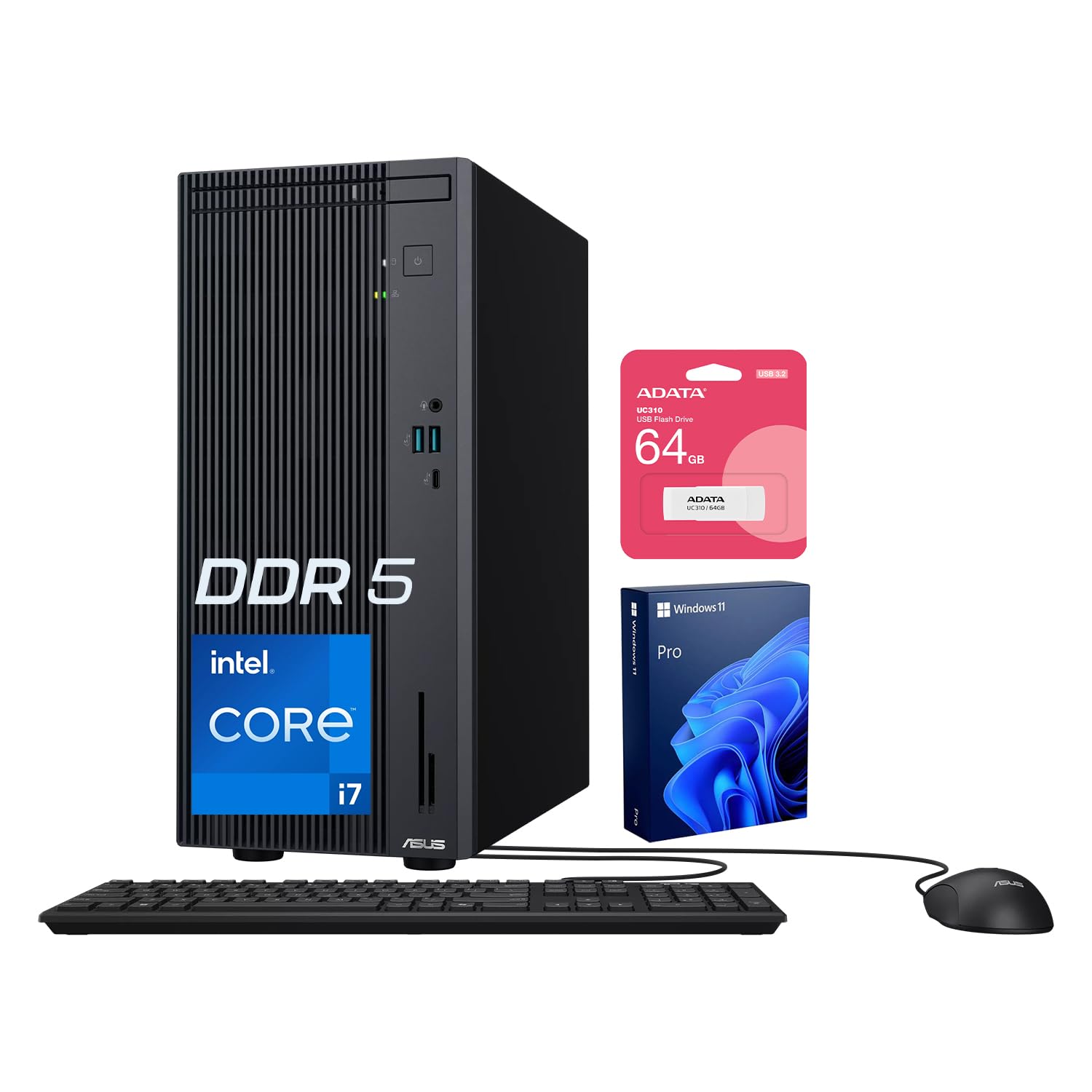
A future-proof tower with 10 cores and 32GB of RAM for serious work.
For anyone who does not want to think about upgrades for years, the ASUS V500 comes loaded with a 10-core Intel Core i7-13620H processor (up to 4.9 GHz), 32GB of DDR5 memory, and a 1TB SSD — a combination that handles heavy multitasking, virtual machines, and large datasets without flinching. The 24 MB of cache here is noticeably larger than what most mid-range towers carry, which helps when you are jumping between demanding programs.
It supports dual monitors through HDMI and DisplayPort outputs, making it a natural fit for a trading desk or a developer workstation. Windows 11 Pro is pre-installed, adding BitLocker encryption and remote desktop features for security-minded users. One buyer who searched hard for “the best value under K” says it is “so quiet, so fast, so lightweight,” and praised the 32GB RAM and 1TB SSD as a huge upgrade from older hardware. Note that the original seal was opened solely for upgrading, and the upgraded components carry a 1-year warranty from the seller.
Generous bundle: Comes with a wired keyboard and mouse plus an A-DATA 64GB USB flash drive for transferring files. One honest caution: A few buyers reported the included flash drive was missing from their shipment — check your box right away and contact the seller if it is not there.
Your machine if: You need a powerful, upgradable tower for professional work and you want 32GB of RAM from day one. Not ideal if: You prefer a compact, space-saving design or you are on a strict budget.
5. HP Pro Tower 290 G9
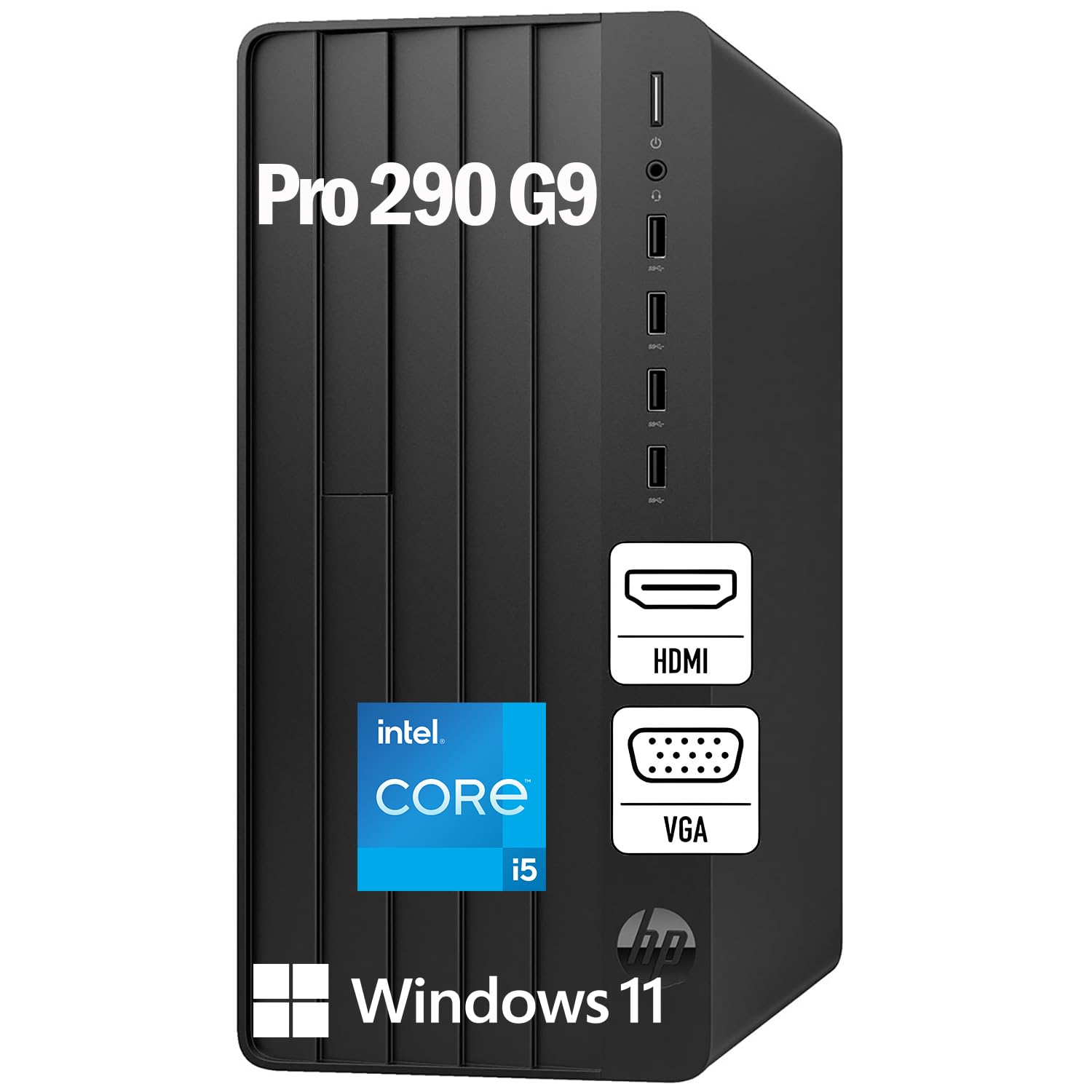
A dependable, no-nonsense tower for a home office that just works.
The HP Pro Tower 290 G9 is built around a 12th Gen Intel Core i5-12500 processor with 6 cores running up to 4.6 GHz and a sizable 18 MB cache, making it a strong middle-ground choice for remote work and everyday productivity. It comes with 16GB of DDR4 RAM (enough for smooth multitasking) and a 512GB PCIe NVMe SSD that boots Windows 11 Home quickly. The Intel UHD Graphics 770 integrated GPU supports dual monitors via HDMI and VGA, so you can run a two-screen setup for spreadsheets and video calls side by side.
Connectivity includes Wi-Fi 6 and Bluetooth 5.3, plus a front panel with four USB 3.0 ports for easy access to thumb drives. The compact tower measures about 12 x 6 x 13 inches, so it fits under most desks without dominating the room. One buyer who replaced an older Windows 10 PC reports it is “fast for daily use” and handles streaming baseball games without glitches. Another noted the PC was quiet — “quieter than MacBook Air” — after adjusting a couple of driver settings for their HP printer.
Business-class build: It includes TPM 2.0 security and uses 15% post-consumer recycled materials in its construction. Watch out: A few buyers received units that failed to boot (SSD not detected, error 3F0), so test it immediately on arrival and be ready to use the return window if needed.
Choose this for: A straightforward, mid-range tower that handles daily office work, web browsing, and streaming without fuss. skip it if: You need a built-in DVD drive (there is none) or you prefer a compact all-in-one to save desk space.
6. HP ProDesk 600G4 Tower Desktop (Renewed)
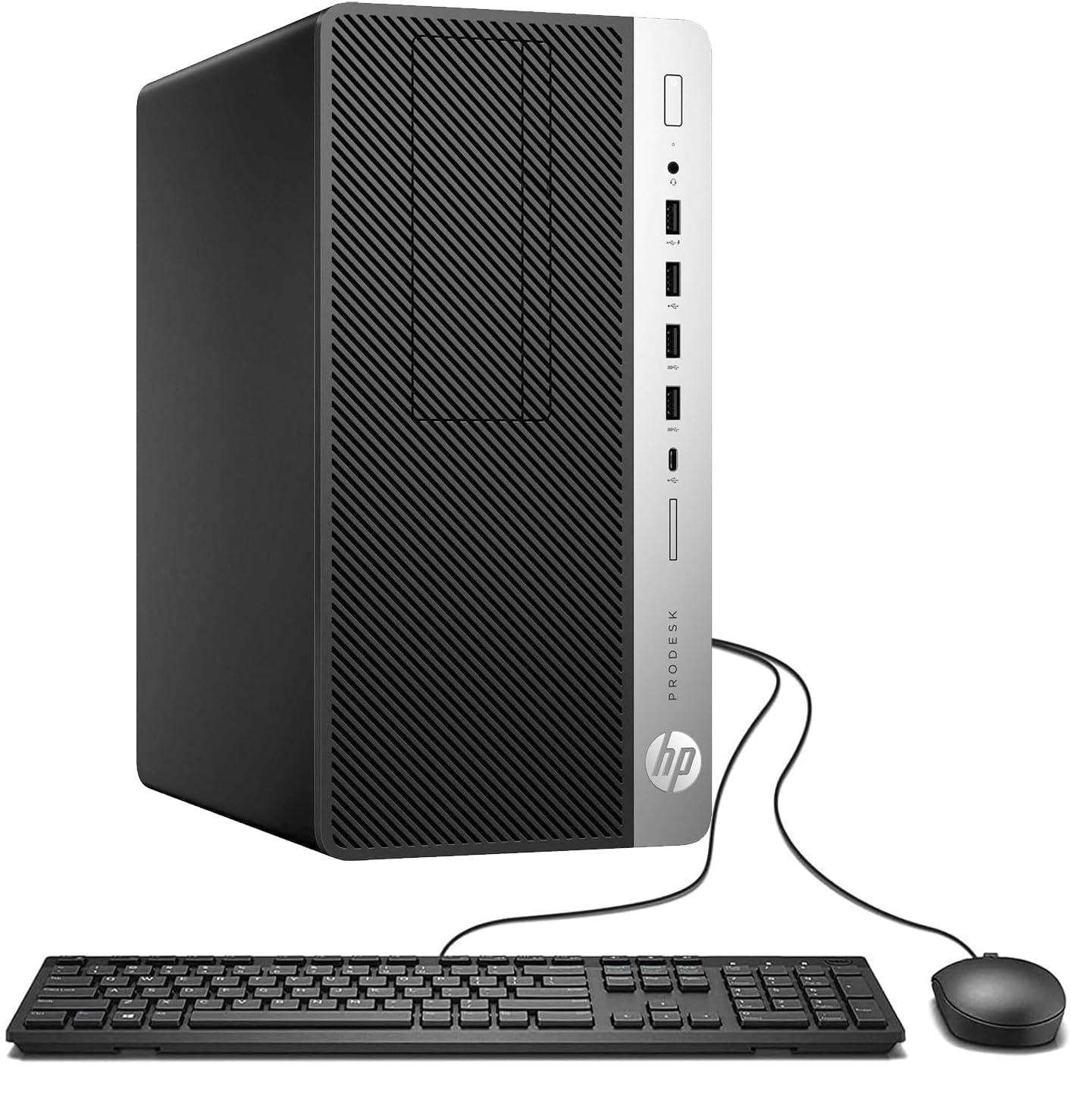
A refurbished workhorse with a huge 1TB SSD and 32GB of RAM.
If your priority is maximum storage and memory for the least money, this renewed HP ProDesk 600G4 delivers an 8th Gen Intel i7-8700 (6 cores, up to 4.6 GHz) with 32GB of DDR4 RAM and a 1TB solid-state drive. That is a lot of RAM for the price — enough to run multiple virtual machines or edit large photo libraries without slowing down. The tower supports 4K resolution (3840×2160) through its dual DisplayPort outputs, so it can drive a high-resolution monitor or a two-screen setup for productivity.
Buyers have mixed experiences: one reports it is “fast, works great with Windows 11” and another says the performance is “5 stars” after setting it up with dual monitors. However, since it is a refurbished unit, you should expect some quirks — one reviewer noted the included USB Wi-Fi adapter is poor (no 5GHz support) and the cheap SSD may need replacing. The rear ports use DisplayPort (you will need an adapter for HDMI monitors), and the case may have cosmetic marks from repainting.
Room to expand: Four internal SATA slots and a DVD drive give you options for adding more storage or an optical disc reader. The honest limit: The processor is from 2018, so it lacks modern efficiency and integrated AI accelerators — fine for office work, but do not expect the latest security features or low power draw.
Best for: Budget-focused buyers who need 32GB of RAM and a 1TB SSD for heavy multitasking on a tight budget. Not for: Anyone who wants a flawless out-of-box experience, built-in Wi-Fi 6, or a compact form factor.
7. Dell Optiplex 7060 SFF (Renewed)

A tiny, cheap tower that packs 32GB of RAM for serious number-crunching.
The Dell Optiplex 7060 SFF (Small Form Factor) offers a compelling deal for budget buyers who need raw memory capacity: an 8th Gen i7-8700 (6 cores, up to 4.6 GHz) paired with 32GB of DDR4 RAM and a 512GB NVMe SSD. The cache memory installed size is 12 MB, which is modest by modern standards, but the sheer amount of RAM makes it a capable machine for running multiple database queries, large spreadsheets, or memory-heavy research software without slowing down.
It comes with Windows 11 Pro pre-installed and includes a wireless keyboard and mouse. Ports are generous — 5 USB 3.0, 2 USB 2.0, and 2 DisplayPorts for dual-monitor support at 4K resolution. One buyer mentioned the PC “worked well for 1 year, then broke: right speaker channel lost sound, system froze on opening programs.” That buyer later had it repaired under an Asurion warranty. Another described it as “amazing build” and “super quiet,” praising its compact size. Since this is a refurbished unit, consider buying an extended warranty for confidence.
Compact footprint: The small form factor case takes up less desk space than a standard tower while still offering room for an optical drive. Common refurb gotchas: The included keyboard and mouse are cheap (they need AA/AAA batteries), and the SSD might be SATA instead of the advertised NVMe — check and ask for a swap if it is wrong.
Grab it if: You need a dirt-cheap machine with 32GB of RAM for memory-heavy tasks like data analysis or running virtual labs. Avoid if: Reliability is your top concern — refurbished units come with higher risk, and buyer reviews show a non-trivial failure rate after one year.
8. MECHAZER All-in-One Desktop 23.8″ Curved
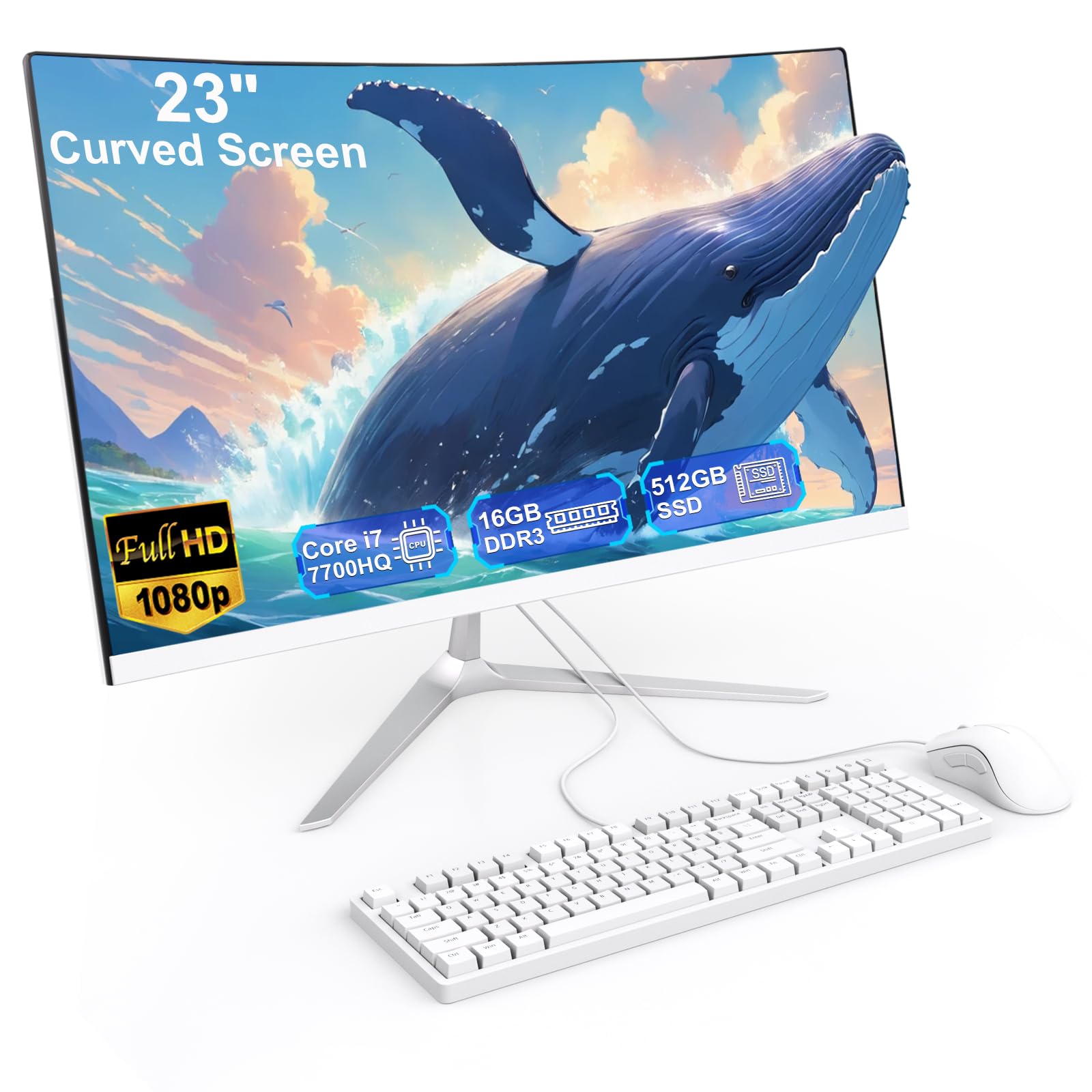
A curved screen all-in-one that brings a touch of flair to your desk.
If you want an all-in-one that looks different from the usual flat-screen design, the MECHAZER wraps its 23.8-inch display in a subtle curve that makes the screen feel more rich for movies and documents. Inside, it runs on a 7th Gen Intel Core i7-7700HQ processor (4 cores, 8 threads, up to 3.8 GHz) with 16GB of RAM and a 512GB SSD — a combination that delivers smooth daily performance for office work, web browsing, and light video streaming. The cache memory here is 6 MB, far smaller than modern chips, but for basic tasks you are unlikely to notice the difference.
It comes pre-installed with Windows 11 Pro and includes a wired keyboard and mouse. Connectivity options are solid: dual-band Wi-Fi, Bluetooth 5.0, 4 USB 3.0 ports, HDMI, Ethernet, and VGA for older monitors. A unique bonus is the built-in fingerprint reader, so you can log in with a tap. One buyer who uses it in a home office says the “23.8” curved screen saves desk space” and the “clear, vibrant display” handles documents and video lag-free. Another noted the arch-shaped base eliminates a bulky stand, saving even more room.
Desk-friendly design: The curved screen and arch base create a smaller footprint than most all-in-ones, and the rear-facing speakers keep the front clean. Processor age: The i7-7700HQ is from 2017 — it lacks modern efficiency cores and integrated AI features, so it may feel slower than newer chips when multitasking with many browser tabs.
Great for: Someone who wants a stylish, space-saving all-in-one with a fingerprint reader for quick logins and does not push heavy multitasking. Not for: Power users who need the latest processor performance or plans to keep the computer for more than 3-4 years without feeling obsolete.
9. Lenovo IdeaCentre AIO 24″
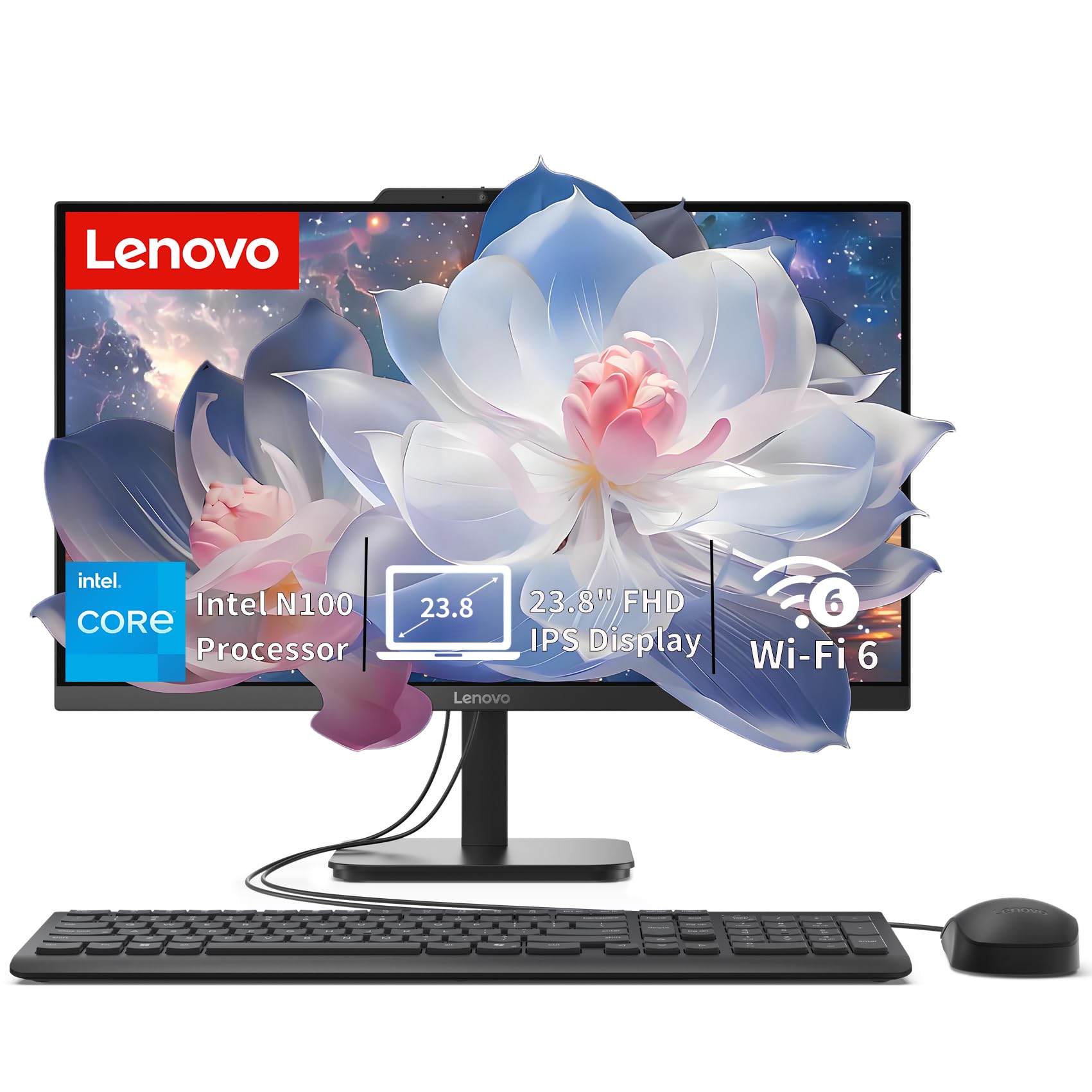
An affordable all-in-one with a sharp anti-glare screen for long work sessions.
For a budget-friendly AIO that puts screen quality first, the Lenovo IdeaCentre pairs a 23.8-inch Full HD IPS display with an anti-glare coating (250 nits brightness, 99% sRGB) so you can work near a window without fighting reflections. It is powered by an Intel N100 processor (4 cores, up to 3.4 GHz, 6 MB cache) with 8GB of DDR4 RAM and a 512GB PCIe SSD — enough for browsing, office apps, and video calls, but not for heavy multitasking or large creative projects.
Connectivity is modern: Wi-Fi 6, Bluetooth 5.2, Gigabit Ethernet, one USB-C port at 10Gbps, two USB-A 10Gbps ports, and an HDMI-out 1.4b for a second display. The built-in HD webcam and dual 2W speakers with a mono microphone cover basic video conferencing needs. One buyer who got the unit as an open-box “at around 50% price” calls it an “excellent machine” with a “stunning display” after 4+ months of use. However, another buyer reports the machine “worked for two weeks then stopped working,” so quality control seems inconsistent.
Anti-glare bonus: The IPS anti-glare display makes a real difference if your desk sits near a sunny window or overhead lights. Warranty catch: Some US owners mention this unit cannot be registered for a Lenovo warranty because it is a grey-market import — check the seller’s origin and local warranty coverage before buying.
Best for: A student or home user who needs a clean, all-in-one setup for basic work and values an easy-on-the-eyes screen. Skip if: You need more than 8GB of RAM, want to do any gaming, or prefer a longer manufacturer warranty.
10. GEEKOM A9 Max Mini PC
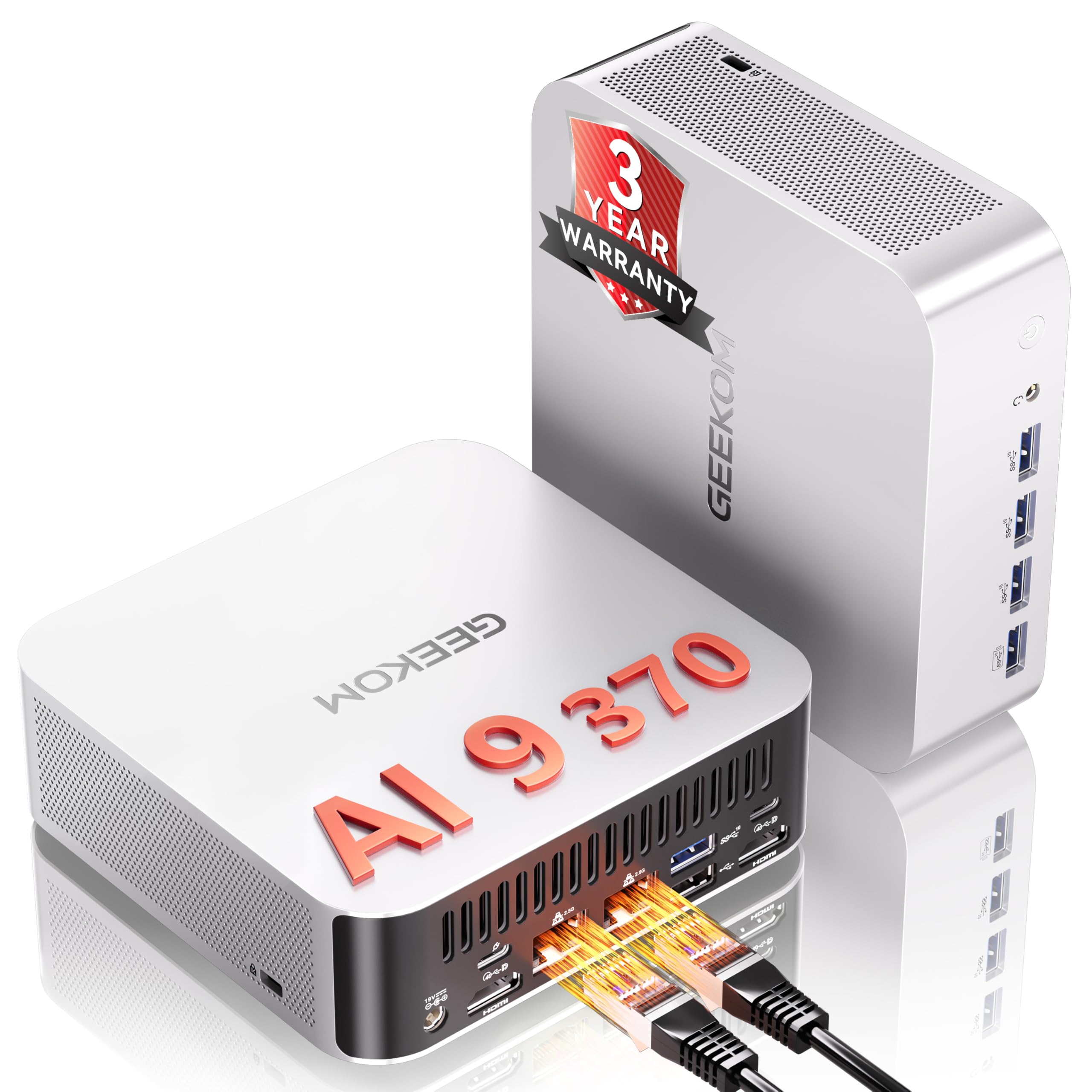
A tiny AI powerhouse that edits 4K video and runs local AI models.
For creative professionals and tech enthusiasts who want bleeding-edge performance in a compact package, the GEEKOM A9 Max is built around the AMD Ryzen AI 9 HX 370 — a 12-core, 24-thread processor with a dedicated XDNA 2 NPU that delivers up to 80 TOPS of AI performance. That makes it capable of running local AI workflows (like Stable Diffusion or Copilot+ features) right on the desktop without a separate graphics card. It comes with 32GB of DDR5 RAM (expandable to 128GB) and a 1TB PCIe Gen4 SSD, plus room for a second drive up to 8TB total.
The integrated Radeon 890M Graphics with 16 RDNA 3.5 Compute Units handles 4K video editing in Adobe Premiere Pro and DaVinci Resolve, and can even play AAA games like Cyberpunk 2077 at playable settings. It supports up to four 8K displays through dual USB4 and dual HDMI 2.1 ports — a massive advantage for financial traders or video editors who need pixel-dense screen real estate. Connectivity is cutting-edge: Wi-Fi 7, Bluetooth 5.4, dual 2.5GbE LAN ports, and a premium all-metal chassis with the IceBlast 2.0 cooling system to keep it from throttling under heavy loads.
3-year warranty: While many brands offer just one year, GEEKOM backs the A9 Max with a 3-year limited warranty covering defects in materials and workmanship. The investment: This is the most expensive pick on this list — it makes sense only if you actually use AI tools, edit video, or need 8K display support. For everyday browsing and office work, a mid-range mini PC will save you serious money.
Buy this if: You are a video editor, 3D artist, AI hobbyist, or power user who needs desktop-class performance from a tiny chassis. Pass if: Your daily routine is limited to web browsing, email, and streaming — you will not use the AI or GPU capabilities that drive the higher price.
11. Core Innovations 24″ All-in-One Desktop

The cheapest all-in-one you can buy — but know the risks.
At the entry level, the Core Innovations 24-inch AIO pairs a 2.9 GHz Intel Celeron N5095 processor with 4GB of RAM and 128GB of storage — the bare minimum for Windows 11 to function. The 24-inch 1920×1080 IPS display is decent for the price, and the built-in webcam and microphone make it usable for basic video calls. The cache memory installed size is just 1.5 MB, a fraction of what modern chips offer — the GEEKOM A5 has 16 MB compared to 1.5 MB, a difference you will feel in everyday responsiveness.
Buyer reviews are sharply divided. One reviewer calls it “the best” and says “the quality is excellent,” while another who purchased four units for an office reports “they lasted not even eight months before failing” and the manufacturer refused to honor the warranty. A different buyer notes the screen does not tilt or adjust, and the stand comes at an awkward angle. At this price, you are gambling on reliability — the specs simply cannot keep up with modern multitasking needs, and the 4GB RAM cap is a hard limit.
Cheapest entry point: If your budget is extremely tight and you only need a computer for the simplest tasks (one browser tab, basic typing), this will work — for a while. Major trade-offs: Multiple customers note units failing within months, the manufacturer support is poor, and the 4GB RAM makes Windows 11 sluggish even during light use. You are much better off saving a bit more for the GEEKOM A5 or a refurbished Dell tower.
Only buy if: You absolutely cannot stretch your budget beyond the bare minimum and you are comfortable with the real possibility the computer may fail within a year. Strongly avoid if: You need a reliable machine for work, school, or any task where downtime matters — buy a used premium PC before you buy this new entry-level model.
Understanding the Specs
Processor (CPU) — The Brain of the Computer
The processor is what determines how fast your computer feels. Measured in gigahertz (GHz), a higher number means it can do more calculations per second. But the generation matters more than the raw speed — a 12th Gen Intel Core i5 at 4.6 GHz is significantly more efficient and powerful than a 7th Gen i7 at 3.8 GHz. For a home computer, aim for at least a 12th Gen i5 or an AMD Ryzen 5 from the 5000 series or newer.
RAM — How Many Things You Can Do at Once
RAM (Random Access Memory) is your computer’s short-term workspace. 8GB is the minimum for comfortable browsing and office work — you can have a few browser tabs and a video call open without major slowdown. 16GB is the balance for most people, letting you run a dozen tabs, a spreadsheet, and a streaming service simultaneously. 32GB is overkill for standard home use but essential if you edit video, run virtual machines, or work with massive datasets.
Storage — Where Your Files Live
Storage comes in two main types: SSDs (Solid State Drives) are fast — they boot Windows in seconds and load apps instantly. HDDs (Hard Disk Drives) are slower and older; avoid them for your main computer. Look for an NVMe SSD (the fastest kind of SSD) with at least 512GB of capacity. If you store a lot of photos, videos, or games, 1TB is a safer bet. Some mini PCs let you add a second drive later, which is a nice upgrade path.
Form Factor — Big Tower, Mini PC, or All-in-One
The shape of your computer matters for your desk setup. A traditional tower (like the HP Pro Tower 290 or ASUS V500) is easiest to upgrade later — you can add more RAM, swap the SSD, or install a discrete graphics card. A mini PC (like the GEEKOM A5 or IT13) is tiny and silent, but it uses laptop-grade components that are harder to upgrade. An all-in-one (like the Dell EC24250 or Lenovo IdeaCentre) combines the screen and computer into one unit — clean looking, but nearly impossible to upgrade and usually more expensive for the same performance.
FAQ
Can I upgrade the RAM in a mini PC later?
Is a refurbished computer like the Dell Optiplex 7060 a good deal?
How much RAM do I really need for home use in 2026?
Is a Celeron or N100 processor fast enough for everyday tasks?
What is the difference between a mini PC and a tower desktop?
Can I connect two monitors to these computers?
How important is Wi-Fi 6 vs Wi-Fi 5 for a home computer?
How important is Wi-Fi 6 versus Wi-Fi 5 for a home computer?
Can these computers run Windows 11 smoothly?
Is an all-in-one computer more expensive than a tower plus a monitor?
What does a 3-year warranty on a mini PC really cover?
What is the best computer for a student on a tight budget?
Final Thoughts: The Verdict
If you want one dependable pick, the best home computer is the GEEKOM A5 2026 Edition Mini PC because it delivers a modern AMD Ryzen 5 processor, 16GB of upgradeable RAM, and a compact, silent design at a price that is tough to top. If you want a premium, more powerful compact machine for creative work or multiple 8K monitors, grab the GEEKOM IT13 Mini PC. And for a clean, cable-free all-in-one that is perfect for a home office or student desk, the Dell 24 All-in-One Desktop EC24250 is the best pick.
How We Picked
We do not accept paid placement. Every pick is matched to a real buyer and a real use-case; we do not hands-on test units.
Sources & Methodology
Specifications: manufacturer listings and product documentation. Review insights: verified customer reviews, as of July 2026. Pricing: not shown on this page (it changes often); check the current price via the retailer link.
As an Amazon Associate, WellFizz earns from qualifying purchases. This does not affect which products we feature.
Related Guides

Mo Maruf
I created WellFizz to bridge the gap between vague wellness advice and actionable solutions. My mission is simple: to decode the research and give you practical tools you can actually use.
Beyond the data, I am a passionate traveler. I believe that stepping away from the screen to explore new environments is essential for mental clarity and physical vitality.