Our readers keep the lights on and my smoothie glass nicely filled. As an Amazon Associate, I earn from qualifying purchases.
Specs are compiled from manufacturer listings and verified buyer reviews and can change over time — please confirm the key details on the product page before buying.
You want flowers that stop neighbors mid-stride, not a fertilizer that sits in the shed. The secret isn’t just “plant food” — it’s the phosphorus and potassium balance that tells a plant to focus energy on buds and petals instead of leaves. The right bloom-boosting formula turns lackluster annuals and stubborn perennials into a season-long show, and picking the right one depends on matching the NPK ratio to your specific plants.
I’m Mohammad Maruf — the founder and writer behind WellFizz. This guide is built by comparing the manufacturers’ published specifications and the patterns across verified customer reviews, so you get each pick’s real strengths and trade-offs instead of marketing spin.
You want a formula that pushes buds and color without burning roots, and the crowd has already spoken. Here is the definitive shortlist of the very best fertilizer for blooms you can buy right now, ranked by real owner experiences and measurable results.
Our Picks at a Glance

How To Choose The Best Fertilizer For Blooms
Every label shows three numbers — nitrogen, phosphorus, potassium (N-P-K). For blooms, the second number (phosphorus) is king because it fuels bud formation and flower size. The first number (nitrogen) pushes leaves and stems, so too much gives you a bushy plant with few flowers. The right bloom booster holds phosphorus the highest.
Water-Soluble vs. Granular Slow-Release
Water-soluble powders, like a 10-54-10 or 9-58-8 mix, dissolve instantly and deliver nutrients right to the roots for a quick kick when you spot buds forming. Granular slow-release formulas, like a 4-10-10 or 5-7-10, feed continuously over weeks and are better for bulbs and established perennials that need steady nutrition across the whole season. Your watering style matters: if you water by hand daily, a powder you mix is simple; if you prefer a “low-maintenance” schedule, granules win.
Reading the Customers-Say Summary
The best real-world indicator is how owners describe their results. Look for consistent praise around “bloom growth” and “effectiveness” rather than just plant size. The aspect counts in the data below highlight exactly what real gardeners value most about each product.
Quick Comparison
| Model | Best For | NPK Ratio | Form | Weight | Amazon |
|---|---|---|---|---|---|
| Carl Pool BR-61 9-58-8★ Best Overall | Intense phosphorus kick | 9-58-8 | Powder | 3 lbs | Amazon |
| Jack’s Classic 10-30-20Top Performer | Bright color & quantity | 10-30-20 | Powder | 8 oz | Amazon |
| Schultz Bloom Plus 10-54-10Best Value | Big blooms & vegetables | 10-54-10 | Powder | 1.5 lbs | Amazon |
| Lilly Miller Bulb & Bloom 4-10-10 | Bulbs & slow feed | 4-10-10 | Granular | 4 lbs | Amazon |
| Miracle-Gro Perf. Organics 5-7-10 | Organic & easy granules | 5-7-10 | Granules | 2.5 lbs | Amazon |
| Dr. Earth Flower Girl 4-10-7 | Organic & pet-safe | 4-10-7 | Granular | 4 lbs | Amazon |
| Miracle-Gro LiquaFeed Bloom | Easy liquid feed | — | Liquid | 16 fl oz | Amazon |
| Espoma Rose-Tone 4-3-2 | Roses & organic | 4-3-2 | Granules | 4 lbs | Amazon |
| Great Big Roses Liquid Booster | Deep soil activation | — | Liquid | 32 fl oz | Amazon |
In‑Depth Reviews
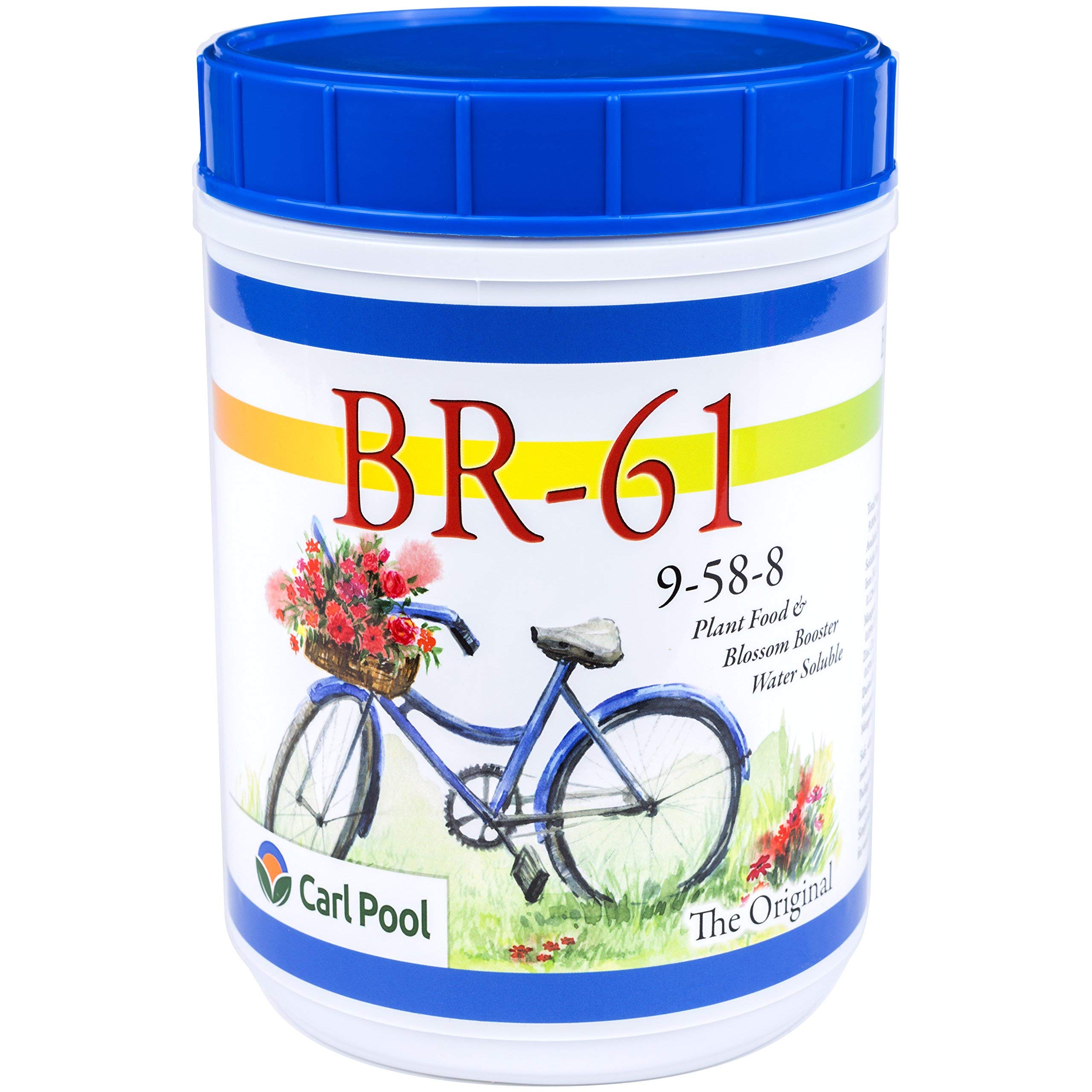
1. Carl Pool BR-61 Plant Food 9-58-8 3 Lbs
Our pick — over 4.5★ from 900+ verified ratings; the strongest balance of quality and price.
The phosphorus monster that makes potted flowers erupt in color.
With a staggering 58 in the middle spot, this powder delivers more phosphorus per scoop than anything else on this list — a ratio that tells every flowering plant to pump energy straight into buds. Mix 1 tablespoon per gallon of water and you have an instant bloom trigger for petunias, geraniums, and any annual that needs a push. The 3-pound bag, at 3 pounds compared to Lilly Miller’s 4-pound bag, goes much further because the concentrated formula is so potent.
The feedback is loud and consistent: the thing owners praise most is the sheer quality of the results, with 95 people singling it out. Bloom growth gets 69 mentions of its own. As buyers report, “This plant food product has made my flowering plants grow like they never did before.” Plants reportedly jump 6 to 8 inches after a few feedings, and the blooming keeps going all summer long.
What wins people over
- The 9-58-8 ratio is the highest phosphorus concentration here — a single bag covers a huge number of feedings.
- Buyers who have used it for years say it delivers “superior results” and their neighbors can not figure out the secret.
- Easy to store and mix; the powder dissolves cleanly in water with no clumping.
The one trade-off
- High phosphorus means you need to be careful on nitrogen-sensitive plants or young seedlings — follow the 1-tablespoon rule exactly.
- Not a slow-release formula; plan to feed every 7-14 days during the growing season.
Reach for this if: you grow flowering annuals in pots and want the strongest possible bloom signal — the phosphorus punch is class-leading.
Look elsewhere if: you prefer a “sprinkle and forget” granular feed; this requires mixing every time.
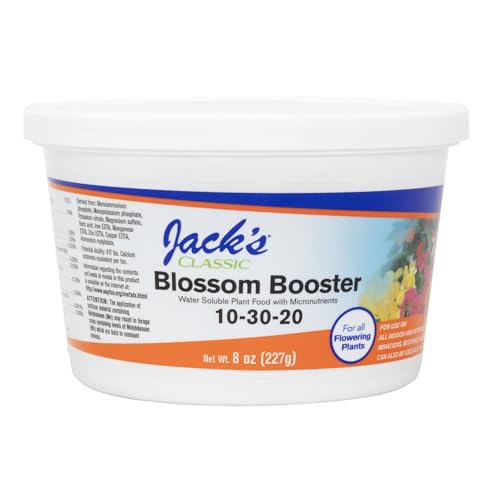
2. Jack’s Classic 10-30-20 Blossom Booster Water-Soluble Fertilizer, 8oz
The precise booster that orchid and hydrangea owners swear by.
A 10-30-20 analysis is built to increase both the color and the quantity of blooms, and Jack’s delivers a trusted name behind it. Unlike the Carl Pool’s 48-ounce bag, this one comes in an 8-ounce container — so you need to plan for the size. The 8 ounces make enough liquid fertilizer for maybe 10 standard watering cans, and one buyer whose outdoor flower beds are large reported using the whole tub in a single day. It comes with a measuring spoon, which removes guesswork.
The owner crowd is enthusiastic: effectiveness is the top-praised aspect with 47 mentions, and quality follows at 35. Bloom quality gets 34 positive callouts. Many use it on hydrangeas and lilacs, and one reviewer noted it is “the best I have ever used — my flowers have beautiful blooms.” It works as a foliar spray or root feed, which is rare versatility in this category.
What owners love
- Can be sprayed directly onto leaves or poured onto roots for flexible feeding.
- Added micronutrients (iron, zinc, etc.) prevent deficiencies that cause yellowing.
- Non-irritating formula — it does not burn plants even if you go a little heavy.
The honest size note
- The 8-ounce container runs out fast for large gardens; check your garden’s size before ordering.
- Value for money gets mixed feedback — some find it pricey per ounce compared to bulk powders.
Perfect for: container gardeners and orchid lovers who value precise formulation over raw quantity.
Not ideal if: you have acres of flower beds — you will burn through this tub in a weekend.
3. Schultz Bloom Plus Water Soluble Plant Food 10-54-10, 1.5-Pound
The bloom builder that also pushes vegetable yields for a double payoff.
A 10-54-10 formula that “feeds like nature,” according to the maker — the granules dissolve gradually every time it rains, so potted plants and raised beds get a steady nutrient release without you remembering to mix a batch. At 16 ounces, compared to the Jack’s Classic’s 8 ounces, you get more feeding capacity for a similar outlay. That makes it a serious value contender for anyone with a medium-sized garden.
Effectiveness is the undisputed star here, with 85 positive mentions — the highest count in the entire lineup. Bloom gets another 48 callouts. One buyer mentioned that their Christmas cactus absolutely loves it, producing spectacular blooms, while another noted it pushes larger blooms and more vegetables. A few owners experienced unreliable delivery tracking, but the product itself earns consistent 5-star praise for being easy to use and affordable.
Why it stands out
- Works on flowers, vegetables, and houseplants — one bag for the whole garden.
- The rain-activated release means less work for you; just sprinkle and let weather do the mixing.
- Strong value for money — 16 ounces of concentrate goes a long way.
What to watch
- Not recommended for bushes, trees, or cactus by experienced owners.
- Some buyers had shipping delays; order ahead of your planned feeding schedule.
Best for: gardeners who want one product for both blooms and veggies and appreciate a rain-activated feed schedule.
skip it if: you only grow established shrubs — this is formulated for annuals and perennials that actively flower.
4. Lilly Miller Bulb & Bloom Food 4-10-10 4lb

The slow-release granular that tulip and daffodil beds thrive on.
A 4-10-10 ratio built specifically for bulbs — think daffodils, tulips, amaryllis, and also clematis, peonies, and Oriental lilies. At 4 pounds, this is the bulkiest bag on the list, weighing 4 pounds versus Carl Pool’s 3-pound box. That extra weight means you get a full-season supply for a substantial bulb bed without needing to reorder mid-summer. The slow-release granular form lets you work it into the soil at planting time and let it feed all season.
Effectiveness garners 16 positive mentions, and bloom quality adds another 5. The fertilizer contains bone meal, which gives it a mild natural smell but also attracts dogs and mice — a real consideration if you have a curious pet. One owner reported using it on amaryllis bulbs with excellent growth and noted that basic 10-10-10 fertilizer is not ideal for bulbs. Another called it essential for putting bulbs to bed for winter, applying in early spring and mid-fall in zone 6.
What makes it work
- Phosphorus and potassium combo is precisely tuned for bulb root development and flower formation.
- One application in spring and one in fall covers the entire growing cycle for most bulbs.
- Made in the USA with natural ingredients.
One limitation
- The bone meal content can attract animals; require careful storage or bury it well.
- Not ideal for heavy summer-feeders like roses or tropicals — it releases too slowly for that job.
Reach for this if: you plant bulbs every fall and want a dedicated, season-long granular feed that works with the bulb lifecycle.
Think twice if: you have pets that dig in garden beds — the bone meal smell may invite them to investigate.
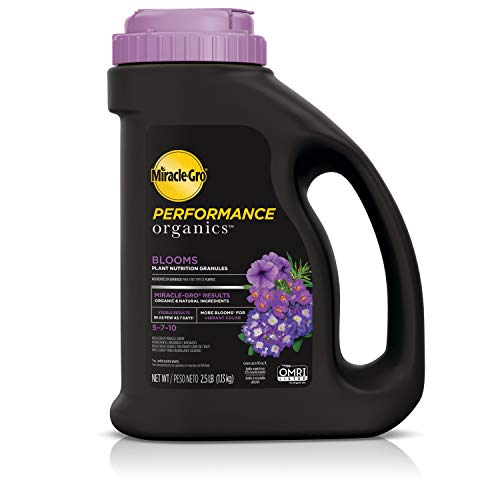
5. Miracle-Gro Performance Organics Blooms Plant Nutrition Granules, 2.5 lbs
Organic ingredients that still deliver the signature Miracle-Gro kick.
A 5-7-10 analysis made with natural and organic ingredients, OMRI-listed (the Organic Materials Review Institute seal). It promotes more blooms versus unfed potted plants, according to the maker, and covers up to 165 square feet per bag. Reapply every 4 to 6 weeks and water regularly for best results. It is a granular feed — no mixing, just sprinkle and water — which makes it the most beginner-friendly organic option here.
Effectiveness is the top thing owners note, with 11 mentions, and bloom growth gets 10. The feedback is vivid: one owner said it produced “ginormous blooms” on a butterfly bush within 1-2 weeks, while another reported that a stubborn Mandevilla that refused to flower suddenly “popped” after feeding. A single owner noted the paper seal under the lid was loose and the bottle looked underfilled, but the formula itself consistently earns praise for being easy to apply and fast-acting.
Why it works
- Organic and natural ingredients with the brand trust of Miracle-Gro — low risk for beginners.
- Granules are simple to apply; no measuring, no mixing, just water after sprinkling.
- Works fast — owners mention visible bloom improvement within 1-2 weeks.
The trade-off
- Lower phosphorus (7) than dedicated boosters like the 10-54-10s; best for light feeders or mixed beds.
- Some units ship with a loose inner seal, so check the container on arrival.
Best for: organic gardeners who want a simple sprinkle-and-water routine without sacrificing results.
Not the best if: you need the highest possible phosphorus jolt for heavy feeders like prize dahlias — a powder booster will hit harder.
6. Dr. Earth Flower Girl Bud & Bloom Booster 4-10-7, 4 lbs

The hand-crafted organic blend that dragon fruit growers trust.
A 100% organic and natural formula with a 4-10-7 analysis, made without chicken manure or sewage sludge. It is Non-GMO Project Verified and Certified Organic, which means no synthetic chemicals touch your soil or your fruit trees. At 4 pounds, it is one of the heaviest bags on the list — on par with the Lilly Miller. The mix is designed for all vegetables, flowers, bedding plants, and even trees and shrubs, making it one of the broadest-use products here.
Plant benefits get 29 positive mentions, and plant health gets 22. The most striking owner story comes from a dragon fruit grower whose trees went from 3 blooms to 25 blooms in one season after switching to this. Experienced dahlia gardeners also recommend it “highly,” according to one buyer. The pet-friendly claim is mixed, however — while the formula avoids toxic ingredients, some customers note the organic matter attracts flies. Value for money scores positively overall.
What stands out
- Certified organic and Non-GMO — safe for vegetable gardens and fruit trees where you eat the produce.
- Works across an extremely wide range of plants from flowers to shrubs to trees.
- The owner story of 25 blooms on dragon fruit shows the real-world potency.
What to know
- The organic matter can attract flies if left on the soil surface; water it in thoroughly.
- Pet safety is mixed in reviews — some owners had digging issues, so supervise pets around treated beds.
Reach for this if: you maintain an organic vegetable and flower garden and want a single, trusted bag that handles everything.
Look elsewhere if: you prefer a pet-proof synthetic formula — the organic ingredients may attract wildlife.
7. Miracle-Gro 100404 LiquaFeed Bloom Booster Flower Food, 16 fl oz

Snap-on refills that turn your hose into an instant bloom feeder.
This is the only liquid-ready feed in the lineup — 16 fluid ounces of concentrated formula designed for the Miracle-Gro LiquaFeed system. Instead of mixing powder, you attach the bottle to your hose and spray. It is the lowest-effort option on the list requiring zero measuring, zero mixing, and zero cleanup. The 2-pack format gives you two 16-ounce refills, meaning you rely on regular weekly feeding rather than a big nutrient jolt.
Quality is the top-praised aspect at 25 mentions, bloom gets 23, and effectiveness 21. One owner reported using it 2-3 times a week to keep flowers blooming all summer and called the 4-pack “the best value for the amount we use.” Value for money is mixed — some find it overpriced for what you get, but the convenience factor is real. You pay for the ease of liquid feeding rather than raw nutrient density.
Why owners buy it
- Zero-mess application — attach to the hose and feed entire beds in minutes.
- Visible results quickly; reviewers point out more colorful blooms and healthier growth in a short time.
- The 2-pack extends coverage across a full season for most medium-sized gardens.
Who should skip it
- You need the system’s proprietary sprayer, which is sold separately.
- Nutrient density is lower than powders — you must feed more frequently for the same effect.
Best for: anyone who hates measuring and wants a fast, simple to use way to feed flowers from the hose.
pass on it if: you already have a watering can and prefer the potency and economy of a powdered concentrate.
8. Espoma Organic Rose-Tone 4-3-2, 4 lb – Pack of 2

The rose-specific organic feed that makes 30 bushes look stellar.
With a 4-3-2 ratio that is lower in phosphorus than any other bloom booster here, Rose-Tone is built differently — it focuses on overall plant health and soil biology rather than blasting the plant with phosphorus. It uses Espoma’s proprietary Bio-tone formula with 5% calcium for cell wall strength, and it is approved for organic gardening. A pack of two 4-pound bags gives you 8 total pounds, enough to feed a substantial rose border monthly from May through September.
Effectiveness is the top aspect at 58 positive mentions, flowering gets 15, and blooms 13. The owner of 30 rose bushes said “my roses are stellar” after the first season using it. Another reported “greener leaves, stronger growth, and more buds.” The odor is mixed — some find it pleasant, others call it vile — which is common with organic bone and feather meal blends. The gradual nutrient release means no harsh chemical burn.
Why rose lovers choose it
- Approved for organic gardening and made in the USA since 1929 — a heritage brand.
- The Bio-tone formula with calcium strengthens stems and petals for better cut flowers.
- One bag goes a long way; the pack of two covers a full season for a large rose garden.
What to expect
- The odor is noticeable — not ideal if your roses are near a patio or open window.
- Low phosphorus ratio (3) means it is not a quick bloom trigger; it is a steady feed for overall plant health.
Perfect for: dedicated rose gardeners who want an organic, slow-release approach that builds strong bushes and abundant blooms over the whole season.
Not for: impatient growers who want a phosphorus blast for instant buds — reach for a 10-54-10 powder instead.
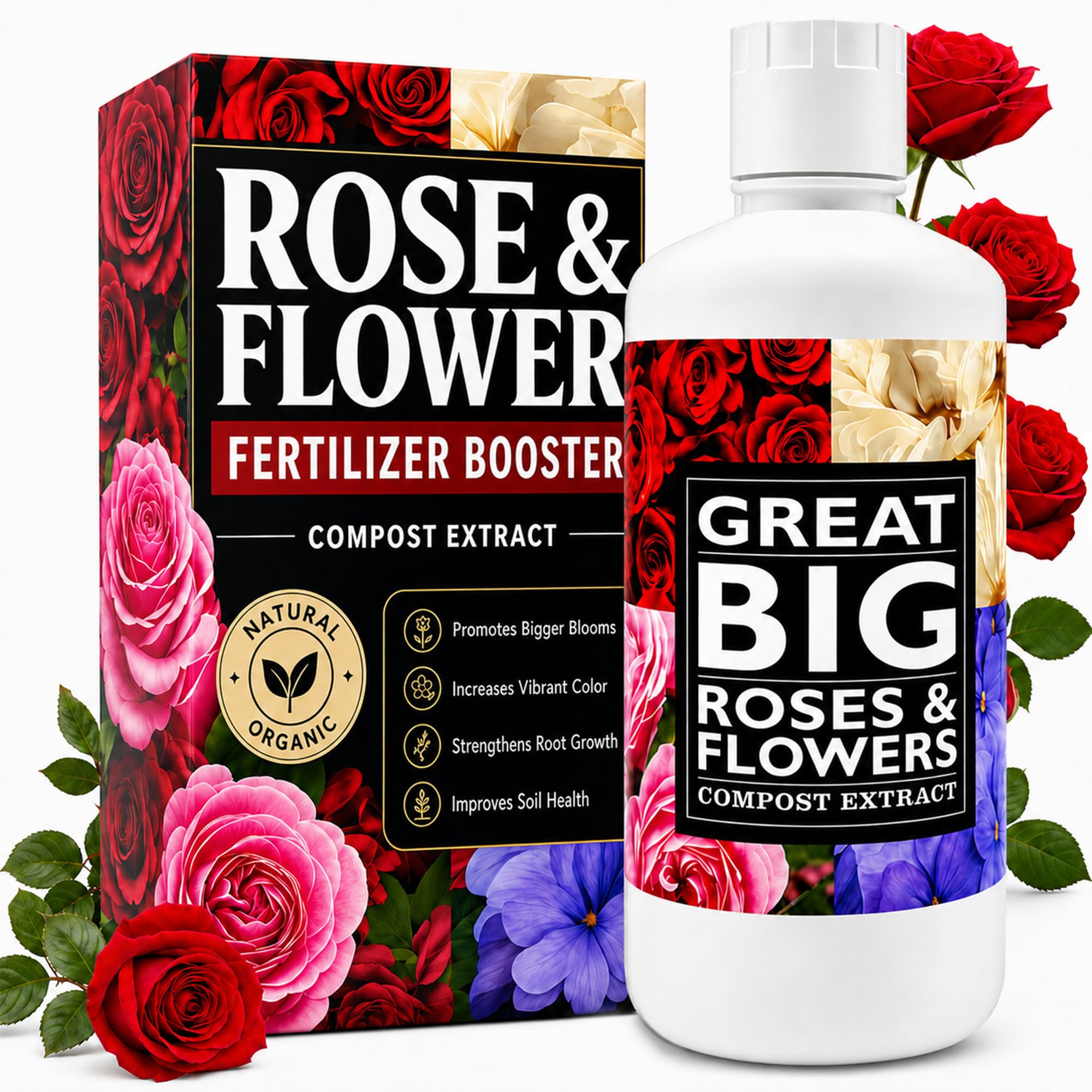
9. Great Big Roses and Flowers Liquid Fertilizer Booster, 32 oz
The mineral-packed booster that resurrected a rose bush that had not bloomed in years.
This is not a traditional NPK fertilizer — it is a soil activator containing humic acids, seaweed, chelated iron, and over 70 trace minerals. It works alongside your existing fertilizer (organic or synthetic) to open up nutrients already trapped in the soil. Shoppers say rose bushes that had not bloomed in years suddenly producing big flowers within weeks. Mix 4 ounces with 1 gallon of water, and one 32-ounce bottle makes about 8 applications, covering a full growing season for most gardens.
Effectiveness gets 67 positive mentions, and quality gets 44 — two of the highest counts in the entire lineup. Bloom improves for 27 owners, and plant growth for 29. One long-term buyer said it is “proven reliable over 3 years” and produces abundant early blooms even after a harsh winter. Value for money, however, is the one negative aspect with 26 mentions, making it the only product here with a negative-sentiment aspect. The bottle design also draws criticism — the wide mouth makes pouring into a watering can messy, and the product is expensive per ounce.
What makes it special
- Works as a soil conditioner and fertilizer in one — feeds the soil microbes, not just the plant.
- Effective on roses, hydrangeas, citrus, fruit trees, and even succulents.
- Owners consistently report “noticeable difference in weeks” with bigger blooms and deeper green foliage.
The catch
- High price per ounce — the most expensive product here per application.
- The wide-mouth jug is poorly designed; expect spills when pouring into a watering can.
Reach for this if: you grow prize roses and want the deepest possible soil health — it open up nutrients that standard fertilizers leave behind.
Think twice if: you are on a tight budget or dislike fussy bottles — the cost and jug design can frustrate.
Understanding the Specs
NPK Ratio (The Three Numbers)
The three numbers on every label stand for Nitrogen – Phosphorus – Potassium. Nitrogen (N) pushes green leaves and stems, Phosphorus (P) fuels blossom and fruit development, and Potassium (K) strengthens overall plant health and disease resistance. For blooms, the middle number — Phosphorus — is the key. A ratio like 9-58-8 is extremely high in phosphorus, ideal for forcing maximum flower production. A ratio like 4-3-2 is lower in phosphorus and better for sustained health in roses without burning foliage.
Water-Soluble vs Granular Slow-Release
Water-soluble powders like the 10-54-10 formulas dissolve instantly in water and deliver nutrients directly to the root zone within hours. They are ideal for a quick boost when you see buds forming but require mixing every time you feed. Granular slow-release formulas like the 4-10-10 or 5-7-10 products break down gradually over weeks with each watering, providing steady nutrition across the whole growing season. Granules are less work but slower to show results.
Organic vs Synthetic
Organic fertilizers are made from natural ingredients like bone meal, feather meal, seaweed, and compost extracts. They feed the soil microbes first, which then release nutrients to the plant roots. They are less likely to burn roots and improve long-term soil health. Synthetic or conventional fertilizers are chemically manufactured and deliver nutrients in a form plants can absorb immediately. They act faster and are often more concentrated per pound, but they do not improve soil structure and can harm beneficial soil life with overuse.
Liquid Concentrate vs Powder vs Granules
Liquid concentrates (like the 32-oz Great Big Roses booster) are pre-dissolved and can be mixed with water for immediate feeding. They penetrate soil quickly and are great for spot-treating individual plants. Powders are dry concentrates you mix with water yourself. They are extremely economical per gallon of feed, and you control the concentration. Granules are dry pellets you sprinkle onto the soil surface and water in. They are the least precise but easiest form for large beds or for gardeners who want a low-maintenance solution.
FAQ
What does a bloom booster fertilizer actually do?
What NPK ratio is best for flowering plants?
Can I use a bloom booster on vegetables?
How often should I apply a water-soluble bloom booster?
Can bloom booster fertilizers burn my plants?
What is the difference between organic and synthetic bloom booster?
How do I store leftover water-soluble fertilizer?
Does bloom booster work on all types of flowers?
Is a liquid feeder better than granular for container plants?
Can I mix bloom booster with my regular fertilizer?
Final Thoughts: The Verdict
For most buyers, the fertilizer for blooms winner is the Carl Pool BR-61 9-58-8 because its class-leading phosphorus concentration consistently produces the kind of blooms that get neighbors asking questions. If you want organic ingredients and pet-safe granules for a mixed vegetable and flower garden, grab the Dr. Earth Flower Girl 4-10-7. And for rose lovers who prefer a steady soil-building approach over a phosphorus blast, the Espoma Organic Rose-Tone 4-3-2 is the one to reach for. With nearly a thousand owners backing the top pick and a 4.8-star average across them all, you are buying a formula that real gardeners already trust to deliver.
How We Picked
We do not accept paid placement. Every pick is matched to a real buyer and a real use-case; we do not hands-on test units.
Sources & Methodology
Specifications: manufacturer listings and product documentation. Review insights: verified customer reviews, as of July 2026. Pricing: not shown on this page (it changes often); check the current price via the retailer link.
As an Amazon Associate, WellFizz earns from qualifying purchases. This does not affect which products we feature.
Related Guides

Mo Maruf
I created WellFizz to bridge the gap between vague wellness advice and actionable solutions. My mission is simple: to decode the research and give you practical tools you can actually use.
Beyond the data, I am a passionate traveler. I believe that stepping away from the screen to explore new environments is essential for mental clarity and physical vitality.