Our readers keep the lights on and my smoothie glass nicely filled. As an Amazon Associate, I earn from qualifying purchases.
Specs are compiled from manufacturer listings and verified buyer reviews and can change over time — please confirm the key details on the product page before buying.
Fighting dandelions and clover while trying to thicken up a patchy lawn usually means two separate trips around the yard — one with a sprayer, one with a spreader. A single product that does both, killing broadleaf weeds (weeds with flat, branching leaves) and feeding the grass at the same time, saves you an afternoon and removes the guesswork. The trick is picking the right formula for your grass type and yard size, because not all weed-and-feed products play nice with every lawn.
I’m Mohammad Maruf — the founder and writer behind WellFizz. This guide is built by comparing the manufacturers’ published specifications and the patterns across verified customer reviews, so you get each pick’s real strengths and trade-offs instead of marketing spin.
Your yard size, the application method you prefer, and the specific weeds you are battling determine the best fertilizer and weed killer for you. This article lines up the top performers and the honest limits of each one.
Our Picks at a Glance

How To Choose The Best Fertilizer And Weed Killer
Not every bag or bottle that says “weed and feed” works well for every yard. A few key factors separate the products that actually green up your grass and kill the weeds from the ones that leave you frustrated and still hand-pulling. Here is what to check before you buy.
Match the Formula to Your Grass Type
Some blends are safe for St. Augustine and centipede grasses, while others can scorch or even kill those turf types. A product like Spectracide Weed & Feed specifically calls out St. Augustine compatibility, which matters if you live in a warm-season region. Always scan the fine print before spreading — a product that is perfect for fescue in the north can be disastrous for a southern Bermuda lawn.
Coverage Area — The Real Cost Per Yard
One bottle of Scotts Liquid Turf Builder covers up to 6,000 sq ft for warm-season lawns. A single bag of The Andersons Professional Surge covers up to 16,000 sq ft. If you have a large property, buying a bigger granular bag often works out to fewer trips to the store and less money per square foot, even though the upfront price is higher.
Liquid vs. Granular — Which Application Fits Your Weekend
Liquid hose-end sprayers (like the Spectracide and Scotts options) are fast and require no special equipment — just screw onto a garden hose and walk. Granular products need a rotary or drop spreader, which takes a little upfront setup but often gives more even coverage across a big lawn and feeds the grass for up to 3 months with a single application.
Quick Comparison
| Model | Best For | Coverage | N-P-K Ratio | Form | Amazon |
|---|---|---|---|---|---|
| Scotts Liquid Turf Builder + Plus 2★ Best Overall | All-around liquid ease | 6,000 sq ft (warm) | — | Liquid Spray | Amazon |
| Spectracide Weed & Feed 20-0-0Top Performer | Big coverage, St. Augustine safe | 7,500 sq ft | 20-0-0 | Liquid Spray | Amazon |
| Jonathan Green Veri-Green 21-0-3 | 3-month feed, 250+ weed control | 5,000 sq ft | 21-0-3 | Granular | Amazon |
| Jonathan Green Green-Up 21-0-3 | Deep greening for visible results | 5,000 sq ft | 21-0-3 | Granular | Amazon |
| The Andersons Premium 24-0-16 | Iron-boosted deep green | 5,000 sq ft | 24-0-16 | Granule | Amazon |
| The Andersons Professional Surge 16-0-9 | Large-yard pro-grade power | 16,000 sq ft | 16-0-9 | Granule | Amazon |
In‑Depth Reviews
1. Scotts Liquid Turf Builder with Plus 2 Weed Control
Our pick — over 4★ from 36,500+ verified ratings; the strongest balance of quality and price.
The liquid all-rounder that kills dandelions and clover while greening up your lawn in one pass.
You attach this Scotts formula to your garden hose, and it covers up to 6,000 sq ft for warm-season lawns (4,000 sq ft for cool-season), so you can hit the whole front yard without mixing or measuring. What wins people over is the speed: buyers report that plantain, dollar weed, and clover show visible wilting in about a week. One owner put it this way: “Killed plantain, dollar weed, clover in 1 week; Japanese clover took 2 weeks.” The fertilizer side delivers a quick nitrogen boost — nitrogen (N) is the nutrient that makes grass grow green and fast — so your grass grows thicker and fuller, which directly competes with the weeds for sunlight and space.
The obvious trade-off is that it does not kill crabgrass. Several owners note that same limitation. You also need to keep pets off for 24-plus hours after spraying, and the manufacturer warns that some weeds — like Japanese clover — take up to two weeks. But for the sheer volume of broadleaf weeds it hits (buckhorn, chickweed, ground ivy, henbit, oxalis, pigweed, plantain, poison ivy, ragweed, spurge, and more), this is the most versatile spray-on option available at a price that undercuts professional lawn services by a wide margin.
Compared to the Spectracide below, the Scotts covers 25% less area (6,000 vs. 7,500 sq ft) but carries a broader weed list and a much larger owner base that confirms it works on the toughest yard invaders. The hose-end sprayer itself has a simple on/off lever, and owners mention it is easy to control so you do not accidentally over-spray a flower bed.
What Wins Owners Over
- Screw-and-spray hose-end applicator eliminates mixing and spreader setup
- Kills plantain, dollar weed, clover, and dandelions in 1-2 weeks
- Nitrogen boost makes grass thick and full after two applications
The Honest Limits
- Does not kill crabgrass — your main enemy gets a pass
- Japanese clover can take a full two weeks to die
- Keep pets and kids off the lawn for 24+ hours after spraying
Best for medium lawns: If you have a 4,000-to-6,000-sq-ft yard with dandelions, clover, and plantain, this is the fast spray-on solution you want in the garage.
Think twice if: Crabgrass is your main problem or you have a cool-season lawn that only gets 4,000 sq ft of coverage — you will need a second bottle for the back yard.
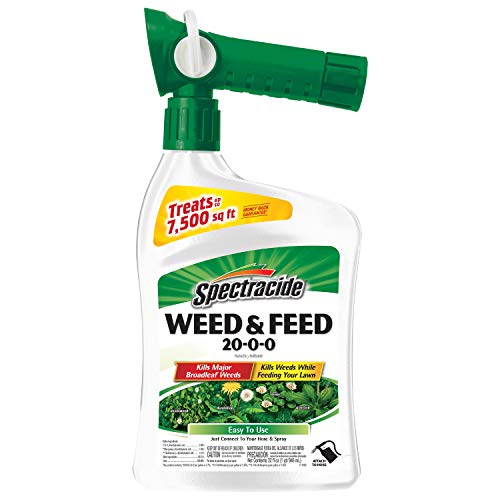
2. Spectracide Weed & Feed 20-0-0 (Ready-to-Spray)
Covers 7,500 sq ft compared to the Scotts at 6,000 sq ft, with a 20% nitrogen jolt that turns grass dark green.
A single 32-ounce bottle of Spectracide treats up to 7,500 sq ft — a noticeable jump over the 6,000 sq ft the Scotts covers — which matters if you have a third-of-an-acre lot and do not want to buy two bottles. The 20-0-0 nitrogen formulation delivers a strong fertilizer punch that owners say shows real greening after about two weeks, especially after some rain. The dual action is straightforward: it kills major broadleaf weeds (dandelion, chickweed, knotweed, plantain, clover, mallow, purslane, and others) while feeding the grass. The “QuickFlip” sprayer simply grips onto your hose — grip, flip, go — with no tools at all.
The honest feedback splits two ways. Many owners love the fast weed kill — they watch weeds turn white within days — and the fact that it is safe for St. Augustine grass, which is a critical compatibility check for southern lawns. On the other hand, tough weeds like lawn violets often require three treatments, and the product has a distinct salty smell that lingers for a few days after application. The sprayer gets mixed reviews: a few units arrive with a defective nozzle, though most owners say it works exactly as designed.
This is the right pick if you need wider coverage per bottle and you grow St. Augustine, but plan for a second application on stubborn weeds like violets. At the coverage numbers, it beats the Scotts on pure square footage and the Jonathan Green granules on convenience — no spreader, no bag, just hose water and a walk.
Why It Stands Out
- 7,500 sq ft per bottle, compared to 6,000 sq ft for the Scotts and 5,000 sq ft for some granular competitors.
- Specifically safe for St. Augustine grass — a deal-saver for southern yards
- QuickFlip hose sprayer makes application faster than any spreader
The Trade-Offs
- Lawn violets may need three spot treatments to fully die
- A few customers note a defective sprayer nozzle from the start
- Salty chemical smell hangs in the air for a couple of days
Reach for Spectracide if: You have St. Augustine grass, a lawn over 6,000 sq ft, or you just want the widest per-bottle coverage available.
skip it if: You hate chemical smells near your house or you are battling lawn violets — you will need multiple applications and patience.
3. Jonathan Green (16002) Veri-Green Weed and Feed 21-0-3

A granular 21-0-3 that feeds your lawn for up to 3 months and tackles more than 250 weed types.
The most obvious difference with a granular feed like the Veri-Green is how long it lasts. The 21-0-3 analysis — 21% nitrogen (N, for growth), 0% phosphorus (P, often omitted in weed-and-feeds), and 3% potassium (K, for root strength and stress resistance) — provides gradual, consistent nutrient release for up to 3 months. That is triple the duration of a liquid spray that washes away after a few weeks. That extended feeding means your grass gets steady nutrition all season. The fine particle size delivers even coverage through a rotary or drop spreader over a 5,000 sq ft area. The weed control is broad — 250-plus broadleaf weeds, including dandelions, chickweed, clover, wild onions, thistle, and poison ivy — and reviewers point out that they see a greener, healthier lawn within just a couple of weeks.
Here is the honest complication: effectiveness on weeds is the most-discussed aspect, and the consensus is mixed. The instructions warn that it cannot be used at the same time as seeding a new lawn, so if you are doing a full reseed, you need to plan the timing separately. The quality of the product itself is the strongest positive — 15 owners single out the build and consistency — but the weed-killing results do vary by yard.
On price per square foot, this is a solid mid-range value compared to the granular options from The Andersons, and it feeds longer than any liquid on this list. The real fit is for someone who already owns a spreader and wants a low-maintenance feed that lasts the whole summer.
What You Get
- Feeds for up to 3 months with one application — lasts far longer than liquids
- Controls over 250 broadleaf weeds, including poison ivy and thistle
- Fine granule size gives even, thorough coverage across 5,000 sq ft
What To Watch
- Weed-killing results vary — not every owner sees complete die-off
- Cannot be applied at the same time as seeding new grass
- Requires a spreader; not a grab-and-go hose-end product
Best for weekly spreader users: If your routine already includes a rotary or drop spreader, this bag delivers a full season of feeding with one trip to the yard.
Think twice if: You are starting a new lawn from seed or you want guaranteed weed kill on every single species — results vary by yard conditions.
4. Jonathan Green (12344) Green-Up Weed & Feed 21-0-3

If turning your lawn dark green fast is the goal, this 21-0-3 granular feed is the favorite.
Greening is the standout quality here — owners mention it 6 times as the best thing about this product. One owner says it made their yard “look the best on my street.” The 21-0-3 analysis feeds for up to 3 months with gradual release, and the fine particle size means the nutrients reach the root zone evenly. Like the Veri-Green sibling above, it kills over 250 broadleaf weeds down to the root, including dandelions, chickweed, clover, wild onions, thistle, and poison ivy. Application is via a rotary, drop, or hand-held spreader, and the manufacturer recommends late spring or early fall for best results.
The honest split: 19 owners discuss effectiveness, and the feedback is mixed. Some report that the grass greens up beautifully while the weeds die back — exactly what you want. Others note a frustrating outcome: “the lawn got nice and green..but so did the weeds!” The formula did not kill every weed for those owners, which is a risk with any selective weed-and-feed. The bag is also described as small (15 lb for 5,000 sq ft), and a few bags arrived with clumps that were hard to break down. If your primary goal is deep, fast greening and you can accept partial weed control, this is your pick. If you need total weed annihilation, the liquid options above are more reliable.
Compared to the Veri-Green, this is essentially the same coverage and N-P-K ratio with a different brand name in the Jonathan Green lineup.
Rave for the green: This is the one owners say made their lawn the envy of the street in terms of color — the 21-0-3 plus fine particles really deliver a deep shade.
But check expectations: The weed kill is inconsistent; if your yard has a heavy mix of tough weeds, you may end up with green grass and still-green weeds.
Reach for it when: Your grass is pale and patchy and you want a dramatic color change — the greening effect is the strongest positive in the feedback.
pass on it if: You are battling a jungle of broadleaf weeds and need guaranteed die-off on every species.
5. The Andersons Premium Weed and Feed 24-0-16

Iron-enriched granules give your yard a deep blue-green color that liquids just cannot match.
This 18 lb bag from The Andersons packs a 24-0-16 analysis plus iron, which produces a fast green-up from quick-release nitrogen and a longer feeding from slow-release nitrogen. The iron is the key differentiator — it promotes a deeper, richer green tone that owners say makes their lawn “look much better” in about two weeks. It controls existing dandelions and over 250 broadleaf weeds, and it is safe for bahia, Bermuda, bluegrass, centipede, fescue, rye, St. Augustine, and zoysia grass. That is a wider grass-type compatibility list than most competitors offer, which makes it a flexible choice if you are unsure of your exact turf variety.
The honest feedback from owners: most are thrilled, with several calling it “way better than Scott’s” and noting the grass grows wonderfully. One owner who had a pre-emergent failure (a chemical applied in spring to stop weed seeds from sprouting) used this as a rescue treatment and saw major improvement. But a minority report that even after two applications, it failed to slow or kill the majority of weeds, including nutsedge. If you have a serious nutsedge problem, this product may not be your solution. It is also one of the more expensive per-bag formulas on this list, though the iron and dual-release nitrogen are premium features that justify the cost for owners who want show-stopping color.
Where this really shines compared to the Jonathan Green granular options is the iron content — the Greens do not include it, and owners of the Andersons consistently mention the deeper color. The coverage is the same 5,000 sq ft as the Jonathan Green bags, so you are trading a 3-month feed period for a richer green hue.
The Big Win
- Iron delivers a deep, dark green that owners say beats Scott’s visibly
- Dual-release nitrogen: fast green-up from quick-release, extended feed from slow-release
- Compatible with 8 grass types including St. Augustine and zoysia
The Catch
- Nutsedge is notably resistant — some shoppers say no kill after two apps
- Premium price per bag; not the cheapest option per square foot
- Not for sale in NY, FL, CA, and IN — check local availability
Best for color-obsessed lawn lovers: If you want the darkest green on the block and have a standard broadleaf weed problem, the iron in this bag is your secret weapon.
Look elsewhere if: You have nutsedge in your yard or you live in one of the restricted states (NY, FL, CA, IN) — the purchase simply will not ship.
6. The Andersons Professional Surge Weed and Feed 16-0-9
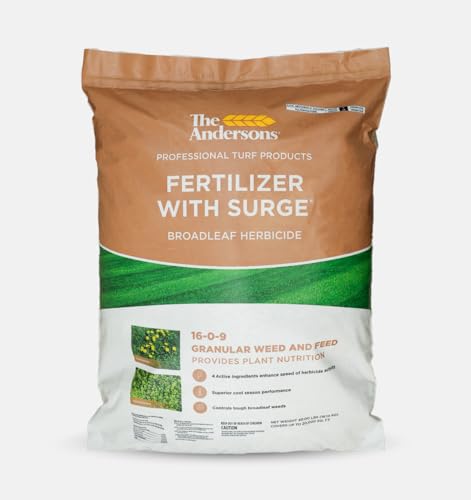
This 40 lb professional-grade bag covers up to 16,000 sq ft — more than double any other pick here.
If you have a large property, buying multiple small bags or bottles gets expensive fast. The Andersons Professional Surge comes in a 40 lb bag that treats up to 16,000 sq ft, which is more than double the coverage of the next-largest pick on this list (the Spectracide at 7,500 sq ft). The 16-0-9 analysis is a true professional-grade, four-way weed-and-feed that targets over 250 common weeds, including dandelions, clover, chickweed, and plantain. The small particle size delivers more particles per square inch, which means more even distribution and better contact with weeds. It is designed to perform well even in the cooler temperatures of spring and fall, extending your treatment window.
The mixed reality: 69 owners discuss effectiveness — the single highest count across any aspect on any product here — and the verdict is split. Many owners who switched from Scott’s to this product are “super happy,” noting it killed creeping Charlie and other stubborn weeds fast. The greening effect gets 17 positive mentions, with owners saying it “greens up grass nicely” and makes lawns look better than ever. But the value-for-money gets 13 negative mentions, with some owners saying it is “too expensive for the results” and they saw “no noticeable difference from cheaper brands.” A few owners also caution that timing with pre-emergent application is critical — applying it too late reduces its weed-killing power significantly.
For the scale alone, this is the only choice if your lawn stretches beyond 8,000 sq ft. The per-square-foot cost is actually lower than the smaller bags, but the upfront investment is higher. The weed-killing consistency is good but not guaranteed — some yards see dramatic results, others see marginal improvement.
Scale Champ
- 16,000 sq ft per bag — single-handedly covers a half-acre property
- Professional-grade four-way formula kills over 250 weed species
- Small particles deliver more coverage per square inch for even results
Reality Check
- Highest upfront cost — some owners feel cheaper brands work just as well
- Effectiveness on weeds is the most-discussed aspect and results are mixed
- Not for Floratam St. Augustine, dichondra, carpetgrass, or bentgrass
Perfect for acreage owners: If your yard is a half-acre or bigger and you own a spreader, this one bag replaces 3-4 smaller purchases in one trip.
Think twice if: Your lawn is under 5,000 sq ft (the bag will last multiple seasons and may clump) or you want guaranteed weed kill without having to dial in the timing.
Understanding the Specs
N-P-K Ratio — The Three Numbers That Matter
Every bag of fertilizer displays three numbers like 21-0-3 or 20-0-0. They stand for Nitrogen-Phosphorus-Potassium. Nitrogen (the first number) is what makes your grass green and grow fast — a higher first number like 21 or 24 gives a stronger green-up. The third number is potassium, which strengthens roots and helps the lawn handle drought or disease. A zero in the middle means the product contains no phosphorus, which is common in weed-and-feeds because phosphorus can feed weed seeds in the soil.
Coverage Area — How Much Ground One Bag Covers
Liquid products measure coverage in square feet per bottle — like 6,000 or 7,500 sq ft. Granular bags list coverage too, such as 5,000 or 16,000 sq ft. Your yard size determines which is more economical: a small lot under 5,000 sq ft is fine with a liquid spray, but a half-acre (roughly 21,780 sq ft) needs a professional-size granular bag like the Andersons Professional Surge at 16,000 sq ft. Always measure your property before buying — the biggest mistake owners make is guessing too small and running out halfway through the lawn.
Weed Control Lists — Not All Formulas Kill Everything
Some brands list a specific set of weeds they control (dandelion, clover, chickweed, plantain). Others claim “over 250 weeds.” The key is to identify your worst weed — if you have creeping Charlie or lawn violets, check the label carefully before you buy. Products like Spectracide have mixed results on violets (some owners need three applications), while the Jonathan Green formulas cover poison ivy and wild onions. Crabgrass is the most common weed NOT killed by selective weed-and-feeds — many products specifically state this limitation.
Application Method — Liquid vs. Granular
Liquid products (Scotts, Spectracide) screw onto a garden hose — you walk, spray, and finish in 20 minutes. No cleaning, no calibration. Granular products (Jonathan Green, The Andersons) need a spreader — either a rotary (broadcast) or drop (precision) type. Granular takes more setup and cleanup, but the fertilizer releases slowly over weeks or months, feeding the grass long after a liquid spray has washed away. Choose liquid for speed and convenience; choose granular for longer feeding and better coverage on large, irregularly shaped lawns.
FAQ
Can I use a fertilizer and weed killer on a newly seeded lawn?
How long should I wait before letting my pets back on the lawn?
What is the difference between 21-0-3 and 20-0-0 on the bag?
Will a fertilizer and weed killer kill crabgrass?
How often should I apply fertilizer and weed killer to my lawn?
Is it safe for St. Augustine grass?
Should I water the lawn before or after applying a granular weed-and-feed?
What is the best time of year to apply weed and feed?
Can I use a weed-and-feed if my lawn has a lot of moss or clover?
How do I know if a product is compatible with my spreader?
Final Thoughts: The Verdict
If you want one dependable pick, the fertilizer and weed killer winner is the Scotts Liquid Turf Builder with Plus 2 Weed Control because it combines the fastest hose-end application with a proven weed list that covers the most common yard invaders. If you want maximum per-bottle coverage and St. Augustine safety, grab the Spectracide Weed & Feed 20-0-0. And for acres-sized properties where one bag needs to last the whole season, the The Andersons Professional Surge 16-0-9 is the one to reach for.
How We Picked
We do not accept paid placement. Every pick is matched to a real buyer and a real use-case; we do not hands-on test units.
Sources & Methodology
Specifications: manufacturer listings and product documentation. Review insights: verified customer reviews, as of July 2026. Pricing: not shown on this page (it changes often); check the current price via the retailer link.
As an Amazon Associate, WellFizz earns from qualifying purchases. This does not affect which products we feature.
Related Guides

Mo Maruf
I created WellFizz to bridge the gap between vague wellness advice and actionable solutions. My mission is simple: to decode the research and give you practical tools you can actually use.
Beyond the data, I am a passionate traveler. I believe that stepping away from the screen to explore new environments is essential for mental clarity and physical vitality.