Our readers keep the lights on and my smoothie glass nicely filled. As an Amazon Associate, I earn from qualifying purchases.
Specs are compiled from manufacturer listings and verified buyer reviews and can change over time — please confirm the key details on the product page before buying.
If your cycle never arrives on the same date twice, standard ovulation kits feel like a cruel joke. You are burning through strips, staring at faint lines, and still missing the window. A fertility tracker for irregular periods changes that by using real data — temperature, hormone levels, or cervical fluid — to spot patterns a calendar alone cannot see. This guide covers nine of the most capable options, from wearable sensors to lab-grade hormone monitors, so you can pick the one that finally gives you clear answers.
I’m Mohammad Maruf — the founder and writer behind WellFizz. This guide is built by comparing the manufacturers’ published specifications and the patterns across verified customer reviews, so you get each pick’s real strengths and trade-offs instead of marketing spin.
Whether you are actively trying to conceive or just want to understand what your body is doing, the right fertility tracker for irregular periods turns chaos into a usable pattern you can actually act on.
Our Picks at a Glance


How To Choose The Best Fertility Tracker For Irregular Periods
A tracker that works for a textbook 28-day cycle can be useless when your own cycle stretches 35 days one month and 45 the next. The picks here handle real-world unpredictability by measuring something your body does consistently — either temperature, hormones, or cervical fluid changes. Here is what separates a useful tracker from a frustrating one.
Hormone tracking breadth
Basic ovulation sticks only measure LH (luteinizing hormone), the surge that happens just before ovulation. With an irregular cycle, you can miss that surge entirely. The best fertility trackers for irregular periods also measure estrogen (E3G) and progesterone (PdG). Estrogen rises in the days leading up to ovulation, giving you a wider early-warning window. PdG confirms ovulation actually happened afterward. If your cycles are long or anovulatory, PdG confirmation is what tells you whether you ovulated at all.
Sensor type and daily effort
Some trackers demand a morning urine test. Others use a wearable sensor that collects data while you sleep. A morning test gives you exact hormone numbers, but you must do it every day (often at the same time). A wearable like a ring or armband is more passive — you just put it on and sync it. For irregular cycles, the wearable approach can be easier to stick with over a long, uncertain month. The trade-off is that wearables measure temperature trends rather than direct hormone levels, so they take longer to build an accurate picture.
Recurring costs
Some devices are a single purchase with no refills. Others require you to buy test wands or strips every cycle. When you have irregular periods, you might test for 40+ days in a single cycle, which makes per-strip cost add up fast. Look at the cost per test strip versus a one-time sensor fee. For unpredictable cycles, a tracker with no ongoing expenses often ends up being the more practical (and cheaper) choice over a few months.
Quick Comparison
| Model | Best For | Hormones Tracked | Sensor Type | Recurring Costs | Amazon |
|---|---|---|---|---|---|
| Daysy★ Best Overall | Hands-off BBT tracking | Temperature only | Wearable thermometer | None | Amazon |
| Proov CompleteFull Hormone Panel | Full hormone panel | FSH, LH, E1G, PdG | Test strips + app | Per cycle refill | Amazon |
| femometer Ring Gen1Compact Wearable | Sleep-based BBT tracking | Temperature only | Wearable ring | None | Amazon |
| Surearly SMART | Digital hormone reader | LH, PdG | Digital reader + strips | Per cycle refill | Amazon |
| Mira Fertility Plus | Quantitative hormone data | LH, E3G | Monitor + wands | Per cycle refill | Amazon |
| Inito | Multi-hormone precision | Estrogen, LH, PdG, FSH | Monitor + strips | Per cycle refill | Amazon |
| Tempdrop | Discreet overnight BBT | Temperature only | Wearable armband | None | Amazon |
| femometer Ring Gen2 | All-day health + cycle insights | Temperature only | Wearable ring | None | Amazon |
| kegg | Cervical fluid analysis | Electrolyte changes | Insertable sensor | None | Amazon |
In‑Depth Reviews
1. Daysy Fertility Tracker
Our pick — 4.5★ from 300+ verified ratings; the strongest balance of quality and price.
The smart thermometer that learns your irregular rhythm without needing test strips.
Daysy is not a hormone monitor. It is a precision basal body thermometer made in Germany and designed in Switzerland, built around a 99.4% accuracy rate for identifying fertile versus non-fertile days. You take your temperature each morning with the sensor, and Daysy’s algorithm — backed by over 40 years of research — analyzes the pattern. A green light means non-fertile. Red means fertile. For irregular periods, Daysy adapts to your data instead of relying on a calendar prediction. The crowd favorite here is the reliability: owners consistently say it works once you commit to daily use, and there are no subscriptions or refill costs.
One real-world example: a buyer with irregular cycles logged 11 green days (safe, non-fertile days) in her very first cycle — a meaningful number when you normally have no idea where you stand. That said, consistency is the catch. The device demands that you take your temperature at roughly the same time every morning before getting up. A few buyers report a “ridiculous learning curve” if they skip mornings or travel across time zones. The app also had early sync hiccups, though most say the setup smoothed out after a few days. For anyone who can stick with a five-minute morning routine, this is the most trusted single-sensor option for chaotic cycles.
Reliable Rhythm
- FDA-registered medical device with 99.4% accuracy
- No ongoing subscription or strip purchases
- Adapts to irregular cycles using your actual temperature data
- Compact, rechargeable, and easy to travel with
Needs Discipline
- Requires same-time morning temperature taking every day
- Learning curve: you must read the manual and follow instructions
- Bluetooth sync can be finicky during initial setup
- Shows fertile status but does not provide exact hormone numbers
Your best bet if: you want a hormone-free, subscription-free device and can commit to a daily morning routine — this gives you the clearest green-light/red-light guidance for irregular cycles.
Look elsewhere if: you need to see exact hormone levels or want a fully passive wearable that tracks while you sleep.
2. Proov Complete Fertility Test Kit
The only at-home test that tracks all four key fertility hormones across your whole cycle.
Proov Complete tests FSH (follicle-stimulating hormone), LH (luteinizing hormone), E1G (a urine marker of estrogen), and PdG (a urine marker of progesterone). This gives you a full hormonal map rather than just a surge alert. For irregular periods, the value is in the PdG confirmation — it tells you whether you actually ovulated, which is the missing piece when cycles are unpredictable. The kit includes 20 tests and uses the free Proov Insight app, which guides you through testing and provides an “Ovulation Score.” The app’s color-coded results and built-in timer make the daily routine straightforward.
One owner with 3+ years of infertility and irregular periods reported getting pregnant within a single cycle of using Proov. Buyers consistently praise the hormone-by-hormone breakdown, saying it helped them spot issues like low progesterone or missed surges. The trade-off is that the kit costs per cycle, and a few users note that the 10-minute wait per test adds up over a long tracking window. Some also mention results can be less crisp than lab work, though the trends are generally reliable. It is a powerful diagnostic tool if you want to understand your full hormonal picture rather than just a yes/no on ovulation.
Cycle Intelligence: Testing FSH, E1G, LH, and PdG on one strip reveals patterns single-hormone tests miss — invaluable for tracking unpredictable cycles.
Cost Reality: The per-cycle cost is higher than single-use OPKs, but the depth of data means you may need fewer cycles to understand your body.
Best for: anyone who wants to confirm ovulation with PdG and monitor estrogen trends — especially if you have been trying to conceive for a while without answers.
Think twice if: you are on a tight budget or prefer a passive tracker that does not require daily urine tests.
3. femometer Ring Gen1
Slim ring that takes your temperature continuously while you sleep, no alarm needed.
At just 2.7mm thick, the femometer Ring Gen1 uses multiple upgraded temperature sensors to measure BBT (basal body temperature) via your finger throughout the night. You never need to wake up at a specific time to take a reading — the ring does it automatically. In the morning, the Femometer Connect app syncs the data and generates custom fertility charts. For irregular cycles, this passive approach removes the biggest barrier: remembering to take your temperature at the same time every day. The ring also provides professional sleep insights, giving you a broader picture of your health. It is rechargeable and has no subscription fees.
Health tracking is the thing owners praise most — a strong 38 buyers highlight it as the standout feature. They say the ring’s overnight temperature averages are accurate enough to confirm ovulation, even for those with broken sleep. Functionality also earns high marks, with 29 owners mentioning it as a positive. Some users note the sizing kit is essential because the ring fits differently from standard jewelry rings. A few also report occasional Bluetooth disconnections. For the price, it is among the most affordable wearable options for cycle tracking, and it is lightweight enough that you forget you are wearing it.
Hands-Off Accuracy
- Fully automatic temperature tracking while you sleep
- No subscription or per-cycle costs
- Ultra-slim design (2.7mm) for comfortable all-night wear
- Includes sleep analysis to monitor overall health
Fit & Connection
- Sizing can be tricky — order the sizing kit first
- Bluetooth syncing may occasionally disconnect
- Only tracks temperature, not multiple hormones
- Requires wearing a ring to bed every night
Reach for this if: you want the easiest possible BBT tracking with zero daily effort — put it on, sleep, sync, done.
skip it if: you need specific hormone readings or your finger size fluctuates during your cycle.
4. Surearly SMART Digital Ovulation Test Kit
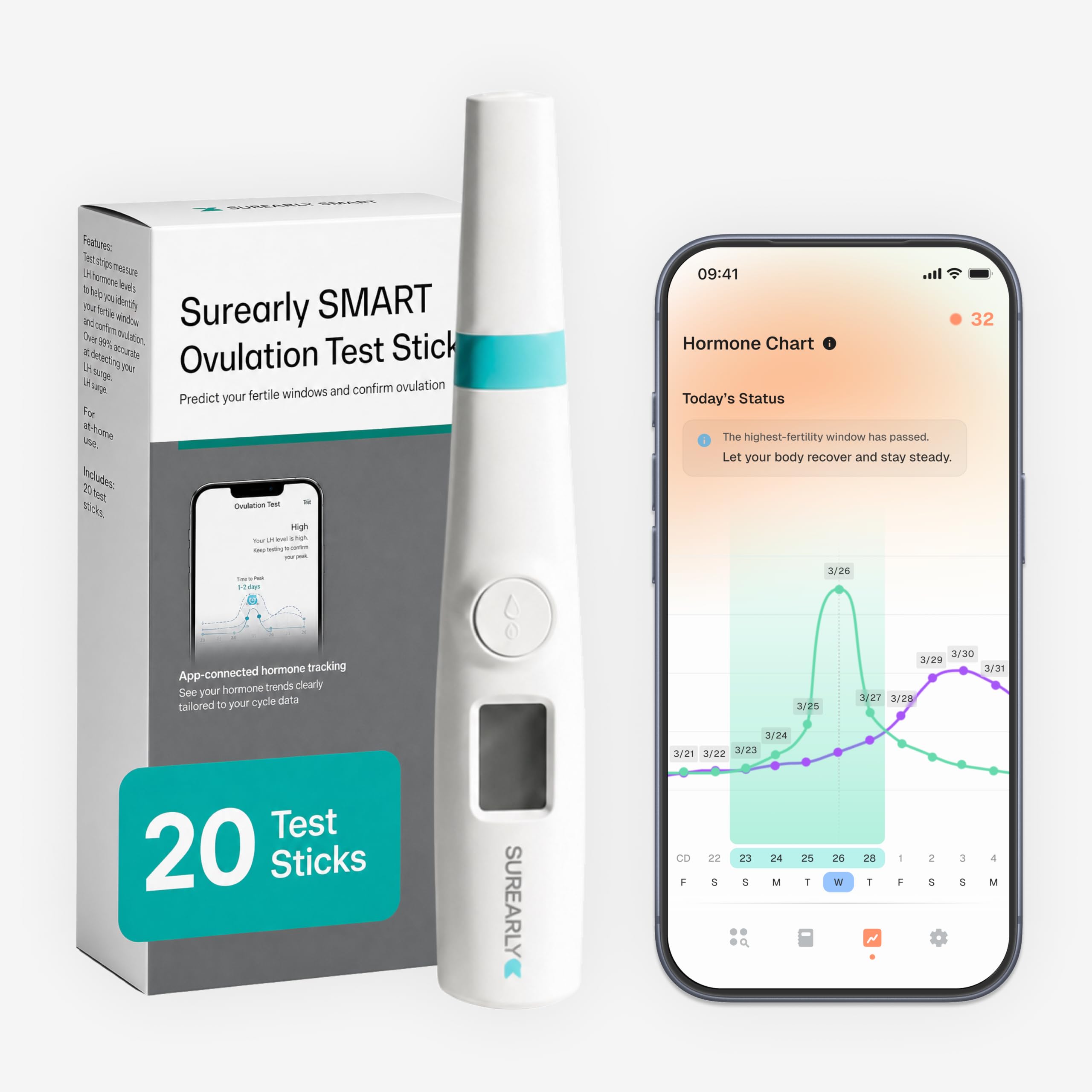
Digital test reader that removes line-gazing guesswork and automatically logs every result.
The Surearly SMART kit combines a digital reader with 20 test sticks that measure both LH (to find your fertile window) and PdG (to confirm ovulation afterward). Instead of squinting at faint lines, you insert the stick into the reader, and the companion Soonr app records each result automatically. Results are clear in 5 minutes. For irregular cycles, the built-in PdG tracking is the critical advantage — standard OPK strips only predict ovulation, but PdG confirms it happened. The device is FDA listed and EU IVDR certified, made in an ISO-certified facility in South Korea. The Starter Kit includes one reader and 20 test sticks for one full cycle.
Owners consistently highlight how easy the system is to use, with the app tracking trends and removing the manual charting effort. A few note that the reader occasionally returns error readings on some sticks, which can mean missing a peak if you do not have spares. The app interface also has minor quirks — some find the numerical values hard to locate. But the consensus is clear: for anyone tired of interpreting traditional OPK strips, this reader-and-app combo delivers lab-grade precision at home. The optional premium app tier adds gamified partner tracking, but the free version already covers charts, trends, and sharing.
Clarity Upgrade: The reader replaces subjective line-interpretation with clear digital results — a huge relief when your cycle length is unpredictable.
Prep Needed: Some users report occasional faulty strips, so having backup tests or ordering extra refills is a smart move for longer cycles.
Best for: anyone who hates guessing at faint lines and wants a clean, app-connected system that tracks both LH and PdG.
Consider alternatives if: you want a passive wearable or need to track more than two hormones.
5. Mira Fertility Plus Tracking Monitor
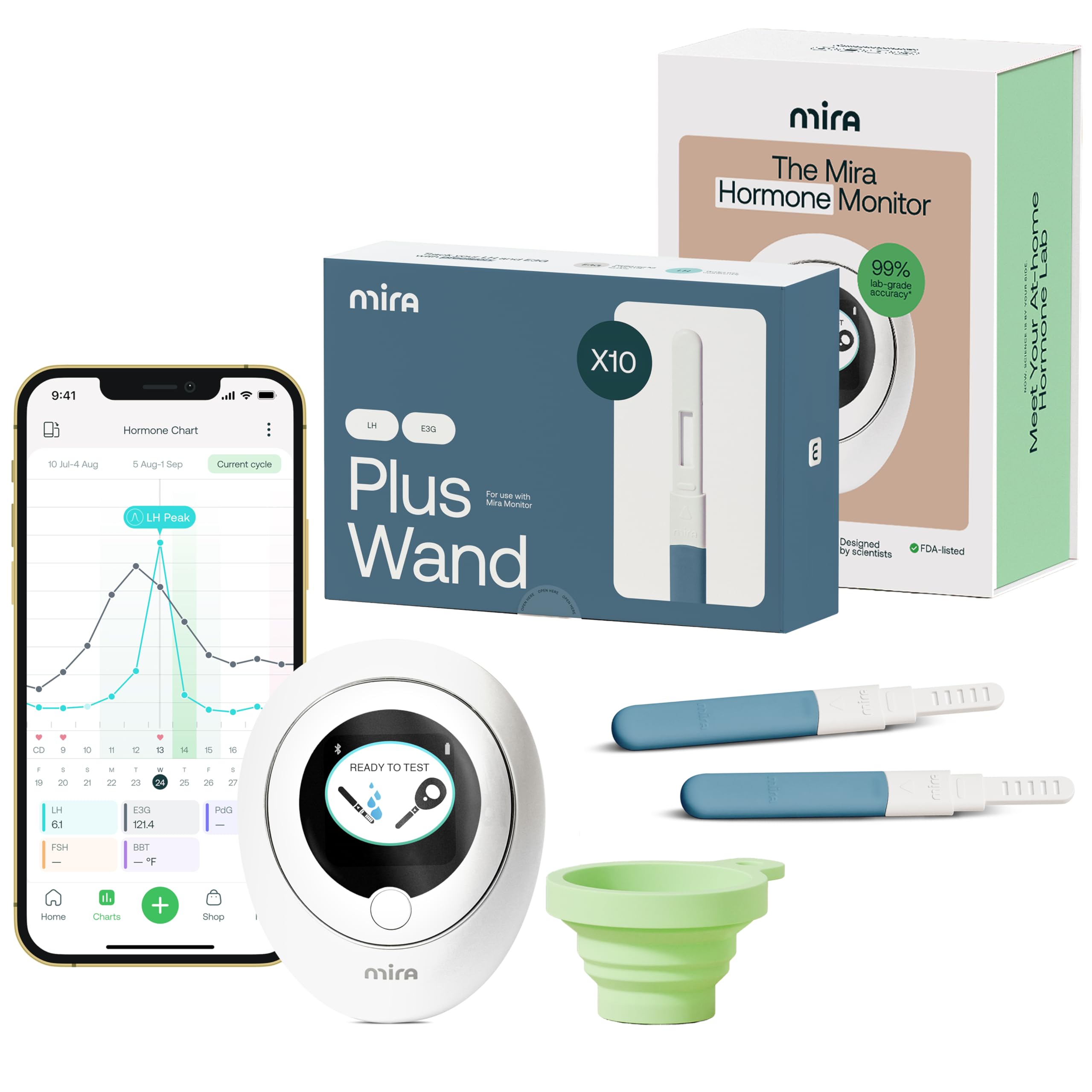
Gives you actual hormone concentration numbers instead of just positive-or-negative results.
Mira Fertility Plus is different from standard ovulation kits because it measures quantitative levels of LH and E3G (estradiol) — not just a threshold test. You dip a wand in urine, insert it into the monitor, and in about 21 minutes the Mira App displays your actual hormone levels on a chart. This numeric precision is a breakthrough for irregular periods because it shows you the rising trend of estrogen before the LH surge, giving you a 6-day fertile window heads-up. The system claims up to 99.5% accuracy in hormone detection, and the app uses AI to learn your personal pattern and adjust predictions over time.
One long-term user says Mira revealed she was ovulating late — something standard OPK strips never caught. Others with PCOS (polycystic ovary syndrome) praise how the monitor tracks their fluctuating, low-level hormones that basic sticks miss. The main friction is the cost of replacement wands, which can run – per cycle. A small number of users also report occasional wand failures that return no result, and Mira’s customer service can be slow.
Laser Precision
- Shows exact LH and E3G concentrations on a chart
- AI adapts predictions to your unique cycle patterns
- Catches late or weak ovulation that standard strips miss
- Travel-friendly automatic syncing via the app
Ongoing Cost
- Replacement wands are expensive per cycle
- 21-minute wait per test feels long for daily use
- Some wand failures reported with no refund
- Customer service wait times can be frustrating
Best if: you need to see the exact numbers behind your cycle — ideal for PCOS, late ovulation, or anyone who wants to share hormone charts with a doctor.
Skip if: the per-cycle wand cost is a dealbreaker or you prefer a shorter daily testing routine.
6. Inito Fertility Monitor
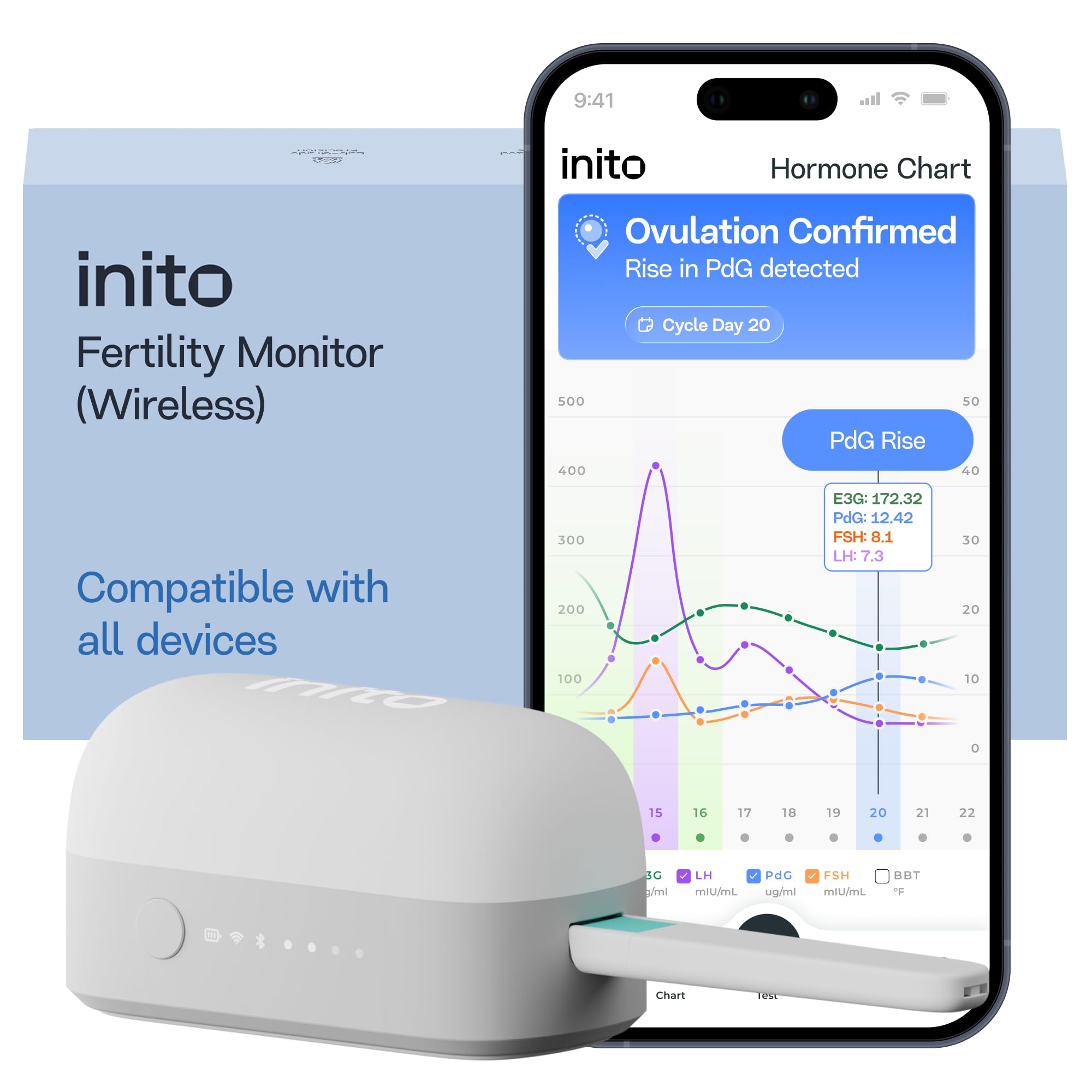
Measures all four fertility hormones on a single test strip for a complete cycle picture.
Where most monitors track one or two hormones, Inito measures estrogen, LH, PdG, and FSH (follicle-stimulating hormone) from one urine sample on one strip. For an irregular cycle, this is the full diagnostic picture. The FSH reading tracks follicle growth, estrogen rises ahead of your fertile window, LH confirms the surge, and PdG confirms ovulation. The free app displays actual numeric values and hormone charts that you can share with your doctor. The device is compatible with all iPhones and uses a rechargeable lithium-ion battery. It is a premium but powerful tool for anyone who has been struggling to make sense of a consistently unpredictable cycle.
The thing owners praise most is the ease of use — 8 buyers specifically mention how straightforward the daily routine is. Another 7 call out its effectiveness, with one saying it helped them catch their fertile window and exact ovulation day. The app includes hormone charts, fertility insights, and doctor-shareable data. The catch is connectivity: 5 owners note that the device only works over WiFi or hotspot, which makes it unreliable when traveling or in areas with spotty internet. Setup also requires Bluetooth pairing, and a few received boxes missing a code, though customer support resolved it. For home use with good WiFi, it is the most comprehensive single-strip system available.
Total Visibility: Getting FSH, estrogen, LH, and PdG from one test lets you see the full story — follicle growth, surge, and confirmation — not just one piece.
WiFi Dependency: The device needs a network connection to sync, which limits its usefulness during travel or at a weekend cabin.
Best for: home users who want the most complete hormone picture and are comfortable with WiFi-based syncing.
Reconsider if: you travel frequently or prefer a tracker that stores data offline until you sync.
7. Tempdrop Wearable Fertility Monitor
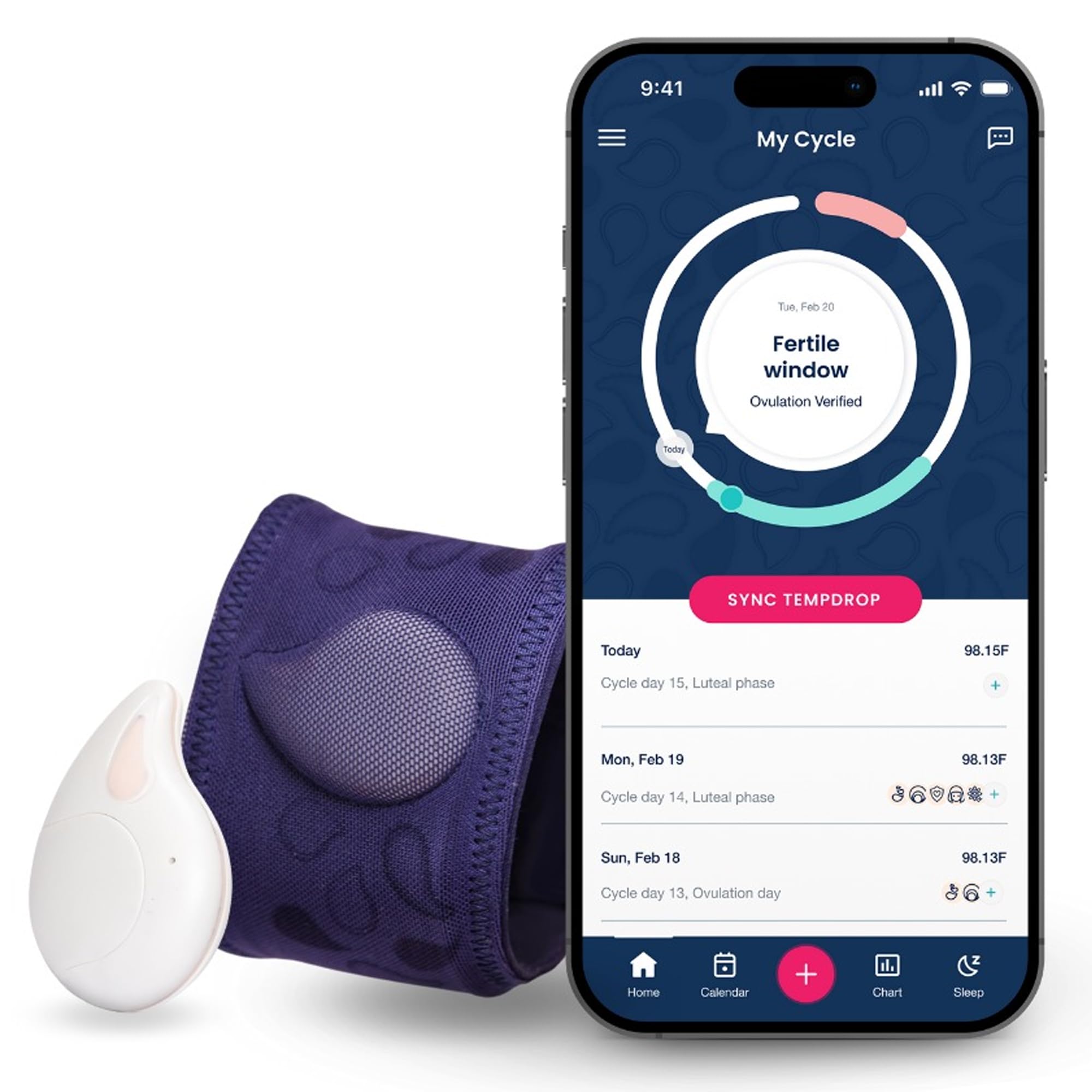
A soft armband that tracks your BBT while you sleep — no morning alarm or thermometer needed.
Tempdrop is a wearable sensor that you strap onto your upper arm before bed. It records your basal body temperature continuously through the night using a medical-grade thermometer. In the morning, you sync it to the Tempdrop app, and the algorithm accounts for nightly wake-ups and movement — a critical feature for postpartum or breastfeeding mothers whose sleep is constantly interrupted. The company claims 98.6% fertile window accuracy and 93.3% ovulation day accuracy. The sensor stores up to 60 hours of data, and the replaceable coin cell battery lasts over 6 months. For irregular cycles, the adaptive algorithm learns your unique temperature rhythms and adjusts over time, which removes the rigid same-time-morning routine of oral thermometers.
Buyers consistently call out ease of use as the top benefit — 63 owners praise how simple it is to just wear and forget. Sleep tracking also gets high marks from 35 users, especially mothers who appreciate the algorithm handling broken sleep. That said, accuracy ratings are mixed: it is the most-discussed topic with 66 mentions split between satisfied and unsatisfied users. Some find the algorithm takes a few cycles to calibrate. A few also report the armband feels tight (though it comes with an extender). A minor but notable detail: some premium app features now require a subscription, which irks owners who feel the device cost should include them. For anyone who wants to stop waking up at 5 AM to take a temperature, this is the top solution.
Zero Morning Effort
- Wearable sensor tracks BBT without disturbing sleep
- Algorithms handle wake-ups — ideal for breastfeeding mothers
- Battery lasts over 6 months and is replaceable
- Stores up to 60 hours of data before syncing
Calibration & Cost
- Accuracy improves over time — can take multiple cycles
- Some premium app features require a subscription
- Armband fit may feel restrictive for some users
- Data connectivity can be occasionaly inconsistent
Ideal for: anyone who hates morning routines or has irregular sleep — the armband does the work for you.
Not for: those who want immediate pinpoint accuracy from day one, or who refuse any app subscription model.
8. femometer Smart Ring Gen2
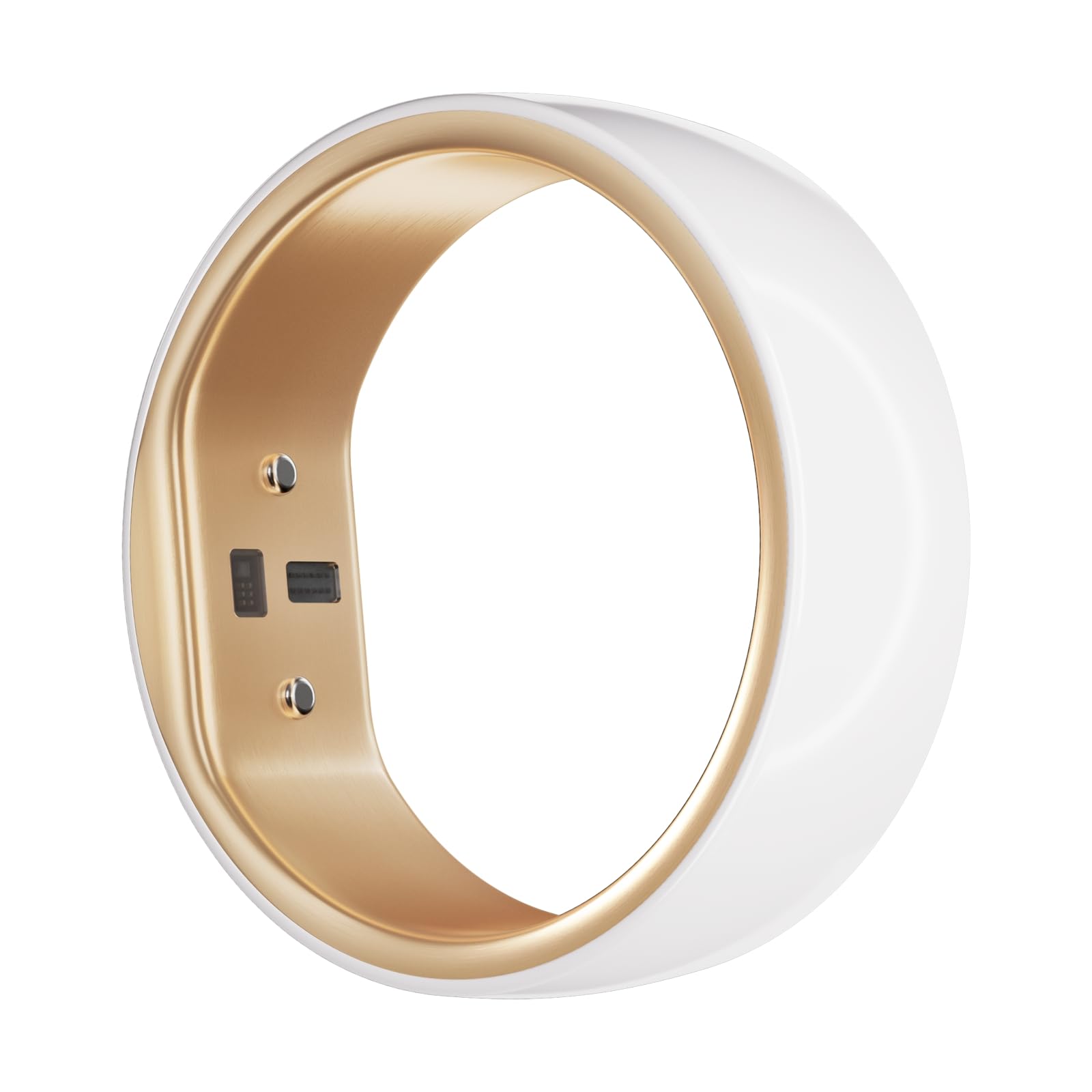
A next-gen ring that adds heart rate and sleep stages to your cycle tracking data.
The femometer Smart Ring Gen2 is an upgrade on the Gen1, adding 24/7 continuous heart rate monitoring, HRV (heart rate variability) tracking, and detailed sleep stage analysis (deep, light, REM). It still uses BBT technology for cycle and ovulation detection, but with 1,400+ nightly temperature measurements — far more granular than a single morning reading. The ring is just 2.7mm thick, weighs only 3.3 grams, and is water resistant to 100 meters. The ceramic exterior with aluminum core looks premium and is designed for all-day and all-night wear. The femometer app is free with no subscription, and the ring connects via Bluetooth to both iOS and Android phones.
Health tracking is the top praise-winner at 32 mentions, with owners loving the combination of cycle data and general wellness insights in one device. Functionality comes second with 24 mentions. Battery life is the most-discussed issue — lasting around 7 days per charge per the spec, some owners mention shorter life after a few months. The bigger concern is durability: 17 customers note the ceramic outer shell cracking or detaching within the first month of use, and value-for-money scores are negative as a result. A few users also note that BBT data requires a manual sync each morning. For the price, you are getting serious lifestyle tracking alongside fertility data, but the build quality complaints are worth noting.
Full Health Picture
- Tracks heart rate, HRV, sleep stages, blood oxygen, and cycle data in one ring
- Ultra-light at 3.3g and comfortable for 24/7 wear
- Water resistant to 100m — swim and shower safe
- No subscription required for the core app features
Durability Doubts
- Multiple reports of the ceramic shell cracking or detaching
- Battery life can degrade, requiring daily charging over time
- Manual daily sync required for BBT data
- Some owners consider the price too high given the build concerns
Best for: anyone who wants one device for cycle tracking, heart rate, and sleep analysis — and prefers a ring over a smartwatch.
Think twice if: durability is your top concern, or you need a tracker that syncs automatically without manual input.
9. kegg Fertility Tracker
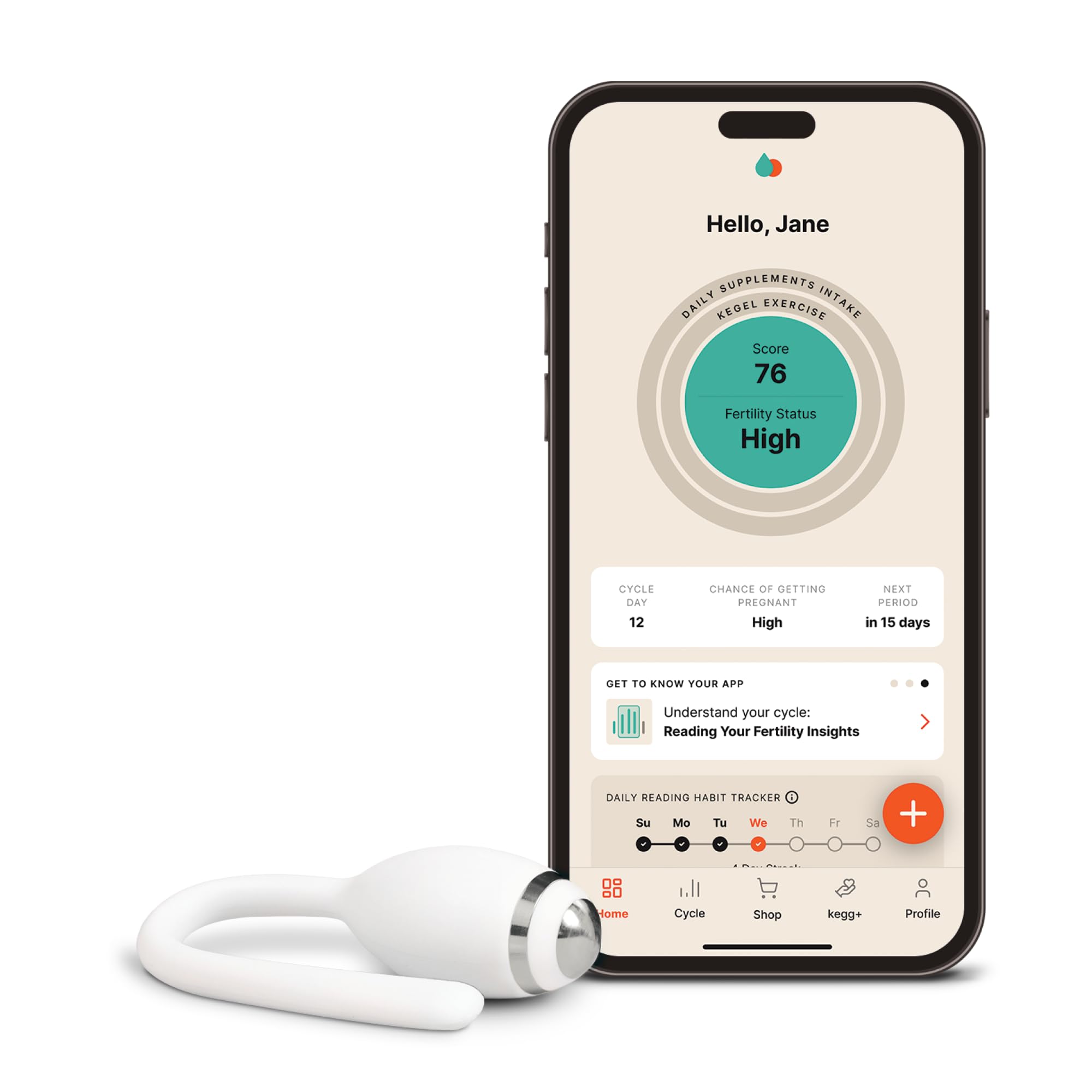
A small insertable sensor that measures cervical fluid — your body’s earliest fertility sign.
kegg takes a completely different approach from temperature or hormone trackers. It uses advanced sensing technology to measure the electrolyte levels in your cervical fluid, which change as you approach ovulation. Because cervical fluid is the substance that actually nourishes and transports sperm, it is often a more direct fertility sign than secondary measures like temperature. The device is a small, reusable sensor that you insert for a couple of minutes each day. It syncs to the free app, which shows you your fertile window in advance. There are no recurring costs — no strips, no wands, no subscription. It is FSA/HSA eligible.
Effectiveness is the top reason owners recommend this device — 88 buyers highlight its success rate. The community swarm reviews: one user with PCOS and irregular periods on metformin conceived on her first cycle using kegg. Another owner with 5+ years of unexplained infertility and multiple failed IUIs got pregnant within 3 cycles. Ease of use is the second most-praised aspect at 55 mentions — the daily routine takes just a couple of minutes. The app also gives you access to a private community for chart support. The biggest skepticism comes from some users who argue the algorithm is influenced by the cycle start date you enter, rather than being a purely objective biological measurement. Accuracy gets mixed feedback, with 22 mentions split between believers and doubters. If you want a method that measures the actual environment sperm encounter, kegg is unique in this list.
Unique Insight
- Directly measures cervical fluid, the most immediate fertility sign
- One-time purchase with zero ongoing refill costs
- Daily use takes only a couple of minutes
- Includes private community for support and chart sharing
Method Skepticism
- Some users question whether the algorithm is influenced by manual data input
- Requires daily insertion, which may feel cumbersome
- Accuracy receives mixed reviews
- Battery life is adequate but not exceptional
Best for: anyone who wants a non-hormonal, upfront-cost-only method that tracks the body’s earliest fertility signal — especially for PCOS or long, unpredictable cycles.
Skip if: you are uncomfortable with daily internal sensors or want a method with more established peer-reviewed data behind it.
Understanding the Specs
LH, E3G, PdG and FSH
These are the four main fertility hormones. LH (luteinizing hormone) surges 24-36 hours before ovulation; standard OPK strips only look for this. E3G (estrone-3-glucuronide, a urine measure of estrogen) rises in the days before the LH surge, giving you a wider fertile window. PdG (pregnanediol-3-glucuronide, a urine marker of progesterone) confirms that ovulation actually happened. FSH (follicle-stimulating hormone) drives follicle growth. Trackers that measure all four give you a complete picture, which is especially helpful for irregular cycles where one piece alone is misleading.
Basal Body Temperature (BBT)
Your body’s lowest resting temperature, taken immediately after waking. For most people, BBT rises about 0.5 to 1 degree Fahrenheit after ovulation due to progesterone. With an irregular cycle, a single daily reading can be noisy — that is why some trackers use overnight averages (like the femometer rings) or an algorithm that accounts for wake-ups (like Tempdrop). A BBT tracker will never predict ovulation in advance, but it is excellent at confirming it happened and spotting cycle patterns over several months.
Sensor Type: Wearable vs. Urine Test
Wearable sensors (armbands, rings, thermometers) track temperature trends passively while you sleep. They require no daily active effort beyond wearing the device. Urine test kits (test strips, digital readers, monitors) require you to actively collect a sample each morning. For irregular periods, a wearable is easier to maintain over a long cycle, but it provides less detail than a multi-hormone urine test. The best choice depends on whether you prioritize consistency of use or depth of data.
Recurring Costs and Refills
Trackers fall into two groups. One-time purchase devices (Daysy, Tempdrop, both femometer rings, kegg) have no ongoing consumable costs. Others (Proov, Surearly SMART, Mira, Inito) require you to buy test strips or wands every cycle. For an irregular cycle that can last 40-50 days, a per-cycle kit may run out before you ovulate, forcing you to buy extra refills. Always check the number of tests included and the cost per additional test before choosing a subscription-based tracker.
FAQ
Can I use a standard ovulation kit if I have irregular periods?
How long does a BBT tracker take to learn my irregular cycle?
Which hormone is most important for tracking with an irregular cycle?
Will a fertility tracker work if I have PCOS?
Do I need a subscription for any of these trackers?
How accurate are wearable BBT rings compared to oral thermometers?
Can I share my fertility data with my doctor?
Which tracker is best if I travel frequently?
Do any of these trackers help with pregnancy prevention, not just conception?
What is the cheapest long-term option for tracking an irregular cycle?
Final Thoughts: The Verdict
If you want one dependable pick, the fertility tracker for irregular periods winner is the Daysy because it combines FDA-registered accuracy with no recurring costs and adapts its algorithm to your unique cycle data — turning the chaos of an unpredictable cycle into simple green and red light guidance. If you want the deepest hormone-level insight and do not mind buying refills, the Proov Complete or Inito gives you a full multi-hormone picture. And for the truly hands-off approach where you never think about tracking at all, the femometer Ring Gen1 or Tempdrop are the quiet champions that do their work while you sleep.
How We Picked
We do not accept paid placement. Every pick is matched to a real buyer and a real use-case; we do not hands-on test units.
Sources & Methodology
Specifications: manufacturer listings and product documentation. Review insights: verified customer reviews, as of July 2026. Pricing: not shown on this page (it changes often); check the current price via the retailer link.
As an Amazon Associate, WellFizz earns from qualifying purchases. This does not affect which products we feature.
Related Guides

Mo Maruf
I created WellFizz to bridge the gap between vague wellness advice and actionable solutions. My mission is simple: to decode the research and give you practical tools you can actually use.
Beyond the data, I am a passionate traveler. I believe that stepping away from the screen to explore new environments is essential for mental clarity and physical vitality.