Our readers keep the lights on and my smoothie glass nicely filled. As an Amazon Associate, I earn from qualifying purchases.
Specs are compiled from manufacturer listings and verified buyer reviews and can change over time — please confirm the key details on the product page before buying.
Pigs are escape artists with a single-minded mission: get to the other side of whatever you put up. A fence that works for cattle or horses often fails the first time a 250-pound sow leans on it, roots under it, or tests a weak corner. The right fencing for pigs needs to handle pressure at ground level and stand up to the elements for years — and you need to know which material, gauge (wire thickness), and style actually does the job before you start digging post holes.
This guide is built by comparing the manufacturers’ published specifications and the patterns across verified customer reviews, so you get each pick’s real strengths and trade-offs instead of marketing spin.
These reviews break down the best fencing for pigs so you can choose with confidence and avoid the headache of a second install.
Our Picks at a Glance
How To Choose The Best Fencing For Pigs
Pigs don’t test a fence in the middle — they test it at the bottom, with their snouts, and at the bottom, with their weight. That changes what kind of fence you need compared to, say, a deer fence or a simple garden barrier. The right choice depends on a few measurable things you can check before you buy.
Wire Gauge: The Real Strength Number
Gauge is the wire thickness, and the number works backward — lower means thicker. A 12-gauge wire is thicker and stronger than a 14-gauge wire, which is stronger than 16-gauge. For pigs, you rarely want anything thinner than 14-gauge. The beefier the wire, the better it resists the pushing and leaning that pigs do naturally. Check the gauge in the specs before you click buy.
Mesh Pattern: Graduated Openings Are the Smart Choice
Look for a fence where the openings (the spaces between the wires) get smaller near the bottom — typically from about 8 inches at the top down to 3.5 inches near the ground. This graduated mesh keeps piglets from squeezing through while saving weight and cost higher up where the gaps can be larger. It is the most practical design for mixed-species pens, too.
Coating and Material: Galvanized Is the Standard
A hot-dip galvanized coating protects the steel from rust. If your fence will sit in rain, mud, or humid pasture, galvanized wire is not optional — it is the difference between a fence that lasts a decade and one that rusts out in two years. Most farm-grade fencing in this category uses it.
Quick Comparison
| Model | Best For | Wire Gauge | Length | Height | Amazon |
|---|---|---|---|---|---|
| 12 Gauge Cattle Panel (Product 1)★ Best Overall | Heavy-duty garden trellis or small pens | 12-ga | 100 ft | 4 ft | Amazon |
| Cattle Panel 14-Gauge (Product 7)Also Great | Large permanent pastures | 14-ga body / 12-ga borders | 328 ft | 4 ft | Amazon |
| Farm Fence 6ft (Product 6) | Tall barrier for large livestock | Not specified | 100 ft | 6 ft | Amazon |
| Farm Fence 4ft x 164ft (Product 2) | Light sheep or pig fencing on a budget | 14-ga | 164 ft | 4 ft | Amazon |
| Livestock Fence 4ft x 164ft (Product 3) | Budget value runs | 14-ga | 164 ft | 4 ft | Amazon |
| Electric Fence Net 35×164 (Product 4) | Temporary or rotational paddocks | Not specified | 164 ft | 35 in | Amazon |
| Electric Fence Netting 35×164 (Product 5) | Portable hog and goat containment | Not specified | 164 ft | 35.4 in | Amazon |
In‑Depth Reviews
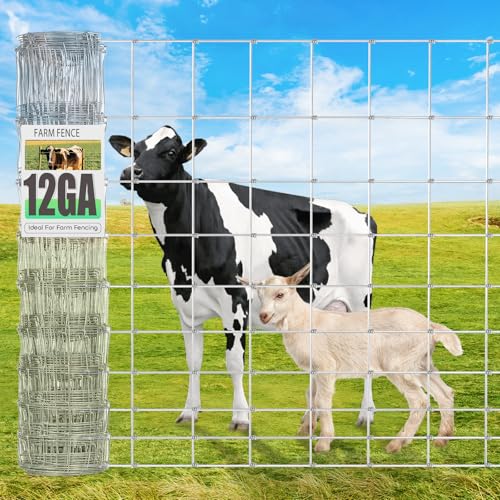
1. 12 Gauge Heavy Duty Cattle Panels for Garden Trellis, 4ftx100ft
This is the thickest wire in the whole list at a true 12-gauge (about 0.1 inch of steel) — buyers call it “very heavy and sturdy.”
The hot-dip galvanizing gives it serious rust resistance, and the hinge-joint weaving is designed so the mesh handles impact from cattle, hogs, and horses without snapping. It is 100 feet long and 4 feet tall — shorter than the top pick, but noticeably heavier per foot. As the data makes clear: “12GA (0.1 inch) is thick material” and you will need a mini bolt cutter to cut it — standard cable cutters will not work. That is inconvenient for installation, but it also means a determined hog will have a very hard time bending or breaking through.
There is genuine disagreement in the reviews about whether every roll is consistent, with a few saying their wire was thinner than marked. But the majority of buyers — particularly those using it as a garden trellis or a pig pen — give it top marks for strength. Compared to the 14-gauge options like the Farm Fence 4ft x 164ft (Product 2), this one is the obvious choice if your absolute priority is maximum physical strength in a shorter run.
Why owners love it
- True 12-gauge wire at 0.1 in thickness — the beefiest option in this roundup
- Hot-dip galvanized for rust resistance in wet pig pens
- Hinge-joint weave handles impact without breaking weld points
Installation realities
- Requires a mini bolt cutter for cutting — standard cable cutters will not cut 12-gauge
- Some rolls reported inconsistent gauge by a few buyers
Choose this one when: you need absolute strength over a shorter distance and can handle the heavier installation work.
Not for you if: you need a long continuous run like 328 feet and prefer lighter handling over maximum gauge thickness — the Cattle Panel (Product 1) is your better bet.
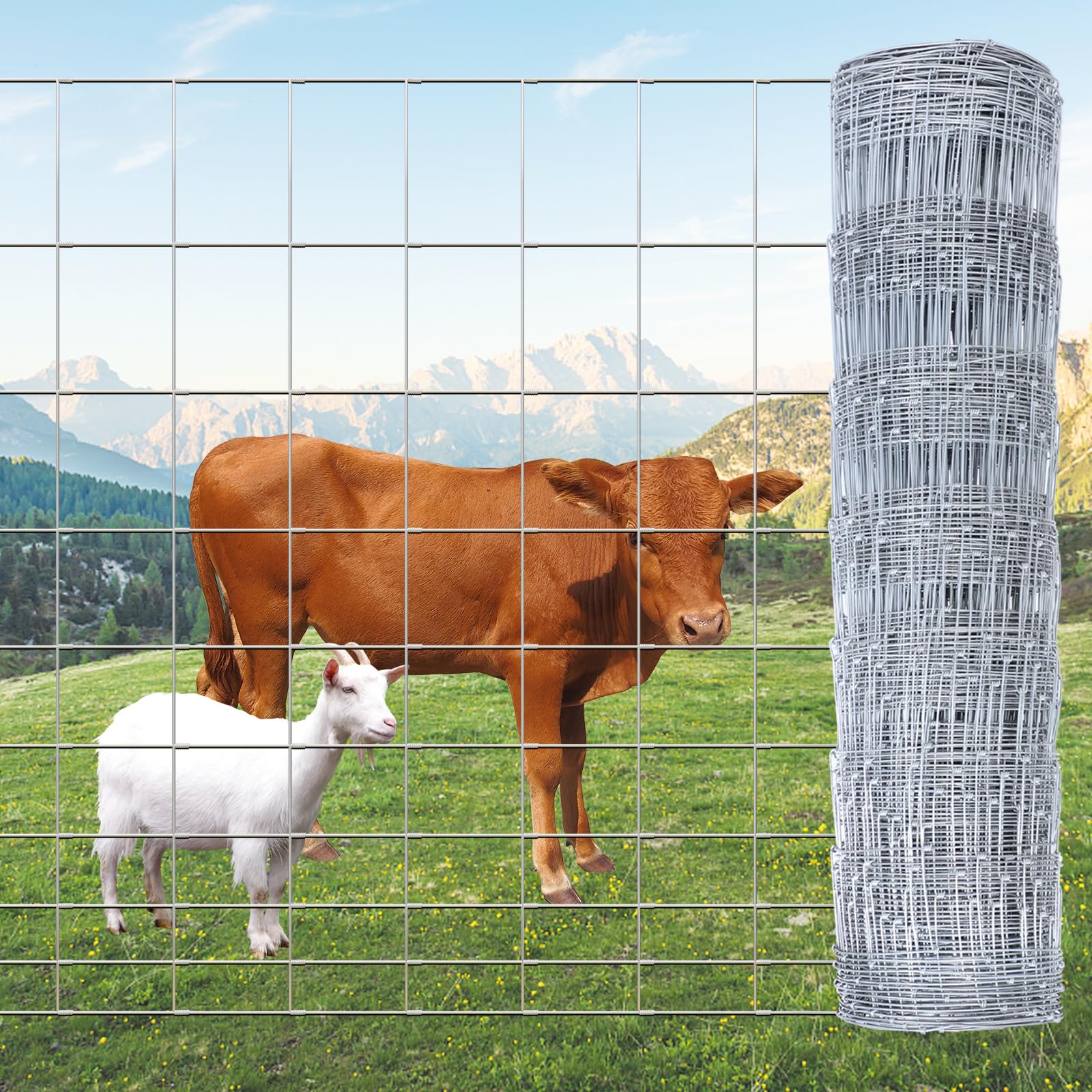
2. Cattle Panel 14-Gauge Galvanized Woven Wire Fence 4FT x 328 FT
The long roll built to hold pigs for 15 to 20 years, backed by the numbers in the specs.
This panel delivers where it counts: the mesh body is 14-gauge galvanized steel wire, but the top and bottom borders are reinforced with 12-gauge wire — a smarter design that puts the thickest steel where the stress hits. Gauge measures wire thickness, and a lower number means thicker wire; 12-gauge (about 0.1 inch) is heavier than 14-gauge (about 0.08 inch). The graduated mesh steps from 8-inch openings at the top down to 3.5-inch openings at the bottom, so piglets stay inside and predators stay out. At 4 feet tall and a full 328 feet long, one roll covers a large pasture pen without splicing panels together. The same length is 328 feet, compared to the 100-foot rolls from other picks like the 12 Gauge Cattle Panel (Product 1). Buyers report the bottom mesh keeps rabbits and “junk out,” and one review sums it up: “Well built and well worth the price.” The manufacturer states this fence performs reliably for 15-20 years in normal environments and 10-15 years in coastal or high-humidity conditions—backed by the heavy galvanized coating.
The trade-off is the sheer length and weight: you will want help unrolling it, and a quality wire cutter is essential (high-tensile steel does not yield to standard diagonal cutters). Some buyers mention the wire can arrive bent in spots from shipping, though most report the packaging held up.
What wins owners over
- Reinforced 12-gauge border wires on a 14-gauge body — double strength at the top and bottom edges
- Graduated mesh from 8 in down to 3.5 in, so piglets can’t squeeze through the bottom
- 328 ft of coverage from a single roll, saving you splices and extra posts
The honest caveats
- Heavy and stiff to unroll alone; a second person is recommended
- Some units arrive with minor bends from shipping packaging
Reach for this if: you need a permanent pasture fence that will resist rooting, leaning, and weather for 15-plus seasons.
Look elsewhere if: your setup requires a fence under 100 feet or you need something you can move every few weeks.
3. Farm Fence 6ft x 100ft Heavy Zinc Coating Field Wire Fencing
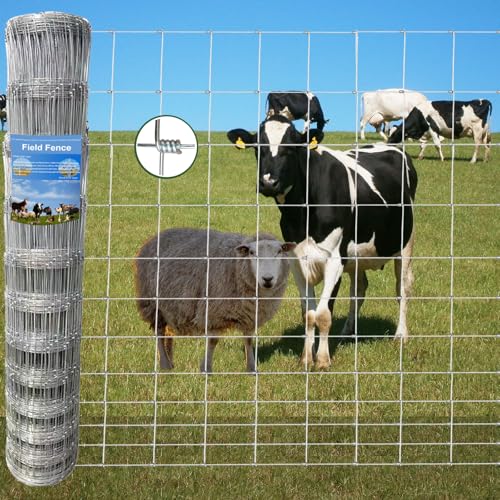
Height is this fence’s selling point: at 6 feet tall, it keeps athletic hogs and deer out where 4-foot panels stop at the shoulders.
At 6 feet tall, this goes to the top of the class for height — useful if you have athletic hogs or simply want a fence that doubles as a deer barrier. The hot-dipped galvanized wire uses a knotted, woven construction (not welded), which gives it the flexibility to handle ground movement without snapping. Graduated mesh openings get tighter near the ground to block small animals. Buyers consistently mention the quality is good for the purpose, with one stating the wire stood up “strong sturdy and standing up to the test of time.” On the flip side, those wire knots can catch on each other during unrolling — the feedback from owners is that the roll unwraps very tightly and can spring quickly, so wear gloves.
Compared to the 4-foot panels above, this unit gives you an extra 2 feet of height and the same woven reliability, but the 100-foot length means you will need more rolls for the same pasture coverage as the 328-foot Cattle Panel (Product 7).
The standout feature: the 6-foot height is uncommon in this category and gives you real flexibility for jumping animals or deer.
The catch: wire knots snag during installation — expect to cut zip ties and work slowly to avoid the wire snapping loose.
Best for you if: you need a tall, permanent fence and value the extra height more than the per-foot cost savings of a longer roll.
skip it if: you are fencing under 4-foot pens and can get more footage from a standard-height roll like the 328-foot Cattle Panel (Product 1).
4. Farm Fence 4ft x 164ft Heavy Zinc Coating Cattle Fence

A 164-foot 14-gauge woven fence that hits a balance between length and cost, with buyers calling it “sturdy, rust-free after 2 months.”
This fence uses 14-gauge galvanized steel wire (hot-dip coated) with a twisted weaving that buyers found “sturdy, rust-free after 2 months” in real-world use. The graduated mesh shrinks toward the bottom — a design that blocks rabbits and groundhogs while keeping the top lighter for handling. At 164 feet and 4 feet tall, it splits the difference between the 100-foot rolls and the 328-foot giant. Buyers who used it for sheep and light hog containment say it handles well and feels reliable, though a few note the wire is not as thick as 12-gauge and would need a hot wire for heavy cattle. Compared to the cheaper picks below, this one holds a higher consistency in reviews—most owners call it good value.
The real contrast is with the Livestock Fence (Product 5) below: this one has a slightly higher buyer satisfaction score on the review pages, and the “sturdy, rust-free after 2 months” feedback from owners is a concrete durability data point.
Why this works: the 164-foot length means fewer splices than a 100-foot roll for a typical pen, and the 14-gauge hot-dip galvanizing holds up to wet pasture conditions.
The honest note: owners recommend pairing it with a hot wire if you are containing aggressive hogs or bulls — the 14-gauge is sturdy but not 12-gauge tough.
Pick this for: a medium-sized pen where you want the best of both worlds—decent length and solid 14-gauge wire without paying premium prices.
Think twice if: you need the absolute heaviest gauge or the longest single roll; those are the picks above and below.
5. Livestock Fence, 4ft x 164ft Galvanized Cattle Fence, Heavy Zinc Coating

A 14-gauge roll that buyers rate highest for its value per dollar, though you will wrestle it during unrolling.
This fence uses 14-gauge high-carbon steel wire with a galvanized finish, and at 164 feet long, it competes directly with the Farm Fence (Product 4) on length and price. The graduated mesh design is the same idea — smaller openings near the bottom — and buyers consistently rate the value for money as the product’s best quality. The reviews page shows the strongest positive signal is “value for money” above all other aspects. Owners found it “well-made and 14 gauge,” though they also warn: “it keeps getting caught on itself so that’s a pain in the ass but for the most part, we forged through it and got it done.” That handling difficulty is the main real-world friction point — the wire is heavy and tends to snag itself during unrolling.
Compared to the Farm Fence (Product 4), this one has a slightly lower overall satisfaction in reviews and more mixed feedback on sturdiness. A handful of buyers found the top rows easy to bend.
What the data highlights
- Value for money is the #1 praised aspect in owner feedback
- 164 ft of 14-gauge high-carbon steel — solid length at a manageable price point
- Graduated mesh gets smaller toward the bottom for piglet security
What to expect at install
- Wire snags and catches on itself during unrolling — plan for two people and patience
- Mixed feedback on overall sturdiness; some find the top rows too flexible for aggressive pigs
Best for: the shopper who prioritizes a low cost per foot for a 164-foot roll and is willing to wrestle the wire during setup.
Not ideal if: you want the easiest unrolling experience or need a fence that resists heavy, repeated leaning without an electric wire.
6. Portable Electric Fencing Net, 35″x164′
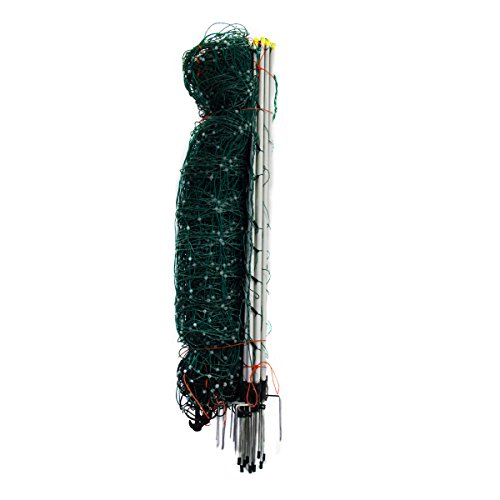
A 35-inch high electric net that owners call quick to move — perfect for rotational pig paddocks where woven wire is impractical.
This is not a woven wire fence — it is an electric netting system with 14 fiberglass step-in posts and a bright green visibility color. At 35 inches high and 164 feet long, it is designed for temporary or rotational grazing, not permanent containment. The electricity does the work, not the physical strength of the wire. Owners mention it “worked even better than another fence we had bought on Amazon” and that “posts were easy to push into ground fencing stayed taught and kept our goats penned in.”
The honest limitation is durability: the plastic step-in posts and legs can break after a few moves, especially in hard ground. Some buyers also note that determined animals may learn to endure the shock or push through if the netting is not tensioned properly.
The big upside: you can set up and take down this entire 164-foot run by yourself in under an hour — no posts to drive, no wire to tension.
The trade-off: the 35-inch height is low for large hogs; a determined pig can push over or jump a temporary net if the charge is weak.
Go with this if: you practice rotational grazing and need a fence you can move every week or two without fighting heavy rolls of wire.
pass on it if: you need a one-and-done permanent fence that hogs cannot push through — choose a woven panel like the Cattle Panel (Product 1) instead.
7. Electric Fence Netting, 35.4″ x 164′ with 14 Posts
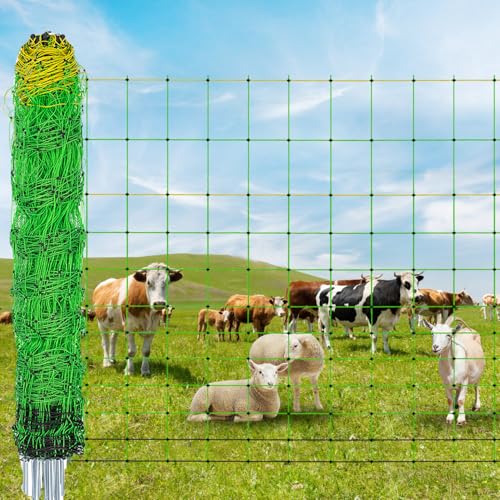
A lighter, portable electric net at 16 pounds that customers note works best for light-duty rotational use — and it includes rubber gloves.
This electric netting kit uses stainless steel conductors woven into nylon wire, making it lighter and more flexible than all-steel fence. It comes with 14 fiberglass posts and 2 stainless steel T-stakes, and includes a pair of rubber gloves for safe handling. At 35.4 inches high and 164 feet long, it is nearly identical in concept to Product 6, but the manufacturer explicitly notes it works for hogs, goats, sheep, and cattle when paired with a 0.25-joule energizer (not included). An energizer is the device that sends electrical pulses through the fence to deliver a shock. Buyers praise the easy one-person setup: “Easy 1-person setup, quick clamps to link 4 units.” The functionality is the most consistent positive in owner feedback.
The honest weakness is in the netting itself — reviewers describe it as “slightly flimsy” and not suitable for large or aggressive animals. Some found chickens could walk through it when not electrified. Compared to the other electric net in this guide (Product 4), this one weighs 16 pounds — a pound more — and includes the rubber gloves, which is a small but practical bonus.
Why it stands out
- 16-pound total weight makes it the most portable option for a single person to carry and move
- Stainless steel conductors in a nylon weave are more flexible than all-steel electric netting
- Includes rubber gloves — a minor but smart inclusion for safe setup
Install realities
- Netting is not designed for aggressive or large adult hogs — use for piglets or light rotational paddocks
- Some buyers found it challenging to adjust the size without adding extra T-posts
Reach for it when: you need a portable electric fence for light-duty paddock rotation and want stainless steel conductors that do not rust.
Avoid if: your pigs are large, aggressive rooters that need a physical barrier — go with a galvanized woven wire fence like the Cattle Panel (Product 1) instead.
Understanding the Specs
Wire Gauge (Thickness)
This is the single most important number on a pig fence. Gauge is written backward: a lower number means a thicker, stronger wire. A 12-gauge wire is about 0.1 inch thick — roughly the diameter of a heavy paper clip — and can take a lot of leaning from a 300-pound hog. A 14-gauge wire is a step thinner (about 0.08 inch), which is still strong but more flexible. If the gauge is not listed at all, assume the wire is thinner than you want. For permanent pig fencing, 14-gauge is the minimum; 12-gauge is better for high-pressure pens.
Graduated Mesh
Look for this phrase in any pig fence product. It means the fence openings are larger near the top (maybe 8 inches wide) and get progressively smaller toward the bottom (down to 3.5 inches or smaller). Why it matters: a piglet’s head is about the size of a large apple. If the bottom openings are small enough, a piglet cannot squeeze through, and a full-grown sow cannot get her snout under the bottom wire to root her way out. The larger openings at the top also reduce the total weight of the fence roll, making installation easier.
FAQ
Will a regular cattle fence hold pigs?
What gauge wire is best for pigs?
Can I use electric netting for pigs?
How tall should a pig fence be?
What is the difference between woven and welded wire fence for pigs?
Do I need to bury the bottom of a pig fence?
How long does galvanized pig fence last outdoors?
Can I use pig fencing as a garden trellis too?
Final Thoughts: The Verdict
The Cattle Panel 14-Gauge Woven Wire Fence earns the top spot because its 328-foot roll, reinforced 12-gauge borders, and graduated mesh give you the longest, strongest permanent enclosure per dollar in this list. If you rotate pastures and need a fence you can move in under an hour, grab the Portable Electric Fencing Net. And for a budget-conscious permanent pen up to 164 feet, the Farm Fence 4ft x 164ft offers the most balanced mid-range value with a solid 14-gauge build.
How We Picked
We do not accept paid placement. Every pick is matched to a real buyer and a real use-case; we do not hands-on test units.
Sources & Methodology
Specifications: manufacturer listings and product documentation. Review insights: verified customer reviews, as of July 2026. Pricing: not shown on this page (it changes often); check the current price via the retailer link.
As an Amazon Associate, WellFizz earns from qualifying purchases. This does not affect which products we feature.
Related Guides

Mo Maruf
I created WellFizz to bridge the gap between vague wellness advice and actionable solutions. My mission is simple: to decode the research and give you practical tools you can actually use.
Beyond the data, I am a passionate traveler. I believe that stepping away from the screen to explore new environments is essential for mental clarity and physical vitality.