Our readers keep the lights on and my smoothie glass nicely filled. As an Amazon Associate, I earn from qualifying purchases.
Specs are compiled from manufacturer listings and verified buyer reviews and can change over time — please confirm the key details on the product page before buying.
Feeding tube formulas are medical necessities: getting enough calories to a body that cannot chew or swallow safely. A calorically dense formula delivers more energy per milliliter, cutting feeding time. Your choice affects weight gain, digestion, comfort, and daily energy.
I’m Mohammad Maruf — the founder and writer behind WellFizz. This guide is built by comparing the manufacturers’ published specifications and the patterns across verified customer reviews, so you get each pick’s real strengths and trade-offs instead of marketing spin.
Finding the best feeding tube formula to gain weight means matching a formula’s calorie density to the body’s needs and the tube’s flow.
Our Picks at a Glance


How To Choose The Best Feeding Tube Formula To Gain Weight
Before you buy, get a doctor or dietitian’s guidance. These are medical nutrition products, and the right one depends on your health needs and daily calorie goals.
Start With Calorie Density
Calorie density is how many calories each milliliter of formula holds. Standard hospital formulas often sit around 1.0 calories per milliliter, while weight-gain formulas push higher. A 1.5 kcal/mL formula concentrates 1,500 calories into one liter, and a 2.0 kcal/mL formula crams 2,000 calories into that same liter. Higher density means fewer feedings and less liquid to process, so check this number first — it does the heavy lifting for weight gain.
Check Protein Per Serving
Protein helps the body hold onto muscle while calories are rebuilding fat stores. Since your body may be stressed or healing, protein is not optional. Look at the protein grams listed per 1000 milliliters, which lets you compare formulas fairly. A 2.0 kcal/mL formula can carry 84 grams of protein per liter, while a standard 1.5 kcal/mL formula often lists around 68 grams.
Match The Formula To Your Needs
Some formulas are gluten-free and suitable for lactose intolerance, while others add fiber for bowel regularity or use MCT oil to make digestion easier. A complete formula delivers 100% of your daily vitamin and mineral needs, while a real-food blend is more like a blended meal with a different texture. Your doctor can tell you which type your condition needs, and your feeding method — bolus, gravity, or pump — will guide how easily the formula flows.
Quick Comparison
| Model | Best For | Calorie Density | Protein | Unit Size | Amazon |
|---|---|---|---|---|---|
| Isosource 1.5 Cal★ Best Overall | Balanced everyday tube nutrition | 1.5 kcal/mL | — | 8.45 fl oz | Amazon |
| Nestle Nutren 1.5Best Value | Value and digestive flexibility | 1.5 kcal/mL | 68 g / 1000 mL | 250 ml | Amazon |
| 1.5 Cal High-ProteinWeight Keeper | Quick weight maintenance | 1.5 kcal/mL | — | 8 oz can | Amazon |
| Nutren 2.0 | Maximum density, less volume | 2.0 kcal/mL | 84 g / 1000 mL | 8.45 fl oz | Amazon |
| Abbott Jevity 1.5 Cal | 1000 mL jug, fewer changes | 1.5 kcal/mL | — | 1000 mL | Amazon |
| Real Food Blends | Whole-food purees, 6 meals | — | — | 9.4 oz pouch | Amazon |
| Jevity 1.5 High Protein | Regularity and steady gains | 1.5 kcal/mL | — | 8 oz carton | Amazon |
| Kate Farms Peptide 1.5 | Sensitive digestion | 1.5 kcal/mL | 24 g organic | 11 fl oz | Amazon |
| Liquid Hope | Organic whole-food nutrition | — | 23 g | 12 oz pouch | Amazon |
In‑Depth Reviews
1. Isosource 1.5 Complete Nutrition
Our pick — 4.5★ from 400+ verified ratings; the strongest balance of quality and price.
The clinician’s staple that keeps tube-fed patients going, one 8.45 fl oz can at a time.
If your oncologist or dietitian names a formula, this is often the one they mean. Each compact 8.45 fl oz can packs 1.5 calories per milliliter, a calorically-dense boost built for recovering bodies that need energy without a lot of liquid volume. The added fiber supports bowel regularity, a real concern when your nutrition arrives straight through a tube.
Buyers consistently call this a lifeline for tube feeding, praising the calorie content and balanced nutrition as the reason their family member keeps their strength. As owners put it, “I lived on this exclusively for 18 months after cancer surgery and needed a feeding tube.” As a complete liquid formula, it works as a sole nutrition source, not a supplement.
The one trade-off is taste. Since it’s meant for tube use first and oral drinking second, some owners find the flavor worse than they expected when taken by mouth. If you plan to sip it rather than tube-feed, that’s the catch to weigh.
Why It Leads
- 1.5 kcal/mL density supports weight gain per feed
- Contains fiber, which helps with digestive health and bowel function
- Complete liquid nutrition that can be a sole source
- Trusted by oncologists and delivered quickly
Who Should Pause
- Flavor is mixed when taken orally
- Teeny 1 x 1 x 1 inch listed dimensions undersell the real can size
Pick it for: a proven, complete tube formula with fiber that doctors recognize and patients tolerate.
Think twice if: you need a flavor you’ll enjoy sipping by mouth rather than through a tube.
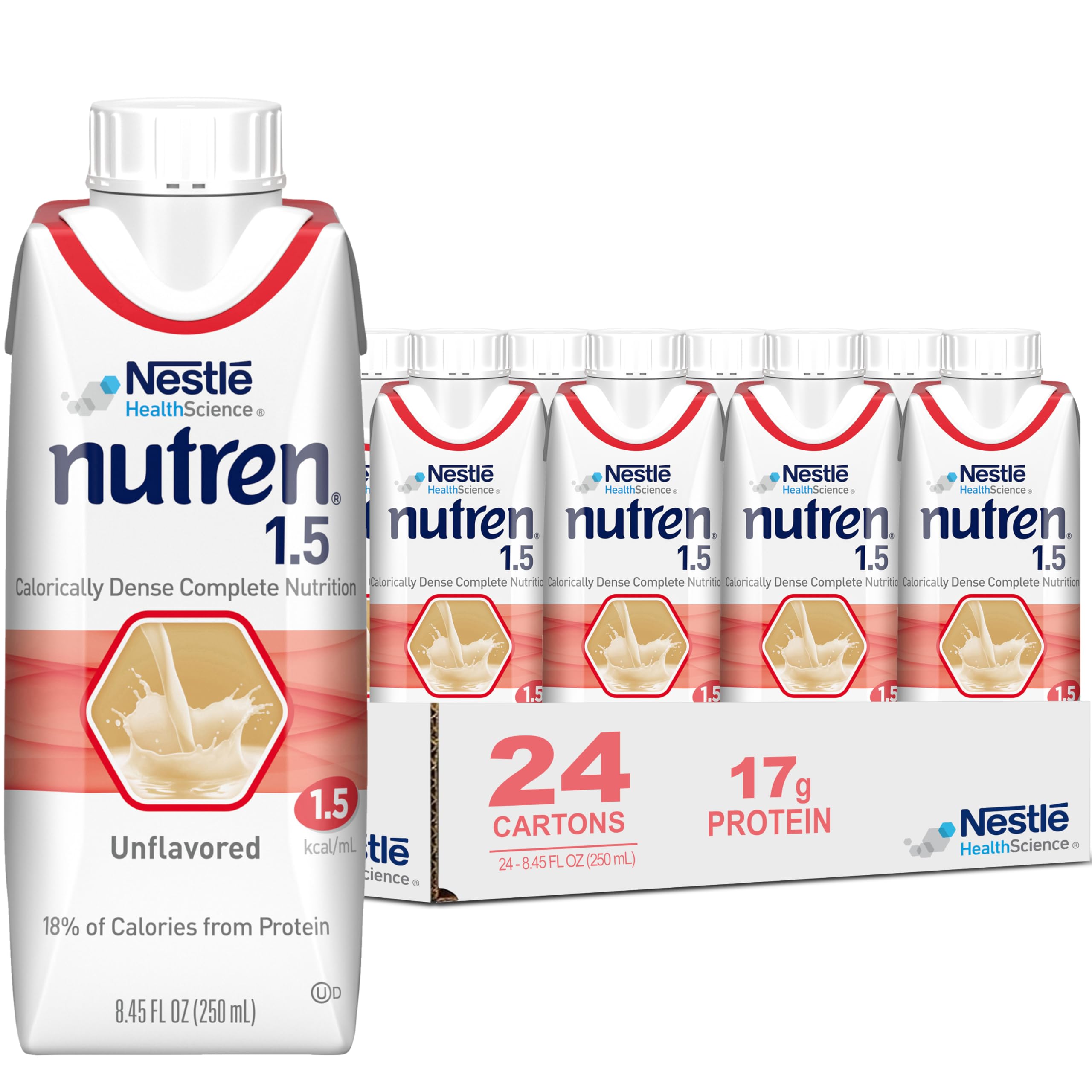
2. Nestle Nutren 1.5
A 250 ml bottle that balances a full nutrition profile with a friendlier price point.
This formula delivers 1.5 calories per milliliter — which translates to 1,500 calories per 1000 mL — alongside a solid 68 grams of protein per 1000 mL. That protein comes from a casein (from milk) and soy blend, helping you hold onto muscle while you gain weight. It’s also suitable for lactose-intolerance, gluten-free, and kosher diets, which widens its usefulness considerably.
The 250 ml bottle is noticeably smaller than the 1000 mL jugs on this list, which hold 1000 mL vs 250 mL. That smaller format is perfect for gravity or pump feeding sessions or as a ready meal on the go. Buyers report fast turnaround and fresh expiration dates, noting the price beats their home health company’s rates — a meaningful win if you’re paying out of pocket.
This is meal-replacement territory: the maker clears it for short- or long-term tube feeding but not for IV use. Keep that in mind when you set up your feeding routine.
What Wins People Over
- High in protein, calories, and potassium
- Suitable for lactose-intolerance and gluten-free diets
- Compact 250 ml size handles feeding cycles well
- Frequently cheaper than home health suppliers
What To Expect
- You’ll need more bottles than a 1000 mL jug to cover a full day
- Must be used under medical supervision
Reach for it if: you want a proven Nestle formula with dietary flexibility at a value-oriented price.
Look elsewhere if: you need the absolute maximum calorie concentration and want to minimize bottle changes.
3. 1.5 Cal High-Protein Nutrition, Case of 24
A 24-pack of 8 oz cans with high protein and 1.5 calories per mL — built to hold the line on weight.
Each 8 oz can delivers 1.5 calories per mL of energy-dense nutrition, with high-protein support to maintain muscle strength and recovery during a challenging period. It’s unflavored, which makes it flexible for both oral and tube feeding, and it’s balanced with essential vitamins and minerals as a complete nutrition source. The whole case weighs in at 17.34 pounds and holds 192 fluid ounces across those 24 cans.
Buyers describe a 6-8 cans per day recommendation to maintain weight, always stressing that the exact usage should come from your nutritionist. One family’s account is striking: “It saved my 52 year old son’s life… He is probably better nourished now than any other time in his life.” This outcome is exactly what a high-calorie tube formula is designed to achieve.
Shipping can be slow, which may disrupt a fixed feeding schedule. Some orders arrive later than expected, which matters when you’re managing a daily feeding schedule on a fixed supply.
Strong Points
- High-protein formula supports muscle strength
- Unflavored, so it adapts to oral or tube use
- Complete nutrition with essential vitamins and minerals
- 8 oz cans are easy to handle and pour
Watch Out For
- Delivery can run slow for some orders
- Not designed for oral intake during transition from tube feeding
Grab it for: a straightforward, high-protein, high-calorie formula that patients and families rely on for serious weight maintenance.
Consider other options if: slow shipping would break your supply chain or you’re specifically transitioning back to eating by mouth.
4. Nutren 2.0 kcal/ml

The most calorie-crammed formula here — 2.0 calories per mL — for aggressive gains without fluid overload.
Here’s the density champion: a 2.0 kcal/mL formula packs 2,000 calories into a single liter, a full 33% more calorie-dense than the 1.5 kcal/mL options above. It also delivers 84 grams of protein per 1000 mL, which is 24% more protein than Nestle’s own 1.5 formula. That means fewer feedings and less liquid volume to reach the same calorie target — a real advantage when restricted fluid intake is part of your care plan.
Owners mention using this to regain weight after significant loss, with one account noting it provided 550 calories per container, compared to 258 calories per 8 oz from a hospital formula and helped win back 6 of 19 lost pounds. It’s suitable for lactose-intolerance, gluten-free, and kosher diets, and it’s recommended by nutritionists for short- or long-term tube feeding.
The flip side: taste gets mixed reviews since it’s a tube-first formula. Some owners find it tastes horrible by mouth, so if oral sipping is part of your plan, test a single bottle before committing to a case.
The Density Advantage
- 2.0 calories per mL means fewer feedings per day
- 84 g protein per 1000 mL supports weight regain
- Suitable for lactose-intolerance and gluten-free diets
- Recommended by nutritionists
The Trade-Off
- Flavor is polarizing if taken orally
- Not for individuals with galactosemia
Choose this when: you need maximum calories in minimum volume and your nutritionist approves the higher density.
skip it if: you plan to drink it by mouth — the taste may not work for you.
5. Abbott Jevity 1.5 Cal 1000mL

A 1000 mL jug that lasts 4x longer per unit than the smaller 250 ml bottles, cutting changeovers.
This is the big-volume play: a single 1000 mL ready-to-use jug holds 1000 mL, compared to a 250 ml bottle from the same category, which means fewer container changes throughout the day. It delivers 1.5 calories per mL and is gluten-free with fiber — a combination that owners say covers all the essentials for tube feeding, including bowel regularity.
Customers note steady weight gain and fewer feeding interruptions with this jug format.
The trade-off is that a 1000 mL jug is more awkward to pour and store than single-serve bottles. It’s also a case of 8 rather than 24, so the case itself will run out sooner in count — even if it lasts longer per jug.
The Big-Jug Wins
- 1000 mL per jug cuts feeding-session changes
- Gluten-free with fiber for digestive support
- Hospital-recommended for stomach tube feeding
- Proven for weight gain over a year of use
Consider This
- Fewer units per case than smaller formats
- Large jugs need fridge space after opening
- One owner’s review was in a different language, so check details carefully
Pick this for: tube-fed patients who need high volume per container and appreciate a formula that keeps things moving.
Think twice if: you prefer grab-and-go single servings that are easier to store.
6. Real Food Blends Variety Pack
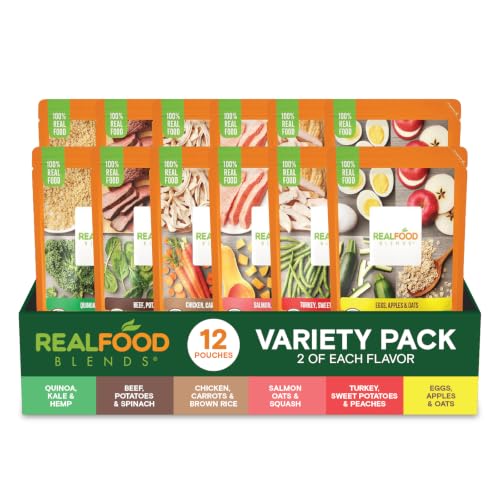
A true blenderized diet of pureed beef, potatoes, and spinach for tube-fed adults and children.
This is a whole-food alternative to processed tube formulas. Each 9.4 oz pouch blends just 6 recognizable ingredients — pineapple juice, beef, potatoes, spinach, grapeseed oil, and water — into a shelf-stable, ready-to-feed meal. It’s a truly blenderized diet, made with whole foods for adults and children with feeding tubes, and it works with bolus, gravity, or pump delivery methods.
Buyers who switched from standard drinks call the difference life-changing. One family’s story: after 7 weeks of oral radiation and major weight loss, a husband on a g-tube was getting sick from Ensure and other brands, and the hospital nutritionist gave them Real Food to try instead. Another owner simply calls it “so much healthier than traditional formulas.” It also helps some patients transition from tube feeding back to eating by mouth.
The main drawback is the higher price per calorie. Owners note these pouches work great but are expensive, especially compared to bulk bags of formula. If budget is your primary constraint, a traditional formula stretches further per dollar.
Why It Stands Out
- Only 6 whole-food ingredients per pouch
- Works with bolus, gravity, or pump feeding
- Shelf-stable and ready to feed
- Helps some transition from tube to oral eating
What Holds It Back
- Pricier than bulk formula per calorie
- Some users report indigestion, so monitor tolerance
Reach for this if: you want a clean whole-food puree over processed formula and the budget allows.
Look elsewhere if: cost is the deciding factor and you need tighter per-calorie economics.
7. Jevity 1.5 High Protein with FOS, 2-Case Special

The crowd favorite at 4.8 stars, delivering steady weight gain and notably regular digestion.
This Abbott formula pairs 1.5 kcal/mL density with FOS, a prebiotic fiber that owners say keeps things regular. For a bed-bound family member, that bowel regularity is often as important as the calories. Buyers with Multiple Sclerosis patients on PEG tubes mention it as essential, crediting the formula with keeping their loved one “regular” and gaining much-needed pounds.
At 8 oz per tetra carton, it’s a convenient single-serving size that’s easy to grab, and the 2-case special means you get 48 cartons in one order. One tube-fed owner is blunt about its value: “I have a feeding tube and this product is essential for my health and nutrition.”
The catch: reviews are glowing but relatively few, and it’s positioned at a higher price point. If you need to stretch every dollar, you’ll pay a premium for the 2-case convenience.
Standout Strengths
- Top-rated at 4.8 stars across owners
- FOS fiber supports bowel regularity
- 8 oz cartons are easy to handle
- Complete, balanced nutrition as a sole source
Keep In Mind
- Higher cost than single-case alternatives
- Fewer total reviews than the most-reviewed picks
Choose it for: a highly-rated formula that supports both weight gain and digestive regularity.
Pass it by if: budget is tight and you’re comfortable buying single cases.
8. Kate Farms Organic Adult Peptide 1.5

An organic, plant-based, peptide formula that’s unusually gentle on sensitive stomachs.
This formula is made for impaired digestion. It’s a calorically dense, peptide-based nutrition with 500 calories per 325 mL carton (1.5 cal/mL), featuring 24 g of organic hydrolyzed pea protein. The peptides are already broken down, which makes them easier to absorb, and it’s built without artificial sweeteners or common allergens.
Owners with severe gastroparesis say this is “the only formula I can tolerate” — it’s absorbed well and reduced diarrhea almost completely from the start. That’s a meaningful difference for bed-bound patients with poor digestion. The formula adds MCT oil and prebiotic fiber to promote easier digestion.
The downside is two-fold: it’s expensive, and insurance may not cover it. One owner with severe gastroparesis notes their state BCBS plan covers no formula at all, leaving them to pay out of pocket. There’s also an occasional negative review pointing at the agave syrup and brown rice syrup as pro-inflammatory for that individual — so tolerance isn’t universal.
Why It Helps
- Hydrolyzed pea protein is easier to absorb
- Organic, plant-based, free of common allergens
- Contains MCT oil and prebiotic fiber for digestion
- Reduces diarrhea in sensitive patients
Before You Buy
- Premium price point and often not insurance-covered
- High sugar content from agave and brown rice syrup is a concern for some
Pick this for: patients with digestion issues who need a gentle, organic, plant-based formula even at a premium.
Skip if: your care plan prioritizes cost and your stomach tolerates standard formulas fine.
9. Liquid Hope Tube Feed Formula

The first organic, plant-based, whole foods tube formula — 23g protein and 8g fiber per serving.
Liquid Hope claims a first: an organic, plant-based, whole foods tube feeding formula tune for adults. Each 12 oz pouch carries 450 calories, 23g of protein, and 9 g of naturally occurring dietary fiber. It’s gluten-free, dairy-free, soy-free, and corn-free — a clean ingredient list that owners say is “way better than hospital feed.”
Buyers chose this for diabetic dads on G-tubes during radiation and 88-year-old mothers on 2-year feeding regimens, describing it as a life-saver. The ingredient quality is the most-praised aspect, and owners note it tastes better cold and diluted with water rather than straight from the pouch.
You will hit a few practical snags. The pouches are hard to pour, so you may need to thin the formula with water or a protein liquid to get it to flow smoothly through your tube. Each case weighs 18 pounds, which makes storage a heavy lift. Opinions on value split: some reviewers point out the confidence justifies the cost, while others call it too pricey for what you get.
The Clean-Food Appeal
- Organic, plant-based, whole food ingredients
- Gluten, dairy, soy, and corn-free
- 9 g natural dietary fiber per 12 oz
- Preferred by many over hospital formulas
The Practical Realities
- Pouches are hard to pour and need thinning
- Heavy case at 18 pounds
- Value is a mixed call for budget-focused buyers
Reach for it if: organic whole-food ingredients matter more to you than convenience and cost.
Look elsewhere if: you need a formula that pours smoothly with zero prep work.
Understanding the Specs
Calorie Density (kcal/mL)
This is the single most important number for weight gain. 1.5 kcal/mL means 1,500 calories per liter; 2.0 kcal/mL means 2,000 calories per liter. Higher density lets you hit your calorie target with less volume, which matters when fluid intake is restricted or feeding time is short.
Protein Per 1000 mL
Protein prevents muscle loss while you gain weight. Compare formulas on grams per 1000 mL — a 2.0 formula often lists 84 grams while a 1.5 lists around 68 grams. If a formula lists grams per container instead, check the container size to compare fairly.
FAQ
What is the difference between a 1.5 kcal/mL and a 2.0 kcal/mL tube feeding formula?
How do I know how many cans or bottles to feed each day?
Can I drink these formulas by mouth instead of using a tube?
Are these formulas suitable for lactose intolerance or gluten-free diets?
How does a real-food purée like Real Food Blends differ from a standard formula?
Will a higher-calorie formula help someone gain weight faster?
How long does a case of formula last?
Can I use a pump, gravity, or bolus feeding method with these formulas?
Final Thoughts: The Verdict
For most buyers, the feeding tube formula to gain weight winner is the Isosource 1.5 Cal because it combines a proven 1.5 kcal/mL density with fiber and a reputation trusted by oncologists. If you want maximum calorie concentration with the fewest feedings, grab the Nutren 2.0. And for a clean, whole-food approach that some find life-changing, the Real Food Blends is the one to reach for — if the premium cost fits your budget.
How We Picked
We do not accept paid placement. Every pick is matched to a real buyer and a real use-case; we do not hands-on test units.
Sources & Methodology
Specifications: manufacturer listings and product documentation. Review insights: verified customer reviews, as of August 2026. Pricing: not shown on this page (it changes often); check the current price via the retailer link.
As an Amazon Associate, WellFizz earns from qualifying purchases. This does not affect which products we feature.
Related Guides

Mo Maruf
I created WellFizz to bridge the gap between vague wellness advice and actionable solutions. My mission is simple: to decode the research and give you practical tools you can actually use.
Beyond the data, I am a passionate traveler. I believe that stepping away from the screen to explore new environments is essential for mental clarity and physical vitality.