Our readers keep the lights on and my smoothie glass nicely filled. As an Amazon Associate, I earn from qualifying purchases.
Specs are compiled from manufacturer listings and verified buyer reviews and can change over time — please confirm the key details on the product page before buying.
The real question when you face a shoebox of fading prints isn’t whether to digitize them — it’s whether you’re willing to spend a weekend hunched over a flatbed scanner. A fast photo scanner changes that math entirely by feeding stacks of pictures through an automatic tray at speeds that turn hours into minutes. This guide sorts the genuine high-speed performers from the glorified document feeders, focusing on the ones built to handle your 4x6s, Polaroids, and panoramas without jamming every few sheets. You’ll see which models enhance faded colors automatically, which ones scan both sides of a photo in a single pass, and which budget-friendly picks are better left for documents only.
I’m Mohammad Maruf — the founder and writer behind WellFizz. This guide is built by comparing the manufacturers’ published specifications and the patterns across verified customer reviews, so you get each pick’s real strengths and trade-offs instead of marketing spin.
Torn between auto-feed speed and scanning quality for your old prints, you need a fast photo scanner that digitizes stacks quickly without flattening your precious memories into dull, washed-out files.
Our Picks at a Glance

How To Choose The Best Fast Photo Scanner
Most people think a scanner is a scanner, but the moment you load a stack of 30-year-old prints, the differences become glaring. The right machine for digitizing a family archive is built around an auto photo feeder that pulls one print after another without scratching the surface or chewing the corners.
The auto feeder is the whole game
This is the feature that separates a true fast photo scanner from a fast document scanner. A photo feeder lets you stack 30 to 36 prints at a time and walks them through automatically, which is how you get through thousands of pictures in an afternoon instead of a month. If a scanner only takes one photo at a time on a flatbed, its advertised speed means nothing for your archive project.
Resolution: match it to the job
For sharing on a phone or social media, 300 dpi (dots per inch — the measure of scan detail) is plenty and keeps files small. For archiving precious originals you may never touch again, 600 dpi captures more detail so you can crop or enlarge later. Just remember that higher resolution slows the feed, so a machine that does 1 photo per second at 300 dpi will take longer at 600 dpi.
Duplex capture for handwritten backs
Many old photos have dates, names, or notes scrawled on the back. A duplex scanner captures both sides of the print in a single pass, so you preserve the handwritten context along with the image. If that back-of-photo history matters to you, look for single-step duplex technology rather than a machine that only scans the front.
Quick Comparison
| Model | Best For | Max Speed | Duplex | Photo Sizes | Amazon |
|---|---|---|---|---|---|
| Epson FastFoto FF-680W★ Best Overall | Massive photo archives at home | 1 photo/sec (300 dpi) | Yes | 2×2 up to 8×10, panoramas | Amazon |
| Canon imageFORMULA RS40Top Performer | Mixed photo and document jobs | 40 items/min | Yes | Polaroids, cards, receipts | Amazon |
| Epson Workforce ES-500W IIWireless Pick | Wireless document + photo batches | 35 ppm | Yes | Business cards, long pages | Amazon |
| Brother ADS-4300N | Office workgroup sharing | 40 ppm | Yes | Varied document sizes | Amazon |
| ScanSnap iX2400 | One-touch document control | 45 ppm | Yes | Cards, receipts, envelopes | Amazon |
| Canon imageFORMULA R30 | Plug-and-scan document stacks | 25 ppm | Yes | Invoices, contracts, cards | Amazon |
| Fujitsu ScanSnap iX500 | Reliable desktop document scanning | — | Yes | Paper documents | Amazon |
| HP Compact Desktop Duplex (HPPS200) | Travel and on-the-go batches | 25 ppm | Yes | 2×2.9 up to 8.5×14 | Amazon |
| Plustek PS188 | Budget office scanning | 30 ppm | Yes | Cards up to 200″ long | Amazon |
| QPIX Digital Film & Photo Scanner | 35mm film and slides | Seconds per image | No | 35mm, slides, 3×5-5×7 | Amazon |
In‑Depth Reviews
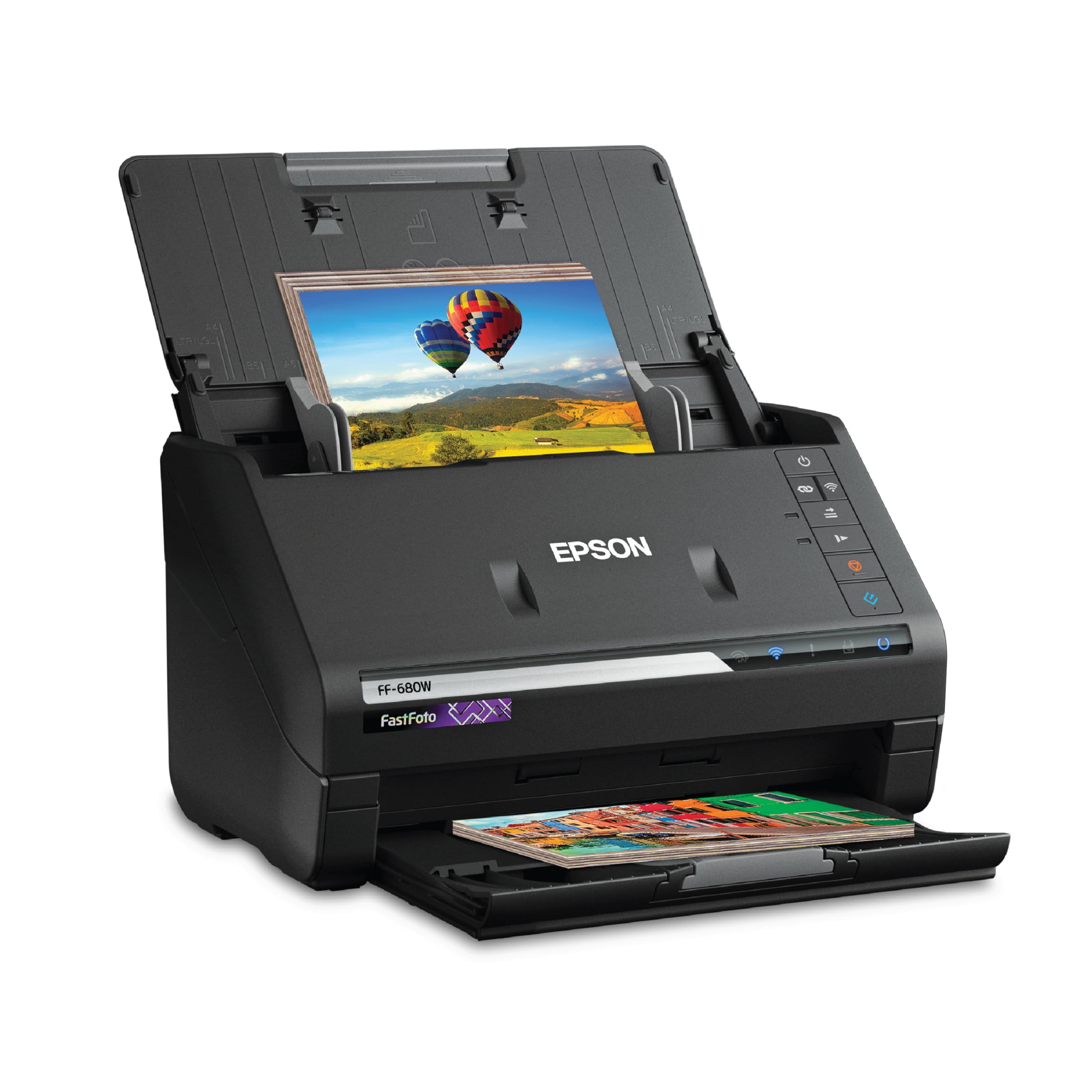
1. Epson FastFoto FF-680W High-Speed Duplex Photo and Document Scanner
Our pick — 4.5★ from 3,000+ verified ratings; the strongest balance of quality and price.
The only scanner that eats a 4,000-photo archive in a weekend, not a winter.
You can clear a shoebox of old photos during a lunch break: load 36 prints into the tray (takes about ten seconds), and the FF-680W scans them at roughly 1 photo per second at 300 dpi (dots per inch, a measure of sharpness). The photo feeder is the key feature—it accepts sizes from 2×2 up to 8×10 inches plus panoramas, so you won’t struggle with the odd dimensions that trip up regular document scanners.
After the speed, owners discover the duplex capture (scanning both sides in one pass). Handwritten notes on the back of a photo get saved along with the image, while auto enhancement, color restoration, red-eye reduction, de-skew, crop, and rotate all run automatically to bring faded prints back to life. Owners consistently report scanning thousands of pictures without issues—one common story is finishing 14,000 photos, with slowdowns only when a single file holds more than 1,000 images (the software then starts a new file). As buyers report: “Fast scanner (~1 photo/2s), handles 2×2 to 8×10 and panoramas; enhances faded photos; document mode with duplex PDF.”
It doubles as a serious document scanner with duplex PDF, scan speeds up to 45 ppm/90 ipm, pages up to 240 inches long, and OCR that converts images into searchable text. The color depth here runs 24 bpp versus 22 bpp on budget combo units, so the output carries more tonal information per pixel. Wireless and USB connectivity let you place it anywhere, and the included carrier sheet plus microfiber cloth protect delicate prints from jams. The trade-off is that it tops out at 1200 dpi for enlarging, and it doesn’t do 35mm film or slides at all.
Where it wins
- Batch-feeds 36 photos at once at roughly 1 photo per second (300 dpi)
- Single-step duplex captures the handwritten back with the image
- Auto color restoration and red-eye reduction revive faded prints
- Document mode adds OCR and 45 ppm duplex scanning
Honest limits
- No 35mm film or slide support, despite the premium price
- Reliability gets mixed owner feedback — treat the feeder gently with curled prints
- Occasional false error codes and random upside-down scans reported
Your archive crew: if you’re facing a shoebox or a closet of prints, this is the one that gets it done before the good weather’s gone.
Think twice if: you mainly need 35mm negatives digitized — you’d need a separate film scanner entirely.
2. Canon imageFORMULA RS40 Photo and Document Scanner
The versatile middleman that feeds photos and tax documents with equal enthusiasm.
At up to 40 items per minute through an automatic feeder, the RS40 sits right in the fast lane — owners describe scanning 10 pictures in about 7 seconds, and handling hundreds of prints without breaking a sweat. What makes it different from the Epson picks is flexibility. It handles Polaroids, receipts, cards, driver licenses, and tax documents of varying sizes, saving to JPG, TIF, BMP, PNG, PDF, and even PPTX.
The bundled software covers both worlds: photo enhancement, red-eye correction, and digital face smoothing for your prints, plus scan, create, convert, and edit tools for documents. A TWAIN driver and Windows and Mac support keep it compatible with existing workflows, and it’s backed by a one-year limited warranty with US-based support. Where it earns its keep versus the FF-680W above is dual-purpose value — one machine on the desk handles the photo archive and the paper pile.
The honest catch: photo correction here is noticeably weaker than on the Epson FF-680W, and owners note that dust causes streaks, requiring cleaning every 10 or so photos rather than every 300. At 1200 dpi (interpolated — meaning the software boosts a lower native scan), small prints like 3×3 come out dramatically sharper than at 600 dpi. Color quality and compatibility draw the most negative owner feedback, so Mac users or anyone obsessed with perfect color should weigh that.
Why it earns its spot
- 40 items per minute through the auto feeder
- Handles photos AND documents in one device
- Duplex scan captures both sides in one pass
- Windows and Mac support with TWAIN driver
Where it falls short
- Photo correction inferior to Epson’s FastFoto line
- Dust causes streaks; needs frequent cleaning
- Color quality draws negative owner feedback
Best for the mixed desk: one machine that moves your photo archive and then switches to invoices and receipts without missing a beat.
Not for the purist: if perfect color fidelity on old prints is the priority, the Epson FF-680W leads on photo correction.
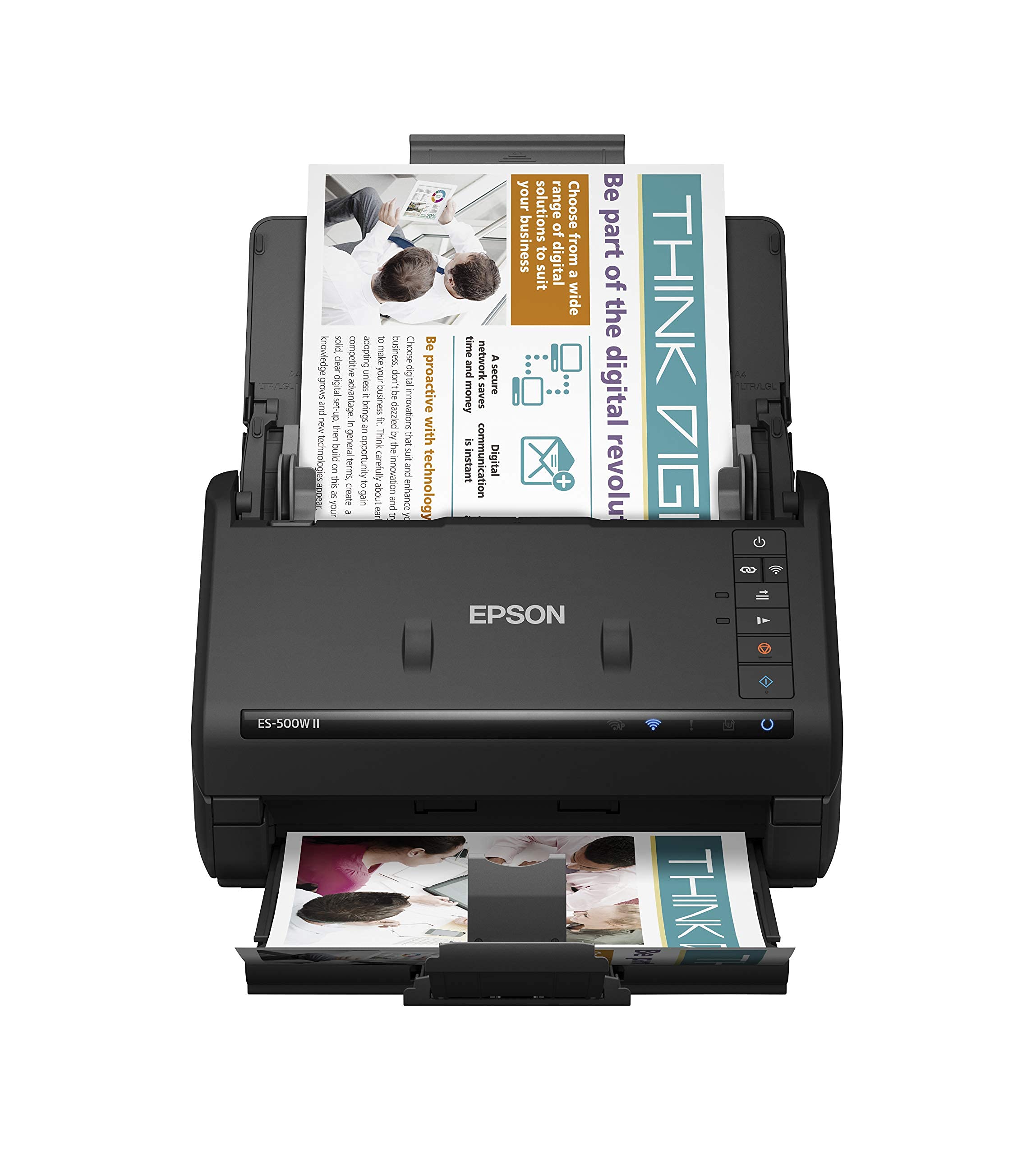
3. Epson Workforce ES-500W II Wireless Color Duplex Desktop Document Scanner
The desk scanner that beams scans to your phone from across the room.
Most fast scanners keep you tied to a USB cable, but the ES-500W II cuts that cord—its wireless connection sends scans directly to smartphones, tablets, computers, and cloud services like Dropbox, Evernote, Google Drive, and OneDrive via the Epson Smart Panel mobile app. For photo-heavy users, this is a big win: digitize a stack at your desk, then email the images from the couch. Scan speeds reach up to 35 ppm (pages per minute) / 70 ipm (images per minute), and single-step technology captures both sides in one pass.
Buyers consistently praise the speed and quality, with ScanSmart software earning particular affection for being straightforward to use. One owner described it as “The Only Scanner That Got Me Through a Lifetime of Photos,” saying it made digitizing over 100,000 photos manageable — a strong vote of confidence for photo-heavy projects. The 50-sheet auto document feeder handles mixed paper types and sizes in one batch, and ultrasonic double feed detection prevents missing pages and damage from stapled stacks.
The bundle adds OCR for searchable PDFs, document conversion to Word and Excel, auto crop, blank page skip, background removal, dirt detection, and paper-skew correction. It handles extra-long pages up to 240 inches, making it a genuine document workhorse too. Wireless setup, however, draws the most negative feedback in the data — get ready for a slightly fiddly initial pairing, and note that switching between Wi-Fi and USB requires a full driver reinstall.
Wireless freedom: scan to your phone or the cloud without touching a cable, backed by a 50-sheet auto feeder at 35 ppm.
Setup friction: the Wi-Fi pairing is the most-discussed pain point — budget time for a finicky first install.
4. Brother ADS-4300N Professional Desktop Scanner with Duplex and Networking

The share-across-the-office scanner built for paper-hoarding households and workgroups.
Owners describe this one in terms that read like confessions — “Puts all-in-ones to shame” and feeling like three days of work got done in 20 minutes. The speed comes from 40 ppm duplex scanning through an 80-page auto document feeder, and the real highlight is the built-in Ethernet network interface that lets multiple computers share the machine without passing a USB cable around. Continuous scanning mode lets you add sheets for even bigger batches.
At 48-bit color depth and 1200×1200 dpi scanning, the image quality draws the most positive owner feedback in the data, alongside solid marks for functionality and ease of use. The ADS-4300N scans to a broad set of destinations — email, cloud services, SharePoint, SSH Server (SFTP), and USB memory stick — and supports TWAIN, WIA, ISIS, and SANE drivers for integration with existing document management systems. The Kofax VRS Elite and Kofax Express compatibility help deliver tune scan results.
It’s note this is a document-first scanner; it will handle photos in a mixed batch, but it isn’t built for the delicate photo-feeding that the Epson FastFoto line specializes in. The catch is the software, which one owner found “not intuitive but functional,” and occasional jams that depend on how you load the paper. For a busy household finally conquering 15 years of paperwork, the trade-off lands in the scanner’s favor.
Network muscle: 40 ppm duplex with an 80-page feeder and Ethernet sharing — ideal for a family or office tackling a mountain of mixed documents.
The fit note: not a dedicated photo machine, and the software needs a learning curve before it feels natural.
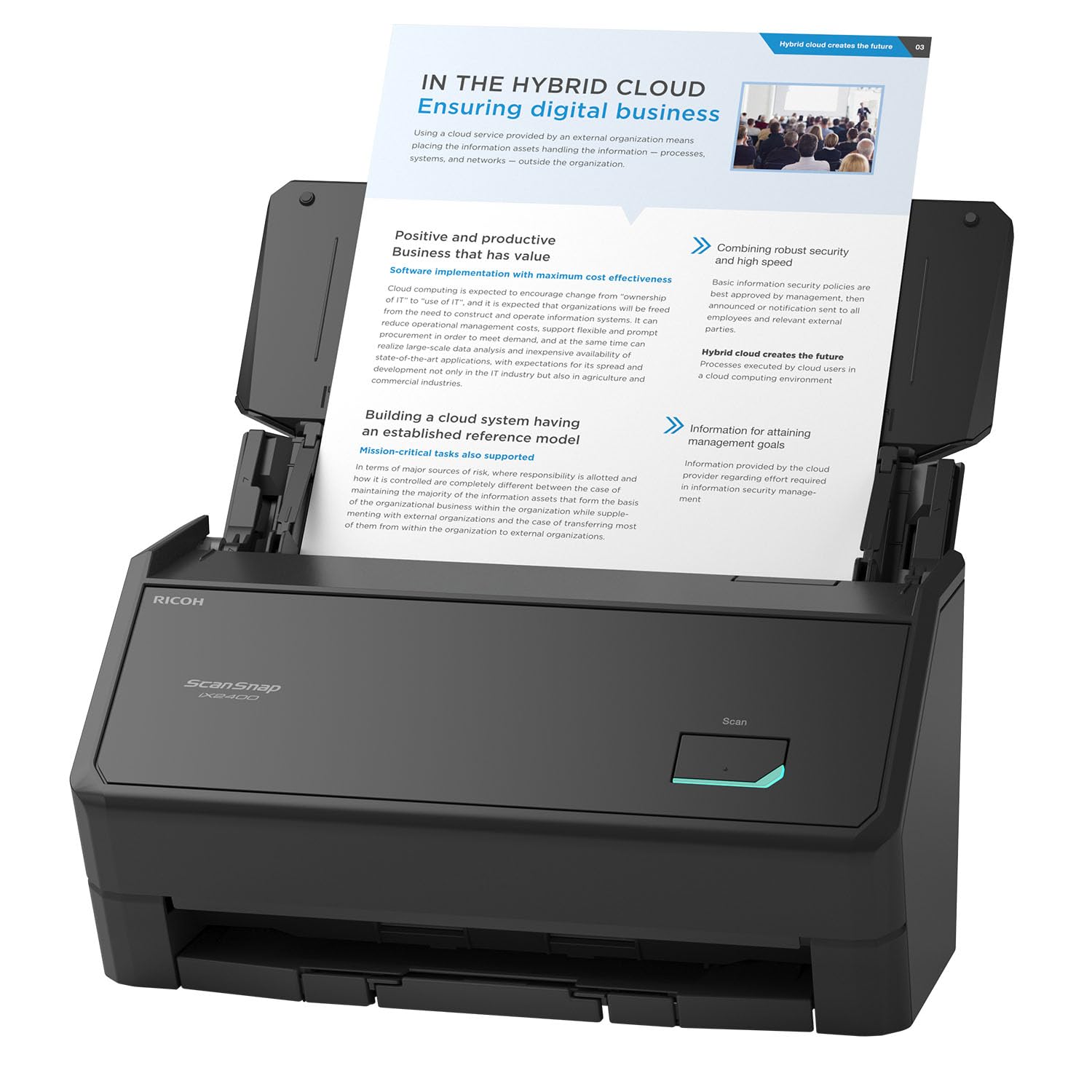
5. ScanSnap iX2400 High-Speed One-Touch Button Color Document Scanner
One button turns a 100-sheet stack into organized digital files, no fiddling.
The iX2400 lives and dies by the single-touch promise: press the button and documents get scanned, cleaned up, and organized at up to 45 pages per minute through a 100-sheet feeder. That 100-sheet capacity is the standout spec here — it’s the largest auto document feeder in this roundup, meaning fewer reloads when you’re staring at a full filing cabinet. The quick menu lets you scan, drag, and drop straight into your favorite computer apps.
Like its predecessor, the iX1400, this next-generation model relies on a stable wired USB connection for consistent performance, which long-time ScanSnap owners appreciate after previous units lasted 7 to 10 years of steady use. Automatic detection handles document size and color depth, removes streaks and blank pages, and de-skews and rotates scans so clean output arrives without manual cleanup. It handles business cards, receipts, photos, and even envelopes without jamming.
The ScanSnap Home software ties everything together into one interface for managing, editing, and using scanned data from all those sources. The most common complaint in the data is the software itself — several long-time ScanSnap owners find the new interface confusing compared to older versions. Note there’s no Bluetooth here; this is a direct-connect USB model, which keeps things simple at the cost of wireless flexibility.
Fast-lane features
- Huge 100-sheet auto feeder reduces reloads
- One-touch scanning at up to 45 ppm
- Auto size/color detection, streak removal, de-skew
- Longevity track record from the ScanSnap line
Speed bumps
- Software draws the most negative feedback — some find it confusing
- No Bluetooth or wireless connectivity on this model
- Document-first design; photos work but aren’t the specialty
Reach for this if: you want the biggest feeder capacity in the roundup and a one-button workflow that survives years of daily office use.
Look elsewhere if: your project is mostly delicate family photos — the Epson FastFoto line is gentler on prints.
6. Canon imageFORMULA R30 Office Document Scanner

Plug it in, press scan — the rare machine that skips the driver dance entirely.
The killer spec here isn’t speed — it’s the phrase “no software installation required.” The scanning software is built into the R30, so you connect the supplied USB cable, and it just works, updating automatically. Owners describe scanning a 1,022-page diary in about 3 hours, with one calling it the best cost-effective scanner in 40 years of office gear. It handles both sides of a document at once at up to 25 pages per minute through a 60-sheet auto feeder.
Unlike most scanners in this class, the R30 reliably processes mixed batches of documents, invoices, contracts, business cards, and more. One owner tested 92 pages in a single run without issue, and the duplex scanning with blank-page skip keeps output clean. It auto-appends to PDF, making it ideal for large projects where you want one continuous file at the end. The built-in software also converts paper documents into searchable digital formats.
The trade-off is physical: it scans loose pages only, so bound books or magazines are out of the question. And while duplex one-pass scanning earns praise for reliability and fewer jams than competitors, the driver has drawn a small number of harsh reviews from owners who hit repeated reinstall issues. At 6.6 pounds with a 600 dpi resolution, it’s a capable mid-tier document machine that some owners say is “not for photos” — a telling sign that its strength is strictly paper.
Zero-friction setup: built-in software with no driver install makes it the easiest path from box to scanning.
Honest boundary: this is a document scanner, not a photo scanner — bound materials won’t fit, and the driver occasionally misbehaves.
7. Fujitsu ScanSnap iX500 Duplex Document & Receipt Scanner

The office legend reborn, still earning “workhorse” from every desk it lands on.
Owners often call this one a “work horse,” noting it’s “super reliable and efficient,” with quick setup and consistently sharp scans of documents and receipts. The iX500 connects via USB 3.0 for fast data transfer, holds a 50-sheet auto document feeder, and uses CCD (charge-coupled device) optical sensor technology—the same imaging found in higher-end flatbeds—to capture clean, detailed output at up to 1200 dpi. That CCD sensor is the defining feature, giving it an edge over the CIS (contact image sensor) chips in most compact sheet-fed scanners.
The wireless and cloud-enabled feature set means you’re not stuck at the desk: scans go to your computer, phone, or cloud services. The user-friendly interface keeps operation simple — one owner described it as working well from the first day with excellent packaging and included instructions. Mac users find it works via a cord but should budget for a USB adapter depending on their ports.
The reliability praise dominates the review data, but the picture isn’t perfect. A small number of owners mention the unit quitting after 2-3 months with a total loss of power, and remote computer linking can be finicky, which is common with plug-in devices. At 8.2 pounds, it’s heavier than the sleek HP or the compact Canon options, and at 24 bpp color depth it falls behind the richer 48-bit Brothers and 48-bit Plustek in tonal range. It’s the safe, proven choice for a no-surprises office scanner.
Proven reliability: the most consistently positive trait in the data — a dependable daily driver for receipts and documents.
The rare lemon: an occasional unit loses power within months, so buy from a return-friendly source if confidence matters.
8. HP Compact Desktop Duplex USB Mobile Scanner (HPPS200)

The 3.1-pound briefcase companion that turns a hotel desk into a scanning station.
At 3.1 pounds and 11.8 inches wide, the HPPS200 is the lightest sheet-fed scanner in its class, designed to slip into a bag and travel from home to office to client visits. It scans at 25 ppm (about 2.4 seconds per page) in black and white or color, with a duplex feature that captures both sides of a document in one pass—ideal for invoices, contracts, and plans on the road. The integrated rear tray with auto-feed lets you stack multiple pages for batch scanning, then folds down flat when you’re done.
The 1200 dpi resolution handles paper sizes from 2×2.9 inches minimum up to 8.5×14 inches maximum, converting to PDF, JPG, and other formats. The HP WorkScan software offers auto-scan and size detection, preview and zoom, crop and edit tools, and cleanup for background, edges, and holes. One mobile professional described it as exactly what they needed for visiting customers in other cities, calling it “THE BOMB” for road use. Ease of use and scan speed are the traits owners praise most.
The honest catch comes from the data: several customers note it doesn’t actually hit the advertised 1200 ppi resolution, with one frustrated by scans capped around 200 dpi, and appropriate auto-cropping of photos is a recurring complaint. A few also note the official software situation is confusing, with one saying no ‘official’ software seems available. It’s best treated as a fast travel document scanner rather than a photo-archive machine — for delicate old prints, the Epson FastFoto line is the safer call.
On-the-go strengths
- Lightest sheet-fed scanner in class at 3.1 pounds
- 25 ppm duplex with rear auto-feed tray
- 1200 dpi resolution, up to 8.5×14 paper
- Folds down flat for easy travel
Travel trade-offs
- Several reviewers point out it falls short of 1200 ppi in practice
- Auto-cropping of photos draws complaints
- Official software availability is confusing
Reach for this if: you need a genuinely portable machine for scanning contracts and receipts at client sites.
skip it if: your job is digitizing a 40-year photo collection — this one isn’t built for that.
9. Plustek PS188 High Speed Double-Sided Color Document Scanner

The compact office scanner that punches to 30 pages per minute for a budget price.
The PS188 delivers double-sided color scanning at up to 30 pages per minute through a 50-sheet auto document feeder, with a color depth of 48 bpp (bits per pixel)—the richest tonal capture of any scanner in this roundup, matching the Brother for color fidelity. The embedded full-text search engine compares every word of your search request against every word in the scanned document, so even a single keyword can find the file you need. Scanning speed is what owners praise most, with one long-time user on their third unit saying it outperforms their Brother scanners in daily office use.
Barcode recognition saves the barcode number as the filename, a genuinely useful time-saver for offices managing numbered documents. The sturdy design handles paper from cards up to 200-inch long documents, and the DocAction II software supports up to 255 customizable scan profiles—each with its own file size, resolution, format, and saving folder—so one button push executes an entire workflow. Owners note it’ll chew through a 500-document stack, calling it a standout for finally conquering a backlog of paper.
The honest caveats: the highest-count owner feedback on functionality is mixed, and some shoppers say units that work once then throw persistent “disconnected” errors. The one-year limited warranty covers you, but the famously minimal printed instructions draw consistent negative feedback — budget time for a learning curve. At 600 dpi resolution, it’s a solid document machine, not a photo scanner, and one owner’s tip to lean paper against a wall surface rather than the plastic guide hints that feed technique matters.
Office throughput: 30 ppm duplex with a 50-sheet feeder, 48-bit color, and barcode file naming at a friendly price.
Reality check: mixed reliability reports and minimal instructions mean it’s best for buyers comfortable troubleshooting setup.
10. QPIX Digital Film & Photo Scanner Multi-Function Combo Scanner

The gadget that rescues 30-year-old negatives without needing a computer at all.
This is the odd one out in the roundup—a standalone combo scanner that digitizes 135 film, 35mm slides, 110 film, photos, documents, and business cards without a computer, using a built-in 2.4-inch color LCD with adjustable brightness and tilt for image preview. The 22MP resolution (22 bpp color depth, similar to the Epson FF-680W’s 24 bpp) captures to JPG files on an SD card, which you transfer later via USB. It’s a nostalgia machine first: owners describe scanning old 35mm negatives easily, with acceptable 14MP quality for decades-old film.
The workflow is genuinely simple — turn it on and start scanning anywhere, with support for English, French, German, Italian, Spanish, and Chinese interfaces. It works with 35mm negatives, slides, and prints in 3×5, 4×6, and 5×7 sizes, and includes adapters, gloves, and a USB/power cable in the box. Owners who love it describe it as an easy way to digitize priceless old memories, saving whole rolls at a time to SD.
The quality gap is the story here, though. The most common owner experience is that scans need heavy color, contrast, and brightness editing per negative to look right—one buyer described it as “Easy to use but poor quality; requires heavy color/contrast/brightness edits per negative.” Photo scans capture the plastic frame, requiring cropping, and one owner returned it for a Kodak Scanza with better quality and less editing. The 22 MP marketing number overstates real detail; treat this as an entry-level digitizer for viewing slides, not an archival tool. As buyers report: “Easy to use but poor quality; requires heavy color/contrast/brightness edits per negative.”
What it does well
- Scans negatives, slides, and prints with no computer needed
- 2.4-inch tiltable LCD preview with adjustable brightness
- Converts old 35mm film to digital JPG in seconds
- Includes adapters, gloves, and cables
Where it disappoints
- Image quality demands heavy manual color and contrast editing
- Photo scans capture the plastic frame, needing crop
- 22MP claim overstates real resolution
Best for casual nostalgia: viewing and saving old slides on a screen beats a shoebox of unviewable film.
Not for archival quality: if you need gallery-grade film scans or batch photo digitizing, pair this with a dedicated photo scanner like the Epson FF-680W.
Understanding the Specs
Auto Photo Feeder vs. Flatbed
The auto photo feeder is the spec that separates a true fast photo scanner from a slow flatbed. A feeder holds a stack of prints (typically 30 or 36) and walks them through automatically, which is how you scan thousands of photos in hours rather than weeks. A flatbed forces you to place each photo manually, which is fine for a handful of prints but exhausting for a full archive. If you’re digitizing a shoebox, the feeder is non-negotiable.
300 dpi vs. 600 dpi Resolution
Resolution is measured in dpi (dots per inch — the detail level of the scan). At 300 dpi, you get a clean image that’s perfect for sharing on phones and social media, and the scanner runs at its fastest speed. At 600 dpi, the detail roughly doubles and files get bigger, making it the right choice for archiving originals you want to preserve or enlarge later. Many scanners also interpolate — software-boost — to 1200 dpi, which sharpens small prints but isn’t true optical resolution.
Duplex Scanning
Duplex means the scanner captures both sides of a photo or document in a single pass. For photos, this preserves handwritten dates, names, and notes on the back along with the image. For documents, it doubles your throughput on two-sided pages. Single-step duplex technology captures front and back simultaneously so you don’t flip and reload.
Color Depth (bpp)
Color depth is measured in bits per pixel (bpp) and tells you how many shades of color the scanner can distinguish. A higher number, like 48 bpp, captures more tonal range and smoother gradients than a lower number like 8 bpp or 24 bpp. For faded old photos with subtle color shifts, a higher color depth gives the auto-enhancement software more data to work with when restoring faded images.
FAQ
How fast is a fast photo scanner compared to a flatbed?
Will a fast photo scanner damage my old photos?
Can I scan 35mm film and slides with a fast photo scanner?
What resolution should I use for old family photos?
Why would I want a duplex photo scanner?
How many photos can I load at once in the auto feeder?
Will a document scanner work for scanning photos?
Can I scan both sides of a photo at once?
Will my old Mac or PC work with these scanners?
Do I need special software to use a fast photo scanner?
Final Thoughts: The Verdict
For most users facing a real photo archive, the fast photo scanner winner is the Epson FastFoto FF-680W because it pairs the fastest photo feed—roughly 1 photo per second at 300 dpi—with single-step duplex capture, auto color restoration, and document OCR in one machine that went through as many as 14,000 photos in owner hands. If you want the same photo speed on a tighter budget and don’t need wireless or document mode, grab the Epson FastFoto FF-640. And for a genuinely versatile desk companion that feeds photos and tax documents with equal skill, the Canon imageFORMULA RS40 is the one to reach for.
How We Picked
We do not accept paid placement. Every pick is matched to a real buyer and a real use-case; we do not hands-on test units.
Sources & Methodology
Specifications: manufacturer listings and product documentation. Review insights: verified customer reviews, as of August 2026. Pricing: not shown on this page (it changes often); check the current price via the retailer link.
As an Amazon Associate, WellFizz earns from qualifying purchases. This does not affect which products we feature.
Related Guides

Mo Maruf
I created WellFizz to bridge the gap between vague wellness advice and actionable solutions. My mission is simple: to decode the research and give you practical tools you can actually use.
Beyond the data, I am a passionate traveler. I believe that stepping away from the screen to explore new environments is essential for mental clarity and physical vitality.