Our readers keep the lights on and my smoothie glass nicely filled. As an Amazon Associate, I earn from qualifying purchases.
Specs are compiled from manufacturer listings and verified buyer reviews and can change over time — please confirm the key details on the product page before buying.
A chainsaw on a farm isn’t a tool for weekend yard art — it’s the difference between a downed tree blocking the lane for a week and having next winter’s firewood stacked by sundown. You need something that starts when the temperature drops, handles hardwood without bogging, and survives being treated like a piece of equipment rather than a hobby. This guide focuses on the specs and owner experiences that distinguish a farm-worthy saw from a hobbyist tool.
I’m Mohammad Maruf — the founder and writer behind WellFizz. This guide is built by comparing the manufacturers’ published specifications and the patterns across verified customer reviews, so you get each pick’s real strengths and trade-offs instead of marketing spin.
Whether you’re clearing storm damage, processing firewood, or milling timber, finding the right farm chainsaw means balancing displacement, bar length, and real-world durability against your actual workload — and we’ve done that digging for you.
Our Picks at a Glance


How To Choose The Best Farm Chainsaw
Picking a chainsaw for farm work means matching the saw to the wood you actually cut — not the biggest log you can imagine. A saw that’s too small struggles and wears you out; one that’s too large is a beast you don’t want to lift all day. Here are the three things to get right.
Engine Displacement (cc) — The Real Power Number
To get the cutting power you need for farm work, look at the engine’s displacement in cubic centimeters (cc) — that’s the volume of air and fuel the engine can pull in, and more cc almost always means more grunt. For typical farm tasks like cutting firewood and clearing 20-inch logs, a 50cc to 60cc saw is a balance. For heavy milling or felling massive timber, you want 70cc and above. Smaller saws under 45cc are fine for limbing but will bog down in hard, thick trunks.
Bar Length — Matching the Saw to the Wood
The bar length determines the diameter of the tree you can cut in one pass. A good rule: the bar should be at least 2 inches longer than the tree’s diameter. A 20-inch bar handles most firewood and storm cleanup. A 24-inch bar gives you more reach for felling and larger trunks. A 36-inch or 42-inch bar is for serious milling or giant timber — those saws are heavy and harder to maneuver for everyday cutting.
Weight, Handling, and Anti-Vibration — Your Hands Will Thank You
A lighter saw (around 11 to 14 pounds) lets you work longer without fatigue but may lack the grunt for big cuts. A heavy saw (19 to 30 pounds) muscles through anything but will wear you out on a long day. Look for an anti-vibration system (sometimes called LowVib) — it reduces the shaking that numbs your hands and wrists over hours of cutting. A well-balanced saw with good ergonomics makes a bigger difference than a few extra cc of power.
Quick Comparison
| Model | Best For | Engine Displacement | Bar Length | Item Weight | Amazon |
|---|---|---|---|---|---|
| Husqvarna 450 Rancher★ Best Overall | Versatile daily firewood & storm cleanup | 50.2cc | 20 inches | 11.3 pounds | Amazon |
| PROYAMA 68CCBest Value | Budget firewood with two bar options | 62cc (claimed 68cc) | 24 / 20 inches | 14.5 pounds | Amazon |
| FARMMAC F380WPro Grade | Heavy firewood & professional logging | 72cc | 24 inches | 19.8 pounds | Amazon |
| NEO-TEC NS892V1 | Milling & large timber | 92cc | 36 inches | — | Amazon |
| ECHO CS-590 | Durable workhorse from a trusted brand | 59.8cc | 20 inches | 20.1 pounds (9.12 kg) | Amazon |
| FARMMAC F660V | Affordable milling & ranch use | 92cc | 36 inches | 18.2 pounds | Amazon |
| FARMMAC F070W | Extreme milling & massive timber | 105cc | 42 inches | 29.7 pounds | Amazon |
| NEO-TEC NS8105 | Heavy milling on a budget | 105cc | 42 inches | 30 pounds | Amazon |
In‑Depth Reviews
1. Husqvarna 450 Rancher 20 Inch Gas Chainsaw
Our pick — 4.5★ from 500+ verified ratings; the strongest balance of quality and price.
The polished farm companion that slices through storm damage without a fight.
What wins here is the balance — this saw is built for the kind of afternoon where you drop a half-dozen trees and still have energy left. Its 50.2cc X-Torq engine delivers 3.2 horsepower, which is plenty for 20-inch logs and most firewood you’ll tackle on a farm. At just 11.3 pounds, it’s noticeably lighter than the FARMMAC F380W (19.8 pounds), making a long day of cutting far less punishing on your shoulders and arms. Buyers report the “20-inch bar length easily cut larger logs from recent storm damage,” which sums up the daily reality for most landowners.
The handling is where Husqvarna’s engineering shows up. Smart Start technology means the saw fires up without a wrestling match, and the inertia-activated chain brake adds real safety against kickback — a feature that matters when you’re working alone. The LowVib system (anti-vibration technology) and ergonomic trigger keep your hands from going numb, which is the difference between a saw you reach for and one you leave in the shed. The crowd favorite — with thousands of positive ratings — it’s the saw you buy when you want proven reliability and don’t want to gamble on a clone.
The trade-off is that durability has some soft spots: a small number of owners mention chains breaking on the first day, so checking the chain tension and oil output before heavy use is smart. It burns fuel a little quicker than an older Stihl 021, but the cutting speed makes up for it. If you’re on a tighter budget and comfortable with mechanical tinkering, the PROYAMA below saves money — but for a saw that just works, this is the one.
What Owners Celebrate
- Reliability gets the most praise — over 50 owners single it out as dependable and ready to run.
- Cuts large trees easily; buyers mention it “slices through” hardwoods without bogging down.
- Starts easily and stays running, with manageable weight for its power class.
The Real Caveats
- A small batch of units arrive with an overtightened chain or spark plug — check both before first start.
- Chain breaking on the first day is rare but reported; inspect the chain closely from the start.
- Fuel consumption is a touch higher than some older saws, though the power gain offsets it.
Reach for it if: you need one saw that does everything — firewood, storm cleanup, limbing — without a hassle.
Think twice if: you plan to mill large timber regularly; a longer bar and bigger cc saw will serve you better.
2. PROYAMA 68CC Gas Powered Chainsaw
The two-bar bundle that delivers a lot of grunt for customers willing to turn a wrench now and then.
This saw leans hard into value — a claimed 68cc engine (actual displacement is closer to 62cc, as customers note), a 24-inch bar plus a spare 20-inch bar, and a price that undercuts the Husqvarna 450 Rancher by a wide margin. The engine, while loud and with noticeable vibration, offers power that owners compare favorably to an Echo 590, meaning it will chew through oak and hickory without hesitation. Quick-Start technology helps it fire up in a few pulls, and the anti-vibration system does take some edge off the shaking.
The honest catch is consistency. Some owners receive a saw that runs beautifully for months, while others report starting issues after the first tank of fuel. A recurring note is that the plastics around the exhaust can soften or melt if the saw runs hot. A few buyers also mention the 20-inch bar actually measures 18 inches of usable cut. The saw is heavy at 14.5 pounds, and the high oil consumption means keeping the bar oil topped up is a must. Customer support has been helpful for some, but others found it unresponsive.
If you have some mechanical experience and want a powerful budget option for farm firewood, this is a strong pick — just budget time for potential setup and tuning. It’s not the saw for someone who wants to pull it from the start and never look at it again.
The Upside
- Powerful motor cuts through oak and elm with impressive speed — comparable to saws costing twice as much.
- Comes with both a 24-inch and a 20-inch bar, giving flexibility for different jobs out of one box.
- Starts easily when the carburetor is set right; many owners get a 2-pull cold start.
What to Watch
- Build quality is uneven; some units arrive with starting issues that require carburetor adjustment or parts replacement.
- High vibration and loud operation make long sessions less comfortable than premium saws.
- The exhaust can melt plastic components if not shielded — a known nudge from the design.
Best for: the budget-conscious handyman who cuts a few cords a year and is comfortable with basic tuning.
Not for: anyone who needs a saw that works perfectly straight from the start, every time.
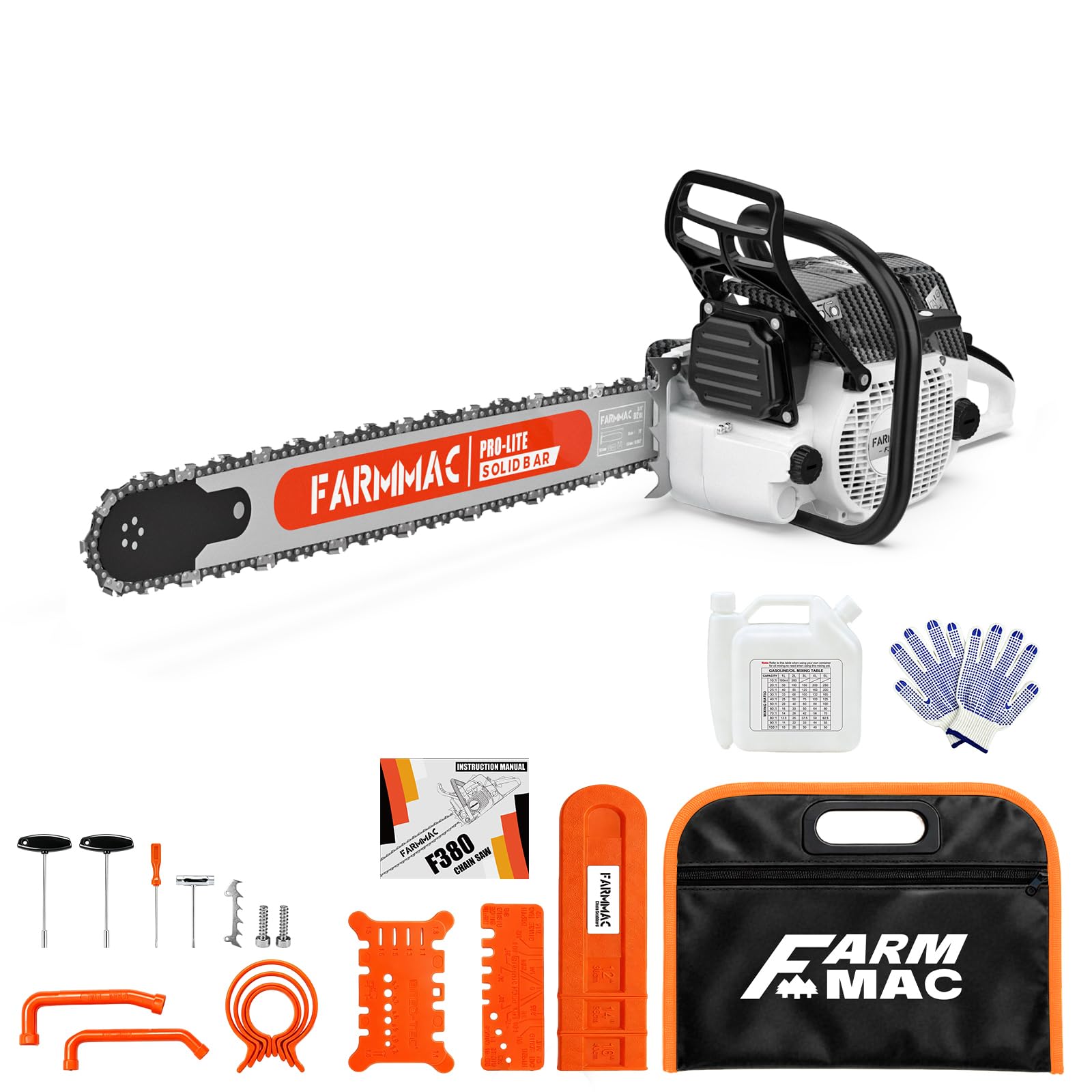
3. FARMMAC F380W Gas Chainsaw with 24 Inch Alloy Solid Bar
The big-block clone that muscles through a cord of wood before lunch.
If your farm demands cutting through 24-inch oak logs day after day, the FARMMAC F380W is built for that reality. Its 72cc engine cranks out 4.8 horsepower — a 50% jump over the Husqvarna 450 Rancher’s 3.2 hp — and the 24-inch alloy solid bar handles large trunks with authority. The weight is significant at 19.8 pounds, noticeably heavier than the Husqvarna’s 11.3 pounds, but that mass translates to momentum through the cut. As one owner puts it: “after cutting 8 cords of wood, the saw has already been worth the price.”
The saw is a clone of the Stihl MS381/380 platform, meaning many parts interchange with Stihl OEM components — a big advantage for long-term maintenance. Owners note that it requires some initial tuning (the carburetor often needs adjustment from the start, and cold starts take a few pulls), but after break-in, it runs and cuts with impressive power. The magnesium alloy crankcase adds durability without bulk. A few buyers mention the chain tensioner can be finicky, and the saw does leak bar oil if the flow screw isn’t kept closed between uses.
This is not a saw for light limbing or quick afternoon jobs — it’s a serious tool for serious cutting. Anyone looking for a lighter, more refined experience should look at the Echo CS-590. But for outright power per dollar on a farm that sees real production, this saw punches well above its price point.
What It Delivers
- 72cc / 4.8 hp engine that cuts through big hardwood logs faster than most saws double its price.
- Stihl OEM parts compatibility simplifies repairs and upgrades — a long-term win for owner-maintainers.
- Full wrap handle and magnesium alloy construction add professional-grade durability.
The Cost of Power
- Heavy at 19.8 pounds; fatigue sets in faster during all-day cutting compared to lighter saws.
- Requires carburetor tuning and break-in attention — not a grab-and-go tool.
- Chain tensioner design is a common frustration; owners recommend a lightweight replacement bar to ease setup.
Reach for this if: you cut firewood by the cord or need a production-level saw for a fair price.
Look elsewhere if: you want a light, low-maintenance saw for occasional weekend work.
4. NEO-TEC NS892V1 92cc Gas Powered Chainsaw with 36-Inch Bar
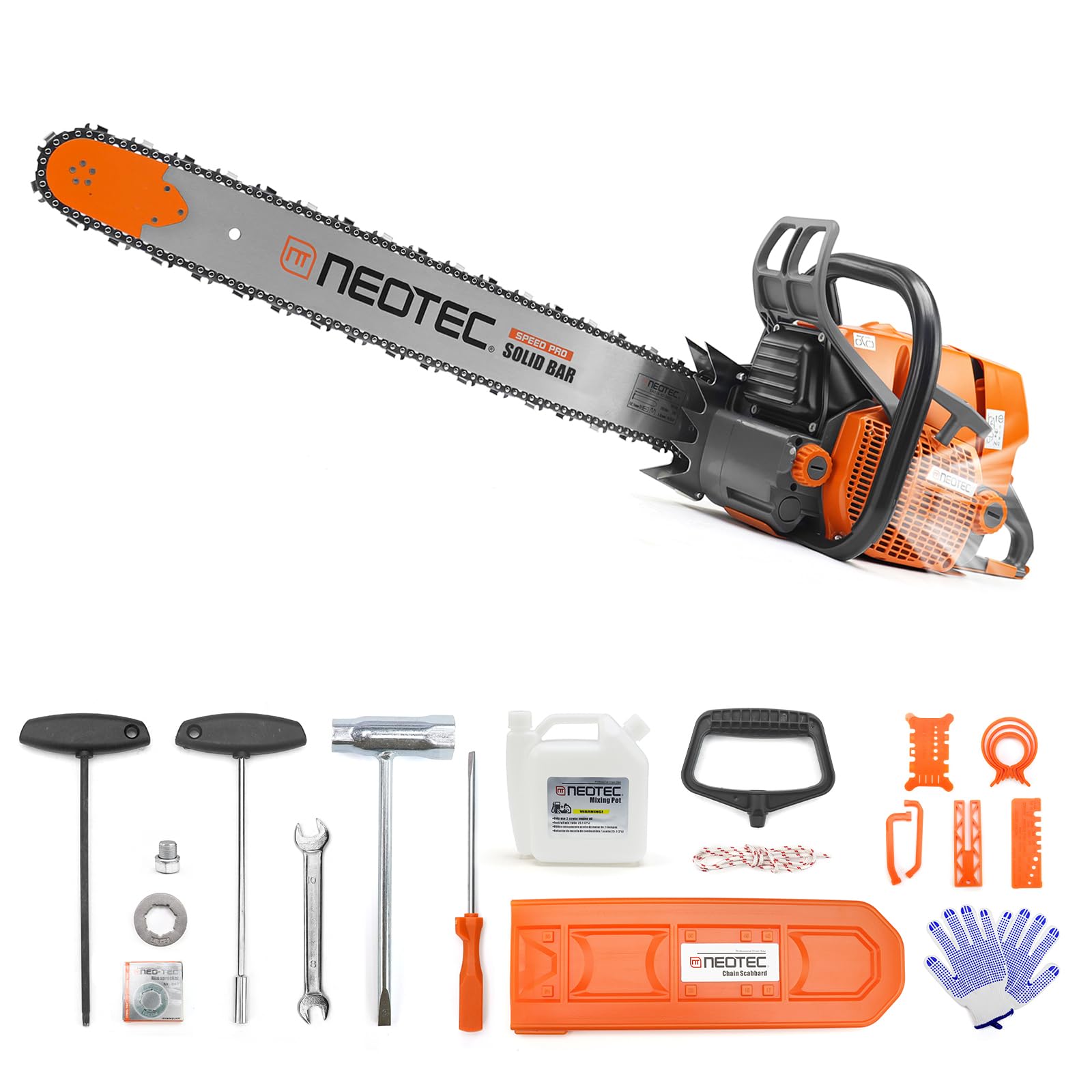
A 92cc miller’s dream that starts right up and asks where the big trees are.
When you need to turn a 36-inch oak into slabs or clear massive timber, the NEO-TEC NS892V1 delivers 7 horsepower from its 92cc engine — the kind of grunt that makes short work of wood that would stop a smaller saw mid-cut. The 36-inch bar and full-chisel chain are purpose-built for felling and milling, and buyers confirm it “started right up” from the start and handles easy. The magnesium alloy body resists the heat and stress of extended cutting sessions, and the NGK spark plug provides reliable ignition.
This saw is a clone of the Stihl MS660 / G660 platform, so parts interchange is available for those comfortable with maintenance. It is a large, heavy saw — not something you want to limb with for hours — but for its intended task of big wood, it performs admirably. The included chain is sharp, and saw is easy to handle given its size. Owners appreciate the safety features like the quick-stop chain brake and safety switch, which add confidence when working with a 36-inch bar.
The trade-off is that this is a specialized tool. For general farm firewood cutting, a 20-inch or 24-inch saw will be more maneuverable and less exhausting. But if your farm has timber that needs milling, or you regularly drop trees over 30 inches in diameter, this saw is a high-value entry into serious cutting.
Pure Power: The 92cc engine delivers 7 hp — enough to pull a 36-inch bar through hardwood without bogging, making it ideal for milling and large-scale felling.
Ideal for: landowners with large timber, milling setups, or serious forestry work who want professional-grade power at a non-professional price.
Skip it for: daily firewood cutting or any task where a 20-inch bar would be more practical — this saw is too big for small jobs.
5. ECHO CS-590 20 Inch Gas Chainsaw
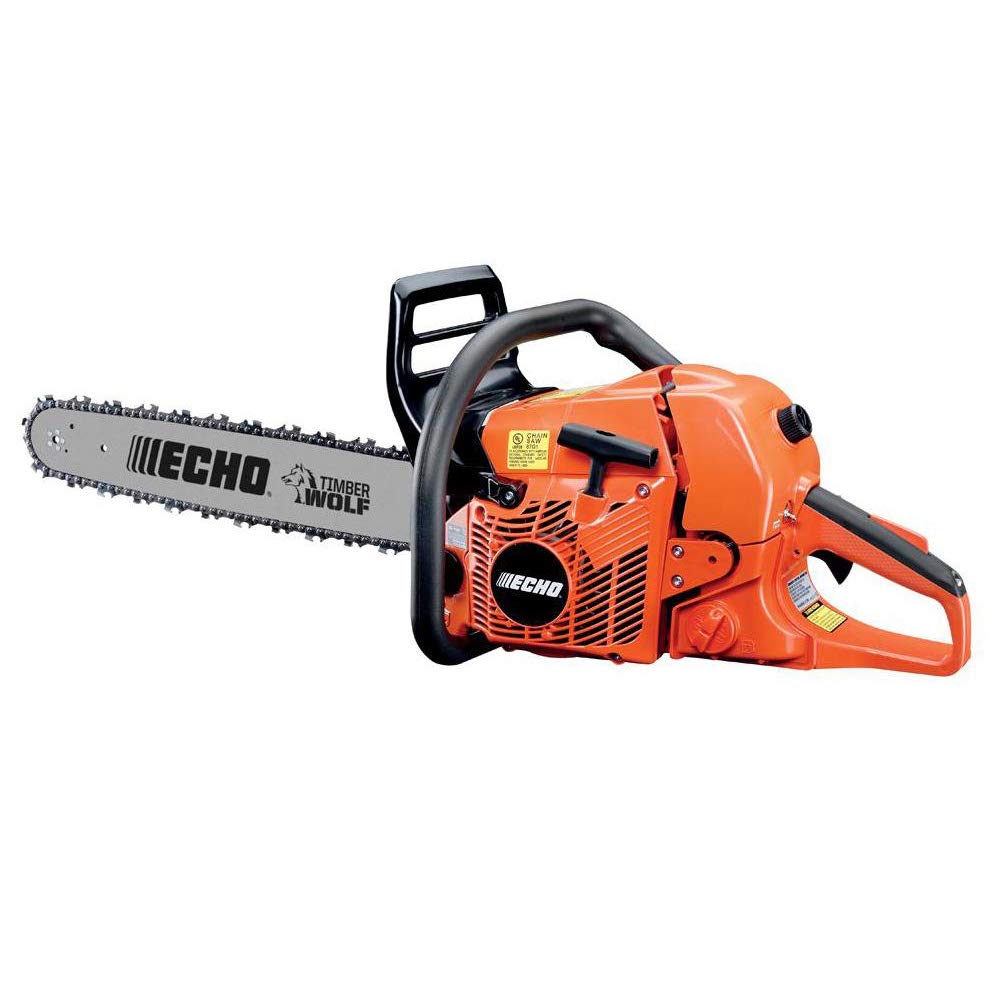
The Japanese-made survivor that keeps cutting after the ATV runs it over.
Reliability is the Echo CS-590’s calling card. With a 59.8cc engine producing 3.9 horsepower, it’s a 20-inch saw that sits in the balance between the lighter Husqvarna 450 Rancher and the heavier FARMMAC F380W. It’s built in Japan, and owners consistently report it surviving rough treatment: one owner’s 5-year review notes it survived being run over by an ATV, has cut roughly 20 cords of wood, and still starts on the 2nd or 3rd pull. The auto-adjustable chain oiler keeps the bar lubricated, and the anti-vibration handle reduces fatigue during long sessions cutting oak, hickory, and elm.
The main caveat is that the factory carburetor is set too lean from the factory — owners strongly recommend adjusting the high and low mixture screws before heavy use to prevent piston damage. There’s also a known split in experience: many reviewers point out the saw starts easily and runs great from the start, while a smaller group receives units that won’t start at all. Ethanol-free gas and quality 2-cycle oil at a 40:1 ratio (not 50:1) are recommended for longevity. The plastic handle and basic bar cover feel less premium than the saw’s engine core.
If you want a saw from a major brand with a proven track record and strong parts availability, and you’re comfortable with a small initial carburetor tweak, the Echo CS-590 is a durable, powerful choice for farm work. It’s heavier than the Husqvarna by about 9 pounds, but that weight comes with a reputation for lasting years.
Long-Term Trust: Shoppers say cutting 20+ cords over 5 years with nothing but routine maintenance — the echo chamber of praise is loud and specific.
The Tuning Reality: The lean factory carb setting is a fixable design choice; adjust the mixture screws before first heavy use to protect the piston.
Best for: the owner who wants a proven, long-lasting saw for firewood and storm cleanup and is willing to do a simple carburetor adjustment.
Not for: someone who wants a grab-and-go saw with no setup — check the fuel mixture and settings before your first big cut.
6. FARMMAC F660V 36 Inch Gas Chainsaw

The 7-horsepower budget miller that turns logs into lumber without turning your wallet inside out.
For anyone who wants to mill their own lumber or handle large-scale felling without paying premium prices, the FARMMAC F660V brings 92cc of displacement and 7 horsepower to the table. It’s designed to accept bars from 24 inches up to 42 inches, and while it ships as a powerhead that requires assembly, owners find that the Walbro carburetor, tin-plated pistons, and NGK spark plug add legitimate performance to the package. The full wrap handle and magnesium alloy construction make it stable during heavy cuts, and buyers report it “cranks on the first pull” after proper setup.
The honest side is that assembly instructions are poor, and the spark plug often arrives overtightened to the point of needing heat to remove. Several owners note the fuel cap can leak, and there is no primer bulb, making cold starts difficult — one owner reported a 30-minute struggle on first use. The saw is compatible with MS660/066 parts, which makes future repairs easier, but the fit and finish is clearly not at a Stihl level. It’s built for ranch and farm use where occasional maintenance is expected.
This saw makes sense if you need 92cc-class power for a fraction of the premium brand cost and you have the patience for initial setup. If you want a saw that just works with no fuss, the Echo CS-590 or Husqvarna 450 Rancher are better daily choices.
The Power Play
- 92cc engine with Walbro carb and NGK plug delivers strong, reliable power for milling and large logs.
- MS660/066 parts compatibility means easy sourcing for future repairs and upgrades.
- Magnesium alloy body and full wrap handle provide durability and stability under load.
Assembly & Starting Hurdles
- Poor instructions and an overtightened spark plug are common initial frustrations.
- No primer bulb makes cold starting a chore; owners mention 10-30 minutes of pulling on the first time.
- Fuel cap leaks between its two-piece construction — a design flaw that owners manage with careful tightening.
Grab it for: budget milling or heavy ranch cutting where you need 92cc power and are comfortable with a DIY setup process.
Pass on it if: you need a reliable daily cutter for firewood — the starting issues and assembly headaches make it less suitable for frequent small jobs.
7. FARMMAC F070W 105cc Gas Chainsaw with 42 Inch Alloy Solid Bar
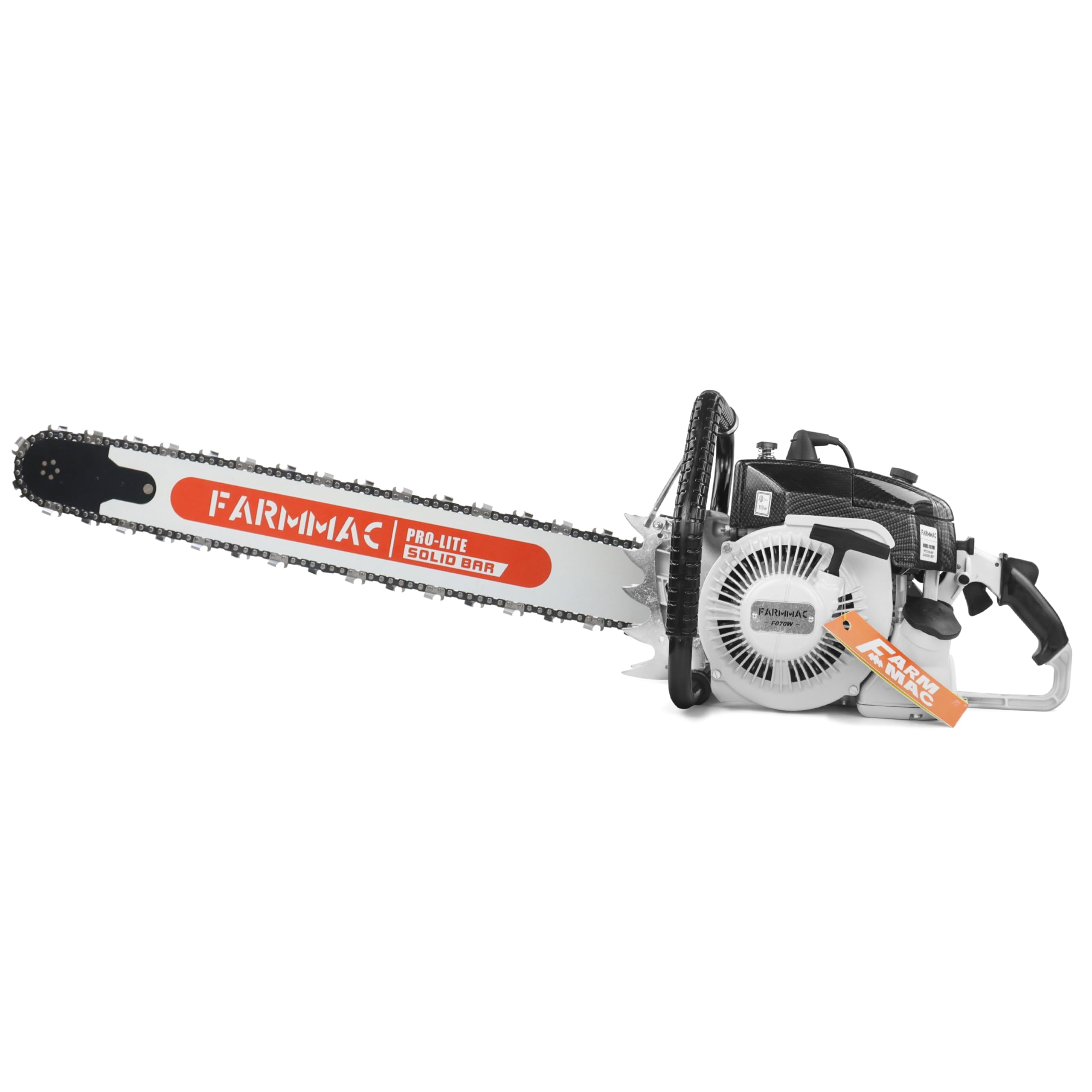
A 105cc, 42-inch monster built for milling massive timber — and not much else.
At 105cc and 6.5 horsepower, the FARMMAC F070W is a purpose-built machine for the most extreme cutting tasks on a farm — think 48-inch oak trunks, large-scale milling, or professional forestry work. The 42-inch alloy solid bar handles hardwood and softwood alike, and the magnesium alloy body keeps the weight at 29.7 pounds, which is remarkable for a saw of this size. The 2200GS flywheel provides stable ignition, and the saw is compatible with the Stihl MS070, MS090, and MS1050 platforms, meaning parts are available for long-term ownership.
The honest truth is that this saw is too much for 95% of farm work. It’s heavy, awkward for limbing, and burns through fuel at a rate that matches its power. The mixing ratio is 25:1 for FB grade oil or 40:1 for FD grade oil, which is a specific maintenance requirement. It’s a saw for the person who regularly cuts timber that would stop a smaller saw completely. Smaller farms with typical firewood needs will find the NS892V1 above or the Echo CS-590 far more practical daily tools — this one lives in the truck for the big jobs.
If you need to mill 42-inch slabs or fell trees over 4 feet in diameter, this saw delivers the power. For anything less, you’re carrying around more saw than you need.
class-leading Power: 105cc and 6.5 hp with a 42-inch bar mean it can handle the biggest timber on your property — the kind of tree that makes smaller saws look like toys.
The Weight Price: At nearly 30 pounds, this saw demands strength and endurance; it’s not for casual half-hour sessions.
For the logger, not the homeowner: this saw belongs in the hands of someone regularly milling giant hardwoods or felling mature timber.
Overkill for firewood: if you cut 20-inch logs for the wood stove, a 50cc or 60cc saw is a better fit — save your shoulders.
8. NEO-TEC NS8105 42 Inch Gas Chainsaw

A 105cc, 42-inch brute that either fires right up or fights you — there’s rarely an in-between.
The NEO-TEC NS8105 is, on paper, a twin of the FARMMAC F070W: 105cc, 6.5 horsepower, and a massive 42-inch bar. In practice, it’s a clone saw with a split personality. Buyers who get a good unit report it “filled with gas, filled with bar oil, pumped a few times and fired right up” and then cuts through redwood for days on a milling operation. Others receive a saw that takes three days to start on the initial fill and then refuses to start on the second tank. The magnesium alloy body and heavy-duty build are real, and the saw handles 8-foot oak trunk slabs impressively when it’s running right.
The quality control gap is the defining story here. The factory chain angles are balanced for loading and avoiding binding, and the saw comes with a proper 0.404″ chain pitch and 0.063″ gauge for serious cutting. But the inconsistency in starting reliability is the risk you take. Owners who are comfortable with carburetor adjustment, spark plug checks, and general troubleshooting fare fine. Those expecting a turn-key experience may end up with a very expensive paperweight for a few days. The saw is also heavy at 30 pounds and requires real strength to handle.
If you’re milling big timber and can afford to troubleshoot the saw, the NEO-TEC NS8105 offers serious power at a price that beats premium brands by a wide margin. If you need certainty, the FARMMAC F070W above has a higher owner satisfaction rating.
When It Works
- 105cc / 6.5 hp engine delivers serious milling power for large slabs and big felling jobs.
- Magnesium alloy body provides durability and heat management for extended cutting sessions.
- Factory chain angles are well-balanced for loading, reducing the risk of binding during cuts.
Quality Control Lottery
- Inconsistent starting is the biggest complaint; some saws work perfectly, others never start reliably.
- Heavy at 30 pounds and difficult to handle for all-day use — requires physical strength.
- Customer support is inconsistent; some owners get quick help, others are left on their own.
Reach for it if: you need a 42-inch bar for milling and you’re willing to gamble on quality control or have the skills to tune the saw yourself.
skip it if: you need a reliable tool from the start — the FARMMAC F070W or NEO-TEC NS892V1 offer more consistent owner experiences for similar power.
Understanding the Specs
Engine Displacement (cc)
This is the volume of the engine’s cylinders, measured in cubic centimeters. More cc almost always means more power and torque — a 92cc engine will muscle through a 30-inch log that would stop a 50cc saw dead. On a farm, the right displacement matches your typical tree diameter: 50-60cc for firewood and storm cleanup, 70-92cc for heavy felling and milling, and 105cc for timber operations. But more cc also means more weight and fuel consumption, so don’t overshoot your actual workload.
Bar Length and Chain Pitch
The bar length in inches determines the widest tree you can cut in a single pass. A 20-inch bar is the go-to for general farm work. A 36-inch or 42-inch bar is for milling and large timber. The chain pitch (like 3/8″ or 0.404″) and gauge (like 0.063″) must match the bar and sprocket — using the wrong chain damages the saw. Low-kickback chains add safety, especially for less experienced operators. A longer bar lets you cut bigger wood but makes the saw harder to maneuver for smaller tasks.
Weight and Anti-Vibration (AV) System
Saw weight ranges from about 11 pounds (a light 50cc saw) to over 30 pounds (a big 105cc miller). Heavier saws cut with more authority but fatigue your arms and shoulders faster. An anti-vibration system uses springs or rubber mounts to isolate the handles from the engine’s shaking — critical for all-day use, because sustained vibration damages nerves and joints in your hands. Test the saw’s balance before buying; a well-balanced saw feels lighter than its listed weight.
Clone vs. Brand-Name Saw
“Clone saws” are aftermarket copies of popular professional models (like the Stihl MS660 or Husqvarna 372XP). They use the same bolt pattern and many interchangeable parts but at a fraction of the cost. The trade-off is inconsistent quality control, poorer fit and finish, and sometimes questionable customer support. For a farm owner who is handy with tools and can tune a carburetor, a clone saw offers incredible value. For someone who needs reliability without tinkering, a brand-name saw from Husqvarna, Echo, or Stihl is the safer bet.
FAQ
What is the best engine size (cc) for a farm chainsaw?
Does a longer bar mean I can cut bigger trees?
What is an anti-vibration system and do I need it?
Are clone chainsaws (like FARMMAC or NEO-TEC) good quality?
How often do I need to sharpen the chain?
What is the best fuel mix for a 2-cycle farm chainsaw?
Will a farm chainsaw work with a chainsaw mill?
How long does a farm chainsaw last?
Is a 20-inch bar enough for a farm chainsaw?
What is the difference between a top-handle and rear-handle chainsaw?
Final Thoughts: The Verdict
For the majority of shoppers, the farm chainsaw winner is the Husqvarna 450 Rancher because it balances reliable starting, manageable weight, and proven cutting power for the daily mix of firewood and storm cleanup. If you need maximum power per dollar and can handle a carburetor tune, the FARMMAC F380W is the heavy-duty choice for serious production. And for low-maintenance durability from a major brand, the ECHO CS-590 is the workhorse that keeps cutting season after season.
How We Picked
We do not accept paid placement. Every pick is matched to a real buyer and a real use-case; we do not hands-on test units.
Sources & Methodology
Specifications: manufacturer listings and product documentation. Review insights: verified customer reviews, as of July 2026. Pricing: not shown on this page (it changes often); check the current price via the retailer link.
As an Amazon Associate, WellFizz earns from qualifying purchases. This does not affect which products we feature.
Related Guides

Mo Maruf
I created WellFizz to bridge the gap between vague wellness advice and actionable solutions. My mission is simple: to decode the research and give you practical tools you can actually use.
Beyond the data, I am a passionate traveler. I believe that stepping away from the screen to explore new environments is essential for mental clarity and physical vitality.