Our readers keep the lights on and my smoothie glass nicely filled. As an Amazon Associate, I earn from qualifying purchases.
Specs are compiled from manufacturer listings and verified buyer reviews and can change over time — please confirm the key details on the product page before buying.
Every room has that one spot — near the window, by the sofa, next to the desk — where the air just sits still. You turn the AC down, but your face stays warm while your feet get cold. The fix isn’t a colder thermostat. It’s. I’m Mohammad Maruf, founder of WellFizz. This guide compares the manufacturers’ published specs and patterns from verified customer reviews, so you get each pick’s real strengths and trade-offs instead of marketing spin. You will find a whisper-quiet tower for the bedroom, a metal brute for the garage, and a smart fan you can control from bed.
Our Picks at a Glance


How To Choose The Best Fans For Home
Not every fan is built for the same job. A high-velocity metal fan that keeps a workshop cool will blast you out of bed. A sleek tower fan perfect for a nursery won’t touch the stale air in a garage. Think about where it lives, how much noise you can tolerate, and if you want to feel the breeze directly or just want the whole room to feel fresher.
Airflow Capacity (CFM)
CFM (cubic feet per minute) is the number that tells you how much air the fan can move. A higher CFM means it can cool a larger space faster. A desk fan for a home office might be fine at 200 CFM, while a 14-inch industrial floor fan pushing 2,560 CFM is what you want for a workshop or a big basement.
Noise Level (dB)
Decibels (dB) measure sound pressure. A fan operating at 20 dB is whisper-quiet — you will barely notice it in a bedroom. At 30 dB, it is about as loud as a quiet library. Above 50 dB, it starts to sound like light traffic or a conversation. If you are a light sleeper, look for a fan that advertises 25 dB or lower on its sleep mode.
Form Factor and Oscillation
Tower fans save floor space and usually oscillate (rotate side to side) to spread air across a wider area. Floor fans and air circulators are more compact but often tilt up and down instead. Oscillation is measured in degrees — 90° is standard for a tower fan, while some premium models offer 180° to cover an entire room.
Quick Comparison
| Model | Best For | Airflow (CFM) | Noise Level | Height | Amazon |
|---|---|---|---|---|---|
| Simple Deluxe 18″ Floor Fan★ Best Overall | Workshops & Garages | 4,012 cfm | Not listed | 18″ blades | Amazon |
| Shark TurboBlade Bladeless FanPremium Pick | Whole-Room Custom Airflow | Not listed | Not listed | 44.8″ | Amazon |
| DREO 42″ Tower FanBest Investment | Quiet Bedroom Cooling | 1,473 cfm | 20 dB | 42″ | Amazon |
| PNTCK 13.2″ Tower Fan | Small Desks & Bedrooms | 24 cfm | 24 dB | 13″ | Amazon |
| Amazon Basics Air Circulator | Budget Home Office | Not listed | Not listed | 14.1″ | Amazon |
| VEVOR 14″ Industrial Fan | Medium Rooms & Gyms | 2,560 cfm | Below 60 dB | 17.7″ | Amazon |
| Pureborne 42″ Smart Tower Fan | Smart Home Enthusiasts | 1,100 cfm | 25 dB | 42.9″ | Amazon |
| Lasko Elevation Tower Fan | Tall Rooms & Bedrooms | 240 cfm | 28 dB | 42″-54″ adjustable | Amazon |
| GoveeLife 36″ Smart Tower Fan | App-Controlled Cooling | Not listed | 29 dB | 36″ | Amazon |
In‑Depth Reviews
1. Simple Deluxe 18 Inch 3-Speed High Velocity Heavy Duty Metal Industrial Floor Fan
Our pick — over 4.5★ from 650+ verified ratings; the strongest balance of quality and price.
Moves more air than anything else here — 4,012 CFM — in an all-metal build, without sounding like a hurricane.
This is the fan for the tough spots. With an airflow capacity of 4,012 CFM (cubic feet per minute, the volume of air pushed each minute), this fan moves a massive amount of air. The 18-inch aluminum blades and all-metal construction mean it holds up in a greenhouse, a workshop, or a garage where plastic fans crack and fade. The permanently lubricated motor and ball bearings (smooth metal spheres that reduce friction) are built to run for years if you keep it clean.
Buyers report one unit has been running 24/7 in an enclosed pool room since June 2024 with zero rust or complaints. The low speed is enough for most rooms, and on high, it sounds like you are on a tarmac — which some owners love as white noise. It is for indoor use only and shouldn’t be plugged into anything over 120V.
The trade-off? It is a floor fan, not a tower. It occupies floor space and doesn’t oscillate side to side. You aim it and let it rip.
What wins people over
- Massive 4,012 CFM airflow — clears stale air fast in large rooms
- All-metal build with aluminum blades — tougher than any plastic fan
- Quiet enough on low to use in a bedroom, per long-term owners
Who should think twice
- No oscillation — you aim it in one direction and leave it
- Indoor use only — not rated for outdoor exposure
- On full speed it sounds like airport tarmac noise
Reach for this if: you need a durable, high-volume fan for a garage, workshop, greenhouse, or large basement where plastic fans fail.
Look elsewhere if: you need a slender tower that tucks into a corner or oscillates to cover a wide room.
2. Shark TurboBlade Bladeless Tower Fan, Charcoal, TF202S
The bladeless fan that twists, pivots, and wraps a whole room in a blanket of moving air, with 180° oscillation.
This isn’t a low-maintenance fan. The Shark TurboBlade pivots vertically and horizontally, and its twistable vents let you send air in multiple directions at once. You can set it to Air Blanket Mode for a wide horizontal breeze across a bed, or Tower Mode for a focused vertical stream. With 10 speeds and 10 corresponding noise levels, you can dial in everything from a whisper-soft nap breeze to a powerful turbo jet sound on high.
The bladeless design makes cleaning simple, and the magnetic remote snaps onto the body so it never gets lost. Owners say it significantly lowered room temperature without AC and that the oscillation is smooth and quiet. The catch is the footprint: at 14.3 pounds and nearly 12 inches deep, it takes up more floor space than a standard tower fan. — at 14.3 pounds and nearly 12 inches deep, it takes up more floor space than a standard tower fan. The remote can also feel unresponsive at times, and a few owners note the air feels room-temperature after running for a few hours (it does not cool the air itself, it circulates it).
Versatility king: The ability to pivot, twist, and oscillate 180° makes this the most customizable airflow machine in this lineup — Owners call the Air Blanket feature a standout for sleeping..
Best for: someone who wants directed airflow over a bed or desk, with the flexibility to change the pattern room to room.
Skip if: floor space is tight or you expect a dead-silent fan at every speed.
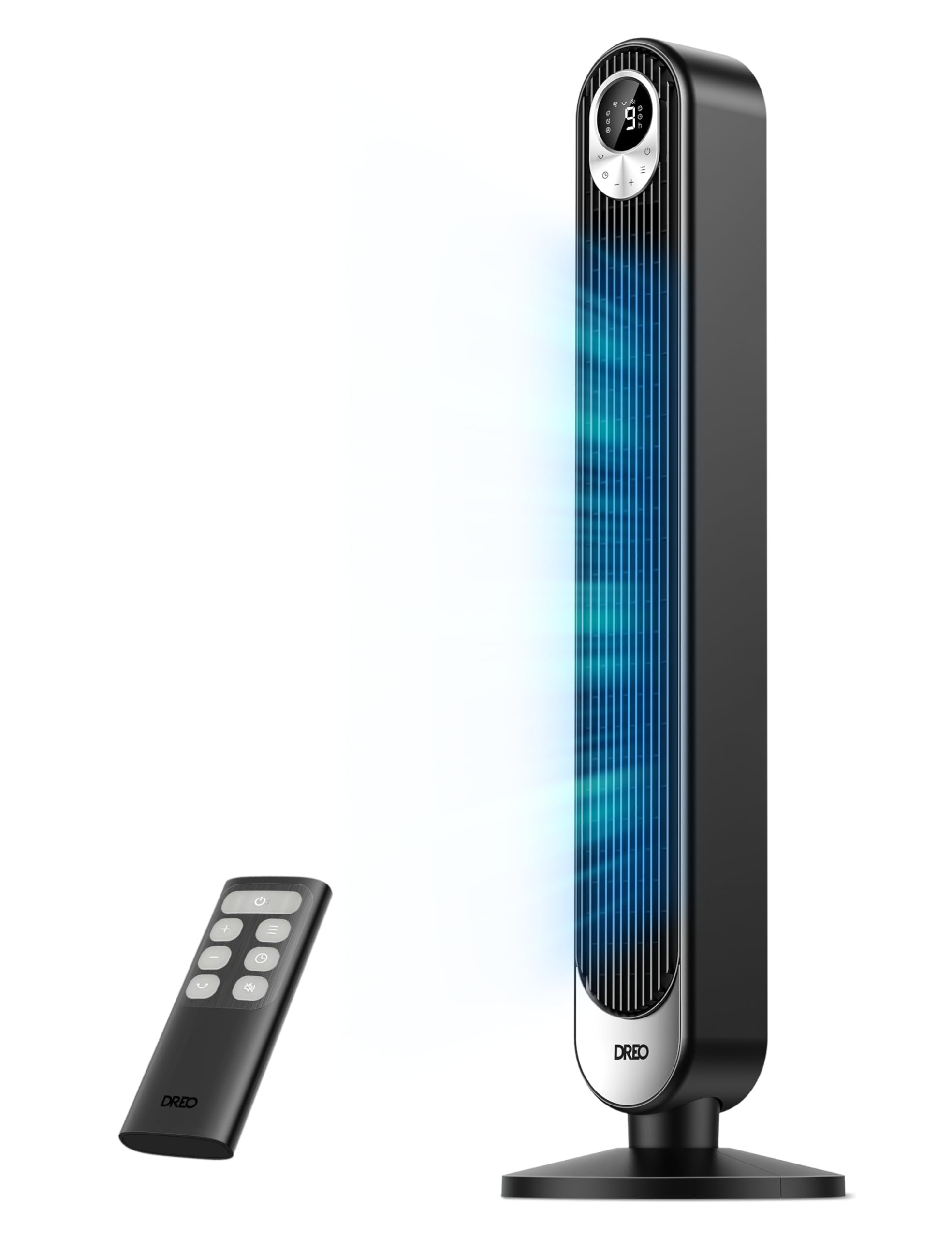
3. DREO Tower Fan for Bedroom, 42 Inch
The 42-inch tower that moves more air (1,473 CFM) than most floor fans, yet whispers at 20 dB — quieter than a library.
The DREO is the crowd favorite for a reason: it delivers 1,473 CFM at just 20 dB. The 20 dB noise level is quieter than a library, so it vanishes in a bedroom at night. The display dims automatically after 30 seconds, and a 12-hour timer lets you low-maintenance.
With 9 speeds and 4 modes (Standard, Natural, Sleep, Turbo), you can find a setting for a napping child or a hot summer afternoon. Owners consistently praise the remote, the tool-free assembly, and the removable rear grille that rinses clean under a faucet. The only minor note is that at higher speeds the noise is noticeable — but still far quieter than most tower fans.
Performance per decibel: The DREO delivers 1,473 CFM and runs quieter, making it the best blend of power and peace in this list.
Reach for this if: you want a powerful tower fan that disappears into your room and your sleep.
Look elsewhere if: you need a smart-home fan with Alexa or app control — the DREO is a manual remote model.
4. Pureborne 42” Tower Fan with WiFi
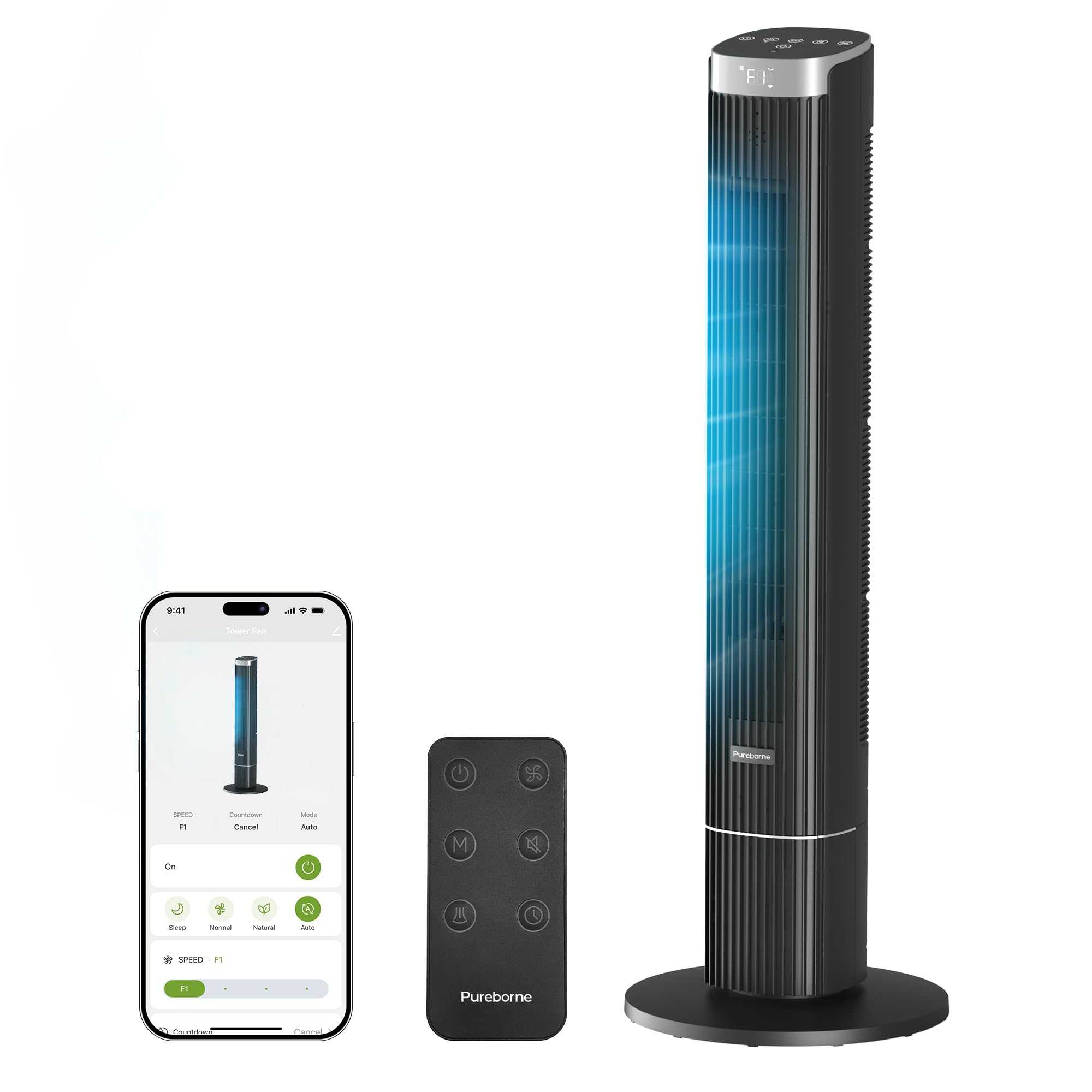
A smart tower fan that talks to your voice assistant (Alexa or Google Assistant) and shows the room temperature, running at 25 dB.
Control this fan from your phone via the Havaworks app, or use voice commands with Alexa and Google Assistant. It only works with 2.4GHz WiFi, so check your router before buying. The 1,350 RPM motor delivers 25 ft/s airflow with 90° oscillation, and the improve air outlet spans 19 to 36 inches, so the breeze hits you whether you are sitting or standing. At 25 dB, it is quiet enough for a bedroom, and the Sleep mode lowers speed every 30 minutes while the display dims after 30 seconds.
Owners love the 4 modes — Auto (adjusts to room temperature), Natural (imitates a breeze), Normal (constant speed), and Sleep. The 42.9-inch height makes it a solid presence without dominating the room. The main caveat is that the app experience is less polished than Govee or DREO, and a few owners found the voice setup finicky.
What stands out
- App, voice, and remote triple control — change settings from bed or across town
- 25 dB operation with sleep mode that auto-dims the display
- improve 19-36 inch air outlet covers sitting and standing positions
The honest catch
- Only supports 2.4GHz WiFi — not compatible with 5GHz networks
- App interface is functional but not as refined as competitors
Best for: smart home enthusiasts who want to control a bedroom fan with their voice or phone.
Skip if: you have a 5GHz-only mesh network and can’t set up a 2.4GHz band.
5. Lasko Elevation Tower Fan, 42”-54” Adjustable Height

Scales up to 54 inches high so you can send the breeze right over your bed, with a 28 dB noise level.
Most tower fans top out at 42 inches. The Lasko Elevation extends to 54 inches, which means you can aim the airflow over the foot of a tall bed or a standing desk without the air hitting your knees first. At 28 dB it is quiet on low settings, and the sturdy base means no wobble even at full height. The 90° oscillation and AirSense technology adjust speed based on room temperature automatically.
Owners consistently mention the adjustable height as the reason they bought it — it covers a bed without taking up nightstand space. The 240 CFM airflow is modest compared to the DREO (1,473 CFM) or the Simple Deluxe (4,012 CFM), so it is better for personal cooling in a bedroom or office than for clearing a large room. The 12-hour auto shut-off is a feature some love and others wish they could disable for continuous use.
Height advantage: The 12-inch adjustability range (42 to 54 inches) is unique in this lineup — perfect for directing air over a tall headboard or across a standing workstation.
Reach for this if: your bed is high, your desk is standing height, or you just want the air directed above furniture.
Look elsewhere if: you need maximum CFM to cool a whole living room — this is a personal-space fan.
6. GoveeLife 36 in. White Tower Fan

A smart fan with 8 speed levels and an AC motor (alternating current, the traditional type) rated to outlast 5,000 hours of use.
The GoveeLife fan integrates with Alexa, Google Assistant, and Siri shortcuts, so you can include it in a “good night” routine that dims lights and starts the fan. It has 5 distinct modes (Normal, Natural, Sleep, Auto, and Custom) and 8 adjustable speed levels. At 29 dB it is slightly louder than the DREO but still quiet enough for sleep. The 75° oscillation covers most of a bedroom, and the auto-cooling mode uses the built-in temperature sensor to adjust speed as the room warms up.
Owners praise the Alexa integration across multiple devices and note that the fan is powerful enough to feel from across the room. One owner had an initial unit with clicking noises, but Govee’s support replaced it within 24 hours. The AC motor is rated for over 5,000 hours — roughly 208 days of continuous use — which is a strong durability claim for this price tier.
What impresses
- 8 speeds and 5 modes offer more granular control than most tower fans
- Smart home integration works with Alexa, Google Assistant, and Siri
- ETL certified with a motor rated for over 5,000 hours of use
What to know
- Some units arrive with clicking noises; Govee support generally resolves fast
- 29 dB is quiet but not as whisper-quiet as the DREO at 20 dB
Best for: someone building a smart home with Alexa and wanting temperature-based auto-cooling.
Skip if: absolute silence at night is your top priority — the DREO is 9 dB quieter.
7. VEVOR Floor Fan, 3 Speeds High Velocity 14 Inch Industrial Fan
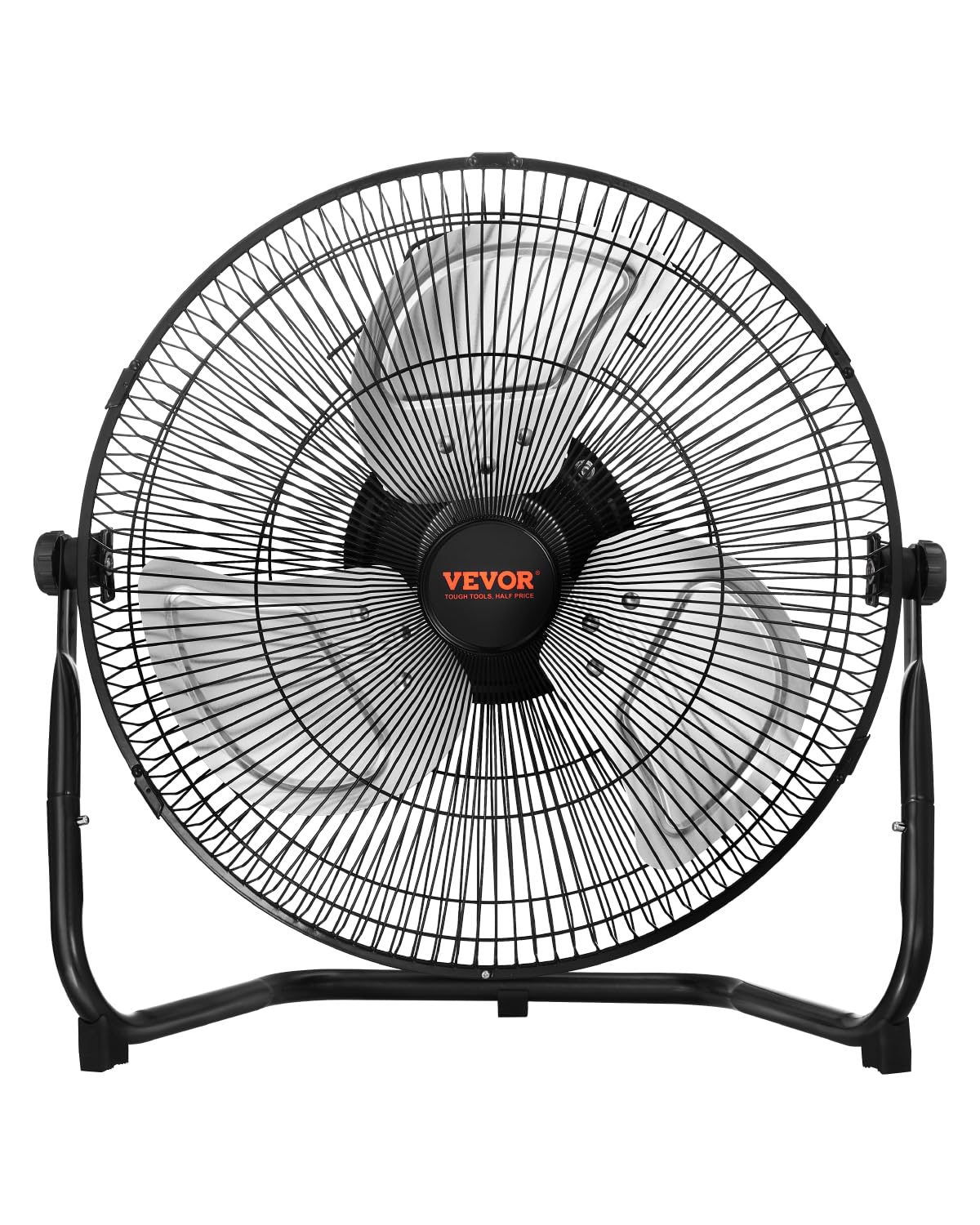
The metal 14-inch fan that tilts a full 360 degrees and stays quiet (below 60 dB) while moving 2,560 CFM.
If the Simple Deluxe is too big or too powerful for your space, the VEVOR 14-inch is the next step down without giving up metal construction. It delivers 2,560 CFM of airflow with a maximum noise level below 60 dB(A) (a weighted decibel scale that matches human hearing) — quieter than most fans at this power level. The 360° vertical tilt means you can aim it straight up for ceiling circulation or down at your legs under a workbench. The metal grill has a black powder rust-proof coating, and the 14-inch aluminum blades are built to take bumps.
Owners call it “absolutely quality” and note it is lightweight but sturdy, with the highest setting being plenty powerful. It is heavier than the Amazon Basics desk fan but feels far more durable. The only real trade-off is that at 7.09 inches deep and 17.72 inches tall, it takes up more floor footprint than a tower fan, and it doesn’t oscillate side to side — just tilts vertically.
Build quality per dollar: The VEVOR leads on quality according to 60 owners., and the all-metal construction with a powder-coated finish makes it a step above plastic floor fans at this price.
Reach for this if: you want a metal, high-velocity fan for a medium room, gym, or office that won’t blast your ears off.
Look elsewhere if: you need oscillation side to side — this fan only tilts up and down.
8. Amazon Basics Air Circulator Fan, Desk Fan

The compact desk fan that punches above its weight — until the motor fails after about 6 months of constant use, according to many owners.
This 14.8-inch fan with 11-inch plastic blades is the most popular fan on this list by review volume, and for good reason. At 4.2 pounds, you can move it from the kitchen counter to the bedroom floor without a second thought. The 90° tilt head lets you aim the air exactly where you want it, and the 3-speed rotary knob is as simple as it gets. On low, it is quiet enough for an office cubicle. On high, it sounds like a small jet engine — but it moves air impressively for its size.
The catch is reliability: many owners mention motor failure after six months of constant use. Owners mention it as a “cheaper Vornado” that works great for the price, but a significant number report the motor failing after 6 months of constant use. One owner noted “Lasted 6 months constant use, mo” — the motor just gives out. The noise level is the most-discussed aspect, with over 2,800 mentions, most of them positive, but a fair number note it gets loud on higher settings. If you need a cheap fan for occasional use in a small room, this is a steal. If you run it 24/7, expect to replace it within a year.
The upside
- Light at 4.2 lbs — easy to carry room to room or take camping
- 90° tilt lets you direct airflow exactly where needed
- Quiet on low setting, perfect for office or bedside
The honest caveat
- Durability is a concern — multiple customers note motor failure after 6 months
- Gets loud on higher speeds, unlike the quieter DREO or Lasko
Best for: a budget buy that sits on a desk or nightstand for light, occasional use.
Skip if: you need a fan to run constantly through a hot summer — the metal VEVOR or Simple Deluxe will outlast it.
9. PNTCK 13.2″ Tower Fan with Remote
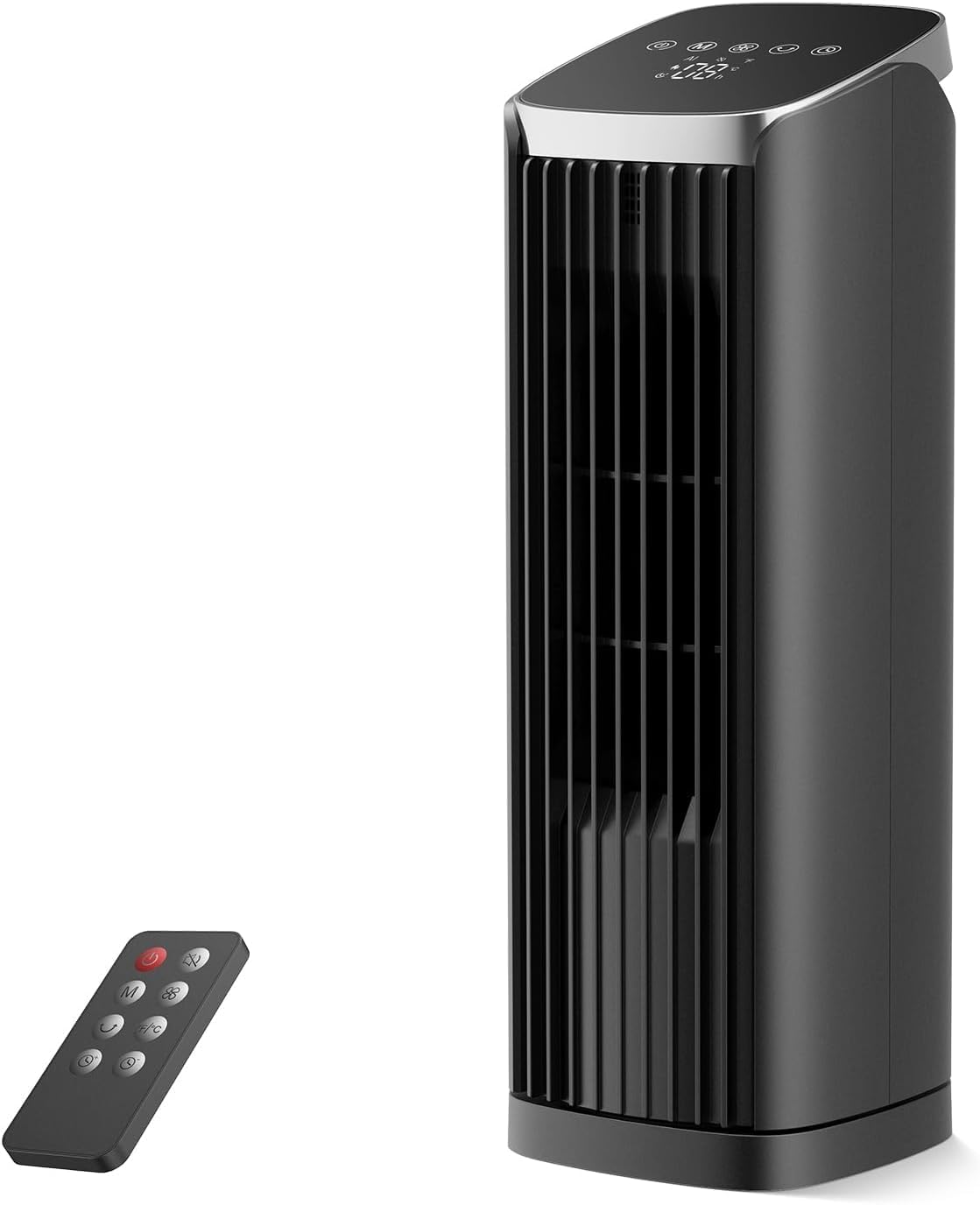
The tiny 13-inch tower that fits on a cluttered desk and cools with 24 dB of silence, moving 24 CFM.
If your desk is already crowded with a monitor, lamp, and coffee mug, the PNTCK tower fan takes up just 4 inches by 4 inches of space. At 3 pounds, you can lift it with one finger. The 24 ft/sec airflow is modest (24 CFM) compared to the big fans in this list, but for a desk or nightstand, it is plenty. The remote control includes a button battery pre-installed, and the 4 modes (Normal, Natural, Sleep, AI) give you more options than you would expect at this size.
The biggest owner complaint is a rattling noise on the lowest oscillating setting. — “Only complaint – on the lowest speed oscillating the fan makes a really weird noise and sounds like something’s rattling in the fan.” Once you set the speed above the lowest, it quiets down. The built-in temperature gauge shows the room temp on the display, which is a nice extra. At this price, it is a solid backup fan or a travel-friendly option for a hotel room or dorm.
Desk-mate: At 4x4x13 inches, this is the most compact tower fan in the roundup — it makes the Amazon Basics desk fan look bulky by comparison.
Reach for this if: you need a tiny, lightweight fan for a desk, nightstand, or dorm room where space is at a premium.
Look elsewhere if: you need to cool a whole room — the 24 CFM is meant for personal space, not full-room circulation.
Understanding the Specs
CFM — Cubic Feet per Minute
This is the raw measure of how much air the fan pushes in one minute. A higher number means it can cool a larger space faster. The Simple Deluxe moves 4,012 CFM, which is enough to cycle the air in a 20×20 foot room about 10 times per hour. A desk fan like the PNTCK at 24 CFM is best for personal cooling — right on your face or chest. For a standard bedroom, look for at least 1,000 CFM if you want the whole room to feel fresher.
dB — Decibels (Noise Level)
Decibels measure sound pressure. Every 10 dB increase feels about twice as loud. A fan at 20 dB (like the DREO) is quieter than a library and barely audible from across a room. At 28 dB (Lasko), you will hear a soft whoosh on low settings. At 60 dB (VEVOR’s max), it is about as loud as a normal conversation. For a bedroom, aim for 25 dB or lower. For a workshop or garage, anything under 60 dB is comfortable while you are working.
DC vs AC Motors
DC (Direct Current) motors are newer in home fans. They are more energy-efficient, quieter, and allow finer speed control — the DREO uses a DC motor and offers 9 speeds. AC (Alternating Current) motors are the traditional type. They are cheaper to manufacture, last a long time, and deliver more raw torque, which is why the Simple Deluxe and VEVOR use them for high-CFM output. The trade-off is that AC motors are generally louder and less efficient at low speeds.
Oscillation and Tilt
Oscillation means the fan rotates side to side to spread air across a wider area. Most tower fans oscillate 90°, which covers a standard room corner. The Shark TF202S goes up to 180°, so it can push air across an entire open-plan space. Tilt means the fan head moves up and down. The VEVOR offers 360° vertical tilt, letting you aim air at the ceiling or the floor. Desk fans like the Amazon Basics offer a 90° tilt for directing the breeze precisely at your face or torso.
FAQ
Will a tower fan cool my whole bedroom?
Is a higher CFM always better?
What does “bladeless” actually mean?
How many decibels is too loud for sleeping?
Can I use an indoor fan outdoors?
How long should a home fan last?
What is the advantage of a DC motor fan?
Can I control a fan with my phone?
How do I clean a tower fan?
What size fan do I need for my room?
Final Thoughts: The Verdict
For most people, the best fan
Related Guides

Mo Maruf
I created WellFizz to bridge the gap between vague wellness advice and actionable solutions. My mission is simple: to decode the research and give you practical tools you can actually use.
Beyond the data, I am a passionate traveler. I believe that stepping away from the screen to explore new environments is essential for mental clarity and physical vitality.