Our readers keep the lights on and my smoothie glass nicely filled. As an Amazon Associate, I earn from qualifying purchases.
Specs are compiled from manufacturer listings and verified buyer reviews and can change over time — please confirm the key details on the product page before buying.
Most fans just blow air at you; a true air circulator pushes air around the entire room, mixing the warm and cool pockets so every corner feels even. That is the difference that decides whether you feel a draft or feel comfortable. This guide breaks down the eight best models for real air circulation, focusing on the specs that actually matter — airflow in CFM, reach in feet, and noise in decibels.
I’m Mohammad Maruf — the founder and writer behind WellFizz. This guide is built by comparing the manufacturers’ published specifications and the patterns across verified customer reviews, so you get each pick’s real strengths and trade-offs instead of marketing spin.
You want a fan that actually moves air where you need it—whether that’s a quiet bedroom or a hot garage. These fans for air circulation are chosen because they deliver real airflow, not just noise.
Our Picks at a Glance


How To Choose The Best Fan For Air Circulation
The single biggest mistake buyers make is picking a fan by its physical size or the brand name instead of its measured airflow. For circulation, the number that matters is CFM (cubic feet per minute) — this tells you exactly how much air the fan can move in one minute. A big, expensive tower fan might move far less air than a compact metal floor fan.
Next, you need to match the fan’s power to your room size. A small desk fan is perfect for a home office or a tent, but it will be useless in a large living room. For bigger spaces, look for a radius of airflow and strong CFM numbers to ensure the air actually reaches the far corners of the room.
Noise Level: The Hidden Decider
Circulators often get a bad reputation for being loud, and sometimes that reputation is earned. Before you buy, check the decibel (dB) rating — a measure of sound pressure. A fan at 20dB is whisper-quiet, while a fan at 60dB is closer to normal conversation or a loud office. Think about where the fan will live; a bedroom sleeper needs a different fan than a garage tinkerer.
Oscillation vs. Focused Beam
Oscillating fans (those that rotate side to side) spread the breeze across a wide area, making them great for general room cooling. But a fixed fan that uses vortex technology to throw a narrow, powerful beam of air is often better at actually stirring the air in a large room — that is the true meaning of circulation.
Quick Comparison
| Model | Best For | Airflow (CFM) | Max Noise | Oscillation | Amazon |
|---|---|---|---|---|---|
| DREO Smart Tower Fan★ Best Overall | Quiet smart bedroom cooling | 978 cfm | 20 dB | 90° | Amazon |
| Amazon Basics Air CirculatorBest Value | Compact budget-friendly spaces | — | — | 90° Tilt | Amazon |
| VEVOR Heavy Duty Floor FanAir Mover | Garages, gyms, & large rooms | 2400 cfm | 60 dB(A) | 360° Tilt | Amazon |
| Vornado 673T Whole Room Circulator | Whole-room air mixing | 333 cfm | — | 90° Pivot | Amazon |
| PELONIS Omni-Directional Pedestal | Adjustable height for any room | 900 cfm | 26 dB | 135°+90° | Amazon |
| Vornado 80 High Velocity Box Fan | Powerful airflow that feels 20 ft away | — | — | Fixed | Amazon |
| Air King Pivoting Utility Fan | Job sites & drying projects | — | 60 dB | 360° Pivot | Amazon |
| Lasko Wind Curve Tower Fan | Space-saving slim tower | 262 cfm | — | 60° | Amazon |
In‑Depth Reviews
1. DREO Smart Tower Fan
Our pick — over 4.5★ from 92,000+ verified ratings; the strongest balance of quality and price.
A smart tower delivering 978 CFM at a whisper-quiet 20 dB.
If you want a fan that does the thinking for you, this is it. It moves 978 cfm at full tilt, which is high for a tower fan and explains why owners say it cools rooms fast.
Its 20 dB operation, as quiet as a library, makes it a top choice for sleepers. You get 8 speeds and 4 modes (Normal, Natural, Sleep, and Auto), where Auto mode senses the room’s ambient temperature and adjusts the speed itself. Smart integration via the DREO app and voice control means you can adjust the breeze from bed without fumbling for a remote.
Assembly is tool-free and takes about two minutes, a point buyers consistently raise. The safety details are thoughtful, too — the grills are pinch-proof and the plug is fused, which means an extra layer of protection inside the plug itself. It’s also easy to clean, with a removable rear grille and impeller wheel. Buyers report a 12-14 foot reach at 42W, efficient enough for all-night use.
The Quiet Achiever: The low noise level (20 dB) is the single most-praised feature in the review data — thousands of owners single it out. The performance and airflow follow closely behind, making this a rare fan that’s both powerful and unobtrusive.
A Note: While it’s powerful for a tower fan, the 978 cfm output is dwarfed by the sheer 2400 cfm of the VEVOR industrial unit — so this is built for comfort, not for drying a flooded basement.
Reach for this if: You want a feature-packed, near-silent fan for a bedroom or office that you can control with your voice or phone.
Look elsewhere if: You need maximum raw air movement for a huge garage or workshop, where a heavy-duty metal fan is a better fit.
2. Amazon Basics Air Circulator Fan
A 4.2-pound desktop dynamo that punches far above its small footprint.
This table fan packs a punch despite its size. It has three 11-inch blades and runs at 70 watts, so you feel the breeze across a small room. The 90-degree variable tilt lets you aim the air exactly where you need it—over a desk, across a bed, or up toward a stuffy corner.
The best part is its portability. Weighing just 4.2 pounds, it’s easy to carry from the bedroom to the living room to the kitchen, and its compact footprint means it won’t dominate a tabletop. The 3-speed rotary knob on the back is ancient in design but intuitive in practice — you’ll never need a manual.
However, the conversation around this fan is a bit more complicated on the durability front. The review data notes that some units have a shorter lifespan, with buyers reporting that a motor can fail after about 6 months of constant, heavy use. If you’re planning to run it 24/7, this might be a concern.
Why It Wins Fans Over
- Size is the top praised aspect — it’s compact, stores easily, and fits on a nightstand or desk
- Noise level earns high marks; it’s genuinely quiet on the low setting
- Airflow and performance are praised, with one owner calling it a “compact powerhouse”
Where It’s Vulnerable
- Reliability gets negative feedback, with several owners reporting failures after months of constant use
- A few found it louder than expected on the highest speed
Who It’s For: Campers, dorm dwellers, and anyone who wants a cheap, portable breeze for a personal space.
Who Should Pass: If you demand a fan that runs non-stop for years without complaint, you may want to invest in a beefier model.
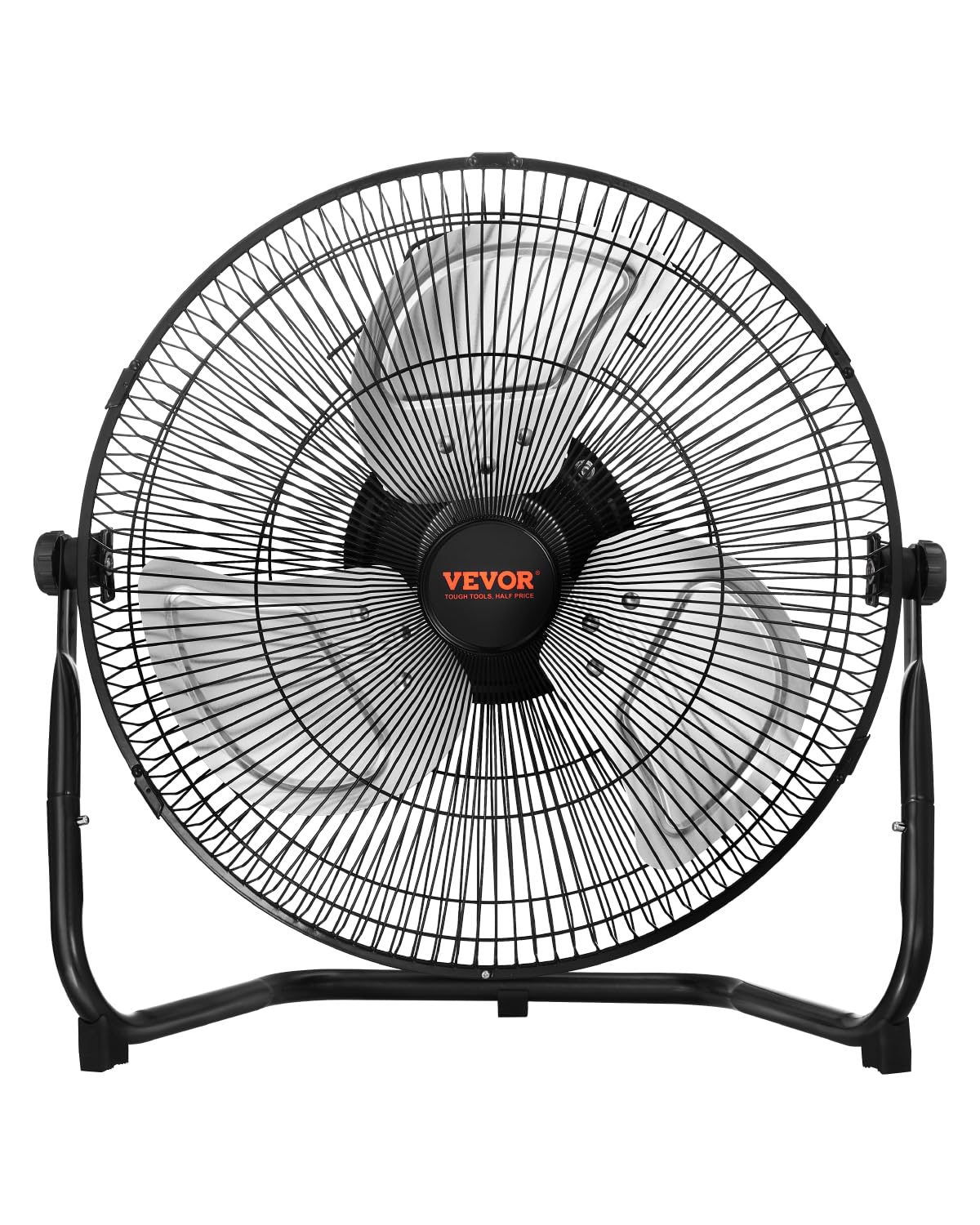
3. VEVOR 14 Inch Heavy Duty Floor Fan
The garage workhorse that moves a staggering 2400 CFM — roughly double the DREO’s output.
This is the fan you buy when you’re done playing games. The VEVOR is an industrial-grade unit that delivers up to 2560 CFM of airflow, which dwarfs the DREO smart tower’s 978 CFM by a factor of 2.5. It blows air at 19.69 ft/s with an air throw of 19.69 feet, making it ideal for gyms, garages, workshops, and even large bedrooms during a heatwave.
Built to last, this fan features a 14-inch aluminum blade and a metal grill with a black powder-coated finish (a baked-on paint that resists rust). The 3-speed dual ball-bearing motor keeps things running smoothly, and the max noise is kept below 60 dB(A) — about the level of a normal conversation. This is not a silent fan, but it’s remarkably quiet for the hurricane it produces.
You can pivot the head 360° vertically, so you can direct the flow straight up to a ceiling to mix air, or down at a sweaty treadmill. The built-in handle makes it easy to haul around. One oddity in the review data is a mention of impressive “battery life” and being “cable-free,” which contradicts the standard AC power plug, but the consensus clearly celebrates its all-metal construction and power.
Real Talk on Reviews: The review data is overwhelmingly positive, with owners praising the “all metal construction” and calling it the “best value on the market.” The single most-mentioned positives are build quality and airflow, in that order.
Get this if: You need to cool a large, demanding space and value brute-force metal durability over smart features.
skip it if: You’re a light sleeper who needs whisper-quiet operation for a small bedroom — the 60dB(A) ceiling will be too loud for some.
4. Vornado 673T Whole Room Air Circulator

The specialist that uses deep-pitched blades and vortex action to mix the air in the whole room, not just blow at you.
Vornado is famous for a specific approach: instead of oscillating to spray air around, they use a focused, high-velocity beam of air to stir the whole room. The 673T uses deep-pitched fan blades inside an enclosed air duct to move air faster and farther. With a 90-degree pivoting head, you can aim that beam straight up to pull warm air from the ceiling down to your level, or at your desk for targeted cooling.
The simple 3-speed manual dial keeps things retro and reliable, and the removable grille makes cleaning a breeze. It’s rated for indoor use and built to meet U.S. voltage requirements. But the standout in the data is the support — Vornado promises to replace it for up to 5 years, and the products are designed and supported in Andover, KS. That’s a big confidence boost.
In practice, owners mention it’s a great size and effective at bringing down the temp in a bedroom when used with an AC and ceiling fan, by as much as 2-3 degrees. The airflow is described as powerful, though a minority of buyers found it less strong than an older, larger Vornado model they owned.
The Verdict: This is a quieter, effective alternative to oscillating fans, with a loyal following that prefers it over some big-name competitors. The 333 CFM rating is modest on paper, but the vortex technology concentrates it effectively.
The Caveat: It’s not a budget fan, and some users are disappointed if they expect hurricane-force winds — this is about circulation, not direct blast.
Best for: People who understand that whole-room circulation is about mixing air, not just creating a draft, and who value a 5-year warranty.
Think twice if: You have a huge open-plan space that needs the raw volume of a commercial fan.
5. PELONIS Omni-Directional Pedestal Fan

A tall, adaptive pedestal fan that oscillates in 3D and adjusts its height for any seating position.
This fan stands out because it covers the whole room from multiple angles. It features OmniFlow Auto-Oscillation, which automatically combines 135° horizontal and 90° vertical oscillation. That means it’s not just sweeping left and right — it’s also nodding up and down, creating a draft-free, even breeze in every corner. With 900 CFM of airflow, it’s a true whole-room player.
The dual-height design is a genuinely useful trick. You can set it low at 23.2 inches for kids, pets, or sitting at a desk, or raise it to 42.5 inches to target sofas and beds. Owners appreciate the sturdy metal stand and how easy it is to assemble — often just twisting a few parts together without tools.
It operates at a library-quiet 26 dB, which is slightly louder than the DREO’s 20 dB but still quiet enough for a nursery or a Zoom call. The remote works well, and the memory function recalls your last settings after a power cut. The main criticism concerns reliability, with a few owners reporting oscillation issues after a few months, and some feeling the value isn’t quite there.
What Owners Rave About
- Noise level is the top-praised trait, described as incredibly quiet for the air output
- Build quality is second, with a sturdy metal stand noted repeatedly
- Remote control and adjustability are also well-regarded features
Points to Ponder
- Reliability gets a mixed verdict, with some oscillation failures reported
- Value for money is split — some say worth it, others don’t
Reach for it if: You want a quiet, adjustable tower-pedestal hybrid that can serve the whole family at different heights.
Look elsewhere if: You’re on a strict budget or are concerned about long-term reliability based on the mixed reports.
6. Vornado 80 High Velocity Box Fan

The 20-inch box fan that moves more air on low than two older fans combined did on high.
Calling this a box fan feels like an insult. The Vornado 80 is a serious air mover. Customers note feeling its powerful airflow from 20 feet away, which is proof of Vornado’s vortex engineering. It’s available in ice white and has 5 speed settings, offering more granularity than the typical 3-speed box fan. The durable construction means it’s built for years of service, and the metal sides add rigidity.
One of the top praises in the data is its performance on low speed — it’s genuinely quiet, quieter than some desk fans, making it a great option for noise-sensitive people. On high, though, it sounds like a jet turbine, which some users actually enjoy as a white noise machine. It’s a heavy, thick fan, which means it’s very sturdy but won’t fit in a standard window frame — so plan for floor use.
Cleaning is easy thanks to the removable grille, which simply detaches for a quick wipe-down. There’s also cord storage built in. The main quirk is that it defaults to starting on the highest speed, which can be a jolt if you’re reaching for a gentle breeze. It also lacks a remote, so you’re getting up to change settings.
The Takeaway: If you want a premium, high-velocity fan for a large room, this is a top contender, with owners calling it the “best fan” they’ve used in years.
The Catch: It’s loud at top speeds and heavy to move — it’s a floor-dweller, not a tabletop unit.
Who It Suits: People with large living areas who want serious air movement and don’t mind getting up to change the speed.
Who It Doesn’t: Anyone who needs a fan that fits in a window or needs to be whisper-quiet at all speeds.
7. Air King Pivoting Utility Fan

A compact 11.25-inch utility blower that spins at 1475 RPM for drying, ventilating, and job-site cooling.
This is not a household comfort fan; it’s a tool. The Air King is a commercial-grade pivoting utility blower built for cooling, ventilating, exhausting, and drying. Its 3-speed motor hits a maximum of 1475 RPM (revolutions per minute — how fast the blades spin), creating a focused, narrow air stream that owners describe as powerful enough to feel from across a room. It’s the perfect companion for drying out a flooded carpet or directing air toward a sweaty workspace.
Despite the high power, it’s surprisingly quiet on the low setting, and the noise level is rated at 60 dB on high — about the level of normal conversation. It features a pivoting head that rotates 360 degrees, so you can point it in any direction, even straight up. The ABS plastic housing is modeled to be tough and durable.
One standout feature is the built-in grounded outlets on the fan. This allows you to plug other tools or devices into the fan itself, which is incredibly handy on a job site where outlets are scarce. Reviewers point out 5-10 years of service, with one fleet of 45-50 units seeing only a single failure.
An Honest Note: While the focused power is praised, the narrow beam means you must be in its path to feel the cooling — it’s not a broad oscillating breeze.
Pick this up if: You’re a contractor, hobbyist, or homeowner who needs a focused, relentless blast of air for drying and ventilating, not just comfort.
Leave it if: You want a silent, soft-spoken circulating breeze for a living room — this is a workhorse, not a show pony.
8. Lasko Wind Curve Tower Fan
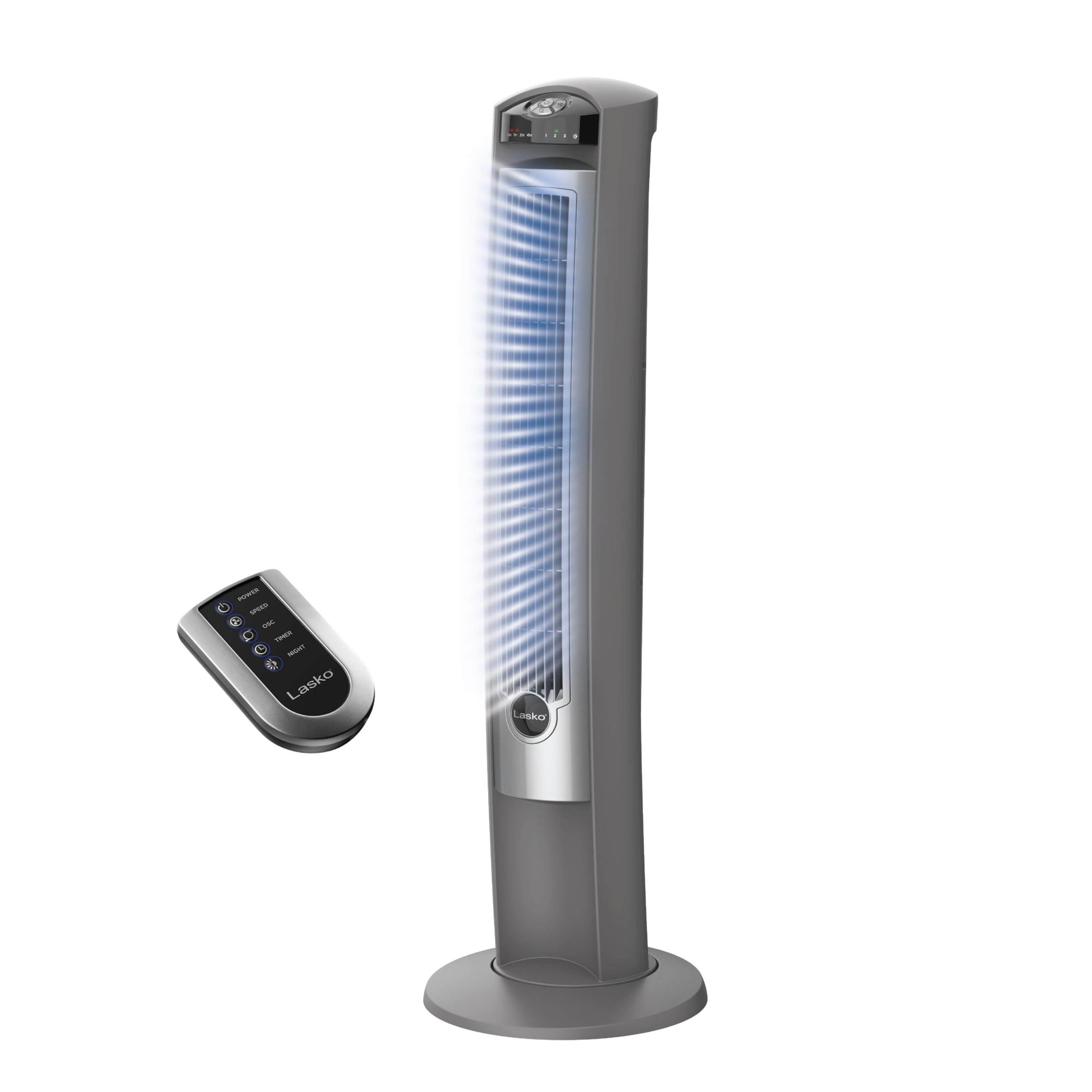
A slim, space-saving tower that’s been a bedroom staple for years, with owners running it daily for 3+ years.
The Lasko Wind Curve is the reliable, no-nonsense choice for small to medium rooms. With a 42-inch height and slim profile, it fits neatly into a corner without dominating the space. It delivers 262 CFM of airflow, which is modest compared to the big movers, but it’s perfectly suited for focusing a cooling breeze on 1-2 people or keeping a bedroom comfortable.
The 60-degree oscillation ensures a refreshing breeze reaches you without waiting for the fan to swing back around. The remote control handles everything — power, 3 speeds, oscillation, a 7.5-hour timer, and a nighttime setting that dims the LED controls and lowers the fan speed for sleep. It’s a well-designed interface that owners consistently praise.
Portability is a plus; it has a carry handle and is lightweight, so moving it between rooms is easy. Durability shines: one owner ran it daily for 3+ years in a hot climate, another for 6+ years. It’s not the quietest fan at high speed, with a slight hum reported, but on low it’s unobtrusive.
The Long-Haul Pick: The review data shows a fan that holds up remarkably well over years of daily use, with owners repeatedly repurchasing the same model.
The Trade-Off: It’s not a whole-house circulator; its lower CFM means it’s best suited to personal spaces rather than large open-plan areas.
Reach for this if: You want a reliable, good-looking tower fan with a great remote for a bedroom or small office.
pass on it if: You’re trying to cool a large living room or need powerful air mixing across a big open space.
Understanding the Specs
Airflow Capacity (CFM)
CFM stands for cubic feet per minute — the volume of air the fan moves each minute. It’s the single best number for comparing fans. A high-CFM fan like the VEVOR (2400 cfm) is a true air mover, while a lower-CFM fan like the Lasko (262 cfm) is better for gentle, personal comfort. Don’t be fooled by a fan’s physical height; a tall tower fan can still move less air than a squat metal floor fan.
Air Velocity & Reach (ft/s)
This measures how fast the air is moving as it leaves the fan (feet per second) and how far it travels. The DREO’s 28 ft/s velocity and 34-foot reach deliver a noticeable breeze across a large master bedroom. A longer air reach is crucial for whole-room circulation, as it allows the fan to push air to the far walls and bounce it back, mixing the room’s air.
FAQ
How many CFM do I need for a large bedroom?
What is the difference between a fan and an air circulator?
Which fan is best for sleeping at night?
Will the VEVOR metal floor fan be too loud for my apartment?
Can I use the Air King utility fan to dry a damp carpet?
Why does the Vornado box fan start on the highest speed?
What does the 90 degree oscillation on the DREO tower fan actually do?
Which fan can reach me from across the room?
Are smart tower fans like the DREO worth the extra cost?
How do I clean a tower fan with a removable grille?
Final Thoughts: The Verdict
For most homes, the DREO Smart Tower Fan is the best pick because it runs at a whisper-quiet 20 dB (about as loud as a library) while pushing 978 cfm (cubic feet per minute—the volume of air it moves) and works with smart home systems. If you need raw power for a large garage or gym, the VEVOR Heavy Duty Floor Fan blows a massive 2400 cfm, making it the strongest here. For a cheap, portable option, the Amazon Basics Air Circulator is a favorite for small rooms.
How We Picked
We do not accept paid placement. Every pick is matched to a real buyer and a real use-case; we do not hands-on test units.
Sources & Methodology
Specifications: manufacturer listings and product documentation. Review insights: verified customer reviews, as of August 2026. Pricing: not shown on this page (it changes often); check the current price via the retailer link.
As an Amazon Associate, WellFizz earns from qualifying purchases. This does not affect which products we feature.
Related Guides

Mo Maruf
I created WellFizz to bridge the gap between vague wellness advice and actionable solutions. My mission is simple: to decode the research and give you practical tools you can actually use.
Beyond the data, I am a passionate traveler. I believe that stepping away from the screen to explore new environments is essential for mental clarity and physical vitality.