Our readers keep the lights on and my smoothie glass nicely filled. As an Amazon Associate, I earn from qualifying purchases.
Specs are compiled from manufacturer listings and verified buyer reviews and can change over time — please confirm the key details on the product page before buying.
The biggest hurdle for a family telescope is the frustration of a beginner who can’t locate anything in the sky. Top family scopes eliminate this friction with app-guided navigation, auto-tracking mounts, or large apertures that reveal lunar detail. This guide breaks down the key specs and trade-offs to help you choose a scope that will actually get used.
I’m Mohammad Maruf — the founder and writer behind WellFizz. This guide is built by comparing the manufacturers’ published specifications and the patterns across verified customer reviews, so you get each pick’s real strengths and trade-offs instead of marketing spin.
You want a telescope the whole family can actually use, not a complicated gadget that gathers dust. This family telescope roundup compares real specs and buyer feedback so you can pick the one that fits your backyard and your budget.
Our Picks at a Glance

How To Choose The Best Family Telescope
Every family has different needs, but the core question is always: what do you want to see, and who will operate it? A toddler’s stargazing session differs from a teen’s astrophotography attempt, so the right scope depends on that answer.
Aperture: The Most Important Number
Aperture is the diameter of the main lens or mirror, determining how much light the scope collects. More light reveals dimmer objects and finer detail on bright ones. A 90mm refractor is a solid starting point for family use, but a 150mm reflector will show you significantly more of what’s out there, at the cost of size and weight.
Mount Type: Manual vs. Computerized
The mount is what holds the telescope and lets you move it. A manual altazimuth mount is simple and intuitive — great for kids. An equatorial mount is better for serious tracking of planets as they drift across the sky, but it has a learning curve. A computerized GoTo mount finds objects for you, which is the ultimate frustration-killer for beginners.
Smart Features vs. Classic Simplicity
Some scopes now use your smartphone’s camera to analyze the sky and tell you where to point. Others are purely manual — you find things with a finderscope. For a family, app-guided scopes often lead to more consistent success because they eliminate the guesswork, but they require a charged phone and a bit of setup time.
Quick Comparison
| Model | Best For | Aperture | Focal Length | Mount | Amazon |
|---|---|---|---|---|---|
| Dwarf 3 Smart Telescope★ Best Overall | Astrophotography | Dual Lens | — | App-Controlled | Amazon |
| MEEZAA 80mm RefractorFamily Value | Kids & Families | 80mm | 500mm | Alt-Azimuth | Amazon |
| MEEZAA 90mm RefractorBest Value | Beginners | 90mm | 800mm | Alt-Azimuth | Amazon |
| Hawkko 90mm Refractor | Value Hunters | 90mm | 900mm | Alt-Azimuth | Amazon |
| Celestron StarSense LT 80AZ | App Navigation | 80mm | 400mm | Manual w/ App | Amazon |
| Gskyer 600x90mm | Versatile Viewing | 90mm | 600mm | Alt-Azimuth | Amazon |
| Dianfan 150EQ | Planetary Detail | 150mm | 650mm | Equatorial | Amazon |
| Sky-Watcher Heritage 150 | Light Gathering | 150mm | 750mm | Tabletop Dobsonian | Amazon |
| Celestron 114LCM | Automatic Find | 114mm | — | Computerized GoTo | Amazon |
In‑Depth Reviews
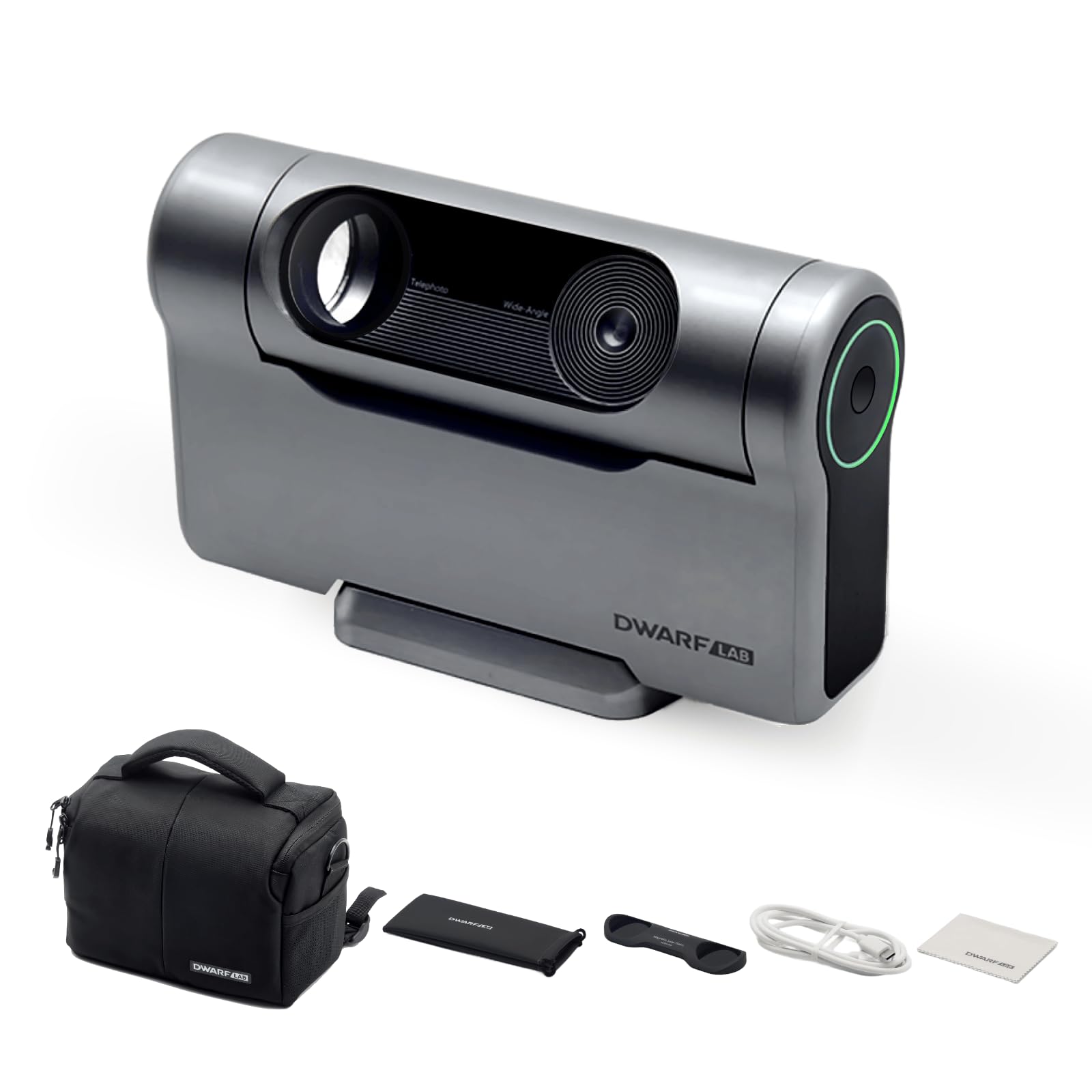
1. Dwarf 3 Smart Telescope
Our pick — over 4.5★ from 150+ verified ratings; the strongest balance of quality and price.
The book-thick smart scope that turns a suburban backyard into a deep-sky observatory.
If your family’s goal is to see and photograph nebulae, galaxies, and the Milky Way without fighting a manual mount, this is the one. Weighing just 2.28 kg, it’s dramatically more portable than the Dianfan 150EQ below — you can practically slip it into a backpack. Its built-in motorized mount automatically tracks celestial objects, so once you tap a target in the DWARFLAB app, the scope finds it and holds it steady for you.
What wins people over is the optical quality — it’s the most-praised feature of this scope. The dual-lens system is clever: a telephoto lens for planets and deep-space objects, and a wide-angle lens for the Milky Way and star trails. Because the app handles the image stacking and denoising in the cloud, a total beginner can produce stunning nebula photos in minutes, no PC software needed. It even works well under heavy light pollution; as buyers report from San Jose, it captures “excellent photos of dim objects under heavy light pollution.”
The built-in battery (24,000mAh) lasts all night, which makes it a joy for camping trips. The recurring trade-off is that it’s a camera system, not an eyepiece scope — you’re looking at images on a phone or tablet screen, not through a lens. The app’s interface can occasionally feel finicky, and a DWARF tripod is worth adding for stability. It’s a premium investment, but for a family that wants to actually see and share deep-sky objects, it’s the most rewarding path.
Why It Wins Families Over
- Captures detailed, colorful images of galaxies and nebulae automatically.
- Compact 1.36 kg design is easy to transport and store.
- Built-in 24,000mAh battery runs the whole night.
- App processing makes astrophotography possible for absolute beginners.
The Honest Trade-Offs
- No eyepiece — views are on a screen, not through the lens.
- Premium pricing reflects its advanced tech.
- Best results come with the recommended DWARF tripod.
Best for: Families ready to capture Instagram-worthy shots of the Orion Nebula and Andromeda Galaxy with minimal expertise.
Consider if: You want a traditional eyepiece experience, or your budget doesn’t stretch to this premium smart scope.
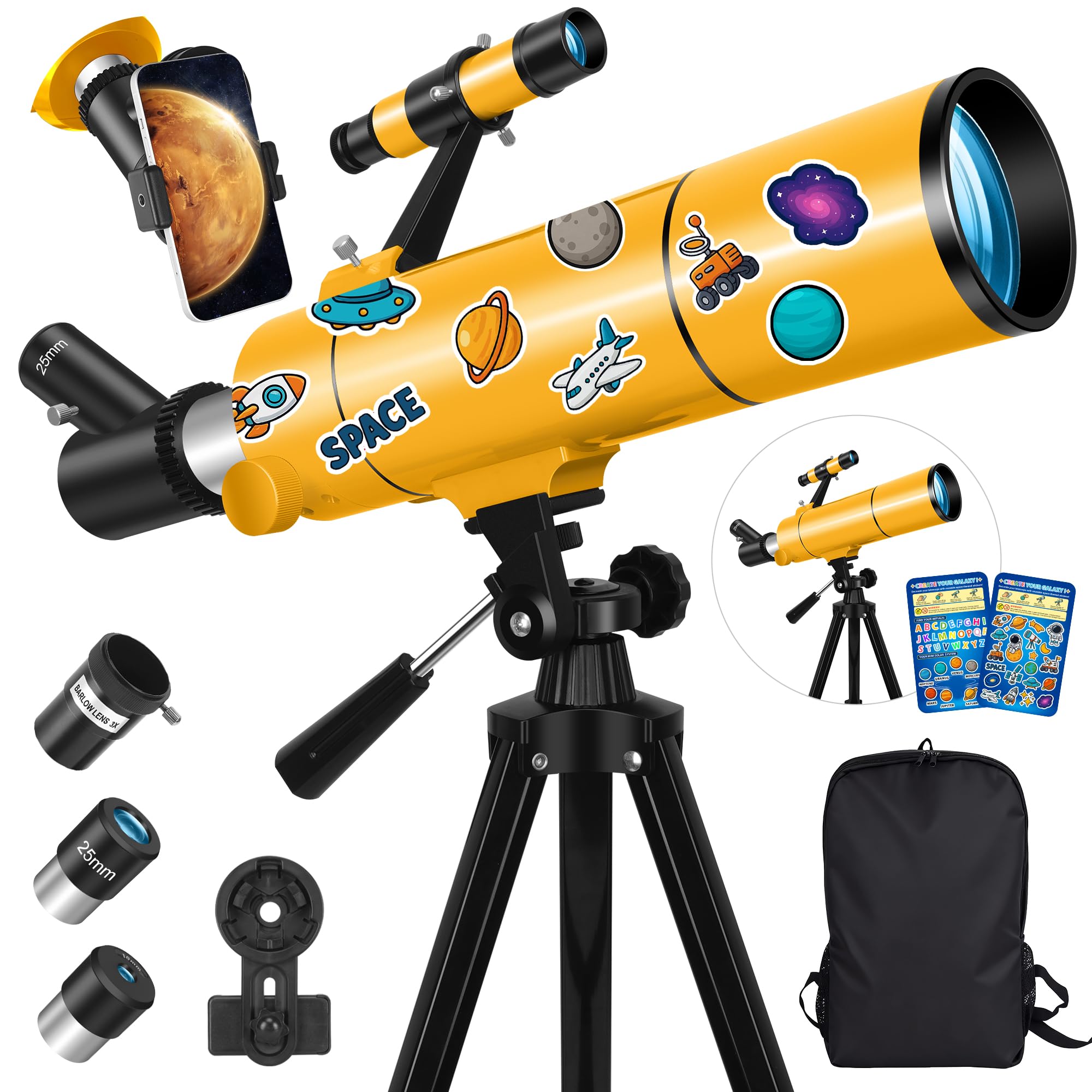
2. MEEZAA 80mm Aperture 500mm Refractor
The cheerful yellow starter kit that has kids actually helping with setup instead of wandering off.
This is the definition of a family-first telescope. Its 80mm aperture and 500mm focal length give crisp, bright views of the Moon’s craters and Jupiter’s moons, but the real genius is the packaging. Assembly is genuinely tool-free and takes about ten minutes, and reviewers rave that the kids can join in. The included waterproof backpack and a fun set of space stickers make it feel like a toy, yet the optics are legitimately good for the money.
You can carry this scope anywhere—it weighs just 6 lbs, and buyers call it sturdy. The tripod adjusts from 16.92 to 44.48 inches, so it fits a child and an adult. A 45° zenith mirror (a diagonal that bends the light path) keeps images upright, so daytime birdwatching looks natural, not upside down. The phone adapter is a favorite: families snap Moon photos to share on social media.
The honest truth is that at 150X maximum magnification (via the 3X Barlow), the image gets dim and wobbly, so you’ll get the best results at lower power. The finder scope needs alignment from the start, and because it’s a manual mount, you’ll be nudging the tube to keep the Moon centered. That’s a small price to pay for a kit that gets the whole family engaged. For a first telescope that won’t gather dust, this is the smartest value on the list.
What Families Love
- Tool-free assembly in about 10 minutes, perfect for kids.
- Waterproof backpack and stickers included.
- Adjustable tripod fits children and adults at 16.92 to 44.48 inches.
- Upright images for daytime bird and nature viewing.
Keep In Mind
- Manual mount requires periodic tracking adjustments.
- Finder scope needs alignment before first use.
- Images soften at maximum magnification.
Reach for this if: You want a low-friction introduction to astronomy for kids aged 8-12 that they can truly help operate.
Look elsewhere if: You’re hunting for faint galaxies or want app-guided navigation from day one.
3. MEEZAA 90mm Aperture 800mm Refractor
The 90mm refractor that proves you don’t need to spend double for crisp lunar detail.
This MEEZAA steps up from the 80mm model with a larger 90mm aperture and a longer 800mm focal length, which translates directly into more light and more detail. The thing everyone raves about here is the ease of use — it’s the single most-mentioned positive in the reviews. With a stainless steel tripod extending from 28 to 46 inches, it feels far more stable than its price suggests, and the included metal tube resists wind wobble better than cheaper plastic designs.
Unlike the entry-level 80mm MEEZAA that’s aimed squarely at kids, this one is built for an adult or older teen who wants a serious first scope. The fully multi-coated glass lenses boost brightness and clarity, and the 32X to 240X magnification range (with the 3X Barlow) lets you zoom in on Saturn’s rings, not just the Moon. The carry bag holds all the accessories neatly, making it a great companion for camping trips and backyard star parties.
There are a couple of quirks you should expect. The view through the finder scope is inverted, which can be confusing at first, and the tripod needs occasional re-tightening as it gets used. One owner found the phone adapter adds a bit of weight that unbalances the focuser, so you’ll want to be gentle when filming. But for under worth of telescope, the combination of aperture, stability, and included kit is hard to argue with.
What Earns Its Keep
- 90mm aperture pulls in noticeably more light than 80mm models.
- Stable stainless steel tripod handles outdoor breezes.
- Full kit: phone adapter, 10mm/25mm eyepieces, 3X Barlow, carry bag.
- Most buyers assemble it in about 10 minutes.
The Quirks
- Inverted view in the finder scope takes getting used to.
- Tripod legs may need occasional re-tightening.
- Manual mount requires patience to track objects.
Ideal for: Teens and adults who want a proper first telescope with a stable mount and room to grow.
Think twice if: Your main user is under 10 — the 80mm MEEZAA is a friendlier fit for smaller hands.
4. Hawkko 90mm Aperture 900mm Refractor

The longest focal length in the entry class, giving you sharper planetary close-ups for less.
The Hawkko 90/900 squeezes the most focal length out of the 90mm class — 900mm versus the MEEZAA’s 800mm. That extra length translates into higher usable magnification and more detail on planets like Jupiter and Saturn. The multi-coated optics are praised for their clarity, and the claimed 73% light transmittance improvement helps keep images bright and sharp. This is a scope that rewards patient viewers with genuine planetary detail, including Jupiter’s moons and faint cloud bands.
Assembly is rated at under 15 minutes, and the stainless steel tripod offers smooth 360° rotation from a comfortable 28 to 46 inches in height. Buyers love pairing this with the free Celestron SkyPortal app on their phone to guide them to objects, which makes it a smart mid-range choice between a basic refractor and the pricier app-integrated Celestron. The complete kit — finder scope, zenith mirror, 25mm and 10mm eyepieces, 3X Barlow, and phone adapter — means nothing else is needed to get started.
The most common feedback is that the focuser can wobble slightly when a phone is attached, so you’ll want to support it when capturing video. A couple of buyers mentioned shipping delays, but that’s a logistics issue, not a quality one. For families who want a serious manual refractor with strong planetary performance without climbing into the bracket, the Hawkko delivers exceptional value.
The Strong Points
- 900mm focal length provides high magnification headroom.
- Sharp view of Jupiter’s moons and Saturn with the 3X Barlow.
- Stable 360° rotating tripod from 28 to 46 inches.
- Pairs beautifully with free planetarium apps.
Watch Out For
- Focuser wobble when a smartphone is attached.
- Phone adapter can unbalance the tube at high power.
- Slight learning curve with the manual finder scope.
Pick this if: Planetary close-ups are your priority and you want a stable, complete kit at a mid-range price.
skip it if: You’d rather have an app guide you to targets than find them yourself.
5. Celestron StarSense Explorer LT 80AZ

The scope that uses your phone’s camera to tell you exactly where to point, making a total beginner feel like a pro.
This Celestron’s a neat extra is its patented StarSense technology. Instead of a fully motorized mount, it uses a phone dock that reads the star patterns overhead to calculate your telescope’s position, then shows on-screen arrows to guide you to any target. When the bullseye turns green, the object is in your eyepiece. It’s a clever half-step — you get app-powered navigation at a far lower price than a full GoTo mount. For a family, this dramatically shortens the journey from “I can’t find anything” to “wow, there’s Saturn’s ring.”
With an 80mm refractor (a lens-based telescope) and a 400mm focal length, you’ll see the Moon’s craters, Jupiter’s moons, and Saturn’s ring clearly. The manual altazimuth mount (which moves up-down and left-right) has a slow-motion rod, so tracking objects feels smooth. One family called it “the families gift”—a scope everyone can use. Plus, the 2-year US warranty and Celestron’s California support mean help is a phone call away.
The catch is that the app experience gets mixed feedback. Some users report the alignment works flawlessly, while others struggle with focusing and the app’s reliability — the app was the most negative aspect in review analysis. The low 400mm focal length means high magnification isn’t its strength, so keep expectations realistic on planetary detail. It’s a scope that improve the experience of *finding* things rather than the raw magnification power, and for that, it has few rivals at its price.
Why It’s Brilliant
- StarSense app guides you to thousands of objects using your phone.
- Slow-motion rod makes manual tracking smooth.
- Backed by a 2-year US warranty from a trusted brand.
- Lightweight and simple to set up.
The Reality Check
- Some users find the app finicky to align.
- 400mm focal length limits high-power magnification.
- Mixed reports on overall stability of the tripod.
Best suited to: Technically-inclined families who want guided sky navigation but are happy to turn the knobs themselves.
Not for: Anyone who wants fully automatic tracking without touching the scope, or who expects high-magnification planetary views.
6. Gskyer 600x90mm AZ Refractor

The German-engineered refractor that gives you three eyepieces and a tall tripod for the full family.
The Gskyer 90mm is a staple for a reason — it’s been a top seller for years, and the review volume backs up its reputation. It comes with three eyepieces (24X, 60X, and 120X) plus a 3X Barlow lens, giving you a wider spread of magnifications than most kits. The adjustable aluminum tripod extends from about 31.5 inches to 49 inches, the tallest range in this group aside from the Dianfan, making it comfortable for standing adults.
The fully coated optics deliver pleasingly clear views of the Moon and Jupiter’s moons, with buyers noting its ease of assembly and suitability for kids. The included phone mount with a Bluetooth shutter is a nice bonus for capturing lunar shots. Reviewers use it for both astronomy and daytime birdwatching, which makes it a genuinely versatile family instrument.
Where it falls short of premium scopes is stability at the top end of its zoom range. Some owners mention slight shaking at maximum magnification, which they fix with small rubber washers, and one found the stock tripod too low for their comfort and swapped in a photography tripod. It’s a classic, capable refractor that suits casual moon-gazers and budding astronomers alike.
The Case For It
- Three eyepieces provide 24X, 60X, and 120X views from the start.
- Tall tripod reaches up to 49 inches for comfortable standing use.
- Great for both stargazing and daytime terrestrial viewing.
- Includes a phone mount with Bluetooth shutter.
The Trade-Offs
- Some shake at maximum magnification with the stock setup.
- Manual tracking needs regular adjustment.
- Optics are good, not exceptional, at this price.
Reach for this if: You want a proven, versatile refractor with multiple eyepieces for a wide range of family viewing.
Consider the alternative if: You need a heavier, more stable tripod for serious high-power work.
7. Dianfan 150EQ Professional Reflector
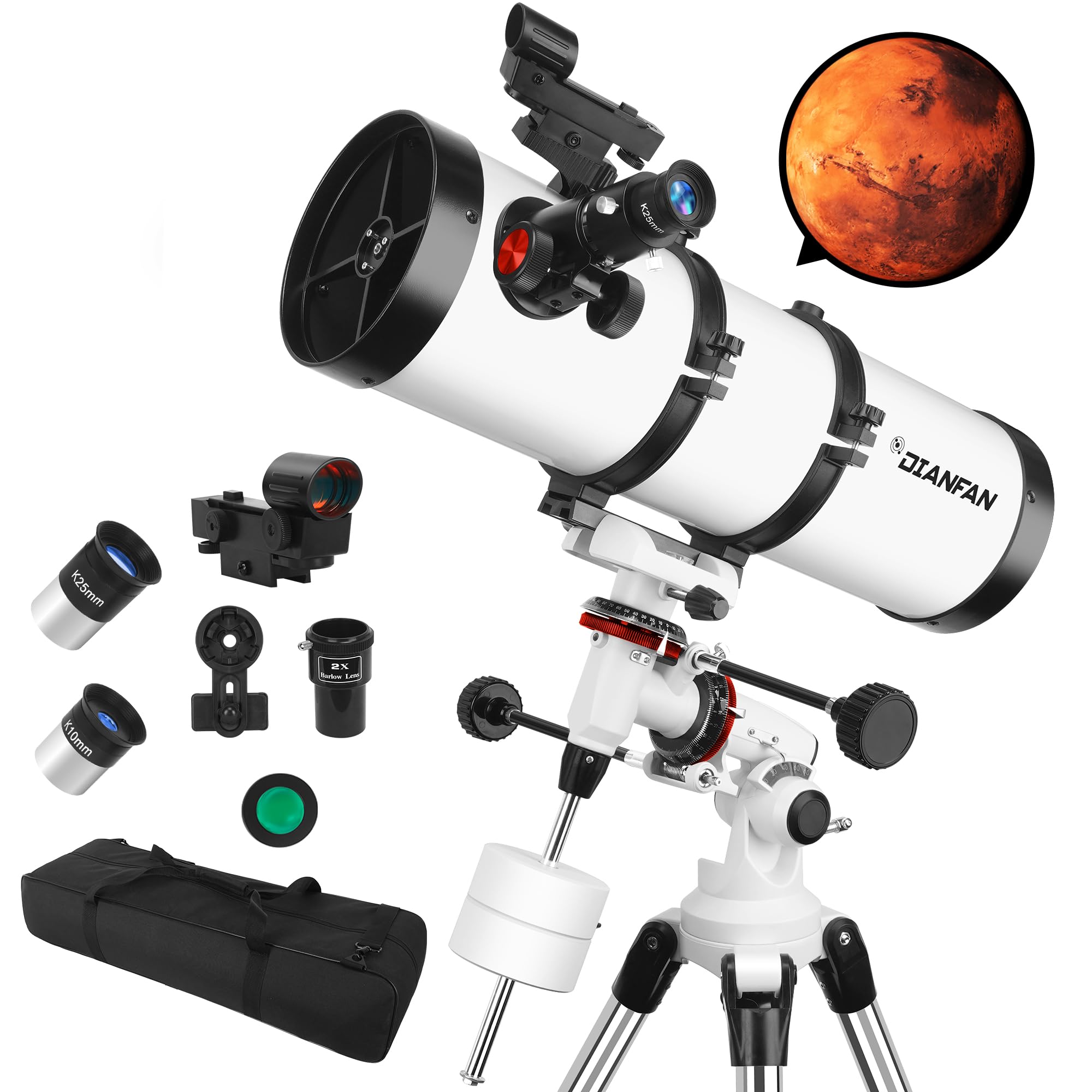
The 150mm reflector that captures more light than an 80mm scope, open up deep-sky wonders.
For families ready to step beyond the Moon and into galaxies, the Dianfan 150EQ is where the real light-gathering begins. Its massive 150mm aperture pulls in vastly more light than the 90mm refractors above, revealing faint nebulae, star clusters, and detail on the Moon that smaller scopes simply can’t show. The 650mm focal length yields a fast f/5-ish system that’s well-suited to wide-field views of the Milky Way.
This scope’s German equatorial mount (a mount that aligns with Earth’s axis) uses slow-motion cables and dials, so you can follow Saturn as the Earth turns—essential for keeping it in view at high power for minutes. The tripod is overbuilt and sturdy, and the telescope height ranges from 48.4 to 66.2 inches, the tallest in this guide. A buyer who owns 13 telescopes called it a “terrific telescope at the price point,” praising the distortion-free mirrors and smooth focuser.
The trade-off is the learning curve: an equatorial mount takes about 20 minutes to set up, more than an altazimuth, and the view is inverted—fine for stars, odd for daytime. The phone adapter is flimsy and can fall off, so handle it gently. The red dot finder may need a small offset adjustment to align. If you spend a couple of sessions learning the mount, the views beat anything else at this price.
The Performance Payoff
- Massive 150mm aperture reveals deep-sky objects.
- Smooth equatorial mount with slow-motion controls for tracking.
- Tall, stable stainless steel tripod from 48.4 to 66.2 inches.
- Detailed views of Saturn’s rings, Jupiter’s moons, and lunar seas.
The Learning Curve
- Equatorial mount is more complex for beginners to master.
- Phone adapter is a weak point and may need reinforcement.
- Finder scope may need manual alignment adjustments.
Best for: Families with an older teen or adult who’s willing to learn a proper equatorial mount for serious deep-sky views.
Think twice if: You want a grab-and-go scope for younger kids, or you’re not ready for the setup complexity.
8. Sky-Watcher Heritage 150 Tabletop Dobsonian

The 150mm Dobsonian that’s so simple to use, it might be the best first telescope a family can buy.
Here’s the secret that astronomy hobbyists all know: a Dobsonian mount is the cheapest way to get the biggest aperture, and the Sky-Watcher Heritage 150 is a textbook example. It’s a “tabletop” scope, meaning you place it on a sturdy table or stool, and the mount moves smoothly by hand to point at anything in the sky. No tripod, no balancing weights, no equatorial alignment — just point and look. Customers note it needs no assembly and is brilliantly easy to use.
Inside that collapsible tube sits a 150mm borosilicate parabolic primary mirror with Sky-Watcher’s proprietary Radiant Aluminum Quartz (RAQ) coating. This quality mirror is the star of the show — it produces sharp, contrast-rich views of the Moon and planets, and its fast f/5 focal ratio (750mm focal length) reveals wide swaths of the Milky Way. Buyers consistently say it outperforms scopes costing more, with one calling it “really is the best for beginners” and superior to a popular Celestron Astromaster 130.
The challenges are worth knowing. As a tabletop scope, you need a sturdy surface — a wobbly picnic table will ruin the view, and it works best at a lower seated height. The 23-pound weight is manageable but not backpack-friendly, and the collapsible open-tube design benefits from a DIY light shroud to block stray light. The stock 2X Barlow can distort, so a higher-quality low-power eyepiece is a smart future upgrade. It’s a scope that the whole family can use in seconds, with the raw aperture to keep them interested for years.
Why It’s So Loved
- Huge 150mm aperture reveals deep-sky objects clearly.
- No assembly and no tripod — just set it on a table and go.
- High-quality parabolic mirror with RAQ coating.
- Collapsible design for easier storage and transport.
What It Needs From You
- Requires a sturdy, stable surface at the right height.
- Open tube design benefits from a DIY light shroud.
- Manual tracking — you nudge it by hand.
Reach for this if: You want the maximum light-gathering for your money with zero setup frustration.
Look elsewhere if: You need a full-height tripod scope, or you want motorized tracking and app navigation.
9. Celestron 114LCM Computerized Reflector
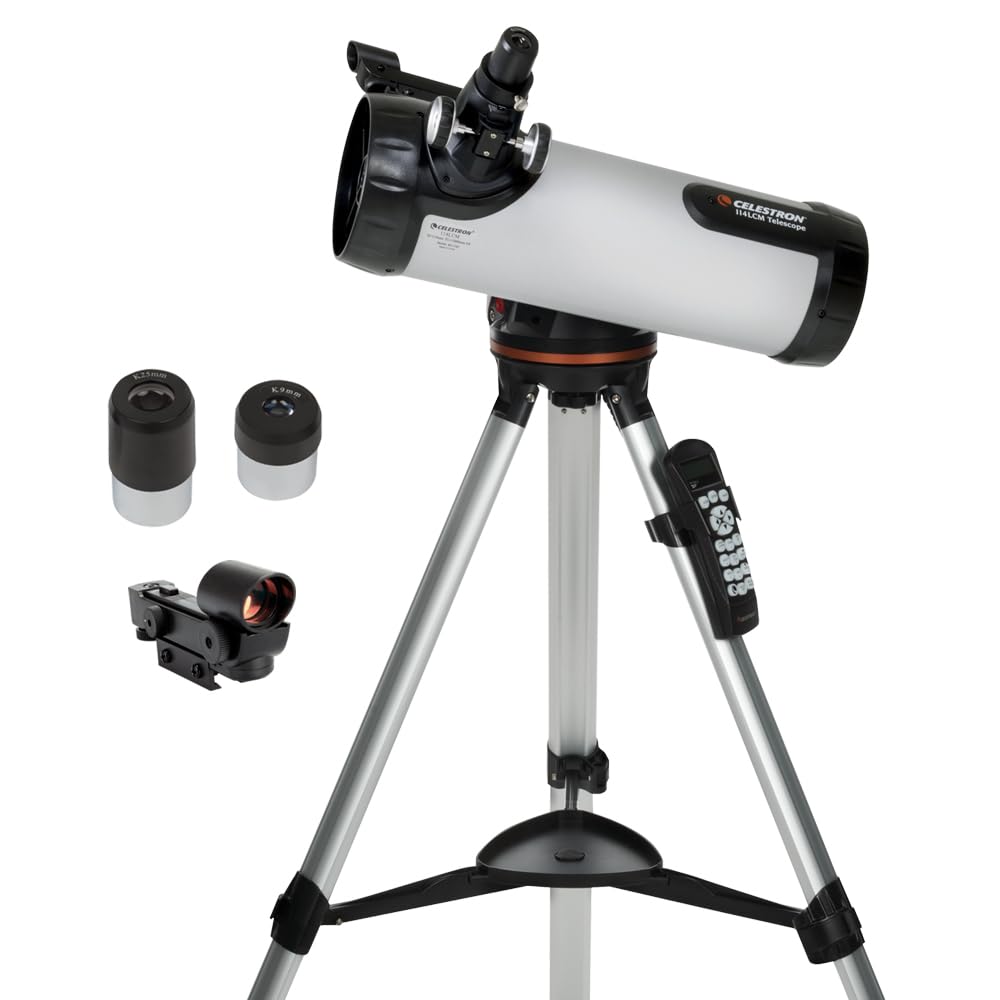
The fully computerized scope that uses a handset to find thousands of objects, so nobody gives up in frustration.
The 114LCM takes all the guesswork out of stargazing. Its computerized GoTo mount can automatically locate 4,000 celestial objects — you just type one in on the NexStar+ hand controller or press the Sky Tour button, and the scope slews to it on its own. For a family with zero astronomy experience, this is the ultimate frustration-killer: instead of spending 20 minutes trying to find Saturn, you spend 20 seconds watching the scope find it for you. With its 114mm aperture, it delivers bright views of the Moon’s craters and Jupiter’s bands.
Setup is genuinely quick, with most buyers assembling and aligning in under five minutes. The full-height tripod is sturdy and adjustable, and the StarPointer red dot finderscope helps confirm what the GoTo finds. Celestron’s 2-year US warranty and free download of Starry Night software add solid value. Reviewers point out it tracks Jupiter’s moons smoothly enough for video capture, and it finds objects impressively well even in light-polluted city skies.
The mixed feedback here revolves around alignment and stability. A recurring challenge is the alignment process — some users find it finicky, and the mount can be sensitive to being perfectly level. The focuser knob is a bit coarse at high magnification, causing some image oscillation. The 114mm aperture is a step down from the Sky-Watcher’s 150mm, so deep-sky views won’t be as bright. It also runs on AA batteries, so a rechargeable lithium pack is a smart accessory. For families who want automation over aperture, this Celestron delivers a wonderfully “it just works” experience once dialed in.
The Automation Advantage
- Computerized GoTo finds 4,000 objects automatically.
- Sky Tour button generates a list of the best targets for the night.
- Full-height tripod and easy setup in minutes.
- Smooth tracking holds objects for video recording.
The Drawbacks
- Mount alignment can be finicky and sensitive to leveling.
- Coarse focus knob causes wobble at high power.
- Runs on AA batteries — a lithium pack is a worthwhile upgrade.
Pick this if: You want a “smart telescope” that finds objects for you without needing to learn the sky or a phone app.
Consider the Sky-Watcher instead if: You’re happy to find objects yourself in exchange for significantly more light-gathering power at a smaller price.
Understanding the Specs
Aperture and Light Gathering
Aperture is the diameter of the primary lens (in a refractor) or mirror (in a reflector), usually measured in millimeters. It is the single most important spec because it determines how much light the scope collects. A 90mm aperture gathers more light than an 80mm aperture, meaning dimmer objects become visible and brighter objects show more detail. For family use, 80mm is a fine starting point for the Moon and planets, while 150mm opens the door to galaxies and nebulae.
Focal Length and Magnification
Focal length is the distance in millimeters the light travels to reach the eyepiece. Longer focal lengths (like 900mm) provide higher magnification with the same eyepiece, but they also narrow your field of view, making objects harder to find and track. The magnification is calculated by dividing the focal length by the eyepiece’s size (e.g., 500mm ÷ 25mm = 20X). A Barlow lens multiplies this, such as a 3X Barlow turning 20X into 60X, but very high magnification often results in dimmer, shakier images — so start low and work up.
FAQ
How much telescope do I need to see Saturn’s rings?
What is the difference between a refractor and a reflector telescope?
Is a computerized GoTo telescope worth it for a family?
What does a Barlow lens do and should I use it?
Can I take photos with these telescopes?
How hard is it to assemble a beginner telescope?
Is a bigger aperture always better for kids?
What is the best telescope for viewing in a city with light pollution?
Final Thoughts: The Verdict
For most families, the best family telescope is the Dwarf 3 Smart Telescope because it removes every barrier to stunning views — a crowd favorite praised for its easy setup and amazing pictures. If you want an affordable, Kid-proof classic, grab the MEEZAA 80mm for tool-free family fun. And if you’re chasing maximum light-gathering and don’t mind a little assembly, the Sky-Watcher Heritage 150 is a tabletop giant that will keep the whole family exploring for years.
How We Picked
We do not accept paid placement. Every pick is matched to a real buyer and a real use-case; we do not hands-on test units.
Sources & Methodology
Specifications: manufacturer listings and product documentation. Review insights: verified customer reviews, as of July 2026. Pricing: not shown on this page (it changes often); check the current price via the retailer link.
As an Amazon Associate, WellFizz earns from qualifying purchases. This does not affect which products we feature.
Related Guides

Mo Maruf
I created WellFizz to bridge the gap between vague wellness advice and actionable solutions. My mission is simple: to decode the research and give you practical tools you can actually use.
Beyond the data, I am a passionate traveler. I believe that stepping away from the screen to explore new environments is essential for mental clarity and physical vitality.