Our readers keep the lights on and my smoothie glass nicely filled. As an Amazon Associate, I earn from qualifying purchases.
Specs are compiled from manufacturer listings and verified buyer reviews and can change over time — please confirm the key details on the product page before buying.
The real test of any family game night is the moment the scoreboard comes out—somebody loses, and suddenly the whole evening tilts. The games below dodge that trap entirely, leaning on cooperative play where the whole table wins together or trivia that keeps everyone laughing at the same joke. You’ll find picks that turn a quiet living room into a shouting match of laughter, and a few that get the youngest kids counting and turn-taking without them ever realizing it’s a lesson.
I’m Mohammad Maruf — the founder and writer behind WellFizz. This guide is built by comparing the manufacturers’ published specifications and the patterns across verified customer reviews, so you get each pick’s real strengths and trade-offs instead of marketing spin.
Spanning word association, snail racing, and monster-battling strategy, these are the family game night games worth clearing the coffee table for.
Our Picks at a Glance


How To Choose The Best Family Game Night Games
The perfect family game is less about the box art and more about what happens at your specific table. The biggest question isn’t “is it fun”—it’s whether every person in the room, from the six-year-old to the grandparent, can actually play without frustration.
Age range and reading level
Check the box’s suggested minimum age before you commit. Games like Snail’s Pace Race are built for age 3 and up with zero reading required, while word games like So Clover! demand a solid vocabulary and are best for ages 10 and up. If you have a mixed-age group, look for games where younger players can team up with an adult or where the mechanics don’t hinge on reading speed.
Cooperative vs. competitive
Cooperative games have everyone working toward one shared goal, which means no one stomps off at the end. The trade-off is that some kids (and adults) genuinely love the thrill of winning outright. If your family tends to get competitive, a trivia game with teams can channel that energy positively; if you’d rather avoid the tears, a coop game where everyone wins or loses together is the safer bet.
Playtime and setup
A 60-minute strategy epic might be amazing on paper, but it will lose a young audience by minute 20. Fast, self-contained rounds—think 15 to 30 minutes—fit into a weeknight and let you play multiple games in one sitting. Real-time games that use a timer app add a frantic energy that keeps even restless players engaged, while slower drafting games let everyone chat and pass pieces at their own pace.
Quick Comparison
| Model | Best For | Playtime | Players | Ages | Amazon |
|---|---|---|---|---|---|
| Asmodee So Clover!★ Best Overall | Creative word lovers | 30 min | 3-6 | 10+ | Amazon |
| Ravensburger Snail’s Pace RaceToddler Winner | Toddlers and preschoolers | 15 min | 2-6 | 3+ | Amazon |
| Peaceable Kingdom Space EscapeStrategy Staple | Cooperative strategy | — | 2-4 | 7+ | Amazon |
| Runs in The Family | Learning family quirks | 15 min | — | 8+ | Amazon |
| Who Knows More? Kids or Adults | Team trivia battles | — | — | 8+ | Amazon |
| Ravensburger Horrified: Greek Monsters | Older kids who love strategy | 60 min | 1-5 | 10+ | Amazon |
| Buffalo Games Planted | Relaxed strategy with pretty pieces | 20-30 min | 2-5 | 10+ | Amazon |
| Asmodee Harmonies | Calm, beautiful puzzle-building | 30 min | 1-4 | 10+ | Amazon |
| Wiggles 3D 5-Minute Dungeon | Chaotic, high-energy groups | 5 min | 2-5 | 8+ | Amazon |
In‑Depth Reviews
1. Asmodee So Clover! Party Game
Our pick — over 4.5★ from 950+ verified ratings; the strongest balance of quality and price.
The word game that makes everyone feel like a genius while working together
So Clover! flips the party game script by making your whole team cheer for each other instead of against each other. In a 30-minute session, you write one clue that links two keywords on a clover leaf, and your teammates race to guess which pair you meant. The more creative the connection, the higher the team scores—so you’re actively rewarded for clever, unexpected thinking rather than just naming the obvious match.
Bring it on a family vacation or to a gathering of any size. The soft limit is 3 to 6 players, but the review pages make clear that people team up and it doesn’t matter. It’s also noticeably compact and portable, which is why it keeps earning a spot in travel bags. What wins people over is the pure gameplay — owners consistently single out how it gets everyone’s brain working creatively while staying genuinely laugh-out-loud funny.
You’ll be playing within minutes, so no one loses interest waiting. The rules are simple enough to grasp in a round or two, yet the wordplay and logic puzzles keep adults engaged while staying easy for kids. Inside the box you get 220 password cards, 6 clover boards, abrasive markers, and a scorecard—everything you need to start. The 9.06 x 6.3 x 6.46-inch box fits on a shelf or in a carry-on for travel.
Why it wins the night
- Genuinely cooperative — no winners, no losers, just shared laughs
- Replay value is enormous; buyers report “countless hours” of play
- Compact and portable enough for travel and vacations
Who might want to skip it
- Requires strong vocabulary and abstract thinking, so it’s not for young kids
- Best with at least 3 players, so date-night duos may be left out
Reach for this if: your family loves wordplay, lateral thinking, and collaborative wins.
Look elsewhere if: you need something a preschooler can play tonight without help.
2. Ravensburger Snail’s Pace Race Game
A preschool-perfect race where nobody loses and the wooden snails steal the show
For the youngest gamers in the house, Snail’s Pace Race is the first board game that actually works. Six chunky wooden snails and two colored dice bring a 15-minute race to life, and because every snail moves forward (never backward), there’s no concept of “losing”—the only question is which snail crosses the finish line first. That non-competitive design earns the Parent’s Choice Gold Seal Award and explains why it’s a staple in preschool classrooms.
The educational payoff is built into the fun. Kids practice color recognition, counting, and turn-taking with every roll, and the wooden snails are durable enough to survive heavy use — owners mention it standing up to three months of daily preschool play. The 9 x 2.25 x 13.25-inch board, versus Space Escape’s 11.02 x 8.66 x 2.36-inch board, fits comfortably on a small table. It’s made for 2 to 6 players aged 3 and up, and the rules are simple enough for a four-year-old to set up on their own after a single play.
One honest note: some units ship with labels stuck directly on the box, which can leave sticky residue if you’re gifting it. That’s a packaging gripe, not a game flaw. Also, the suggested age is spot-on—older kids will outgrow it quickly, so this is a phase purchase rather than a forever favorite.
A gentle first win: the adorable theme and forgiving mechanics make it the rare game where kids cheer for the underdog instead of sulking.
The pick for: parents of 3 to 5-year-olds who want a screen-free way to practice counting and patience.
Not the pick for: families with only older kids who need more strategic challenge.
3. Peaceable Kingdom Space Escape
A space-station escape that turns teamwork into the only way home
Space Escape comes from the same designer behind the hugely respected Pandemic, so the pedigree is real. You and your fellow players work as one team to guide Mole Rats across a space station, gather equipment, and reach the escape pod before snakes stop you. The 11.02 x 8.66 x 2.36-inch board needs a real table, but rewards careful, shared decision-making.
The cooperative design means it’s especially great for a household where someone hates losing. Owners talk about kids aged 4 to 11 teaming up with adults, and because there’s no reading required, even younger players can grasp the rules through a quick verbal explanation. Strategy runs deep for a family game — you draw cards that give you one action and the snakes one action, then decide as a team which Mole Rats to move and where to send the snakes. There’s an optional challenge mode that the rules describe as open up after you win three times, which keeps it replayable beyond the first few sessions.
Buyers rate it 4.8 stars across a few hundred reviews, praising it as a top cooperative pick for ages 7 and up.
What families love
- Everyone wins or loses together — ideal for kids who dislike losing
- No reading needed, so younger siblings can join in
- Challenge mode extends the replay life
What to know
- Requires 2 to 4 players, so solo nights won’t work
- Needs table space for the full-size board
Choose this if: you want a strategy game that builds teamwork without the stress of elimination.
Think twice if: your group prefers loud, fast party energy to thoughtful planning.
4. Runs in The Family

A trivia twist where matching your family’s answers beats knowing the right one
Runs in The Family flips trivia on its head by testing how well you know the people across the table, not how much you remember from school. Draw a topic card, then score points every time your answer lines up with another player’s. With over 200 topics and a 15-minute playtime, it’s built for quick rounds that spark memories and laughter long after the cards are put away.
The 8.8-ounce box slips into a bag for vacations or restaurant waits. Families report playing it with three generations at once — ages 8 to 60 in one reported session — and the flexible length means you can run a five-minute round or a full evening. Because the prompts nudge you to recall shared history, it doubles as a way to actually learn things about each other you never knew.
The honest trade-off is value for money. Owners are split — many find it worth every penny, while a few describe it as overpriced for what’s essentially a deck of cards. The writing is basic, and some topic prompts don’t fit every family dynamic, but those cards are skippable in favor of the ones that hit home. The overwhelmingly positive side is that it bridges age gaps better than most games on this list.
Why it works
- Gets even non-gamers engaged thanks to no learning curve
- Travel-friendly 8.8 oz box works for on-the-go play
- Creates genuine conversation and inside jokes
Keep in mind
- Some prompts feel silly or don’t fit every family — skippable but noticeable
- A few owners question the value given the simple components
Grab this for: families with wide age ranges who want a quick, laugh-filled warm-up game.
Pass if: you prefer deeper strategy over social conversation.
5. Who Knows More? Kids or Adults

The trivia showdown that lets kids actually win against the grown-ups
For families that enjoy a friendly rivalry, Who Knows More? sets the kids’ team against the adults’ team in a trivia showdown. Categories span history, pop culture, science, and random facts, so every trivia fan finds something. The first team to 20 points wins, and since the kids’ questions are truly different from the adults’, children have a genuine chance to win—customers note the kids call the tough adult questions “great.”
It’s a card game through and through, with no board or extra pieces to set up. The 2 x 6.7 x 4.7-inch box is built for ages 8 and up. Families report playing it for hours at gatherings, with everyone ending up laughing. That’s the core reason it works: it frames the kids-versus-adults dynamic as a fun rivalry rather than a mismatch in knowledge.
The catch is difficulty balance. Some adult questions are genuinely tough, and a 9-year-old may struggle with certain adult-level wording. A few owners also note that replay value is limited — with the cards you get, you can clear them in about two sittings. There’s no expansion pack mentioned, so this is more of a phase game than a permanent collection piece. For the price of a mid-range board game, it delivers a lot of laughs before you reach the bottom of the deck.
A level playing field: the split question decks are the smartest part — kids get questions they can actually answer, so the match stays fun for everyone.
Best for: trivia-loving families who enjoy a spirited team rivalry.
Not for: groups who replay the same game weekly and need endless variety.
6. Ravensburger Horrified: Greek Monsters
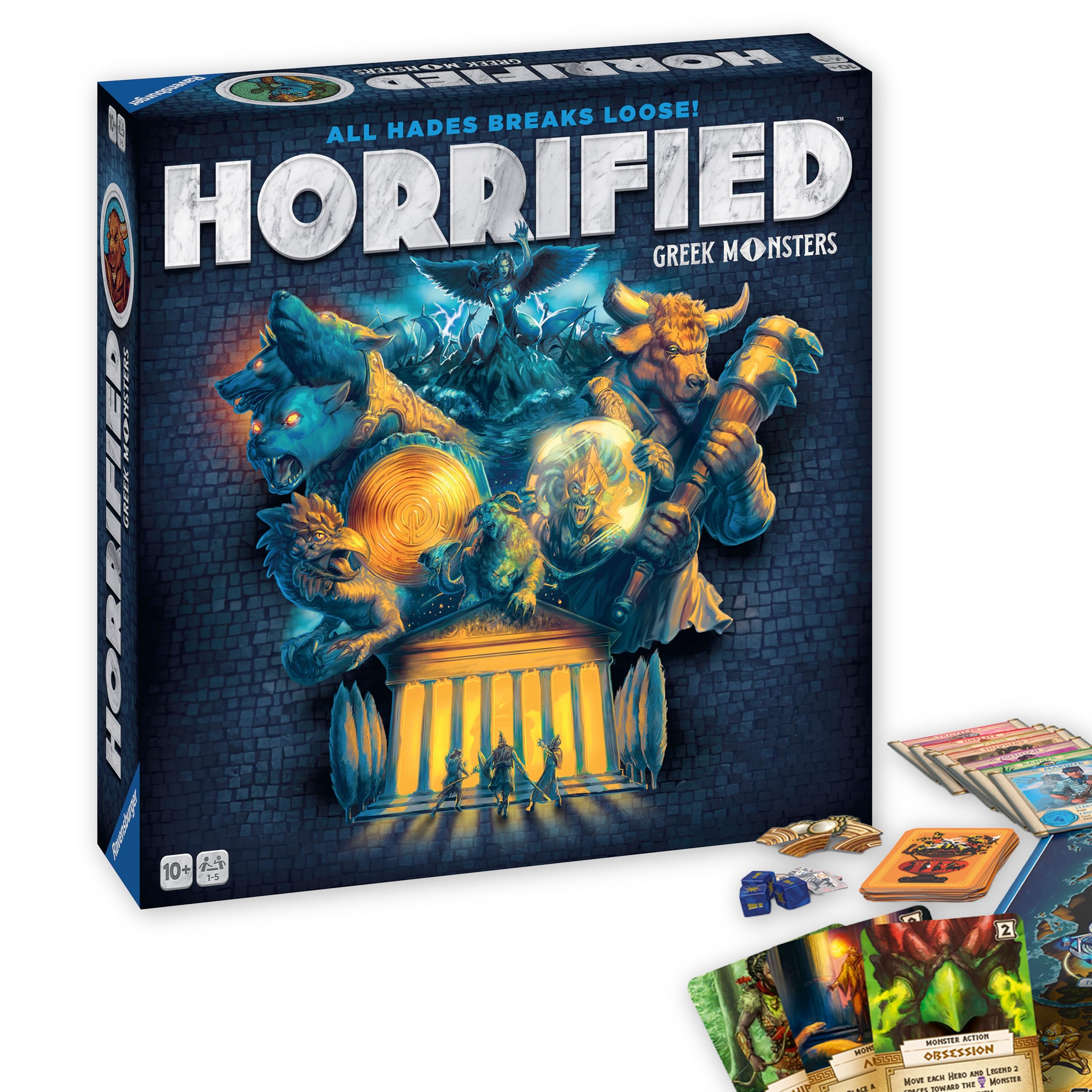
A 60-minute monster-defense epic for families who want real strategy with their teamwork
Horrified: Greek Monsters takes everything you love about the Horrified series and gives it a mythological makeover. You defend Elysium against six iconic monsters — think Medusa, Cerberus, and Chimera — each with its own unique challenge that changes how you play every game. Designed for 1 to 5 players aged 10 and up, this is the deepest cooperative game on the list, with a 60-minute session that demands real planning and problem-solving.
This game sharpens critical thinking and teamwork. Each hero has unique abilities, and you race against the clock to rescue people and capture monsters across the Labyrinth and through the Underworld Door. Owners call it a solid middle ground between a full tabletop RPG and a casual family game—the rules are clear enough to learn in one sitting, yet the strategy keeps experienced gamers hooked. It also mixes with American versions of the series if you collect multiple Horrified games.
The pieces are high quality, with thicker cardboard than some earlier series entries, and there’s a satisfying “pick up and deliver” mechanic where you’re constantly making tactical choices. The mix of monster types delivers strong replayability — each session feels fresh because you’re solving different puzzles. The main caveat is the learning curve: while the basics are easy, mastering the unique monster mechanics takes a game or two, and some owners find the difficulty level genuinely challenging.
What makes it special
- Six unique monsters mean every game is a different puzzle
- Strong replayability with hero abilities and lair mechanics
- Works solo or with up to 5 players
Consider this
- 60-minute sessions are long for younger or restless kids
- Some learning curve before you master the monster-specific rules
Choose this if: you have kids aged 10 and up who love strategy, mythology, and a genuine challenge.
Skip if: you need a quick game to fill 20 minutes before bed.
7. Buffalo Games Planted

A gardening strategy game with stunning artwork that even plant lovers will frame
Planted turns the gentle world of houseplants into a surprisingly strategic resource-management game. Over a fast 20 to 30-minute session for 2 to 5 players, you gather water and plant food tokens to nurture your garden toward becoming the ultimate plant parent. Designed by the acclaimed Phil Walker-Harding, the game is tactical without being stressful — you’re optimizing and managing resources rather than attacking each other.
The star of the show is the presentation. There are 42 unique plant varieties to discover, from the fiddle leaf fig to the monstera, each with different needs and gorgeous, inclusive artwork. Owners constantly rave about how mesmerizing and beautiful the pieces are, calling them tactile and adorable. If you have plant lovers in the family, this game gets them recognizing species and talking about propagation long after the table is cleared.
It strikes a rare balance: deep strategy for experienced gamers, yet a theme and difficulty that works for casual players and kids as young as 9 or 10. The rules are easy to learn, and the pieces are durable, with a score pad and bags included. The 10.5 x 10.5-inch board needs table space for 2 to 3 players, with 30-45 minute sessions that keep everyone engaged.
What shines
- Beautiful, tactile pieces that owners adore handling
- Easy to learn with genuine strategic depth
- Fast 20-30 minute sessions fit a weeknight
Worth noting
- Needs table space for the board and cards
- Resource management themes may not excite action-loving kids
Perfect for: plant-loving families who want a calm, beautiful, and genuinely strategic game.
Swerve if: your crew wants loud, frantic energy rather than quiet optimization.
8. Asmodee Harmonies Board Game

A 3D landscape-building puzzle that is pure calm, beauty, and quiet strategy
Harmonies is the game you pull out when you want the family to unwind, not argue. You build a dreamlike 3D landscape by stacking wooden tokens to form terrain, then place animals into habitats that score victory points. With 120 wooden tokens and high-quality cards, the tactile experience is the entire point — owners describe it as gorgeous, peaceful, and deeply satisfying to build.
It runs about 30 minutes and handles 1 to 4 players, which makes it unusually flexible — you can enjoy a thoughtful solo game or share it around the table. The rules are straightforward enough to learn in minutes, but the pattern-building and tile-placement mechanics offer real depth. Owners call it simple to learn with surprising strategy underneath, and it’s calming yet engaging, with three difficulty levels to keep it fresh over many sessions.
The most notable feature is the included solo version, which is rare for a family game and means you can still play on a night when nobody else is free. It also packs beautifully — the pieces stay put in the box, and the artwork is so attractive that it’s become a favorite of collections with 200+ games. The only real limitation is minimal player interaction; it’s a multiplayer solitaire feel where everyone builds their own landscape side by side. Some owners find it repetitive after heavy play, but for a 30-minute wind-down game, that’s a minor note.
Why it stands out
- Stunning 3D build that’s genuinely relaxing to play
- Solo mode means you never need to wait for a group
- High-quality wooden tokens that feel great in hand
The trade-off
- Minimal interaction between players — each builds independently
- Can feel repetitive after many sessions
Reach for this if: you want a beautiful, low-stress game that works solo or with the family.
Not ideal if: your family thrives on direct competition and player interaction.
9. Wiggles 3D 5-Minute Dungeon

Five minutes of frantic card-matching chaos that turns everyone into a shouting hero
5-Minute Dungeon is the opposite of a calm, meditative game night — it’s a real-time cooperative card game where you and your team race against a 5-minute timer to defeat dungeons and bosses. You match cards to symbols in the dungeon deck as fast as you can, calling out plays and coordinating moves at a frantic pace. Defeat all 6 bosses across the double-sided mats and you win the whole campaign.
This updated edition packs 275 cards, 5 double-sided hero mats (10 heroes total), and 3 double-sided boss mats (6 bosses total), including the extra-challenging Dungeon Master: Final Form boss. There’s also a free timer app for Android and Apple devices with six themed narrators, which adds a layer of personality to the countdown. It’s easy to learn in minutes — match the symbols, shout, and go — and works for teams of 2 to 5 players aged 8 and up.
The energy is the whole appeal. Owners describe it as intense, fun, and fast-paced, with rounds that provoke yelling and laughter in equal measure. Because everyone plays simultaneously, there’s no waiting around, which keeps kids and adults equally involved. The quality of the cards and box are solid, and it’s portable enough for coffee shop sessions. The one honest caveat is that intensity — if your family prefers relaxed games, this might be overwhelming. But for a high-energy group, it’s a guaranteed laugh riot.
What makes it a hit
- Real-time play means nobody sits idle — everyone plays at once
- Incredible energy with kids and adults both getting loud
- Free timer app with six themed narrators adds variety
Know before you buy
- High intensity can be stressful for some players
- Rounds are chaotic, which isn’t for every family’s vibe
Pick this if: your family loves fast, loud, and chaotic games where everyone plays together.
Skip if: you prefer thoughtful turns and quiet strategy.
Understanding the Specs
Playtime
Playtime is the single biggest factor in whether a game actually hits the table. Short games — 15 to 30 minutes — fit into weeknights and keep kids engaged from start to finish. Longer games like Horrified at 60 minutes are better for weekends when nobody’s rushing. A 5-minute game like 5-Minute Dungeon works as a party opener or a quick burst of chaos.
Player count and age range
Before buying, verify the player count fits your household. Some games require at least 3 players, while others work solo or with 2. The age rating reflects reading level and attention span more than skill—a game rated ages 10+ typically assumes fluent reading and abstract strategy, while ages 3+ games focus on simple color matching and counting.
FAQ
What is the best cooperative game for a family with mixed ages?
Are there family games that work with just two players?
How do I choose a game for a 3-year-old who has never played board games?
What does cooperative gameplay actually mean in these games?
Is there a family trivia game where kids can actually win?
How long does a typical family game night take with these games?
What is the difference between So Clover! and a typical word game?
Can I play these games solo?
Which of these games has the best replay value?
What makes a board game good for a “family game night” specifically?
Final Thoughts: The Verdict
For most families, the family game night games winner is the Asmodee So Clover! because it turns wordplay into a shared win — it’s the rare game that makes everyone at the table feel clever, and its 4.9-star average across 900+ ratings makes it the clear crowd favorite. If you have preschoolers, the Ravensburger Snail’s Pace Race is the perfect first board game. And for a high-energy group of older kids, the Wiggles 3D 5-Minute Dungeon delivers pure chaotic fun in five-minute bursts.
How We Picked
We do not accept paid placement. Every pick is matched to a real buyer and a real use-case; we do not hands-on test units.
Sources & Methodology
Specifications: manufacturer listings and product documentation. Review insights: verified customer reviews, as of August 2026. Pricing: not shown on this page (it changes often); check the current price via the retailer link.
As an Amazon Associate, WellFizz earns from qualifying purchases. This does not affect which products we feature.
Related Guides

Mo Maruf
I created WellFizz to bridge the gap between vague wellness advice and actionable solutions. My mission is simple: to decode the research and give you practical tools you can actually use.
Beyond the data, I am a passionate traveler. I believe that stepping away from the screen to explore new environments is essential for mental clarity and physical vitality.