Our readers keep the lights on and my smoothie glass nicely filled. As an Amazon Associate, I earn from qualifying purchases.
Specs are compiled from manufacturer listings and verified buyer reviews and can change over time — please confirm the key details on the product page before buying.
If you are hunting for a board game that gets actual buy-in from your teenager — not the groaning, the eye rolls, or the “do we have to?” — you already know the trap. The sweet-spot games that are strategic enough to keep a 15-year-old engaged but simple enough that a parent or younger sibling can jump in without a 45-minute tutorial are surprisingly rare. This guide cuts through the noise and points you straight at the nine titles that actually pull it off, whether your teen is into cutthroat negotiation, cooperative puzzles, or fantasy quests.
I’m Mohammad Maruf — the founder and writer behind WellFizz. This guide is built by comparing the manufacturers’ published specifications and the patterns across verified customer reviews, so you get each pick’s real strengths and trade-offs instead of marketing spin.
From lightning-fast party games that play in 15 minutes to epic quests that eat an entire evening, these nine options represent the current best of what works for modern families. Settle in with the full breakdown of the family board games for teens that actually deliver on that promise.
Our Picks at a Glance


How To Choose The Best Family Board Games For Teens
The perfect family board game for teens lives at the intersection of a few simple traits. A game that is too simple will bore a teenager within a single round; a game that is too complex will lose the family members who are not regular hobbyists. You want a box that rewards smart decision-making but can be taught in under ten minutes. Look for a playtime around 30–60 minutes — short enough to fit into a weeknight but long enough to feel like an event. The age rating on the box is a good starting point, but the real test is whether the core mechanic (word association, resource trading, tile placement) requires actual thought or just a dice roll.
Player Count & Group Dynamics
Teenagers often have friends over, so a game that only plays 2–4 can leave someone out. The best picks in this category handle 4–6 players comfortably, and some scale all the way up to large party groups. If your family tends to split into smaller pairs, a dedicated two-player game like Sky Team is a great specialized buy. Also consider whether your group enjoys working together (co-op games like So Clover!) or competing head-to-head (strategy games like Catan). Many teens enjoy both, but the mood of the evening matters.
Replayability & Theme
Teens will reject a game that feels like the same puzzle every time. Games with modular boards (Catan), randomized card decks (Talisman), or variable difficulty scenarios (Sky Team) offer the kind of infinite variety that keeps a box coming off the shelf. The theme also needs to be a hook — a game about landing a plane or fighting a forest fire grabs attention faster than an abstract math puzzle. Look for a game whose world your teen wants to visit, not just tolerate.
Quick Comparison
| Model | Best For | Players | Playtime | Style | Amazon |
|---|---|---|---|---|---|
| So Clover!★ Best Overall | Word-Loving Families | 3–6 | 30 min | Co-op | Amazon |
| Runs in The FamilyBest Value | Quick & Social | 2+ | 15 min | Party | Amazon |
| PlantedBest Themed | Nature & Strategy | 2–5 | 30 min | Strategy | Amazon |
| Harmonies | Puzzle & Art Lovers | 1–4 | 30 min | Tile Placement | Amazon |
| Talisman 5th Ed | Fantasy Adventurers | 2–6 | 60+ min | Adventure | Amazon |
| Sky Team | Duo Coordination | 2 | 20 min | Co-op | Amazon |
| Outsmarted! | Trivia & Large Groups | 2–24 | 60 min | Quiz Show | Amazon |
| Fire Tower Deluxe | Fast-Paced Competition | 2+ | 30 min | Competitive | Amazon |
| CATAN 6th Ed | Classic Strategy | 3–4 | 60-90 min | Trade & Build | Amazon |
In-Depth Reviews
1. Asmodee So Clover! Party Game
Our pick — over 4.5★ from 950+ verified ratings; the strongest balance of quality and price.
The word game that turns a full family around a table into a single brainstorming brain.
This is the most universally beloved game in the list, and for good reason. So Clover! is a cooperative word association party game where every player writes a one-word clue that links two random keywords on their clover board. Teammates then try to guess which clue connects to which pair. It sounds simple, but the real magic is in the laughter when someone makes a wildly creative — or wildly off — connection. The whole table cheers together or groans together because you are all on the same side. Reviews call it “endlessly engaging,” and with over 220 password cards and six clover boards in the box, the variety keeps it fresh for dozens of sessions. It plays 3–6 players in about 30 minutes, making it the perfect opener or main event for a teen-heavy game night.
The thing everyone raves about is the gameplay itself — the cooperative energy means no one gets eliminated and sits on their phone. What wins people over is how it challenges your vocabulary and reasoning skills without ever feeling like homework. As owners put it: the game gets “everyone’s brain thinking creatively.” The only real trade-off is the soft player count — you can easily have people team up if you have more than six, but the box is officially capped there. For a family with a teen who loves words or just loves a good challenge, this is the first box you should grab.
What Works
- Fully cooperative — no winner/loser drama, just team success
- Extremely easy to teach and learn in under two minutes
- Portable box and quick 30-minute sessions make it travel-friendly
- Encourages creative thinking and fosters inside jokes
Something to Note
- Officially designed for 3–6 players; larger groups need to team up
- Relies on word association, which might not click for every teen
Reach for this if: you want a game that brings a whole family together with zero competition anxiety — teens, parents, and even younger kids can all contribute equally.
Look elsewhere if: your group prefers competitive fire, direct conflict, or has members who are not excited about word puzzles.
2. Runs in The Family: Board Games for Family Night
The bite-sized bundle that gets the whole table guessing how everyone else thinks.
At just 15 minutes per round and a package barely larger than a deck of cards, this is the game you reach for on a weeknight when nobody wants to commit an hour. The concept is pure social connection: draw a topic card, and everyone writes down an answer they think matches how their family would respond. Score points for syncing up. It is the kind of game that sparks real conversation because a wrong guess — thinking your dad would say “pizza” when he wrote “tacos” — becomes a funny memory. Buyers report playing “a round of it every night after dinner,” which is the highest praise a quick-party game can earn. With over 200 topics, the content runs deep enough to survive regular rotation. The box is also under 9 ounces and measures just 1.7 x 4.5 x 0.1 inches, so it disappears into a backpack for trips.
The fun and family-friendly aspect are the top praise points by a wide margin. However, opinions on value for money are mixed — some find the -ish price point perfectly fair for the laughter, while a few feel it is a bit steep for what is essentially a deck of cards in a box. For a teen-heavy group that enjoys banter and revealing how everyone’s brain works, though, this is a bargain. It plays ages 8 and up, works with as few as 2 or as many as you have paper for, and is ready to go in under a minute.
Why It Works
- Extremely fast setup and gameplay — 15 minutes is a real estimate
- Encourages family bonding through shared memories and funny mismatches
- Ultra-portable; fits in a coat pocket or small bag
- Works with a flexible number of players beyond the listed count
Consider This
- Some questions are house-specific or feel repetitive after many plays
- The value-per-play is excellent, but the physical components are simple cards
Grab it for: a low-commitment evening where the goal is laughs and connection, not deep strategy — perfect for a family with younger teens or mixed generations.
skip it if: your family craves complex mechanics or long campaigns that demand multiple sessions.
3. Buffalo Games Planted Strategy Boardgame
The horticultural race where you become an obsessive plant parent without the watering.
Planted is a quick, charming strategy game that taps into the houseplant trend without feeling gimmicky. Designed by acclaimed game designer Phil Walker-Harding, it tasks 2–5 players with managing resources (water tokens, plant food) to grow 42 unique plant varieties. Each plant type from the fiddly fiddle leaf fig to the lush monstera has its own requirements, which forces genuine strategic thinking about what to cultivate and when. The game runs 20–30 minutes, making it faster than most strategy titles. The pieces and cards are high quality, and the artwork is beautiful. Owners describe it as “fun, low-key” and compare it favorably to games like Sushi Go, which is high praise in the casual strategy space.
The visual appeal and high-quality components get the most love after the gameplay itself. The cardboard tokens are thick and the cardstock feels durable. The game does ask for a bit of spatial and resource planning, which is exactly the kind of mental engagement teens appreciate without feeling lecture-y. The minor and occasional complaint is that the token supply can run thin in a full five-player game — some owners use one token to represent four, which is a workaround but worth noting. For a family with a teen who loves plants or any strategy fan who wants a relaxed but rewarding puzzle, Planted delivers a genuinely distinct experience.
Strong Points
- Unique plant-theme with real variety from 42 distinct cards
- Quick setup and easy to teach — instructions are clear and concise
- Beautiful, tactile components that players enjoy handling
- Designed by a well-known creator, adding credibility to the balance
Weak Point
- At five players, the included resource tokens can feel scarce
Pick it for: a family that enjoys beautiful things on the table and a strategic puzzle that doesn’t overwhelm — ideal for teens who appreciate nature or aesthetics.
pass on it if: you need high player interaction or a game where you directly attack opponents — this is a quiet, solitary-feeling race.
4. Asmodee Harmonies Board Game

The 3D landscape builder that turns the table into a canvas for deep, quiet strategy.
Harmonies is a tile-laying strategy game where you stack and place colored wooden tokens to build a dreamlike 3D landscape on your personal board, then place animal cubes on matching patterns to score points. The rules are straightforward — place a tile, build terrain, match animals — but the tactical depth runs very deep. The game includes 120 wooden tokens and 42 beautifully illustrated animal cards, and every round forces you to balance terrain height, animal placement, and future planning. It works wonderfully with 1–4 players, and the solo mode is surprisingly engaging, which is rare for a puzzle game at this price point. Owners describe it as “satisfying when plans work” and note it sits alongside favorites like Cascadia and Azul. The visual aesthetic is stunning, with art from Libellud that brings the oneiric (dreamlike) landscape theme to life.
The gameplay and ease of learning are the most-praised elements by a massive margin. The 3D stacking mechanic feels tactile and rewarding. The game can feel a little solitary — player interaction is minimal since everyone builds their own landscape — which might disappoint a teen looking for direct competition. The tile-laying pattern is also abstract, so the theme is more aesthetic than functional. For a teen who loves puzzles, art, or solo gaming, Harmonies is a premium choice. For a group that feeds on table talk and sabotage, it may be too quiet.
What Shines
- Beautiful 3D tile-laying puzzle with high-quality wooden pieces
- Three difficulty levels add excellent replayability
- Solo mode is well-designed and genuinely fun
- Quick to learn with deep tactical options
What to Expect
- Minimal direct player interaction — it is more of a simultaneous puzzle race
- The game can end abruptly once the tile deck runs out
Best suited for: a family where one or two members want a deep mental challenge while others can play casually — teens who enjoy pattern recognition will get lost in it.
Not for: groups that thrive on chatter, negotiation, or take-that moments.
5. Avalon Hill Talisman: The Magical Quest 5th Edition

The dice-rolling fantasy epic that makes every teen feel like they are on a real quest.
Talisman is a classic fantasy board game that has been doing the “roll and move, land on a space, draw a card” adventure loop for decades, and the 5th Edition is the best it has ever looked. The game board depicts three regions of a magical land, and 100 illustrated adventure cards bring enemies, strangers, and magical objects into every game. You choose from 12 detailed character figures — Prophetess, Wizard, Thief, and more — and race to be the first to acquire a Talisman, reach the Crown of Command, and defeat its guardian dragon. The game feels like a simpler Dungeons & Dragons session without a Dungeon Master. The rules are easy: roll the die, move your figure, draw a card, resolve it. But the combination of 12 unique characters and 100 cards means every session unfolds differently. The 5th Edition features updated graphics and redesigned figures that look great on the table.
What wins people over is the sense of adventure and the beautiful art and components. One reviewer notes it is “a long game that is great for game lovers,” while another says it is “excellent — beautiful to look at and fun to play.” The catch is the game length. A full game of Talisman can stretch several hours, and it is not a casual 30-minute commitment. Some characters feel unbalanced compared to others, and a player can get unlucky and feel stuck. For a teen who loves fantasy, roleplaying, and long story arcs, Talisman is an absolute treasure. For families who need a quick weeknight game, it can be a significant time investment.
Adventure Highlights
- Gorgeous 5th Edition art and detailed character figures
- 12 unique characters and 100 cards provide huge replayability
- Easy-to-understand core loop — great intro to adventure gaming
- Can support cooperative play where players team up
Adventure Caveats
- Game length can run several hours, which is a major commitment
- Some characters feel unbalanced — luck of the draw matters heavily
Reach for it when: you have a weekend afternoon and a teen who devours fantasy novels — the immersion is class-leading in this price tier.
it’s not for you if: you need a predictable 30-minute game or have players who dislike random dice outcomes.
6. Scorpion Masqué Sky Team

The tense, silent cockpit where you and your teen become pilot and co-pilot against the elements.
Sky Team is the 2024 Game of the Year (Spiel des Jahres winner) and it is easy to see why — it is a pure, tense, cooperative two-player game about landing an airplane. One player acts as the pilot, the other as the co-pilot. You each have your own set of dice, and you place them silently on a shared cockpit board to control speed, altitude, flaps, and brakes. The catch: you cannot talk about your specific dice placements. You can only gesture, point, or write notes before the round. Once the dice are placed, you trust your partner. This mechanic completely avoids the “alpha player” problem that kills many co-op games, because neither player can command the other. The game plays in about 20 minutes, includes 20 different airport scenarios with increasing difficulty, and has optional modules like kerosene leaks and ice on the tarmac. Owners describe it as “like Top Gun but with dice” and praise its “endless replayability.”
The cooperative game dynamic is the most-praised aspect by far — the silent communication creates a unique tension and payoff that no other game on this list offers. The art is cute and rich, and the components are excellent for the price. The trade-off is clear: this game is strictly for two players. It does not expand to a group. If your family has exactly one teen who wants to partner with one parent, Sky Team is the best two-player game you can buy. For larger families, it works as a side game but cannot be the main event.
Why It Wins Awards
- Brilliant silent communication mechanic prevents one player from dominating
- 20 scenarios offer huge variety and increasing challenge
- Quick 20-minute rounds make it easy to play multiple sessions
- Compact box and quick setup — under two minutes to start
The Limitation
- Strictly two-player — cannot include siblings or more family members
Best for: a parent-teen duo who want a game that demands genuine teamwork and creates real moments of triumph — perfect for a quiet evening.
Not for: families with more than two players at the table or groups that dislike high-pressure, timed decision-making.
7. Outsmarted! App-Connected Live Quiz Show
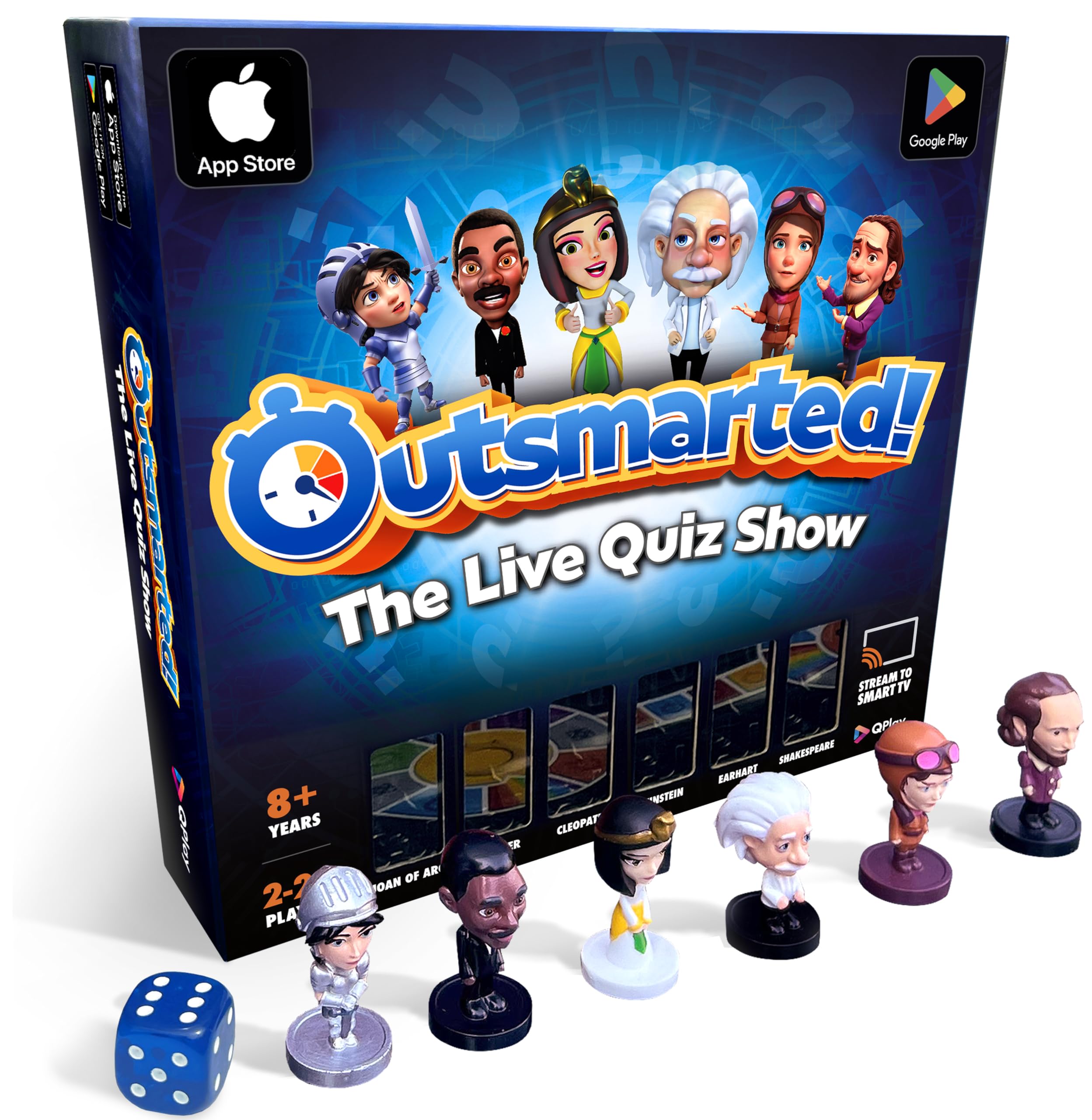
The live TV quiz show in a box that levels the playing field across generations.
Outsmarted is a trivia game that replaces a traditional game host with a free app. You connect your phone or tablet, pick game length and team structure, and the app reads questions aloud, keeps score, and builds tension with sound effects. The killer feature is automatic age-based difficulty adjustment — the app asks a 9-year-old easier questions and a grandparent harder ones, so a teenager and an adult can compete on equal footing. It supports up to 24 players, includes over 10,000 multimedia questions (with images, music, and video), and a Breaking News category that refreshes every week. The physical box includes a board, dice, six 3D genius figurines, and a folding tablet stand. It is the world’s first remote-play board game, meaning relatives in another state can join your game via the app. Owners praise it as a “family favorite for bonding with teens” and note the remote play works well for long-distance family game nights.
The huge question bank and automatic balancing are the big draws, with the app doing all the heavy lifting. The downside is that the game relies on a device and app, which may feel less “board-gamey” to some. A few owners note that some extra content packs cost money and that the setup requires a bit of initial account registration. For a family with teens who love trivia, current events, and competition, Outsmarted is a modern, scalable solution that keeps every single person at the table in the game until the final question.
Modern Advantages
- Age-based difficulty means a 9-year-old and a 40-year-old genuinely compete
- Remote play lets out-of-state relatives join the game
- 10,000+ questions with multimedia keep every round fresh
- Breaking News updates weekly for topical relevance
Something to Know
- Requires a smart device (phone/tablet) to run the app
- Extra content packs require in-app purchases past the included base
Reach for it when: you have a large, multi-generational gathering and want every age group to feel equally challenged — the app does the referee work.
look elsewhere if: your family wants a completely screen-free, analog board game night.
8. Runaway Parade Games Fire Tower Deluxe Edition

The firefighting battle where you save your tower and burn down someone else’s.
Fire Tower is a fast-paced, competitive strategy game with a unique premise: you are a firefighter defending your tower from a growing forest fire, but you are also actively trying to spread the fire toward your opponents’ towers. Each turn you draw an action card, adjust the wind direction (affecting how fire spreads), and decide whether to extinguish your own flames or fan the enemy’s. The deluxe edition includes 135 glimmering fire gems, a printed cloth bag, custom meeples, and an engraved wind die. The watercolor artwork by Kevin Ruelle is gorgeous and gives the game a distinct tactile feel. It plays 2+ players in 15–30 minutes. One clever mechanic: even after your tower is burned, you can return as a vengeful “Shadow of the Wood” with special powers, keeping you engaged until the end. Owners love the tension, calling it “like Risk but faster and with more variety.”
The ease of play and unique theme are the most-praised elements — the game is intuitive enough to teach in minutes but has enough strategic depth to reward repeated plays. The deluxe components add real value. The only occasional nitpick is that the wooden firebreak pieces feel less thematic than the rest of the high-quality components. For a family with teens who enjoy direct confrontation and fast, meaningful decisions, Fire Tower is a fantastic pick. The game works well with 4 players, teams of two, and scales down to a tight 2-player duel without losing its edge.
Why It Burns Bright
- Unique, intuitive theme that immediately grabs attention
- Deluxe edition components are high-quality and tactile
- Short playtime (15–30 minutes) with deep strategic decisions
- Team mode and “Shadow of the Wood” rule keep everyone engaged
Minor Complaints
- Wooden firebreak pieces feel a bit plain compared to the rest of the components
- Takes about 2–3 plays to fully internalize all the action cards
Best for: a family night where the teen loves fast conflict and direct strategy — it delivers the tension of a good war game in a fraction of the time.
Not for: players who dislike direct confrontation or prefer cooperative games where nobody gets targeted.
9. CATAN Board Game (6th Edition)

The trading-and-building titan that has been hooking new generations for over two decades.
When people say “board game classic,” CATAN is often the first name on their lips, and the 6th Edition is the smoothest version yet. You and up to three other players settle an island by rolling dice for resources (brick, wood, wheat, ore, sheep), trading with each other, and building roads, settlements, and cities. The first to 10 victory points wins. The modular hexagonal board means no two games are ever the same — you literally build the island before you play on it. The 6th Edition introduces card trays, chunkier wooden pieces, an updated beginner-friendly rulebook, and cleaner card art. It supports 3–4 players (an expansion enables 5–6) and runs about 60–90 minutes per game. The player aid cards are clearer, and the card backs have been slightly redesigned for easier sorting. The core appeal remains the negotiation: “I’ll give you one ore if you give me two brick” leads to tense, real conversations that teens love because they feel like real bargaining.
The strategic depth and replayability are the most-praised features by far — the crowd favorite across 39,000+ ratings. Owners say it is “easy to learn in 1-2 rounds” and that the “ever-changing setup” keeps it fresh. The one honest trade-off is that the game requires a full, focused session. 90 minutes is the floor for a 4-player game, and it can stretch longer. The robber mechanic (a black pawn that blocks a tile) can also feel punishing to an unlucky player. For a family with a teen who enjoys negotiation and planning, CATAN is the gold standard. For a quick after-dinner game, it is a heavy ask. It also requires exactly 3–4 players for the base game, so smaller families need the expansion or to play with friends.
Enduring Strengths
- Modular board ensures near-infinite replayability — no two setups match
- Combines luck, negotiation, and strategy in a balanced way
- 6th Edition has welcome quality-of-life upgrades (card trays, chunkier pieces)
- Widely available expansions and a massive community for support
Honest Caveats
- 60–90 minute playtime requires a significant time commitment
- Can feel punishing if dice rolls are unlucky multiple turns in a row
- Only plays 3–4 base; expansion needed for larger groups
Reach for it when: your teen enjoys real strategy and negotiation — the trading phase creates memorable moments of “I will trade you… but you owe me one.”
Think twice if: your family prefers short, fast, or low-interaction games — CATAN demands full attention and a full hour.
Understanding the Specs
Playtime
This is the most practical spec for a family. A 20-minute game fits a weeknight after dinner. A 90-minute game is a weekend afternoon event. The best picks here span both extremes. Pay attention to the “estimated playing time” on the box, but also account for setup and rule explanation, which can add 10–15 minutes the first time you play. A game with a 30-minute estimate usually hits that mark after the first play.
Player Count
The number on the box tells you the official range, but some games handle more if players team up. For families with one teen, a 4-player game works well with two parents and the teen. For larger families or friends over, look for games that handle 6+ players. Dedicated two-player games like Sky Team are for focused bonding, not group nights. Always check whether a game is competitive or cooperative — competitive games with more players can lead to longer wait times between turns.
Game Style
Cooperative games (So Clover!, Sky Team) mean everyone wins or loses together and are great for reducing tension among siblings. Competitive games (Fire Tower, CATAN) have clear winners and can get competitive, which many teens find notable. Party games (Runs in The Family) focus on quick laughs and minimal strategy. Strategy games (Planted, Harmonies) require planning ahead. Knowing which style your teen prefers is the single biggest factor in whether a game hits the table more than once.
Replayability
Teens lose interest in games that play the same every time. Look for games with modular boards (CATAN), variable setups (Talisman), randomized card decks (So Clover!), or multiple difficulty scenarios (Sky Team). A game with a static board and fixed card order might be notable for two plays and then collect dust. The number of components and variety in the box is a good clue — a game with 100 cards or 20 scenarios has built-in staying power.
FAQ
What is the best family board game for teens who hate losing?
How do I know if a board game is too childish for my teenager?
Can a 6-year-old play these games with a teen?
What if my family has more than 6 players?
How long does it take to learn each of these games?
Are app-connected games like Outsmarted worth it?
Which game is best for a teen who loves fantasy?
How do I get a teen interested in board games if they only play video games?
What is the difference between CATAN and Talisman?
Do any of these games require extra purchases to be fully enjoyed?
Final Thoughts: The Verdict
For most families, the best family board games for teens starts with So Clover! because it is the rare cooperative game that genuinely engages every age at the table without a single argument. If your teen is a fantasy fan who thrives on long, rich quests, grab the Talisman 5th Edition for weekend marathons. And for the duo — a parent and a single teen who want a game that demands real teamwork — the Sky Team is a pure, tense masterpiece that no other game on this list replicates. Every box here is a winner for the right personality; the perfect pick is the one your teen is excited to pull off the shelf on a Friday night.
How We Picked
We do not accept paid placement. Every pick is matched to a real buyer and a real use-case; we do not hands-on test units.
Sources & Methodology
Specifications: manufacturer listings and product documentation. Review insights: verified customer reviews, as of July 2026. Pricing: not shown on this page (it changes often); check the current price via the retailer link.
As an Amazon Associate, WellFizz earns from qualifying purchases. This does not affect which products we feature.
Related Guides

Mo Maruf
I created WellFizz to bridge the gap between vague wellness advice and actionable solutions. My mission is simple: to decode the research and give you practical tools you can actually use.
Beyond the data, I am a passionate traveler. I believe that stepping away from the screen to explore new environments is essential for mental clarity and physical vitality.