Our readers keep the lights on and my smoothie glass nicely filled. As an Amazon Associate, I earn from qualifying purchases.
Specs are compiled from manufacturer listings and verified buyer reviews and can change over time — please confirm the key details on the product page before buying.
A thick, green Bermuda lawn next spring starts with the right fall fertilizer, not a spring product. Fall feeding pushes nutrients into the roots, storing energy for winter dormancy and a fast spring comeback. This guide compares six fall formulas for warm-season grasses, focusing on the low-nitrogen, high-potassium ratios that matter most.
I’m Mohammad Maruf — the founder and writer behind WellFizz. This guide is built by comparing the manufacturers’ published specifications and the patterns across verified customer reviews, so you get each pick’s real strengths and trade-offs instead of marketing spin.
A “winterizer” for Bermuda grass prioritizes root development over green-up, and our top picks reflect that science. Use this comparison to find the best fall fertilizer for bermudagrass that fits your lawn size and your feeding style.
Our Picks at a Glance

How To Choose The Best Fall Fertilizer For Bermuda Grass
When soil temperatures drop, Bermuda grass goes dormant and turns brown, but its roots stay alive and need feeding to survive winter stress and wake up strong in spring. Your fall fertilizer choice matters more for root health than for green color. To pick the right bag, focus on three things: the nutrient ratio (the N-P-K numbers on the label), the nitrogen type (fast-release vs. slow-release), and the coverage area (how many square feet one bag handles).
Read the N-P-K Ratio Backwards
The three numbers on the bag (like 10-0-20) stand for Nitrogen, Phosphorus, and Potassium. In fall, you want the first number (Nitrogen) moderate and the third number (Potassium) high. Potassium hardens the plant against cold stress and disease. A spring fertilizer often leads with nitrogen for top growth—that is the wrong move for October.
Check for Slow-Release Nitrogen
Nitrogen feeds leaf growth, but in fall you want it trickling into the roots over weeks, not dumped all at once. Products with “slow-release” or “controlled-release” nitrogen feed consistently, which reduces the risk of burning the grass and stores energy for spring. Fast-release nitrogen can push a flush of growth right before frost, which is wasteful and vulnerable to cold damage.
Match Coverage to Your Lawn
Bags are rated for square footage, from a 4,000 sq. ft. coverage up to 15,000 sq. ft. If you have a small yard, buying a 45-pound bag meant for a large pasture is overkill and leaves you storing fertilizer that goes stale. Measure your lawn roughly—length times width—and pick a bag that covers it comfortably in one or two passes.
Quick Comparison
| Model | Best For | N-P-K Ratio | Coverage | Nitrogen Type | Amazon |
|---|---|---|---|---|---|
| Scotts Turf Builder WinterGuard★ Best Overall | All-grass fall feeding | — | 4,000 sq. ft. | Standard granules | Amazon |
| Green Thumb GT58105Root Builder | Deeper roots & iron | 32-0-10 | 5,000 sq. ft. | 50% controlled release | Amazon |
| Fertilome Centipede 15-0-15 | Warm-season deep green | 15-0-15 | 5,000 sq. ft. | Slow-release nitrogen | Amazon |
| GreenView Fairway Formula | Winter hardiness | 30-0-12 | 7,500 sq. ft. | 59% slow-release | Amazon |
| Jonathan Green Winter Survival | Large lawns | 10-0-20 | 15,000 sq. ft. | Slow-release nitrogen | Amazon |
| Simple Lawn Solutions 0-0-25 | Liquid potassium boost | 0-0-25 | 12,800 sq. ft. | Concentrated liquid | Amazon |
In‑Depth Reviews
1. Scotts Turf Builder WinterGuard Fall Lawn Food
Our pick — over 4.5★ from 13,500+ verified ratings; the strongest balance of quality and price.
The go-to winterizer that builds deep roots for any grass type you throw at it.
Scotts is the name everyone knows, and this WinterGuard formula is the one they reach for by the tens of thousands. It is formulated to build strong, deep grass roots so your lawn recovers better next spring, and it works on any grass type—so it is a safe bet even if your yard mixes Bermuda with something else. Each 10 lb. bag covers 4,000 sq. ft., which is the smallest footprint here and suits a typical suburban lot.
The purpose of this fall feed is repairing the damage summer heat and drought cause, then stocking the roots for winter. Owners describe a lawn that comes back in spring looking healthier and greener than ever. Because it comes as dry granules, you can apply it to a wet or dry lawn, then water it in.
Where this wins is pure trust and simplicity. It is not the most specialized formula for Bermuda, but it is the most proven, with a reputation for consistency that shows up in review after review. If you want a single bag that handles the whole yard without overthinking ratios, this is it.
Why owners stick with it
- The grass “came back in the spring looking healthier and greener than ever before” after a fall feeding.
- Stabilized a fresh, newly grown lawn through the cold months.
- Works on any grass type—no need to match a specific turf.
The trade-offs to know
- At 4,000 sq. ft. coverage, larger lawns need multiple bags.
- No potassium-heavy ratio listed, so it is a generalist, not a full winterizer.
Reach for this if: you want a dependable, widely proven winter feed for a standard-size yard without hunting for a specialty formula.
Look elsewhere if: you have a very large lawn—the coverage per bag is the lowest here.
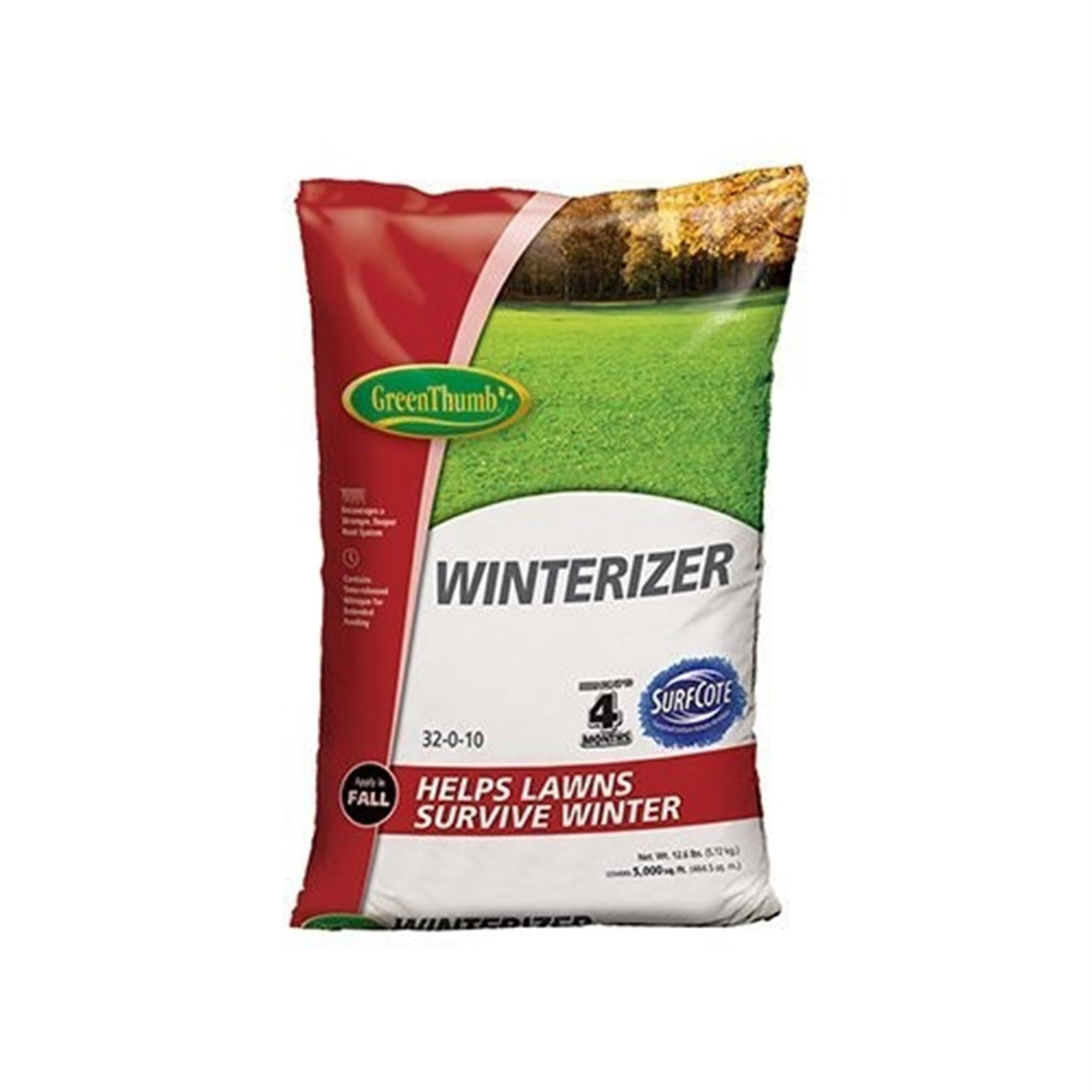
2. Green Thumb GT58105 Winterizer Lawn Fertilizer
A high-nitrogen winterizer with iron that feeds roots for up to 16 weeks straight.
Green Thumb’s winterizer is built for the root system, encouraging a stronger, deeper network that helps your lawn survive winter stress. Its 32-0-10 formula is the highest nitrogen here, but half of it is controlled release—so it feeds continuously for up to 16 weeks instead of hitting the grass all at once. That long window is ideal for a fall application that carries through to spring.
The bag weighs 12.6 pounds and covers up to 5,000 square feet. It also packs 2% iron, which is what drives that deep greening effect even in cool weather. One owner applied it in late November and reported springtime green-up exactly as promised, while another compared its ease of use favorably to Scotts.
Because the nitrogen is so high, this is best for lawns that can handle a strong feed. It is a powder form, so it spreads easily through a standard spreader without clumping issues. For Bermuda specifically, the iron content is a nice perk for color, though the real win here is the long, steady root feed.
What stands out
- 50% controlled-release nitrogen feeds for up to 16 weeks—a long winter runway.
- 2% iron delivers a deep green color that owners noticed quickly.
- Spreads easily and is “just as good as Scott’s” per owner comparisons.
Keep in mind
- The 32% nitrogen makes it a heavier feed than most fall winterizers—not ideal for weak, newly seeded lawns.
- At 12.6 pounds, it is lighter than other bags here, so it covers less ground per pound.
Who it suits: anyone who wants one application to last the whole winter and values a strong greening effect from iron.
Who should skip it: delicate or newly seeded lawns that need a gentler, lower-nitrogen approach.
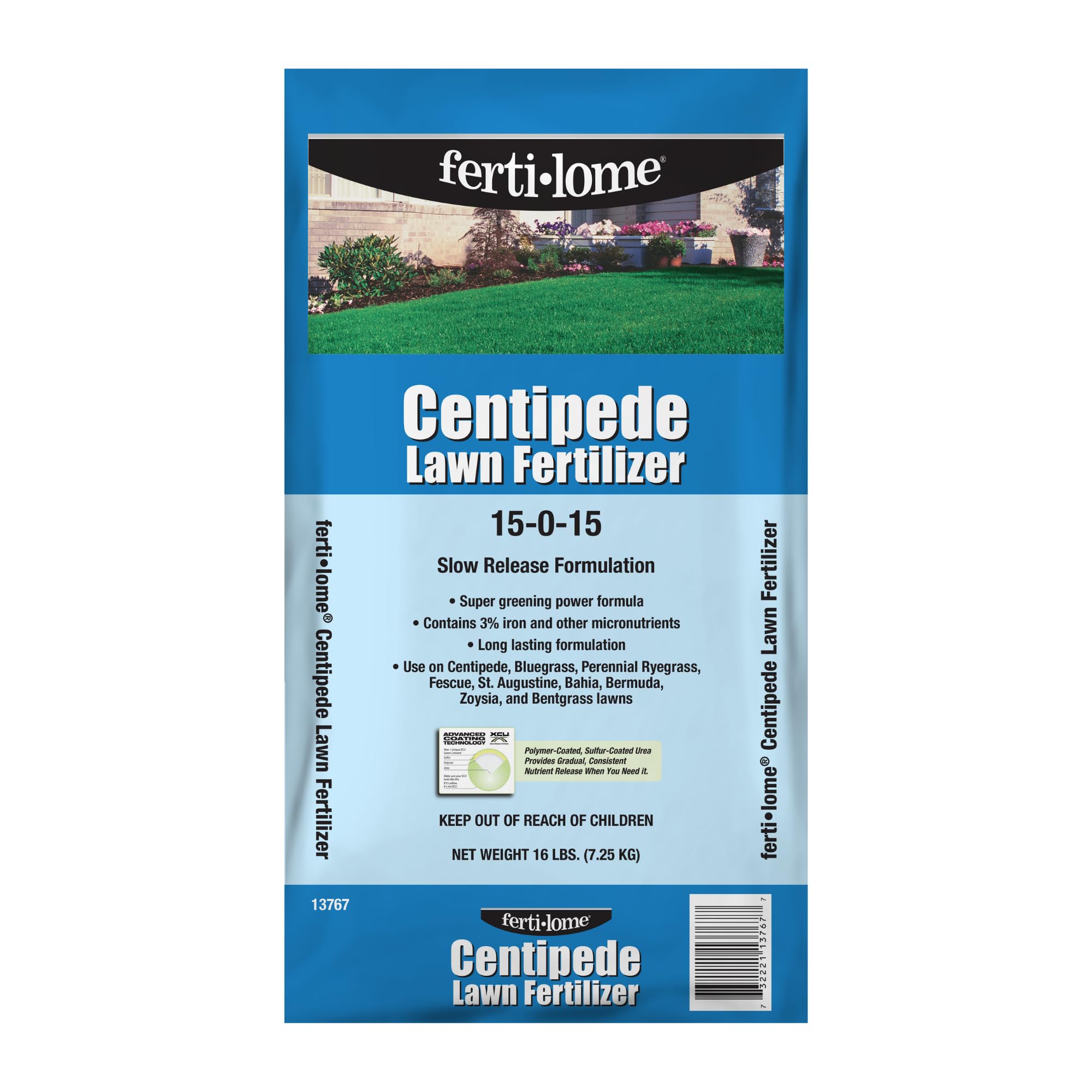
3. Fertilome Centipede Lawn Fertilizer 15-0-15
A 16-pound warm-season feed that repairs plugs and turns the whole block jealous.
Despite the centipede name, this Fertilome bag lists Bermuda first among its target species—along with Zoysia, St. Augustine, and Bahia. Its 15-0-15 ratio keeps nitrogen moderate while holding potassium equal, which is a sound fall balance for warm-season turf. The 16 lb. bag covers up to 5,000 square feet at the recommended 4 lbs. per 1,000 square feet.
The slow-release nitrogen is the safety feature here; it reduces the risk of burning your grass, which matters if you are feeding new plugs or repairing bare spots. Owners using it with new plugs reported not losing a single one, and the grass became a much deeper green than the rest of the block. The iron in the mix is what drives that fast, dark color response.
Fertilome is heavier than the Green Thumb bag at 16 pounds, and it is purpose-built for southern lawns. The crowd’s verdict is clear: germination and filling in bare spots are what win people over, and the value-for-money feedback is strong. For a Bermuda owner who wants a warm-season-specific feed, this is the most targeted pick.
Why it wins for southern lawns
- Explicitly lists Bermuda, Zoysia, and St. Augustine as target species.
- Slow-release nitrogen cuts the risk of burning new plugs.
- Owners found it filled bare spots and produced a “much deeper green” than neighboring grass.
Consider this
- At 15% nitrogen it is lighter than the Green Thumb 32-0-10, so it is a maintenance feed, not a heavy root builder.
- Best applied in early fall—it is not designed for a late-November deep winter feed.
Best for: Bermuda and other warm-season lawns that need a gentle, burn-safe feed plus a deep color boost.
The catch: you may need a second, higher-potassium application if your soil is already low on potassium for winter.
4. GreenView Fairway Formula Fall Lawn Fertilizer

A premium 30-0-12 fall feed with moisture-proof packaging and 12 weeks of steady feeding.
GreenView built this for lawns that need to toughen up, thicken, and green up fast after a rough summer. The 30-0-12 NPK formula leans heavy on nitrogen for recovery, with 59% of it in slow-release form so the feed lasts up to 12 weeks. It also skips phosphate entirely and deliberately protects waterways, which is a thoughtful touch for eco-minded owners.
This 22.5 lb. bag covers 7,500 sq. ft., placing it mid-pack on coverage. Buyers who switched after decades with Scotts called it a step up, reporting a deep green lawn within two weeks of a mid-October application that lasted through winter to late spring in cold, snowy Northern Virginia. The moisture-proof packaging is a real differentiator—it pours out without the clumping that plagues name-brand bags.
At this tier, you are paying for consistent results and a bag that does not fight you at the spreader. The recurring praise centers on winter hardiness and quick spring green-up. For a Bermuda lawn in a transition zone, this strikes a strong balance between recovery nutrition and winter preparation.
The high points
- 59% slow-release nitrogen feeds for up to 12 weeks without burning.
- Moisture-proof packaging stops the clumping that other big-brand bags suffer.
- One owner got a “deep green lawn within 2 weeks” that lasted through a snowy winter.
The honest trade-off
- Pricier per bag than the value options, and the high nitrogen means careful application on stressed turf.
- No phosphate means a lawn with low phosphorus may need a separate source.
Choose this if: you want a premium, long-lasting fall feed with superior handling and quick visible results.
Think twice if: you are on a tight budget or your soil test shows you already need extra phosphorus.
5. Jonathan Green Winter Survival Fall Lawn Food

The 45-pound giant whose 10-0-20 ratio feeds roots on up to 15,000 square feet.
Jonathan Green’s Winter Survival is the potassium king of this list. At 10-0-20, it leads with a high-potassium formula that promotes deep rooting and stores nutrients for spring—exactly the philosophy a fall Bermuda feed should follow. The 45 lb. bag covers up to 15,000 sq. ft., more than three times the area of Scotts’ 4,000 sq. ft. bag, making it the clear choice for pastures, large yards, or shared community turf.
The slow-release nitrogen keeps grass greener later into the year, and the brand suggests a second application in the first week of November if you spread early, to safeguard the lawn over winter. Owners spreading it in early November in the northeast saw a significantly healthier lawn by mid-December compared to untreated areas. The quality and appearance feedback is strong, with yards described as “super green” even in winter.
This is also a dual-purpose bag—it boosts newly seeded lawns while helping established turf grow thicker with deeper roots. The trade-off is physical: at 45.1 pounds, it is a heavy lift, and the mixed feedback on growth suggests newer grass can still die off if the winter is brutal. For big acreage, though, nothing else here keeps up.
Why big lawns love it
- The 10-0-20 ratio is the highest potassium here, directly targeting winter hardiness.
- Covers 15,000 sq. ft.—a 3.8x gap over the Scotts 4,000 sq. ft. coverage.
- Owners reported a “super green” lawn in winter and better color than untreated areas.
The weight of it
- At 45.1 pounds, it is physically the heaviest bag—hard to haul and maneuver alone.
- Newer grass may still struggle in extreme cold, per one honest owner.
Best for: large properties and pastures where one bag needs to cover a huge area with a strong potassium punch.
skip it if: you have a small lot—you will struggle to use 45 pounds before it goes stale.
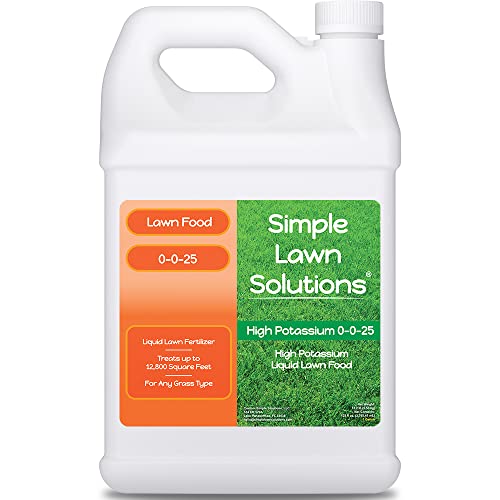
6. Simple Lawn Solutions High Potassium Lawn Food 0-0-25
A pure liquid potassium tank that boosts hardiness on any grass, including Bermuda.
This is the specialist of the group—a liquid concentrate with a 0-0-25 ratio. There is zero nitrogen here; it is pure potassium, designed to promote turfgrass hardiness and help lawns prepare for temperature swings. If your Bermuda already got its nitrogen feed earlier in the season, this gallon is the targeted supplement to fortify it before winter stress hits.
One 1-gallon jug covers 12,800 square feet when used with a hose-end sprayer, and it works with backpack, pump-up, or spray-tank rigs. Owners note it is particularly convenient for large areas, and the effectiveness feedback is strong, with improved root growth and grass health reported after winter. Because it is a liquid, it takes effect faster than granules, and it works on any grass type from Bermuda to St. Augustine.
The honest caveat is value—some owners feel the price runs high for what is essentially a single-nutrient supplement, and potassium alone rarely produces a visible green-up response since it works on plant endurance rather than color. Think of this not as your main fall feed, but as the finishing layer for a lawn that is already well-fed on nitrogen.
The specialist’s edge
- Pure 0-0-25 potassium targets winter hardiness without pushing unwanted leaf growth.
- Covers 12,800 sq. ft. per gallon with a hose-end sprayer—huge value per ounce.
- Owners reported improved root growth and grass health after winter.
Know before you buy
- It does not green up the lawn—potassium works on endurance, not color.
- Some owners find it overpriced for a single-nutrient supplement.
Reach for this if: you want to layer a fast-acting potassium boost on top of an already-fed lawn before a hard freeze.
Look elsewhere if: you want one bag to do everything—this is a specialist, not an all-in-one.
Understanding the Specs
N-P-K Ratio
The three numbers on a fertilizer bag tell you the percentage of Nitrogen, Phosphorus, and Potassium inside. For a fall application on Bermuda, you want moderate nitrogen for some leaf growth, low or zero phosphorus (which is often restricted by law), and high potassium to strengthen the roots against cold. A ratio like 10-0-20 is a classic winterizer; a ratio like 32-0-10 is more of a recovery feed.
Slow-Release Nitrogen
Nitrogen can come as fast-release or slow-release. Slow-release nitrogen breaks down gradually, feeding the grass steadily over several weeks instead of all at once. That reduces the risk of burning the lawn and means one fall application can carry the grass through the winter. The label may say “slow-release,” “controlled release,” or list a percentage like 50% or 59%—the higher the percentage, the longer the feed lasts.
Potassium (K)
The K in N-P-K is the nutrient responsible for plant hardiness. It helps grass build stronger cell walls and resist stress from cold, drought, and disease. A winterizer with high potassium—like a 10-0-20 or 0-0-25—prepares the root system to survive dormancy and come back vigorous in spring. This is the single most important nutrient for a fall feed.
Coverage Area
Coverage tells you how many square feet a bag or jug will treat at the recommended rate. Smaller bags cover around 4,000 to 5,000 sq. ft., while heavy-duty bags cover 15,000 sq. ft. or more. Matching coverage to your lawn size prevents waste, and it explains the price gap—a 45-pound bag covering 15,000 sq. ft. is priced for large properties, not standard suburban lots.
FAQ
What is the best N-P-K ratio for Bermuda grass in the fall?
Is Scotts WinterGuard safe to use on Bermuda grass?
Can I use a centipede fertilizer on my Bermuda lawn?
Should I use liquid or granular fertilizer for fall feeding?
How many square feet will a 10 lb. bag of fall fertilizer cover?
The Scotts Turf Builder WinterGuard covers 4,000 sq. ft. per 10 lb. bag, which suits a typical suburban yard. If your lawn is larger, the Green Thumb GT58105 covers 5,000 sq. ft. at 12.6 pounds, and the Jonathan Green bag covers 15,000 sq. ft. at 45 pounds. Measure your lawn length times width to find the right bag size.
When should I apply fall fertilizer to Bermuda grass?
Is high nitrogen bad for Bermuda grass in the fall?
What does the 0-0-25 liquid fertilizer do for my lawn?
Does phosphate matter for a fall Bermuda lawn?
Will fall fertilizer make my Bermuda grass greener in winter?
Final Thoughts: The Verdict
Across the board, the fall fertilizer for bermudagrass winner is the Scotts Turf Builder WinterGuard because it is the most proven, crowd-trusted fall feed that works on any grass type. If you want a longer-lasting root feed with iron for color, grab the Green Thumb GT58105. And for a large property that needs a single bag to cover huge square footage, the Jonathan Green Winter Survival is the one to reach for.
How We Picked
We do not accept paid placement. Every pick is matched to a real buyer and a real use-case; we do not hands-on test units.
Sources & Methodology
Specifications: manufacturer listings and product documentation. Review insights: verified customer reviews, as of August 2026. Pricing: not shown on this page (it changes often); check the current price via the retailer link.
As an Amazon Associate, WellFizz earns from qualifying purchases. This does not affect which products we feature.
Related Guides

Mo Maruf
I created WellFizz to bridge the gap between vague wellness advice and actionable solutions. My mission is simple: to decode the research and give you practical tools you can actually use.
Beyond the data, I am a passionate traveler. I believe that stepping away from the screen to explore new environments is essential for mental clarity and physical vitality.