Our readers keep the lights on and my smoothie glass nicely filled. As an Amazon Associate, I earn from qualifying purchases.
Specs are compiled from manufacturer listings and verified buyer reviews and can change over time — please confirm the key details on the product page before buying.
When the temperature drops below zero, a regular sleeping bag is just a heavy blanket. You need something the cold cannot punch through — a bag built to hold your body heat against a deep freeze, whether you are in a deer camp, an unheated cabin, or your own living room during a winter power outage. The difference between a good night and a dangerous one depends on real insulation, a sealed draft-free design, and a temperature rating you can trust at its word.
I’m Mohammad Maruf — the founder and writer behind WellFizz. This guide is built by comparing the manufacturers’ published specifications and the patterns across verified customer reviews, so you get each pick’s real strengths and trade-offs instead of marketing spin.
We break down the top options on the market and how they actually perform when the mercury plummets, so you can find the best extreme cold sleeping bag that matches your winter camping style and the real temperatures you face.
Our Picks at a Glance


How To Choose The Best Extreme Cold Sleeping Bag
Choosing the right bag for sub-zero temperatures is about more than just picking the lowest number on the tag. You need to match the insulation, shape, and weight to your specific trip — a heavy canvas bag that is perfect for ice fishing will be a nightmare on a long hike. Here are the key categories to consider.
Temperature Rating and Insulation
The temperature rating on a sleeping bag (like -25°F or -30°F) is a survival limit, not a comfort guarantee. You want a bag rated 10-20 degrees colder than the coldest temperature you expect to sleep in. Look for “extreme” or “survival” ratings that have a safety margin, especially if you are a cold sleeper. The insulation type matters too — synthetic fills like TechLoft Silver hold heat even when damp, while down fill is lighter and more compressible but loses all its warmth when wet.
Shape: Mummy vs. Rectangle
Mummy-shaped bags taper toward the feet and include a close-fitting hood. This design has less air volume inside, so your body heat does not have to work as hard to keep you warm. They are the standard for true cold-weather camping and backpacking. Rectangle bags, like the oversized ones on this list, give you a ton of “wiggle room” and can often be unzipped to act as a blanket, but they lose heat faster. They are a solid choice for car camping, base camps, or hunting cabins where weight is not the main concern.
Weight, Portability, and Construction
An extreme cold sleeping bag is a heavy piece of gear by necessity — the thick insulation and durable outer shells like cotton canvas add pounds. A canvas bag can easily weigh 13 pounds or more. If you are driving to your campsite, that heft is fine. If you are backpacking, look for a lighter, more compressible synthetic or down mummy bag. Key construction details include a draft tube along the zipper to block cold air, a draft collar around the neck, and a hood with a drawcord to cinch tight around your face. A good two-way zipper also lets you vent your feet if you get too warm.
Quick Comparison
| Model | Best For | Temperature Rating | Weight | Shape | Amazon |
|---|---|---|---|---|---|
| ALPS OutdoorZ Redwood -25★ Best Overall | Extreme Car Camping | -25°F | 13 lbs | Rectangle | Amazon |
| Guide Gear -30Best Value | Budget Sub-Zero | -30°F | 12.7 lbs | Rectangle | Amazon |
| TETON Sports Deer HunterHunting Favorite | Hunting & Elk Camp | Extreme Cold | 8.5 lbs | Rectangle | Amazon |
| Akmax.cn Goose Down | Backpacking | -13°F | 5.2 lbs | Mummy | Amazon |
| Browning McKinley -30 | Oversized Warmth | -30°F | 12.8 lbs | Rectangle | Amazon |
| USGI Gear 4-Piece Modular | Tactical Versatility | 50°F to -50°F | — | Mummy | Amazon |
| Tennier Industries 5-Piece MSS | Genuine Military Issue | Sub-Zero | ~9 lbs | Mummy | Amazon |
| Tennier Gilette ECW Down | Classic Sub-Zero | Subzero | 8 lbs | Mummy | Amazon |
| Military Modular Sleep System | Modular All-Season | Sub-Zero | ~9-10.8 lbs | Mummy | Amazon |
In‑Depth Reviews
1. ALPS OutdoorZ Sleeping-Bags Redwood -25
Our pick — over 4.5★ from 900+ verified ratings; the strongest balance of quality and price.
The canvas fortress that turns a frozen truck bed into a warm bed at home.
This bag uses a rugged cotton canvas outer shell and a soft 100% cotton flannel liner to keep you warm even when you are not moving. The core reason it wins as the overall best pick is that it earns its -25°F rating: a two-layer offset construction (the inner and outer seams are staggered so no cold stripe forms) stops drafts, while the TechLoft Silver synthetic fill stays warm if it gets damp. It is a huge rectangle at 38 inches wide and 80 inches long — roomy enough that buyers report a 6’3″, 230-pound adult fits comfortably with space to move.
Owners rave about the warmth, with over 170 reviews singling it out. Many say it stays warm even near the -25°F limit. The bag is strictly for vehicle use: at 13 pounds, it is much heavier than the TETON Sports Deer Hunter bag (8.5 pounds), which is lighter but less insulating. When temperatures climb above 32°F, several owners say they have to unzip because it is too toasty. The rolled size (21.3 x 16.9 x 16.7 inches) takes up major trunk space.
If you drive to your campsite, ice shack, or cabin and face real sub-zero nights, this bag makes warmth your only worry. skip it if you plan to hike with your gear or regularly sleep in above-freezing temps — you will overheat and the bulk will be a problem.
What wins people over
- Genuine -25°F rating works in practice, with owners comfortable near that limit
- Huge 38″ x 80″ rectangle fits tall, broad-shouldered adults
- Durable cotton canvas shell and thick plastic zipper resist abuse
- Two-layer offset construction prevents cold spots
The honest downsides
- 13-pound weight makes backpacking impossible
- Too warm to use comfortably above 32°F without unzipping
- Bulky roll takes up a lot of storage space in a car or closet
Reach for it if: you drive to your campsite, ice shack, or cabin and face real sub-zero nights where warmth is the only priority.
Look elsewhere if: you need to carry your bag into the backcountry or sleep in temperatures that range above freezing.
2. Guide Gear Sleeping Bag for Adults, -30 Degrees
Sub-zero performance that does not require a second mortgage to buy.
The Guide Gear bag gives you a -30°F rating using 9 pounds of fiberfill insulation in a cotton duck canvas shell, all at a price that undercuts most competitors. That is critical: the temperature rating is 10 degrees lower than the ALPS Redwood’s, making it a more capable bag in extreme cold for less money. At 39 inches wide and 90 inches long, it is generously sized — several buyers mention it fits themselves and a child or tall users up to 6’8″. The included hood traps heat around your head, a must for any extreme cold bag.
Owners confirm the real-world warmth. One review from someone who used this bag nightly for 9 months in Colorado and Alaska calls it “very warm, comfortable, can unzip as blanket.” The 2-way zipper lets you vent your feet without opening the whole thing. The canvas shell is durable, though a few note the stitching can fail over time. The wide rectangular shape suits restless sleepers who hate feeling confined.
At 12.7 pounds, it is almost as heavy as the ALPS Redwood. The head area is quite wide and lacks a proper cinching drawstring — one long-term owner notes this causes heat loss around the neck, and a safety pin on the zipper keeps it from sliding open. This bag suits car camping and off-grid living where space is plentiful, but pass on it if you need to carry your gear on foot; the bulk and weight are prohibitive.
class-leading value for the cold: The -30°F rating and 12.7 pounds of fiberfill insulation provide extreme warmth at a price that is tough to top — just make sure you are driving to your campsite, not walking.
3. TETON Sports Deer Hunter Sleeping Bag
The elk-camp standby that cuts the weight while keeping the warmth.
The TETON Sports Deer Hunter is the lightest canvas rectangle here at 8.5 pounds — that is a full 4.5 pounds less than the ALPS Redwood and the Guide Gear bag, making it easier to carry from a truck to a hunting blind. The “Teton Tough” canvas shell and fiber-fill double-layer construction still deliver extreme cold protection. At 90 inches long by 39 inches wide, it is the longest and widest on this list, with a half-circle mummy-style hood at the top for extra head warmth.
Owners mention sleeping well at elk camp in 35-45°F heavy rain while staying warm in just basic pajamas. More than 60 owners praise the warmth specifically. Zipper and shoulder draft tubes (fabric baffles that block cold air from sneaking through the zipper track) help seal heat in. The downside: some owners note the zipper occasionally snags the liner — holding the fabric away while closing helps. A few also mention the bag needs airing out before first use due to chemical treatment.
For a 6’3″, 210-pound person, this bag offers plenty of room. It is not a backpacking bag, but at 8.5 pounds it is manageable for short carries from a vehicle. If the ALPS Redwood is too heavy for your needs, grab this lighter alternative that still delivers extreme warmth. it’s not for you if you are a restless sleeper who frequently rolls; the zipper can snag the liner when you move.
Best for hunters: who need a tough canvas bag that does not weigh as much as a small bear — the blend of durability and reduced weight at 8.5 pounds is the draw.
Think twice if: you are a restless sleeper who frequently rolls; the zipper can snag the liner when you move.
4. Akmax.cn Goose Down Mummy Sleeping Bag

Real goose down warmth that compresses small enough for a real hike.
The Akmax.cn Mummy is the only bag on this list that uses goose down fill, and that is why it weighs just 5.2 pounds — dramatically lighter than any canvas bag here (compare it to the 13-pound ALPS). The mummy shape (82.68 inches long, 31.5 inches wide) tapers to minimize internal air volume, so your body heat goes further. The water-resistant nylon shell keeps moisture out while remaining breathable, addressing the main weakness of down bags.
Owners back up the -13°F rating. One experienced winter camper reports sleeping hot at 22°F, calling it the “best value sleeping bag.” Another military user says it keeps him warm in 30-degree weather. The YKK zipper is noted as durable. The bag packs down compactly into its included compression sack, which is the whole point for backpackers and mountaineers.
The trade-off is the snug fit. One owner explicitly warns it is restrictive, saying “unless your claustrophobic” it is good, but the tight diameter can feel confining. Some down leakage is reported, and the phone pocket is too small for a modern Samsung phone. This down bag offers the best warmth-to-weight ratio here for backpacking, but look elsewhere if you thrash around at night; a rectangle will suit you better.
Lightweight warmth for trails: Goose down fill at 5.2 pounds with a -13°F rating in a compressible mummy shape — the best option here for anyone who has to carry their sleep system on their back, as long as a snug fit does not bother you.
5. Browning McKinley -30° Sleeping Bag

-30°F warmth with the space to stretch out like you own the tent.
Browning uses the same TechLoft Silver synthetic insulation as the ALPS Redwood but in a 12.8-pound rectangle rated to -30°F. That is five degrees more extreme than the ALPS, which matters in genuine deep cold. The two-layer offset construction eliminates cold spots the same way. The standout feature is the extra-roomy 90-inch by 36-inch rectangle — one owner says it covers a twin mattress. The 210T nylon diamond ripstop outer shell is tough and water-resistant, and the brushed polyester liner feels soft.
More than 135 owners praise the warmth. An Arctic paratrooper reports staying warm at -2°F while wearing only silk long johns. The insulated chest and zipper baffle (an extra flap of fabric behind the zipper) seals in heat effectively. Compression straps help it pack down to 21 x 17 inches, but at 12.8 pounds, that phrase is relative.
This bag is impractical for hiking, just like the ALPS and Guide Gear bags. Review pages sum it up as the “warmest bag” for car or snowmobile camping, but “too bulky for hiking.” Some owners note the Velcro can snag the material and recommend removing it immediately. For deep winter car camping where you want a bag that feels like a bed, the McKinley is a top contender. steer clear if you need a bag for any kind of hiking.
The strengths
- Proven -30°F TechLoft Silver insulation in a two-layer build
- Spacious 90″ x 36″ rectangle fits large adults and restless sleepers
- Padded neck collar and shoulder draft blocker seal in heat
- High-quality 210T diamond ripstop nylon shell
The drawbacks
- 12.8 pounds is heavy and bulky for any kind of hiking
- Velcro closures can snag and damage the bag fabric if not handled carefully
6. Military Sleeping Bag System Tactical Gear – 4-Piece
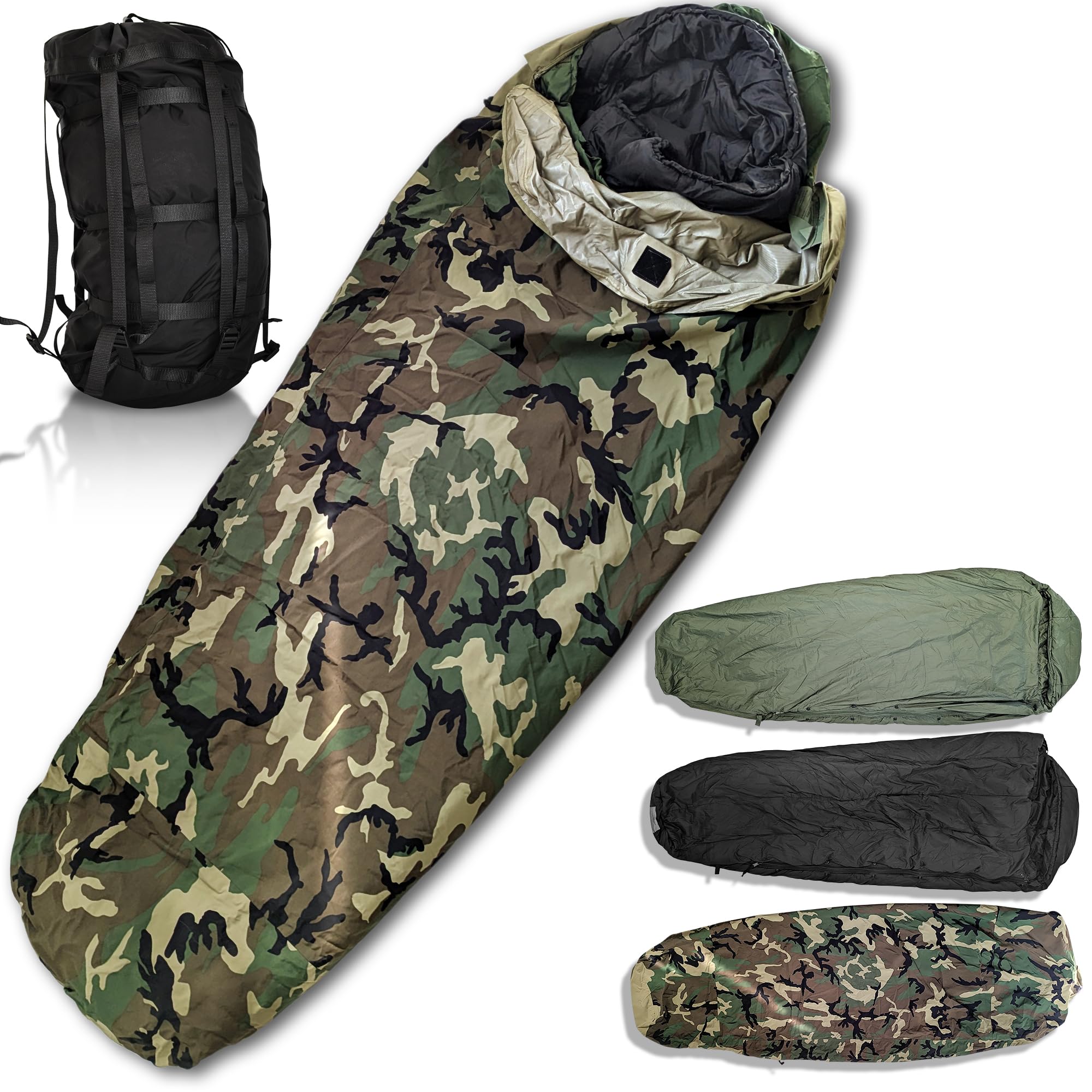
Four layers that let you dial in exactly the warmth you need, from mild to -50°F.
This is a complete 4-piece modular system, not a single bag. It includes a lightweight Patrol Sleeping Bag (rated for 50°F down to 30°F), an Intermediate Cold Weather Bag (for around 20°F to -10°F), and a waterproof Bivy Cover with a triple-laminated build. Zip them together and you get a system rated down to -50°F — that is 25 degrees colder than the ALPS Redwood’s rating. The shells are 210T nylon ripstop with a DWR (durable water repellent) coating, and heavy-duty YKK zippers are used throughout.
Veterans and current military members are the core audience. One former Marine calls it “the real deal,” saying it is the exact system they had in the Corps from 2003-2007. Another owner tested it in heavy dew and woke up completely dry. The versatility is the killer feature: use just the patrol bag for summer, add the intermediate for fall, or combine all three layers for a winter survival expedition. A compression stuff sack keeps the whole system manageable for camping.
The modular nature adds complexity — you manage multiple layers and a bivvy cover instead of one simple bag. It is also not ultralight; the full system has some heft. If you want a single system that covers every season and can handle -50°F, this makes sense. If you just want a simple, bomb-proof bag for deep cold, the ALPS or Browning rectangles are simpler.
Layered versatility for survivalists: The ability to go from 50°F to -50°F by adding or removing layers makes this the most adaptable kit here — ideal for preppers and military collectors who want one system for everything.
7. Genuine U.S. Military Goretex 5-Piece Improved Modular Sleeping Bag System

The actual US Army sleep system that has kept soldiers warm in every cold war zone.
This is the genuine Improved Modular Sleeping Bag System (MSS) from Tennier Industries, the same one issued to US troops. It is a 5-piece set: a patrol bag, an intermediate cold weather bag, a Gore-Tex bivy cover, and two compression stuff sacks. The system weighs about 9 pounds total. The quality is the most talked-about feature — over 40 owners praise the build, and many confirm it is the “exact same system” they carried in service. The Gore-Tex bivy cover is waterproof and breathable, with multiple owners saying it saved them during unexpected snowstorms.
Like the USGI Gear system above, the versatility of layering is the key. You can use the green patrol bag alone for mild nights, add the black intermediate bag for cold weather, and zip both into the Gore-Tex bivy for extreme sub-zero conditions. One 6’5.5″, 280-pound owner says it fits him well with plenty of chest room. The durability is legendary — one owner says it will “last for decades.” The condition of new stock is often described as “perfect.”
The honest downside is weight and the price tag. At around 9 pounds, it is lighter than the 13-pound canvas bags, but it is still too heavy for ultralight backpacking. The price is a premium over the similar USGI Gear 4-piece system. Some owners note that “surplus” versions may show signs of wear. Go for it if you want the genuine article with a Gore-Tex membrane and the full 5-piece kit from a known US contractor. If you are more price-sensitive, the USGI Gear version above is a close alternative.
Reach for it if: you want the real military MSS with proven sub-zero performance and a Gore-Tex bivvy — the quality and layering are class-leading in versatility.
Look elsewhere if: your budget is tight or you need the lightest possible bag for long-distance trekking; the 9-pound system is still substantial.
8. Very Warm Thick Old School Military US Army Subzero ECW Down OD Green Sleeping Bag

The old-school down mummy that defined sub-zero warmth for a generation of soldiers.
This is a classic US military Extreme Cold Weather (ECW) sleeping bag from Tennier/Gilette. It uses an 80% down and 20% polyester filling inside a water-repellent poplin cotton outer shell. At 84 inches long, 30 inches wide at the top and 14 inches at the bottom, it is a classic mummy shape with a drawcord hood. It weighs 8 pounds — lighter than any of the canvas giants here and close in weight to the TETON Sports bag, but the down fill gives it a higher warmth-to-weight ratio in dry conditions.
Seven owners praise the warmth specifically. One calls it the “warmest bag I have ever owned” after 8 years of use, adding a waterproof bivy to seal it against moisture. Another confirms it keeps them warm “in snow or power outage.” The mummy shape is snug — it fits a 6-foot, 190-pound user perfectly, but it would be a tight squeeze for larger folks. The 80% down fill gives it excellent warmth for the weight, though down loses all insulating power if it gets wet.
The main caveat is that many of these bags are old military stock. One owner who bought it “new” found it looked used and was likely old surplus, calling it “overpriced for the quality” in that condition. The seller matters a lot. If you get a genuine new-old-stock bag, you get a legendary piece of gear. If you buy from a questionable source, you might get a worn-out unit. At its best, this is a durable, warm, and relatively light sub-zero bag for collectors and purists who treat down with care.
A classic for collectors and purists: The 80% down fill and 8-pound weight make this a legitimately warm and portable sub-zero bag — just ensure you buy from a reputable seller to avoid old, worn-out surplus stock.
9. Military Modular Sleep System 4 Piece with Goretex Bivy Cover

The three-bag system that tens of thousands of campers swear is the best buy in cold-weather gear.
This is a fan-favorite product with over 850 owner ratings. The total weight averages around 9 to 10.8 pounds depending on how you pack it. Made in the USA, this surplus-issue military system has been tested by thousands of service members and campers. The quality is the most-mentioned aspect, with over 230 owners praising it. The warmth is also a huge selling point — more than 180 owners single it out.
The three-piece setup offers incredible versatility: use only the green bag for summer, add the black bag for shoulder seasons, and zip both into the bivy for sub-zero winter conditions. The Gore-Tex membrane on the bivy is genuinely waterproof, keeping you dry in rain and snow. One owner tested it in a hammock in teens-to-20s°F and stayed warm with extra layers. The value for money is the third most-praised aspect, with over 150 owners calling it a great buy.
The honest downsides are weight and bulk. At around 10.8 pounds fully packed, it is not ultralight — several owners say it is “too heavy for long winter backpacking trips.” Some “very good” surplus units arrive with minor flaws like frayed drawstrings or extra snaps, but the condition is overwhelmingly praised as “better than described.” This is the best modular system for the money, but it is a car-camp or truck-camp setup, not a trail-running adventure.
Why it wins
- Three-piece modular system (patrol, intermediate, bivy) covers from 50°F to sub-zero
- Genuine Gore-Tex bivy cover is fully waterproof and breathable
- Exceptional value for a complete military-grade sleep system
- Over 850 ratings with widespread praise for quality and warmth
The drawbacks
- Total weight of ~10.8 lbs is heavy for hiking; best for car/truck camping
- Surplus units may have minor cosmetic flaws (frayed threads, extra snaps)
Understanding the Specs
Temperature Rating (EN 13537 / Survival)
A sleeping bag’s temperature rating tells you the lowest temperature at which it is designed to keep you alive, not necessarily comfortable. There are typically three numbers: a Comfort rating (for a cold-sleeping woman), a Lower Limit (for a warm-sleeping man), and an Extreme rating (a survival limit, not for regular use). For an extreme cold bag, you want an Extreme rating of -20°F or lower. Experienced campers always add a 10-15°F buffer — if the forecast says 0°F, bring a bag rated to at least -10°F or -20°F.
Insulation: Synthetic vs. Down
Synthetic insulation (like TechLoft Silver or standard polyester fiberfill) is made of fine polyester fibers that trap air. Its main advantage is that it still provides some warmth when wet, and it dries quickly. It is also usually less expensive. Down insulation (goose or duck feathers) is warmer for the same weight and compresses much smaller, which is why backpackers love it. But down is useless when wet — it clumps into cold, wet lumps. For extreme cold camping, synthetic is often the safer choice if you expect moisture, while down is for dry, cold climates where weight is critical.
FAQ
How do I stay warm in an extreme cold sleeping bag?
Can I wash an extreme cold sleeping bag?
What is the difference between a mummy and a rectangle sleeping bag for extreme cold?
How important is a draft tube or zipper baffle?
Is a -30°F sleeping bag too warm for 20°F weather?
What does “two-layer offset construction” mean?
How do I store an extreme cold sleeping bag to make it last?
Is a modular military sleep system worth the extra cost?
Final Thoughts: The Verdict
For the majority of shoppers, the extreme cold sleeping bag winner is the ALPS OutdoorZ Redwood -25 because it delivers proven -25°F warmth in a
Related Guides

Mo Maruf
I created WellFizz to bridge the gap between vague wellness advice and actionable solutions. My mission is simple: to decode the research and give you practical tools you can actually use.
Beyond the data, I am a passionate traveler. I believe that stepping away from the screen to explore new environments is essential for mental clarity and physical vitality.