Our readers keep the lights on and my smoothie glass nicely filled. As an Amazon Associate, I earn from qualifying purchases.
Specs are compiled from manufacturer listings and verified buyer reviews and can change over time — please confirm the key details on the product page before buying.
Every laptop eventually sends the same warning: your storage is almost full. An external drive is the direct fix — it gives you breathing room for games, photos, video projects, and backups without forcing you to delete anything. The real question is which technology fits your life: a classic hard drive (HDD, a drive with spinning magnetic platters) with massive capacity for the same money, or a solid-state drive (SSD, a drive with no moving parts) that moves files in seconds instead of minutes.
I’m Mohammad Maruf — the founder and writer behind WellFizz. This guide is built by comparing the manufacturers’ published specifications and the patterns across verified customer reviews, so you get each pick’s real strengths and trade-offs instead of marketing spin.
The shift from slow spinning disks to pocket-sized SSDs has changed backup habits. This guide cuts through the noise to help you find the best external hard drives for your actual workflow, whether that is near-instant game loading or safe long-term photo storage.
Our Picks at a Glance


How To Choose The Best External Hard Drives
Picking the right drive starts with one simple decision: do you need speed or raw space? An SSD has no moving parts and transfers data at over 1,000 MB/s — so a large 10GB video file copies in about 10 seconds. A traditional HDD uses spinning platters and offers more storage for less money, but tops out below 200 MB/s — the same file takes over a minute. Match the type to what the drive will do every day.
Speed vs. Capacity
For active work — editing video, running games, or moving large files daily — an SSD is worth the premium. The wait time difference is dramatic. For pure backup archives you write once and rarely touch, an HDD gives you multiple terabytes for a fraction of the cost. A mixed approach works, too: an SSD for current projects, an HDD for cold storage.
Compatibility and Connection
Almost every modern drive connects over USB, but generations matter. USB 3.0 (5 Gbps, enough for HDDs) is plenty for HDDs, while SSDs need USB 3.2 Gen 2 (10 Gbps) to hit their full speeds. Check whether the drive is pre-formatted for Windows (NTFS) or requires reformatting for a Mac. If you own a console, look for explicit PlayStation or Xbox support in the listing.
Build and Portability
A portable drive goes in your bag, so size and durability count. SSDs are smaller, lighter, and far more drop-resistant since they lack spinning parts. Some models add IP-rated water and dust resistance and a carabiner loop. HDDs are more fragile — treat them gently and avoid drops. For a desk-bound backup drive that stays home, size matters less and value per terabyte matters more.
Quick Comparison
| Model | Best For | Speed | Capacity | Interface | Amazon |
|---|---|---|---|---|---|
| Samsung T7 Portable SSD 1TB★ Best Overall | Top-tier speed & reliability | 1,050 MB/s | 1 TB | USB 3.2 Gen 2 | Amazon |
| SanDisk Extreme Portable SSD 1TBPremium Pick | Rugged outdoor use | 1,050 MB/s | 1 TB | USB 3.2 Gen 2 | Amazon |
| Seagate Portable 1TB HDD | Budget backup | — | 1 TB | USB 3.0 | Amazon |
| WD 4TB Elements Portable HDD | High capacity on a budget | — | 4 TB | USB 3.2 Gen 1 | Amazon |
| Toshiba Canvio Basics 1TB | Simple plug-and-play | — | 1 TB | USB 3.0 | Amazon |
| WD 1TB Elements Portable HDD | Basic file storage | — | 1 TB | USB 3.0 | Amazon |
| Maxone 1TB Ultra Slim HDD | Slim, budget-friendly | — | 1 TB | USB 3.0 | Amazon |
In‑Depth Reviews
1. Samsung T7 Portable SSD 1TB
Our pick — over 4.5★ from 21,000+ verified ratings; the strongest balance of quality and price.
The drive that turned waiting into a thing of the past for owners of everything from MacBooks to PlayStation 5s.
This is the drive people rave about most: speed and reliability are the top two praises, with hundreds of owners calling it out for both. That makes sense when you look at the numbers — it hits read speeds up to 1,050 MB/s and writes up to 1,000 MB/s. Buyers report real-world performance of 900+ MB/s when connected over USB 3.2 Gen 2, which lets you shift a full video project in seconds. The internal cache is a single gigabyte, but with PCIe NVMe technology (a fast data-transfer standard) the difference over a traditional HDD feels almost instant — it is roughly five times faster than a standard mechanical drive on cache alone.
Beyond speed, the T7 is incredibly compact — about the size of a credit card and thin enough to slide into a pocket. The solid aluminum unibody provides drop protection up to 6 feet, and owners confirm it stays cool during long sessions (warm, not hot). It comes with both USB-C to USB-C and USB-C to USB-A cables, so it works with modern laptops and older PCs alike. The AES 256-bit hardware encryption (a security chip that scrambles data to keep it safe if the drive is lost) keeps private files safe without slowing the drive down.
Some owners note the included software is basic, and the full speed is tied to having a USB 3.2 Gen 2 port. If your PC only supports USB 3.0, you will still get solid performance but not the maximum potential.
What Owners Celebrate
- Fast enough for active video editing and large game transfers — real-world speeds of 850-950 MB/s.
- Credit-card size and lightweight, so you can keep it in a pocket or bag without bulk.
- Silent operation and durable metal build that survives everyday drops.
The Trade-Offs
- Maximum speed requires a USB 3.2 Gen 2 port, not just any USB socket.
- Pricier per gigabyte compared to a traditional hard drive, but owners feel the difference is worth it.
Your best bet if: you work with large files daily — video projects, game libraries, or professional backups — and the extra cost pays for itself in time saved.
Think twice if: every dollar counts and you mostly archive files you rarely move; a large HDD gives you more capacity for the same money.
2. SanDisk Extreme Portable SSD 1TB
The SSD that shrugs off dust, rain, and a three-meter drop — built for the field, not just the desk.
The SanDisk Extreme matches the Samsung T7 on speed — up to 1,050 MB/s read and 1,000 MB/s write — but adds a level of physical toughness the T7 does not offer. The IP65 rating means it is fully protected against dust ingress (no spec of dust gets in) and low-pressure water jets, so a splash from a canteen or a dusty trail is no threat. Owners confirm that after a year of use the drive still performs perfectly, which lines up with the 3-meter drop protection (an upgrade from the previous 2-meter standard).
This drive is shaped for life on the move. It has a rubberized outer shell that absorbs shocks, and the built-in carabiner loop lets you clip it directly to a belt loop or backpack. Owners routinely use it for RAW photo files, 4K video, and gaming. The drive includes a USB-C to USB-C cable plus a USB-A adapter, so setup is plug-and-play on both Windows and Mac. The SanDisk Memory Zone app (free software) helps manage and free up space automatically.
The speed of an SSD over an HDD is the defining advantage here — owners describe the difference as “incredibly fast” for large file transfers. The one recurring note is the drive can get slightly warm during extended transfers, and the included cable is short. If you work outdoors or travel frequently and need your data to survive weather and bumps, this is the ruggedized answer the T7 cannot match.
Field Readiness: IP65 protection and a 3-meter drop rating make this the go-to for photographers, videographers, and anyone who works in unpredictable conditions.
Speed Equal: It matches the Samsung T7 on raw transfer rates, so your choice here is about durability features, not performance.
Reach for this if: you need a drive that survives genuine outdoor use — worksites, hiking shoots, or a bag that gets rained on.
Look elsewhere if: you are storing data on a desk and do not need the extra ruggedness; the price premium buys features you will not use.
3. Seagate Portable 1TB External Hard Drive
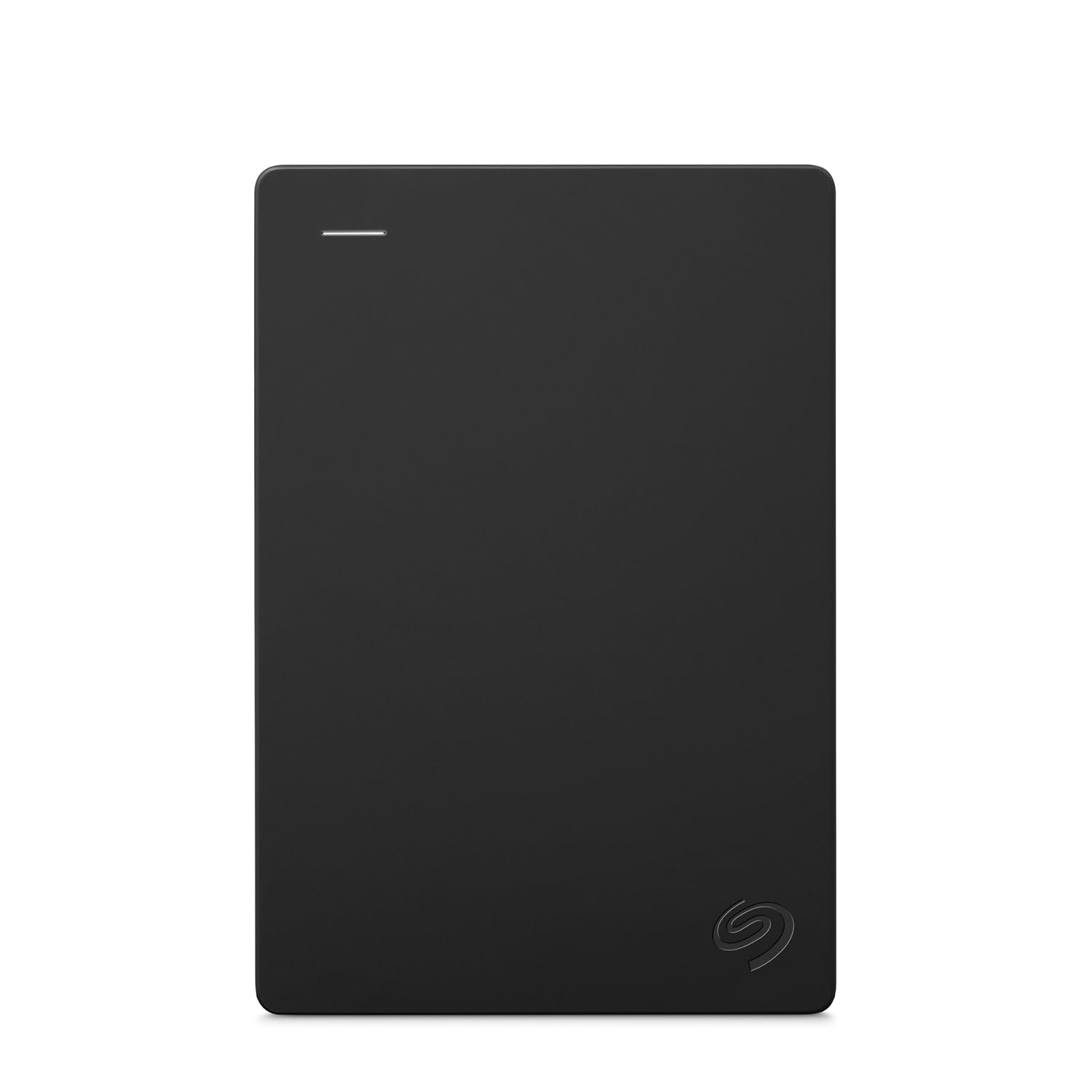
The crowd favorite for straightforward backup — plug it in, drag your files, and forget it.
This Seagate drive is among the most popular external hard drives on the market, and the reason is pure simplicity. It is a standard mechanical HDD that works without any software installation: connect the included 18-inch USB 3.0 cable to a computer, and it appears automatically. Owners across PCs, Macs, PlayStation 4, PlayStation 5, and Xbox consoles all report the same experience — instant recognition. The cache is 1 GB, which is typical for a standard HDD, and much slower than the SSDs above — expect 100-150 MB/s in real-world copy speeds, compared to over 900 MB/s for the Samsung T7.
The 1-year Rescue Service is a standout feature here. If you lose data due to a drive failure, Seagate provides recovery services, which costs extra on most competing HDDs. Owners appreciate the confidence this adds for a backup drive. The drive itself is compact and well-built, and owners routinely use it to offload iPhone photos and videos, store game libraries, or create Time Machine backups on a Mac (after reformatting).
A few owners note that resale units may require disk initialization before use, though brand-new drives are truly plug-and-play. This is a mechanical drive, so it is inherently slower than any SSD — and it is more sensitive to drops. If your priority is maximum gigabyte-per-dollar for large archives and you do not need ruggedness, this is the benchmark.
Reliability First: The built-in Rescue Service is the differentiator — most HDDs leave data recovery as your problem after a failure.
Console Ready: Works with both PlayStation and Xbox from the start, making it a popular choice for expanding game storage cheaply.
Best for: anyone building a simple, affordable backup system — set it up once and store photos, documents, and games without fuss.
Skip if: you need fast daily file access or plan to edit video directly from the drive; an SSD will save you significant time.
4. WD 4TB Elements Portable HDD

Four terabytes of reliable storage in a package barely larger than a deck of cards.
The WD Elements 4TB drive delivers exactly what the name promises: a massive capacity in a small, portable enclosure (2.5-inch form factor). This is a mechanical hard drive with a USB 3.2 Gen 1 interface (5 Gbps), making it fast enough for large backups and media libraries but not for active editing. Owners consistently praise the value — the capacity-per-dollar ratio beats every SSD on this list. One owner put it plainly: it holds “just about everything and almost another lifetime more.”
Compatibility is broad. The drive is pre-formatted for Windows but works with Mac after a simple reformat. Owners have connected it to older 2011 Mac desktops (no Thunderbolt needed) and reported flawless Time Machine backups. It also works with PS4 for game storage, and multiple owners mention the drive lasting for years of continuous use. The drive is bus-powered, meaning it draws power from the USB port — no separate wall plug required.
The honest trade-off is that this is a mechanical drive. Long-term customers note about a 70% reliability rate over 5 years of use, with some failures after the 2-year mark. That is typical for any HDD, but note if you plan to store irreplaceable data. The 4TB capacity makes it an excellent archive drive for photos, music, and documents, but you will want to keep a separate backup of critical files.
Terabytes for Little: You get four times the capacity of any 1TB SSD for roughly the same money — the value king for deep archives.
Durability Note: Like all HDDs, it is more fragile than an SSD; a drop or bump could damage the spinning platters.
Reach for this if: you need to store large media collections, project archives, or game libraries — the 4TB capacity makes it a single-drive solution.
Look elsewhere if: the drive will travel daily in a bag; the extra money for an SSD buys drop protection and confidence.
5. Toshiba Canvio Basics 1TB

A no-fuss HDD with a matte finish that stays clean and a reputation for quiet reliability.
The Toshiba Canvio Basics is a mechanical HDD that focuses on the essentials: storage, simplicity, and a clean look. The matte, smudge-resistant finish is a practical touch — it keeps the drive looking new even after frequent handling. Owners describe it as “one of the best hard drives I own” and note it is “small, portable, and fits in your pocket if need be.” It connects via USB 3.0 and is compatible with USB 2.0 without any external power cord.
Setup is genuinely plug-and-play on Windows — no software installation needed. For Mac users, the drive arrives pre-formatted NTFS for Windows, so you will need to reformat it for macOS. Owners call the transfer times quick, and the drive stays cool even during use. The 1TB capacity handles family photos, videos, and document backups without issue. The enclosure is polycarbonate (a type of durable plastic), which keeps it lightweight.
The real-world feedback is overwhelmingly positive: owners praise the quality, price, and ease of use. A few point out that the cable length is decent but could be longer for certain desk setups. This is a straightforward, reliable HDD that does not try to be anything more — if you need a secondary drive for file archives and want something that looks good on a desk, this hits the mark.
Clean and Quiet: The matte finish resists fingerprints, and owners confirm it runs cool and silent during normal use.
Mac Note: Pre-formatted for Windows; you will need to reformat for Time Machine, but the process is quick and well-documented by owners.
Best for: users who want a no-fuss, good-looking backup drive that just works — no apps, no cables to manage, no heat.
Think twice if: you need to edit video directly from the drive; this is an archive tool, not a work drive.
6. WD 1TB Elements Portable HDD

Western Digital’s baseline portable drive — no extras, just consistent storage that tens of thousands of owners trust.
The WD 1TB Elements is the entry point for among the most recognized names in storage. It is a mechanical 2.5-inch HDD with USB 3.0 connectivity, back-compatible with USB 2.0. Owners describe it as “reliable, quiet, and perfect for backups.” The drive arrives pre-formatted for Windows and can be easily reformatted for Mac. Its compact size makes it easy to toss in a bag for portable use.
The feedback leans heavily on the drive’s consistency. Owners use it for photo archives, music sample libraries, and as a secondary backup alongside an SSD. The plug-and-play nature means no setup friction, and the drive is recognized immediately on both Windows and macOS. Owners of larger capacities (the Elements line goes up to 20TB desktop drives) also note the portable version shares the same reliable character — quiet during idle with only a soft whir during data access.
There are two practical limits. First, the NTFS format (Windows’ default format) limits write access on a Mac without reformatting to ExFat for dual-OS use. Second, it is a standard HDD: drop it and the data could be lost. A few reviewers point out the drive arriving with earlier usage hours, so buying directly from Amazon or an authorized seller is advisable. For the price, this is a solid workhorse for document and photo backups.
Reliability Baseline: WD’s reputation is built on drives like this — owners routinely praise it as “sturdy” and “what you’d expect when you buy one of these.”
Cross-Platform: Works well on Windows, needs a quick reformat for Mac — an easy step that owners do without complaint.
Best for: buyers who want a low-cost backup drive from a trusted brand, with the expectation that it will be stationary or handled with care.
Skip if: you plan to carry the drive daily and need drop protection; an SSD will survive your commute better.
7. Maxone 1TB Ultra Slim HDD

Surprisingly slim at 0.4 inches thick, this aluminum-clad HDD is the thinnest mechanical drive on the list.
The Maxone 1TB Ultra Slim stands out because of its all-aluminum body and slender profile — it is only 0.4 inches thick. That makes it easy to slide into a laptop sleeve or bag pocket. Owners call it “slim and lightweight” and confirm it works well with both Windows and older computers. The drive runs on USB 3.0 (up to 5 Gbps) and is compatible with USB 2.0, and it is powered entirely through the USB cable — no separate power supply needed.
One owner shared a real-world test: they installed a large 60GB game on the drive and played it successfully without any crashes. The drive is also commonly used for photo backups — another owner transferred 4,000 photos in about an hour. The aluminum body helps keep the drive cool and quiet during use. The 3-year warranty with free technical support is a solid addition at this price point.
Several owners note durability is a concern if the drive is handled roughly. One reported the port broke after carrying the drive loose in a bag, and others advise that dropping it can cause connectivity issues. This is the trade-off for the ultra-slim design — the port is not reinforced as heavily as a thicker, more rugged drive. Keep it in a protective sleeve, and it is a capable, budget-friendly backup tool. The cache on this drive is 5 GB, compared to 1 GB on the other HDDs — making multitasking slightly snappier.
Slim Advantage: At 0.4 inches, it is noticeably thinner than a standard 2.5-inch HDD, making it ideal for tight bags.
Handle with Care: Owners warn the USB port is delicate; a protective case or careful handling is recommended for daily carry.
Best for: users who prioritize a thin, lightweight backup drive for occasional use — perfect for a laptop bag’s secondary pocket.
Not for: heavy daily carry or users prone to bumps and drops; the slim design trades port ruggedness for thickness.
Understanding the Specs
SSD vs. HDD — The Core Choice
A solid-state drive (SSD) uses electronic flash memory chips with no moving parts — this makes it much faster at opening files and more resistant to damage from drops. A hard disk drive (HDD) stores data on spinning magnetic platters, which is cheaper per gigabyte but slower and more fragile. For daily active use, an SSD is the upgrade for speed. For deep, static backups where you rarely access the files, an HDD gives you more space for the money.
USB Generations and Speed
USB 3.0 (5 Gbps) is the baseline for most external drives and works fine with any HDD. USB 3.2 Gen 2 (10 Gbps) is twice as fast and essential for open up the full speed of SSDs that advertise 1,050 MB/s. The drive and the host port must both support the higher standard to see the benefit. Older USB 2.0 ports still work with all modern drives, but transfers will be significantly slower (480 Mbps) — a 10GB file would take several minutes instead of seconds.
FAQ
How much faster is an external SSD compared to a portable HDD?
Will an external hard drive work with my PlayStation or Xbox?
Do I need to install software to use an external hard drive?
Can I use an external drive for both Windows and Mac?
Is an external SSD worth the extra money for gaming?
How rugged are portable SSDs versus portable HDDs?
What is AES 256-bit hardware encryption on an external drive?
Can I use a portable external drive for video editing?
How long does an external hard drive typically last?
Final Thoughts: The Verdict
Across the board, the best external hard drives winner is the Samsung T7 Portable SSD because it delivers near-instant transfer speeds, pocket-sized portability, and proven reliability that owners across 21,000+ reviews confirm daily. If you need a rugged drive for outdoor work, grab the SanDisk Extreme Portable SSD with its IP65 rating and 3-meter drop protection. And for no-fuss, high-capacity backup on a budget, the Seagate Portable 1TB HDD is the one to reach for — it just works.
How We Picked
We do not accept paid placement. Every pick is matched to a real buyer and a real use-case; we do not hands-on test units.
Sources & Methodology
Specifications: manufacturer listings and product documentation. Review insights: verified customer reviews, as of July 2026. Pricing: not shown on this page (it changes often); check the current price via the retailer link.
As an Amazon Associate, WellFizz earns from qualifying purchases. This does not affect which products we feature.
Related Guides

Mo Maruf
I created WellFizz to bridge the gap between vague wellness advice and actionable solutions. My mission is simple: to decode the research and give you practical tools you can actually use.
Beyond the data, I am a passionate traveler. I believe that stepping away from the screen to explore new environments is essential for mental clarity and physical vitality.